It is Monday. The sun is shining. The air is (relatively) warm. I sit at my desk committed to writing. Yes, committed. To write. Not draw. Not photograph. Not dream the day away. To write. To put pen to paper. Or finger to key. Yes. Write. It’s not easy. Because I could just take a short walk in the sun with my camera or even just a notebook and a pen and then come back to my desk and write something sustained with a beginning and an end. Really, I could. But I know myself. If I walk out the door right now, into the sun, hours will pass. A few words may get jotted down on paper. A picture or two or one hundred may get taken. But I will have reneged on my promise to myself to write a sustained piece with a beginning and an end. And so I sit. I am lucky that I have windows all around me. Through one window I see an oak tree with its branches bare. Perhaps a bird will visit soon to keep me company. As I write.
Sunlight shining through a water droplet. A tealight candle flickering in a blue glass votive. Lamplight through a sheer a silk panel. Illumination in all its forms, and from all the various sources, reveals the world. That is what I think of when I see sunlight dancing on a wave or flashing in the bright eyes of a child. Similar thoughts run through my mind when I see a painting by Joseph Mallord William Turner. His works are considered pre-cursors to those of the Impressionists. Events and details are only suggested not made explicit through the fluid use of light and color.

Posted in Inspiration | 1 Comment »
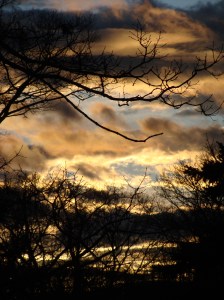 I remember, as a child, drawing a sky using orange and purple crayons. A twilight sky in Virginia. In the fields below were white tailed deer. I had forgotten that moment until I viewed this picture recently shot at work.
Posted in Branches, Nature Notes | Leave a Comment »
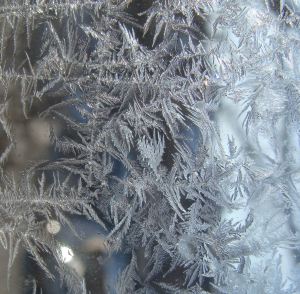
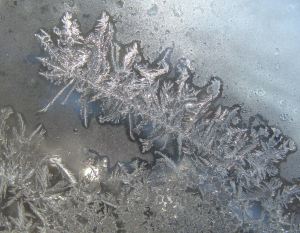
Cold enough for ice to form on the windows. But what ice formations they are!
Posted in Branches, Nature Notes, Uncategorized | Leave a Comment »
 She may be more famous for Mrs Dalloway and Orlando, but it is her Blue & Green that I love the most. Imagine that.
BLUE & GREEN
GREEN
THE POINTED FINGERS of glass hang downwards. The light slides down the glass, and drops a pool of green. All day long the ten fingers of the lustre drop green upon the marble. The feathers of parakeetstheir harsh criessharp blades of palm treesgreen, too; green needles glittering in the sun. But the hard glass drips on to the marble; the pools hover above the desert sand; the camels lurch through them; the pools settle on the marble; rushes edge them; weeds clog them; here and there a white blossom; the frog flops over; at night the stars are set there unbroken. Evening comes, and the shadow sweeps the green over the mantlepiece; the ruffled surface of ocean. No ships come; the aimless waves sway beneath the empty sky. It’s night; the needles drip blots of blue. The green’s out.
BLUE
The snub-nosed monster rises to the surface and spouts through his blunt nostrils two columns of water, which, fiery-white in the centre, spray off into a fringe of blue beads. Strokes of blue line the black tarpaulin of his hide. Slushing the water through mouth and nostrils he sings, heavy with water, and the blue closes over him dowsing the polished pebbles of his eyes. Thrown upon the beach he lies, blunt, obtuse, shedding dry blue scales. Their metallic blue stains the rusty iron on the beach. Blue are the ribs of the wrecked rowing boat. A wave rolls beneath the blue bells. But the cathedral’s different, cold, incense laden, faint blue with the veils of madonnas.
Posted in Uncategorized | Leave a Comment »


I have a “thing” about the color blue. As I have written in the past, growing up in the foothills of the Blue Ridge Mountains has certainly shaped my color-love. And, then there’s the fact that my mother loved all things blue. One of the items she treasured most in life was a small cobalt blue candy dish that my father gave her. Every now and then I tinker with a neverending essay about the color blue, and I usually start by searching the internet for images that will both inspire me and ground me. A search for “blue butterflies” introduced me to the website of Peg Steunenberg. A visual treat for sure. http://www.pegsteunenberg.com/index.html
Posted in Uncategorized | Leave a Comment »
There are at LEAST two reasons to find a copy of Guy Murchie’s Music of the Spheres. His command of language is one. If you can find a copy, just read the first chapter to get a sense of what I mean. It opens thus: “The stars beneath my feet stare upward, strange and bold. They do not twinkle. They burn steadfastly in the black, bottomless sky.” The second reason is the artwork, illustrations done by Murchie himself. The book was first published in 1961. Written over fifty years later, I’m not sure how much of what Murchie wrote in over 600+ pages stands the test of time, but it surely perseveres as a beautiful poetic discourse on the workings of the universe.
 Chet Raymo’s Soul of Night, published in 2005, reminded me of Music of the Spheres with its melding of science, art and philosophy. It is a compilation of lyrical essays that allow even the non-scientist to imagine and explore heady concepts of astronomy. Each essay is prefaced by detailed Michael McCurdy wood engravings. You can find more of McCurdy’s work here: http://www.michaelmccurdy.com/ Chet Raymo is Professor Emeritus at Stone Hil College in Massachusetts. He used to write for the Boston Globe but now his essays can be found at http://www.sciencemusings.com/
Posted in Books I Love | Leave a Comment »
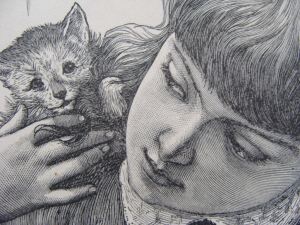
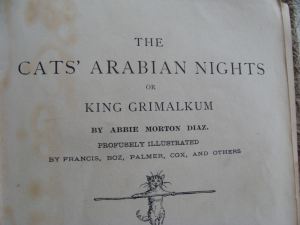 The Cats’ Arabian Nights was first published by D. Lothrop of Boston in 1881. It was written by Abby Morton Diaz and illustrated by a number of artists. I found the book in a small antiques shop while traveling through Virginia. The images hooked me more so than the book’s story which is a feline rendition of the classic Arabian Nights tale. Since returning to Boston, I have begun to research the author (who had strong and important Boston connections) and the illustrators. It has been much easier to find information on Ms. Diaz, e.g. http://womenshistory.about.com/library/etext/bl_townsend_diaz.htm
Of all the illustrators listed in the book, Lizzie Lawson intrigues me most. Her images moved me to buy the book. 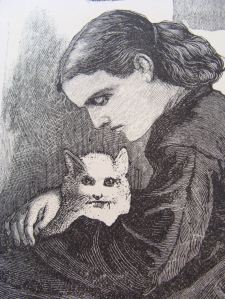 I think because her drawings seem filled with such emotion.
Posted in Uncategorized | Leave a Comment »
I was browsing in the Curious George bookstore in Harvard Square when this book called out to me. The story is sweet and simple, about a young child trying to find Mama. The smoky hued illustrations depict a Korean town circa 1938. Written in both Korean and English, I bought it as a gift for a young Korean American friend of mine but I think its quite suitable as a gift for anyone of any age who enjoys being transported by wo rds and images to a different world.
Posted in Uncategorized | Leave a Comment »

 When I first picked up a camera a few years ago, I mostly took pictures of trees and forests. Now I most often take pictures of branches and leaves. Outside my window right now are the mostly bare branches of a great oak tree. I say mostly because I can see hanging on with great tenacity a small rust colored leaf. It is the only one, and though the wind blows quite heartily, that leaf does not fall. Not yet. There is great beauty, great strength in the tree that towers over my room, but so is there in the leaf. From my perch at my desk I cannot get a full view of the tree, of its magnificence, but the leaf attached to its branch fills my vision. To sit and reflect on a leaf is one of those magic moments of rest that I think helps me get through the more hectic parts of my life. A moment of rest and reflection and a heightened awareness of simple rustic beauty … that is what it is like to read Carin Berger’s The Little Yellow Leaf.
Posted in Books I Love, Branches, Nature Notes | Leave a Comment »

