Anulfo Baez writes The Evolving Critic, a Metro Boston Blog for Art, Architectural, Urban Planning and Community Explorations. It is clear when you meet him, or when you read his excellent blog, his passions for art and architecture and for all things that fall in the urban sphere. But what I did not know until I shared my photographs with him was his love for the calla lilly. He has consistently encouraged me to photograph this plant and finally I asked him, “Why? What is it with you and the calla lilly?” What he shared helps me better understand Anulfo, and reminds me of the powerful lingering influences of one’s childhood experiences.
***
A Fascination with the Toxic
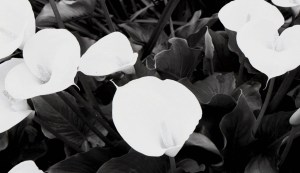
Image 1: Calla Group by Anulfo Baez
Growing up in a tiny rural town on the Southern coast of the Dominican Republic, meant that I was always surrounded by trees, shrubs and flowers. I grew up with my feet firmly planted on the ground (literally) anxiously looking after our banana, lime, pomegranate, cherry, guava and coconut trees. Flowers like hibiscus, passion flowers, fragrant white oleanders and calla lilies nurtured sweet and colorful memories of my homeland.
More than any of the tropical flowers I grew up knowing and caring after, calla lilies have always been my favorite. I’m fascinated by the elegant trumpet-like flower and their dark green leaves. Through my studies in the history of art and architecture, I’ve noticed that I have not been the only person fascinated with this toxic South African flower ( if ingested, the calla is known for causing oral irritation, intense burning and irritation of mouth, tongue and lips, excessive drooling, vomiting, difficulty swallowing). Artists like Imogen Cunningham, Tina Modotti, Georgia O’Keefe, Diego Rivera and Robert Mapplethorpe among others, have all explored the infinite and awe inspiring beauty of the calla lily.
One of my all time favorite photographers Imogen Cunningham (1883-1976) allowed for a very intimate, almost scientific view of a calla. Often linked to the Precisionists, Cunningham’s later works are in sharp focus and often depict views of American industrialization and modernization. Yet Cunningham today is celebrated for her close-ups of plant forms and female nudes.

Image 2: Imogen Cunningham Calla Lily (1925)
Another photographer whose work I admired is Robert Mapplethorpe, who portrays the calla lily as an extension of the human body. His images of flowers are charged with eroticism, allowing for a deep personal connection between the photograph and those who experience it.

Image 3: Robert Mapplethorpe Calla Lily (1984)
Both Cunningham and Mapplethorpe proved that the possibilities are endless when it comes to photographing callas and as a person who grew up by callas, I can understand and relate to artists who seek to highlight the beauty of the calla lily.
Read more about Anulfo and his views in his own words.
***
Sources
Image 1: Anulfo Baez
Image 2: The Robert Mapplethorpe Foundation
Image 3: The J. Paul Getty Museum, Los Angeles
Read Full Post »


 Words + Images