Feeds:
Posts
Comments

Posts Tagged ‘politics’

Previous Interludes

photo by Joseph A. Horne, Mt. Olivet Cemetery

photo by Joseph A. Horne, Mt. Olivet Cemetery

In 1949, when Joseph A. Horne received an award from the Netherlands for his part in the restitution of books to that country, he was Chief of the American Information Center in Frankfurt, better known as Amerika Haus.  In a 2013 blog post, illustrator Eric Carle described his experiences at Amerika Haus as a young man:  “The Amerika Haus countered the negative view of the United States and the free world. It housed a library with books and magazines mostly in English, arranged discussion groups, performed plays, concerts, movies and exhibitions, for instance, a show on architecture from the United States. From time to time, the Amerika Haus arranged joint ventures with German cultural institutes …  The concept of the Amerika Haus was ingenious, successful and resonated with the German population eager for more contact with the outside world from which it had been isolated for many years.” A 20-year old art student, Carle would be hired to design posters for Amerika Haus events.

Libraries as places of cultural exchange was not a new idea.  Since 1938, the U. S. State Department had operated a global Cultural Relations Program, working with private citizens and organizations like the American Library Association, establishing libraries, orchestrating and/or collaborating with others to produce a wide range of activities from teacher/student exchanges to fine art exhibitions.  In post-war Germany the first Amerika Haus was established in Frankfurt by October 1947.  Others quickly followed.

The_Logan_Daily_News_Thu__Oct_22__1953_(3)

These centers, soon located across Germany, drew peoples of all ages and backgrounds curious about the U.S. and seeking education and cultural opportunities that had been denied under Hitler, and then again under Stalin for those people living in Soviet-occupied areas.

By 1953, the libraries were being operated under the auspices of the United States Information Agency (USIA), known abroad as the United States Information Service (USIS).  Established under President Eisenhower, USIA focused on public diplomacy, and consolidated a number of foreign information activities into one agency, including the existing network of libraries.  The USIA would focus on delivering programming overseas with the Department of State providing foreign policy guidance. Titles changed and field operations shifted, but people like Joseph Horne continued what they had been doing since the end of the war, serving as liaison and ambassadors of U.S. culture and democratic ideals. The libraries were a focal point.  Pulitzer Prize winning journalist, Hal Boyle, reported from Berlin in 1954:

The centers were viewed by many as a strategic investment against the rise of the Soviet Union and communism, not by using force, but by using arts, literature, music and commercial publications.  As Joseph Horne would later tell his son, “One of the most powerful pieces of U.S. propaganda ever was the Sears Roebuck catalog.

As the Cold War intensified, libraries, and especially Amerika Haus libraries in Germany, would become unexpected targets as the anti-Communist fervor intensified across the U.S.

Concerns had escalated to the point that government employees had to swear they were not Communist. Television networks made their employees sign loyalty oaths. Public media encouraged people to report anyone suspected of being “red.””
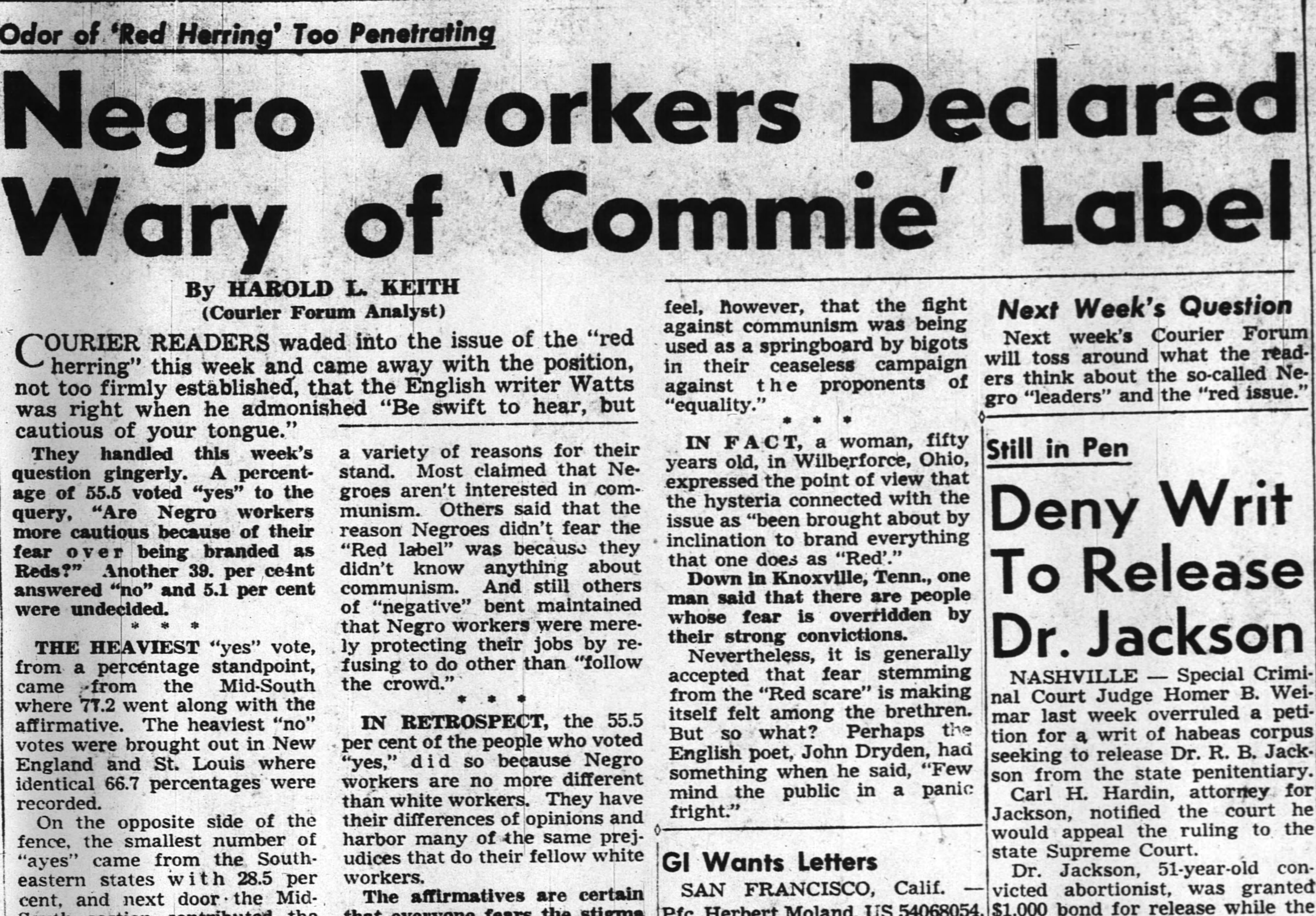
Excerpt from The_Pittsburgh_Courier_Sat__May_31__1952_

Excerpt from The_Pittsburgh_Courier_Sat__May_31__1952_

Lists were compiled by private groups as well as government agencies.  Celebrities were especially put under a spotlight.  People were blacklisted. They lost their jobs.  People were threatened with jail and expulsion from the country.

None more so than Wisconsin Senator Joseph McCarthy fanned the nation’s fears, with his fervent accusations of subversive activities at home and abroad.  In David Caute’s book, The Dancer Defects: The Struggle for Cultural Supremacy during the Cold War, he describes McCarthy’s interest in the State Department libraries, places where he believed Soviet and communist-leaning propaganda was being distributed.

McCarthy’s two aides, Roy Cohn and David Schine, would embark on a highly publicized tour of numerous European cities “striking at the cultural centers known as America House. … A major purge occurred in Berlin and throughout West Germany where the [United States Information Agency] had 40 branch libraries visited by an estimated 15 million people in the course of 1952.” He goes on to quote a 1953 Herald Tribune reporter as writing, “The burning of books is now progressing merrily in all American diplomatic missions abroad for all to see.

Russian American Vera Micheles Dean was head researcher for the New York-based, and anti-Communist, organization Foreign Policy Association.  In 1953, when her books were ordered pulled from the Amerika Haus libraries by the State Department, she put two questions to Secretary of State Dulles:  Who was responsible for drawing up the list of proscribed books? On what grounds were her writings forbidden?

In a 1953 article in opposition to McCarthy’s attacks against the libraries, correspondent Raymond Wilcove writes:  “More than 35 million people in 67 countries continue to throng America’s overseas libraries as Congress debates their value. Those who have seen them in operation say they provide America’s best show-window to the world.

Horne would later share that he remembered his phone calls from Cohn.  While he did not share the detail of the conversations, he was not complimentary about the interaction.  Despite the purge, in the end, the Amerika Haus libraries would survive McCarthy.  McCarthy would not survive Edward R. Murrow.

Edward R. Murrow

Edward R. Murrow

In the 1950s, on his CBS program See It Now, developed with colleague Fred Friendly, Murrow produced a series of reports about McCarthy’s activities.  His March 9, 1954 broadcast is widely hailed as one of television’s great moments.  Murrow began the report with these words,

Because a report on Senator McCarthy is by definition controversial, we want to say exactly what we mean to say, and I request your permission to read from the script whatever remarks Murrow and Friendly may make. If the Senator feels that we have done violence to his words or pictures and so desires to speak, to answer himself, an opportunity will be afforded him on this program. Our working thesis tonight is this question: If this fight against Communism is made a fight between America’s two great political parties, the American people know that one of these parties will be destroyed, and the Republic cannot endure very long as a one party system.”

Having been diligent at collecting film and audio clips of the Senator speaking in public, Murrow proceeded to air clips of the Senator, in his own words, making statements in one setting that he makes very differently in another. Murrow remarked,  “On one thing the Senator has been consistent. Often operating as a one-man committee, he has traveled far, interviewed many, terrorized some, accused civilian and military leaders of the past administration of a great conspiracy to turn over the country to Communism, investigated and substantially demoralized the present State Department …

Murrow was dogged in his examination of the Senator, finally concluding, “No one familiar with the history of this country can deny that congressional committees are useful. It is necessary to investigate before legislating, but the line between investigating and persecuting is a very fine one and the junior Senator from Wisconsin has stepped over it repeatedly. His primary achievement has been in confusing the public mind, as between the internal and the external threats of Communism. We must not confuse dissent with disloyalty. We must remember always that accusation is not proof and that conviction depends upon evidence and due process of law. We will not walk in fear, one of another. We will not be driven by fear into an age of unreason, if we dig deep in our history and our doctrine, and remember that we are not descended from fearful men — not from men who feared to write, to speak, to associate and to defend causes that were, for the moment, unpopular.
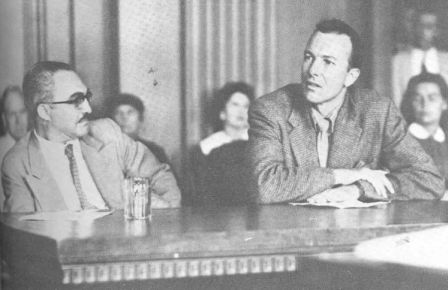
Pete Seeger Before McCarthy

Pete Seeger Before McCarthy Hearing

This is no time for men who oppose Senator McCarthy’s methods to keep silent, or for those who approve. We can deny our heritage and our history, but we cannot escape responsibility for the result. There is no way for a citizen of a republic to abdicate his responsibilities. As a nation we have come into our full inheritance at a tender age. We proclaim ourselves, as indeed we are, the defenders of freedom, wherever it continues to exist in the world, but we cannot defend freedom abroad by deserting it at home.

Langston Hughes Before McCarthy

Langston Hughes Before McCarthy Hearing

The actions of the junior Senator from Wisconsin have caused alarm and dismay amongst our allies abroad, and given considerable comfort to our enemies. And whose fault is that? Not really his. He didn’t create this situation of fear; he merely exploited it — and rather successfully. Cassius was right. “The fault, dear Brutus, is not in our stars, but in ourselves.”

Good night, and good luck.”

McCarthy’s influence waned. By the end of the year he would be censured by Senate.  In 1957 he died at the age of 48.  The libraries that he had so maligned were still going strong.  In 1959,  journalist Tom A. Cullen would write: “I have just visited the American “spy factory” in West Berlin.  That’s what the Communists call Amerika Haus, the new $250,000 United States Information Center.  But in an afternoon there I could find nothing more sinister than a few gray-haired grannies reading newspapers.  Or maybe it’s American jazz that’s sinister – there was a whole group of eager German youths listening to the latest long-playing jazz discs from the States.

Throughout this period, Joseph Horne’s foreign service activities would take him from Frankfurt, Germany to Genoa, Italy where he served as Public Affairs Officer. Intermittent time would be spent in the U.S. as his family grew.  In approximately 1957 or 1958 he would be assigned as Cultural Affairs Officer in Bangalore, India.  In 1961, President John F. Kennedy would appoint Edward R. Murrow as director of the United States Information Agency.  “Edward R. Murrow was my boss,” Horne would tell his son. India during this time, like much of the world, was going through great change. More to follow in the next Interlude.


Sources & Additional Readings

Amerika Haus: The First Fifty Years

History of the Amerika Haus

http://ericcarleblog.blogspot.com/2013/08/amerika-haus.html

DAI Heidelberg Library & USA Information

Information Bulletin April 1949

The Dancer Defects: The Struggle for Cultural Supremacy during the Cold War … by David Caute, page 26

Joseph McCarthy

Cohn & Schine Time Cover 1954

Vera Micheles Dean

Edward R. Murrow addresses Joseph McCarthy full video

Transcript of Murrow addressing McCarthy

https://en.wikipedia.org/wiki/Communist_Control_Act_of_1954



Read Full Post »

“He moves in darkness as it seems to me,

not of woods only and the shade of trees.”

— excerpt from Robert Frost’s Mending Wall

Yesterday, I watched a former politician speaking with great authority, as his wife looked upon him adoringly, as he spouted hatred and nurtured fears in a subtle way.  I had to turn off the television before I put my shoe through it.  I sat for a bit trying to remember that Booker T. Washington quote, about allowing no man to belittle his soul by making him hate him.

Not long afterwards I found myself reading about current politicians and wannabe politicians, echoing the sentiments of that former politician.  They spoke with great gravity about the need for bordering walls. Southern walls.  Northern walls.  Who knows,maybe even walls within cities. Nothing new, I suppose. Throughout human history, there have been such calls. It’s the public response to those calls that I wonder most about.

In Frost’s poem, Mending Walls, as two men rebuild the wall separating their farms, one says, “Good fences make good neighbors.” The poem’s narrator replies…

Spring is the mischief in me, and I wonder

If I could put a notion in his head:

“Why do they make good neighbors? …

Before I built a wall I’d ask to know

What I was walling in or walling out,

And to whom I was like to give offence.

Something there is that doesn’t love a wall,

That wants it down! …”

Read Full Post »

Blues 1

Blue Rose in the Hall

Maybe it was fear that made the young men shout “Nooooo!” as I stood next to a For Sale sign in front of a house in a suburb outside of Boston.  Fear of change, fear of something different coming into their midst.  And maybe it was fear that made a woman look me up and down as I questioned her entrance into a building (part of my job at the time).  As she left the building she made sure to look at me in that same way and I had to think, “Well, if looks could kill, I’d be six feet under.” And maybe it was fear that made the waitress do some things during a meal, such that once I’d left the restaurant with my friend (whose favorite restaurant it was), she said, “I’m sorry.  I didn’t expect that to happen.”

Now if I were to say that all of those fairly recent events happened, in part, because all the other individuals were white and I am black … well, I think there are folks who might say, as is often said today, why does everything have to be attributed to race?  Because race does matter.  As does class, gender, and economics. It all matters.  But here’s why race stands out for me:  slavery. “Slavery ended,” someone said to me once. “Why keep bringing that up?”

Born in the 1970s USA, I have never been a slave.  I have never been shackled or forced to give up a child or beaten if I tried to put pen to paper or pick up a book.  I’ve never stood in a market while an overseer pointed out my attributes so that someone might buy me as a companion for their children or an extra servant in the kitchen.  Never needed to carry papers proving freedom (or ownership), nor been branded, or had to hope that my master would free our children in his will.

As former slaves did about 150 years ago, I’ve never been in a position of celebrating freedom and, on the other hand, having to deal with the realities of having little but the clothes on my back and waiting for forty acres and a mule.  Never had to deal with “separate but equal” or segregated schools (my older brothers did who were born in the 1950s and 1960s).  Never been in a position or location where I had the right to vote but other forces, those perhaps suffering from fear of change, were putting strategies into place to prevent me from voting (my parents dealt with that).

Nor have I had to watch a loved one (or even a stranger) brutally beaten, mutilated, hung from a tree or a telephone pole, and burned.  I’ve heard a few stories from older family, watched the documentaries and read quite a few articles.  When I read the stories of lynching, especially in old newspapers recently digitized, and see the images, I cry.  I cry for the people who died, the people who watched and tried to help, and even for the people who watched and did nothing.  I did wonder what the people who did nothing were thinking? And what about the people who sang and danced and even cut off parts for souvenirs or mailed those parts to white politicians trying to effect some change?

For some, did the actions they witnessed mean nothing because the people to whom the deeds were done looked nothing like them?  Or was it just that they did not know what to do? Were some people truly scared or were they simply seeking pleasure in establishing control over another?  All of those incidents are part of the fabric of this country, as are the people, of all races and backgrounds, who fought to end slavery, the people who fought to end routine lynchings and the people who continue to fight for economic and voting rights for all people.

Yes, I do indeed bring up slavery and other injustices from the so-called past because of present-day incidents like in Ferguson.   Slavery is an institution, one of many, that this country has yet to deal with. I don’t care about politics or how people choose to identify themselves in this country as Republican, Democrat, Tea Party, Libertarian and so on.   Political labels and tenets change over time.  But what about human behavior?  How has that changed over time?  Or has it?  Why do we treat people the way that we do?

You can “follow the money” in terms of why slavery was entrenched in this country for so long.  Economics, economics, economics.  In too many venues of late, I have read people saying stop talking about race and focus on the economic issues in a Ferguson.  Of course, economics is an issue and powerful factor leading to injustices happening in many communities.  But it comes down to a bit more than money to treat people as inferior or to hear their screams of pain and laugh or to make assumptions about their children’s ability to learn regardless of resources provided for education.  And it is about more than economics to see all those things taking place around you and to do nothing. To some extent, I feel little right to judge others because I do not always know what to do as I learn about the horrors around me, in this country and abroad.  I do know with regard to slavery and the seeds that were planted that continue to sprout, I do not want to forget.

I’ve been researching the past, including slave times, quite a bit of late for various projects as well as to better understand current events.  In the remembering, and rediscoveries, I don’t come to hate people who look different than me.  Not at all.  A part of me mourns.  I mourn the horrors, and I also celebrate the courage of so many different peoples, their hopes, their activism and their creativity in finding the beauty in this life.  And I celebrate such in the people who are active today.

As a final note in my Sunday ramblings, if you chose to read so far, … I came upon a 1920s newspaper article about a lynching. The reporter recounted that witnesses heard the dying man sing a song with his last breaths as the flames consumed him.  I looked up the song and came upon the following 1950s rendition by Sam Cooke.  A powerful piece.


Read Full Post »

foreword to the interludes

interlude: genesis

interlude: exodus, part 1

interlude: exodus, part 2

Son of farmer in dust bowl area. Cimarron County, Oklahoma , photo by Arthur Rothstein, 1936.

Son of farmer in dust bowl area. Cimarron County, Oklahoma , photo by Arthur Rothstein, 1936.

“A gentle wind followed the rain clouds, driving them on northward, a wind that softly clashed the drying corn. A day went by and the wind increased, steady, unbroken by gusts. The dust from the roads fluffed up and spread out …  Now the wind grew strong and hard …  the dust lifted up out of the fields and drove gray plumes into the air like sluggish smoke. The corn threshed the wind and made a dry, rushing sound. The finest dust did not settle back to earth now, but disappeared into the darkening sky.”  — in the opening chapter of The Grapes of Wrath by John Steinbeck.

Liberal (vicinity), Kan. Soil blown by dust bowl winds piled up in large drifts on a farm, photo by Arthur Rothstein, 1936.

Liberal (vicinity), Kan. Soil blown by dust bowl winds piled up in large drifts on a farm, photo by Arthur Rothstein, 1936.

In April 1935, as Joseph A. Horne was teaching music in West Virginia, President Franklin Delano Roosevelt was creating the Resettlement Administration (RA) in Washington, D.C.  Guided by Rexford G. Tugwell, the agency intent was to help farmers and other rural poor suffering from the economic impacts of the Great Depression and the devastation of dust storms and other ecological events.   A Historical Section was created within the agency to document existing poverty as well as report the benefits of the agency’s work.  This section would be led by Roy E. Stryker.

Rexford Tugwell and Roy Stryker

Rexford Tugwell and Roy Stryker

In the 1920s, Tugwell and Stryker, both economists, had taught at Columbia University.  While there, they had collaborated on the book, American Economic Life. Stryker’s contribution included using photography to complement the text, something he also did as part of his lectures at the university.  He was not a photographer but he, and Tugwell, recognized photography as a useful, illustrative tool to convey and strengthen information.

Farmer and sons walking in the face of a dust storm. Cimarron County, Oklahoma, photo by Arthur Rothstein, 1936.

Farmer and sons walking in the face of a dust storm. Cimarron County, Oklahoma, photo by Arthur Rothstein, 1936.

Stryker left academic life to follow his friend and mentor to the Resettlement Administration. Three decades later, Stryker would recount that “Tugwell never said, “Take pictures.”  He said, “We need pictures.”  He never said how to take them.  He said, “Remember,” — and this is the only thing I can remember — “remember that the man with the holes in his shoes, the ragged clothes, can be just as good a citizen as the man who has the better shoes and the better clothes.” (Interview, June 13, 1964)

Farmer, local type, Brown County, Indiana, photo by Theodor Jung, 1935.

Farmer, local type, Brown County, Indiana, photo by Theodor Jung, 1935.

The agency’s original focus was on Rural Rehabilitation, Rural Resettlement, Land Utilization and Suburban Resettlement.  Activities included purchasing exhausted farmlands from farmers to convert the land into pastures or parks, for instance, and providing training for farmers to rehabilitate their farms through refinancing and other debt adjustments.  Out of work farmers were given jobs.  Building projects were begun.  The most controversial feature of the agency’s efforts was relocation.

Scottsboro (vicinity), Alabama. Farmers who have been resettled at work in a sand pit at Cumberland Mountain Farms, a U.S. Resettlement Administration project, photo by Arthur Rothstein, 1935.

Scottsboro (vicinity), Alabama. Farmers who have been resettled at work in a sand pit at Cumberland Mountain Farms, a U.S. Resettlement Administration project, photo by Arthur Rothstein, 1935.

From the beginning, the agency did not have much Congressional support.  Part of it was political.  Tugwell was considered to be one of the most radical of FDR’s New Dealers.  Plus the idea of relocating nearly a million farmers and other rural poor off the land into cities that they’d helped to build seemed too socialistic.

Rehabilitation client, Garrett County, Maryland, photo by Theodor Jung, 1935.

Rehabilitation client, Garrett County, Maryland, photo by Theodor Jung, 1935.

With funding limited by Congress, the Resettlement Administration would eventually dramatically narrow its efforts and focus on building relief camps in California for migratory farm workers.  One of these relief camps would inspire John Steinbeck’s The Grapes of Wrath.

All races serve the crops in California, photo by Dorothea Lange, 1935

All races serve the crops in California, photo by Dorothea Lange, 1935

Faced with rising criticism for his management, Tugwell resigned from the Resettlement Admininistration in 1936.  By September 1937, the agency was folded into a new federal entity, the Farm Security Administration (FSA).  The FSA, with its mandate to help the rural poor, would complete some of the Resettlement Administration’s original projects as well as embark upon a whole other series of financial and technical assistance programs.  Roy Stryker was given the greenlight to continue his documentary photography program.

Negro field worker. Holtville, Imperial Valley, California. He has just made himself shoes out of that old tire, photo by Dorothea Lange, 1935.

Negro field worker. Holtville, Imperial Valley, California. He has just made himself shoes out of that old tire, photo by Dorothea Lange, 1935.

He directed his photographers to take the best picture possible and to capture the story behind the image.  He could not tell them how to use their cameras, but he did suggest themes to focus on.

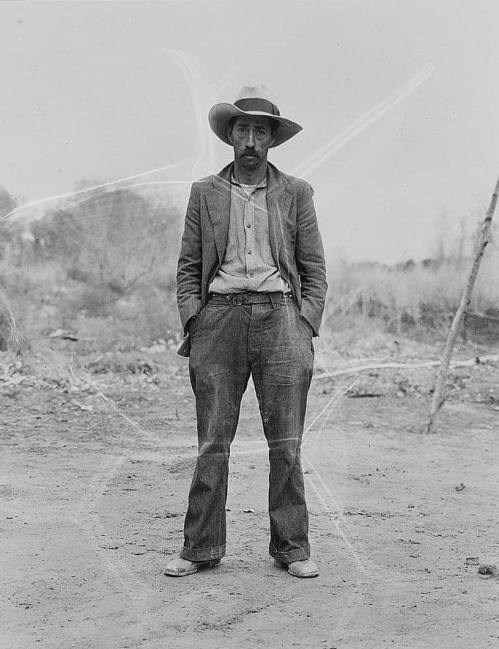
Imperial Valley, California, Mexican. He tells his story: he helped drive the French out of Mexico, fought against Maximilian, and he has, by serving the crops for many years, help build up Imperial Valley, photo by Dorothea Lange, 1935.

Imperial Valley, California, Mexican. He tells his story: he helped drive the French out of Mexico, fought against Maximilian, and he has, by serving the crops for many years, help build up Imperial Valley, photo by Dorothea Lange, 1935.

Based on how they operated in the field, these early documentary photographers, including Dorothea Lange, Walker Evans, Ben Shahn and Arthur Rothstein, were sometimes described as “sociologists with cameras.”

Mexican field worker, father of six. Imperial Valley, Riverside County, California, photo by Dorothea Lange, 1935.

Mexican field worker, father of six. Imperial Valley, Riverside County, California, photo by Dorothea Lange, 1935.

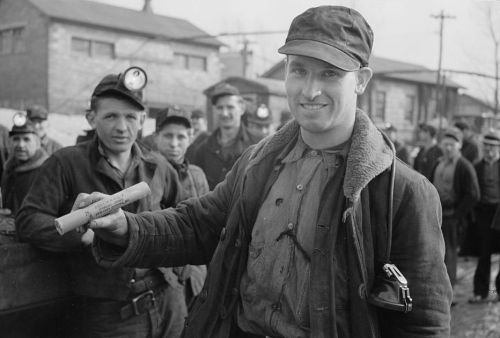
The photographers traveled across the nation, by assignment, sometimes alone and sometimes in groups, to areas of economic challenge, capturing dramatic hardships and also simply documenting people living their daily lives.

Untitled photo, possibly related to: Miners at American Radiator Mine, Mount Pleasant, Westmoreland County, Pennsylvania, photo by Carl Mydans, 1936.

Untitled photo, possibly related to: Miners at American Radiator Mine, Mount Pleasant, Westmoreland County, Pennsylvania, photo by Carl Mydans, 1936.

Farmer and sons walking in the face of a dust storm. Cimarron County, Oklahoma, photo by Arthur Rothstein, 1936.

Warm Springs Indian boy. Molalla, Oregon photo by Arthur Rothstein, 1936.

The FSA would operate from 1937 – 1942, with its photography unit capturing the diversity of the United States.

Negro boys on Easter morning. Southside, Chicago, Illinois, photo by Russell Lee, 1941.

Negro boys on Easter morning. Southside, Chicago, Illinois, photo by Russell Lee, 1941.

That diversity would be represented in the ranks of the photographers that Stryker brought together, men and women of different backgrounds, interests, and photographic skill.

Westmoreland project, Pennsylvania. Westmoreland County. Construction worker on the Westmoreland subsistence homestead project, photo by Walker Evans, 1935.

Westmoreland project, Pennsylvania. Westmoreland County. Construction worker on the Westmoreland subsistence homestead project, photo by Walker Evans, 1935.

In 1942, the photography unit moved into the Office of War Information (OWI)The OWI was created shortly after U.S. entry into World War II as an effort to consolidate existing government information services.

Two children in Anacostia, Washington, D.C. at the Frederick Douglass Housing Project, photo by Gordon Parks, 1942.

Two children in Anacostia, Washington, D.C. at the Frederick Douglass Housing Project, photo by Gordon Parks, 1942.

By 1943, another federal agency, the Office for Emergency Management, would  also be brought under the OWI umbrella, and its activities and some of its staff would merge with Roy Stryker’s photographic unit.  One of those staff would be Joseph A. Horne.

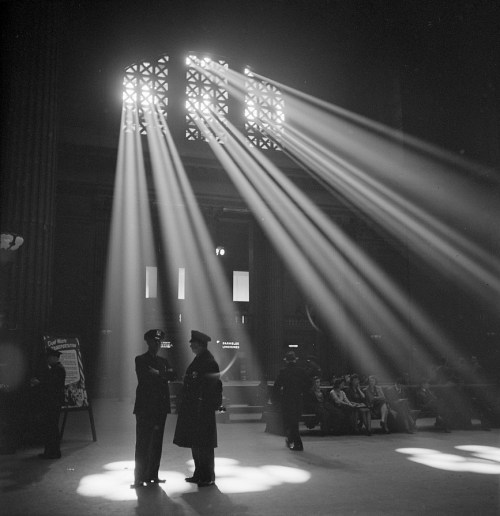
Chicago, Illinois. In the waiting room of the Union Station, photo by Jack Delano, 1943.

Chicago, Illinois. In the waiting room of the Union Station, photo by Jack Delano, 1943.

As these many agencies consolidated into one, the Farm Security Administration-Office of War Information (FSA-OWI), the nature of the photographs taken by its photographers changed to some degree as did the purpose of the images.

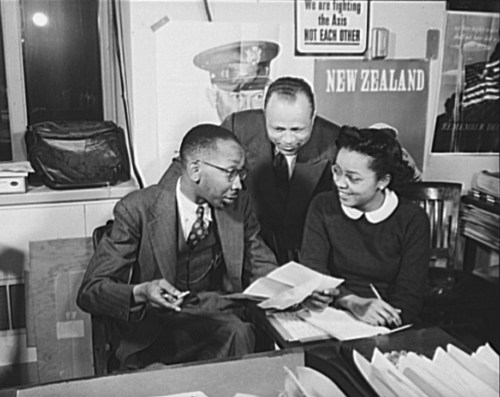
Office of War Information news bureau. Ted Poston, Negro desk editor of the Office of War Information (OWI), discusses a letter from one of the 240 Negro editors to which he sends war news from Washington, with William Clark and Harriette Easterlin, his assistants, photo by Alfred T. Palmer, 1943.

Office of War Information news bureau. Ted Poston, Negro desk editor of the Office of War Information (OWI), discusses a letter from one of the 240 Negro editors to which he sends war news from Washington, with William Clark and Harriette Easterlin, his assistants, photo by Alfred T. Palmer, 1943.

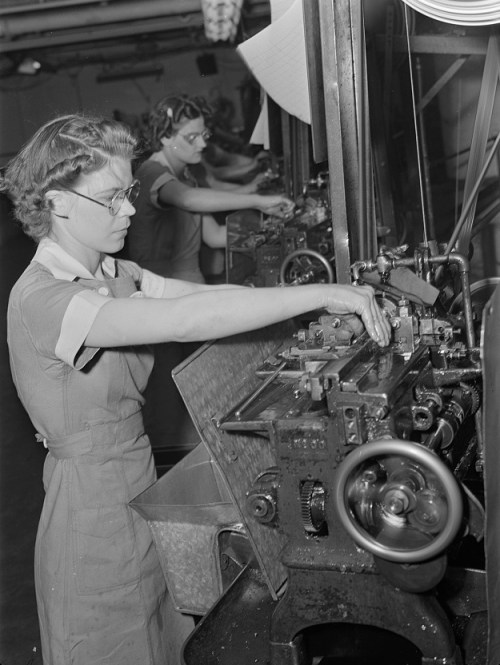
Documenting American life was still important but now with an emphasis on framing the images so that they would inspire patriotism, educate people about how to live and act during war time,  and evoke a sense of national pride in the strength, good humor and resilience of the American people.

Women in industry. Tool production. Arms for the love of America! The capable young woman whose strong hands guide this cutoff machine is one of a Midwest drill and tool factory's many women employees. Almost 1,000 women have recently been employed in this comparatively new plant; sole men workers, other than foreman, are those in the heat treating department. Republic Drill and Tool Company, Chicago, Illinois, photo by Ann Rosener, 1942.

Women in industry. Tool production. Arms for the love of America! The capable young woman whose strong hands guide this cutoff machine is one of a Midwest drill and tool factory’s many women employees. Almost 1,000 women have recently been employed in this comparatively new plant; sole men workers, other than foreman, are those in the heat treating department. Republic Drill and Tool Company, Chicago, Illinois, photo by Ann Rosener, 1942.

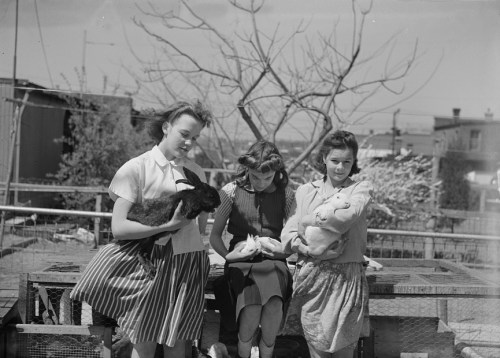
Joseph Horne’s photos that appear in the FSA-OWI Collection, now housed in the Library of Congress, focused on the Washington, D.C. area where he had settled with his family.  His images include the crafting of victory gardens and urban farms.

Washington, D.C. Children with rabbits which were formerly kept as pets, but now are being raised for food, photo by Joseph A. Horne, 1943.

Washington, D.C. Children with rabbits which were formerly kept as pets, but now are being raised for food, photo by Joseph A. Horne, 1943.

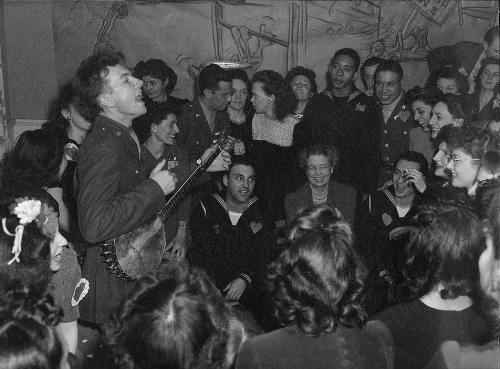
He also photographed the unique monuments located in the Congressional Cemetery, and the mix of peoples who made their way through Washington’s Franklin Park. And then there was that night in February 1944, when he photographed the opening of a new labor canteen.

Washington, D.C. Pete Seeger, noted folk singer entertaining at the opening of the Washington labor canteen, sponsored by the United Federal Labor Canteen, sponsored by the Federal Workers of American, Congress of Industrial Organizations (CIO), photo by Joseph A. Horne, 1944

Washington, D.C. Pete Seeger, noted folk singer entertaining at the opening of the Washington labor canteen, sponsored by the United Federal Labor Canteen, sponsored by the Federal Workers of American, Congress of Industrial Organizations (CIO), photo by Joseph A. Horne, 1944

The photography unit was only one part of the FSA-OWI but it was one of the most successful units.  Through domestic and overseas operations, the  agency had sought to excite and educate Americans at home, and inform (or intimidate) allies and foes abroad, using radio broadcasts (e.g. Voice of America), newspapers, posters, film and photography. But as World War II progressed, conflicts arose around agency management and how to balance civilian and military interests.  Soon, Congress would severely cut the organization’s budget. By 1944, the enormous collection of FSA-OWI photos, black and white and color, would be transferred to the Library of Congress where they remain a valuable resource to this day.

Negro boy near Cincinnati, Ohio, photo by John Vachon, 1942 or 1943.

Negro boy near Cincinnati, Ohio, photo by John Vachon, 1942 or 1943.

By 1945, the Office of War Information as an organization was no more.  Any relevant international activities were transferred to the U. S. State Department, while relevant information gathering and related responsibilities were handed over to the intelligence agencies like the Office of Strategic Services/Central Intelligence Agency.

Joseph Jr. with Camera, photo by Joseph A. Horne.

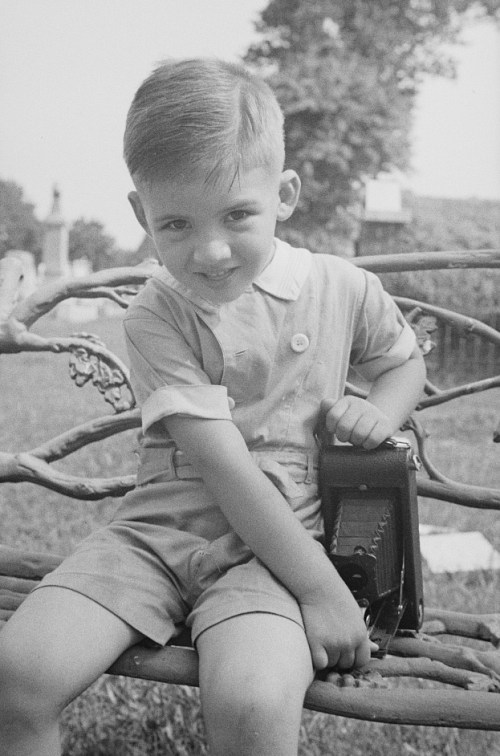
Joseph Jr. with Camera, photo by Joseph A. Horne.

By the spring of 1944, Joseph A. Horne, the fellow with whom we are walking through history, had enlisted in the U.S. Army.  Soon he would be off to Europe where photography would remain an important feature of his life.  But before he traveled overseas, he would let his son play with one of his cameras.

Additional Reading/Sources …

Library of Congress Prints and Online Catalog

Stryker’s Shooting Scripts

Resettlement Administration

Farm Security Administration

Office of War Information

Oral Interviews with Roy E. Stryker

About Roy E. Stryker

Out of One, Many:  Regionalism in FSA Photography

Stryker and the FSA

John Steinbeck

FDR Presidential Library and Museum


Read Full Post »

Just one of those random questions running through my head this morning as I have the luxury of sitting in my home sipping strong coffee in the warmth of my kitchen while there are those in great need of food and shelter who have nothing this morning because the politicians in the fortress of solitude in DC can’t get it together to stop being children in a playground.  Anyway, racism, classism, and all those other -isms are too easily used to excuse the behavior of the men and women in Washington (and those who pay them in the various ways our system allows).  If Obama were blonde haired and blue eyed and with the same ideals there’d still be a fight … because indeed there was one.  Look at the Clinton Years.

Politicians aside with their blinders, fat pockets, or indeed “righteous ideals,” what bothers me most are the people who sit back and do nothing.  And maybe that’s because there are too many distractions.  I mean, on the morning news, immediately following one story of government shutdown, there was a story of a movie star’s fight with his girlfriend.  Really? That’s the next important story?

One of my favorite letters in American history is Martin Luther King’s Letter from a Birmingham Jail.  It was not a letter written to Klansmen or segregationists or to all those others who outright hated; it was a letter written to those who expressed a desire for change but were waiting for the right moment or not wanting to make any waves or simply did not understand the gravity of the situation.  I fear that people have lost sense of our interrelatedness, and thus do not understand the implications – the ripple effects – of the actions (and purposeful inactions) certain politicians are pushing.  If you have a well-paying corporate job with great benefits, why engage in a dialogue about health insurance or food stamps?  But as MLK wrote, “We are caught in an inescapable network of mutuality, tied in a single garment of destiny. Whatever affects one directly, affects all indirectly.”

I am proud to be an American, of its landscapes and its peoples and of course its opportunities.  Or at least of those opportunities that I perceived as a child growing up in Virginia.  And I was proud of its politics.  Probably using a different set of text books than are being allowed in school today, I thought I learned in World History, Civilizations, Civics and Government courses that, my goodness, what a wonderful system of government with its checks and balances, and opportunities for dialogue and debate (and yes, negotiation and compromise).  What a wonderful system.  What has happened?

Anyway, no more caffeine for me today.  Caffeine plus anger gives me a headache.  Perhaps I will be able to take another walk by the Mystic River, the source of these images.  I hope where ever you are, you find a peaceful moment too.  Have a good Tuesday.

Read Full Post »

It was Martin Luther King, Jr. who wrote, “Shallow understanding from people of good will is more frustrating than absolute misunderstanding from people of ill will. Lukewarm acceptance is much more bewildering than outright rejection.”  His words have been in my head a lot this election year as has his following statement:  “Like a boil that can never be cured so long as it is covered up … injustice must be exposed, with all the tension its exposure creates, to the light of human conscience and the air of national opinion before it can be cured.”

leaves blowing in the wind

I did not begin the morning thinking of Martin Luther King’s Letter from a Birmingham Jail.  I began the day thankful after learning, via phone calls and emails, that friends and family across the storm zone were all safe and with power.  But then I accidentally read a blog post.  Actually I skimmed it.  I had almost pressed the like button but there was some phrasing that made me pause.  I slowed down and really read the words before me on the screen.  That’s when the beautifully subtle racism and misogyny of the text became clear.  And I became so sad and so angry.

It was like the post became a flaming match that fell upon the kindling of recent stories about the subtleties of race and voter manipulation (let alone outright voting machine tinkering) in this 2012 election, and of my own experiences with the subtle undercurrent of rising racism and class discrimination and watching  good-hearted people not wanting to talk about it.

I thought of the people I’ve sat quietly beside on recent commutes home, as they’ve talked about how they like the look of Romney and Ryan and don’t like Obama’s look, and then they see me and my brown skin and look away quickly.  I was not angry at them or even necessarily offended.  I simply wanted to ask them, what does a “look” have to do with running a country in a chaotic world?

rain upon the window

I will never tell anyone how to vote.  I will simply say to those in this country who are able to vote, please do and do so with an understanding of who and what you are voting for.  Do more than a skim of the text or a superficial look.  That is what I will try to remind myself anyway.  Okay … tomorrow back to calming words and images.  Be well.

Read Full Post »

Abstract Reflections

This morning I’d put the television on mute as I worked on a paper.  When I finished the paper, I looked up and saw Michele Bachmann being interviewed by Bob Schieffer on CBS’s Face the Nation.  I turned the television off and prepared to walk away.  Then I stopped, sighed and turned the television back on.  I decided I should “walk my talk.”

You see,  I often tell younger friends of mine, especially young relatives, no matter what your political stance, first, be sure you vote, and second, vote responsibly – be informed.  So today, I decided to better inform myself about this candidate instead of only listening to heresay.  Well, without getting too personal, I’ll share a few things that stood out to me.

First, it will be a sad day in journalism when Bob Schieffer is no longer behind the desk.  In clear, concise, respectful language, he asked questions that showed without a doubt that he had done his homework and that he was prepared to ask the hard questions.  He was not to be distracted.

Second, it was sad to see once more that no matter how direct the question, even if repeated, candidates are well-trained in delivering non-answers.  I took public speaking.  It is amazing to see the tools being put to work so well by Ms. Bachmann (and all the other candidates).

Finally …

It may be my imagination but it seems that candidates, male and female, of any party, are so gloriously put together these days that they remind me of watching Entertainment Tonight or any of a half-dozen reality TV shows.  As I watch Bachmann, Perry and all the others on television, I just wonder if people are actually listening to candidates’ words or dazzled by their appearance.  It might make an interesting challenge as candidates share their thoughts on screen, to keep the sound up, but somehow “mute” the image.


Read Full Post »

« Newer Posts