Feeds:
Posts
Comments
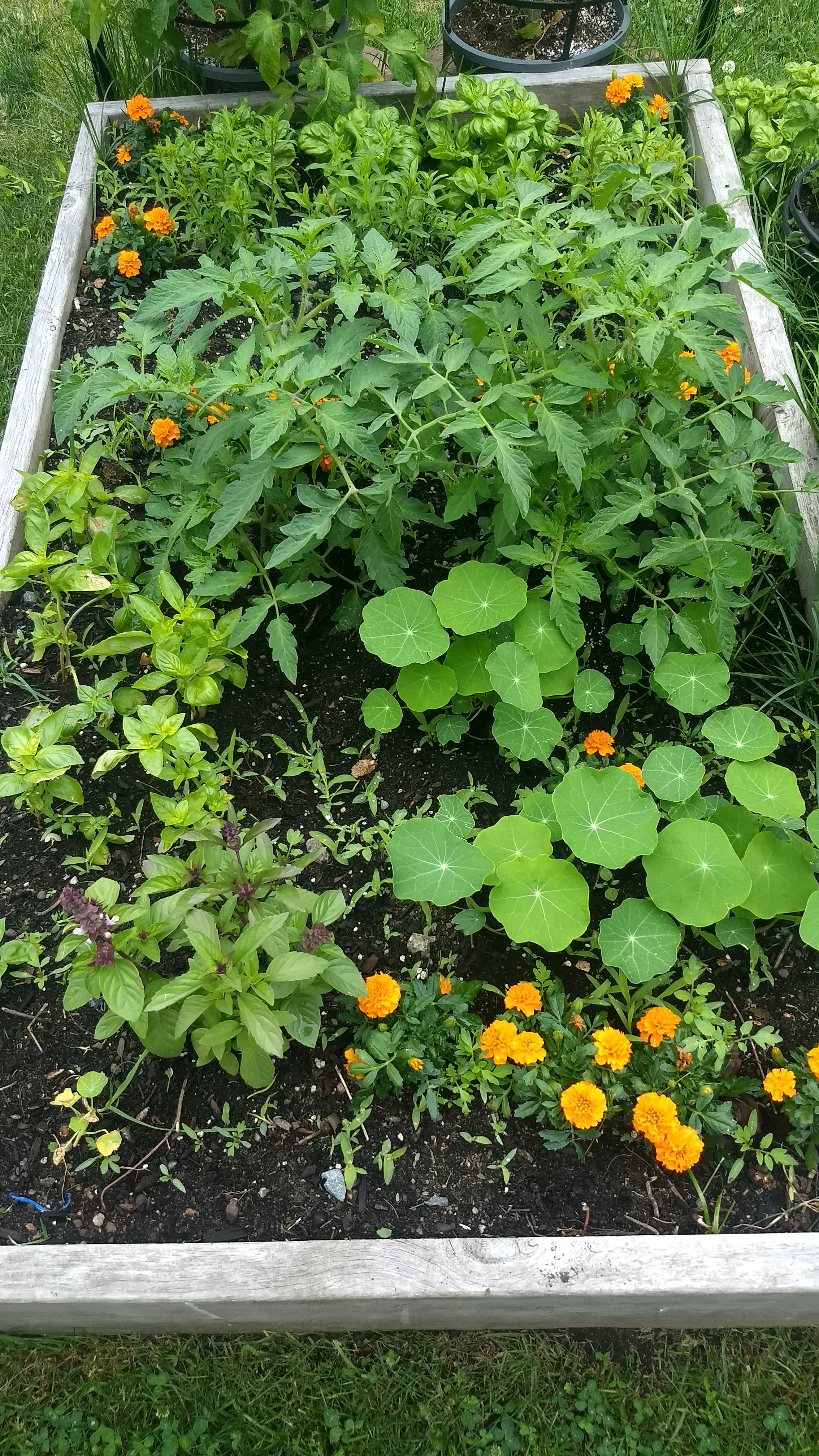
my super eclectic 2×5 raised garden bed

I have to admit it has been mostly people of color who have been most vocal in their curiosity. “Do you live here?” “Nice neighborhood. What’s your rent like?” And if they see Steve standing about with his silvery beard and walking stick, some venture to inquire, “Are you a home health aid?” These are Uber drivers. The White drivers tend to pull up, look at the house and then at me, curious clearly, but leaving the questions unasked.

It is a 1920s wood frame two family house with good bones that need some work. Stuff like fixing holes in walls, replacing plumbing, updating the 1970s washer and dryer in the rental unit and so on and so forth and ,ah, the learnings! One small brick porch was recently repaired while the larger brick porch had to be replaced completely because, as Steve thought based on his tapping his walking stick on the bricks, the interior bricks had crumbled and there was a disaster in the making. That had to be fixed and it looks good. The exterior painting that’s clearly needed? So long as we don’t look too shabby that’s getting pushed out into the far future. I did not realize owning a home was so expensive. But as Steve likes to remind me, we really don’t own the home. The bank owns it until we pay off the mortgage. πŸ™‚

There was an incident on the street recently and the police arrived. I went outside by myself to inquire what was happening. In short during the course of the conversation I informed the officer I was not a tenant, I was the landlord. There followed that moment of silence and that too-familiar look on his face. I was treated with respect but the curiosity remained clear in his face, the Black officer, and later on the face of a White officer.

There are times of late on the Uber ride home, especially after a long day in Boston, and I see the question(s) forming, I am tempted to make up a story. “Yes, I’m a home health care aid. That’s why my bags are filled with groceries and flowers, so that I can take care of the people inside.” “Yes, I’ve been renting for years and luckily the landlord hasn’t raised the rent. Indeed it is a nice neighborhood and I am lucky to be able to afford it.”

I do not think of the queries and reactions as necessarily racist. I think of them as unintentionally or unknowingly biased. There is a perception of me by people of different races and backgrounds that kicks in when they see me, a small brown woman who may look a bit younger than I actually am, standing in front of a multifamily home. Is it so rare that a Black person owns a home in the Greater Boston area?

Yes, it is.

There has been much research on the subject and there is continuing work by people at many levels to fix the inequity in home ownership that has evolved over many many many decades.

I am by trade a storyteller but I will ignore urges to make up a story about our home and my presence in it. It serves no purpose to lie except to perpetuate a misconception. I am simply reminded of my research, and the research of so many scholars, with regard to systemic racism and the seeds that are implanted in the minds of people of all backgrounds as to who Black people are and what they are capable of.


pansies

I am being overrun by pansies …

… some of which I am 99% sure I didn’t plant.

life

Usually, in the morning, I let … I mean that I empower … Steve to roll out of bed, make coffee and cook me, I mean us, eggs over easy. Always one egg on one piece of toast and maybe some fruit on the side. Kind of spartan but it works. But in recent times I noticed the number of eggs in the fridge were diminishing at a faster rate. Now Steve’s tai chi instructor Jon makes occasional house visits because it can be a bit of a trek for Steve to make it to the dojo. Jon can come in the mornings usually after I’ve left for work. One day I called home to ask Steve if Jon had shown up. He said, “Yes. I cooked him breakfast.” I did a double take. “Aren’t we paying him to come over and give you a workout?” “Yes, but I asked if he was hungry and he said yes and so …”

Now what I remember from ages ago, after Steve’s surgeries and he could appear and was indeed pooped all of the time, is that for a visit with company customers he pulled together (without me being present as sous chef) an amazing fruit and cheese grazing platter BEFORE they all went out to dinner and THEN returned to our place for a nightcap that he orchestrated. He was in heaven. When I described this scene to his PCP she nodded sagely and said, “Some people are energized by being hospitable.”

And so this morning as I raced out of bed (alarms didn’t go off) and raced about to make coffee and check the egg situation … well, there were three eggs. I knew Jon was coming by for class. If Steve and I had one each that would leave just one for Jon. So I put the container back in the fridge and decided we were having smoked salmon and cream cheese on toast. Steve, without even knowing the egg situation, said that would be just fine.

When I returned home, I looked in the fridge. One egg in the case. I asked Steve, who was in another room, and already knowing the answer, “Did you fix Jon breakfast?” “Yes,” he shouted back. “He said thank you before we went outside to practice with the kendo sword.”Β 

I smiled and closed the refrigerator door. Gotta buy some more eggs this weekend.

in the afternoon light

daffodils

oxalis

oxalis on the windowsill

snow? what snow?

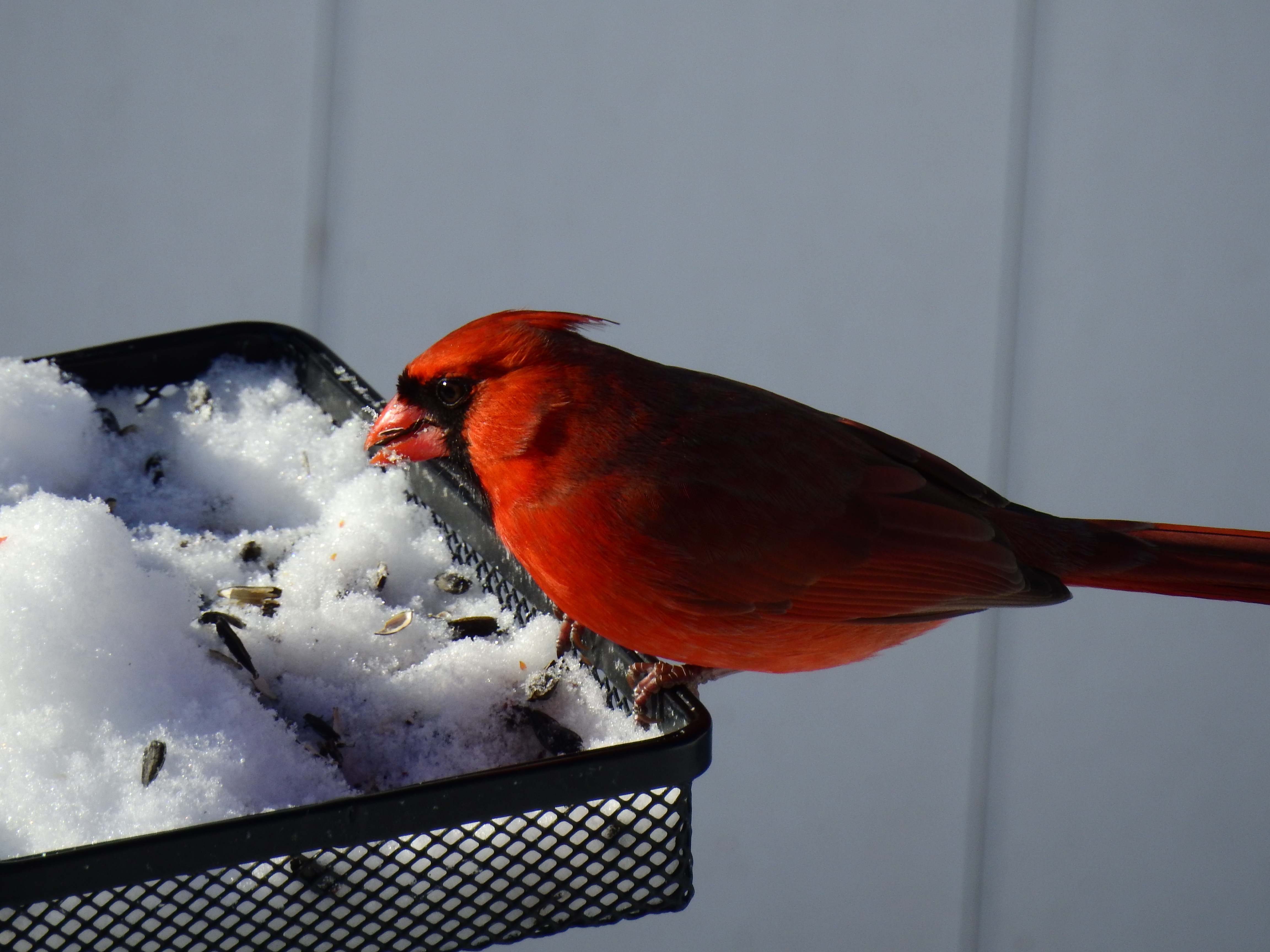
red cardinal
squirrel
blue jay

room for all at the table

starling and a sparrow

dove

This is a list of Black officers employed by English traders in West Africa. This record is just one page from the extensive archives of the Royal African Company.

The Royal African Company (RAC) was formed in 1660 by the royal Stuart family and City of London merchants. Trade focused on the west coast of Africa with a primary interest in trade for gold. That focus would shift to human trade. The RAC shipped more African slaves to the Americas than any other company in the history of the Atlantic slave trade. By 1752 its assets were transferred to the newly formed African Company of Merchants that would operate until 1821. The page I’ve shared has to be from a company ledger produced after 1765.

Many company records have been digitized and are accessible via a genealogical database. It is interesting to peruse these records and see the number of Black men employed by the company. These men listed may have been stationed at the trading post, Cape Coast Castle.

Cape Coast Castle (as rebuilt by the British in 18th century), Ghana

The first man, Cudjoe, was a cabboceer and linguist. Cabboceers were African men appointed by their leaders to supply European traders with trade goods including slaves. The third man Frederick Adoy was a writer, as are several other men on the list. Adoy was the son of a cabboceer and had been educated in England. Writers were the equivalent of clerks for the company. Adoy had the advantage of speaking the native languages. The last man Philip Quaque was born on the Cape Coast but taken to England as a child in 1754 by a missionary from the Society for the Propagation of the Gospel. There, he went to school, was baptized and may have studied theology at Oxford. In 1765 he became the first African ordained in the Church of England. In that same year he received his commission to serve as chaplain and spread the gospel back in Africa.

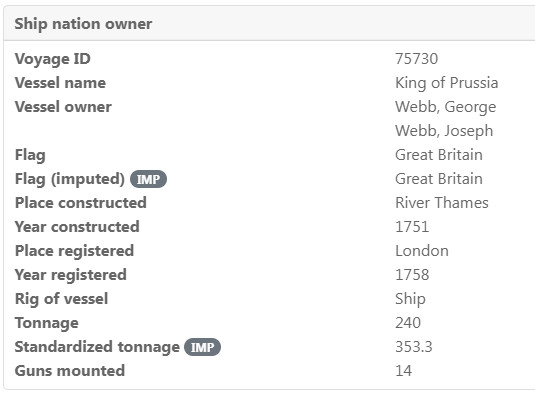
In October he and his English wife Catherine Blunt boarded the ship The King of Prussia, captained by Shepherd. If you switch over to the slavevoyages.org database, you can search for a vessell named King of Prussia.

Entry from Slave Voyages Database

The entry notes in October 1765 Captain John Shepherd and crew departed London for West Africa. After safe delivery of any goods and departure of passengers, like Quaque, Shepherd and company factors began trading activities. When the ship departs, 216 enslaved people are in the hold of the ship. At least 189 survived the voyage, with 107 sold in Grenada and 82 sold in Nevis. Shepherd than returned to London by the fall of 1766.

Quaque never returned to England, except for a short visit in 1784-1785. His wife Catherine died a year after arrival at the Cape Coast. Over time he would eventually marry two African women who bore him sons. He focused his missionary efforts on starting a school primarily for Afro-European (i.e. mulatto) children of the elites. He wrote frequently to the Society for the Propagation of the Gospel back in London. You can read his own words.

He describes in great detail his successes and challenges, challenges that included the fact he was no longer fluent in the local language. His family ties remained within the community but his cultural connection had been distorted by a childhood and devout Anglican upbringing in England. Local and global politics, as well as wars, hampered his mission at every level yet he persevered. For extra money he even worked as a writer/clerk like Frederick Adoy.

Sometimes Quaque had no students and sometimes he had over a dozen. He taught them reading, writing and arithmetic, and of course religion. He had dreams of expansion and wrote of wanting to hire Adoy and fellow Black writer John Acqua (also educated in England) as his teaching assistants. The school never thrived though it did survive. Quaque’s sons, educated in England, even assisted him for a time. Quaque died in 1816 after fifty years of service.

Cape Coast Castle Dungeon

What must he have thought of the slave trade? In the place where he taught brown and black children in a school room, down below brown and black children were chained in the holding cells awaiting transport to the New World. As a writer he would have chronicled the trade that took place. He had been chaplain to the English traders and missionary among his African people. While he vilified slavery, especially later in life, his actions suggest he believed religious conversion would save his people. Still, his criticism would be an important part of the growing abolitionist movement. And while, as indicated in his letters, he may not have felt successful, his legacy endures as does his school.

Sources and Additional Reading

Bartels, F. L. β€œPHILIP QUAQUE, 1741β€”1816.” Transactions of the Gold Coast & Togoland Historical Society, vol. 1, no. 5, Historical Society of Ghana, 1955, pp. 153–77, http://www.jstor.org/stable/41406590.

slavevoyages.org

Royal African Company Records 1694 to 1743

“One of their Own Color and Kindred” Philip Quaque and the SPG Mission to Africa, by Travis Glasson, DOI:10.1093/acprof:oso/9780199773961.003.0007

The Life and Letters of Philip Quaque the First African Anglican Missionary

ah, winter

snow drift against the back door