A new restaurant has opened not far from where I work. I paused in my journey this morning to peer at the menu from afar. Words rang out. “Hey, Nigger. This is where people walk.” Startled I turned toward the voice to see a young white man striding past. Now I’d seen him earlier in the morning. He was clearly strung out on something so there was no need to say anything in return. But as I returned to work I was startled that the words of a junkie, someone clearly in need of some help of some sort, could touch me so. Probably doesn’t help that I am currently immersed in historical research about the profiling and imprisonment of free Black seaman in the antebellum south.
Nor does it help that as Steve and I continue to make our way in this world that people continually, immediately, assume that I am either the paid home health aid or the overnight caregiver. And so then the onus is on me to calmly explain that I am his wife. The onus. I know of a lovely older Black woman in an interracial relationship and she shared that in the retirement community where they reside she always carries her resident card to prove she belongs there and is not “just” a visiting care giver.
We live in a time of unprecedented whitewashing where people in power are trying to normalize outright racism and bigotry and even more so foment deep and abiding ignorance about this nation’s past let alone its present. People are not questioning their assumptions. Race does matter regardless of what a super rich and powerful white minority are trying to assert.
Just some Sunday musings … best get back to my research so that that forgotten story can be shared soon.
Here’s a challenge. In this age of quick reads, read this whole poem, Let America Be America Again, by Langston Hughes. Indeed try reading passages out loud. Written about 90 years ago, it could have been written today. And therein lies the sadness and yet the hope. Read on …
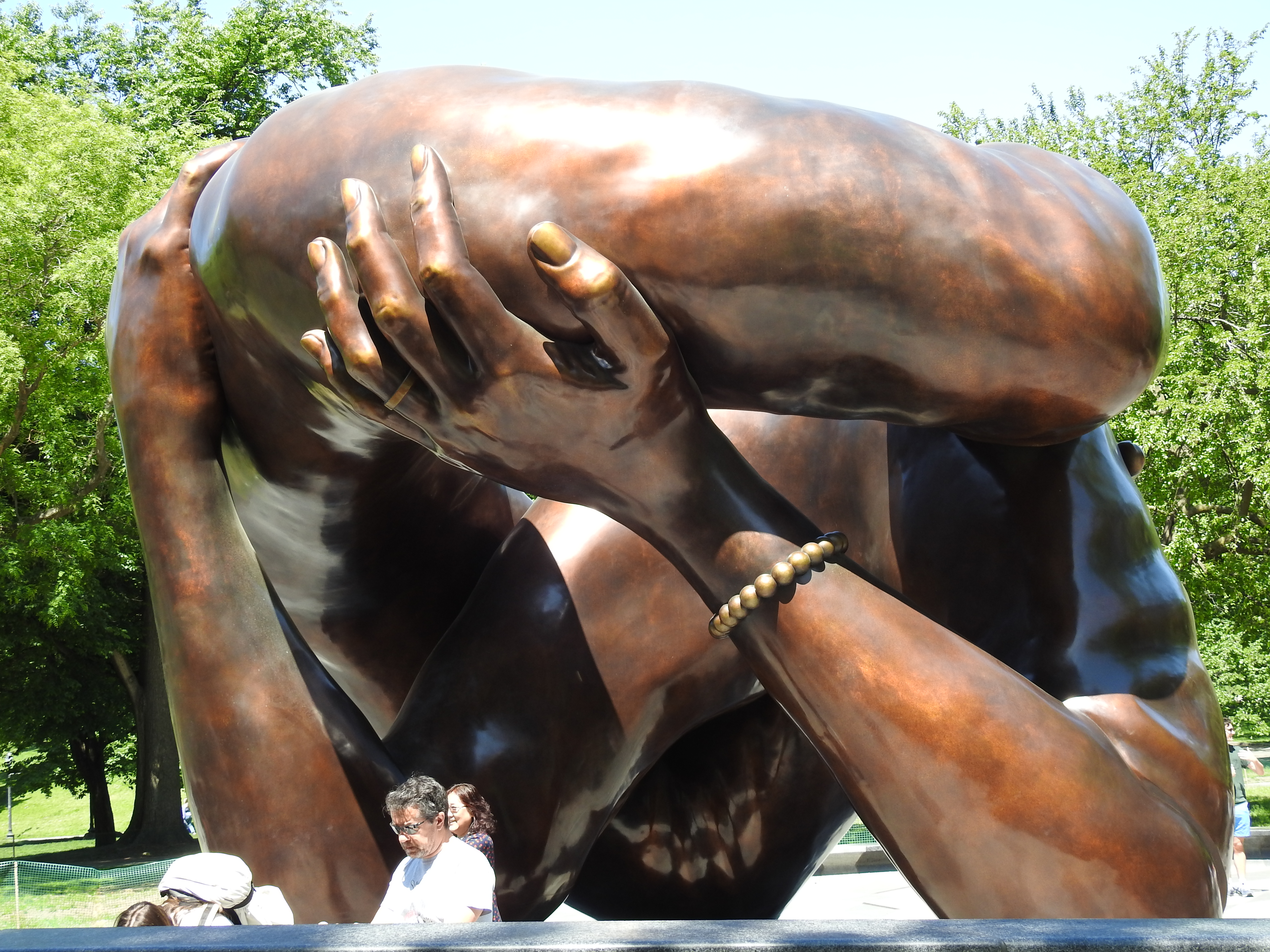
It is a truly interesting interpretation of a beautiful act, an embrace. I’m impressed with the concept though I struggle to understand everything that I am seeing. But for some reason I don’t mind that struggle with this piece. Maybe it is the hands. They are beautifully rendered. The viewer reads into art and what I read into those hands are both gentleness and strength, love and sensuality, partnership.
I enjoyed watching people of all ages engaging with the piece and actually having conversation with each other and with strangers about it and the content of the surrounding 1965 Freedom Plaza. The memorial is located on the Boston Common, adjacent to the Parkman Bandstand, where Dr. King spoke in 1965.
Love it, hate it, neutral about it, or all the feelings that lie in the between spaces of those feelings, I think it is well worth a visit.
There is no description of Winter but somehow I assume Winter is female. She was likely from Angola or possibly Gambia. Many of the enslaved to South Carolina at this time were from those regions. The same is likely true for King, Dido, Bell, Judge, Coaster, York and the nine other individuals along with Winter who were bequeathed to Mary Cochran Smith by her husband James Smith of Charleston, South Carolina. If they were bought from a single “parcel” that is unclear. If they were named by the Smiths or by the captors who first enslaved them is unclear.
There is only so much one can glean from the newspaper advertisements.
Carpenter, Ajax, Hercules, Thunder, Drummer, Soldier and Sailor who together ran away from Royal Governor Boone were new to the Carolina colony, unable to speak English, but based on their names had some inherent skills.
Uriah Edwards placed ads for two months in The South Carolina Gazette seeking the return of his “new Negro girl named Juno about 14 or 15 years of age.” Did he reclaim his property after that time or did he simply stop placing advertisements?
Phebe was a thin spare woman when she ran away from Joseph Wragg. She’d lived in Charles Town aka Charleston since she was sixteen years old because the advertisement stated that she was 36 years old and was well known around town as a washer woman for the past twenty years.
Virtue ran away from Titus Bateman along with a two-year old child. I wonder the name the of the child.
Edward Morris threatened prosecution of anyone harboring his Negro boy Shadwell.
Peter Roberts sought the return of his Eboe man named Primus. And further along the page of the same 1735 newspaper, Joseph Wragg and Company, the trading enterprise of Joseph Wragg and his brother Samuel, advertised “To be sold on Wednesday the 2nd day of July next … a choice parcel of slaves, imported in the ship Dove, Richard Fothergill Commander, directly from Angola.” And if you switch to the Slave Voyages Database you can see that the Dove commanded by Fothergill boarded 290 enslaved Africans of whom 248 survived for sale in Charleston.
When did these 248 people receive their new names?
The South-Carolina Gazette a few months later reported held in jail awaiting return to their enslavers two men both named Primus, a boy named Cesar and an Ebo girl who could not speak English and therefore had no known name. And in that same paper an ad reads “to be sold on the 24th of September a parcel of choice Negroes imported in the Happy Couple … Hill Master directly from the coast of Guiney by Jos. Wragg and Co.” The database shows that ship commanded by Captain Hill disembarked 141 souls.
London merchants Joseph and Samuel Wragg were the largest slave traders in Charleston during the early 1700s. They sat on various Royal councils. They did so well in promoting emigration to the new colony that they and later some of their descendants were granted tens of thousands of acres of land. During the 1730s 20,000 slaves were imported to Charleston, SC, most from Angola and more than a third brought in by Joseph Wragg and Company.
As recorded in transcribed Great Britain Colonial Records, in a report for the King of England about the numbers of enslaved Africans imported to the Carolina Colony at Charleston between May 30, 1721 to September 29, 1726, in July the ship Ruby docked with 112 people on board. Of that number Joseph Wragg received 24 men and women and 3 boys and girls. In September the ship Cape Coast disembarked 126 with Wragg receiving 112 men and women and 3 boys and girls. Other local trading houses received the rest. The South Carolina Gazette was started in 1732 I believe so I can find no newspaper advertisements about how these men, women and children were sold.
I have come to think a lot about what’s in a name or a label. What is conveyed? Should some names or labels be forgotten, erased from memory? But what might be lost along the way? What insights from human history, and how names and labels were used, might inform who we are today? Take the label “turpentine negro.”
The colonization of America resulted in the development of a naval stores industry. Naval stores are products — tar, pitch, turpentine and rosin – produced from pine and at first primarily used in early ship building. Tar was needed to seal wooden ships and ropes. Turpentine would become a vital ingredient in a range of manufacturing from paints and varnishes to paper production. Europe had relied upon Sweden for its tar but with the “discovery” of the New World and its expansive forests, new opportunities emerged for Britain to develop its own naval stores in the colonies. New England forests were tapped for awhile but it was the abundant long leaf pines of the southern colonies that would prove to be most lucrative, especially in the Carolinas and later in Georgia, Florida and Texas.
I first learned of this tree and the concept of naval stores while researching a colonial-era Bostonian. As a young man he joined a business venture where he sailed to the Carolinas, purchased tar and pitch, and then returned to sell the naval stores in New England. I wondered what was the source of tar and how was it produced. In learning about tar, I learned about turpentine production and that’s how I learned about the “turpentine negroes” and “turpentine niggers.” The words, this classification of human beings, can be found used hundreds of time in mostly southern newspapers from the 1880s to 1940s.
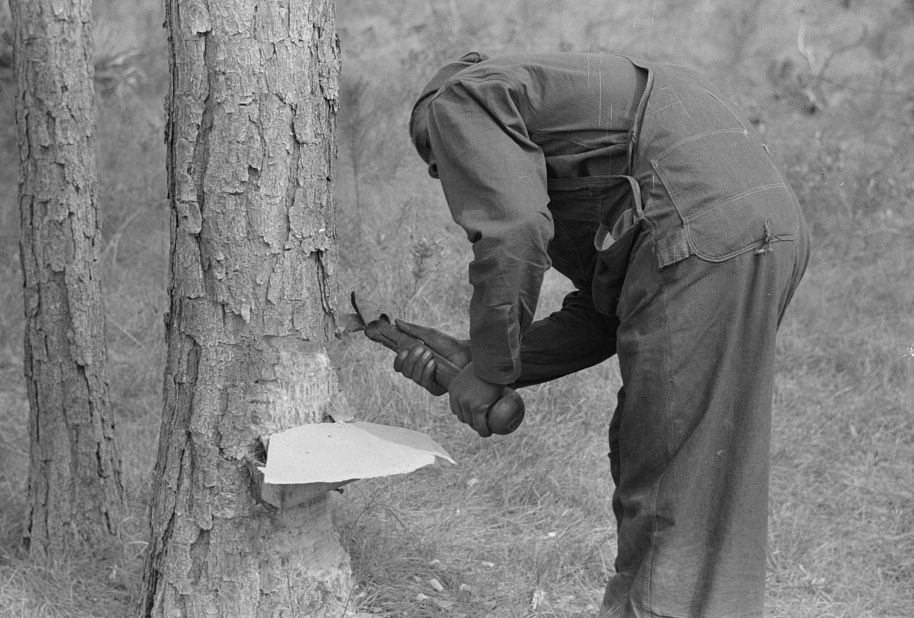
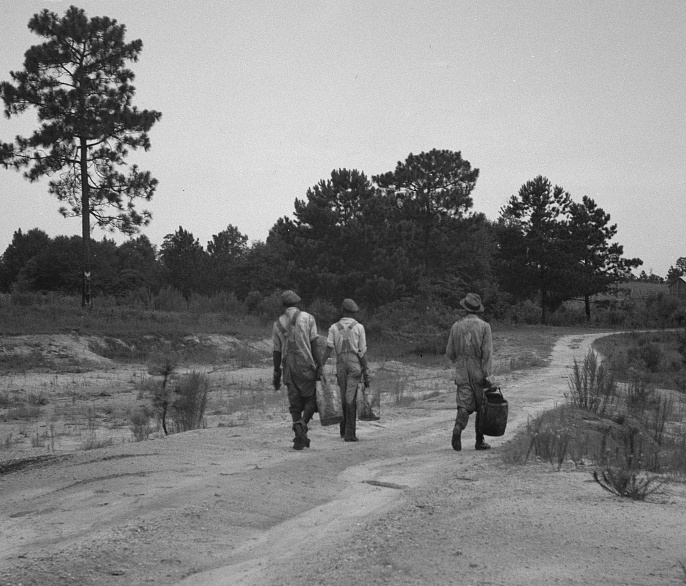
turpentine workers
I know there was turpentine in the house where I grew up. I just don’t remember how my father used it. This is when I really miss my brothers’ memories because when I think of turpentine, growing up in Virginia, it was something very much in the male realm. I don’t think my mother did anything with it except disparage it for its scent.
Disparage. To regard or represent as being of little worth.
Turns out, since before the Revolutionary War, southern Blacks were essential to the production of naval stores. The nature of the work meant they lived in the pine woods. There they formed a unique culture. The first Black workers were mostly enslaved, often hired out by their owners. Even after the Civil War, these workers, now technically free, continued to apply their skills in the turpentine orchards, traveling from pine woods to pine woods across state lines.
Over many generations these men and women produced the goods that helped keep the world’s greatest fleets afloat. They produced goods that enabled improvements in the manufacturing of a diverse range of products. Their labor was valued but they were disparaged as human beings, by whites and sometimes other people of color as well. Thus the distinction that was made by the label, turpentine negro.
Frederick Law Olmstead during his travels in the South wrote in 1855, “There are very large forests of this [long leaf pine] tree in North and South Carolina, Georgia, and Alabama; and the turpentine business is carried on, to some extent, in all these States. In North Carolina, however, much more largely than in the others; because, in it, cotton is rather less productive than in the others, in an average of years. Negroes are, therefore, in rather less demand; and their owners oftener see their profit in employing them in turpentine orchards than in the cotton-fields.“
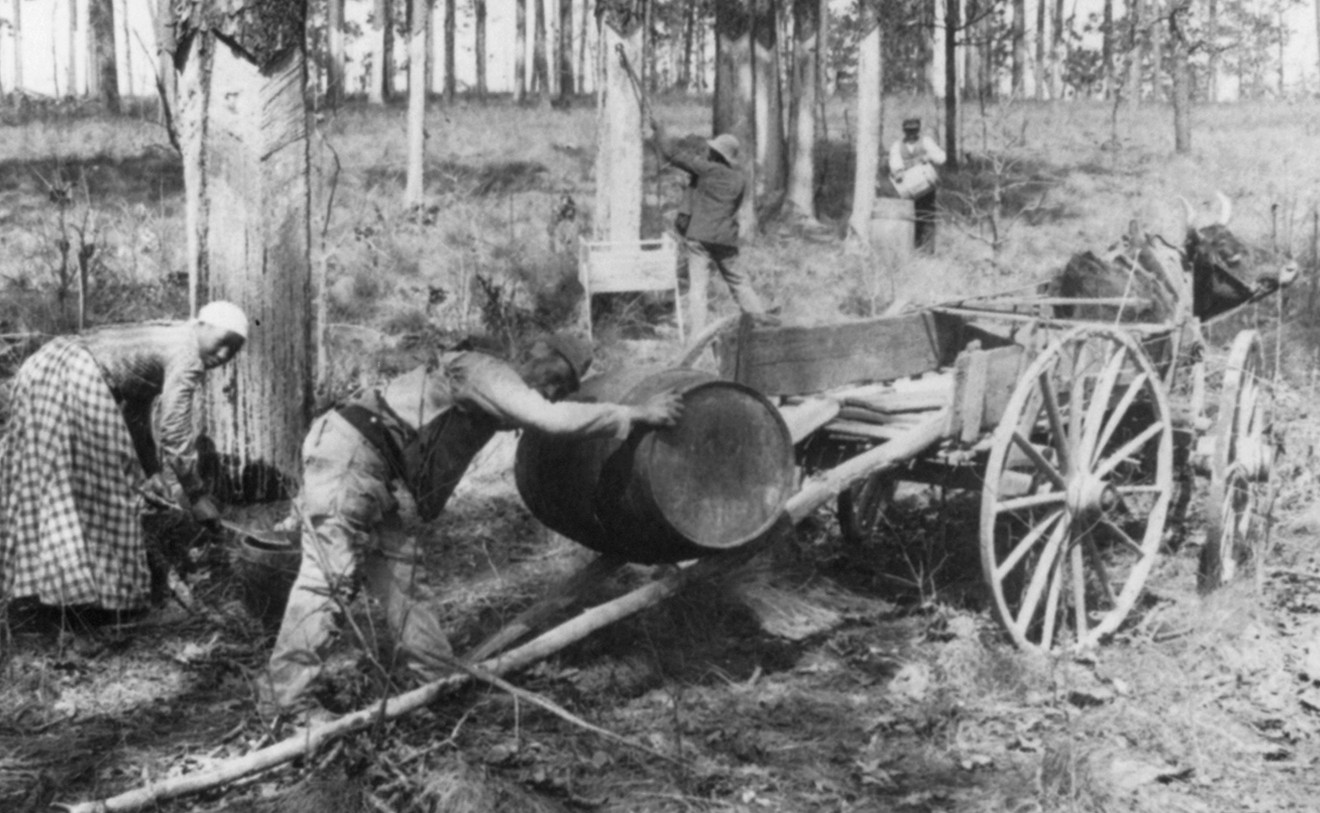
If we enter, in the winter, a part of a forest that is about to be converted into a “turpentine orchard,” we come upon negroes engaged in making boxes, in which the sap is to be collected the following spring. They continue at this work from November to March, or until, as the warm weather approaches, the sap flows freely, and they are needed to remove it from the boxes into barrels. These “boxes” are not made of boards, nailed together in a cubical form, as might be supposed; nor are they log-troughs, such as, at the North, maple-sap is collected in. They are cavities dug in the trunk of the tree itself. A long, narrow ax, made in Connecticut, especially for this purpose, is used for this wood-pecking operation; and some skill is required to use it properly.
A considerable amount of turpentine is shipped in barrels to Northern ports, where it is distilled; a larger amount is distilled in the State.
The orchards operated under a task system. Workers were assigned specific tasks. Olmstead is noted as describing, an overseer had “ten hands dipping + six hands getting timber, seven hands at the cooper shop, five hands at the still, one hand cutting wood, and three wagoning.” After the Civil War, with slavery’s end, the system essentially remained the same.
As C. W. Wimster recalled in a 1939 Federal Writers Project interview:
“My folks believed in education, an I was sent to school regular when I was a boy, but worked in the summers. When I was about ten years old we moved to a camp at Martin, seven miles from Ocala, an I was promoted to talley “man”—keeping tally on the number of trees boxed or streaked by each nigger. Niggers do all the labor in the woods, an most of the work around the still. The manager, foreman, commissary men and woods riders are all white men. At each camp there will be from 50 to 200 niggers, accordin to the number of “crops” worked. A crop is about 10,000 trees. …
turpentine worker’s home, georgia
The white folks live in fairly good homes at one side of the camp, and the niggers in their quarters at the other side in two-or three-room cabins or board houses. We always aimed to have separate quarters for the single niggers to keep them from messin up with the married men’s wives. But this didn’t always work, and there was many a fight on account uv them mixin at night in the woods.”
One of the jobs that Wimster later took was “as manager of eight camps owned by a New York concern at Opal, Okeechobee County. This was a big virgin woods in low, swampy country, and the outfit was a big one of 120 crops. There I had charge of 400 niggers and nine woodsmen (riders).“
three turpentine pickers
When asked about the home life of the Black people in the Florida turpentine camps, Mr. Wimster replied: “Turpentine niggers are a class by themselves. They are different from town niggers, farm laborers or any other kind. Mostly they are born and raised in the camps, and don’t know much about anything else. They seldom go to town, and few of them ever saw the inside of a school house. In nearly every camp there is a jack-leg preacher who also works in the woods, and they usually have church services on Sunday at one or another of their houses.
And every camp has its ‘jook’, as they are now called, but the original name of this kind of a joint was a ‘tunk’. This is a house where the men and women gather on Saturday nights to dance, drink moonshine, gamble and fight. Between dances or drinks, young couples stroll off into the woods and make love. … The supreme authority in a camp is the foreman. To the niggers he is the law, the judge, jury and executioner. He even ranks ahead of God to these people.”
In a 1903 New Orleans newspaper they were described as the worst character of criminal for the police to deal with when they came to town to spend their money. I suspect there were few things worse than to call a successful Black man a “turpentine nigger” nor was it uncommon for a person of color to say, “What do you think I am a turpentine nigger?”
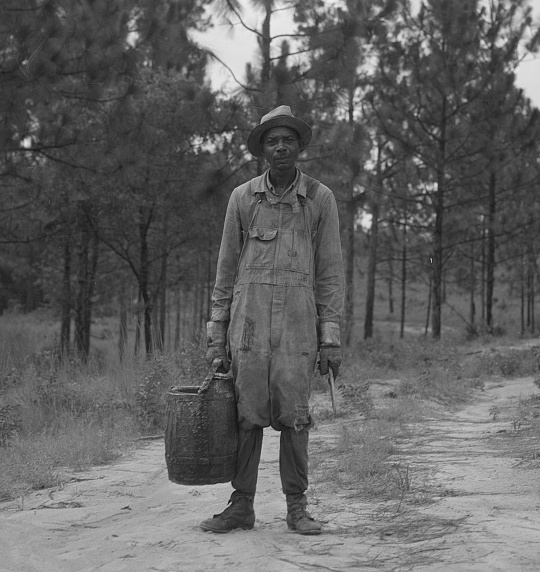
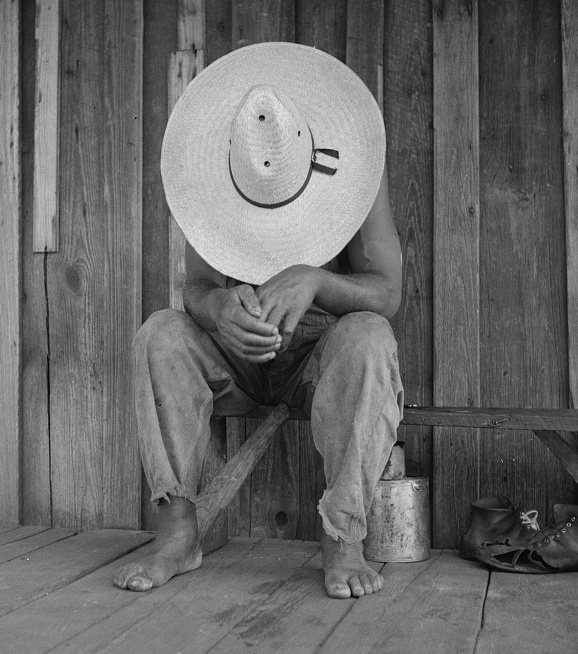
turpentine worker
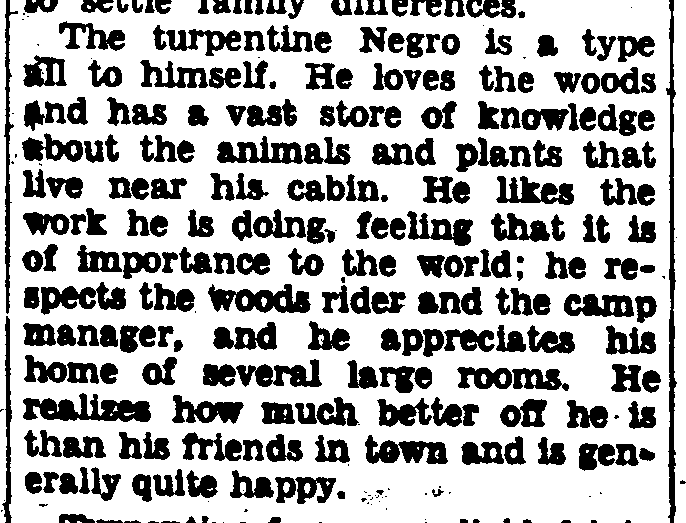
In 1942, author Lillian Cox Athey wrote of the long established industry that stretched from North Carolina to Texas. She noted that long leaf pine covered about 1000 miles, with more than 1200 turpentine camps to be found in the woods and over 45,000 workers. She presents a romanticized view of the camps and their management. And as for the workers:
Excerpt from Evening Star, Washington, DC, 1942
At a 1946 Southern Forestry Convention, one report noted that the times were changing and that the “old fashioned turpentine negro” was to become a shadowy creature of the past. In a post-war world, workers were going to towns, “wearing zoot suits and driving trucks and making money.”
The language is regional. Searching old newspapers the terminology is primarily expressed in deep southern publications. More recent use of the words appears in the historical novels of writers with southern roots. Studying the characterization of these workers from antebellum times to just after World War II suggests that this regional history is also a national if not indeed global history. Shining a spotlight on people, labeled turpentine negroes, illuminates once more the ties that link North and South in the American slave economy and offers the opportunity to think about who benefited from that economy, who suffered, and the enduring legacy long after slavery ended.
Sources of Images & Further Reading
Outland, Robert B. “Slavery, Work, and the Geography of the North Carolina Naval Stores Industry, 1835-1860.” The Journal of Southern History, vol. 62, no. 1, Southern Historical Association, 1996, pp. 27–56, https://doi.org/10.2307/2211205.
Lange, Dorothea, photographer. Turpentine workers. Georgia. United States Georgia, 1937. July. Photograph. https://www.loc.gov/item/2017770332/.
Lange, Dorothea, photographer. Overseer in the turpentine woods. Georgia. United States Georgia, 1937. July. Photograph. https://www.loc.gov/item/2017770378/.
Lange, Dorothea, photographer. Untitled photo, possibly related to: Turpentine worker’s family near Cordele, Alabama. Father’s wages one dollar a day. This is the standard of living the turpentine trees support. United States Alabama Cordele, 1936. July. Photograph. https://www.loc.gov/item/2017768046/.
Lange, Dorothea, photographer. Turpentine worker’s family near Cordele, Alabama. Father’s wages one dollar a day. This is the standard of living the turpentine trees support. United States Alabama Cordele, 1936. July. Photograph. https://www.loc.gov/item/2017763012/.
In the great pine forests of the South – gathering crude turpentine – North Carolina. , ca. 1903. Photograph. https://www.loc.gov/item/2003663487/.
Disembark – to remove or unload cargo or passengers from a ship
Detailed 1781 Map of West Point on the York River, in Virginia. Rochambeau Collection, Library of Congress.
Between 1724 and 1739 at least 18 vessels owned by Englishman William Gerrish engaged in the slave trade. His ships departed from London, sailed to Africa, and transported their human cargo to Antigua, St. Kitts, Montserrat, South Carolina and Virginia for disembarkment. The first ship, at least as identified in the Slave Voyages Database, was called the Negroes Nest. Others were named Flying Horse, Gaboone, Guinea Hen, Hester and Jane, London Spy, Sea Nymph, Speaker, Gally and Tryall. Over 2,933 men, women and children survived the various voyages though that is only a fraction of the original number embarked.
In 1739, one of his ships, the Black Prince, docked at the York River to sell her cargo. An advertisement in the Virginia Gazette noted that the Black Prince had lately arrived from the Gold Coast of Africa with a choice parcel of slaves to be sold at York Town along the York River. The captain, John Sibson, and crew departed London in May 1738 and arrived at their destination in Africa by September. Trade and re-outfitting was completed by March 1739. In that month the Black Prince departed Africa with 137 men, women and children shackled in the hold or maybe chained on deck. The ship reached York Town in May with 112 enslaved people remaining alive. Selling immediately commenced. By October the Black Prince had returned to London.
Between 1732 and 1739, Sibson served as captain of three slave ships, the Black Prince, the Ann and Elizabeth, and the Sarah and Elizabeth. For each four trips he made with these ships he departed London, traveled to Africa and took his cargo to Jamaica, St. Kitts, the Americas, and the York River. On these four voyages he collected 888 men, women and children. 723 survived the journey to their ports of disembarkment.
Between 1698 and 1762, the York River was a point of disembarkment for at least 163 slave ships whose captains sold 31,056 men, women and children. Again, this number represents only a fraction of the people originally boarded in Africa. One can use the Slave Voyages Database to account for some number of those who died along the Middle Passage. When the ships were emptied of their human cargo, captains sought to fill their ships with tobacco. That goal was not so easily achieved as evidenced by an ad Captain Sibson of the Black Prince placed in the Virginia Gazette:
“I find it has been industriously reported for many Years, that Ships which come from Guinea here with Slaves, are never after in Condition to take in Tobacco; which is very absurd and ungenerous, and great Discouragement to bring Negroes here: But I cannot think any Man, who has any Notion of a Ship, can ever imagine any one will venture his Life and Fortune to Sea in a Vessel that is not Sea worthy. However, to clear up all Doubts of that kind, if any Gentleman has Mind to ship any Tobacco on board me, I will cause a Survey to be made of my Vessel by whom they shall desire. and her Condition shall be reported accordingly. I am the readers most obedient servant, John Sibson.” Records indicate he was successful in his endeavor and did indeed depart with a cargo of tobacco.
William Gerrish died in 1741, a respected West India merchant. There are a number of John Sibson’s to be found in various databases one of whom died in October 1739, the month and year that Sibson returned the Black Prince to London. As for the Africans dispersed throughout the West Indies and the Americas … different methods will be needed to tell their stories by the numbers or otherwise.
My first thought was that in November, September and October ran away. But I dug a little deeper and discovered that the first ad for the return of September and October appeared in an October newspaper.
The year was 1736. Described as two new Gambia negroes, September and October were enslaved near Charleston, South Carolina. They wore brown breeches and jackets with brass or white metal buttons. No mention of shoes in this ad nor details about skin color, hair texture or their ability to speak English.
The man who wanted them returned was Thomas Monck. How long the property of Monck it is unclear. Probably not long. If long enough then he would have added to the description that they carried his brand upon their chests. That was Monck’s documented chosen way to mark property, whether horses or people.
Using the Trans-Atlantic Slave Trade Database, you can search by slave ship itinerary. I entered as place of purchase “Gambia.” In 1735 Captain John Coe departed London in the ship Princess Carolina, a vessel owned by David Godin. With a crew of just over a dozen men, he sailed to Gambia and there purchased 211 slaves. In 1736 he delivered the 180 men, women and children who had survived the voyage. Among them was likely September and October.










 Words + Images