A new restaurant has opened not far from where I work. I paused in my journey this morning to peer at the menu from afar. Words rang out. “Hey, Nigger. This is where people walk.” Startled I turned toward the voice to see a young white man striding past. Now I’d seen him earlier in the morning. He was clearly strung out on something so there was no need to say anything in return. But as I returned to work I was startled that the words of a junkie, someone clearly in need of some help of some sort, could touch me so. Probably doesn’t help that I am currently immersed in historical research about the profiling and imprisonment of free Black seaman in the antebellum south.
Nor does it help that as Steve and I continue to make our way in this world that people continually, immediately, assume that I am either the paid home health aid or the overnight caregiver. And so then the onus is on me to calmly explain that I am his wife. The onus. I know of a lovely older Black woman in an interracial relationship and she shared that in the retirement community where they reside she always carries her resident card to prove she belongs there and is not “just” a visiting care giver.
We live in a time of unprecedented whitewashing where people in power are trying to normalize outright racism and bigotry and even more so foment deep and abiding ignorance about this nation’s past let alone its present. People are not questioning their assumptions. Race does matter regardless of what a super rich and powerful white minority are trying to assert.
Just some Sunday musings … best get back to my research so that that forgotten story can be shared soon.
Here’s a challenge. In this age of quick reads, read this whole poem, Let America Be America Again, by Langston Hughes. Indeed try reading passages out loud. Written about 90 years ago, it could have been written today. And therein lies the sadness and yet the hope. Read on …
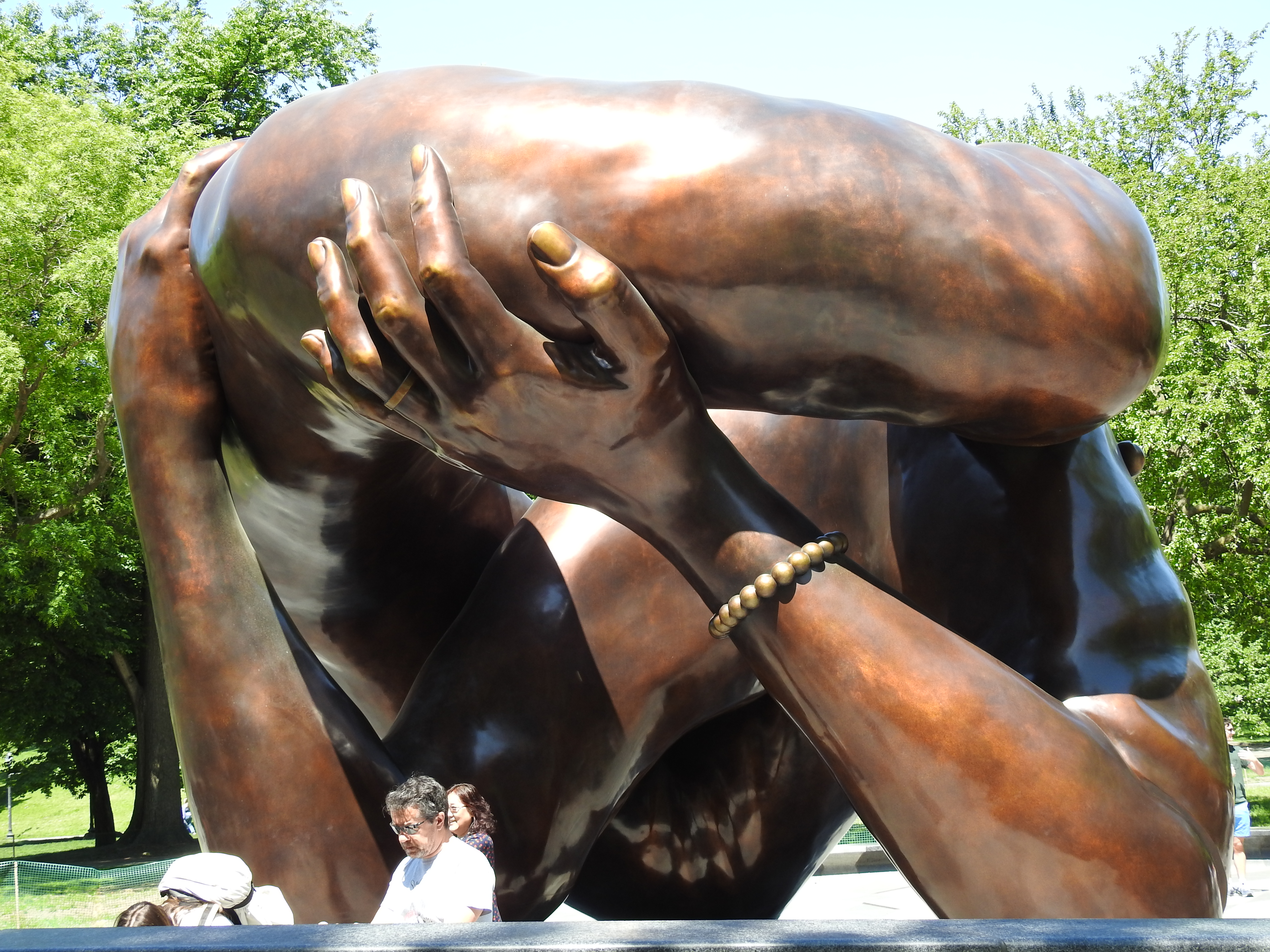
It is a truly interesting interpretation of a beautiful act, an embrace. I’m impressed with the concept though I struggle to understand everything that I am seeing. But for some reason I don’t mind that struggle with this piece. Maybe it is the hands. They are beautifully rendered. The viewer reads into art and what I read into those hands are both gentleness and strength, love and sensuality, partnership.
I enjoyed watching people of all ages engaging with the piece and actually having conversation with each other and with strangers about it and the content of the surrounding 1965 Freedom Plaza. The memorial is located on the Boston Common, adjacent to the Parkman Bandstand, where Dr. King spoke in 1965.
Love it, hate it, neutral about it, or all the feelings that lie in the between spaces of those feelings, I think it is well worth a visit.
There is no description of Winter but somehow I assume Winter is female. She was likely from Angola or possibly Gambia. Many of the enslaved to South Carolina at this time were from those regions. The same is likely true for King, Dido, Bell, Judge, Coaster, York and the nine other individuals along with Winter who were bequeathed to Mary Cochran Smith by her husband James Smith of Charleston, South Carolina. If they were bought from a single “parcel” that is unclear. If they were named by the Smiths or by the captors who first enslaved them is unclear.
There is only so much one can glean from the newspaper advertisements.
Carpenter, Ajax, Hercules, Thunder, Drummer, Soldier and Sailor who together ran away from Royal Governor Boone were new to the Carolina colony, unable to speak English, but based on their names had some inherent skills.
Uriah Edwards placed ads for two months in The South Carolina Gazette seeking the return of his “new Negro girl named Juno about 14 or 15 years of age.” Did he reclaim his property after that time or did he simply stop placing advertisements?
Phebe was a thin spare woman when she ran away from Joseph Wragg. She’d lived in Charles Town aka Charleston since she was sixteen years old because the advertisement stated that she was 36 years old and was well known around town as a washer woman for the past twenty years.
Virtue ran away from Titus Bateman along with a two-year old child. I wonder the name the of the child.
Edward Morris threatened prosecution of anyone harboring his Negro boy Shadwell.
Peter Roberts sought the return of his Eboe man named Primus. And further along the page of the same 1735 newspaper, Joseph Wragg and Company, the trading enterprise of Joseph Wragg and his brother Samuel, advertised “To be sold on Wednesday the 2nd day of July next … a choice parcel of slaves, imported in the ship Dove, Richard Fothergill Commander, directly from Angola.” And if you switch to the Slave Voyages Database you can see that the Dove commanded by Fothergill boarded 290 enslaved Africans of whom 248 survived for sale in Charleston.
When did these 248 people receive their new names?
The South-Carolina Gazette a few months later reported held in jail awaiting return to their enslavers two men both named Primus, a boy named Cesar and an Ebo girl who could not speak English and therefore had no known name. And in that same paper an ad reads “to be sold on the 24th of September a parcel of choice Negroes imported in the Happy Couple … Hill Master directly from the coast of Guiney by Jos. Wragg and Co.” The database shows that ship commanded by Captain Hill disembarked 141 souls.
London merchants Joseph and Samuel Wragg were the largest slave traders in Charleston during the early 1700s. They sat on various Royal councils. They did so well in promoting emigration to the new colony that they and later some of their descendants were granted tens of thousands of acres of land. During the 1730s 20,000 slaves were imported to Charleston, SC, most from Angola and more than a third brought in by Joseph Wragg and Company.
As recorded in transcribed Great Britain Colonial Records, in a report for the King of England about the numbers of enslaved Africans imported to the Carolina Colony at Charleston between May 30, 1721 to September 29, 1726, in July the ship Ruby docked with 112 people on board. Of that number Joseph Wragg received 24 men and women and 3 boys and girls. In September the ship Cape Coast disembarked 126 with Wragg receiving 112 men and women and 3 boys and girls. Other local trading houses received the rest. The South Carolina Gazette was started in 1732 I believe so I can find no newspaper advertisements about how these men, women and children were sold.
This is a list of Black officers employed by English traders in West Africa. This record is just one page from the extensive archives of the Royal African Company.
The Royal African Company (RAC) was formed in 1660 by the royal Stuart family and City of London merchants. Trade focused on the west coast of Africa with a primary interest in trade for gold. That focus would shift to human trade. The RAC shipped more African slaves to the Americas than any other company in the history of the Atlantic slave trade. By 1752 its assets were transferred to the newly formed African Company of Merchants that would operate until 1821. The page I’ve shared has to be from a company ledger produced after 1765.
Many company records have been digitized and are accessible via a genealogical database. It is interesting to peruse these records and see the number of Black men employed by the company. These men listed may have been stationed at the trading post, Cape Coast Castle.
Cape Coast Castle (as rebuilt by the British in 18th century), Ghana
The first man, Cudjoe, was a cabboceer and linguist. Cabboceers were African men appointed by their leaders to supply European traders with trade goods including slaves. The third man Frederick Adoy was a writer, as are several other men on the list. Adoy was the son of a cabboceer and had been educated in England. Writers were the equivalent of clerks for the company. Adoy had the advantage of speaking the native languages. The last man Philip Quaque was born on the Cape Coast but taken to England as a child in 1754 by a missionary from the Society for the Propagation of the Gospel. There, he went to school, was baptized and may have studied theology at Oxford. In 1765 he became the first African ordained in the Church of England. In that same year he received his commission to serve as chaplain and spread the gospel back in Africa.
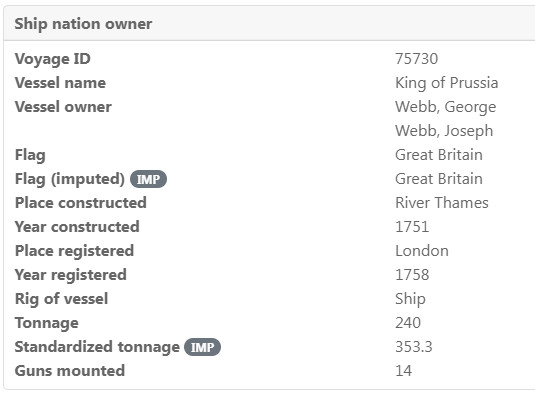
In October he and his English wife Catherine Blunt boarded the ship The King of Prussia, captained by Shepherd. If you switch over to the slavevoyages.org database, you can search for a vessell named King of Prussia.
Entry from Slave Voyages Database
The entry notes in October 1765 Captain John Shepherd and crew departed London for West Africa. After safe delivery of any goods and departure of passengers, like Quaque, Shepherd and company factors began trading activities. When the ship departs, 216 enslaved people are in the hold of the ship. At least 189 survived the voyage, with 107 sold in Grenada and 82 sold in Nevis. Shepherd than returned to London by the fall of 1766.
Quaque never returned to England, except for a short visit in 1784-1785. His wife Catherine died a year after arrival at the Cape Coast. Over time he would eventually marry two African women who bore him sons. He focused his missionary efforts on starting a school primarily for Afro-European (i.e. mulatto) children of the elites. He wrote frequently to the Society for the Propagation of the Gospel back in London. You can read his own words.
He describes in great detail his successes and challenges, challenges that included the fact he was no longer fluent in the local language. His family ties remained within the community but his cultural connection had been distorted by a childhood and devout Anglican upbringing in England. Local and global politics, as well as wars, hampered his mission at every level yet he persevered. For extra money he even worked as a writer/clerk like Frederick Adoy.
Sometimes Quaque had no students and sometimes he had over a dozen. He taught them reading, writing and arithmetic, and of course religion. He had dreams of expansion and wrote of wanting to hire Adoy and fellow Black writer John Acqua (also educated in England) as his teaching assistants. The school never thrived though it did survive. Quaque’s sons, educated in England, even assisted him for a time. Quaque died in 1816 after fifty years of service.
Cape Coast Castle Dungeon
What must he have thought of the slave trade? In the place where he taught brown and black children in a school room, down below brown and black children were chained in the holding cells awaiting transport to the New World. As a writer he would have chronicled the trade that took place. He had been chaplain to the English traders and missionary among his African people. While he vilified slavery, especially later in life, his actions suggest he believed religious conversion would save his people. Still, his criticism would be an important part of the growing abolitionist movement. And while, as indicated in his letters, he may not have felt successful, his legacy endures as does his school.
Sources and Additional Reading
Bartels, F. L. “PHILIP QUAQUE, 1741—1816.” Transactions of the Gold Coast & Togoland Historical Society, vol. 1, no. 5, Historical Society of Ghana, 1955, pp. 153–77, http://www.jstor.org/stable/41406590.
slavevoyages.org
Royal African Company Records 1694 to 1743
“One of their Own Color and Kindred” Philip Quaque and the SPG Mission to Africa, by Travis Glasson, DOI:10.1093/acprof:oso/9780199773961.003.0007
Disembark – to remove or unload cargo or passengers from a ship
Detailed 1781 Map of West Point on the York River, in Virginia. Rochambeau Collection, Library of Congress.
Between 1724 and 1739 at least 18 vessels owned by Englishman William Gerrish engaged in the slave trade. His ships departed from London, sailed to Africa, and transported their human cargo to Antigua, St. Kitts, Montserrat, South Carolina and Virginia for disembarkment. The first ship, at least as identified in the Slave Voyages Database, was called the Negroes Nest. Others were named Flying Horse, Gaboone, Guinea Hen, Hester and Jane, London Spy, Sea Nymph, Speaker, Gally and Tryall. Over 2,933 men, women and children survived the various voyages though that is only a fraction of the original number embarked.
In 1739, one of his ships, the Black Prince, docked at the York River to sell her cargo. An advertisement in the Virginia Gazette noted that the Black Prince had lately arrived from the Gold Coast of Africa with a choice parcel of slaves to be sold at York Town along the York River. The captain, John Sibson, and crew departed London in May 1738 and arrived at their destination in Africa by September. Trade and re-outfitting was completed by March 1739. In that month the Black Prince departed Africa with 137 men, women and children shackled in the hold or maybe chained on deck. The ship reached York Town in May with 112 enslaved people remaining alive. Selling immediately commenced. By October the Black Prince had returned to London.
Between 1732 and 1739, Sibson served as captain of three slave ships, the Black Prince, the Ann and Elizabeth, and the Sarah and Elizabeth. For each four trips he made with these ships he departed London, traveled to Africa and took his cargo to Jamaica, St. Kitts, the Americas, and the York River. On these four voyages he collected 888 men, women and children. 723 survived the journey to their ports of disembarkment.
Between 1698 and 1762, the York River was a point of disembarkment for at least 163 slave ships whose captains sold 31,056 men, women and children. Again, this number represents only a fraction of the people originally boarded in Africa. One can use the Slave Voyages Database to account for some number of those who died along the Middle Passage. When the ships were emptied of their human cargo, captains sought to fill their ships with tobacco. That goal was not so easily achieved as evidenced by an ad Captain Sibson of the Black Prince placed in the Virginia Gazette:
“I find it has been industriously reported for many Years, that Ships which come from Guinea here with Slaves, are never after in Condition to take in Tobacco; which is very absurd and ungenerous, and great Discouragement to bring Negroes here: But I cannot think any Man, who has any Notion of a Ship, can ever imagine any one will venture his Life and Fortune to Sea in a Vessel that is not Sea worthy. However, to clear up all Doubts of that kind, if any Gentleman has Mind to ship any Tobacco on board me, I will cause a Survey to be made of my Vessel by whom they shall desire. and her Condition shall be reported accordingly. I am the readers most obedient servant, John Sibson.” Records indicate he was successful in his endeavor and did indeed depart with a cargo of tobacco.
William Gerrish died in 1741, a respected West India merchant. There are a number of John Sibson’s to be found in various databases one of whom died in October 1739, the month and year that Sibson returned the Black Prince to London. As for the Africans dispersed throughout the West Indies and the Americas … different methods will be needed to tell their stories by the numbers or otherwise.
My first thought was that in November, September and October ran away. But I dug a little deeper and discovered that the first ad for the return of September and October appeared in an October newspaper.
The year was 1736. Described as two new Gambia negroes, September and October were enslaved near Charleston, South Carolina. They wore brown breeches and jackets with brass or white metal buttons. No mention of shoes in this ad nor details about skin color, hair texture or their ability to speak English.
The man who wanted them returned was Thomas Monck. How long the property of Monck it is unclear. Probably not long. If long enough then he would have added to the description that they carried his brand upon their chests. That was Monck’s documented chosen way to mark property, whether horses or people.
Using the Trans-Atlantic Slave Trade Database, you can search by slave ship itinerary. I entered as place of purchase “Gambia.” In 1735 Captain John Coe departed London in the ship Princess Carolina, a vessel owned by David Godin. With a crew of just over a dozen men, he sailed to Gambia and there purchased 211 slaves. In 1736 he delivered the 180 men, women and children who had survived the voyage. Among them was likely September and October.







 Words + Images