Feeds:
Posts
Comments

Posts Tagged ‘Photography’

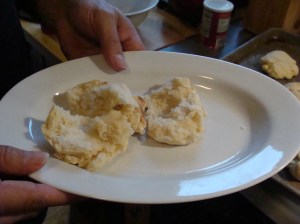
Though I grew up in the South, and my mother cooked in the southern tradition, I must admit that I gasped when Jay added a whole stick of butter to the pan of browning Jimmy Dean sausage.  For years, Jay had been offering to share his mother’s biscuits and gravy with Steve and I.  And finally last week we took him up on his offer.  The basic recipe …

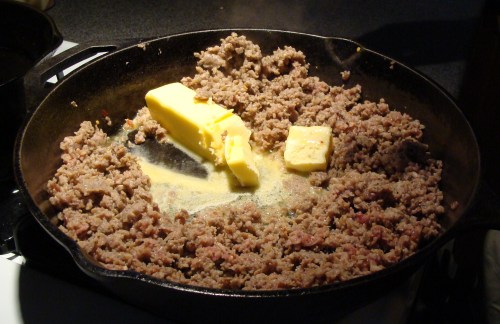
* In a cast iron frying pan, brown one pound of  sausage.

* Once the sausage is nearly browned, add the stick of butter.  Let the butter melt.

* Toss in some flour. The flour browns in all that buttery goodness.  Pour in some milk.

*Add some spices (e.g. cumin or chili powder or whatever you want). Then, the secret ingredient is added.  Molasses! Have you ever heard of such?  Keep cooking until the gravy is thick and golden brown.  Stir occasionally.

As the concoction bubbles, whisk up some drop biscuits.

Once biscuits have browned, split one open on a plate and ladle on the gravy.  Simply delicious.

Read Full Post »

It is an iconic image, that of a cat sitting at a window, looking out into the day.  But two cats?  In this case, two brothers named Peppy (black) and Ash (grey).  For years their owner Dixie has shared their feline exploits.  When she once showed me a picture on her phone of their proud faces with bright cat eyes I knew I wanted to see more.   My gentle nudging has paid off.

Of all the pictures so far, this is my favorite, of the brothers asleep on a tiger print blanket.  One can only imagine of what they dream.

Images by DL.

Read Full Post »

I learned this weekend of an exhibit at the Metropolitan Museum of Art in NYC called “Rooms with a View: The Open Window in the 19th Century.”  As described on the Met’s website, the exhibit is presented in four galleries and represents the works of over forty European artists.  A friend of mine, watching a CBS Sunday Morning profile of the exhibit, said she was reminded of my photography.  Well, I looked through a few of my archives and noticed that I do indeed have a penchant for pictures taken with windows as backdrop.

During the morning show, the curator, I believe, pointed out that the view through the window by itself can be insignificant or downright boring.  It is the juxtaposition of that view with the interior life that creates the romance.  Sometimes the windows are not open, as in this Carl Gustav Carus (German, 1789-1869) painting called Studio in Moonlight (1826).  Next to it is a rosy-hued picture I took several years ago during a visit to Jackson, Mississippi.  In each case it is the illumination that is important, not the specific exterior scene.

I’m not sure if I will be able to see the exhibit, but even just learning about it, heightens my awareness of the photographic opportunities to be had in a room with a window.  We’ll see what emerges over the spring and into summer as more light pours down from the sky.  Meanwhile, for more information about the exhibit, visit here.

Read Full Post »

A gray day, and a bit under the weather, so I pulled out some watercolors and stickers. Quite calming. 😉

Read Full Post »

Mushrooms!

Read Full Post »

… that poppy blossom opened.

Read Full Post »

Read Full Post »

Read Full Post »

It was a pleasure participating in Somerville Open Studios 2011.  I met a lot of wonderful people.  A more detailed post about outcomes I may share later.  For those of you not able to attend the event, the two Geisha, representing the overlap of the four seasons, were beautifully presented by artist Zoe Langosy.  A few signed, limited-edition prints are still available for purchase.  For more information, contact the artist directly through her website  http://www.zoe.langosy.net/folio.php or send me a note that I will share with her.

Read about the origin of these pieces here:  https://wordsandimagesbycynthia.com/2011/04/14/embodying-nature/

Read Full Post »

Two men climbing into the back of a garbage truck to escape the rain are crushed, and so set into motion a strike that will paralyze a city, empower a people, and bring into their midsts one of the great orators in U.S. history, Dr. Martin Luther King Jr.  The city is Memphis, the year is 1968, and it is the place where Dr. King will die at the hands of escaped convict, James Earl Ray.  But before he dies his words will once more stir the hearts and minds of a downtrodden people.   I encourage you to watch the documentary Roads to Memphis to hear Dr. King’s words and indeed the words of the Memphis garbage workers who kept a city clean but could not ride the buses and who felt the need to walk the streets wearing a placard stating clearly, “I am a man.”  I’ve read mixed reviews of the documentary, with negative comments ranging from “it’s not riveting” or “it’s weak and filled with potholes.”  Apparently it brings to light nothing new about the assassination.

Well … perhaps the lens through which I watched the film was different than the reviewers.  What stood out to me were the stories told, and reflected in those stories were the choices people made.  Like the choice the little boy made to participate in the peaceful march through Memphis streets after King’s death.  “Well,” he says when asked why he’s in the march, “I took part in this march today because of Martin Luther King and for what he stood for, because this march is what he died for, and I think that if he died for it, I could carry out what he started.”

Irena Sendler made a choice.  A young Polish Catholic, she and her young friends chose to help the Jewish children dying on the streets in Warsaw during the early 1940’s.  They smuggled the children out of the ghetto and into the homes of individuals as well as into convents and orphanages.  The children were taught Catholic prayers and how to behave in a Christian church so that if they were ever stopped by Gestapo they would know what to do.  And, in 1942,  “as conditions worsened and thousands of Jews were rounded up daily and sent to die at the Treblinka death camp, less than hour outside Warsaw, Sendler and her cohorts began to appeal to Jewish parents to let their children go. ”  They kept careful record of the children’s Jewish names so that they could be reunited with their parents.  Of the 2,500 or so children they saved most had no parents or family members to return to, but some did.  You can see the stories of both the horror and the beauty that people chose to do to and for each other in the documentary, Irena Sendler: In the Name of Their Mothers.

Read Full Post »
« Newer Posts - Older Posts »