Feeds:
Posts
Comments

Posts Tagged ‘black history’

ejsimage

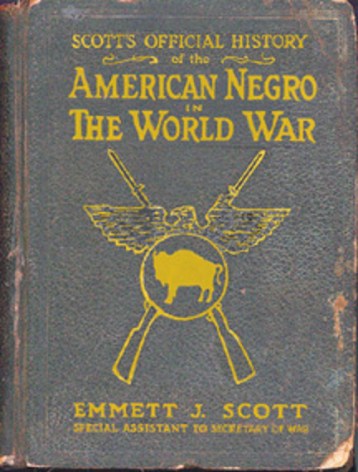
I tend to think of Emmett Jay Scott as one of those individuals upon whose shoulders giants stand. Though today he is largely unknown, during his lifetime he was a noted author, educator, activist and entrepreneur. For eighteen years he served as personal secretary to Booker T. Washington. He was Washington’s closest adviser, publicist and his friend. I knew of Emmett J. Scott because of previous research into Washington’s life and visually Scott was almost always at his side. Like Frederick Douglass, Washington was a figure well-photographed in his day. I accepted his presence but it wasn’t until  I chanced upon the book, Scott’s Official History of the American Negro in the World War (1919), that I decided to learn more.
book-cover

The title page states that it is a complete and authentic narration, from official sources, of the participation of American soldiers of the Negro race in the World War for democracy, profusely illustrated with official photographs. I was captured by the words “profusely illustrated.” As I perused the book online I was astounded by both the words and imagery in a publication that has been somewhat lost to time as has its author.
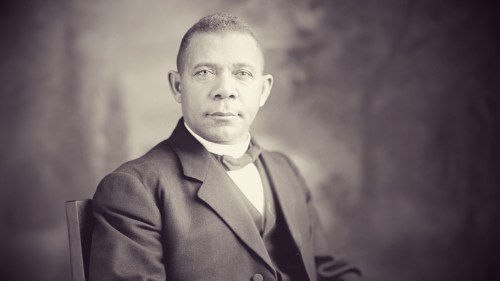
Booker T. Washington

Booker T. Washington

Born in February 1873 in Houston, Texas, Emmett J. Scott was the child of ex-slaves. He attended Wiley College in Marshall, Texas, then worked a series of jobs before employment at a small Houston newspaper. He would eventually co-found the first African American newspaper in Houston, The Texas Freeman, and he would work with political activists like Norris Wright Cuney.  Impressed by Scott’s skills, Booker T. Washington, principal of Tuskegee Institute, hired him in 1897.

washingtontuskegee

Biographers note that “He became widely recognized as the leader of what was to later be known as the “Tuskegee Machine,” the group of people close to Booker T. Washington who wielded influence over the Black press, churches, and schools in order to promote Washington’s views.“[1] Like Washington, Scott believed that uplift for blacks would come through business development, the creation of strong financial institutions and nurturing economic self-sufficiency within African American communities. He ran the National Negro Business League founded by Washington in 1900. At Washington’s side, Scott was also active in U.S. politics at home and abroad. In 1909, Scott joined the American Commission to Liberia appointed by President Taft. After Washington died in 1915, Scott co-wrote a biography about his friend and mentor with Lyman Beecher Stowe, the grandson of Harriet Beecher Stowe.
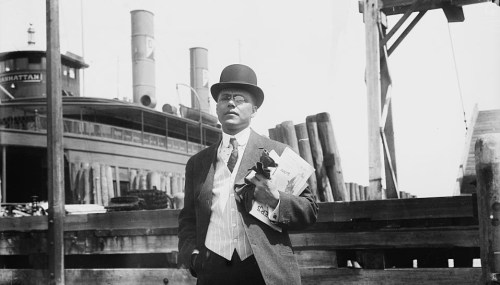
scottliberiancommission

Scott in 1909 as part of the Liberian Commission

Following Washington’s death, Scott remained at Tuskegee and continued to promote Washington’s philosophy through endeavors like the National Negro Business League. As Scott and other black leaders like a young W. E. B. DuBois sought to identify future opportunities for advancement while celebrating current achievements, a storm brewed across the nation.  The early 1900s was a tumultuous period. Race riots proliferated and not just in the South as highlighted in this 1900 dispatch from Columbia, South Carolina regarding a New York riot.

scriot1900

A 1908 Springfield, IL riot and lynching prompted ministers, both black and white, to speak directly to the incident. From a New York pulpit, the Rev. Dr. Madison C. Peter’s would remark:

peterswords

Seven years before Thomas Dixon’s book would be brought to the big screen by D. W. Griffith as Birth of a Nation, Peters  would go on to add, “We are reaping what we have allowed to be sown. Dixon’s novels and Tillman’s speeches have been a menace to the best interests of our republic … keeping alive the race antagonism North and South, which is setting men at one another’s throats when their hands should be clasped in brotherly love.

clansman

Thomas Dixon Jr.

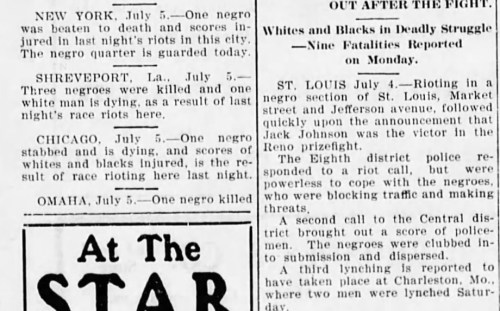
In 1910 when black fighter Jack Johnson beat white fighter James Jeffries in Reno, Nevada in a fight dubbed “the fight of the century” riots broke out across the nation.

jack_johnson1

Jack Johnson

newspaperclipping2

Meanwhile, by 1914, war raged in Europe. The U.S. would eventually join. On April 2, 1917, President Woodrow Wilson asked Congress to declare war on Germany in order to make the world safe for democracy.  The Selective Service Act of 1917 temporarily authorized the government to raise an army through the compulsory enlistment of Americans. The resulting American Expeditionary Force would be sent to Europe under the command of General John J. Pershing.

pershing

Pershing

When the U.S entered the war, it was unclear what the role of black soldiers was to be, assuming there was to be any role at all. After much discussion and vociferous debate it was decided all American men were needed in this Great War, and Emmett Jay Scott was to play a pivotal role in their involvement. As one biographer notes:

motonwilson

Robert R. Moton, President of Tuskegee and President Woodrow Wilson

…there was considerable uneasiness as to what would be the status of the Negro in the war and quite naturally Tuskegee Institute was one of the centers which helped in adjusting these conditions. Dr. Moton, Principal, and Mr. Scott, made frequent visits to New York and Washington, and were constantly in consultation with the authorities at Washington. Out of these discussions and together with the activities of other agencies working towards the same end, the Officer’s Training Camp for Negro Officers was established at Des Moines, Iowa, and later, following a conversation between Dr. Moton and Mr. Scott, Dr. Moton interviewed President Wilson and suggested that a colored man be designated as an Assistant or Advisor in the War Department to pass upon various matters affecting the Negro soldiers who were then being inducted into the service and as the result, Mr. Scott went to Washington on October 1st, 1917, and from then until July 1st, 1919, served as Special Assistant to the Secretary of War.” [2]

draftees

draftees

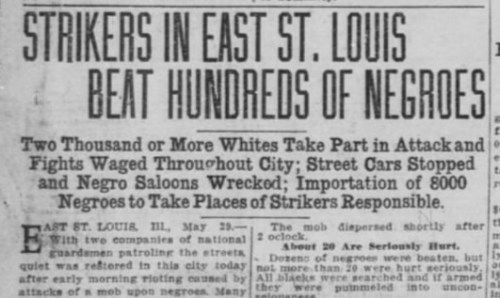
Over a million African Americans responded to their draft calls and nearly three-quarters of a million served. Even as hundreds of thousands stepped forward to answer Wilson’s call, “race antagonism” continued unbridled. On July 2, 1917, a riot broke out in East St. Louis between black and white workers that left over a hundred blacks dead. In a July 4th address, Colonel Theodore Roosevelt preceded his war address to remark, “There has just occurred in a northern city a most lamentable tragedy. We who live elsewhere would do well not to be self-righteous about it, for it was produced by causes which might at any time produce just such results in any of the communities in which we individually dwell.

stlouisriot1

Even as over one hundred indictments were being made in the St. Louis incident, an altercation took place in Houston, TX between black soldiers stationed at Camp Logan and white residents. In the end, according to one source, “Three military court-martial proceedings convicted 110 soldiers. Sixty-three received life sentences and thirteen were hung without due process. The army buried their bodies in unmarked graves.” [3]

Emerging out of the resulting nationwide protests was the question – if we are to make the world safe for democracy shouldn’t we make America safe for democracy?
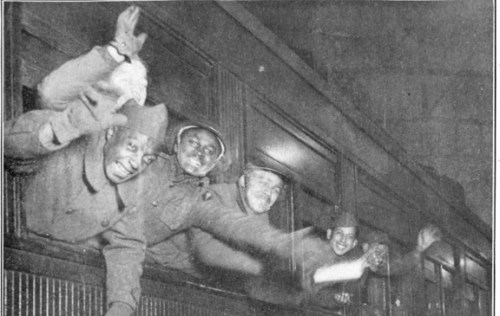
 

soldiers-from-chicago

soldiers from chicago arriving in france

Despite outright discrimination, verbal and physical abuses, and segragation among troops, African Americans served with distinction at every level (as they had in previous engagements like the Spanish-American War).

buffaloes

troop 367th known as the buffaloes

Today I know of many people, of diverse backgrounds, who have no idea of the significant role of African Americans in World War I. Why is that? In part, it is because the visuals were not produced or those that were produced — the illustrations, the paintings, the photography — were not widely distributed. They were not reproduced in the consumer publications of the period. The heroics of individuals, with rare exception, or of whole troops, with rare exception like the Harlem Hellfighters, were not retold, and certainly not in the classroom, as part of the narrative of America’s victory in the Great War.

croix

two officers who received the croix de guerre

What was Emmett J. Scott thinking when he decided to produce his book? He tells us in the preface: “The Negro, in the great World War for Freedom and Democracy, has proved to be a notable and inspiring figure. The record and achievements of this racial group, as brave soldiers and loyal citizens, furnish one of the brightest chapters in American history. The ready response of Negro draftees to the Selective Service calls together with the numerous patriotic activities of Negroes generally, gave ample evidence of their whole-souled support and their 100 per cent Americanism. …

philadelphia

troop from philadelphia

It is difficult to indicate which rendered the greater service to their Country—the 400,000 or more of them who entered active military service (many of whom fearlessly and victoriously fought upon the battlefields of France) or the millions of other loyal members of this race whose useful industry in fields, factories, forests, mines, together with many other indispensable civilian activities, so vitally helped the Federal authorities in carrying the war to a successful conclusion. … 

corporal-mcintyre

corporal fred mcintyre of the 369th

It is because of the immensely valuable contribution made by Negro soldiers, sailors, and civilians toward the winning of the great World War that this volume has been prepared—in order that there may be an authentic record, not only of the military exploits of this particular racial group of Americans, but of the diversified and valuable contributions made by them as patriotic civilians.

return

369th returning home “bringing back the unique record of never having had a man captured, never losing a foot of ground or a trench, and of being nearest to the Rhine of any allied unit where the armistice was signed, and the first detachment of allied troops to reach the Rhine after the armistice.”

In The American Negro in the World War Scott produces a comprehensive account of the involvement of black Americans in World War I, those in the field and those on the home front. I believe it is an important archival record.
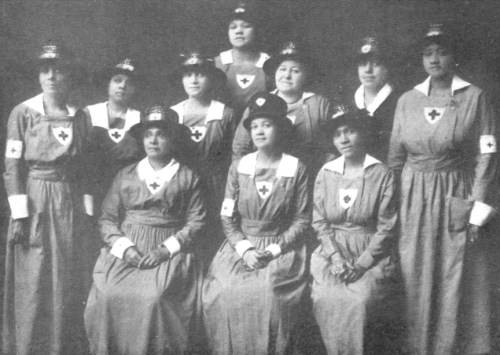
canteen

red cross canteen war workers in chicago

After the war Scott’s efforts with the military were both applauded and criticized. Some, like W. E. B. Du Bois, felt he should have been more vocal about the systemic racism and segregation among the troops stationed in Europe. But in wartime correspondence, just declassified in the 1980s, its clear that Scott worked hard to be a voice for the soldiers and to address injustices committed.

scott-and-team

dr. emmet jay scott and his faithful office corps who co-operated in the performance of his duties as special assistant to the secretary of war

After the war, Scott would move on to Howard University. Outside of his university duties as Secretary Treasurer, he would continue to promote and invest in business development opportunities nationwide. He died December 12, 1957 at the age of 84.

Sources & Additional Reading

The American Negro in the World War – https://archive.org/details/scottsofficialhi00scot_0

or http://net.lib.byu.edu/~rdh7/wwi/comment/Scott/ScottTC.htm

[1] Emmett Scott, Administrator of a Dream

http://www.blackpast.org/aah/scott-emmett-j-1873-1957

https://en.wikipedia.org/wiki/Booker_T._Washington

[2] http://afrotexan.com/AfroPress/Editors/scott_emmett.htm,  a Sketch from the National Cyclopedia of the Colored Race (1919)

They Came to Fight: African Americans and the Great War


[3] http://exhibitions.nypl.org/africanaage/essay-world-war-i.html

http://www.npr.org/2015/10/25/451717690/birth-of-a-race-the-obscure-demise-of-a-would-be-rebuttal-to-racism

Read Full Post »

One thing people might not know about me is that as an adult I learned how to play the harmonica. I’d never played an instrument before. The class was in part an opportunity to do something different and also an homage to my father who played the harmonica when I was a child. I have a very nice harmonica tucked away somewhere. I haven’t played or thought about playing for years until I came across a 1975 recording of Babylon is Falling Down sung by Deacon Dan Smith with Nick Hallman & the Georgia Sea Island Singers. The music is on the disc, Shall We Gather at the River, highlighting Florida’s African American religious music. This song and 14 additional tracks can be accessed online via the following link: https://www.floridamemory.com/audio/cd3.php  Well worth a visit to that page and the larger Florida Memory site to learn about the diverse history of the peoples that have shaped a place that is an important part of the American puzzle.


Read Full Post »

dscn1011

a wall I saw today

Let America Be America Again

Let America be America again.
Let it be the dream it used to be.
Let it be the pioneer on the plain
Seeking a home where he himself is free.

(America never was America to me.)

Let America be the dream the dreamers dreamed–
Let it be that great strong land of love
Where never kings connive nor tyrants scheme
That any man be crushed by one above.

(It never was America to me.)

O, let my land be a land where Liberty
Is crowned with no false patriotic wreath,
But opportunity is real, and life is free,
Equality is in the air we breathe.

(There’s never been equality for me,
Nor freedom in this “homeland of the free.”)

Say, who are you that mumbles in the dark?
And who are you that draws your veil across the stars?

I am the poor white, fooled and pushed apart,
I am the Negro bearing slavery’s scars.
I am the red man driven from the land,
I am the immigrant clutching the hope I seek–
And finding only the same old stupid plan
Of dog eat dog, of mighty crush the weak.

I am the young man, full of strength and hope,
Tangled in that ancient endless chain
Of profit, power, gain, of grab the land!
Of grab the gold! Of grab the ways of satisfying need!
Of work the men! Of take the pay!
Of owning everything for one’s own greed!

I am the farmer, bondsman to the soil.
I am the worker sold to the machine.
I am the Negro, servant to you all.
I am the people, humble, hungry, mean–
Hungry yet today despite the dream.
Beaten yet today–O, Pioneers!
I am the man who never got ahead,
The poorest worker bartered through the years.

Yet I’m the one who dreamt our basic dream
In the Old World while still a serf of kings,
Who dreamt a dream so strong, so brave, so true,
That even yet its mighty daring sings
In every brick and stone, in every furrow turned
That’s made America the land it has become.
O, I’m the man who sailed those early seas
In search of what I meant to be my home–
For I’m the one who left dark Ireland’s shore,
And Poland’s plain, and England’s grassy lea,
And torn from Black Africa’s strand I came
To build a “homeland of the free.”

The free?

Who said the free? Not me?
Surely not me? The millions on relief today?
The millions shot down when we strike?
The millions who have nothing for our pay?
For all the dreams we’ve dreamed
And all the songs we’ve sung
And all the hopes we’ve held
And all the flags we’ve hung,
The millions who have nothing for our pay–
Except the dream that’s almost dead today.

O, let America be America again–
The land that never has been yet–
And yet must be–the land where every man is free.
The land that’s mine–the poor man’s, Indian’s, Negro’s, ME–
Who made America,
Whose sweat and blood, whose faith and pain,
Whose hand at the foundry, whose plow in the rain,
Must bring back our mighty dream again.

Sure, call me any ugly name you choose–
The steel of freedom does not stain.
From those who live like leeches on the people’s lives,
We must take back our land again,
America!

O, yes,
I say it plain,
America never was America to me,
And yet I swear this oath–
America will be!

Out of the rack and ruin of our gangster death,
The rape and rot of graft, and stealth, and lies,
We, the people, must redeem
The land, the mines, the plants, the rivers.
The mountains and the endless plain–
All, all the stretch of these great green states–
And make America again!

by Langston Hughes (1902-1967)


Read more Langston Hughes and find other poems for inspiration, reflection and perhaps even motivation at https://www.poets.org/


Read Full Post »

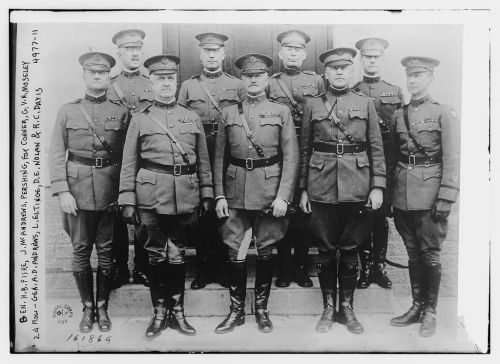
The most valuable qualification in an officer is common sense; contrary to general belief, it is the rarest element found in mankind.” — Major General Fox Conner (1874-1951)

foxconner

He would have been less than ten years old, I think. In a 1930s interview, eighty-two year old former slave Ike Woodward remembered as a child it was his job to lead blind Bob Conner around. Conner had been blinded in a Civil War battle. Woodward’s master, also named Ike Woodward, had sold the services of his young slave to the Conner family. In his his interview for the Works Progress Administration, Woodward would go on to remark that Master Conner was the papa of Mr. Fox Conner, a big man now in the army. That statement led me to ask: who was Fox Conner? An impressive figure it turns out.

connerwithpershing

Conner to the left of Pershing (Source)

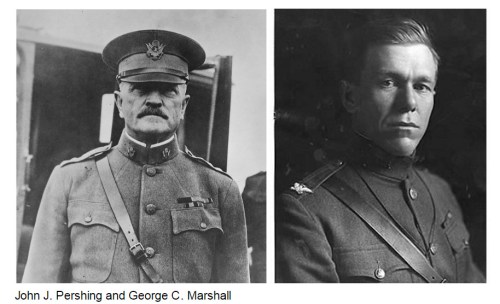
Conner would make his way from rural Mississippi to West Point and embark upon a stellar career in the military, serving in the Spanish American War, Pancho Villa Expedition and World War I. He earned military awards from the Purple Heart to the French Croix de Guerre. It was during World War I that he was selected by General Pershing to be a member of his operations section where one of Conner’s subordinates was George C. Marshall. A far-seeing strategist, he opposed the Treaty of Versailles seeing within it the seeds of a new world war with Germany.

pershingandmarshall

During World War I Conner would become reacquainted with and develop an enduring friendship with an officer by the name of George S. Patton. Back in the States, in the early 1920s, Conner and his wife were the honored guests of a dinner party hosted by the Pattons. Invited to this dinner was a young officer named Dwight D. Eisenhower, whom Patton thought Conner should meet. According to one biographer, Russ Stayanoff, “In Eisenhower, Conner saw a likable, eager young officer available for the “next one;” an officer that he could groom. Conner undoubtedly needed an executive officer with whom he could get along, and Eisenhower fit the bill. The fruits of that February luncheon became apparent when Conner telephoned Ike later in the same week and asked him if he would like the assignment as his executive officer in Panama.

dwighteisenhower

Today Conner is especially remembered for his mentoring of Eisenhower. As Executive Officer for Conner at Camp Gaillard in Panama, Eisenhower received an unparalleled education in military affairs that would be instrumental in his later success at the Command and General Staff School. Conner was a student of history. Whether personally with Eisenhower or through his later lectures at the Army War College, Conner influenced a generation of future leaders. He was a proponent of coalition building and the use of diplomacy in concert with strong leadership to bring about victory. His three axioms or principles of war for a democracy still discussed today: Never fight unless you have to; Never fight alone; and Never fight for long.

Thanks to the internet there appears to be an increasing amount of information available to the general public about Conner, as well as more detailed analyses of his teachings still relevant in this modern age.  A biography was published in 2011 about him and a new book more recently published in 2016. In much of the discourse about Conner that I saw there is reference to him being the son of a blind Confederate soldier. The only way I learned the little that I have of this man and of his enduring legacy was to read the remembrances of the slave “lent out” to help guide his father. Ike Woodward would work at the Conner place until the day Ike’s brother rode in by horseback and scooped him up, conveying that they were now free.

Sources & Additional Reading

Ike Woodward Slave Narrative

https://en.wikipedia.org/wiki/Fox_Conner

Major General Fox Conner: Soldier, Mentor, Enigma: Operations Chief (G-3) of the AEF by Russ Stayanoff, MA

http://www.casematepublishers.com/index.php/general-fox-conner.html#.WIZFhVUrKM8


Read Full Post »

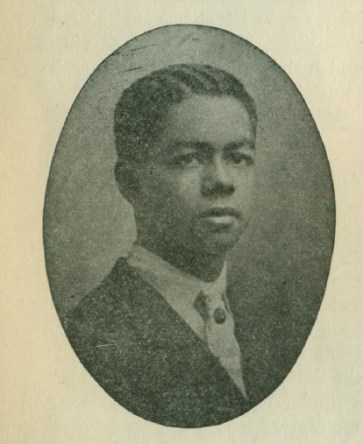
James Weldon Johnson and Aaron Douglas

James Weldon Johnson (1871-1938) and Aaron Douglas (1899-1979)

Originally published in 1927, James Weldon Johnson’s book, God’s Trombones, is a slim volume composed of a prayer and seven poems: Listen, Lord–A Prayer, The Creation, The Prodigal Son, Go Down Death, Noah Built the Ark, The Crucifixion, Let My People Go, and The Judgement Day. The verses were inspired by his experiences attending black churches throughout the American south. The preachers’ oratory inspired Johnson to write these poems and, in the book’s preface, to reflect upon the nature of oration and folk traditions. His poems, I assume, inspired his artistic collaborators, Aaron Douglas and Charles B. Falls. The signature styles of two very different artists were brought together to complement Johnson’s words.

lettering by Charles Buckley Falls

Lettering by Charles Buckley Falls (1874-1960)

A publication was produced that is really quite distinctive with regard to words, images and overall concept. Johnson as scholar as well as poet produced a tome that captured in a unique way the power and importance of religion in the African American experience. He makes real even for those not having attended black churches how the preachers – God’s trombones – used word, rhyme and rhythm to give voice to the stories in the bible even when no bible was present.

Illustration

It would be easy to pick up this book, to skip the preface and go straight to the poems. But don’t. Johnson’s preface is critical, for his brief and cohesive insights into religion and the American experience, and for his guidance in how to truly appreciate what he was attempting to do with this book.

I claim no more for these poems than that I have written them after the manner of the primitive sermons. In the writing of them I have, naturally, felt the influence of the Spirituals. There is, of course, no way of recreating the atmosphere — the fervor of the congregation, the amens and hallelujahs, the undertone of singing which was often a soft accompaniment to parts of the sermon; nor the personality of the preacher — his physical magnetism, his gestures and gesticulations, his changes of tempo, his pauses for effect, and, more than all, his tones of voice. These poems would better be intoned than read; especially does this apply to “Listen, Lord,” “The Crucifixion,” and “The Judgment Day.” But the intoning practiced by the old-time preacher is a thing next to impossible to describe; it must be heard, and it is extremely difficult to imitate even when heard. …

“… The tempos of the preacher I have endeavored to indicate by the line arrangement of the poems, and a certain sort of pause that is marked by a quick intaking and an audible expulsion of the breath I have indicated by dashes. There is a decided syncopation of speech — the crowding in of many syllables or the lengthening out of a few to fill one metrical foot, the sensing of which must be left to the reader’s ear. The rhythmical stress of this syncopation is partly obtained by a marked silent fraction of a beat; frequently this silent fraction is filled in by a hand clap. …

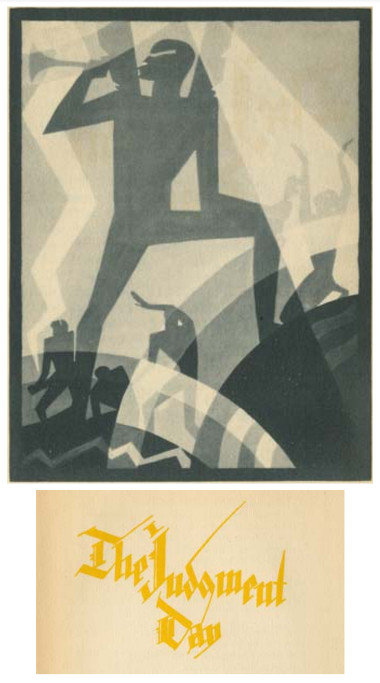
The ensuing poems do read like song and the power of the words are echoed and strengthened by the complementary visusals.

Illustrations by Douglas for the poems, The Creation, The Prodigal Son, and Go Down Death.

Illustrations by Douglas for the poems, The Creation, The Prodigal Son, and Go Down Death.

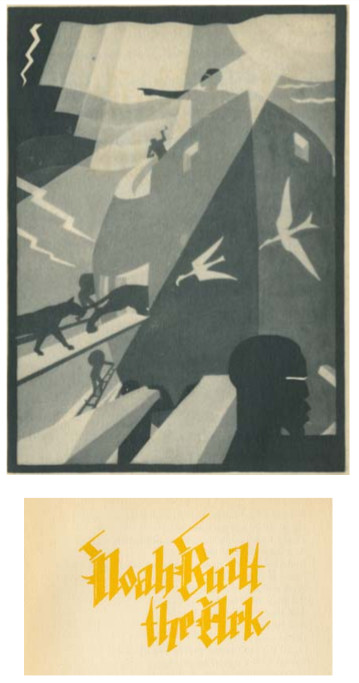
Noah Built the Ark

Illustration and complementary chapter head for Noah Built the Ark

Illustration for The Crucifixion

Illustration for The Crucifixion

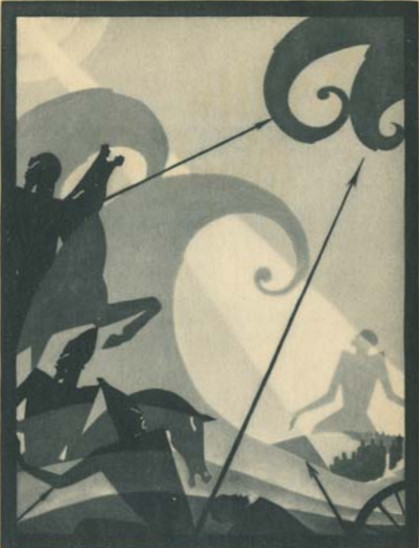
Illustration for Let My People Go

Illustration for Let My People Go


Both Johnson and Aaron Douglas are considered key figures of the Harlem Renaissance. Charles B. Falls was a noted illustrator and designer especially remembered for the posters he created during World War I and II as part of the Victory Books Campaign.

Over time the book has been reprinted numerous times including an edition by Penguin Classics, edited by Henry Louis Gates and with an introduction by Maya Angelou. As Johnson wrote in his preface the poems are really meant to be performed and over the years many individuals and institutions have done just that. Recordings can be found online.  You can also find the book fully digitized and viewable online thanks to the Documenting the American South project at University of North Carolina at Chapel Hill, my primary source for this post. I hope you have the opportunity to view the book in-hand or online: http://docsouth.unc.edu/southlit/johnson/johnson.html


Sources & Additional Readings

God’s Trombones (digitized) – http://docsouth.unc.edu/southlit/johnson/johnson.html

James Weldon Johnson – https://en.wikipedia.org/wiki/James_Weldon_Johnson

Aaron Douglas – https://en.wikipedia.org/wiki/Aaron_Douglas

Charles Buckles Falls – https://en.wikipedia.org/wiki/Charles_Buckles_Falls

The New Negro Renaissance – http://exhibitions.nypl.org/africanaage/essay-renaissance.html

More about the Victory Books Campaign – http://arcweb.sos.state.or.us/pages/exhibits/ww2/services/books.htm

Read Full Post »

In early August I wrote about an experience on the road between Boston and Rhode Island, an experience that I described to people as being in the midst of a Klu Klux Klan rally where no one wore a hood. You can read that post here if you like.  And though I wrote that post about my experience, my feelings in that moment, I also thought about what were the children in the neighboring cars experiencing, children of any race, what questions were they asking their parents and how were their parents responding. I especially thought that when I saw a little brown boy staring at the pickup truck in the lane next to him flying its huge confederate flags.

the full moon obscured by a screen

I was surprised later to find so little commentary on local news and on the internet about that procession of thirty-plus vehicles in New England with their giant flags driving en masse along I-95. But I guess I was using the wrong search terms. I did not think to use the words: Make American Great Again Convoy, an event that took place July 30 and 31 in Foxboro, MA.

I remember writing that I chose not to photograph anything around me that day on the road. But I do realize that it is important to capture the words and images of such events so that they can be documented and remembered. Since I wrote my original post a video has surfaced. When I first saw the still shots and read the transcripts of what people were saying that day on their CBs, I almost shrugged. I wasn’t surprised and my feelings were justified.

Then I watched the video, listened to the words, and it made me want to cry. Not out of fear but out of sadness at what darkness remains in this world. As young white men laugh about lynching niggers from the nearby trees, using blacks as pinatas, I remembered the little brown boy staring into their trucks. And I thought of a young brown cousin who I’ve been told likes to chase Monarchs at his home in New York, and I thought of my young brown nephew who likes to plant gardens in his home in Virginia. They are too young to fear what has been because they don’t know that part of American history … yet. I thought of what these people must be teaching their children and I hoped that their children somehow would one day hold hands with children of all shades and know that they were the same.

It is almost too easy to blame Trump and yet I do not want to let him and his brethren off the hook for what they have allowed to re-surface, unchecked, in this country. He was the spark for their tinder. The video is 4minutes and 45 seconds. It’s hard to listen to, and in no way kid friendly but it should be reflected upon because the sentiments expressed in the video and in similar gatherings online and in person across this country are not going to disappear overnight or anytime soon. Maybe never.

However, somehow, there is always hope for better.

In 1880, Phillips Brooks, then the Rector of Trinity Church in Boston, delivered a sermon at Westminster Abbey in England. The sermon was titled The Candle of the Lord. It was July 4th that he spoke and for the occasion he added some text to the sermon where he asked the British congregation before him to pray for his young country:

“It is not for me to glorify to-night the country which I love with all my heart and soul. I may not ask your praise for anything admirable which the United States has been or done.  But on my country’s birthday I may do something far more solemn and more worthy of the hour. I may ask you for your prayer in her behalf. That on the manifold and wondrous chance which God is giving her, – on her freedom (for she is free, since the old stain of slavery was washed out in blood); on her unconstrained religious life; on her passion for education, and her eager search for truth; on her jealous care for the poor man’s rights and opportunities; on her countless quiet homes where the future generations of her men are growing; on her manufactures and her commerce; on her wide gates open to the east and to the west; on her strange meetings of the races out of which a new race is slowly being born … “

One hundred thirty years later, I’d say we are a nation still being born.

Read Full Post »

Richard Lonsdale Brown, Class of 1910

Richard Lonsdale Brown 1910

In January, I posted the story of an African American artist named Richard Lonsdale Brown (1892-1917). Recently I came across new information that inspired me to revisit his life.  Raised in West Virginia, he traveled to New York City where his talent was recognized. He was featured in the New York Times.  As was often the case for young fine artists, supporters hoped he’d continue his artistic studies in Paris. The trip would never take place. Brown died at the age of 26. Few of his watercolor or oil paintings survive today but he may have left an unexpected legacy in the impact he made upon W. E. B. Du Bois.

W. E. B. Du Bois

W. E. B. Du Bois 1868-1963

The two men would meet shortly after Brown graduated from West Virginia Collegiate Institute, earlier known as the West Virginia Colored Institute. There “In connection with his academic studies he took painting as a trade, under the late George Collins of South America, who was quite an artist. In addition to house painting and interior decoration, the boy showed wonderful aptitude for artistic painting, and was encouraged to paint the hills and scenery along the Great Kanawha River near the institution.” (1)

Brown would eventually make his way to New York City where he would share his portfolio with artist George De Forest Brush. Brown would later share in an interview that he remembered walking up and down Fifth Avenue trying to sell his pictures to galleries to pay for food and rent. He was about to give in to despair when …

Mourning her Brave by George de Forest Brush, 1883

Mourning her Brave by George de Forest Brush, 1883

Brown found the artist’s studio and knocked at his door. Brush answered. He listened and then he reviewed the modest portfolio. An internationally renowned artist, Brush recognized the young man’s talent and invited him to study for a summer in Keene, New Hampshire.  Afterward he studied at the American Academy of Design.  Through Brush, Brown’s work would catch the attention of the founders of the newly formed National Association for Colored People (NAACP), including W. E. B. Du Bois and Mary Ovington. He became their protege.

On January 1912, his artwork was exhibited during the first annual meeting of the NAACP, and would be exhibited during future annual meetings as well.  In March, with Ovington’s aid, his work was exhibited in a NYC gallery. The press was spectacular. The turnout was great. Brown’s works were purchased by collectors from around the world.  Later in the year, his artwork would grace at least two covers of The Crisis, the national magazine published by the NAACP.

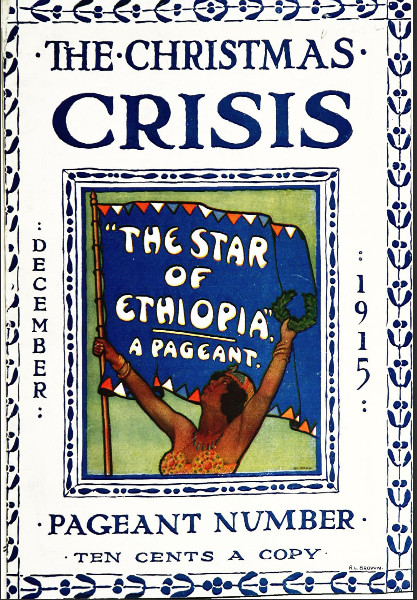
In 1913, he would turn his attention from painting landscapes to design and decoration as he worked with Du Bois to execute The Star of Egypt.  In 1911, Du Bois had written The Star of Egypt, a historical pageant presenting the history of African Americans over time. Brown would serve as set decorator, along with Lenwood Morris. He would travel with Du Bois as they met with both blacks and whites in an effort to raise funds. An elaborate production involving casts of thousands, it was well-received though struggled with financing. The pageant would be staged in three cities during Brown’s life, New York in 1913, Washington, DC in 1915, and Philadelphia in 1916.

December 1915 Cover by Richard L. Brown

December 1915 Cover by Richard L. Brown

His time in the northeast studying art, his work with W. E. B. Du Bois, the changing landscape of America and a world that was on the brink of war, all of these things were influencing Brown’s artistic aspirations. In a 1913 interview about his art, he tentatively but determinedly brings up the question of race.

A few years later he would confide in Mary Ovington about his changing perspective. She shares in her memoir:

That trip South she refers to would take Richard Brown to his parent’s home in Muskogee, Oklahoma.  The year was 1917.  On his World War I draft registration card, completed in Muskogee in June,  he notes his occupation as artist and his race as African. He died of pneumonia in September of that year.

While it is unclear why Brown returned to his parents, it is clear from subsequent editorials by W. E. B. Du Bois in The Crisis that Brown, like many black artists in that time, was not making a living as an artist. Always a proponent for nurturing art within the black community, Du Bois took pride in showcasing the talent of young artists like Richard Brown. As he refers to Brown in editorials over the next few years it is with an underlying note of frustration if not outright anger at the loss of this young man’s talent from the world. Those feelings are directed at the white community and at the black community for not financially supporting the creativity within its midst.

An obituary for Brown in the January 1918 issue of The Crisis states “he started on a trip to see what beauty he might find in the South. … Some of us, perhaps all of us, are to blame that Richard Brown was not given a better chance to develop a gift which some of the greatest artists called wonderful.

In a May 1922 editorial in The Crisis titled Art for Nothing, Du Bois writes:

There is a deep feeling among many people and particularly among colored people that Art should not be paid for. The feeling is based on an ancient and fine idea of human Freedom in the quest of Beauty and on a dream that the artist rises and should rise above paltry considerations of dollars and food. At the same time everybody knows that artists must live if their art is to live. Everybody knows that if the people who enjoy the artist’s work do not pay for it, somebody else must or his work cannot go on. Despite this practical, obvious fact, we are united with singular unity to starve colored artists.

He proceeds to list a series of living artists from Meta Warrick Fuller to William A. Scott all struggling to make a living but he concludes the list with his lost protege, “Richard Brown died of privation while yet a boy.

In another essay about art, in October 1926, he says, “There was Richard Brown. If he had been white he would have been alive today instead of dead of neglect. Many helped him when he asked but he was not the kind of boy that always asks. He was simply one who made colors sing.

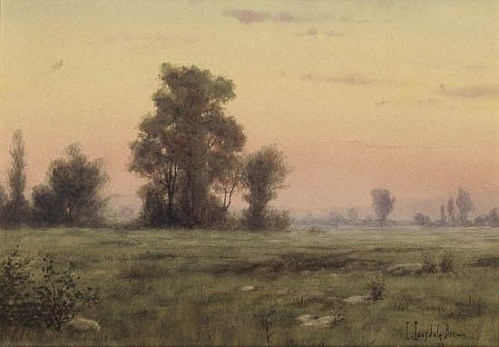
Landscape by Richard Lonsdale Brown

Landscape by Richard Lonsdale Brown

In 1928, Mary Brown, Richard Brown’s mother, wrote to Du Bois. She had a dozen of his paintings and sought his aid in selling them in New York. With the money raised she hoped to create a monument for her son. They were all unframed, she said, and encouraged him to deduct the expense of framing from the sell of the paintings and also to deduct a stipend for his time. He took on the task but was unsuccessful. Even with the aid of Mary Beattie Brady of The Harmon Foundation, he could find no one willing to spend more than few dollars per painting. Brady and he agreed that they should not be sold for so little.  In the last letter between Du Bois and Brown’s mother, dated April 1931, Du Bois expresses his regrets and asks if she’d like him to return the paintings or to hold on to them in hopes that the New York scene might improve.

Today Brown’s paintings sell for thousands of dollars.

Sources and Additional Reading

West Virginia Collegiate Institute Monthly, December 1917, p. 3

The Sun Newspaper, October 5, 1913, p. 39

Star of Ethiopia Photograph, The Crisis Magazine, August 2016

Black and White Sat Down Together: The Reminiscences of an NAACP Founder (pp. 75-76)

Letters of W. E. B. Du Bois, UMASS Special Collections – http://credo.library.umass.edu/

W. E. B. Du Bois

Save

Read Full Post »

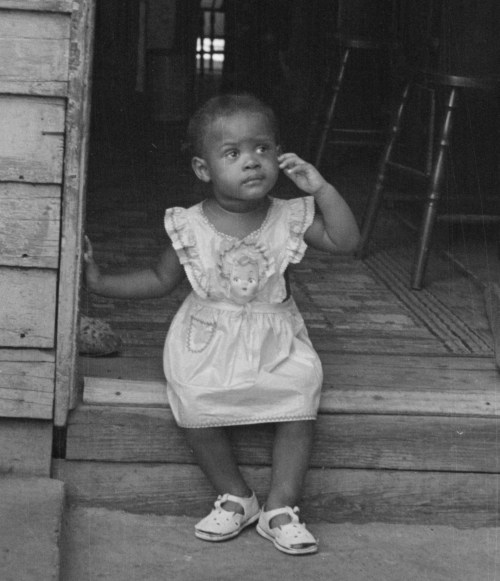
detail from untitled photo by joseph a. horne, 1940s

This photo was taken by Joseph Anthony Horne during the 1940s as he worked for the Farm Security Administration – Office of War Information.  As highlighted in a previous chapter of Interludes, he like many other photographers had been sent out across the country, under the direction of Roy Stryker, to capture the American experience. One of the areas that Horne captured on film was southeast Washington, D.C.,  an area not far from where his family lived and an area that was predominantly African American. The photos he took in that community were notable, for me, in part because there was no characterization or stereotyping. He simply photographed in a straightforward manner people living their daily lives. He, like many of the FSA photographers, was very good at that.  Otherwise in commercial media, unless it was an African-American specific publication, there was either no representation of “colored” people or it was often a mimicry.  Out of all the photos that Horne took in this community, I was especially struck by the series of photos of this little girl who had been positioned in front of the camera by a person who appeared to be her mother. No doubt she’d been placed in a best dress for the occasion. And its that dress that caught my attention.

There are people far more eloquent and scholarly than I who have written and who continue to write about how we as humans form our sense of self, our sense of self-worth, our sense of what is beautiful and our sense of how we individually fit within that definition of beauty.  This little girl is lovely and thoughtful. Her face clearly reads, who are you and what are you doing? The little face affixed to her dress is also lovely. Two different expressions of beauty.

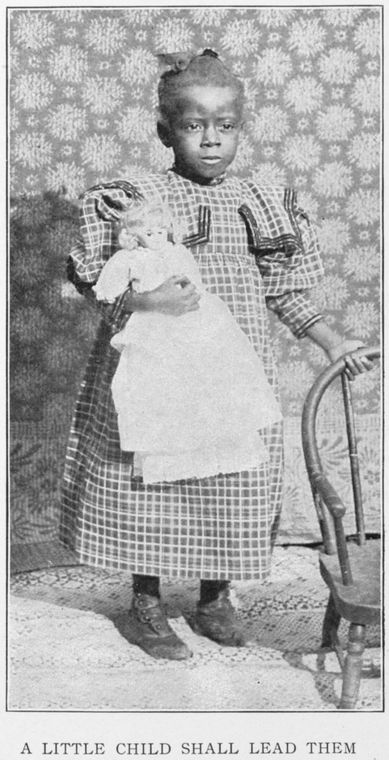
This photograph was taken in 1905 and is located in the NYPL Digital Collection. I don’t know the context in which this photograph was taken though there is that accompanying caption suggesting to me that it was in a magazine and meant as a positive image highlighting how far African Americans had come in the 40-years since slavery and that a new generation would have even more success.  Too true as evidenced by the strength in that little girl’s face, and yet I am struck by the doll wrapped in her arm.  Growing up in the 1970s, I too had a lovely doll around which to wrap my arms and I enjoyed combing her blonde hair and wondering why it was so hard, in fact impossible, to braid her hair the way my mother braided mine. I grew up in a far different time than these two young girls but Toni Morrison’s The Bluest Eye, published the year I was born, certainly resonated in my teenage years. I don’t remember ever wanting blue eyes but I think I wanted blonde hair (or maybe a lion’s mane).

These musings come to the fore because of a convergence of recent events, including having the opportunity to explore the imagery being made available through digital collections, seeing images of the past that had not been made widely available before, images that today have the potential to spark positive conversations about the past, present and future.

I recently pulled together research to tell two stories of one place.  One story focused on two sisters of great wealth whose lives are well-documented and whose enduring influences are often remarked upon.  The second story took great effort to pull together, of a gentleman whose image and good works I could only find because of the old texts and photographs being digitized and made available online.  The two sisters were white and the gentleman was black. They lived during the same time period and interacted in the same place.  When I printed my drafts and shared the stories with an elder (whose age I shall not share), she listened politely to the story of the two women but she took the story of the gentleman. We had a conversation and she said, “Cynthia, all my life I have heard about these women and the people like them. I never heard about this man. You keep doing your research. Why is it important? I want people to know that we were here. To know that we were a part of this place.”

Sources

https://www.loc.gov/item/owi2001000491/PP/

Schomburg Center for Research in Black Culture, Jean Blackwell Hutson Research and Reference Division, The New York Public Library. “A little child shall lead them.” The New York Public Library Digital Collections. 1906. http://digitalcollections.nypl.org/items/510d47df-9e16-a3d9-e040-e00a18064a99


Read Full Post »

Read about The Singing Window at Tuskegee University in Deep South Magazine here. Enjoy!

Photo by Carol M. Highsmith

Photo by Carol M. Highsmith

Read Full Post »

Recently I was walking through the reference section of the Boston Public Library in Copley Square. Though I had a specific destination, probably trying to find a book on stained glass, my eyes kept raking the shelves and a book title made me pause. I pulled the book from the shelf, randomly flipped it open and began to read.

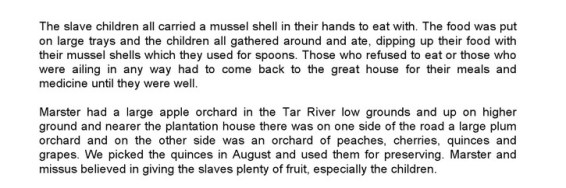
Willis Cofer, seventy-eight years old, a former slave in Georgia, was recounting his memories of how the cook fed the slave children.  They were fed all the time, he said, feeding them bread and milk for breakfast, mostly peas and cornbread for dinner, and then milk and bread for supper.  There were so many children on the plantation that “dey fed us in a trough. Dey jes’ poured de peas on the de chunks of cornbread what dey had crumbled in de trough, and us had to mussel ’em out.  Yessum, I said mussel.  De only spoons us had wuz mussel shells what us got out of de branches.

Strangely enough I had been pondering what to do with my growing collection of mussel shells. I often pick them up when I’m walking along Revere Beach. Sometimes I keep a few shells if we cook some up for dinner.  They have always been a treat. I’d never thought of them as a necessary utensil.  Just like I’d never thought of children being fed in a trough, like the rest of the farm stock.

The book I’d picked up was called Slave Culture, a 2014 series of books that present excerpts from slave narratives.  The narratives were collected starting in 1935.  It was at that time that the Federal Writers’ Project, one of Franklin Roosevelt’s New Deal programs, was established. The program provided jobs for unemployed writers, researchers, historians and others.  One of those jobs included interviewing more than 2000 former slaves across seventeen states like Willis Cofer.

Sometimes the stories captured were kept in the vernacular, like Willis Cofer’s childhood memories and those of Adeline Cunningham, 85, of Texas.  She shared, “Dey feds us well sometimes, if dey warn’t mad at us.  Dey has a big trough jes’ like de trough for de pigs and dey has a big gourd and dey totes de gourd full of milk and dey breaks de bread in de milk. Den my mammy takes a gourd and fills it and give it to us chillun.  How’s we eat it? We had oyster shells for spoons and de slaves come in from de fields and dey hands is all dirty, and dey is hungry. Dey dips de dirty hands right in de trough and we can’t eat none of it.”

Sallie Crane, at least 90 years old when interviewed in Arkansas, remembered eating out of a trough “with a wooden spoon, mush and milk. Cedar trough and long-handled cedar spoons.” Her owner’s children would taunt the slave children with their leftover school lunches, “Hold it out and snatch it back! Finally, they’d give it us, after they got tired of playing.

Other narratives were “cleaned up” by the interviewer or the former slave had received an education dependent upon the whims of his or her previous owners. Mary Anderson of North Carolina recalled in her 1937 interview:

The narratives are in the public domain. They can be found on the Library of Congress website. Universities in many states, especially in the southern states, have made them available in their libraries and online. So why read them? Institutionalized slavery in the U.S. was ended over 150 years ago. People of all shades fought and died to see passage of the Civil Rights Act of 1964 to end segregration and discrimination.  Why revisit the past?

Well, at one point, I believe that there were six million people enslaved in this country and many of those people had been enslaved over successive generations. To oversimplify, they were purposefully denigrated, treated like animals, and considered less than human. They were bred, fed and fattened to be sold and purposefully kept uneducated to dampen any dreams of a different life. And some of the people who suffered were my ancestors, and I’m fairly sure that some of the people cracking literal and figurative whips were my ancestors too. All of that history forms the foundation of this country. The seeds of fear, hate, discrimination that were planted so long ago have not disappeared.  They can too easily sprout again and in some places they clearly have.

I’d say revisit the slave narratives as a way to get a sense of what happened, the impressions made upon a people and upon a country, and to then reflect upon what has changed and what has not.  I was moved by Willie Cofer’s words to consider something I’ve never done before, to create an art installation.  I wanted to … and perhaps I will do it … to find a cedar trunk and carve it into a rough-hewn trough. To place nearby a tree and from its bare branches hang mussel shells. To fill the trough with milk and torn up pieces of bread and peas. I did find a little wooden box and one of my mussel shells and a wooden spoon. I poured in some milk and sprinkled in some corn meal.  I would do a little photo shoot, you see.  It was only when I tore up the bread and tossed it into the box that I began to cry.

Read Full Post »

« Newer Posts - Older Posts »