As I prepare this post, I sit in a hotel room in Dublin, Ireland. Rain falls pretty steadily. The air is chill and the sky is the color of smoke. I should be cold and grumpy and yet I am warmed and made cheerful by the fractal images of Robert Grzybinski.
I was first introduced to Mr. Grzybinski at a company picnic. Somewhere in the course of our brief conversation, as I talked about my photography, he shared that he produced fractals. Well, if you follow this blog at all, you know how much I love shapes and colors. I asked if he’d share some of his images with me, and thankfully, he agreed. He also shared the creative process and inspiration behind his work. It is my pleasure to share his words and images with you. Enjoy! 😉
How do you create these images? I use an ancient MS-DOS program to make them. I give the program a bunch of input parameters, and it generates some output, which usually doesn’t look like much. After that the process is a lot like looking at a microscope slide — zooming in, moving around, looking for the interesting bits. You never know what you will find; it just continually amazes me what is hidden in that space of pure mathematics. Then I compose the image and assign the colors, which is sometimes the hardest part.

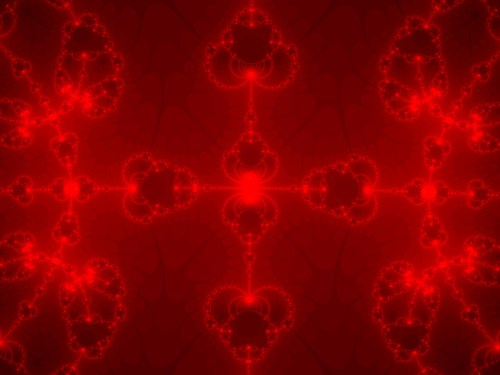
What’s the difference between these two images?The first image (“emboss”) is kind of a classic fractal – curvy, self-similar, spirally (spirals are very common in fractal patterns). It has a kind of sculptural quality. The second image (“treez”) has a spirally character too, but is made up of angular shapes and is completely flat, like something made out of cut-out paper. I especially love the confetti-like background.
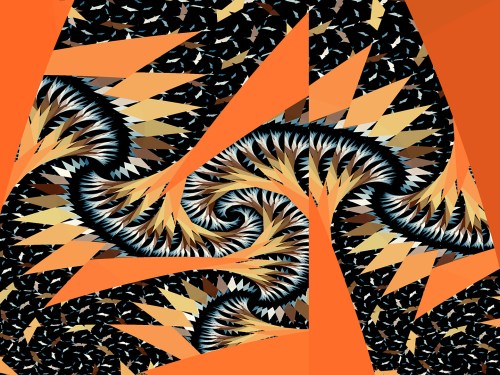
How did you choose the basic algorithm for each? The fractal program has a bunch of built-in functions. From experimenting, I know very roughly what kind of fractal each one will produce. “emboss” was made from one of the built-in functions. The program also gives you the ability to write your own functions, and I have had more fun and mostly more interesting results doing that. The functions are not very complicated, but it is just amazing to see the complexity that results from a few simple lines of code. “treez” was made from one of my own functions.
How many free parameters do the functions have? Depending on the function, there can be up to four or five numerical parameters. It’s usually not obvious or predictable what these parameters do. You have to just stick in some numbers and see the results. There are also many other settings that change the way the image is calculated. Again, you need to play with these to get a feel for what they do.
How did you choose the colors? The programs uses an indexed color system, where each region of the images is represented by a number. You then apply a palette which maps a particular color to each number – so to change the coloration, you just apply a different palette. I created a lot of different palettes with different characteristics (cool, warm, subtle, contrasty, etc.). Sometimes I know what effect I am going for, but sometimes I just try a lot of different palettes and hope something serendipitous happens. “emboss” is an example of that. It was an interesting pattern, and I knew there was something there, but it didn’t really work until I hit on the red/gold palette. Then it just popped out, like something embossed in gold foil.
What inspires you to create new images? What inspires me most is the sense of exploration. It’s a lot like looking through a microscope at a drop of pond water, or maybe exploring the depths of the ocean in a submarine. You just never know what weird and beautiful things will show up next. In a sense, these images already exist somewhere in a mathematical space, and I am just using the computer as a tool to discover them.
View an expansive gallery of Grzybinski Fractals via this link. For more information about Mr. Grzybinski’s fractals, you can contact him directly at cha.otic[at]earthlink.net.

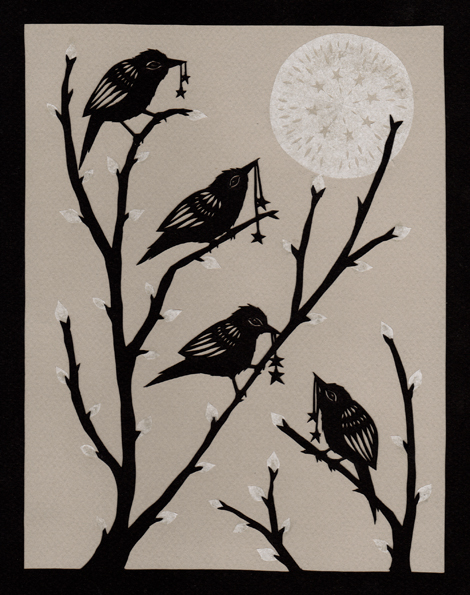
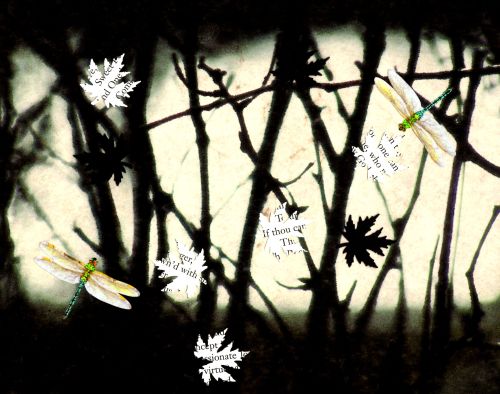


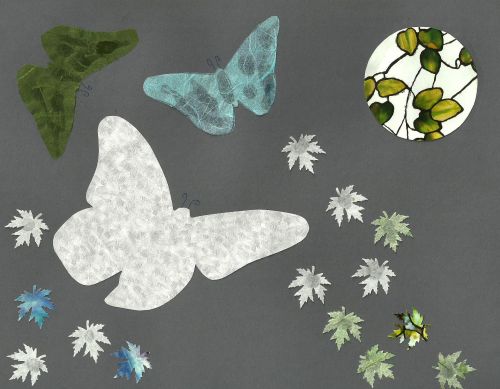


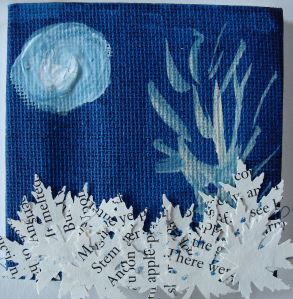 … the leaves clustered at the bottom of this painting, like the ones you can kick about beneath a tree that has loosed all of its foliage … those leaves were created from the beautiful words of Robert Frost in poems I copied from a book. I simply wanted to see “frost on leaves.” We’ll see what the rest of the week has to hold as the moon wanes. 😉
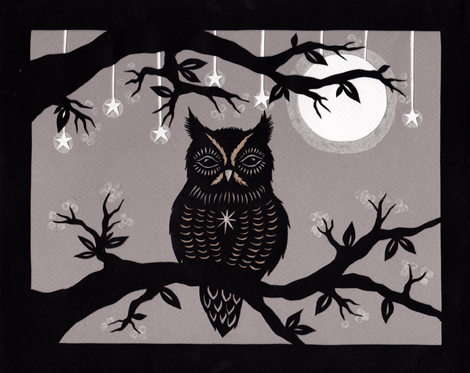
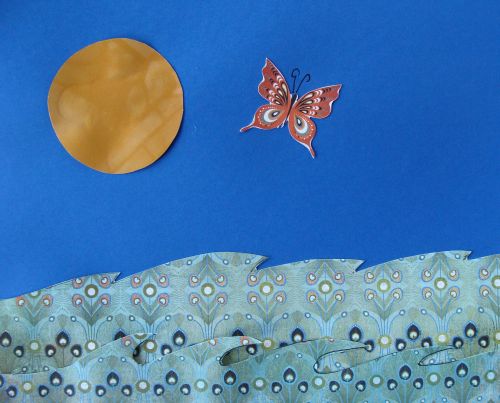 As I explore the craft, I am having a lot of fun with layering papers of different colors and textures, and playing around with the concepts that I take for granted in my photography like illumination, the flow of water, and capturing winged creatures in flight. In the above picture, I want to add a sail boat with billowing white sails. There’s a reason why but I’ll share that reason later if I manage to make a passable sailing vessel. 😉
 Did you know that snails have teeth? I didn’t until I started reading The Sound of a Wild Snail Eating by Elizabeth Tova Bailey. The book recounts the author’s interaction, while bedridden, with a relocated woodland snail. The language is quiet, beautiful and colorful. “While the snail slept I explored the terrarium from my bed … the variety of mosses was so satisfying … Their hues ranged from bright grass greens to deep dark greens and from sharp lemon greens to light blue greens.”
 As someone who spends a great deal of time snapping photos of plants, it was very helpful stumbling upon Sarah Simblet’s Botany for the Artist. A beautiful book in and of itself, its contents reminded me to look more closely at the things I photograph and to better understand the different parts that make up a whole. I found
 Words + Images