Feeds:
Posts
Comments

Posts Tagged ‘musings’

I’ve been thinking about the tree of life ever since a book near-literally fell from the shelves into my arms at the Boston Public Library. A non-descript old fashioned hardback with no book jacket. A bit over-sized though not especially thick. It was turquoise blue with gold lettering on the slender spine that said “Ain’t You Got A Right To The Tree Of Life?” The title page made clear that it was a collection of interviews by Guy and Candie Carawan, with black and white photographs by Robert Yellin, together capturing the words, images and songs of the people of Johns Island, South Carolina. I knew of the island and that the people interviewed must have been the descendants of slaves, slaves who most often were of West African origin, who had labored on the plantations producing indigo, rice and other produce that had made their white owners some of the wealthiest people in America. Slavery ended with the Civil War but by the time this book was published in 1966 a new war of sorts raged for civil rights especially the right to vote.

DSCN3371

Given that the preface was written by Alan Lomax, the famed ethnographer and musicologist, I figured the book was just another cool book documenting folkways before a group of people and their ways vanished. Probably a good read but I had so many books in my bag already. I decided to flip through it just a bit and then I would put it away.  I did put it away but not before I saw myself.

Now I grew up in the foothills of the Blue Ridge Mountains of Virginia not the Lowcountry of South Carolina. But it really didn’t matter as I stared into a book at a landscape that had surely shaped the people, as my childhood landscape had shaped me, and looked into faces that reminded me of home.  Beautiful men and women with dark-hued skin. Some slim as a stick and others quite round. Seniors and babies and every age in between. Some people laughing, some people crying and then there were those with their heads thrown back in song as they prayed through music to God. The poverty comes through too. Even so the poverty does not overshadow the joy, the sense of community, and the intense devotion, a devotion that must have helped these people survive the present when they had little idea what the future held for them and their children.

Look at pictures. That’s all I intended before placing the book back on its shelf.  But then I thought maybe I’d read a page or two, just standing there in the library, and then I’d tuck the book back on the shelf.  It was just a couple of minutes of reading. And then I walked away.

DSCN3373

That night I dreamed about what I’d read. It was a scene described in the first interview by Rev. G. C. Brown. It opens with him describing how his father had been a slave. But then he goes on to describe his grandmother whom he had known. She was a stubborn woman with a cruel owner and when she did not do as was expected of a slave “he’d take her by the ears to the corner of a house, and just bang her head against the corner until she’d bleed. … She died in the insane hospital in Columbia. You couldn’t find three square inches on her head where there wasn’t a scar when she died. And well, you find naked places all through her head where she was beaten until she beaten into unconsciousness. … In her latter years it was discovered that during one of those forays the skull was crushed into her brain.”  It was horrific to think of that woman having to endure such treatment for so much of her life, for her children to know of her abuse at the hands of someone who saw her as less than human … and that people must have stood around and did nothing, for whatever reason, as she was having her head bashed against a wall.

DSCN3200

I returned to the library and checked out the book and have begun to read it properly. I’ve learned more about the people behind the book, Guy and Candie Carawan, and their incredible legacy of social activism. And then there’s Esau Jenkins and his mission of teaching people to read so that they could register to vote.  He operated a bus driving people to their jobs between the island and Charleston. He decided to get a group on the bus in the mornings to teach them how to read the part of the Constitution they needed to read before they could become registered citizens.  As one woman describes she didn’t think Jenkins would have any luck with her; she’d had too little book learning to read such a thing. But somehow, as she described, standing in line and watching the woman before her stammer (and thus failing?), for the woman who’d been on Jenkins’s bus, the words flowed. She even surprised herself.


I am immersed in the music of the peoples’ words as well as the lyrics of their music. The music transcribed by Ethel Raim were songs sung by the island congregation at Moving Star Hall. I can’t read the music notes but the words themselves have impact — sad, uplifting and thought-provoking.

DSCN3210

I’m still working my way through the book, this book that’s not so thick and mostly images. The words I read resonate, in some ways too much so, with words I hear today.  By the way, another book recently fell into my arms at the library, 865 pages including footnotes and index. It’s called The Framers’ Coup The Making of the United States Constitution by Michael J. Klarman. One book at a time …

Sources & Additional Reading

Guy Carawan

Alan Lomax

Esau Jenkins

Moving Star Hall

Ain’t You Got A Right To The Tree Of Life? (1966)

Ain’t You Got A Right To The Tree of Life? (1994 updated & revised)


The Framers’ Coup by Michael J. Klarman


Read Full Post »


1VAGazetteApril11737

April 1 1737 Ad in Virginia Gazette

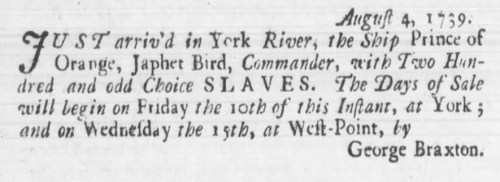
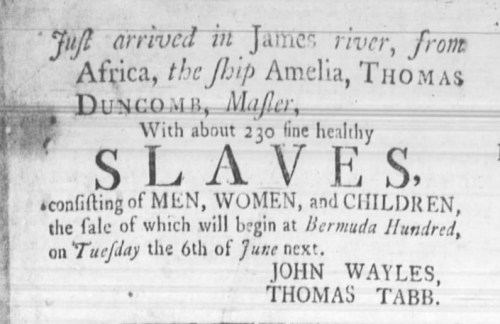
Imagine the infrastructure that had to have been in place in 18th century colonial America before the American Revolution.  Take just one ship arriving in one port city in Virginia, like York or Bermuda Hundred, both on the James River, with a cargo of nearly 500 African slaves.

People would have been herded off the ship and placed into a holding pen of sorts to wait for up to two weeks or more as they are advertised like stock, which in fact they are considered, in newsprint and by word of mouth.  Before they were led out onto an auction block to be sold individually or in small groups they would have been examined intimately, as they had been on the ship, to confirm their health. A few behind the scene deals would be made, of course. Not every slave would need to stand on the block before being transported to his or her place of servitude.

That’s one ship, one port and one delivery of slaves. But there were many ports in colonial America and many ships delivering their human cargo before loading their holes with colonial-made goods, like tobacco and molasses.

So imagine the growth in and the scale of operations over time – not one ship at one port with hundreds of slaves on board but multiple ships dropping off thousands of chained people who had homes and identities that were stripped away. Who had cultures millenia old that were dismissed in this new land. Who had languages, arts and religions that were deemed insignificant. Who had skin in wondrous shades of brown which made them seem so “other” that perhaps that otherness made it especially easy for people to dismiss their humanity.

2VAGazetteJuly81737

July 8 1737 Ad in Virginia Gazette

5VaGazetteAugust31739

August 3 1739 Ad in Virginia Gazette

7VAGazetteAug171739

August 17 1739 in Virginia Gazette

Imagine how a concept of indentured servitude referred to in the early days of colonial life — you could eventually buy your way to freedom — evolved into something much more insidious and institutionalized as black African slavery became the engine for a growing economy. An economic growth that would help fuel the idea of creating an independent United States versus remaining colonies subject to British rule.

4VAGazetteMay251769

May 25 1769 in Virginia Gazette

Not all were in agreement with slavery and eventually the slave trade from Africa would officially end around 1810 (though it would continue illegally long after).  As future generations of slaves were born, not in Africa but in the colonial and then United States, it became de rigeur not to allow them to learn to read or write. To prevent their gathering for worship except under very proscribed conditions. To prevent their free movement by chain, by brand and by paper pass. They were property – perhaps loved or respected by those who owned them – but they were property nonetheless.

9VaGazetteSep151752

September 15 1752 in Virginia Gazette

Tens of thousands and eventually millions of people would be born into a system that had evolved to maintain a “free” labor force through intimidation, denigration and willful ignorance of horrors against humanity. I say willful ignorance because even people who were kind to their slaves had to be aware of what would happen if their slaves ran afoul of patrols without their papers and so on.  The identity of the slaves, their sense of self and of their worth in this world, would be shaped by a cruel system as would be the identities of the people who maintained that system with both wealth and whip. Slavery as an institution, on that scale and by that design, exist no more in this country … but human nature remains the same … the good, the bad, the ugly and all that lies in between.

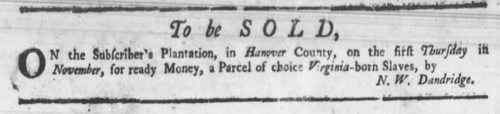
When I compare 18th century newspaper clippings about slave auctions, slaves being sold as part of estate sales, advertisements for the return of runaway slaves, and so on to slave narratives from the 1930s, nearly two centuries later, it is extremely sad and insightful to see how slavery in this country was nearly successful in keeping a people down and it is only because of visionary and courageous people, of all races, working hard across all of those centuries that I am able to sit here pounding away on my computer. Without fear.

Why revisit this past? In this age of 140-character messages, history is becoming increasingly sanitized. And I guess because I am reading too much in this 21st Century about people looking back with nostalgia about those former times.  The patrollers of those centuries, from the 17th into the late 19th centuries, riding through the countryside in various states rounding up brown people without papers were not civil servants – they were a fear mongering horde whose jobs enabled their most base behavior. I don’t care the color of the shirt, red, or the hood, white, all who wore them in those times did so to generate fear. And people are wearing those colors today.

There are far too many people who are fearful today. And that is wrong. That’s my random musing this Sunday. Back to nature photography next week. Maybe.

Read Full Post »

That’s what he said. I made an assumption he was a man based on the timbre of his voice because I was rather blinded by the blowing sleet and snow. I couldn’t see.

I was trying to cross the street, making my way to the train, but the puddle that had formed in the intersection earlier in the day was so large I couldn’t tell where the sidewalk ended and so I was having to walk in the street but I couldn’t see and was just hoping the drivers could see me.

“Here, take my hand!”

And so I reached out and a mittened hand grabbed mine, holding me steady as I danced across the slushy lake to his side. With no windshield wipers for my glasses all I could tell was that he was a tall man dressed a bit more properly for the weather than me. “Thank you,” I said and then I shouted, “Stop!”

He had started across the crosswalk toward the other side but in helping me he hadn’t noticed that the street lights had changed. Not many cars on the road that night but there was one that streaked past.

We crossed the road together, walking into the wind. Though we could not really see each other we still managed to chat about the weather. By the time we made it to the station we had concluded jovially that after surviving that winter of three three-foot snowstorms in a row, how bad was this really?

Entering the station, my glasses instantly fogged. I stared at what I thought was his general direction and said, “Thanks again.” He replied, “And same to you.”

And I thought as I waited on the platform that once again a stranger had taken my hand.


Read Full Post »

dscn1168

When I walked toward the river yesterday, I was so cold. I knew I couldn’t walk the length of the Esplanade photographing its wintry landscape but I felt compelled to try. I had not been to the river in a long time. Rivers have been on my mind of late.

dscn1174

I’ve been thinking about rivers and how they branch and what you can find in those branches over time. How rivers can run deep, they can run shallow, they shape the land even as the land shapes the flow of the waters.

dscn1175

Of late both a song and a poem about rivers periodically run through my mind. The song, composed by Sam Cooke, begins …

I was born by the river in a little tent
Oh, and just like the river I’ve been running ever since

It’s been a long, a long time coming
But I know a change gon’ come, oh yes it will …

The poem, as written by Langston Hughes, opens …

I’ve known rivers:

I’ve known rivers ancient as the world and older than the

flow of human blood in human veins.

My soul has grown deep like the rivers. …

dscn1177

My fingers already freezing, I made it to the river’s edge and began walking along an icy stretch.  I looked around waiting for something to catch my attention. I watched where the sunlight fell. Finally I came to a point, as may always be the case, when I had to decide how much further I could safely continue versus turning back.

dscn1179

I paused, took a deep breath and looked around. I planted my feet and took a few photos. Right there. That was all I had. Just that given moment before I had to race into the nearest shop to warm myself. Later as I scrolled through the few pictures captured I was glad that I had decided to take action in that given moment. What to do in a given moment? That is the question I ponder as I follow rivers and as I do my best to follow the daily news.

dscn1181

It is a deluge. A constant stream of information. A co-mingling of truth, lies, opinion, jargon and drama spread with too much rapidity across social media platforms, often without deep thought or editing. And not just at the Presidential level. The profound nature of the changes taking place right now in human history across this planet is quite breath-taking. It is paralyzing to some, invigorating to others, and then there is everyone in between. For me,  I am learning, as by the river, to pause and take a deep breath, and then to decide what I can do, from where I am, at a given moment.

dscn1197

I’m not sure when I will be returning to the river, at least the Charles River. Too cold right now but Spring will come. The bared branches arching over the water will soon enough be green.


Sources & Additional Reading

The Negro Speaks of Rivers by Langston Hughes

A Change is Gonna Come by Sam Cooke


Read Full Post »

Eventually, it would work this way — some places were safe and some places were not. If you could make it to the safe place, sometimes woods, sometimes city, then you were safe. But eventually laws were changed, compromises made, and so then even if you made it to the safe place, you could be forcibly brought back to the unsafe place. Sometimes people stood up for you. Sometimes those people were steadfast but there were times when even those pillars were pushed aside. That is what the children remember. How if they did not have the right papers, and especially if they had no papers at all, how the pattyrollers could pick them up, hit them, chase them with dogs. It did not matter if they had made it to sanctuary. Laws said that they were less than human. Only 3/5ths. Until a President put pen to paper.

The Forest Floor

It took me a while to understand the word drawn from the childhood experiences of the former slaves, their fears of the pattyrollers. These patrollers were charged with keeping track of slaves in the slave owning states and eventually given legal right to enter into free states and bring back those who had sought a free land.  Back into slavery the children would go … until a President put pen to paper.

That President was Abraham Lincoln. His pen upon paper produced the Emancipation Proclamation, an executive order issued on January 1, 1863.

In his famous eulogy for the slain President, Reverend Phillips Brooks made note that Lincoln served a divided nation and describes how Lincoln was able to stand forth in the struggle between two American natures.

We are told he did not come to the Presidential chair pledged to the abolition of slavery. When will we learn that with all true men it is not what they intend to do, but it is what the qualities of their nature bind them to do, that determines their career! The President came to his power full of the blood, strong in the strength of Freedom. He came there free, and hating slavery. He came there, leaving on record words like these … “a house divided against itself cannot stand. I believe this government cannot endure permanently, half slave and half free. I do not expect the Union to be dissolved; I do not expect the house to fall; but I expect it will cease to be divided. It will become all one thing or all the other.””

Brooks goes on with great eloquence, an eloquence that cannot be conveyed in a blog post but these words stand out to me … “Do not say that [slavery] is dead. It is not, while its essential spirit lives. While another man counts another man his born inferior …” Brooks ends the sermon with Lincoln’s own words delivered at Gettysburg. “He stood there with their graves before him and these are the words he said” –

“We cannot dedicate, we cannot consecrate, we cannot hallow this ground. The brave men who struggled here have consecrated it far beyond our power to add or detract. The world will little note nor long remember what we say here, but it can never forget what they did here. It is for us the living rather to be dedicated to the unfinished work which they who fought here have thus far so nobly advanced.””

Over 150 years after the American Civil War, I live in what is known as a sanctuary city and I work in a place of sanctuary. I read of students demanding that their campuses become places of sanctuary. I wear no blinders, at least on this subject. What has happened before can happen again. But it does not have to. It does not have to. All this said as a new President of a different character continues to put pen to paper.


Read Full Post »

One day I stood before a giant globe atlas with a friend in elementary school. We liked to spin it round and round. That day, and I’m not sure why, he stopped the globe and pointed at a place. He looked at me and said with a smile, “That says nigger. That’s what my mama told me.” I squinted at the spot (I needed glasses) and then I said to him, matter of factly, “No. That says Niger. I think your mama got it wrong.” His smile faded. And then we went out to play.

One day in high school computer class (Pascal!) I sat next to a friend whom I’d known since elementary school. We were both geeky. I wore a short skirt and one of my first pair of pantyhose. I almost felt grown up. He kept rubbing my knee. I was beginning to think he might like me. I didn’t know how to giggle but I did smile at what he was doing. I guess he noticed because he said  all of a sudden, “Cynthia, my mother doesn’t like black people. She wouldn’t let me bring you home.” I simply said, “Okay.” And in my mind’s eye I remembered his mother and my mother talking cordially at a parent-teacher meeting.

One day not long ago I stood in a place where I was tasked to welcome strangers. Two men walked in, one wearing a t-shirt emblazoned with a Nazi symbol and the other wore a t-shirt that said, white people are the best people. I did not feel very welcoming but to be welcoming was my job. In the end, on that day, the gentlemen and I conversed about everything except what they wore on their shirts and the color of my skin. We went our separate ways both still existing and having to live with each other in this world.

All of these things happened to me before Trump was voted in as President. I don’t blame Trump for racism, conservatism, alt-right, Breitbart and all the other ugliness in this world. I blame him for fanning the flames of hate. I hold him accountable for the blinders he chooses to wear about what he has done and his active willful ignorance about the scale of the harm he will do to this nation and the world with his cabinet choices.

He has become the President of a flawed, great nation. That nation will not fall with his presidency but it may fracture in ways not even conceived of yet. Will I hold him, Pence and others accountable? Yes! But I will also hold myself and others accountable if we do not take every opportunity, each day, no matter how seemingly small, to become better educated, informed, engaged and active world citizens.

One day …

Read Full Post »

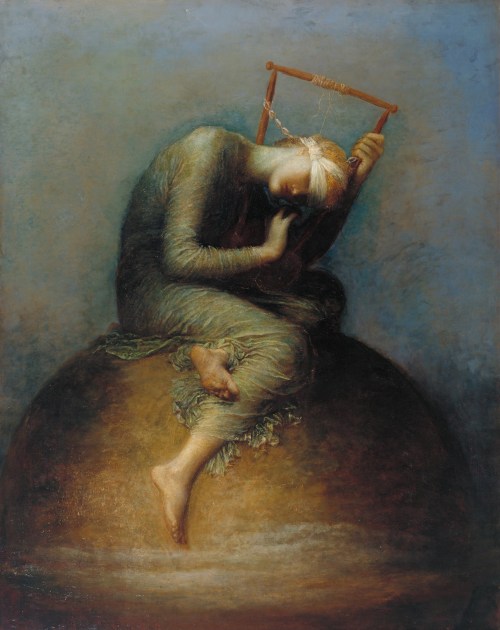
Hope by George Frederick Watts

In 1959, Martin Luther King Jr would open a sermon with these words about shattered dreams, “Our sermon today brings us face to face with one of the most agonizing problems of human experience. Very few, if any, of us are able to see all of our hopes fulfilled. So many of the hopes and promises of our mortal days are unrealized. Each of us, like Shubert, begins composing a symphony that is never finished. There is much truth in George Frederick Watts’ imaginative portrayal of Hope in his picture entitled Hope. He depicts Hope as seated atop our planet, but her head is sadly bowed and her fingers are plucking one unbroken harp string. Who has not had to face the agony of blasted hopes and shattered dreams’?

English painter George Frederick Watts (1817-1904) would paint the first of several versions of Hope in 1885. Its symbolism would prove very popular and over time it would be massively reproduced. I read that by the 1930s however his work fell out of fashion and major galleries like The Tate removed his work from permanent display. So I do wonder when, where and how Martin Luther King first saw Hope. I do know when a young Barack Obama learned of the painting. It was in 1990. Pastor Jeremiah Wright would deliver a sermon, The Audacity to Hope. Wright’s words would move the young student who would eventually rouse a whole nation (mostly) with a notion that he would call, The Audacity of Hope.

So where is hope these days? In part its a personal question that we each have to grapple with on any given day depending on what’s happening in our lives.

sir_edward_coley_burne-jones_-_hope_-_google_art_project

Hope by Edward Burne-Jones, 1896

Watts and later his friend Edward Burne-Jones each painted variations of Hope during dark periods in their lives. For Watts that period included the death of his adopted daughter’s child. Burne-Jones had been commissioned by a wealthy American to paint a dancing figure but as he dealt with the death of his friend and colleague William Morris he asked if instead he might paint Hope. I think of hope as something you hold on to or reach out for. And sometimes it even settles around you like a warm blanket when you least expect it. Or, as Emily Dickinson wrote,

“Hope” is the thing with feathers –
That perches in the soul –
And sings the tune without the words –
And never stops – at all –
And sweetest – in the Gale – is heard –
And sore must be the storm –
That could abash the little Bird
That kept so many warm –
I’ve heard it in the chillest land –
And on the strangest Sea –
Yet – never – in Extremity,
It asked a crumb – of me.

Sources & Additional Reading

http://www.thekingcenter.org/archive/document/shattered-dreams

Click to access July1962-March1963DraftofChapterX,ShatteredDreams.pdf

http://www.nydailynews.com/news/politics/victorian-painting-g-f-watts-inspired-obama-harp-hope-article-1.358686

Watts Magazine, p.14+

https://www.poetryfoundation.org/poems-and-poets/poems/detail/42889

Read Full Post »

Read Full Post »

I’m not as limber as I once was and so I was having difficulty getting through the window but I didn’t have to fret for long because a stranger took my hand and pulled me through and when I lost my shoe on the rim of the window frame, he picked it up and gave it back to me and then turned and continued to help other strangers out of the train.

I wasn’t sure that I’d write about the chaotic experience of being on the Orange Line train yesterday in Boston’s Back Bay Station that filled with smoke. In the moment I was less concerned about the possibility of a fire in the station and more concerned about the growing panic of the people around me. Later I just wanted to let the incident go. But then today I picked up something and I remembered the feel of that man’s hand holding mine.

It was rush hour. People had had a long day and just wanted to get home. The car in which I stood was not packed but it was tight enough especially as most of us wore the beginnings of our winter gear. The lights were on but there wasn’t much air circulating and the intercom system must not have been working because there was no news being shared by anyone. The train had partially pulled away from Back Bay Station before coming to a halt, and later, officials would note that that was the reason the train operator could not open the doors, because of the danger of people stepping onto the tracks and landing on the electrified third rail. But most people were not thinking of that as the smoke grew thicker, and from inside the car, we could see people on the platform start to run for exits.

Even as I was starting to say, please, be calm, I felt my own panic rising. And then people began to scream, especially when they realized the doors were not opening. People began beating at the windows. The smaller windows on the sliding doors were easier to break. Individual flight was on many a person’s mind for sure but others were trying to help scared people through the small openings. Then in the part of the car where I stood, a man on the platform motioned people away from a larger window. He was not a train official or one of the policeman stationed in the area. He was just a regular guy. He kicked at the window, again and again, until it flew in, a single large sheet, shattering into a spider’s web pattern but no jagged edges did I see. People started leaping out the window while that man and some others stood, held out their hands and helped strangers out. I did not stop to ask his name but I think I shall never forget him.

Read more: Boston Globe article

Read Full Post »

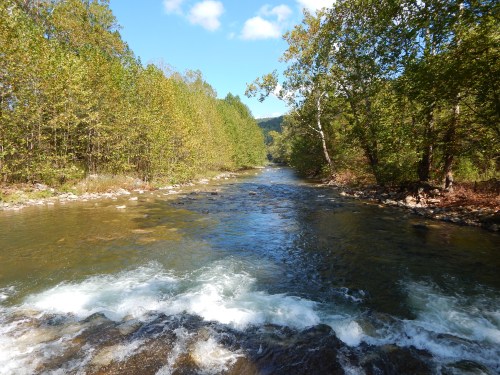
A long trip is nearing its end. I rest in a place that is stunningly beautiful. It is an unexpectedly thought provoking place. The mountains of West Virginia. I have been here before but never during a campaign year. Trump-Pence signs are on many a lawn, as are surprisingly to me, a few Gary Johnson. No Hillary Clinton signs seen so far. As I interact with people here, I can imagine that she would seem quite foreign. I am reminded of the time I sat in an airport near two older ladies watching a television. George W. Bush was on the screen. He spoke but the sound was on mute. One of the ladies said, “I’d invite him to my picnic. I think I’ll vote for him.” Policy and experience were moot. He came across as familiar and likeable. Clinton does not. Yet Trump does? Fascinating.

I am in an area that is approximately 96 percent non-Hispanic White according to demographic tables. Without looking up the statistic, I suspected such a number. I stand out quite a bit. People stare whenever I step out of a car, walk across the parking lot, sit in a restaurant. The culture here is a bit different than my recent experience in South Carolina. There, even if you stand out as different, the culture is such that you “throw up a hand” or acknowledge a presence in some way. At least, that’s the way it used to be. Here … people sometimes seem startled when I say hello or look at them and smile in greeting. Some will nod back. Others just stare. At times I felt uncomfortable, and it wasn’t just the Confederate flags peppering various places. The flags were old and tattered. Perhaps those were really about heritage and not about the new symbolism of hate.

Sitting in a diner — lovely staff, good food –I watched the local news. On screen, a black man was asked by a white man if discrimination still existed. Everyone who walked through the door glanced at me. That’s fine. Once while working with a youth writing program in Boston, we brought the children across town to do an activity. Afterwards we went for ice cream at a nearby ice cream shop. One of the girls leaned against me. She said, “Cynthia, nobody here looks like me. Like us.” I said, “And that’s okay. To go places and to be different. Let’s pick out our ice cream.”

To go places. To be different. Even if one is not readily welcomed. There is value in that especially in a world where it is too easy to view those who are different, those with whom one has had no personal experience, as … well … those who should be held at bay with walls and exclusionary laws that have been passed in the past and can be again.

Because of the various circles I run in for work and pleasure, sometimes people will say to me, “Cynthia, I think you’re the first black person that such-and-such has interacted with.” I have to hope that I am not the last. And I have to hope that interaction is more than what’s shown on TV and in social media.

This is an incomplete post in the sense that these thoughts and my experiences from this trip are still percolating. We’ll see what the future holds. I’m grateful for the opportunity to wind my way through West Virginia and to glimpse just a bit of its natural beauty.

Read Full Post »

« Newer Posts - Older Posts »