Feeds:
Posts
Comments

Posts Tagged ‘storytelling’

Visiting Virginia a few summers ago, I stopped in a small city. It was a literal crossroads of sorts. Fancy antique stores and cheap thrift shops lined the road. Around these buildings people had set up long tables for further display.  My partner and I sauntered through the buildings.  As usual in such places we found a wonderful mix of treasure and trash. Later, he wanted to peruse the tables.  Usually I would have raced ahead but I found myself hesitating as I watched one of the tables being prepared.  Two men arranged an amazing array of items, items that had one unifying theme. They all displayed the Confederate flag.

While I had to pass that table to get back to the car, I did not get close. Eye contact was made with one gentleman. With both our heads held high, we nodded in that southern way of closed lipped acknowledgement. It was not an unexpected sight especially because this encounter took place shortly after all the hullabaloo of removing the Confederate flag from institutions nationwide. Not unexpectedly, at least to me, online sales of the flag (and in-store sales depending on where one lived) went through the roof. But it’s America, right? As private citizens, those gentlemen could choose to sell the flag. And I could choose to walk away.
Recently one of my brothers who lives in southern Virginia described driving past an estate where half of the owner’s lawn was covered by a Confederate flag. I told him I wanted to ask the owner what was the intention behind such a display. He joked that I probably wouldn’t make it halfway up the driveway before the owner would step out with his licensed gun, and perhaps his dog at his side, to encourage me to leave his property. Okay, my brother became a bit more descriptive and I chastised him for making such jokes. If the owner wanted me to leave his property, he could. It’s America, right?

For those who do not know, I am an African American woman who grew up in the foothills of the Blue Ridge Mountains of Virginia. When I return to my hometown or attend a reunion at the school I attended in North Carolina or visit family now settled in South Carolina, I have at least two expectations. One is to bathe in the beauty of the southern natural landscape and two is the likelihood of seeing Confederate flags. After living in New England for nearly twenty years, I certainly have that first expectation. There is no New England state that I have visited where I have not experienced great natural beauty. But that latter expectation … no, I guess I did not have that one though I now do after last weekend.

I later described it as being caught up in a Klu Klux Klan rally but no one wore a hood. There were no torches or anyone burning but there was plenty of black smoke and revving of engines. I’m  sure there were guns but none were on display. Nothing illegal was done that I could see except for some bikers racing by in the breakdown lane but they didn’t do so for long. They just did it to keep up with the pack, or I guess I should say the convoy, of three dozen or more vehicles — trucks, cars, jeeps, bikes — driving along the highway from Massachusetts into Rhode Island, waving the Confederate flag. The American flag was flown too of course.

When I saw the first truck, a large black pick up, with Trump and Pence stenciled in white on the side, I thought, “Well, this is America.” Then as we kept driving along I saw more vehicles, a beat up Corvette with a Confederate flag nailed to the roof, more pickup trucks with large chimneys and flashing lights in addition to their flags, bikers with the flags pinned to their leathers.  I really, really, really didn’t want to be in their midst but there was no other route to our destination.

I could avoid that table in the Virginia flea market with its sea of Confederate flags but I could not escape this experience. We all had to share the road, and we did so for a very long time. Finally the vehicles all left the road, to pull into a Rhode Island rest stop.  Their final destination I have no idea. We completed our journey into the quiet of Rhode Island’s small towns.  I slumped back into the seat, exhausted. Why was I exhausted?

Well …

Later that weekend, people asked me how did I know that there were three dozen or so vehicles in the convoy. I explained that I counted them. With the luxury of being a passenger and not the driver, I looked at each vehicle surrounding and then passing me. I looked at license plates (several New England states were represented). I looked at the drivers who would not look back at me. I got the feeling that they had all been instructed to keep their eyes on the road and to do nothing intimidating individually because what they were doing as a group was much more effective.

I don’t know if it’s nature or nurture, likely a combination, but there’s a thing that happens to me in certain situations. It’s the confluence of past and present. There’s a scene in the movie 12 Years a Slave, and a scene in the movie Glory, and scene in any movie  involving slavery, where a man or woman is tied up and whipped. I have many a friend and family member, of different races and ages and life experiences, who will turn away. I cannot. My back straightens. I hold my head high. Not so much to bear witness but it feels almost like channeling ancestors who did what they had to do to survive but they would not be subjugated. To sit in that position for an hour, so tense, was exhausting.

In that Virginia flea market, when I made eye contact with the vendor selling the Confederate flag, and nodded at him in acknowledgement, in a different day and age, for such behavior, for stepping out of my place, I would have been whipped. I know, I know. There some who might say, there you go stirring up the past again. But that past is a part of my American heritage, and every American’s heritage.

I am a major proponent of “just go with flow” and “just let things go.” Being caught up in that convoy for about an hour, those philosophical tendencies were replaced with something else. I increasingly wanted the drivers to look at me. I wanted to look into his or her eyes and to see who they were. And I wanted them to see me. As with the man in Virginia with the Confederate flag covering his lawn, I want them all to explain to me the intention of their display and to do so with other words than “It’s about heritage, not hate.”

I had my camera with me, of course, but I refused to pull it out. There was no need to capture in pixels and post on this blog such imagery. But I did want to share an experience that I will not let go of but I will certainly move beyond.

Save

Save

Save

Save

Save

Save

Save

Read Full Post »

Before I began photographing the stained glass windows of St. Cyprian’s Episcopal Church in Roxbury, MA, the Rector Monrelle Williams invited a longtime parishoner, Ms. Leslie Gore, to share the church history with me. An active member since a child in the 1950s, she described Sunday School classes of 300-500 children, the different guilds, the cotillions that took place, the plays produced in the lower parish hall, and much more. Finally, I asked her, if there was one thing that she wanted people outside of her congregation to know about St. Cyprian’s what would it be. With a beautiful smile, she said, “I’d want them to know that this place is home. A beautiful place to be. A place where people encompass you.” As I photographed the stained glass windows, I thought of the children she described including her own. As they raced about the church, sang in the choir, and participated in other social and cultural activities, around them they would have seen themselves and learned about their history, American history, rather uniquely.

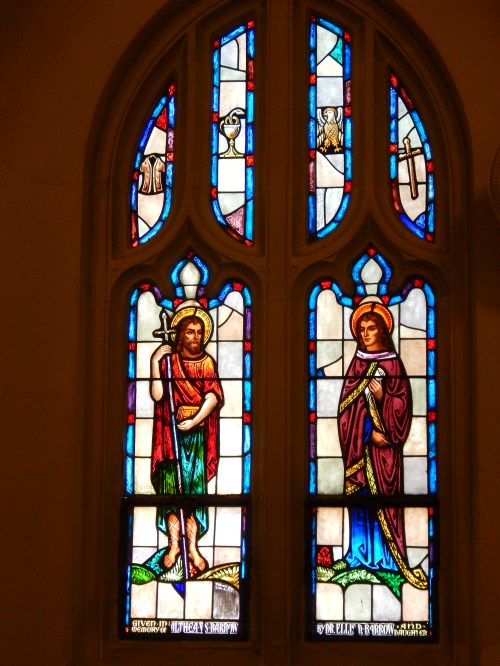
St. Cyprian’s is located at 1073 Tremont Street. While the physical structure was built between 1922 and 1924, the actual coming together of people for worship began much earlier. They were people who had emigrated to the U.S. from the former British West Indies and African Americans migrants from the southern states. Those who moved to Massachusetts primarily settled in Boston and Cambridge. It was the first decade of the 20th Century. It was a period of great change, opportunity and of racism. While many of these peoples wanted to attend existing Episcopal churches, they were rebuffed both overtly and subtly. In May 1910, a group of people decided to meet for worship in a private home. As numbers grew, they began to worship in other churches when those churches were not holding service. It was a nomadic existence, and again one where things were done – e.g. the fumigation of one church after they had left – thus spurring people, under the leadership of Reverend David Leroy Ferguson to raise the funds to buy land and build their own church. A home was created. And in that home there is lovely stained glass with traditional Christian imagery depicting figures from the bible …

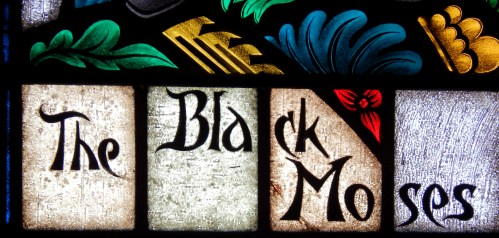
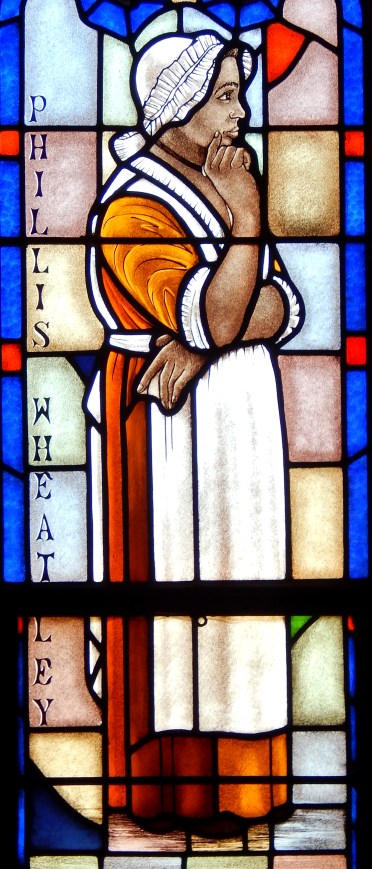
… and then at some point the community of St. Cyprian’s made a decision to depart from the traditional practice of using biblical figures and to instead highlight black people, men and women, “who have made significant contributions to the liberation and empowerment of our people. … Our stained glass windows, therefore do not serve to beautify the building or to enhance its ambience, rather they serve to educate us about the outstanding contribution of men and women to the betterment of our community.” “It is my hope,” a former rector concludes in a descriptive pamphlet, “that as we celebrate their lives and deeds that we may be inspired to follow their blessed footsteps to make our community and nation a better place for all.”

Sojourner Truth and Harriet Tubman

Mary McLeod Bethune

Phyllis Wheatley

Phyllis Wheatley

The images span the past into the present.

Richard Allen and James Forten

Richard Allen and James Forten

Prince Hall

Prince Hall

A booklet titled Voices and Victors in the Struggle features the biographies of each of these people. And thanks to physical libraries and of course the internet, if you are unfamiliar with the historical significance of these folks you can choose to discover why they have been recognized in this church.

Marcus Garvey

Martin Luther King Jr and Frederick Douglass

Martin Luther King Jr and Frederick Douglass

Absalom Jones

Alexander Crumwell

Alexander Crumwell

The Rt. Rev. John Melville Brugess

The Rt. Rev. John Melville Burgess

St. Cyprian’s was built by a people rising above discrimination. Over time and deliberately, members sought to use design as a tool for empowerment and celebration of the achievements of people of color from many different backgrounds.

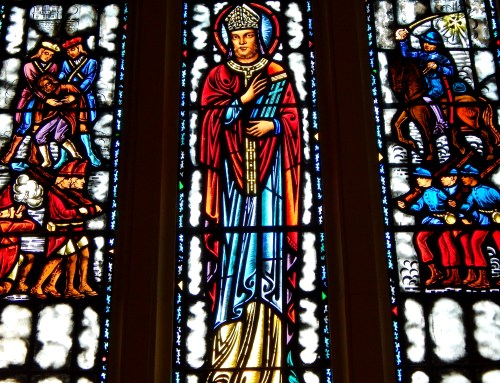
St. Cyprian

St. Cyprian

It was inspiring to learn of this church and its founders, and to see firsthand the beauty and history shared through its windows.

Sources & Additional Reading

About St. Cyprian’s


Save

Save

Read Full Post »

Titian, active about 1506; died 1576 Bacchus and Ariadne 1520-3 Oil on canvas, 176.5 x 191 cm Bought, 1826 NG35 http://www.nationalgallery.org.uk/paintings/NG35

Bacchus and Ariadne, 1520-3, by Titian

In Titian’s painting of Bacchus and Ariadne, Bacchus, god of wine, emerges with his followers from the landscape. Falling in love with Ariadne, he leaps from his chariot, drawn by two cheetahs. Ariadne had been abandoned on the Greek island of Naxos by Theseus, whose ship is shown in the distance. Initially she is fearful. Eventually Bacchus raises her to heaven and turns her into a constellation, represented by the stars above her head. So the story is told on the website of the UK National Gallery where the painting is now housed. While wonderful to see such a work in a book or on the computer screen, it is a whole other experience to view it in person.

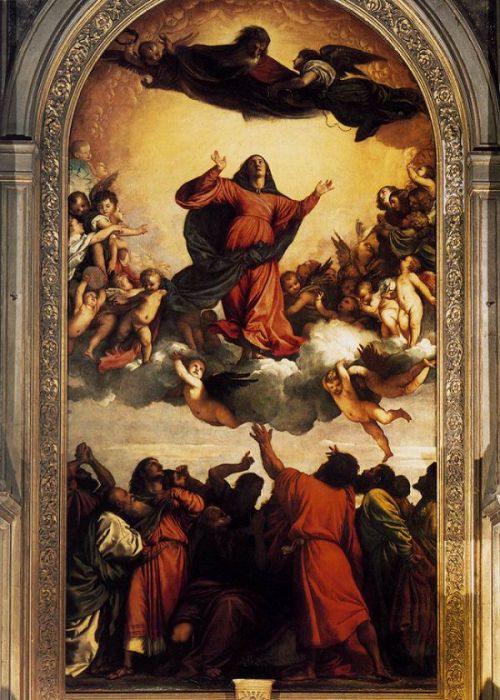
Painter Donald Langosy wrote about such an experience. He was a young poet chasing Ezra Pound around Venice. “But my meeting with Pound was overshadowed, quite unexpectedly, by entering the Frari church one day and finding myself facing Titian’s Assumption. … My encounter with Titian’s painting was an aesthetic epiphany.”

Assumption of the Virgin, by Titian

Assumption of the Virgin, by Titian

From Titian and other Venetian masters, Langosy would begin to understand how artistic technique was the servant of ideas.  He would share their work with his daughter, Zoe. “I learned what it meant when my father pointed to the sky and said, “It’s a Titian blue.”

Diana and Callisto by Titian

Diana and Callisto by Titian

Viewing Titian’s painting in person certainly influenced Langosy’s early work.

Detail from Flora by Langosy

Detail from Flora by Langosy

Pucinello by Langosy

Seeing Titian in later years would become an unexpected opportunity for two artists, father and daughter, to focus on the beauty to be found even during challenging times. In Zoe’s own words:

“Over the years, my father developed multiple sclerosis, and our once-frequent visits to the Boston Museum of Fine Arts or the Gardner Museum became increasingly rare. Shortly before my father lost the ability to walk entirely, he and my mother traveled to London, where I was living at the time. Walking with a cane and with great difficulty, he set out one day with one purpose: to see Titian’s Bacchus and Ariadne at the National Gallery. It was a masterwork that he had never before seen in person and, of all the great works of art in London, it was the one he refused to miss.  While my mother and I wandered through the nearby exhibits, he sat studying that single painting for nearly an hour.”

Detail from Bacchus and Ariadne by Titian

Detail from Bacchus and Ariadne by Titian

“As the years progressed, my father’s MS caused physical discomfort and fatigue that made it increasingly difficult for him to travel even as far as the local art museums we had enjoyed together. Our conversations about art never took place outside the comfort of the studio, living room, or kitchen at my parent’s home in the Boston suburb of Medford. Then, one day, we read in the newspaper about the “Rivals of Renaissance Venice” show at the MFA. That moment created a breakthrough. My father knew this was a show that he could not and would not miss.”

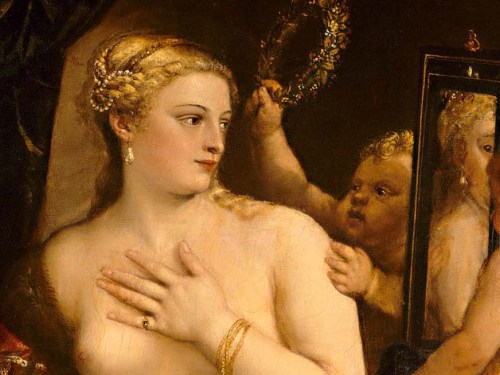
Detail from Venus with a Mirror by Titian, at the MFA 2009 Exhibit

Detail from Venus with a Mirror by Titian, at the MFA 2009 Exhibit

“We chose a time when we knew the museum would be quiet, and, on a hot summer morning, my father, mother, and I traveled into Boston to see the exhibit. Above all, we went to see the Titians. As I pushed my father in his wheelchair, we stopped for a long time at each painting. Sometimes we would quietly look at the art, while other times we would talk about what we saw. For the first time in many years, I was given the gift of being able to walk through a museum with my father again and share with him one of the things that we both love most: art. Visiting the show was highly enriching for all of us.  Since then, my father has found renewed strength to combat the hold that MS had placed on his activities, and he is determined to attempt such outings on a more regular basis.”

Zoe with her father's portrait of Elizabeth

Zoe with her father’s portrait of Elizabeth

—

Want to learn more?

View Langosy’s The Story of My Art: 1, 2, 3, 4, 5 and 6.

View four decades of Langosy’s work at http://www.donald.langosy.net/

See what’s current on Langosy’s Facebook page.

His contact: Zoe Langosy at zlangosy@me.com.

Read Full Post »

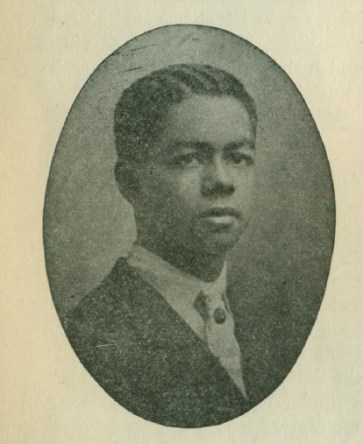
Richard Lonsdale Brown, Class of 1910

Richard Lonsdale Brown 1910

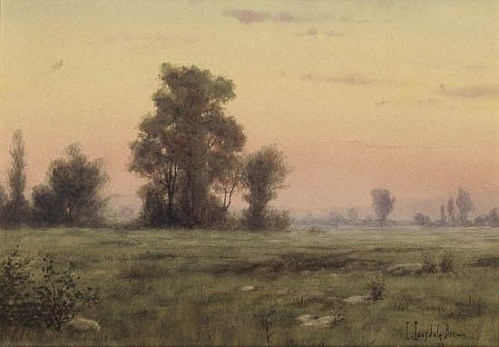
In January, I posted the story of an African American artist named Richard Lonsdale Brown (1892-1917). Recently I came across new information that inspired me to revisit his life.  Raised in West Virginia, he traveled to New York City where his talent was recognized. He was featured in the New York Times.  As was often the case for young fine artists, supporters hoped he’d continue his artistic studies in Paris. The trip would never take place. Brown died at the age of 26. Few of his watercolor or oil paintings survive today but he may have left an unexpected legacy in the impact he made upon W. E. B. Du Bois.

W. E. B. Du Bois

W. E. B. Du Bois 1868-1963

The two men would meet shortly after Brown graduated from West Virginia Collegiate Institute, earlier known as the West Virginia Colored Institute. There “In connection with his academic studies he took painting as a trade, under the late George Collins of South America, who was quite an artist. In addition to house painting and interior decoration, the boy showed wonderful aptitude for artistic painting, and was encouraged to paint the hills and scenery along the Great Kanawha River near the institution.” (1)

Brown would eventually make his way to New York City where he would share his portfolio with artist George De Forest Brush. Brown would later share in an interview that he remembered walking up and down Fifth Avenue trying to sell his pictures to galleries to pay for food and rent. He was about to give in to despair when …

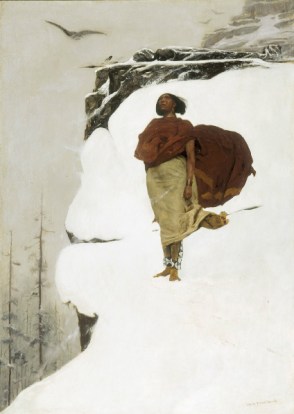
Mourning her Brave by George de Forest Brush, 1883

Mourning her Brave by George de Forest Brush, 1883

Brown found the artist’s studio and knocked at his door. Brush answered. He listened and then he reviewed the modest portfolio. An internationally renowned artist, Brush recognized the young man’s talent and invited him to study for a summer in Keene, New Hampshire.  Afterward he studied at the American Academy of Design.  Through Brush, Brown’s work would catch the attention of the founders of the newly formed National Association for Colored People (NAACP), including W. E. B. Du Bois and Mary Ovington. He became their protege.

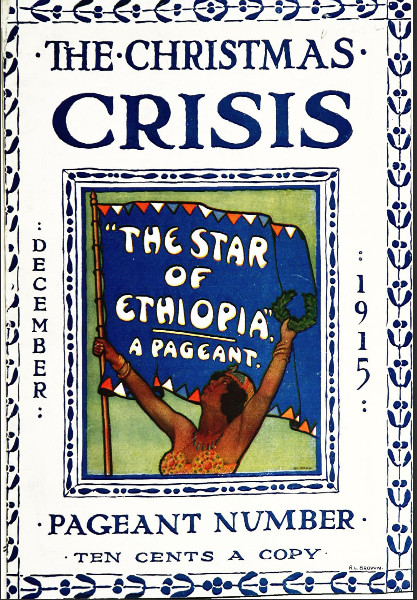
On January 1912, his artwork was exhibited during the first annual meeting of the NAACP, and would be exhibited during future annual meetings as well.  In March, with Ovington’s aid, his work was exhibited in a NYC gallery. The press was spectacular. The turnout was great. Brown’s works were purchased by collectors from around the world.  Later in the year, his artwork would grace at least two covers of The Crisis, the national magazine published by the NAACP.

In 1913, he would turn his attention from painting landscapes to design and decoration as he worked with Du Bois to execute The Star of Egypt.  In 1911, Du Bois had written The Star of Egypt, a historical pageant presenting the history of African Americans over time. Brown would serve as set decorator, along with Lenwood Morris. He would travel with Du Bois as they met with both blacks and whites in an effort to raise funds. An elaborate production involving casts of thousands, it was well-received though struggled with financing. The pageant would be staged in three cities during Brown’s life, New York in 1913, Washington, DC in 1915, and Philadelphia in 1916.

December 1915 Cover by Richard L. Brown

December 1915 Cover by Richard L. Brown

His time in the northeast studying art, his work with W. E. B. Du Bois, the changing landscape of America and a world that was on the brink of war, all of these things were influencing Brown’s artistic aspirations. In a 1913 interview about his art, he tentatively but determinedly brings up the question of race.

A few years later he would confide in Mary Ovington about his changing perspective. She shares in her memoir:

That trip South she refers to would take Richard Brown to his parent’s home in Muskogee, Oklahoma.  The year was 1917.  On his World War I draft registration card, completed in Muskogee in June,  he notes his occupation as artist and his race as African. He died of pneumonia in September of that year.

While it is unclear why Brown returned to his parents, it is clear from subsequent editorials by W. E. B. Du Bois in The Crisis that Brown, like many black artists in that time, was not making a living as an artist. Always a proponent for nurturing art within the black community, Du Bois took pride in showcasing the talent of young artists like Richard Brown. As he refers to Brown in editorials over the next few years it is with an underlying note of frustration if not outright anger at the loss of this young man’s talent from the world. Those feelings are directed at the white community and at the black community for not financially supporting the creativity within its midst.

An obituary for Brown in the January 1918 issue of The Crisis states “he started on a trip to see what beauty he might find in the South. … Some of us, perhaps all of us, are to blame that Richard Brown was not given a better chance to develop a gift which some of the greatest artists called wonderful.”

In a May 1922 editorial in The Crisis titled Art for Nothing, Du Bois writes:

“There is a deep feeling among many people and particularly among colored people that Art should not be paid for. The feeling is based on an ancient and fine idea of human Freedom in the quest of Beauty and on a dream that the artist rises and should rise above paltry considerations of dollars and food. At the same time everybody knows that artists must live if their art is to live. Everybody knows that if the people who enjoy the artist’s work do not pay for it, somebody else must or his work cannot go on. Despite this practical, obvious fact, we are united with singular unity to starve colored artists.”

He proceeds to list a series of living artists from Meta Warrick Fuller to William A. Scott all struggling to make a living but he concludes the list with his lost protege, “Richard Brown died of privation while yet a boy.”

In another essay about art, in October 1926, he says, “There was Richard Brown. If he had been white he would have been alive today instead of dead of neglect. Many helped him when he asked but he was not the kind of boy that always asks. He was simply one who made colors sing. ”

Landscape by Richard Lonsdale Brown

Landscape by Richard Lonsdale Brown

In 1928, Mary Brown, Richard Brown’s mother, wrote to Du Bois. She had a dozen of his paintings and sought his aid in selling them in New York. With the money raised she hoped to create a monument for her son. They were all unframed, she said, and encouraged him to deduct the expense of framing from the sell of the paintings and also to deduct a stipend for his time. He took on the task but was unsuccessful. Even with the aid of Mary Beattie Brady of The Harmon Foundation, he could find no one willing to spend more than few dollars per painting. Brady and he agreed that they should not be sold for so little.  In the last letter between Du Bois and Brown’s mother, dated April 1931, Du Bois expresses his regrets and asks if she’d like him to return the paintings or to hold on to them in hopes that the New York scene might improve.

Today Brown’s paintings sell for thousands of dollars.

Sources and Additional Reading

West Virginia Collegiate Institute Monthly, December 1917, p. 3

The Sun Newspaper, October 5, 1913, p. 39

Star of Ethiopia Photograph, The Crisis Magazine, August 2016

Black and White Sat Down Together: The Reminiscences of an NAACP Founder (pp. 75-76)

Letters of W. E. B. Du Bois, UMASS Special Collections – http://credo.library.umass.edu/

W. E. B. Du Bois

Save

Read Full Post »

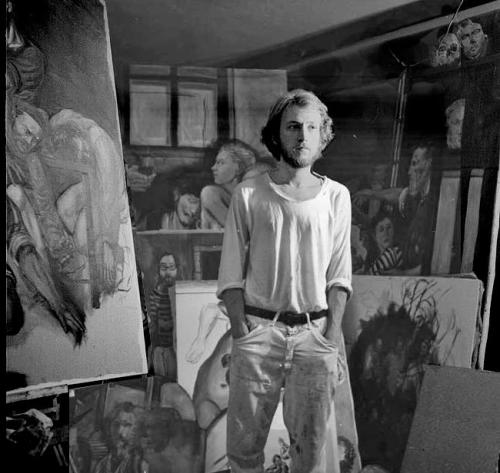
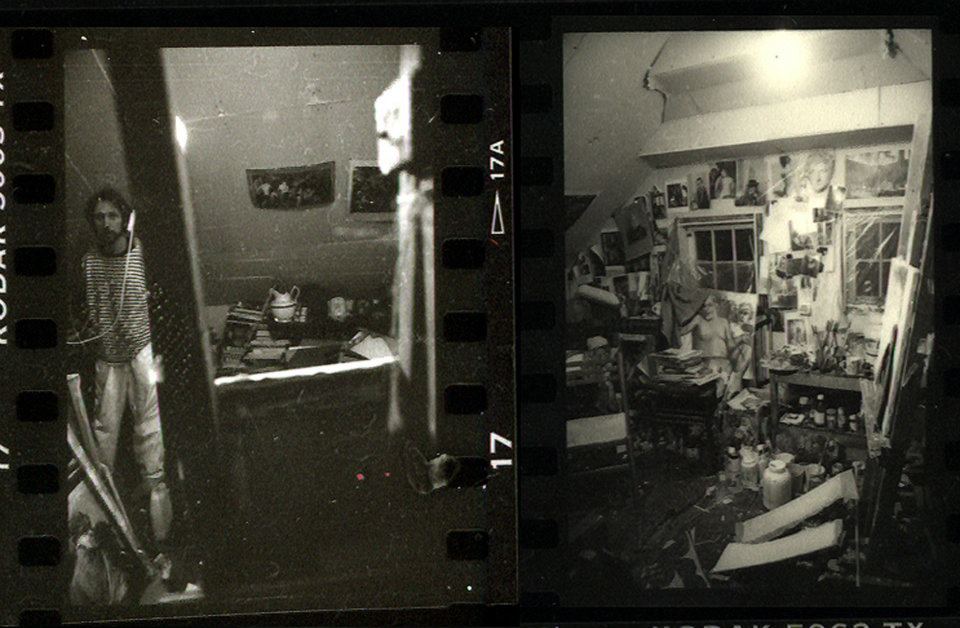
donald langosy in the studio

donald langosy in a studio from the early days

For the past six Thursdays it has been been my pleasure to share the words and images of painter Donald Langosy. In collaboration with his daughter, he produced a unique 14-page memoir visually chronicling his evolution as an artist. I was allowed to share that memoir on this blog interspersed with additional words and images by Langosy.

Last Thursday’s post – story of my art – shakespeare and the joy of being, revealed that Mr. Langosy was diagnosed with multiple sclerosis in 2003. Has it affected how he expresses himself as an artist? Of course. But decrease in mobility and even fine motor skills has in no way decreased his creativity or even his productivity. As he has stated he does not allow MS into his studio, but he has welcomed visitors on occasion.

donald langosy in the studio present day

donald langosy still in the studio present day

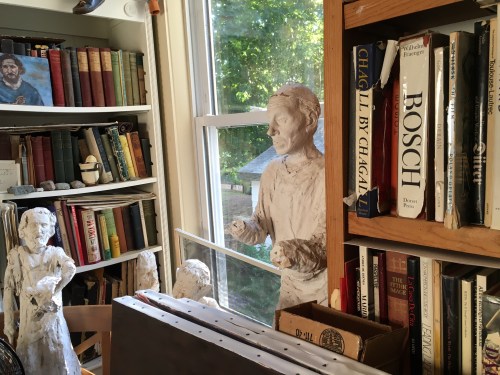
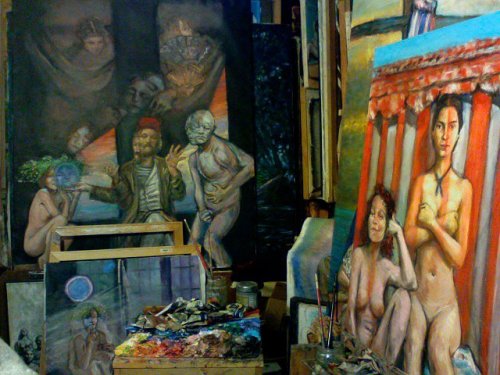
I have been lucky enough to sit in his space and at his side and see his works-in-progress upon the easel, the canvases stacked against the wall, his sculptures tucked in high nooks, and what I especially love (and I tell him each time) the books, the books, the books, on so many different subjects, collected over the years! And no matter how crammed the space becomes with paintings and books and new technologies to enable him in his work, there is always space for the grandchildren.

grandchildren in the studio

grandchildren in the studio

Below are a few more images. Please enjoy this virtual peek inside the studio, present and past, of Donald Langosy.

Photos provided by Zoe Langosy.

—

View The Story of My Art: 1, 2, 3, 4, 5 and 6.

View four decades of Langosy’s work at http://www.donald.langosy.net/

See what’s current on Langosy’s Facebook page.

His contact: Zoe Langosy at zlangosy@me.com.

Read Full Post »

No picture this week but I can share this …

I’ve picked up a few things about him. He’s Haitian and speaks Creole. He joined the neighborhood maybe two years ago. He’s slender, and his skin is like black walnut. Smooth and dark. He’s rather ageless — he could be 40 or he could be 70. Is he good or bad? That I do not know. He does seem to move with grace through the world from my vantage point. I live along a main thoroughfare and along this thoroughfare he walks with an easy gait. And when he walks he sings. Operatically.

Even when I am not peering out of a window, I know that he is near by the song in the air as he moves. I know so little about opera (and that little is thanks mostly to PBS and to Bugs Bunny) and yet when he sings I can recognize what little I have heard. La Traviata. La Boheme. Wagner. And then during a recent rainstorm, when I left the windows a little cracked to let in the wonderful fresh air, I heard his voice.

I looked out a window and there he was, walking along nonchalantly, with his bags from the local grocery store, dark skin and hair, white shirt plastered against his whippet form,  and those khaki pants. His shoes I could not see in the shadows of the looming night. His voice filled the air. This time it was Ave Maria.

His head was tilted back, and when he stepped beneath the glow of the street light, I could see the white of his teeth and eyes. I’d just heard Ave Maria sung at a funeral a week or so before. So solemn that day. This man, my unnamed fellow, sang it with such joy.

We have yet to actually meet. I figure I should not rush out of my home, make him stop his song, to accost him with my questions of “who are you” and “what is your story” or “may I snap your portrait.”

At least, not yet. 🙂

Read Full Post »

“Would you like some cold water?” he asked as I walked away.

“No but thank you,” I said. “I’m just fine.”

“It’s unopened,” he added as he pulled the gallon jug from the white shopping bag. “You can have the first sip.”

“Thanks. I’m good. You take care, ” I said and waved good-bye to the man I’d met in the woods.

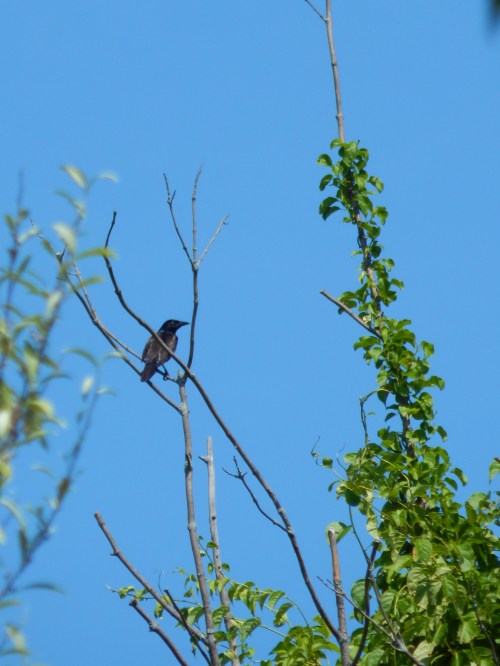
In my previous two posts, I shared images of nature near an office park. I’ve photographed there several times over the years. It is a meandering site with clusters of brick office buildings with each cluster surrounded by asphalt parking spaces. A few small landscaped gardens grace the entrances of some clusters or at least they have regularly mown lawns. And then connecting these manicured areas is just enough almost-wildlands, that are just wild enough to attract rabbits, foxes, deer and even the errant coyote. But mostly it is a haven for birds.

When I visit, I am usually in the company of my partner. He heads into one of the office buildings to check on a piece of equipment. I take my camera and wander the periphery of the parking lot. I look up into the trees, I scan the gullies to see how the sunlight is falling on the water and then I come to an iron gate. The gate is reminiscent of the ones you see on farms, more for keeping large animals at bay and not so much for stopping people.

I slip past the gate and determine whether I am going to go left and make my way up the gravelly path through the more heavily thicketed and treed area or if I will go right into a more meadowy area that becomes marshlands after a good rain. But this time the meadow was completely overgrown and too full of prickly plants for me to venture there, so I made my way up the gravel path.

This area too was overgrown.  In times past I had been able to easily step off the path into the underbrush, not only to photograph wildflowers and animals but also to see what mischief local teens had been up to. You see, the gravel path ends with another iron gate and that gate abuts a small road and a residential area. With what I was wearing, and my lack of bug spray, I had decided not to step off the path that day. I made it to the second iron gate photographing what I could. The birds were singing so loud. I stopped to stare up into the trees. And that’s when I noticed the man slip past the iron gate onto the gravel path.

He hobbled along on two crutches and in one hand he also held a white plastic bag. He seemed dressed rather warmly for a day in the 90s, in his sweater and jacket and long pants. He wore white socks with his well-worn sandals. He moved very deliberately and slowly. As he came nearer, the dappled light caught in the silver of his blonde hair. He had a dark tan but as he came closer I could tell with a good shower he might become just a bit paler.

I smiled in greeting. I’ve been warned I should stop doing that so readily, but I felt no fear as he nodded in reply and then paused to say, “Birdwatching, eh? Seen any cardinals yet? I used to be able to sing their song.” After licking his lips, he began to whistle and when he got to the tweet, tweet, tweet I could genuinely exclaim, “Oh, yes, I know that sound.”

He hesitated, blue eyes darting about, and then said, “Well, okay, good luck.” He continued down the path moving just a bit faster than a snail. I stalled a bit, keeping an eye on him, and then I too began to walk down the path. I caught up with him. I had every intention of passing him so that I could continue my photographic journey in another area. But as I came up to his side he began to talk to me. Random stuff about the birds to be found in the area and during which seasons.

At some point I asked, in part to test an assumption forming in my mind, “Is this path a short cut for you?”

He said, “Oh, yes. This is a great short cut down to the Target.”

Having been to that Target, I didn’t think his statement was true but I said nothing.

He filled the silence quite eloquently.

In the course of our long walk down this short path, this gentleman would share from beginning to end in actually exquisite detail the plot of the 1950s movie, Harvey. He would share highlights from half a dozen academic and literary works that I only knew about because I’d seen their titles while browsing in the Harvard COOP bookstore. In one moment he would be talking about Kierkegaard and in the next about the Cedar Waxwing.

“You are quite the philosopher, sir.”

He shrugged. “Well, that’s what I studied at MIT along with physics.” I didn’t ask him in what year or if he finished. Later, around that subject, he would mumble something about “things happened.”

We made it to the parking lot. Maybe because he knew I would not be there much longer, he began to talk faster, telling me his name, and about his not-so-nice father who had been a famous chemist, stuff about religion. The light became too bright in his eyes on that subject so at that point I knew I needed to end the conversation.

“I need to rest,”he said and eased himself down on the curb.

“Well, nice to meet you. I’m off to photograph birds.”

As I walked away, that’s when he asked if I’d like some cold water.

I took a circuitous route through the office park that brought me back to his location. He was no longer there. I suspect he made his way back into the thicket where he likely has a spot. I think that had been his original intention, with his jug of cold water, until he came upon a small brown woman photographing birds in his woods.

Read Full Post »

Previously in The Story of My Art: I am a Baroque artist

And now …

Read Full Post »

One of my mid-year photographic challenges is to photograph more people. Perhaps a post each Sunday? We’ll see … I begin with Robert Yearwood. At some point I may pair stories/brief interviews with these images. Given that Mr. Yearwood has been in this world since 1938, he has a lot of stories to tell. I first met him at Trinity Church.  I’ve learned a lot from him about patience, letting things go, and especially an idea that I have rephrased a bit — that all who enter a place, regardless of age, race, gender, or creed, the clothes upon their backs or the lack thereof, all shall be equally greeted. Whenever I want to be … not nice to someone … I try to remember that idea. 🙂

Robert Yearwood

Robert Yearwood

Read Full Post »

Previously in The Story of My Art: “painting with the moments”

And now (click on images for larger view) …

details of elizabeth

images of elizabeth

self-portraits of donald

self-portraits of donald

And once freed, what happened? Find out in the next chapters of this artistic journey on Thursday June 23rd. 

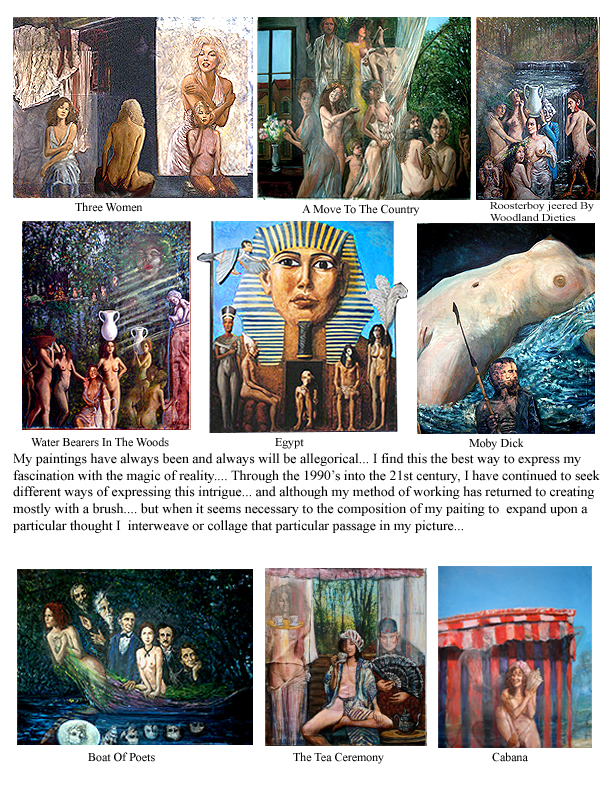
Meanwhile, view details of the Marilyn Monroe painting here and view Mr. Langosy’s art at http://www.donald.langosy.net/ and https://www.facebook.com/The-Art-of-Donald-Langosy-270498092961524/photos/?tab=album&album_id=442071359137529

Contact: Zoe Langosy at zlangosy@me.com.

Read Full Post »

« Newer Posts - Older Posts »