Feeds:
Posts
Comments

Posts Tagged ‘storytelling’

“The most valuable qualification in an officer is common sense; contrary to general belief, it is the rarest element found in mankind.” — Major General Fox Conner (1874-1951)

foxconner

He would have been less than ten years old, I think. In a 1930s interview, eighty-two year old former slave Ike Woodward remembered as a child it was his job to lead blind Bob Conner around. Conner had been blinded in a Civil War battle. Woodward’s master, also named Ike Woodward, had sold the services of his young slave to the Conner family. In his his interview for the Works Progress Administration, Woodward would go on to remark that Master Conner was the papa of Mr. Fox Conner, a big man now in the army. That statement led me to ask: who was Fox Conner? An impressive figure it turns out.

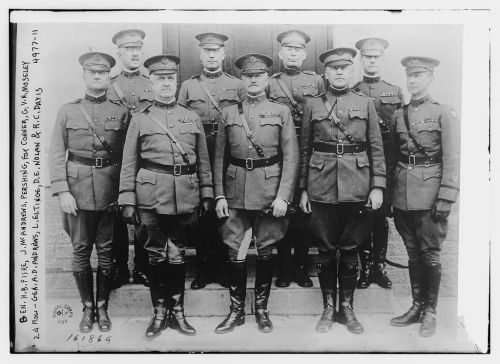
connerwithpershing

Conner to the left of Pershing (Source)

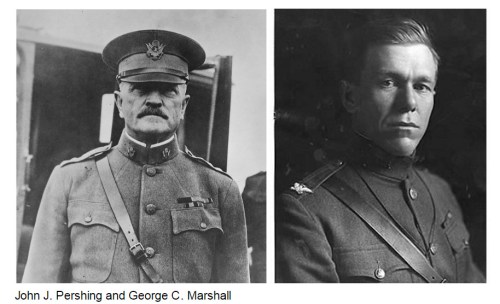
Conner would make his way from rural Mississippi to West Point and embark upon a stellar career in the military, serving in the Spanish American War, Pancho Villa Expedition and World War I. He earned military awards from the Purple Heart to the French Croix de Guerre. It was during World War I that he was selected by General Pershing to be a member of his operations section where one of Conner’s subordinates was George C. Marshall. A far-seeing strategist, he opposed the Treaty of Versailles seeing within it the seeds of a new world war with Germany.

pershingandmarshall

During World War I Conner would become reacquainted with and develop an enduring friendship with an officer by the name of George S. Patton. Back in the States, in the early 1920s, Conner and his wife were the honored guests of a dinner party hosted by the Pattons. Invited to this dinner was a young officer named Dwight D. Eisenhower, whom Patton thought Conner should meet. According to one biographer, Russ Stayanoff, “In Eisenhower, Conner saw a likable, eager young officer available for the “next one;” an officer that he could groom. Conner undoubtedly needed an executive officer with whom he could get along, and Eisenhower fit the bill. The fruits of that February luncheon became apparent when Conner telephoned Ike later in the same week and asked him if he would like the assignment as his executive officer in Panama.”

dwighteisenhower

Today Conner is especially remembered for his mentoring of Eisenhower. As Executive Officer for Conner at Camp Gaillard in Panama, Eisenhower received an unparalleled education in military affairs that would be instrumental in his later success at the Command and General Staff School. Conner was a student of history. Whether personally with Eisenhower or through his later lectures at the Army War College, Conner influenced a generation of future leaders. He was a proponent of coalition building and the use of diplomacy in concert with strong leadership to bring about victory. His three axioms or principles of war for a democracy still discussed today: Never fight unless you have to; Never fight alone; and Never fight for long.

Thanks to the internet there appears to be an increasing amount of information available to the general public about Conner, as well as more detailed analyses of his teachings still relevant in this modern age.  A biography was published in 2011 about him and a new book more recently published in 2016. In much of the discourse about Conner that I saw there is reference to him being the son of a blind Confederate soldier. The only way I learned the little that I have of this man and of his enduring legacy was to read the remembrances of the slave “lent out” to help guide his father. Ike Woodward would work at the Conner place until the day Ike’s brother rode in by horseback and scooped him up, conveying that they were now free.

Sources & Additional Reading

Ike Woodward Slave Narrative

https://en.wikipedia.org/wiki/Fox_Conner

Major General Fox Conner: Soldier, Mentor, Enigma: Operations Chief (G-3) of the AEF by Russ Stayanoff, MA

http://www.casematepublishers.com/index.php/general-fox-conner.html#.WIZFhVUrKM8


Read Full Post »
One day I stood before a giant globe atlas with a friend in elementary school. We liked to spin it round and round. That day, and I’m not sure why, he stopped the globe and pointed at a place. He looked at me and said with a smile, “That says nigger. That’s what my mama told me.” I squinted at the spot (I needed glasses) and then I said to him, matter of factly, “No. That says Niger. I think your mama got it wrong.” His smile faded. And then we went out to play.

One day in high school computer class (Pascal!) I sat next to a friend whom I’d known since elementary school. We were both geeky. I wore a short skirt and one of my first pair of pantyhose. I almost felt grown up. He kept rubbing my knee. I was beginning to think he might like me. I didn’t know how to giggle but I did smile at what he was doing. I guess he noticed because he said  all of a sudden, “Cynthia, my mother doesn’t like black people. She wouldn’t let me bring you home.” I simply said, “Okay.” And in my mind’s eye I remembered his mother and my mother talking cordially at a parent-teacher meeting.

One day not long ago I stood in a place where I was tasked to welcome strangers. Two men walked in, one wearing a t-shirt emblazoned with a Nazi symbol and the other wore a t-shirt that said, white people are the best people. I did not feel very welcoming but to be welcoming was my job. In the end, on that day, the gentlemen and I conversed about everything except what they wore on their shirts and the color of my skin. We went our separate ways both still existing and having to live with each other in this world.

All of these things happened to me before Trump was voted in as President. I don’t blame Trump for racism, conservatism, alt-right, Breitbart and all the other ugliness in this world. I blame him for fanning the flames of hate. I hold him accountable for the blinders he chooses to wear about what he has done and his active willful ignorance about the scale of the harm he will do to this nation and the world with his cabinet choices.

He has become the President of a flawed, great nation. That nation will not fall with his presidency but it may fracture in ways not even conceived of yet. Will I hold him, Pence and others accountable? Yes! But I will also hold myself and others accountable if we do not take every opportunity, each day, no matter how seemingly small, to become better educated, informed, engaged and active world citizens.

One day …

Read Full Post »

In time for the holidays, at the gift shop located at Trinity Church in Copley Square, you will soon find items featuring one of the most striking and provocative images that I have ever taken … probably because the source of the image is so striking and provocative. I think of them as angels though they are harpists robed in white in one corner of the stained glass window, David’s Charge to Solomon, by Edward Burne-Jones and William Morris & Co.

Detail from David’s Charge to Solomon by Burne-Jones and Morris

The women stand in a gallery at the rear of King David’s throne as the aged King delivers his charge to young Prince Solomon, and resting upon the King’s knees are the plans of the future Temple that he will not live to see. The window was presented to Trinity Church in the City of Boston by Frederic Dexter in memory of his father George Minot Dexter (1802-1872). As described in an 1888 church description, “the design is considered especially appropriate as Mr. Dexter lived but just long enough to see the plans of the new church completed and the work begun.”

George Minot Dexter was member of a prominent New England family that traced its roots to England and Ireland. It was a family of farmers, merchants, ministers, doctors and politicians. Dexter would become an architect and civil engineer. In 1836, he was commissioned to design the houses for Boston’s Pemberton Square and all of the accompanying ironwork. Today, 1300 of his architectural drawings for 85 different projects can be found at the Boston Athenaeum, in a building he would help to erect between 1847-1849.

In 1863 Dexter, then senior warden of Trinity Church, would call upon Phillips Brooks. Brooks, the descendant of several New England families of note, was a young minister attracting great attention as he served a Philadelphia parish. The young minister was in demand by many parishes across the nation and Trinity Church was especially active in its attempt to acquire him. It would take six years, in 1869, before Brooks would accept the call.

The church at that time was located on Summer Street in downtown Boston. Forward thinking, Brooks determined that it was time for the church to move to a new location, Boston’s Back Bay. Land had been bought and a building committee had already been formed when Boston’s Great Fire of 1872 destroyed the Summer Street church.

Dexter served on the building committee that selected the design of architect Henry Hobson Richardson. The building, which revolutionized American architecture, would be constructed between 1872-1877. Dexter would not live to see the building’s consecration in February 1877. He died November 26, 1872.

In addition to what has been referred to as The Dexter Window, his service to his church is also featured on a wall tablet, with the inscription by Honorable Robert C. Winthrop. It is located in the North Transept. Winthrop refers to Dexter’s self-sacrificing nature and how he remained “active to the last in good works and particularly in his tender care for the interest of the living and the remains of the dead during the trying scenes which attended the burning of our old house of worship in Summer St …”

He refers to the fact that beneath the Summer Street church was a crypt with family vaults. That crypt was laid bare by the destruction of the building overhead. Dexter would tend to those remains until he lost his life.  In a letter to his friend Miss Mitchell, Phillips Brooks would write:

If you have the opportunity to tour Trinity Church, you’ll notice not only magnificent stained glass windows like David’s Charge to Solomon but also wonderfully decorated tablets with words that provide just a glimpse into the lives of people who considered that space their home. Well worth taking a moment to read. Enjoy!

Sources, Additional Reading and Opportunities

Trinity Church Art & History Tour Information

The Garden Square of Boston by Phebe S. Goodman

http://cdm.bostonathenaeum.org/cdm/ref/collection/p15482coll1/id/839

Life and Letters of Phillips Brooks

Read Full Post »
Read Full Post »

I’m not as limber as I once was and so I was having difficulty getting through the window but I didn’t have to fret for long because a stranger took my hand and pulled me through and when I lost my shoe on the rim of the window frame, he picked it up and gave it back to me and then turned and continued to help other strangers out of the train.

I wasn’t sure that I’d write about the chaotic experience of being on the Orange Line train yesterday in Boston’s Back Bay Station that filled with smoke. In the moment I was less concerned about the possibility of a fire in the station and more concerned about the growing panic of the people around me. Later I just wanted to let the incident go. But then today I picked up something and I remembered the feel of that man’s hand holding mine.

It was rush hour. People had had a long day and just wanted to get home. The car in which I stood was not packed but it was tight enough especially as most of us wore the beginnings of our winter gear. The lights were on but there wasn’t much air circulating and the intercom system must not have been working because there was no news being shared by anyone. The train had partially pulled away from Back Bay Station before coming to a halt, and later, officials would note that that was the reason the train operator could not open the doors, because of the danger of people stepping onto the tracks and landing on the electrified third rail. But most people were not thinking of that as the smoke grew thicker, and from inside the car, we could see people on the platform start to run for exits.

Even as I was starting to say, please, be calm, I felt my own panic rising. And then people began to scream, especially when they realized the doors were not opening. People began beating at the windows. The smaller windows on the sliding doors were easier to break. Individual flight was on many a person’s mind for sure but others were trying to help scared people through the small openings. Then in the part of the car where I stood, a man on the platform motioned people away from a larger window. He was not a train official or one of the policeman stationed in the area. He was just a regular guy. He kicked at the window, again and again, until it flew in, a single large sheet, shattering into a spider’s web pattern but no jagged edges did I see. People started leaping out the window while that man and some others stood, held out their hands and helped strangers out. I did not stop to ask his name but I think I shall never forget him.

Read more: Boston Globe article

Read Full Post »

My earliest memories of my uncle are of a dapper man from New York visiting his big sister (my mother) in Virginia during the summers. He would hang out with my dad drinking my dad’s homemade wine. Then in later years I remember that we would receive beautifully printed Christmas cards that were unlike anything my younger brother and I had ever seen. Several decades have passed since then. My parents have passed away. He’s since moved from New York to settle in South Carolina. Now that travel is difficult for him visiting him was the primary impetus for my recent southern travels.

Uncle Freeman was a silkscreen printer in New York who, while employed at institutions like American Image Editions, printed the works of Andy Warhol, Larry Rivers, Robert Indiana, Ed Paschke and many other artists. Once he’d learned the art of screen printing he informally taught others including Isabelle Collin Dufresne, known as Ultra Violet. A signed copy of her memoir sits on his bookshelf. “She was famous, right?” I asked my uncle. He said, “She wanted to be.”

When we went to visit my uncle, now 80 years old, I was anticipating an interview where I’d collect tawdry details of Warhol and his parties, the lowdown on the New York arts scene of the 80s and 90s, and so on. But my uncle, ever the gentleman, would only chuckle or smile as we queried him relentlessly. He did share some of the prints he still has in his possession and would describe the techniques used to produce the colors and shading on the page. His wife, who loves butterflies, mentioned accidentally cutting up a Salvador Dali screen print because she was so intent on obtaining the butterflies at the top of the page she did not notice Dali’s signature at the bottom. The altered print hangs quite lovely on a bedroom wall.

It was the art on the walls that kept drawing my attention in my uncle’s modest home. A few screen prints hung,  but mostly the walls were lined with canvas paintings. I began to notice artwork outside as well, paintings on trees and wooden panels. Finally I asked who did all of the paintings and he said, “I did.” His wife pulled more from under a bed and those tucked away in closets.  As for when he did them, he said the majority were done while recovering from prostate cancer. As he received treatment, “I couldn’t do much but I could paint.”

He shared no rhyme or reason for his subjects. “Just whatever came to mind and whatever pens and paints I had available.”

Birds seemed to be a favorite theme.

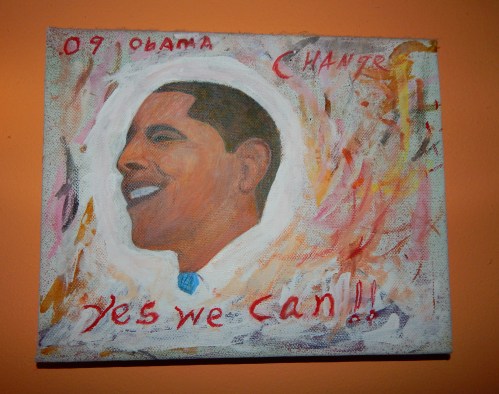
And then there was Obama. Born in the south in the 1930s, having experienced the realities of racism firsthand, Obama’s election meant a great deal. “I have a better painting of him,” he said as I gazed at this one on the wall, but we never got around to finding it.

He hadn’t painted before the cancer, he said, and he hasn’t really painted since his recovery. But I have encouraged him to do so. In fact I suggested a subject.

In the evenings as we sat down to dinner he would make his way slowly to the front door and open it wide. For the first few days that we visited, there was nothing to see but then the final evening, he said, “Cynthia, come over here.” And there they were, this magnificent flock of birds flying overhead, filling the sky with their dark silhouettes. They all seemed to settle in one far distant tree. My uncle said, “Sometimes there are so many in the canopy they turn the tree into a square.” “That’s it!” I said. “That’s what you should paint next. The birds in the sky.” He listened patiently as I described my vision but in the end he just shook his head and chuckled. 🙂

Read Full Post »

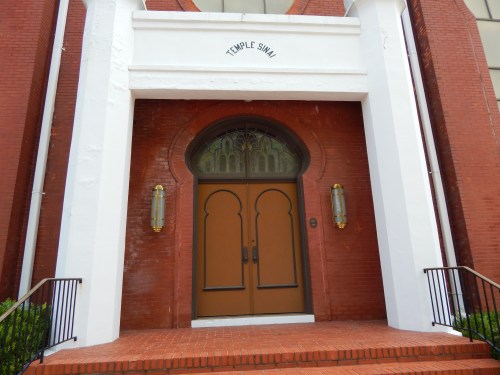
While traveling in Sumter, South Carolina it was my pleasure to visit the Temple Sinai, founded as a Reform Jewish Congregation. The history of Sumter’s Jewish community dates back to 1815. The first Jews who settled in Sumter were Sephardic and came from Charleston, SC. The current congregation was formed in 1895 by the merger of the Hebrew Cemetery Society and the Sumter Hebrew Benevolent Society. Construction of the congregration’s present temple was begun in 1912 and completed in 1913.

A feature article in the March 1913 Sumter newspaper The Watchman and Southron notes “The Temple is situated on the corner of Church street and Hampton avenue and is an imposing structure of red brick with domed roof … The architectural lines are simple, but the proportions are so good and so well harmonized that the general impression is one of beauty, allied to strength and permanence. As impressive as is the exterior of the Temple, it is the interior that is its chief beauty and glory …”

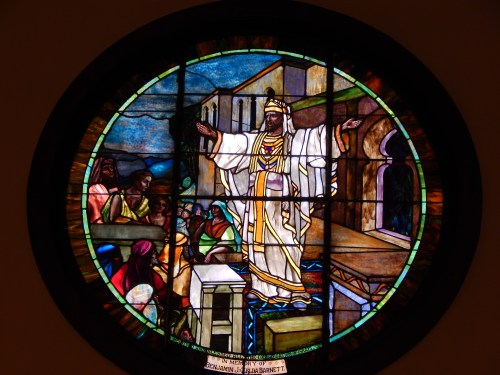
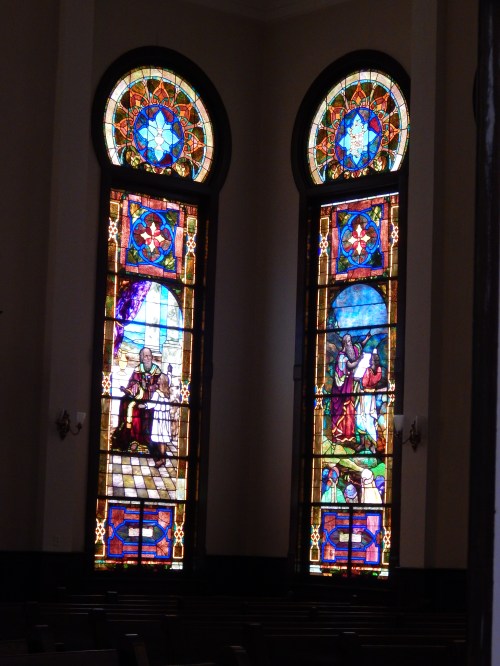
In terms of architectural style the brick building is Moorish Revival. Eleven stained glass windows grace the interior. Ten of the windows are 5 feet wide by 20 feet high and their shape mimic the building’s moorish towers, each a tall window illustrating a story surmounted by a half-window with further decorative detail. The eleventh window is round and is located high on a back wall.  While the specifics of the window designer and makers are elusive, the windows are thought to be handmade in Germany. Installation began in 1912 as indicated in a local newspaper article from September 1912, “The beautiful stained glass windows of Temple Sinai have arrived and are being placed in position.”  One month earlier, the same publication had noted, “The work is winding up on the new Jewish synagogue in this city and it will be only a short time now before the remodeled Temple Sinai will be one of the most beautiful places of worship in the city.”

At age 95, Sumter native Robert Moses, a descendant of one of the first Jewish families to settle in Charleston and then in Sumter, is one of the last active members of Temple Sinai. As part of an educational presentation, he describes the windows as late Victorian in style, with rounded tops and interlacing borders giving them an eastern/Moorish look. Known as drapery glass due to the folding of the glass to add depth and color, the brilliant blues have cobalt added and gold was added to brighten the reds.

Each window depicts a scene from the Old Testament including as described in a 1913 newspaper article:

The Test of Faith, involving Abraham and Isaac …

The Blessing – Isaac Blesses Jacob …

detail from isaac blesses jacob

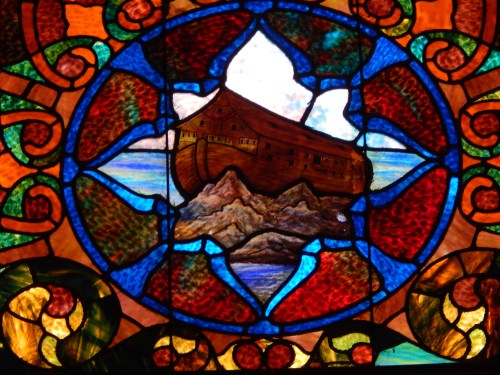
detail from isaac blesses jacob - the ark on ararat

detail from isaac blesses jacob – the ark on ararat

Jacob’s Dream …

detail from jacob's dream

detail from jacob’s dream

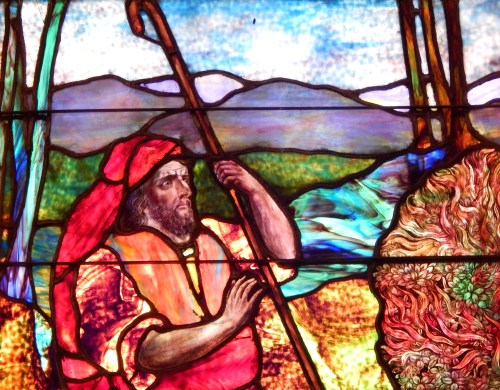
Vision of Moses when he sees the burning bush …

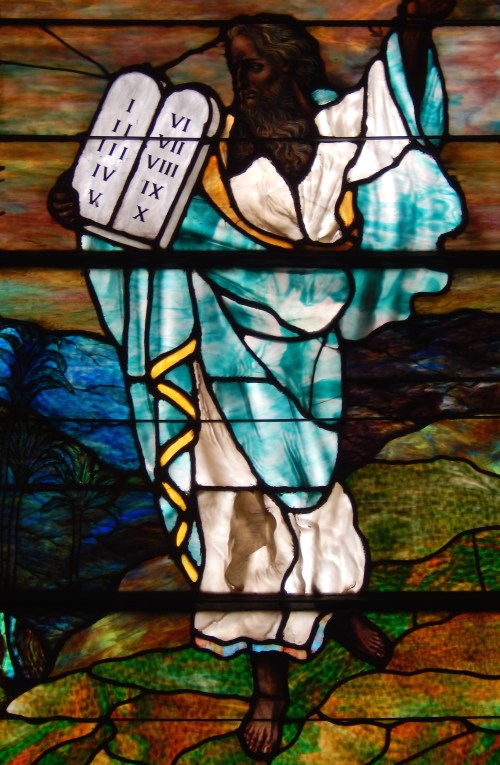
Moses on Sinai with the Ten Commandments …

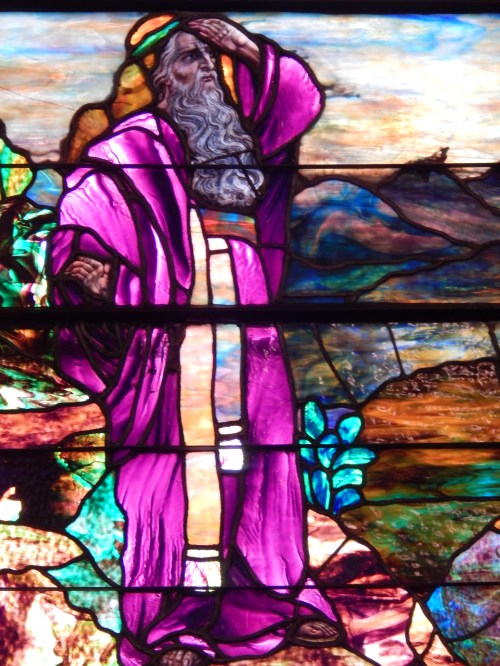
Moses on Nebo overlooking the promised land which he is forbidden to enter …

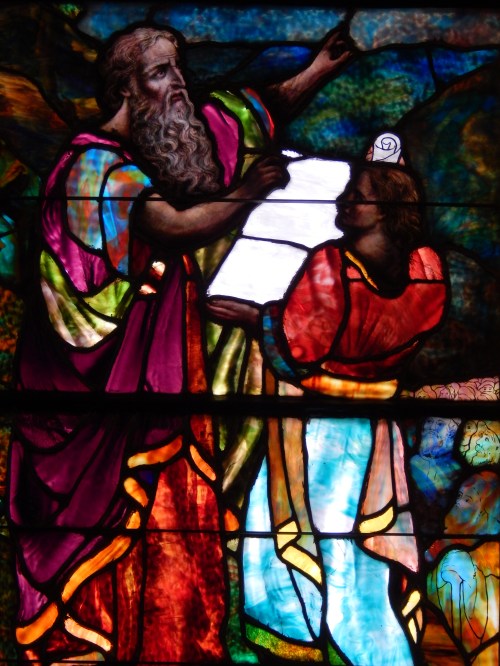
Moses Delivering Laws to Joshua …

Samuel Before Eli …

detail from samuel before eli

detail from samuel before eli

Elijah in Solitude …

detail from elijah in solitude, also known as elijah and the ravens

detail from elijah in solitude, also known as elijah and the ravens

David the Shepherd Boy …

and Solomon at the Dedication of the Temple.

Members of the Moses family were kind enough to allow me entrance into the Temple to photograph details of the windows and share just a bit of the history of people and place. The windows of this place are unique for their pictoral illustration.

Temple Sinai is listed on the National Register of Historic Places. For more information, or to inquire how you can help preserve this historic structure, contact Temple Sinai, 11-13 Church Street, P. O. Box 1673, Sumter, South Carolina 29151 or call (803) 773-2122.

Sources and Additional Reading

(1) “House of Worshop of Jewish Congregation to be Dedicated on March 28th, ” The Watchman and Southron, March 8, 1913.

(2) The Watchman and Southron, September 21, 1912.

(3) The Watchman and Southron, August 10, 1912.

Temple Sinai Wikipedia page

Encyclopedia of Southern Jewish Communities – Temple Sinai

Records of Temple Sinai


Save

Save

Read Full Post »
At this time of year I chase the sun even if that only means I race up the spiral staircase in my home to the highest window to see how the light changes over time in the distant sky.

And just as I thought I was done and walked back down the stairs to download images and such, I looked out the lower window and saw that the sky had turned from gold to orange.

And then, yes once more, when I thought I was done and had walked back down the stairs to download images and compose this post, I looked up. The sky was a wonderful pinkish-red. I decided to watch the sky grow dark instead of racing back up those stairs.

Read Full Post »

In early August I wrote about an experience on the road between Boston and Rhode Island, an experience that I described to people as being in the midst of a Klu Klux Klan rally where no one wore a hood. You can read that post here if you like.  And though I wrote that post about my experience, my feelings in that moment, I also thought about what were the children in the neighboring cars experiencing, children of any race, what questions were they asking their parents and how were their parents responding. I especially thought that when I saw a little brown boy staring at the pickup truck in the lane next to him flying its huge confederate flags.

the full moon obscured by a screen

I was surprised later to find so little commentary on local news and on the internet about that procession of thirty-plus vehicles in New England with their giant flags driving en masse along I-95. But I guess I was using the wrong search terms. I did not think to use the words: Make American Great Again Convoy, an event that took place July 30 and 31 in Foxboro, MA.

I remember writing that I chose not to photograph anything around me that day on the road. But I do realize that it is important to capture the words and images of such events so that they can be documented and remembered. Since I wrote my original post a video has surfaced. When I first saw the still shots and read the transcripts of what people were saying that day on their CBs, I almost shrugged. I wasn’t surprised and my feelings were justified.

Then I watched the video, listened to the words, and it made me want to cry. Not out of fear but out of sadness at what darkness remains in this world. As young white men laugh about lynching niggers from the nearby trees, using blacks as pinatas, I remembered the little brown boy staring into their trucks. And I thought of a young brown cousin who I’ve been told likes to chase Monarchs at his home in New York, and I thought of my young brown nephew who likes to plant gardens in his home in Virginia. They are too young to fear what has been because they don’t know that part of American history … yet. I thought of what these people must be teaching their children and I hoped that their children somehow would one day hold hands with children of all shades and know that they were the same.

It is almost too easy to blame Trump and yet I do not want to let him and his brethren off the hook for what they have allowed to re-surface, unchecked, in this country. He was the spark for their tinder. The video is 4minutes and 45 seconds. It’s hard to listen to, and in no way kid friendly but it should be reflected upon because the sentiments expressed in the video and in similar gatherings online and in person across this country are not going to disappear overnight or anytime soon. Maybe never.

However, somehow, there is always hope for better.

In 1880, Phillips Brooks, then the Rector of Trinity Church in Boston, delivered a sermon at Westminster Abbey in England. The sermon was titled The Candle of the Lord. It was July 4th that he spoke and for the occasion he added some text to the sermon where he asked the British congregation before him to pray for his young country:

“It is not for me to glorify to-night the country which I love with all my heart and soul. I may not ask your praise for anything admirable which the United States has been or done.  But on my country’s birthday I may do something far more solemn and more worthy of the hour. I may ask you for your prayer in her behalf. That on the manifold and wondrous chance which God is giving her, – on her freedom (for she is free, since the old stain of slavery was washed out in blood); on her unconstrained religious life; on her passion for education, and her eager search for truth; on her jealous care for the poor man’s rights and opportunities; on her countless quiet homes where the future generations of her men are growing; on her manufactures and her commerce; on her wide gates open to the east and to the west; on her strange meetings of the races out of which a new race is slowly being born … “

One hundred thirty years later, I’d say we are a nation still being born.

Read Full Post »

Burial places they certainly are, but across time, cemeteries have also served other functions within our communities — as gathering places for celebration, as gardens of serenity for reflection, as time capsules that help us remember and document the past. In the first of two posts, friend and guest contributor Donna Stenwall shares memories of her visits to cemeteries around the world, respecting their universal solemnity while experiencing the unique attributes of each place.

Detail from Oscar Wilde Tomb, Pere Lachaise Cemetery

It seems strange to say this, but cemeteries have always played a role in my life. The small New England town I grew up in is where it all began. One of my earliest memories is walking by the old cemetery on my way to the library. It was locked every day with the exception of July 4th. That’s when we were able to enter and roam the aisles of the chipped and weathered headstones of the residents that founded the town in the 1600’s. With the names and dates barely visible to the naked eye, this is where we were taught the art of stone rubbing.

The “new cemetery” as we called it was the spot to learn how to ride your bike for the first time without training wheels. We would fly up and down the streets of the cemetery enjoying the freedom of 2 wheels, and all the while passing the graves of neighbors that left us too soon.

Since Massachusetts still had Blue Laws at the time (meaning no shopping on Sunday), the place to take your first spin behind the wheel was the parking lot of the newly built mall on Sunday afternoons. There we got accustomed to the feel of the car, practicing forward and reverse and left and right hand turns. But, to practice that three-point turn on a hill that we would be tested on? It was back to the cemetery!

Gates of Pere Lachaise

Gates of Pere Lachaise

When I began to travel, trips to cemeteries were on the itinerary. During my first trip to New Orleans I mentioned to our host that I would like to visit one of the old cemeteries I had heard so much about. The next day we set out to St. Louis Cemetery #3. It was there that I decided I wanted to be buried in a Mausoleum! Breathtakingly beautiful, I thanked our host for such an experience. It wasn’t until later I discovered that his mother was buried in St. Louis Cemetery and that our visit that day had been his first trip back since she had passed many years before.

My first trip to Paris, with its famous cemetery Pere Lachaise, was long overdue and bittersweet. My husband and I had planned a trip to Paris several times but circumstances prevented us from ever getting there.  With a smile and twinkle in his eye he promised that he would take me to Paris on my 50th birthday. Ah, I thought, the City of Lights I will see you soon!

Heartbreakingly, my husband passed away on July 25, 2005 after a brief illness. Two months later, I celebrated my 48th birthday. When my 50th was approaching my dear friend suggested I think about Paris for my birthday. I wasn’t sure I could do it or even wanted to but with the urging of family and friends I made the trip. Paris was worth the wait and every step I took I knew my husband was with me cheering me on!


As a huge fan of Oscar Wilde, I knew I had to venture out to Pere Lachaise, the oldest cemetery in the city of Paris, to pay my respects. Not the easiest spot to get to, we hopped on the Metro, then a bus, and finally by foot. As we made our way to the other side of the cemetery we stopped to visit with Edith Piaf, Proust, Chopin, Colette, Sarah Bernhardt and Moliere. I noticed several people taking photos of the graves. I was a bit uncomfortable believing that these legendary souls were gawked at their entire lives and that now they should be allowed the peace they deserved.

100_1437

On our way to the exit it dawned on me that Jim Morrison of the Doors was buried here and we should find his grave. My friend humored me but after ½ hour of roaming (we were notoriously bad map readers), she was ready to give up. I told her to stay put and I would take 10 more minutes. If I didn’t find his grave we would head back to the apartment.  As I was rounding the corner, there, right in front of me was Jim Morrison, surrounded by metal barriers and his own security guard. His grave was strewn with gifts of cigarette butts and empty bottles of Jack Daniels left by the pilgrims that made the trek.

Several years have passed since my trip but I was reminded of my trip to Pere Lachaise when I caught a documentary on the cemetery and its residents. One scene shows 2 elderly ladies sitting on a bench, taking a moment after visiting their husband’s graves. One was buried next to Jim Morrison. When the interviewer asks her how she feels about all the activity near her husband’s grave, she just smiles and states “at least I know he never gets lonely.”

Photography by Donna Stenwall.

Read Full Post »
« Newer Posts - Older Posts »