Feeds:
Posts
Comments

Posts Tagged ‘storytelling’

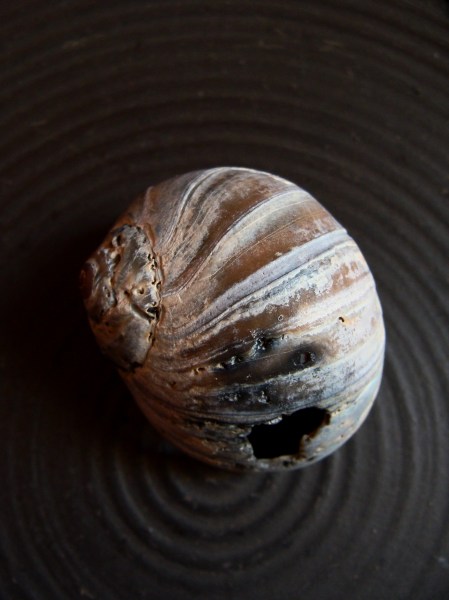
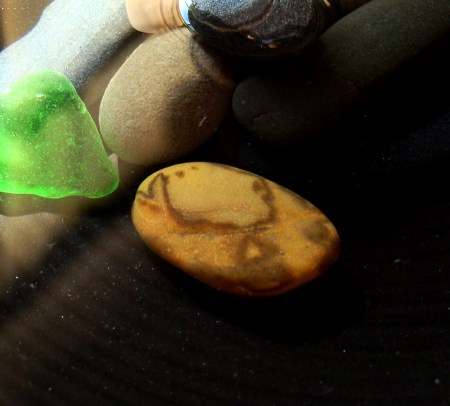
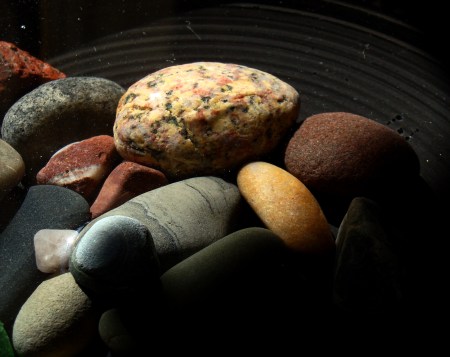
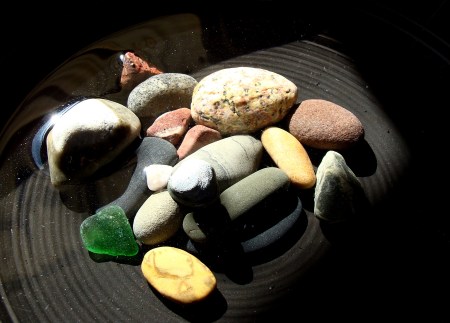
The following images are of rocks and shells and bits of colored glass found on different New England beaches this summer.  I photographed them yesterday after placing them in a bowl I had rediscovered, a beautiful dark clay vessel lined with ridges.  Eventually I filled the bowl with water.  I snapped photos throughout the day whenever whimsy struck.  Near dusk I decided I should empty the bowl before mosquitoes began to breed.  Just as I drained the last drop, the bowl cracked in my hands.  An unseen flaw had been exacerbated by the weight of water.  In an instant, I was reminded of the beauty found in fragile things.
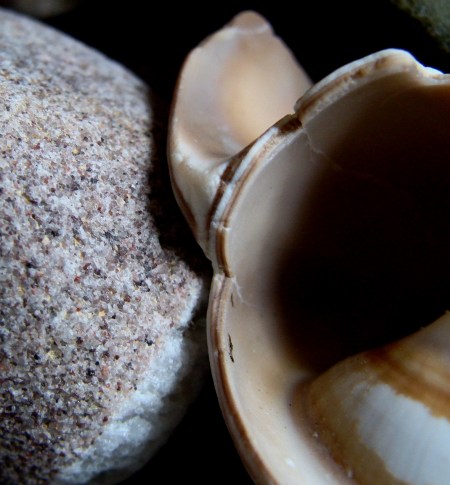
Today, as I worked with the images, admiring the visual expression of soft colors and hard edges and glimpses of the bowl now gone, I was reminded of a series of conversations I’ve been having with people about empathy and compassion (and their lack) in a world that can appear so beautiful and yet so broken at the same time.   I was also reminded of how much I miss the wisdom of my elders as I live through these times.  They may be gone but I do have their stories … though goshdarnit, some of the stories make me ponder even more about the ways of this fragile world.
My father once told me a story of walking to work.  It was southern Virginia in the 1950’s.  He and my mother were newlywed and I think they had one child.  He couldn’t yet afford a car.  As he walked from home to the Public Works Department, he passed a yellow school bus.  The bus was stopped at a red light.  He smiled up at the young children.  The children spat down at him.  He was black and they were white.
My mother’s sister Thelma happily left the south for New York during that great migration in this country.  Though she had no car and did not drive, she could walk wherever she wanted.  One day she walked through Central Park.  She saw this beautiful redheaded woman with smooth milk-white skin.  “She looked like a movie star,” Aunt Thelma recalled.  At the woman’s side was a young boy.  As their paths crossed, eye contact was made and Aunt Thelma prepared herself to exchange a greeting.  Instead the woman tapped her son.  “Then she pointed at me,” Aunt Thelma said.  “She pointed at me and said You see, my dear, that’s a nigger.”  Many decades later, Aunt Thelma looked at me and said with a gentle chuckle, “That’s why to this day I have a hard time watching movies with redheads.”
My mother told me stories.  My brothers, both my elder ones and my younger one, have told me stories.  I have my own growing collection of stories of not being seen as an individual or of being discounted and even despised because of the color of my skin.  I read newspaper accounts of children around the world, who from my perspective look alike, who are trying to kill each other because of deeds that took place long before they were “a gleam in their mothers’ eyes,” who hate in large part because of what is shared by surrounding adults.
As I remember my parents and other elders who led challenging lives in this country, I wonder how is it that they did not plant seeds of hate in the hearts of their children?  How did they choose and succeed I hope in teaching us to lend a hand to help the fallen and not first assess if that person was white, red, black, green or purple or carried a certain bible or had a certain sized bank account?  Perhaps I oversimplify …

My younger brother still lives in Virginia with his family.  He recently called while on his way home from work.  We usually joke and laugh about silly things.  But this time he was more somber.  Finally, he said, “You know, I have a hard time watching television anymore.  Those ads by all the candidates of every party and their followers.  You know how much money some people are putting into these ads just to make me hate somebody?  Don’t they realize how that money could help so many homeless people and others dying on the streets?”

Don’t tell my brother I said this but he reminds me of the bowl that held the stones in these pictures.  To be able to ask such questions suggests to me that a person is not closed off … that there is a beautiful fissure in one’s heart, mind, soul … that helps one remain open to the life experiences of others.  Anyway, the summer is not quite done.  More rocks and shells I may collect.  A new bowl I may find.  Then we’ll see what words and images emerge.  Be well!
Read Full Post »

It has been a joy getting to know the Langosy family of artists.  For decades, Donald Langosy has been painting luminous works on canvas.  Wife Elizabeth Langosy is a writer and editor extraordinaire.  Daughter Hadley is a gifted photographer and sister Zoe produces illustrations gracing publications worldwide.  It is a pleasure to share the words + images of niece, Avery, embarking upon her own creative path, inspired by family and a sense of place.

The Farm

Creation, for me, is painful. In fact, I can’t create. Not from scratch. Instead I use inspirations like collage to “create”. I’ve acquired sacred things as I make my way through life, and each one contributes to everything I make. Whenever I feel used up, dry, boring, I turn to my inspirations for hope. And one of my favorites is The Farm.

I met The Farm when I was just six years old, when my Aunt Hadley introduced me. Hadley’s family has owned The Farm (in truth just a house and land) for eighty years. She grew up wandering its fields. She loved The Farm so much, she got married there. And she loved me so much, she made me her flower girl. Hadley said her vows beneath Hansen Falls, but I didn’t hear them. I was busy scrambling up that same waterfall. They had to stop the ceremony to find me. I was just exploring.  That’s why The Farm has always captivated me. It holds such promise of exploration, adventures, and secrets. There were always fairies at The Farm, and ghosts and spirits and things you couldn’t quite see but just feel. The Farm was like a different world.

Because of The Farm I love magic, ghost stories, the feeling of goose pimples, night breezes, falling stars, I love quiet. I grew up knowing I wanted to create, but not sure what. I tried stories, photography, painting, friendship bracelets…and I found film. I had my media, but I needed my inspirations.

Now I’m embarking on a new adventure at The Farm: a short film about ghost stories, fairies, the quiet of the land, and the deeper silence of a fractured relationship. Film is my media, the Farm is my muse. I just hope I can do it justice.

Avery’s short film is called Draw Down the Moon, and will be out Winter 2012. She and her fellow filmmakers are currently fundraising. See Avery and learn more at http://kck.st/SGRHEw.

Read Full Post »

Recently I had a conversation with that fellow in my life about how we have used music to better understand each other.  Where words have failed, sometimes our different reactions to music have revealed something important about the other.  The most humorous moments have occurred when he has tried to share classics with me like Carl Orff’s Carmina Burana and in my head pop images of King Arthur racing across a moonlit field to battle (i.e. the movie Excalibur by John Boorman), or as he talks about Wagner’s The Ride of the Valkyries and I suddenly hear “Kill Da Rabbit” … or the whir of helicopters blades  in Apocalypse Now.   He quickly learned that I have been well schooled in music … through the movies.  Since he’s more into books than cinema, I compiled a CD of mostly movie-related music — pieces that move me, that I feel sweep the listener along on a journey, that make a body pause and feel.

“I was born by the river in a little tent

Oh and just like the river I’ve been running ever since …

I now realize that I lost the CD and made no backup.  I didn’t even write down the playlist.  But below are some of the more dramatic pieces that come to mind this bright day.  Warning, there is a certain sorrow to some of the songs, but there is uplift as well.  See what you think when you have a few moments to procrastinate.  FYI, in the spirit of pairing words/images/music, these are all links to YouTube renditions but these videos are just a tease.  I highly recommend viewing the entire movie to see the scenes and/or hear the music in context.

  • A Change is Gonna Come, Sam Cooke, 1963 (moving movie moment is the conclusion of Spike Lee’s movie Malcom X)
  • Henryk Gorecki’s Symphony No. 3  (moving movie moment is the conclusion of Julian Schnabel’s movie Basquiat and there’s also the beautiful final scene in the movie Fearless)
  • Samuel Barber’s Adagio for Strings (played throughout Oliver Stone’s Platoon)
  • Especially after sharing Adagio for Strings with my guy, he introduced me to Ralph Vaughn Williams .  I love his Fantasia on a Theme by Thomas Tallis but it is Vaughn Williams’ Dives and Lazarus that I most often listen to when working past a writer’s block.
  • Anything by composer James Horner moves me deeply, but especially his music for the movie Glory.  And then there’s the campfire scene.
  • I’m still not sure if I like the movie Cold Mountain but Gabriel Yared’s soundtrack makes me think of home at the foothills of the Blue Ridge Mountains.  It is the sacred harp singing that makes S. weep each time.  I always see fields of gold when I listen to this song.
  • There’s that repetition by composer Philip Glass that drives some people crazy, but even if you hate his music, please close your eyes and listen to the music from the final scenes of Martin Scorsese’s Kundun.  Ah, when that flute sounds …
  • There is Hans Zimmer’s Journey to the Line in Terence Malick’s Thin Red Line.  First time I saw it, I found the movie too chaotic.  I did not want to like it.  But I could not get the words, images and that music out of my mind.  It’s now one of my favorite movies.
  • And, finally, Moby.   There are two songs in particular that I bow down to him for producing.  The first is the music underscoring the final scene in Michael Mann’s movie Heat as DeNiro and Pacino have their final confrontation.  I believe the song is called God Moving Over the Face of the Waters. The second is the song Natural Blues.

Read Full Post »

Imagine the troubadours of old as they walked the back roads of … some quiet place, with mandolins or banjos in-hand, a song on their lips and through those songs telling stories.  Not of fantasy or fiction.  They sang stories of lives simply lived.  That is the imagery conveyed by a conversation with Clay Rice about how music influences his visual art.  You see, Mr. Rice is famed for his silhouettes of children, nature and life along the Lowcountry of South Carolina.

He carries on a family tradition, first made notable by his grandfather, Carew Rice.  Most of the biographies I found about the Rices emphasized their artistry with paper, but during our brief chat, Mr. Rice made it clear that music has always been a part of his family’s life, and that songs have always been woven into his work, especially his children’s books.  Read more of our conversation here.  Enjoy!

Read Full Post »

Recently, on a warm day in the city of Boston, I raced through one of its many squares toward my favorite hot dog vendor.  I’d already spent most of my half-hour break running errands and knew that I was going to be late returning to work, but darnit, I needed to eat and wanted a good hot dog.  As I made my way through the square, an elderly man stepped into my path.  He said, “Can you spare a quarter?”  I gazed into his watery blue eyes and said, “No, but would you like a hot dog?”  I don’t know why I said what I said that day, and he certainly wasn’t expecting me to say what I said.  He frowned and blinked a few times and then said, “You don’t have a quarter?”  I didn’t quite put my hands on my hips in exasperation, but I did raise an eyebrow as I repeated, “Do you want a hot dog?”  He shrugged.  “Okay.”

He walked with me to the hot dog vendor.  We stood in line together, a small brown woman and a tall older white man.  He told me about his son who was going to give him money later in the week.  He asked me questions about myself  including where I went to school.  I gave him mostly vague responses, not wanting to share too much, but I did admit that I’d studied history at one phase.  He nodded, and then said with great pride, “At university I studied philosophy.”  He then proceeded to tell me about Kierkegaard.

As we moved to the front of the line, the hot dog vendor said, “Hey, dear.  Your usual?”  I nodded and then added, “And this gentleman has an order too.”  The man cleared his throat and then ordered a small dog.   “What about a drink?” I asked.   Like a child, he thought a moment and then said, “Oh, yes.” He looked over the line of drinks displayed on the cart and picked an orange soda.  The hot dog vendor kept looking at me, a quizzical expression on his face.  I just smiled.  The vendor shrugged and began to fill our orders.

“Where do you work?” the man asked as we waited.  I paused, and said, “Many places, but part-time in that church over there.  That’s where I’m coming from today.”  He nodded, his face taking on a sage expression.  “G.K. Chesterston,” he said.  “He wrote a book called Orthodoxy.”  I took my hot dog from the vendor.  “I’ll check it out,” I said and then walked away.

Though I have been in the square many times since, I have yet to see this man again.  Other people, men and women, come up to me and ask for money.  I say no.  I have not been compelled to offer up anymore hot dogs.  Perhaps that moment will come again.  Meanwhile, each week, there is a gentleman I see in a wheelchair with his sign and his cup.  I do not give him money either, but I do smile and nod in greeting as I walk by.  He smiles and nods back, and that seems to be enough.

Read Full Post »

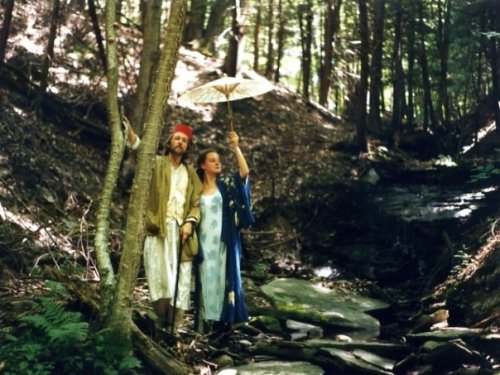
Once upon a time, before I ever thought of picking up a camera, I wrote short stories.  They often involved a bohemian young woman,  in good spirits mostly, searching for something rather intangible.  Not an uncommon storyline I know.

Eventually, in a coffee shop, a tea house, or a meadow by the side of the road,  she would meet a man.  A complicated fellow of the “still waters run deep” sort, if you know what I mean.

The two would engage in all sorts of experiences.  From playful to painful, all of the acts in one way or another focused on finding joy in one’s life …

… and discovering sometimes unexpected beauty if one were willing to see the world through the fresh eyes of another.

Regardless of how much beauty found, by story’s end, the man and woman had often physically parted, choosing to walk separate life paths.

Even so, by story’s end, it was usually clear that the characters would remain forever connected by their memories.

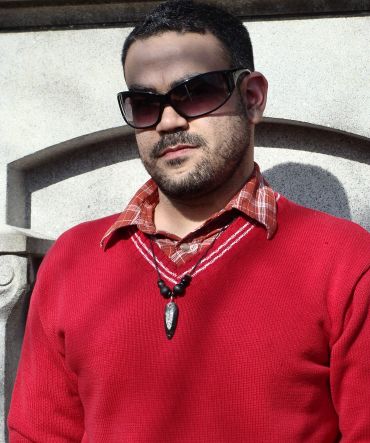
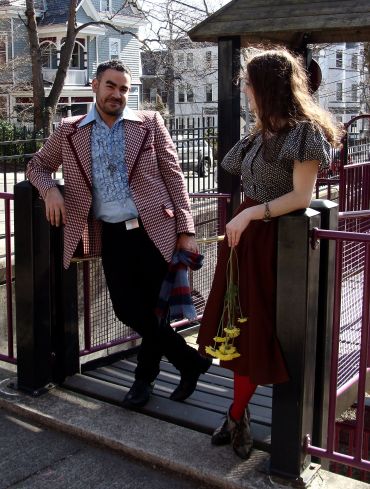
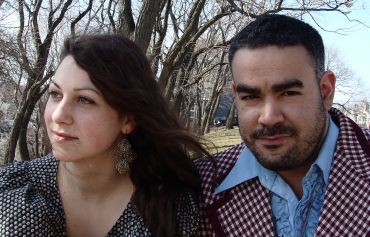
I have not written such stories in many years but they came to mind this week as I sorted through these pictures I took of two friends in their vintage garb.  Knowing of my desire to build my portfolio, they offered me the opportunity to photograph them in various settings.  Quite a treat with such photogenic folk.  And quite unexpectedly inspiring.  Not sure if I will ever put pen to paper for such stories again, but  I do look forward to future fashion shoots.

Read Full Post »

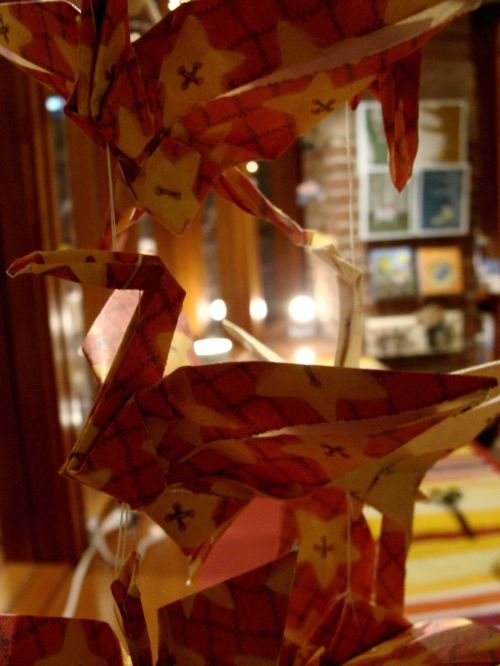
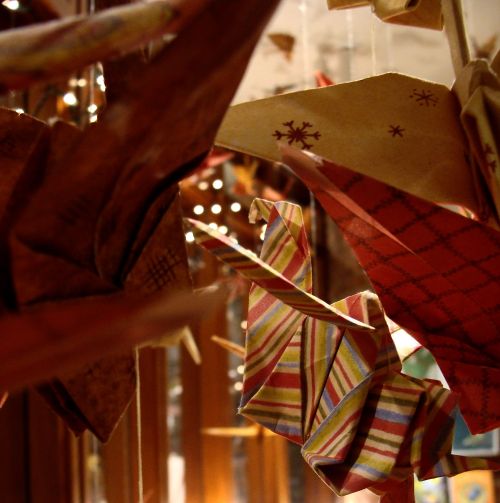
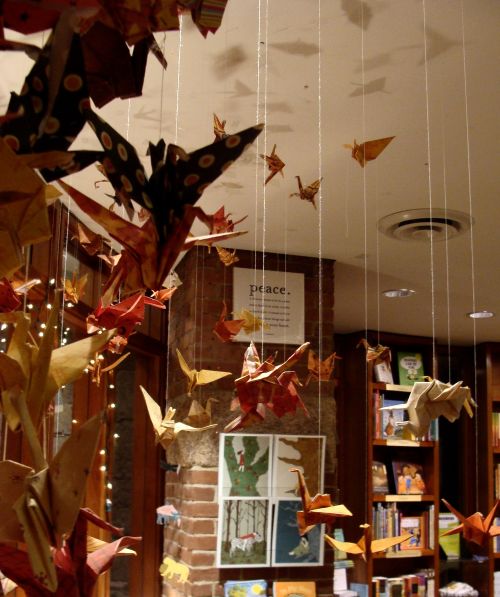
For a while, if you visit The Shop at Trinity Church in Copley Square, Boston, and wander over to the children’s section, you will see an array of paper cranes dangling from the ceiling…

… like a wave of birds in flight …

… colors bright and warm …

… shadows cast upon the ceiling in the wavering lights.

The birds were made by Anulfo Baez, a guest contributor on this site before.  Upon learning that Shop staff were contemplating a new window display involving birds, he donated his origami creations.  Several hundred in number, he had originally intended to make 1,000.  Do you know the lore surrounding One Thousand Cranes?

Even if you do know, read Anulfo’s story, One Thousand Paper Cranes for Japan.  While he did not reach his original goal, I think what he did create will bring a bit of brightness and joy into the life of anyone who has the opportunity to see his art repurposed.

Read Full Post »

Reading photographer Jay Kinghorn’s post about how audio affects perception of visual images reminded me of the “soundtracks” I used to create as I wrote short stories.  The music I collected helped me channel, get lost in, build and sustain emotions that I needed to create strong images on the page.  With the support of a tech savvy roommate, I even played around with Windows Media and tried to weave together my written words with still images and compiled music.  The goal?  Simply to tell a story and use accompanying music to create emotional resonance.  Currently I do little with short stories or movie making though music still influences my work … I sometimes listen to music as I walk along the Charles with my camera.  Perhaps this New England winter, I will jump back into the fiction.  Meanwhile, this late summer morning, I find myself pondering the fact that while audio certainly affects image perception, the flipside is also true.  Visuals influence our perception of audio.

Leaf by the Charles River

Yes, there is some connection to recent Sunday musings where I lamented that, in today’s politics, glossy images distract from listening to candidates’ words.  Nothing novel there – just look at the 1960 Kennedy/Nixon debate where television viewers apparently thought the inexperienced yet highly telegenic Kennedy won the debate while radio listeners thought the less telegenic, more experienced Nixon won.  Politics aside, consider pharmaceutical ads especially the ones that air during the evening news and other programs associated with older viewers.  The companies have to share the side effects associated with the drug being advertised.  Notice how the spoken words (e.g. … this drug may cause this that or the other thing and in rare cases lead to death …)  are paired with images of happy people of all ages meandering — sometimes slowly but always with a smile — along beaches, up mountains, through open-air markets, with a dog or two in tow.  Hope is evoked so powerfully, visually that it becomes easy to let words of risk go in one ear and out the other.  In the end, the images convey the message.  Words become irrelevant.

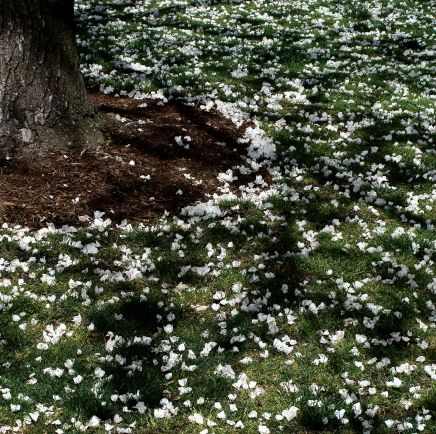
Fallen

Of course, this is nothing new.  Peoples’ visual and auditory responses and perceptions have been manipulated throughout human history, as a means to some end.  I guess that’s what I am struggling with right now.  When I watch a movie or movie trailer or attend a concert or an art exhibit or even a religious service, I am open to being manipulated.  I await the melding of music, words and images to make me experience a story.  But it’s when that manipulation happens in other contexts that I become wary and quite frankly on occasion angry.  Artistically, I am looking forward to exploring these ideas in both my photography and writing, and to better understand how other artists use these ideas and I don’t mean in a Wag the Dog kind of way.


Read Full Post »

This is my nephew, “Little J.”  How could I not smile when peering into that face?  If you’ve followed my blog at all then you know that family is very important to me.  The older I grow the more I recognize that family forms my core.  Maybe one day I’ll bundle up the family stories I’ve shared on this blog and in other venues into a book for Little J and the other young members of my family.  We’ll see … 😉

Read Full Post »

One day at the church where I work part-time, a tourist handed me a wallet found on the front porch.  I glanced inside at the driver’s license.  I don’t remember the name on the card but I remember the owner’s image.  Handsome with thick dark hair and bright blue eyes.  I could see just enough of his shirt and tie to make me think he was a businessman of some sort.  I closed the wallet and tucked it into a little cubby until I could take it to lost and found.  Shortly thereafter, a man entered my area.  I smelled him before I saw him.  Not body odor, just stale alcohol.  His clothes were wrinkled and too big for his scrawny frame.  Thinning brown hair was slicked back.  The blue eyes were the same, though, gently electric.  In a slurred voice he thanked me and then left.  I had the luxury of sitting inside for the rest of the afternoon wondering what had happened to transform that man.  Was he homeless as I suspected?  What was his story?  Well, that story I may never know, and if I were to see him again I am not sure I would have the courage to ask.  But I am glad there are people in this world not afraid to ask like Mark Horvath.

On the street I saw a small girl cold and shivering in a thin dress, with little hope of a decent meal. I became angry and said to God; “Why did you permit this? Why don’t you do something about it?” For a while God said nothing. That night he replied, quite suddenly:

“I certainly did something about it. I made you.”

That is the opening quote on the About page of  Horvath’s InvisiblePeople.tv blog.  The invisible people to which he refers are the homeless.  And here are the links for the organization’s YouTube channel  and his more personal blog, HardlyNormal.  I hope you take time to watch some of the videos shot by Horvath as he interviews the homeless.  Once homeless himself after making some bad decisions, he has a knack for drawing people out of their shells and encouraging them to tell their stories in their own words without fear of judgement.  Please take a look and listen.

Read Full Post »

« Newer Posts - Older Posts »