
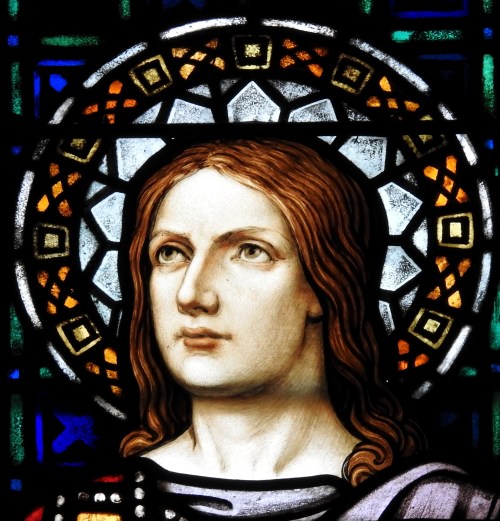
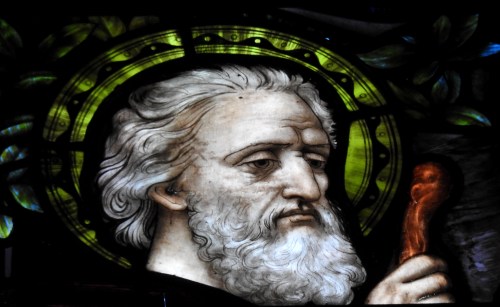
Coming soon I will share words and images from my brief journey inside St. Paul Church in Cambridge, MA. These are photos of St. John the Baptist and St. John the Evangelist.
Posted in Inspiration, Uncategorized, tagged art, beauty, Inspiration, Photography, religious art, stained glass windows on January 11, 2017| Leave a Comment »
Coming soon I will share words and images from my brief journey inside St. Paul Church in Cambridge, MA. These are photos of St. John the Baptist and St. John the Evangelist.
Posted in Inspiration, Uncategorized, tagged architectural tours, art, beauty, design, Henry Holiday, Inspiration, Photography, religious art, stained glass windows, transfiguration on January 11, 2017| 3 Comments »

Three years ago on this blog, I wrote about Henry Holiday’s depiction of the Transfiguration in the stained glass window located at Trinity Church in the City of Boston. At the time I was particularly interested in the position of the hands in his window though my research revealed to me that he was especially noted for his execution of drapery.
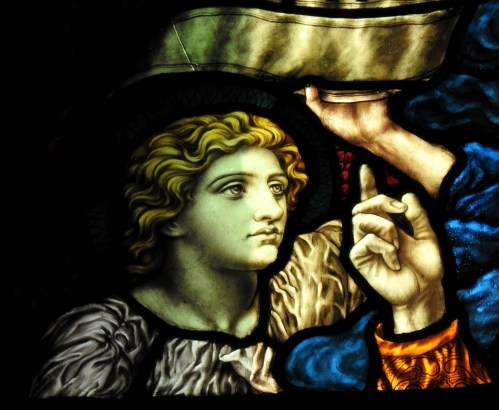
With a new lens and new perspective I’ve been revisiting the window, and I begin to understand what I read about his work with cloth in glass.
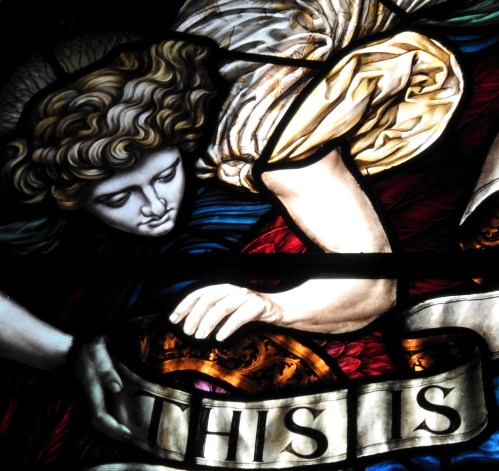
These images are from the top of the window. What’s amazing to me is that much of this detail you cannot see with the naked eye.

And yet the whole of what you see from the ground is quite stunning.

Read an earlier post here: https://wordsandimagesbycynthia.com/2013/10/07/holidays-tranfiguration/
View the window for yourself at Trinity Church: http://trinitychurchboston.org/art-and-architecture
Posted in Inspiration, tagged art, beauty, Inspiration, painting, Photography, stained glass windows on December 31, 2016| 5 Comments »
Happy New Year! No doubt it will be an interesting one.

Best wishes for peace and prosperity and an awareness of the beauty in the world around us.

Strength and courage will be necessary I suspect. As for New Year goals …
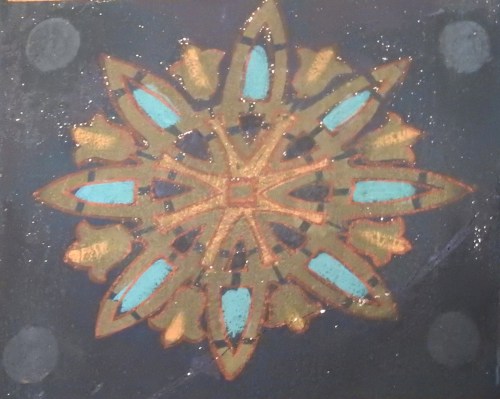
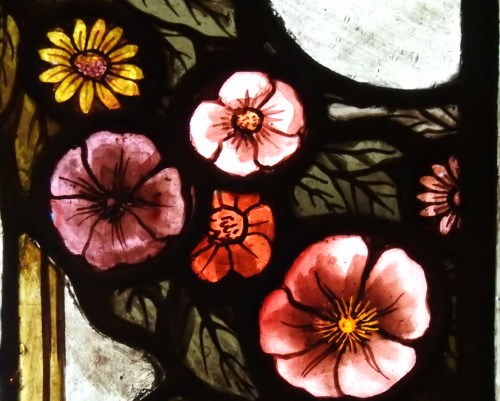
… I’ve made none, not really, except perhaps a commitment to continue to pause and to pause without expectation. These photos I took while pausing inside Trinity Church.
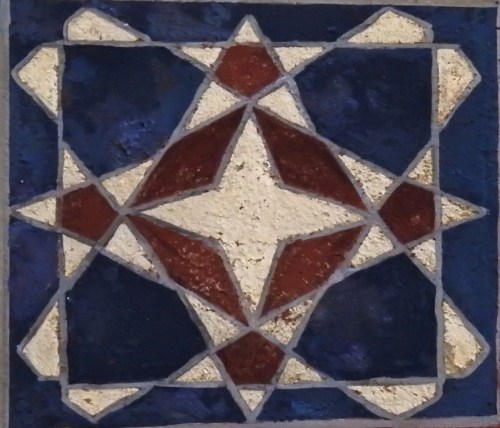
It has been my pleasure to photograph there many times over the years.

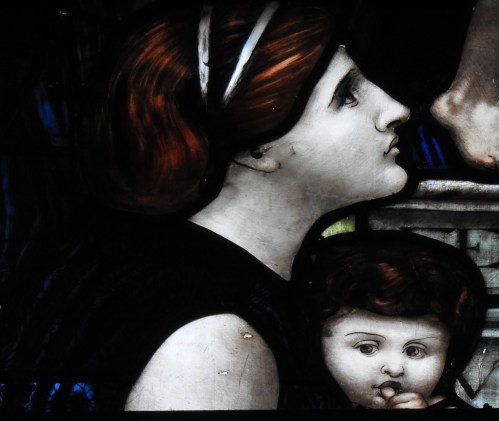
Each time there is always something new to see in the tower, on the walls, in the windows and even on the doors.

We’ll see what 2017 holds. 🙂
Posted in Inspiration, tagged art, beauty, Edward Burne-Jones, Emily Dickinson, G.F. Watts, hope, Inspiration, Martin Luther King Jr, musings, painting on December 15, 2016| 1 Comment »
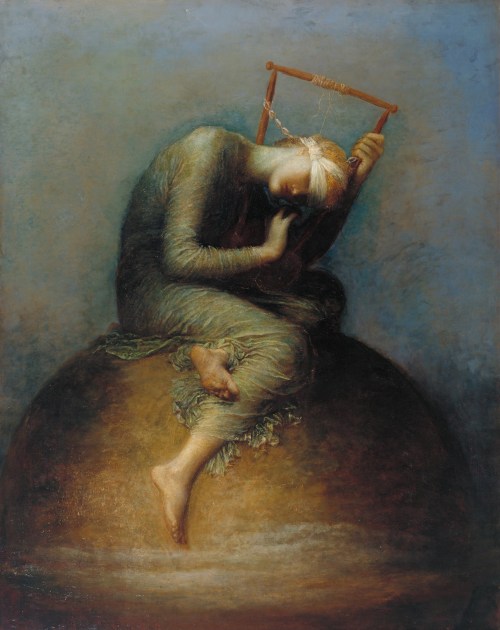
Hope by George Frederick Watts
In 1959, Martin Luther King Jr would open a sermon with these words about shattered dreams, “Our sermon today brings us face to face with one of the most agonizing problems of human experience. Very few, if any, of us are able to see all of our hopes fulfilled. So many of the hopes and promises of our mortal days are unrealized. Each of us, like Shubert, begins composing a symphony that is never finished. There is much truth in George Frederick Watts’ imaginative portrayal of Hope in his picture entitled Hope. He depicts Hope as seated atop our planet, but her head is sadly bowed and her fingers are plucking one unbroken harp string. Who has not had to face the agony of blasted hopes and shattered dreams’?”
English painter George Frederick Watts (1817-1904) would paint the first of several versions of Hope in 1885. Its symbolism would prove very popular and over time it would be massively reproduced. I read that by the 1930s however his work fell out of fashion and major galleries like The Tate removed his work from permanent display. So I do wonder when, where and how Martin Luther King first saw Hope. I do know when a young Barack Obama learned of the painting. It was in 1990. Pastor Jeremiah Wright would deliver a sermon, The Audacity to Hope. Wright’s words would move the young student who would eventually rouse a whole nation (mostly) with a notion that he would call, The Audacity of Hope.
So where is hope these days? In part its a personal question that we each have to grapple with on any given day depending on what’s happening in our lives.

Hope by Edward Burne-Jones, 1896
Watts and later his friend Edward Burne-Jones each painted variations of Hope during dark periods in their lives. For Watts that period included the death of his adopted daughter’s child. Burne-Jones had been commissioned by a wealthy American to paint a dancing figure but as he dealt with the death of his friend and colleague William Morris he asked if instead he might paint Hope. I think of hope as something you hold on to or reach out for. And sometimes it even settles around you like a warm blanket when you least expect it. Or, as Emily Dickinson wrote,
Sources & Additional Reading
http://www.thekingcenter.org/archive/document/shattered-dreams
Click to access July1962-March1963DraftofChapterX,ShatteredDreams.pdf
https://www.poetryfoundation.org/poems-and-poets/poems/detail/42889
Posted in Inspiration, tagged art, beauty, charity, compassion, Inspiration, Photography, urban life, yarn bombing on December 3, 2016| 3 Comments »

Increasingly, as one watches or reads the news, it becomes clear that individual as well as collective action will be necessary to help people survive this looming long winter. These scarves were tied around the trees in Copley Square today. You can read more about the people behind this particular grassroots program to help people stay warm here: http://www.chasethechill.com/


Posted in Inspiration, tagged architecture, art, beauty, Charles McKiim, Inspiration, John La Farge, religious art, stained glass windows on November 21, 2016| 4 Comments »

Detail from Presentation of the Virgin (after Titian) by John La Farge, 1888
At Trinity Church in the City of Boston, there is the stained glass window, Faith, by Burlison & Grylls of London, installed in 1877-1878. It was given in memory of Charles Hook Appleton and Isabella Mason by their teenaged daughters Julia and Marian Alice, known as The Appleton Sisters. The two sisters were extremely close. They lived together on Beacon Street and purchased adjoining property in Lenox, MA.
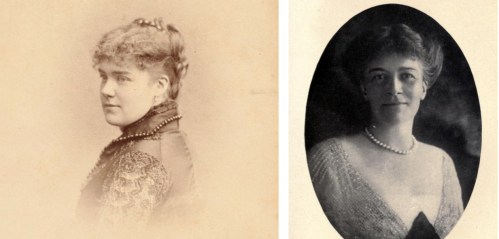
Julia and Marian Alice Appleton
Eventually, the oldest daughter Julia would meet and marry noted architect Charles McKim, a colleague and friend of the artist John La Farge. Sister Alice would marry George Von Lengerke Meyer. As did many families of their social circle the McKims traveled extensively and often throughout Europe. In Venice they visited the galleries and in that city one of Julia’s favorite paintings was Titian’s Presentation of the Virgin, 1534-1538.

In 1887, Julia would unexpectedly die during childbirth. The grieving McKim, along with sister Alice, would commission John La Farge to create a window in Julia’s memory. La Farge would select as focus a small portion of Titian’s large canvas. The window would be designed and completed within five months.
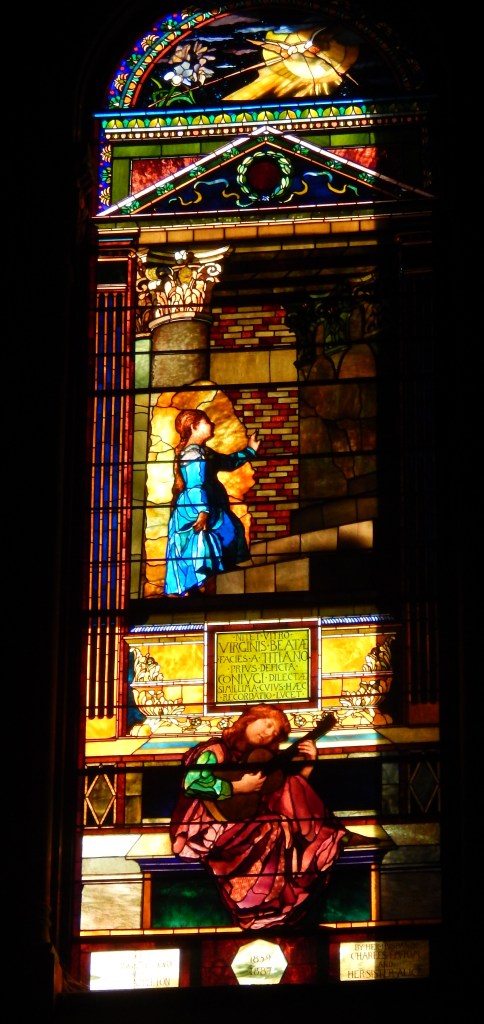
The window depicts a young girl climbing steps and symbolizes Julia’s climb toward heaven. Below this image and considered separate from the story is the image of an angel playing a musical instrument. It is a spectacular window at any time of day but especially when the sun is shining just right through the opalescent and painted glass. For this series of images, that perfect time was approximately 1pm on a sunny day.

La Farge’s early sketch can be found at the Boston Museum of Fine Arts, and the actual window is located on the south wall of Trinity Church located in Boston’s Copley Square.
Sources & Additional Reading
http://library.bc.edu/lafargeglass/exhibits/show/descriptions/all-saints/trinity-boston
Posted in Inspiration, tagged architecture, art, David's Charge to Solomon, Edward Burne-Jones, george minot dexter, history, Inspiration, Phillips Brooks, Photography, religious art, stained glass windows, storytelling, William Morris on November 16, 2016| Leave a Comment »
In time for the holidays, at the gift shop located at Trinity Church in Copley Square, you will soon find items featuring one of the most striking and provocative images that I have ever taken … probably because the source of the image is so striking and provocative. I think of them as angels though they are harpists robed in white in one corner of the stained glass window, David’s Charge to Solomon, by Edward Burne-Jones and William Morris & Co.

Detail from David’s Charge to Solomon by Burne-Jones and Morris
The women stand in a gallery at the rear of King David’s throne as the aged King delivers his charge to young Prince Solomon, and resting upon the King’s knees are the plans of the future Temple that he will not live to see. The window was presented to Trinity Church in the City of Boston by Frederic Dexter in memory of his father George Minot Dexter (1802-1872). As described in an 1888 church description, “the design is considered especially appropriate as Mr. Dexter lived but just long enough to see the plans of the new church completed and the work begun.”
George Minot Dexter was member of a prominent New England family that traced its roots to England and Ireland. It was a family of farmers, merchants, ministers, doctors and politicians. Dexter would become an architect and civil engineer. In 1836, he was commissioned to design the houses for Boston’s Pemberton Square and all of the accompanying ironwork. Today, 1300 of his architectural drawings for 85 different projects can be found at the Boston Athenaeum, in a building he would help to erect between 1847-1849.
In 1863 Dexter, then senior warden of Trinity Church, would call upon Phillips Brooks. Brooks, the descendant of several New England families of note, was a young minister attracting great attention as he served a Philadelphia parish. The young minister was in demand by many parishes across the nation and Trinity Church was especially active in its attempt to acquire him. It would take six years, in 1869, before Brooks would accept the call.
The church at that time was located on Summer Street in downtown Boston. Forward thinking, Brooks determined that it was time for the church to move to a new location, Boston’s Back Bay. Land had been bought and a building committee had already been formed when Boston’s Great Fire of 1872 destroyed the Summer Street church.
Dexter served on the building committee that selected the design of architect Henry Hobson Richardson. The building, which revolutionized American architecture, would be constructed between 1872-1877. Dexter would not live to see the building’s consecration in February 1877. He died November 26, 1872.
In addition to what has been referred to as The Dexter Window, his service to his church is also featured on a wall tablet, with the inscription by Honorable Robert C. Winthrop. It is located in the North Transept. Winthrop refers to Dexter’s self-sacrificing nature and how he remained “active to the last in good works and particularly in his tender care for the interest of the living and the remains of the dead during the trying scenes which attended the burning of our old house of worship in Summer St …”
He refers to the fact that beneath the Summer Street church was a crypt with family vaults. That crypt was laid bare by the destruction of the building overhead. Dexter would tend to those remains until he lost his life. In a letter to his friend Miss Mitchell, Phillips Brooks would write:

If you have the opportunity to tour Trinity Church, you’ll notice not only magnificent stained glass windows like David’s Charge to Solomon but also wonderfully decorated tablets with words that provide just a glimpse into the lives of people who considered that space their home. Well worth taking a moment to read. Enjoy!
Sources, Additional Reading and Opportunities
Trinity Church Art & History Tour Information
The Garden Square of Boston by Phebe S. Goodman
http://cdm.bostonathenaeum.org/cdm/ref/collection/p15482coll1/id/839
Posted in Inspiration, tagged art, art exhibits, beauty, colors, Della Robbia, Florence, Inspiration, Photography, Renaissance, sculpture on November 7, 2016| Leave a Comment »

Della Robbia: Sculpting with Color in Renaissance Florence is a current exhibit at the Museum of Fine Arts, Boston. It is a beautifully curated show featuring glazed terracotta that, as one visitor stated, if you did not know the sculptures were made over 500 years ago, you would think that they were made just yesterday.

The colors are still that vivid thanks to a unique glazing recipe developed by Luca della Robbia (1399/1400–1482). The sculptures produced by his family, based in Florence, Italy, are dramatic in design and expression and rather luminous.
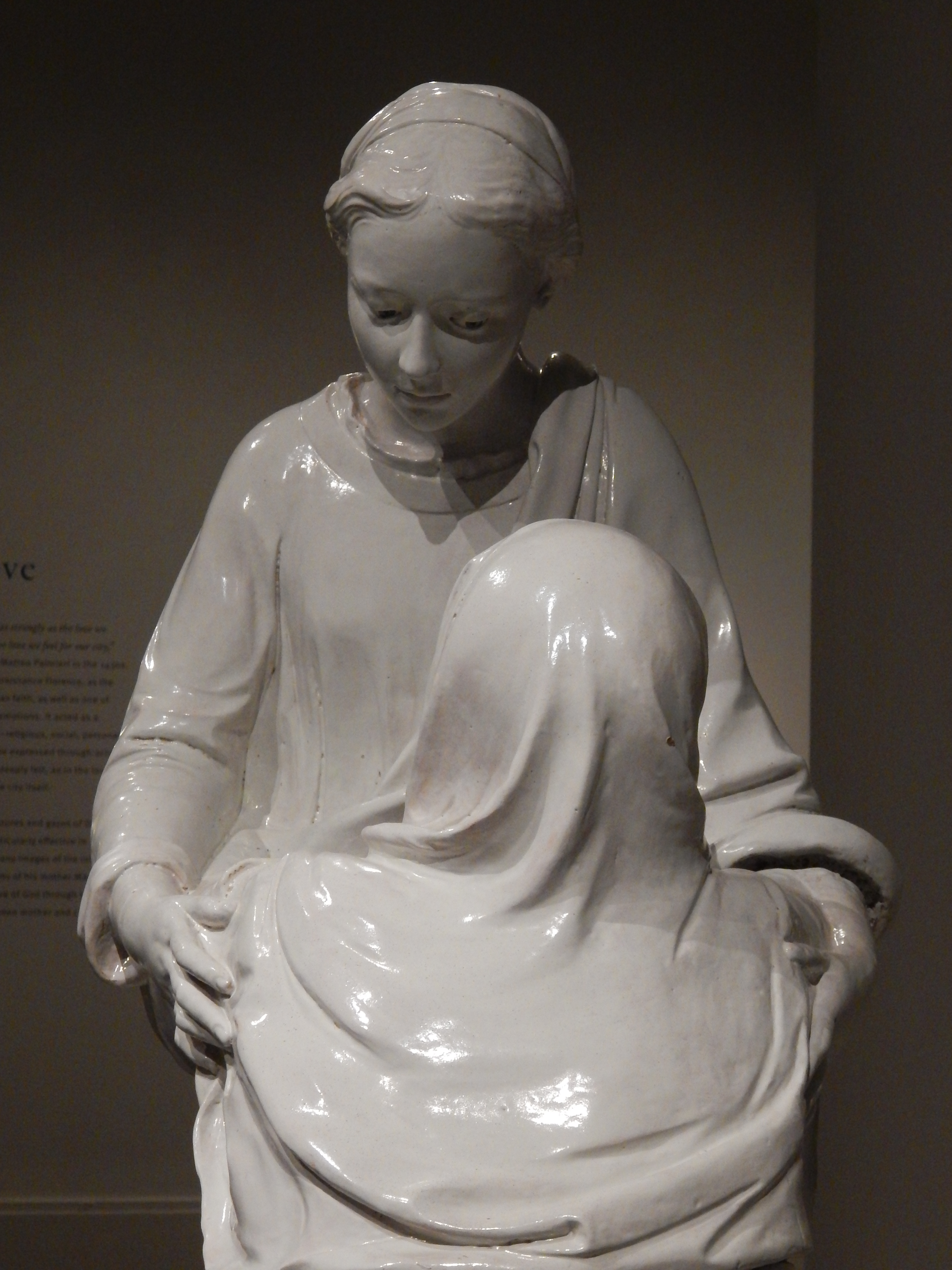
detail from The Visitation, 1455, on loan from the church of San Giovanni Fuorcivitas in Pistoia, Italy
Della Robbia’s signature colors of white and cerulean blue radiate with a brilliance that would become the family hallmark. There is a deep richness to the others colors as well.
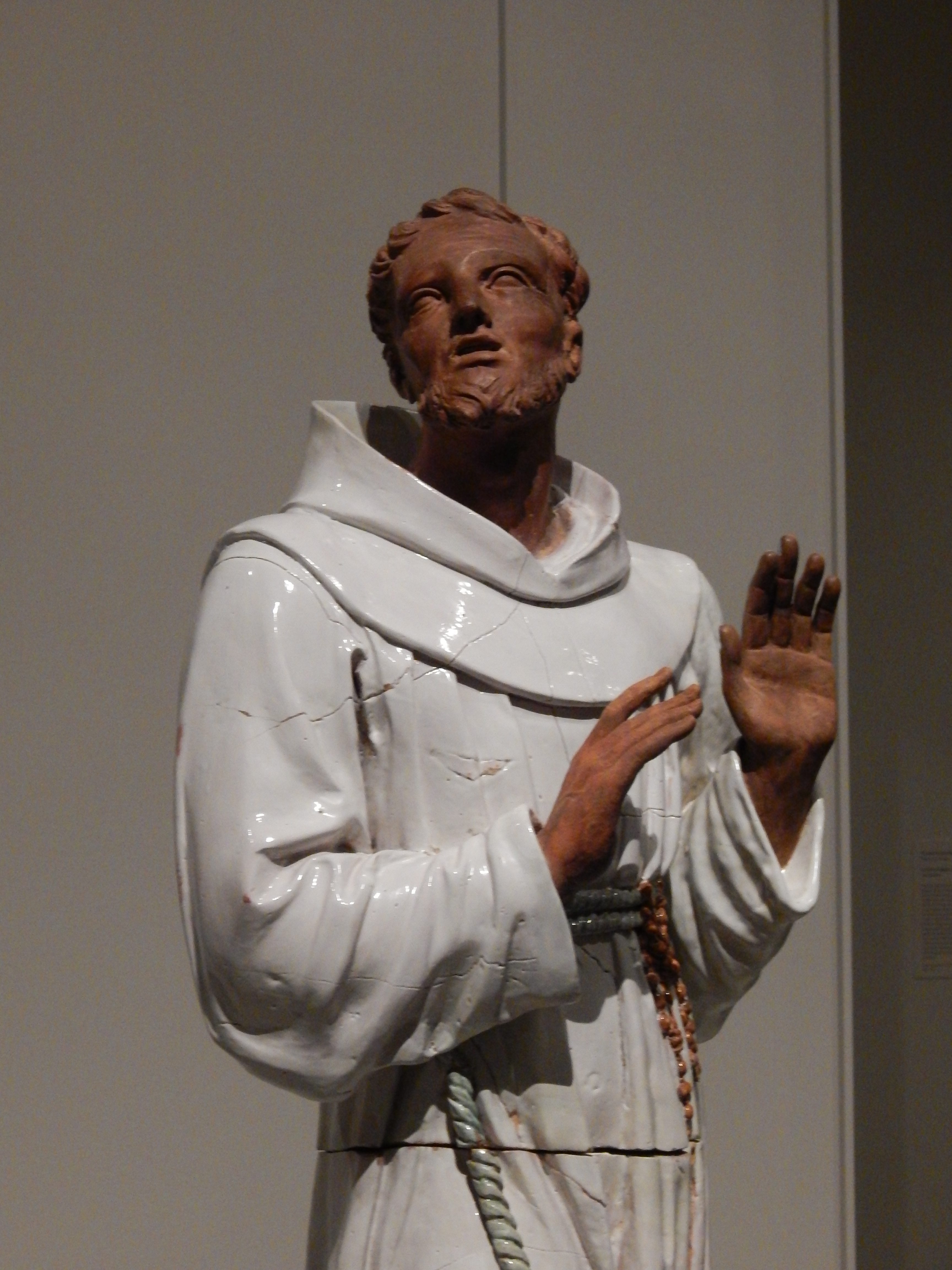

For the exhibit the MFA pulled together nearly 50 objects from U.S. collections and from Italy. On view in the museum’s Lois B. and Michael K. Torf Gallery, the freestanding sculptures and other decorative pieces are organized around three themes – hope, love, and faith. Exhibit curator Marietta CAmbareri describes these as the virtues of the Renaissance, guiding peoples’ lives at the time.

The exhibit, a visual treat, runs through December 4th. More details available here: http://www.mfa.org/exhibitions/della-robbia

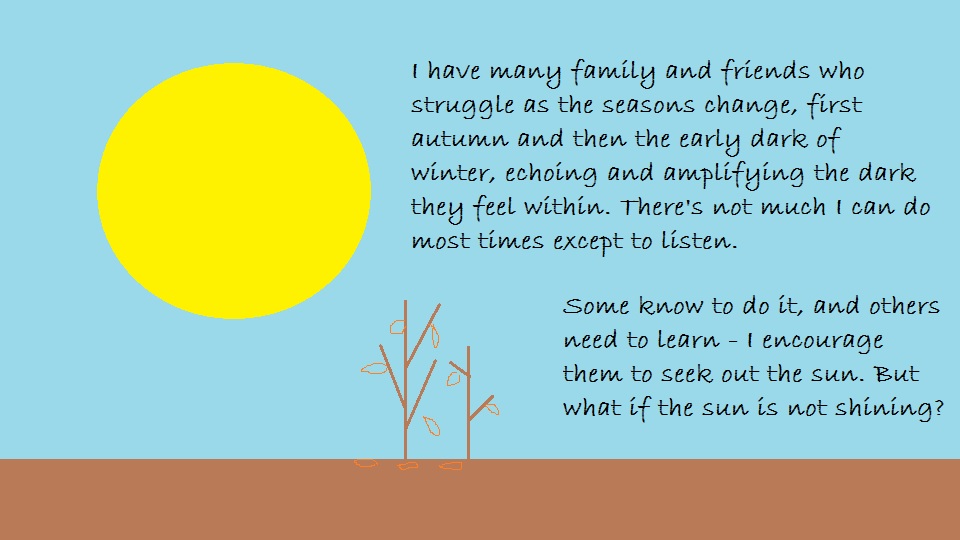
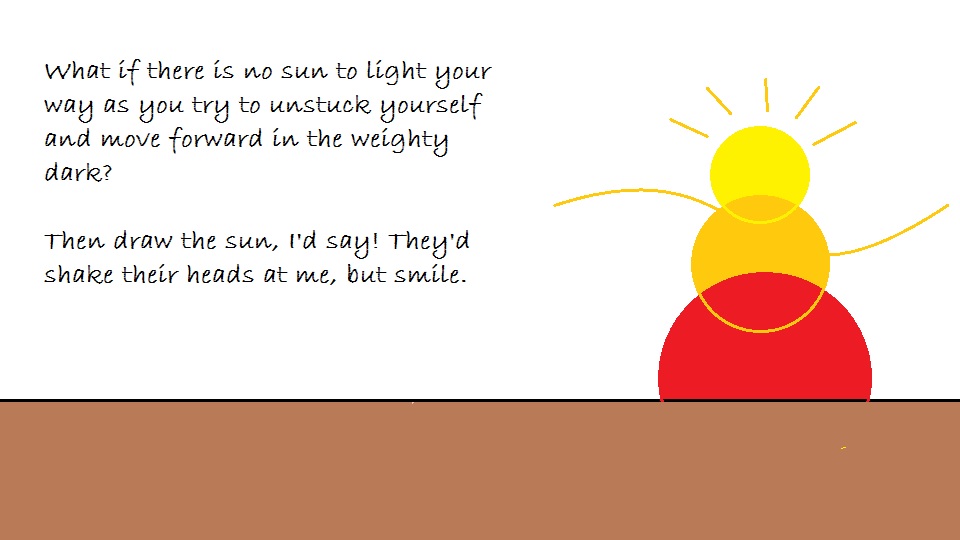
Posted in Inspiration, tagged art, depression, growth, illustration, Inspiration, light, MS Paint, musings, relationships, seeds, storytelling, sun on November 6, 2016| Leave a Comment »
Posted in Inspiration, tagged art, colors, creativity, fun, graphic design, Inspiration, microsoft paint, stationery on November 2, 2016| Leave a Comment »

standing in the rain
My cousin Tim is an artist extraordinaire who creates elaborate urban settings with detailed maps. As a child I watched him do this with pencil to blank paper. He must have quite a collection of notebooks. But at some point he began working with MS Paint. He recently shared with me his latest creation and when I have his permission I hope to share his work and the stories behind his world. Meanwhile, I had to update my hardware and I “discovered” that I had Paint on my machine. I told Tim, “You create maps. I can’t even make a straight line.” He told me about holding down the shift key to solve that problem. He promised to continue sharing his maps with me and I mostly promised to share my adventures with 21st century technology that most people have known about for ages. Between tutorials from young cousins and Youtube videos, I may continue to delve into this digital art world. Meanwhile, here’s my fun for the day. Be well. 🙂







 Words + Images