Feeds:
Posts
Comments

Posts Tagged ‘books’

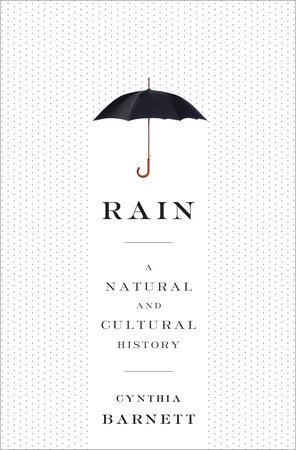
Aside from those times when I’m waiting at the bus station for what seems like hours and the winds are blowing so hard that an umbrella is useless, I love the rain. The sound of rain on rooftops. The scent of rain. The sight of rain striking windows or dripping from leaves.  Peter Gabriel’s Red Rain is one of my favorite songs. All the different renditions of I Can’t Stand the Rain … just love it.  Living in the northeastern part of the U.S.,I’ve rarely had to think about rain. There’s no real lack of it.  I’ve just accepted it when it falls but Cynthia Barnett’s book, Rain, truly gave me a new appreciation for rain’s influence in shaping human society and culture both in the past and in the present.

Over the past two months, I’ve carried the book across two continents.  Just under 300 pages in length, it’s not that long but the writing is dense and detailed. There’s no one narrative thread leading you someplace.  Each chapter is like an umbrella and beneath that umbrella there’s a beautifully complicated web of stories all united by rain. One moment you’re reading about the origin and evolution of the Mackintosh raincoat by 18th century Scottish inventor Charles Macintosh and next you’re reading about Mary Anderson, a Birmingham, Alabama socialite who devised the first windshield wiper.

The Scent of Rain is a particularly fascinating chapter where she explains how rain “picks up odors from the molecules it meets. So its essence can come off as differently as all the flowers on all the continents — rose-obvious, barely there like a carnation, fleeting as a whiff of orange blossom as your car speeds past the grove. It depends on the type of the storm, the part of the world where it falls, and the subjective memory of the nose behind the whiff.” Barnett takes the reader on a journey from a village in Uttar Pradesh where fragrances have been distilled for generations, including the scents of rain, using compounds found in nature to the labs of super-smellers and scent scientists working to synthetically develop the rain scents found in perfumes, detergents, soaps and air fresheners.

In the chapter Writers on the Storm, readers learn how rain in all its guises has influenced musicians from Chopin to Morrissey and the works of directors Robert Capra, Akira Kurosawa and Woody Allen. The book is a treasure trove of interesting stories, and well-researched facts, about how people and nature interact in the presence of rain.  If there is one suggestion I’d have for future editions it is to include maps. Barnett’s prose takes readers around the world and back again and maps illustrating that journey would be a boon.

Please note that I received this book from Blogging for Books for this review.  Additional links are below with information about the author and the book.

http://www.penguinrandomhouse.com/books/228186/rain-by-cynthia-barnett/

http://www.penguinrandomhouse.com/authors/177450/cynthia-barnett/

Read Full Post »

It has become tradition. After visiting Dublin I produce a small book chronicling my travels. The 2015 edition is now available for purchase in print or for immediate download: http://www.blurb.com/b/6648069-dublin-green

p.s. Of course, there’s a cybersale in effect. Save 40% until December 1st with the code: CREATIVE40

http://www.blurb.com/b/6648069-dublin-green


Read Full Post »

Previous Interludes

photo by Joseph A. Horne, Mt. Olivet Cemetery

photo by Joseph A. Horne, Mt. Olivet Cemetery

In 1949, when Joseph A. Horne received an award from the Netherlands for his part in the restitution of books to that country, he was Chief of the American Information Center in Frankfurt, better known as Amerika Haus.  In a 2013 blog post, illustrator Eric Carle described his experiences at Amerika Haus as a young man:  “The Amerika Haus countered the negative view of the United States and the free world. It housed a library with books and magazines mostly in English, arranged discussion groups, performed plays, concerts, movies and exhibitions, for instance, a show on architecture from the United States. From time to time, the Amerika Haus arranged joint ventures with German cultural institutes …  The concept of the Amerika Haus was ingenious, successful and resonated with the German population eager for more contact with the outside world from which it had been isolated for many years.” A 20-year old art student, Carle would be hired to design posters for Amerika Haus events.

Libraries as places of cultural exchange was not a new idea.  Since 1938, the U. S. State Department had operated a global Cultural Relations Program, working with private citizens and organizations like the American Library Association, establishing libraries, orchestrating and/or collaborating with others to produce a wide range of activities from teacher/student exchanges to fine art exhibitions.  In post-war Germany the first Amerika Haus was established in Frankfurt by October 1947.  Others quickly followed.

The_Logan_Daily_News_Thu__Oct_22__1953_(3)

These centers, soon located across Germany, drew peoples of all ages and backgrounds curious about the U.S. and seeking education and cultural opportunities that had been denied under Hitler, and then again under Stalin for those people living in Soviet-occupied areas.

By 1953, the libraries were being operated under the auspices of the United States Information Agency (USIA), known abroad as the United States Information Service (USIS).  Established under President Eisenhower, USIA focused on public diplomacy, and consolidated a number of foreign information activities into one agency, including the existing network of libraries.  The USIA would focus on delivering programming overseas with the Department of State providing foreign policy guidance. Titles changed and field operations shifted, but people like Joseph Horne continued what they had been doing since the end of the war, serving as liaison and ambassadors of U.S. culture and democratic ideals. The libraries were a focal point.  Pulitzer Prize winning journalist, Hal Boyle, reported from Berlin in 1954:

The centers were viewed by many as a strategic investment against the rise of the Soviet Union and communism, not by using force, but by using arts, literature, music and commercial publications.  As Joseph Horne would later tell his son, “One of the most powerful pieces of U.S. propaganda ever was the Sears Roebuck catalog.

As the Cold War intensified, libraries, and especially Amerika Haus libraries in Germany, would become unexpected targets as the anti-Communist fervor intensified across the U.S.

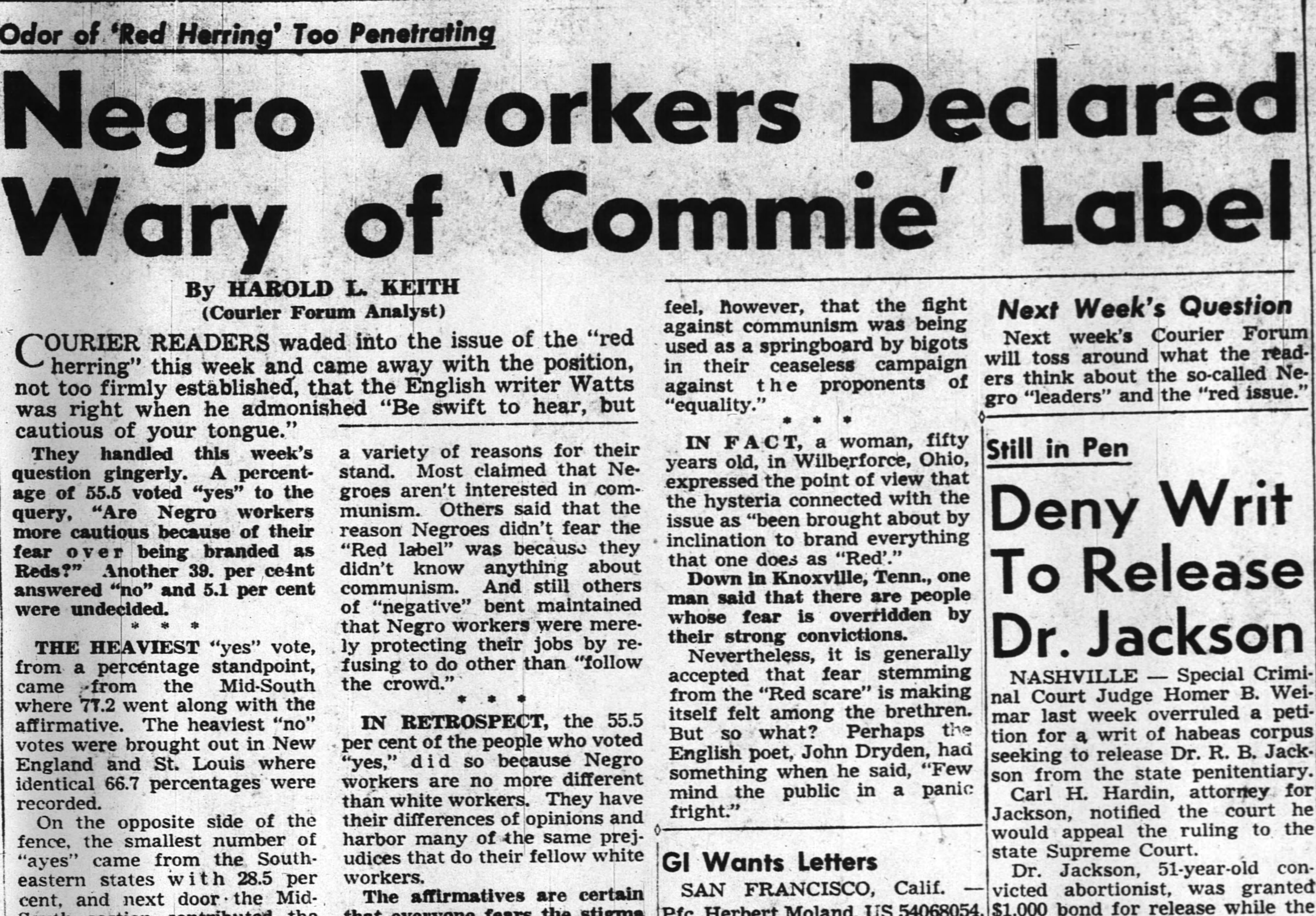
Concerns had escalated to the point that government employees had to swear they were not Communist. Television networks made their employees sign loyalty oaths. Public media encouraged people to report anyone suspected of being “red.””

Excerpt from The_Pittsburgh_Courier_Sat__May_31__1952_

Excerpt from The_Pittsburgh_Courier_Sat__May_31__1952_

Lists were compiled by private groups as well as government agencies.  Celebrities were especially put under a spotlight.  People were blacklisted. They lost their jobs.  People were threatened with jail and expulsion from the country.

None more so than Wisconsin Senator Joseph McCarthy fanned the nation’s fears, with his fervent accusations of subversive activities at home and abroad.  In David Caute’s book, The Dancer Defects: The Struggle for Cultural Supremacy during the Cold War, he describes McCarthy’s interest in the State Department libraries, places where he believed Soviet and communist-leaning propaganda was being distributed.

McCarthy’s two aides, Roy Cohn and David Schine, would embark on a highly publicized tour of numerous European cities “striking at the cultural centers known as America House. … A major purge occurred in Berlin and throughout West Germany where the [United States Information Agency] had 40 branch libraries visited by an estimated 15 million people in the course of 1952.” He goes on to quote a 1953 Herald Tribune reporter as writing, “The burning of books is now progressing merrily in all American diplomatic missions abroad for all to see.

Russian American Vera Micheles Dean was head researcher for the New York-based, and anti-Communist, organization Foreign Policy Association.  In 1953, when her books were ordered pulled from the Amerika Haus libraries by the State Department, she put two questions to Secretary of State Dulles:  Who was responsible for drawing up the list of proscribed books? On what grounds were her writings forbidden?

In a 1953 article in opposition to McCarthy’s attacks against the libraries, correspondent Raymond Wilcove writes:  “More than 35 million people in 67 countries continue to throng America’s overseas libraries as Congress debates their value. Those who have seen them in operation say they provide America’s best show-window to the world.

Horne would later share that he remembered his phone calls from Cohn.  While he did not share the detail of the conversations, he was not complimentary about the interaction.  Despite the purge, in the end, the Amerika Haus libraries would survive McCarthy.  McCarthy would not survive Edward R. Murrow.

Edward R. Murrow

Edward R. Murrow

In the 1950s, on his CBS program See It Now, developed with colleague Fred Friendly, Murrow produced a series of reports about McCarthy’s activities.  His March 9, 1954 broadcast is widely hailed as one of television’s great moments.  Murrow began the report with these words,

Because a report on Senator McCarthy is by definition controversial, we want to say exactly what we mean to say, and I request your permission to read from the script whatever remarks Murrow and Friendly may make. If the Senator feels that we have done violence to his words or pictures and so desires to speak, to answer himself, an opportunity will be afforded him on this program. Our working thesis tonight is this question: If this fight against Communism is made a fight between America’s two great political parties, the American people know that one of these parties will be destroyed, and the Republic cannot endure very long as a one party system.”

Having been diligent at collecting film and audio clips of the Senator speaking in public, Murrow proceeded to air clips of the Senator, in his own words, making statements in one setting that he makes very differently in another. Murrow remarked,  “On one thing the Senator has been consistent. Often operating as a one-man committee, he has traveled far, interviewed many, terrorized some, accused civilian and military leaders of the past administration of a great conspiracy to turn over the country to Communism, investigated and substantially demoralized the present State Department …

Murrow was dogged in his examination of the Senator, finally concluding, “No one familiar with the history of this country can deny that congressional committees are useful. It is necessary to investigate before legislating, but the line between investigating and persecuting is a very fine one and the junior Senator from Wisconsin has stepped over it repeatedly. His primary achievement has been in confusing the public mind, as between the internal and the external threats of Communism. We must not confuse dissent with disloyalty. We must remember always that accusation is not proof and that conviction depends upon evidence and due process of law. We will not walk in fear, one of another. We will not be driven by fear into an age of unreason, if we dig deep in our history and our doctrine, and remember that we are not descended from fearful men — not from men who feared to write, to speak, to associate and to defend causes that were, for the moment, unpopular.
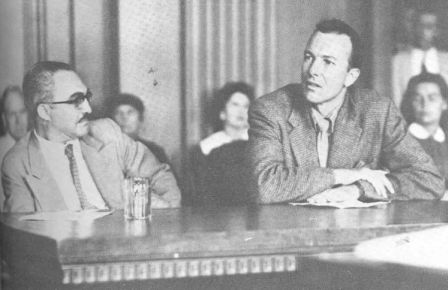
Pete Seeger Before McCarthy

Pete Seeger Before McCarthy Hearing

This is no time for men who oppose Senator McCarthy’s methods to keep silent, or for those who approve. We can deny our heritage and our history, but we cannot escape responsibility for the result. There is no way for a citizen of a republic to abdicate his responsibilities. As a nation we have come into our full inheritance at a tender age. We proclaim ourselves, as indeed we are, the defenders of freedom, wherever it continues to exist in the world, but we cannot defend freedom abroad by deserting it at home.

Langston Hughes Before McCarthy

Langston Hughes Before McCarthy Hearing

The actions of the junior Senator from Wisconsin have caused alarm and dismay amongst our allies abroad, and given considerable comfort to our enemies. And whose fault is that? Not really his. He didn’t create this situation of fear; he merely exploited it — and rather successfully. Cassius was right. “The fault, dear Brutus, is not in our stars, but in ourselves.”

Good night, and good luck.”

McCarthy’s influence waned. By the end of the year he would be censured by Senate.  In 1957 he died at the age of 48.  The libraries that he had so maligned were still going strong.  In 1959,  journalist Tom A. Cullen would write: “I have just visited the American “spy factory” in West Berlin.  That’s what the Communists call Amerika Haus, the new $250,000 United States Information Center.  But in an afternoon there I could find nothing more sinister than a few gray-haired grannies reading newspapers.  Or maybe it’s American jazz that’s sinister – there was a whole group of eager German youths listening to the latest long-playing jazz discs from the States.

Throughout this period, Joseph Horne’s foreign service activities would take him from Frankfurt, Germany to Genoa, Italy where he served as Public Affairs Officer. Intermittent time would be spent in the U.S. as his family grew.  In approximately 1957 or 1958 he would be assigned as Cultural Affairs Officer in Bangalore, India.  In 1961, President John F. Kennedy would appoint Edward R. Murrow as director of the United States Information Agency.  “Edward R. Murrow was my boss,” Horne would tell his son. India during this time, like much of the world, was going through great change. More to follow in the next Interlude.


Sources & Additional Readings

Amerika Haus: The First Fifty Years

History of the Amerika Haus

http://ericcarleblog.blogspot.com/2013/08/amerika-haus.html

DAI Heidelberg Library & USA Information

Information Bulletin April 1949

The Dancer Defects: The Struggle for Cultural Supremacy during the Cold War … by David Caute, page 26

Joseph McCarthy

Cohn & Schine Time Cover 1954

Vera Micheles Dean

Edward R. Murrow addresses Joseph McCarthy full video

Transcript of Murrow addressing McCarthy

https://en.wikipedia.org/wiki/Communist_Control_Act_of_1954


Read Full Post »
On October 22, 2015, Congressional leaders will present a Congressional Gold Medal in recognition of the Monuments Men.  The Congressional Gold Medal is the highest honor the U.S. Congress can bestow upon civilians.  One of the civilians being recognized in this case will be Joseph A. Horne (1911-1987).

Joseph A. Horne

It has been my pleasure over the past few years to research just a bit into the life of Mr. Horne. Through his life journey, I’ve gained a deeper understanding of U.S. and world history.  I’ve been cataloging and sharing my findings on this blog in a series of Interludes.   Mr. Horne served his country throughout his life and part of that service included a very active role as a Monuments Man.  While I hope you have a chance to review the whole Interludes series, following are links to the two specific chapters chronicling efforts made by dedicated men and women during and after World War II to preserve, protect and return stolen works of art and books … efforts that actually continue to this day.

interlude: to protect, preserve and return … if possible

interlude: offenbach archival depot


P. S. I hope to complete the Interludes series by year’s end.  After service as a Monuments man, Mr. Horne continued his career with the U.S. Information Service, interacting with people around the world, rich and poor, literary giants, musicians, and with kings and queens.  “Walking” with him offered me a glimpse of worlds that are no more. I look forward to sharing the stories.

West End Hotel, Bangalore

Press Release Gold Medal Ceremony for Monuments Men

Monuments Men Foundation


Read Full Post »

When I received Owls by Matt Sewell, I quickly flipped through the small hardback book, chuckling unexpectedly at some of the wide-eyed illustrations.  But I was in a rush, you see, and so I tossed the book on the coffee table intending to do a thorough inspection and review later in the day. Having been introduced to Blogging for Books by a friend, I wanted to do a good job.  Well, I can honestly say that it is a wonderful book to share with an inquisitive young reader.  My young friend whom I have mentioned often in this blog, now eight-years old, was visiting and she found the book.  I came upon her sitting quietly reading it on the couch. I watched as she sounded out Latin text and she also chuckled at the illustrations of owls each with a distinctive character.  When she saw me watching her, she waved me over to sit beside her and so we read the book together.  Each reading a page out loud about a different owl.

The author and illustrator is ornithologist Matt Sewell and I keep reading that he is described as the Banksy of the bird world.  Now, I just barely know who Banksy is (you can read more about him here https://en.wikipedia.org/wiki/Banksy ) but you don’t need to know Banksy to enjoy this book with or without a little reader by your side.

Yes, I received this book from Blogging for Books for this review.  A good deal but the best part was watching the joy the book brought to a young reader who is still learning about the world.  As my friend likes to say when she is happy with something, two thumbs up!

Learn more about the author here http://www.penguinrandomhouse.com/authors/152488/matt-sewell/.

Read Full Post »

Here is a link to previous Interludes in our walk though history with Mr. Horne.


Walter Ings Farmer, Director, Wiesbaden Collecting Point

Walter Farmer, Director, Wiesbaden Collecting Point

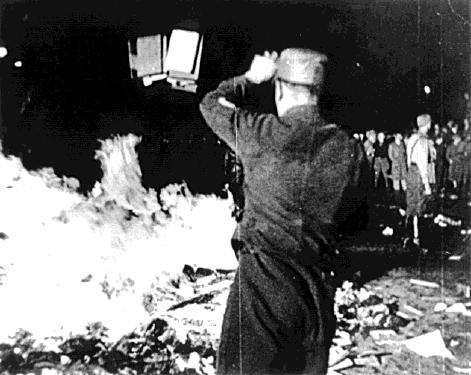
In his book, The Safekeepers: Memoir of the Arts at the End of World War II (2000), Walter Ings Farmer writes that “The story of the Offenbach Archival Depot has never received the attention given to restoration of monuments … Nevertheless an account of MFA&A activities in the Frankfurt area would be incomplete without a description of the rescue of the literary and scriptural treasures that the Nazis had looted with the same nefarious purposes they applied to art collections. … Looting of libraries became as integral to the Nazis plan for cultural domination as the looting of art collections.

1933 Berlin Book Burning

1933 Berlin Book Burning

He describes how Nazi actions escalated from the 1930s public burnings of the authors they wanted to discredit to “a program of search and seizure among the libraries and archives of the nations that they sought to conquer. … These activities established a pattern which resulted in the eventual accumulation in Germany of storehouses full of other nation’s libraries.

Millions of books would be accumulated, along with a stunning amount of other cultural and religious items collected from across Europe.  Farmer writes of being introduced to Offenbach by “his boss” Captain James Rorimer in the fall of 1945.

James Rorimer

James Rorimer

He took me with him to inspect an abandoned warehouse within the I.G. Farben plant at Offenbach,” remembers Farmer. “This building was under consideration to become to repository primarily for Jewish libraries, archives and the Torahs.” Prior to the warehouse in Offenbach being established as a collecting point, library collections were being stored at the Rothschild Library in Frankfurt. Over time it was clear that infrastructure at the Rothschild Library was inadequate.

Based on his and others assessment of the situation, librarian and MFA&A officer Lt. Leslie Poste suggested that detailed cataloging of the items be stopped at Rothschild and that operations be relocated across the river to the I.G. Farben plant, the site of a five-story, reinforced concrete loft building.

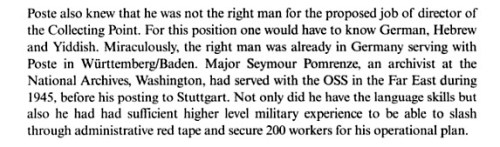
Seymour Pomrenze (center)

Seymour Pomrenze (center)

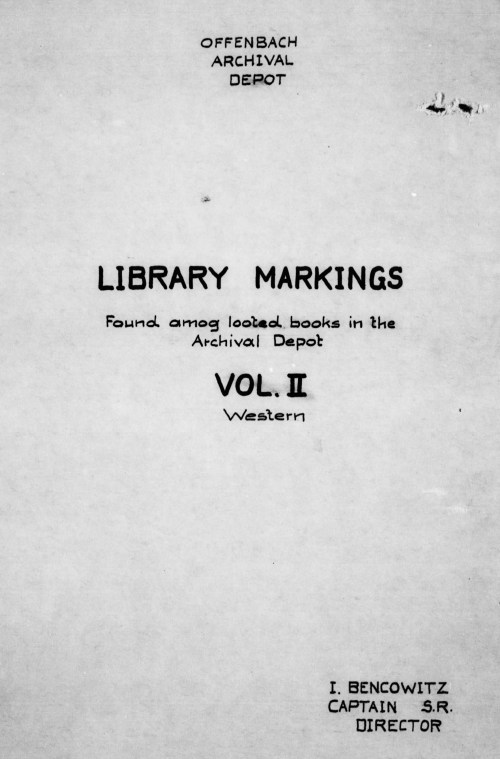
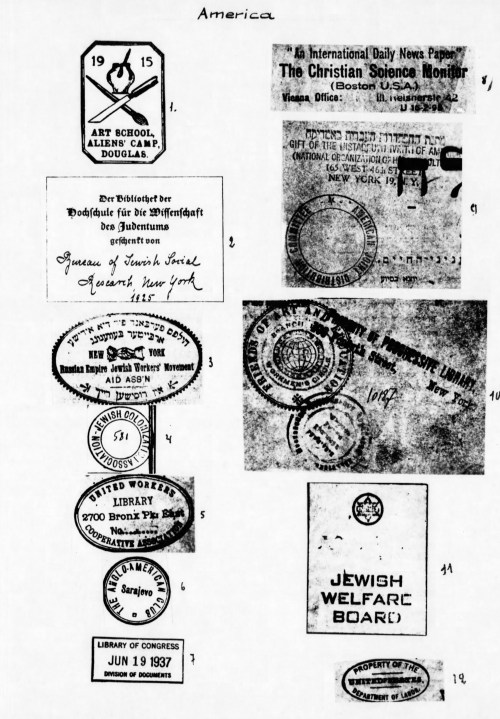
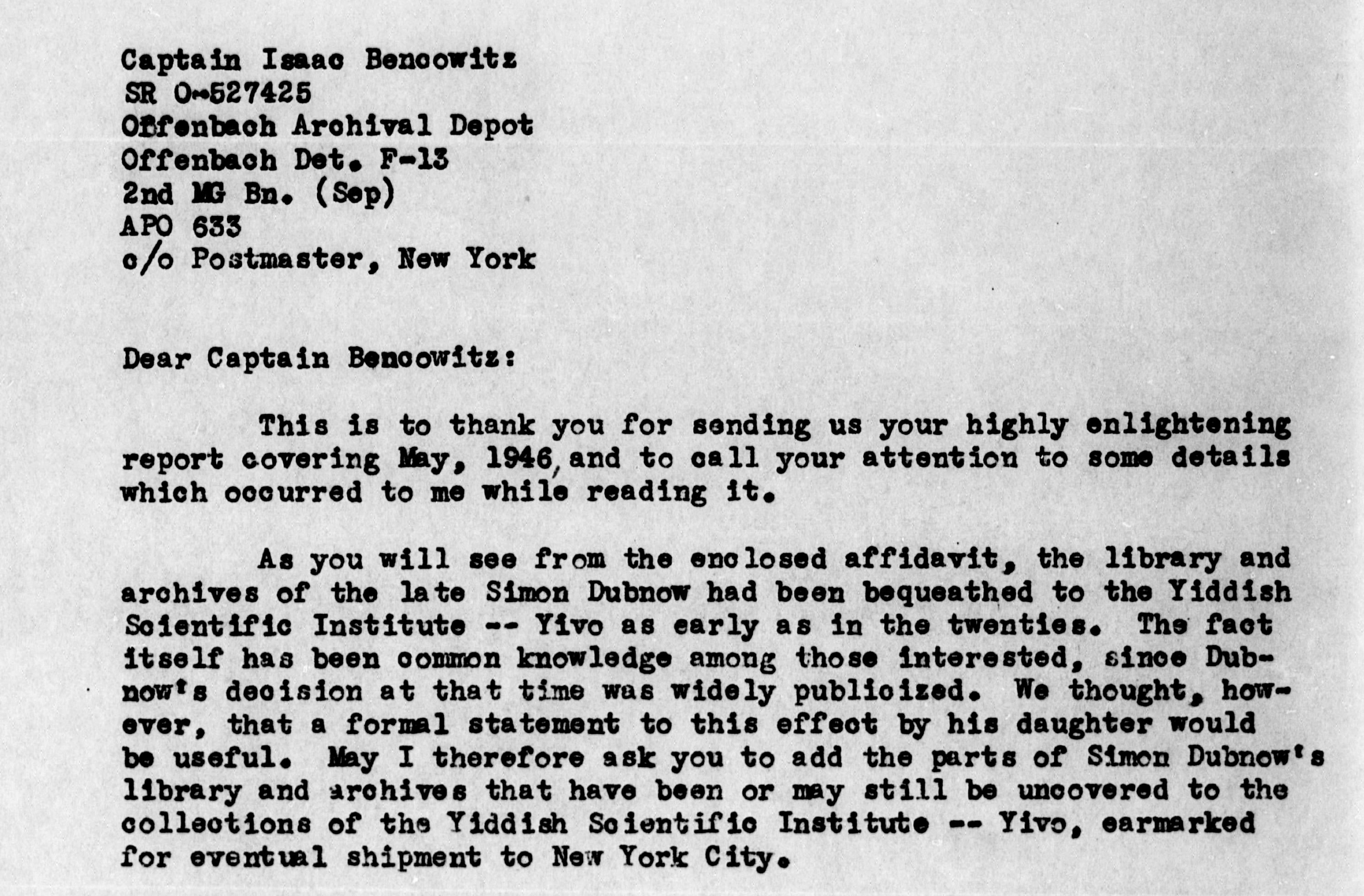
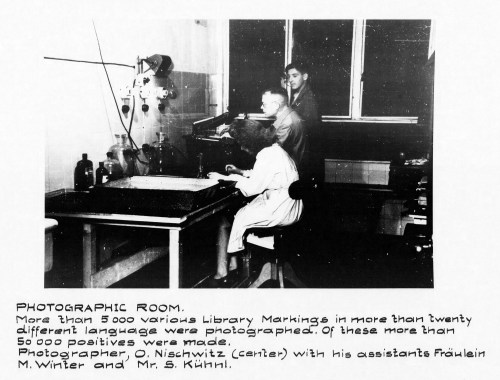
Pomrenze put into place necessary administrative, transportation, cataloging and storage systems enabling the depot to operate much more effectively.  Professional conservation and preservation labs, a photographic studio and other needed infrastructure was created.  His successor, Captain Isaac Bencowitz, refined a system for photographing ex-libris and library markings found in books.

Isaac Bencowitz

Isaac Bencowitz

The resulting cataloging system would significantly increase staff ability to identify and sort items, identifying country of origin and other markers of ownership .  In the end Bencowitz and his team would complete “two volumes with reproductions of library markings belonging to 4,105 libraries of individuals and institutions in Western and Eastern Europe

and two volumes with more than 1,300 bookplates or ex-libris, including 1,200 German-Jewish, German-Masonic and probably German non-Jewish plates as well as over 100 mostly Dutch-Jewish bookplates.” (F. J. Hoogewoud)

As requests were submitted by individuals, families and nation states seeking missing items, MFA&A staff were able to use the catalogs to help them search through the millions of books and cultural items that would eventually be stored at Offenbach.

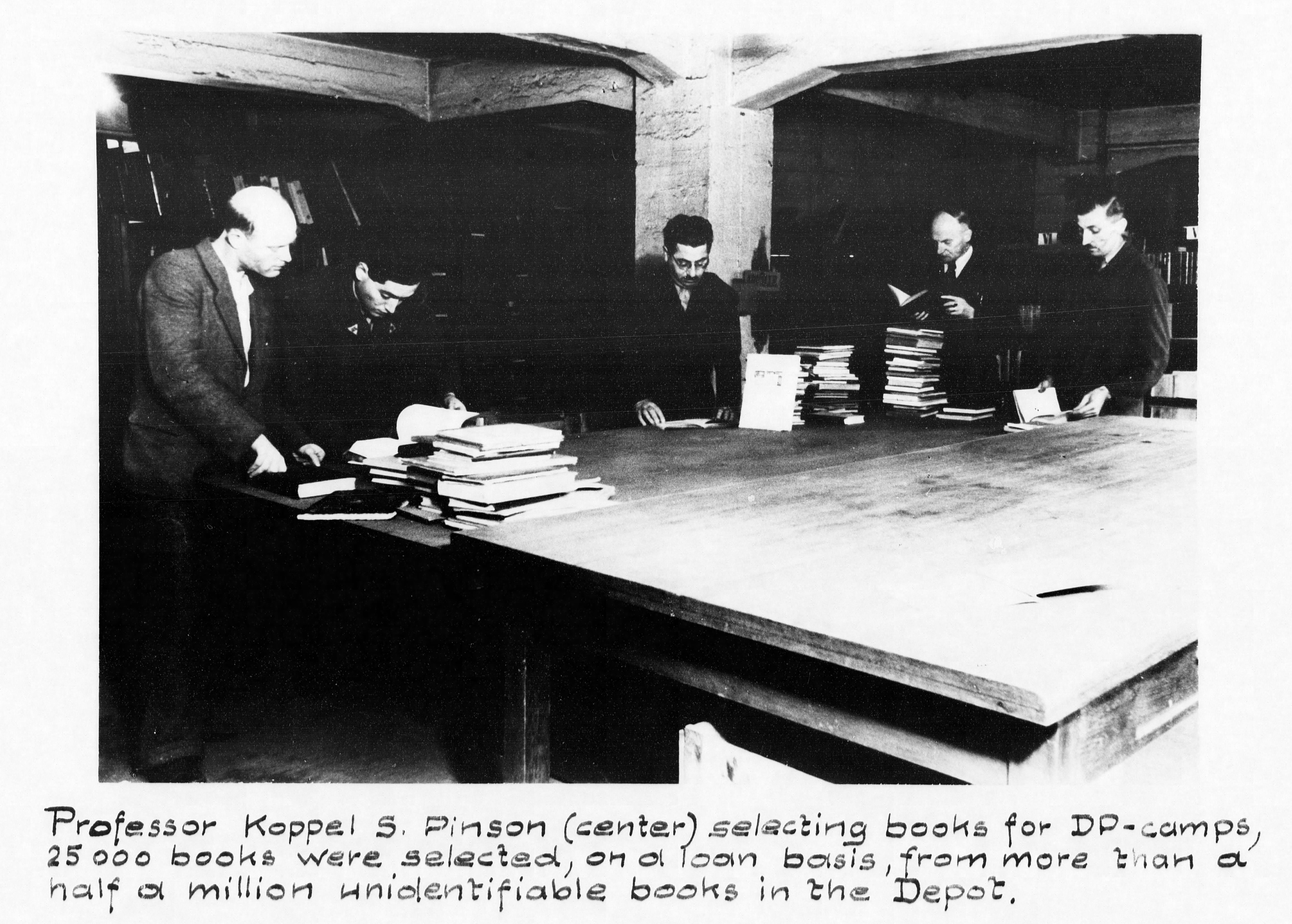
Bencowitz, during his tenure as director, used photography to document the operations of the depot and its staff and volunteers.

Staffing the depot was a mix of U.S. military, Allied and civilian personnel, as well as German civilians, and scholars from around the world. In October 1946, Bencowitz received orders for redeployment.  The imminent nature of his departure and shifting priorities in the region for policy and decision-making made selecting a new director difficult.  As an “emergency measure,” archivist Major Lester K. Born and his assistant, Joseph A. Horne, were sent to Offenbach for temporary duty.  Born was to develop an interim plan for continued operation of the depot, a plan that Mr. Horne was to implement.  In short, a plan was finally developed and by January 1947, Horne became the third director of the Offenbach Archival Depot.

Exactly what Horne was doing prior to assuming his new role remains opaque without futher research.  Archival records show him often assisting MFA&A colleagues like Gordon Gilkey, Leslie Post, Lester Born and Paul Vanderbilt with the acquisition of information about available artwork and cultural items.  His fluency in German, facility with “dead languages,” appreciation and knowledge of the arts, and photographic skills would have made him invaluable in the field.  He produced numerous reports about his trips across Germany about what he was seeing and hearing from locals. People were often very open with him.  Following is an excerpt from a field report after visiting libraries in over a dozen landkreise or rural districts:

By 1947, relations with the Russians had deteriorated significantly, adversely affecting the restitution of items to individuals and institutions in Russian-controlled territories, and the exchange of items between the Russian Zone and other Allied Zones.  With plans well underway to revitalize German economy and culture (including denazification), military and intelligence priorities shifted to stopping the Russians.  And so Horne like many within the MFA&A unit followed orders as high level officials made clear that those in the U.S. intelligence sector had full access to depot materials and freedom to act as they deemed necessary.

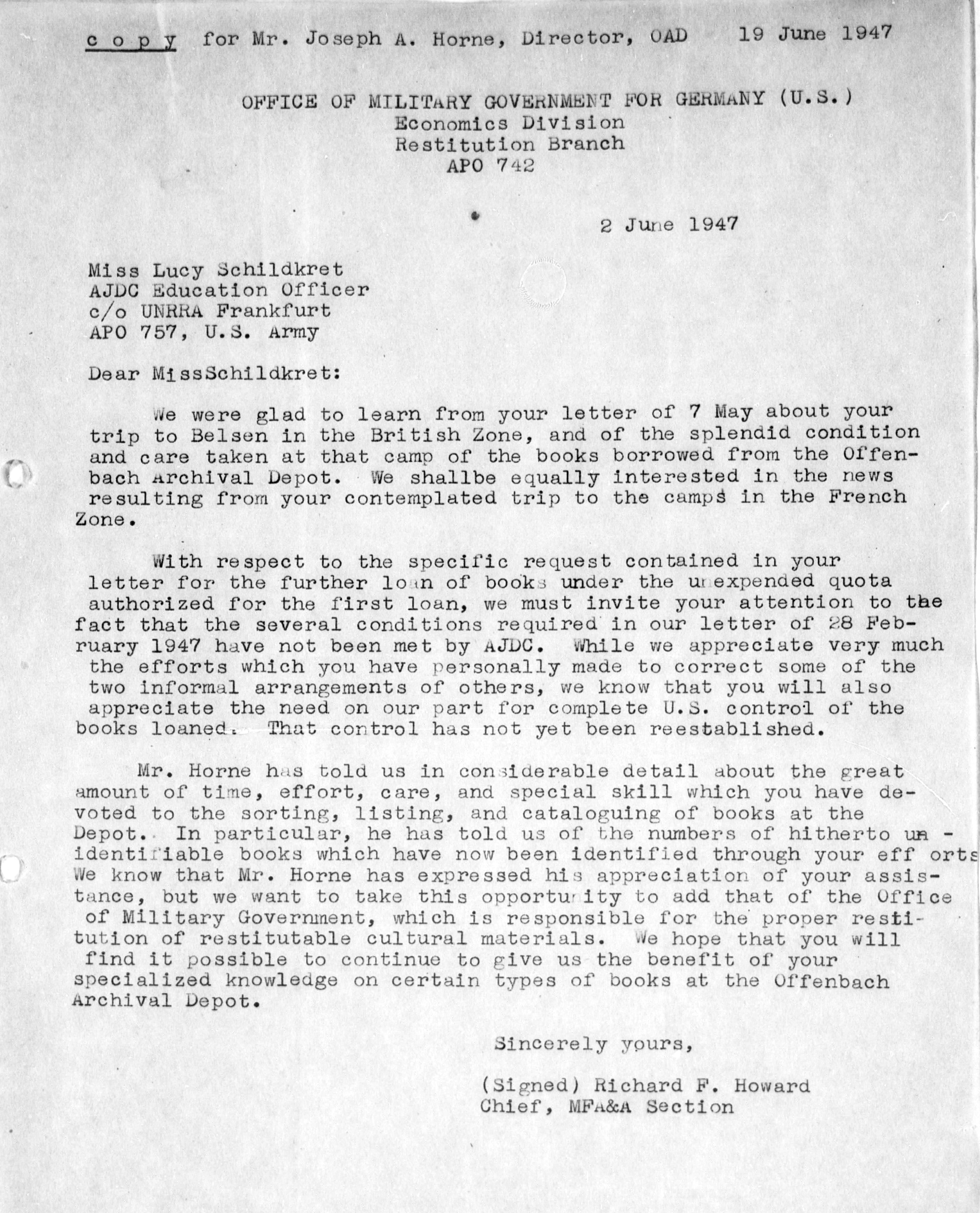
In February 1947, one month after Horne became director of Offenbach, Lucy Schildkret arrived.  She would later write, “his friends called him Tony. Before the war, he’d been on the staff of the Library of Congress’s photographic division.  Transferred from the MFA&A in Berlin, he was then new to the Depot, having taken over his duties barely two weeks before my visit.  About thirty, very tall, thin, lanky, and blond, he was the only American there.  He was in charge of a staff of some forty Germans.”

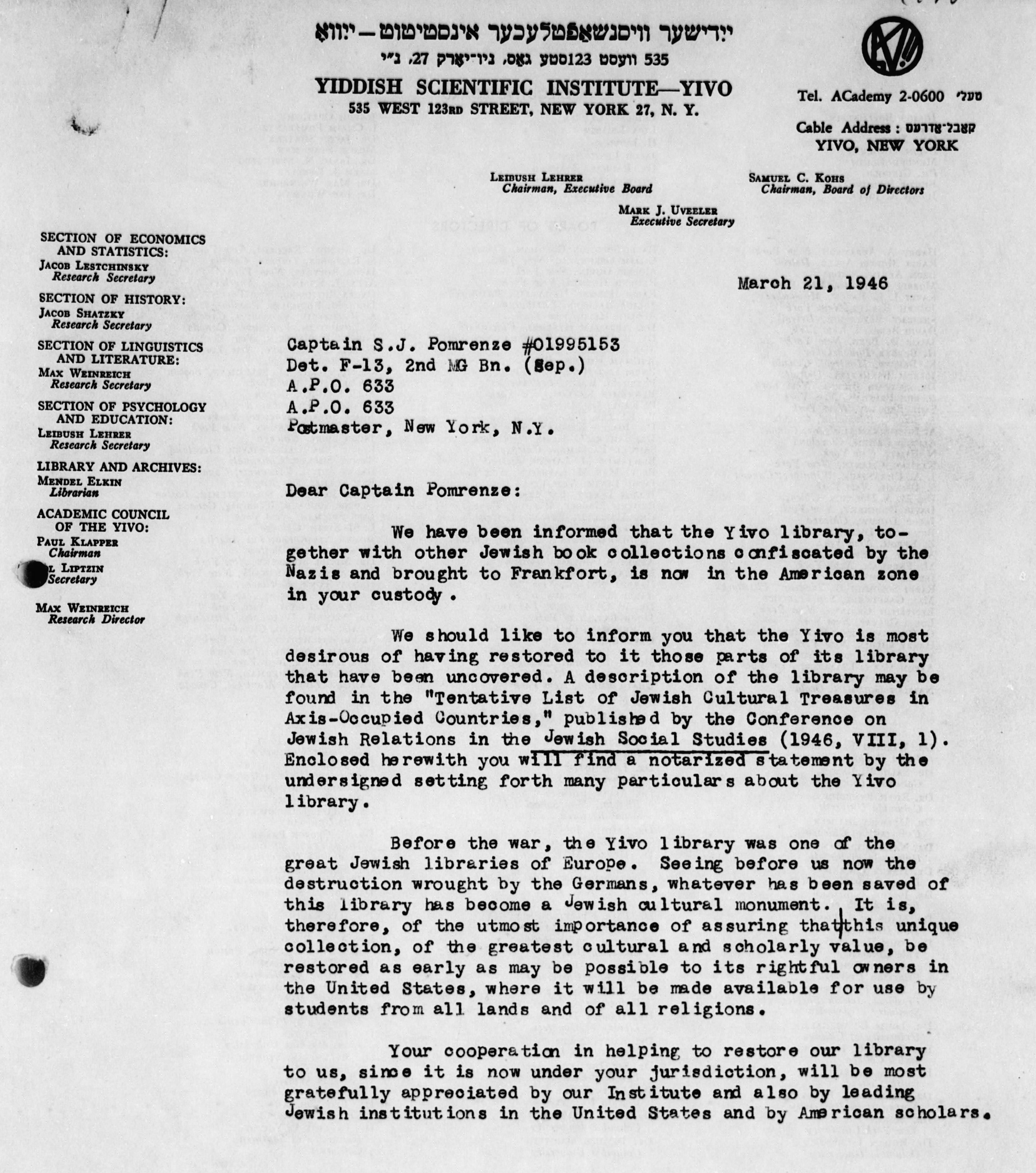
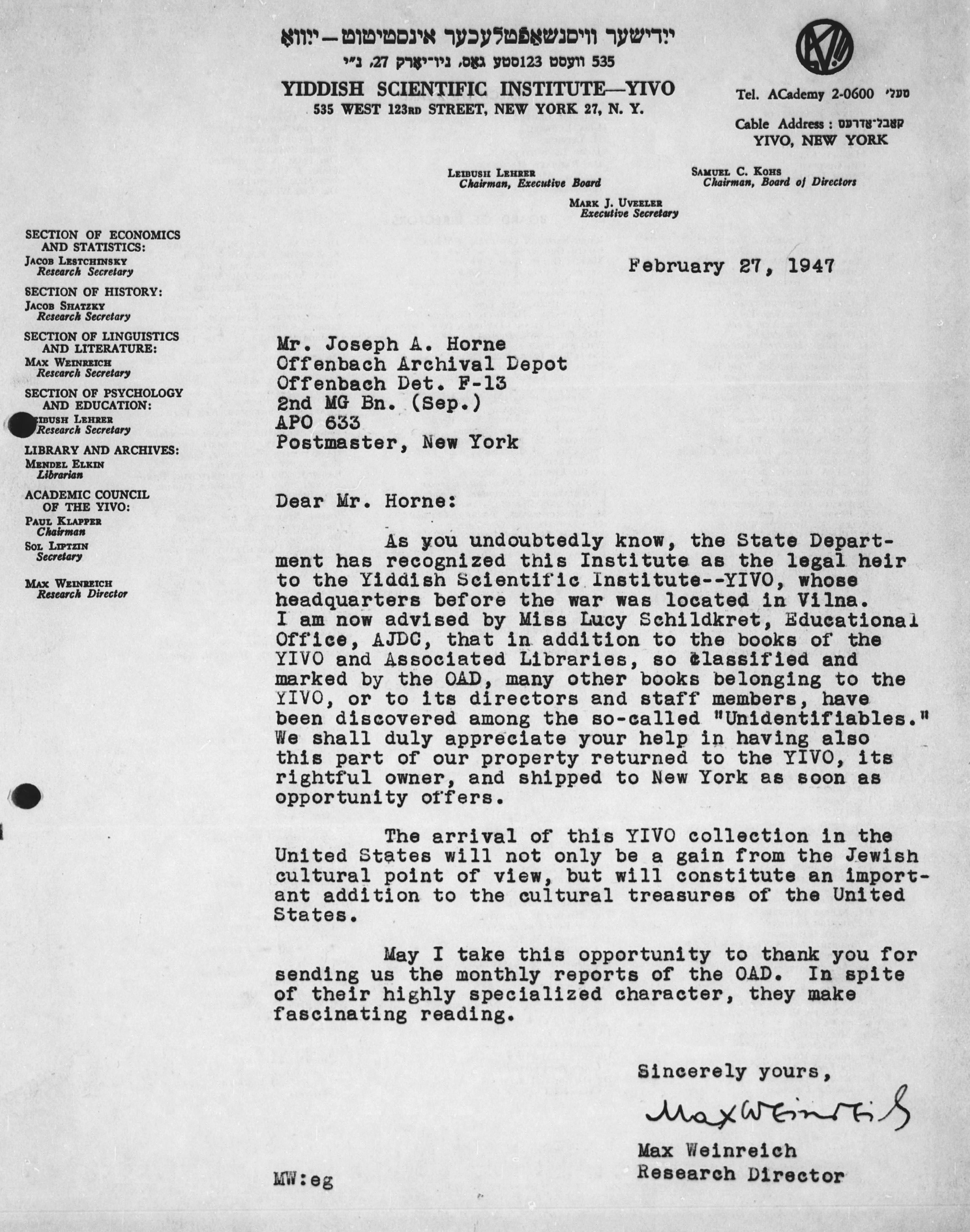
In her memoir, From That Place and Time, Lucy Schildkret describes her encounter with Horne as she works to sort, identify and return the YIVO library of Vilna, Poland.  The Yiddish Scientific Institute (YIVO) was founded in 1925 for the scientific study of Jewish life.  Headquartered in Vilna, the institute had branches around the world including the United States. At the start of the war its headquarters were transferred to New York City.

In late 1945, when the YIVO library was identified as being in Frankfurt, visiting Jewish scholar, Prof. Koppel S. Pinson sought permission from the YIVO leadership in New York to distribute, like a lending library, some of the unidentifiable books to Jews living in the Displacement Camps.  It would take time but he would be granted such authority.

A year later, Lucy Schildkret would also be granted authority to work with the books.

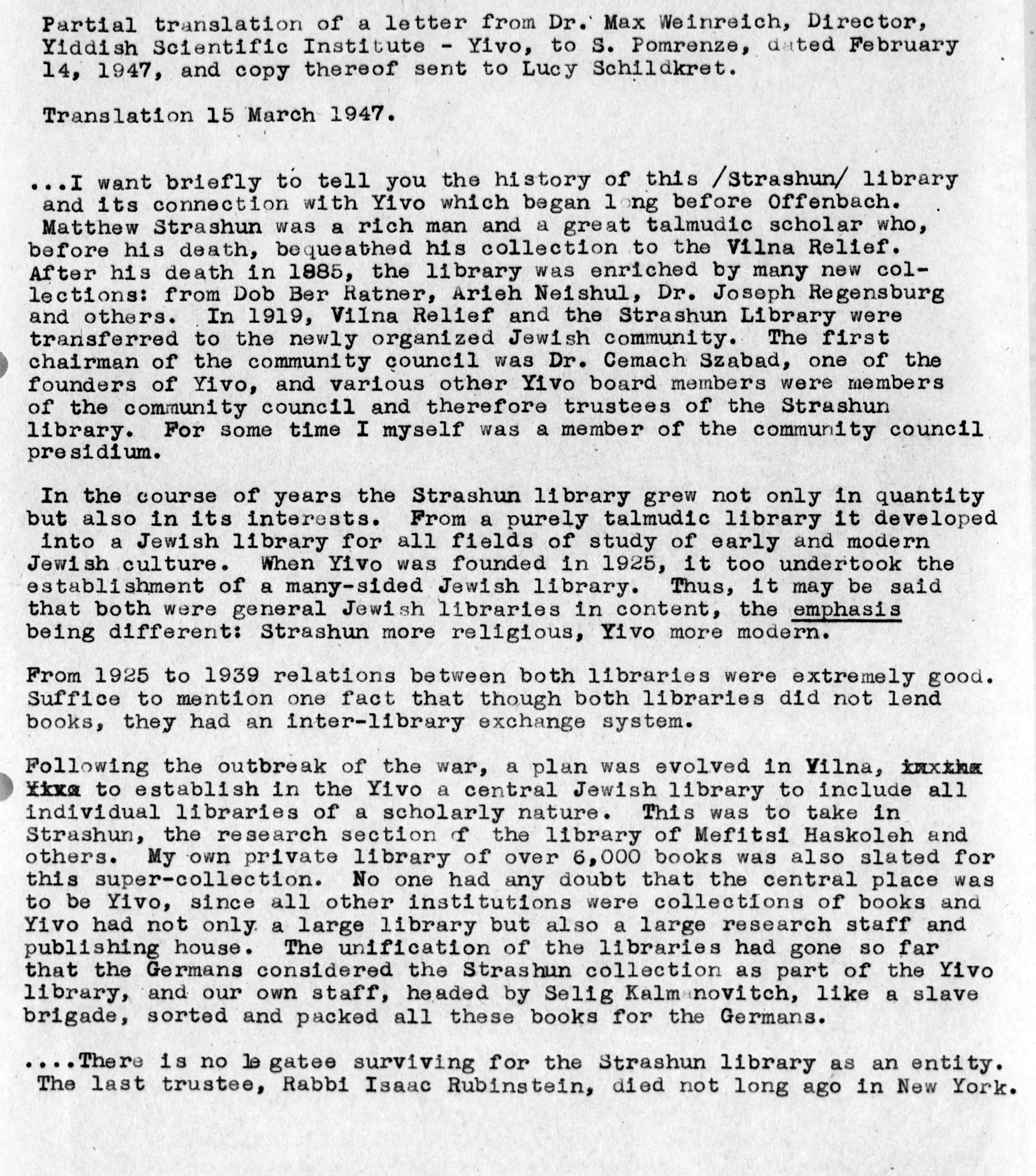
The complexities of sorting, identifying and returning books at the scale demanded of the Offenbach Archival Depot become clearer when reading through the declassified documents relating to what happened with just the YIVO library.  For instance, YIVO like many libraries of its size and mission had been the repository of family libraries.  Books at Offenbach were being identified by ex-libris and other markings as belonging to individuals and/or their families but they had in fact been donated to YIVO (or other institutions) by family members.  There are numerous letters between YIVO administrators with U.S. military officials trying to prove the ownership of items.

Though correspondence about the YIVO library begins in 1945, by early 1947 the vast library had yet to be shipped to YIVO in New York.  The reasons include continual reduction in manpower, both skilled and unskilled, at the depot and complex, bureaucratic chains of command within the U.S. military, between the Allied zones and even within the YIVO organization.  In a March 1947 document, Horne reports to his superiors that Miss Schildkret has been unable to examine several hundred thousand unidentified books because she had yet to receive authorization.

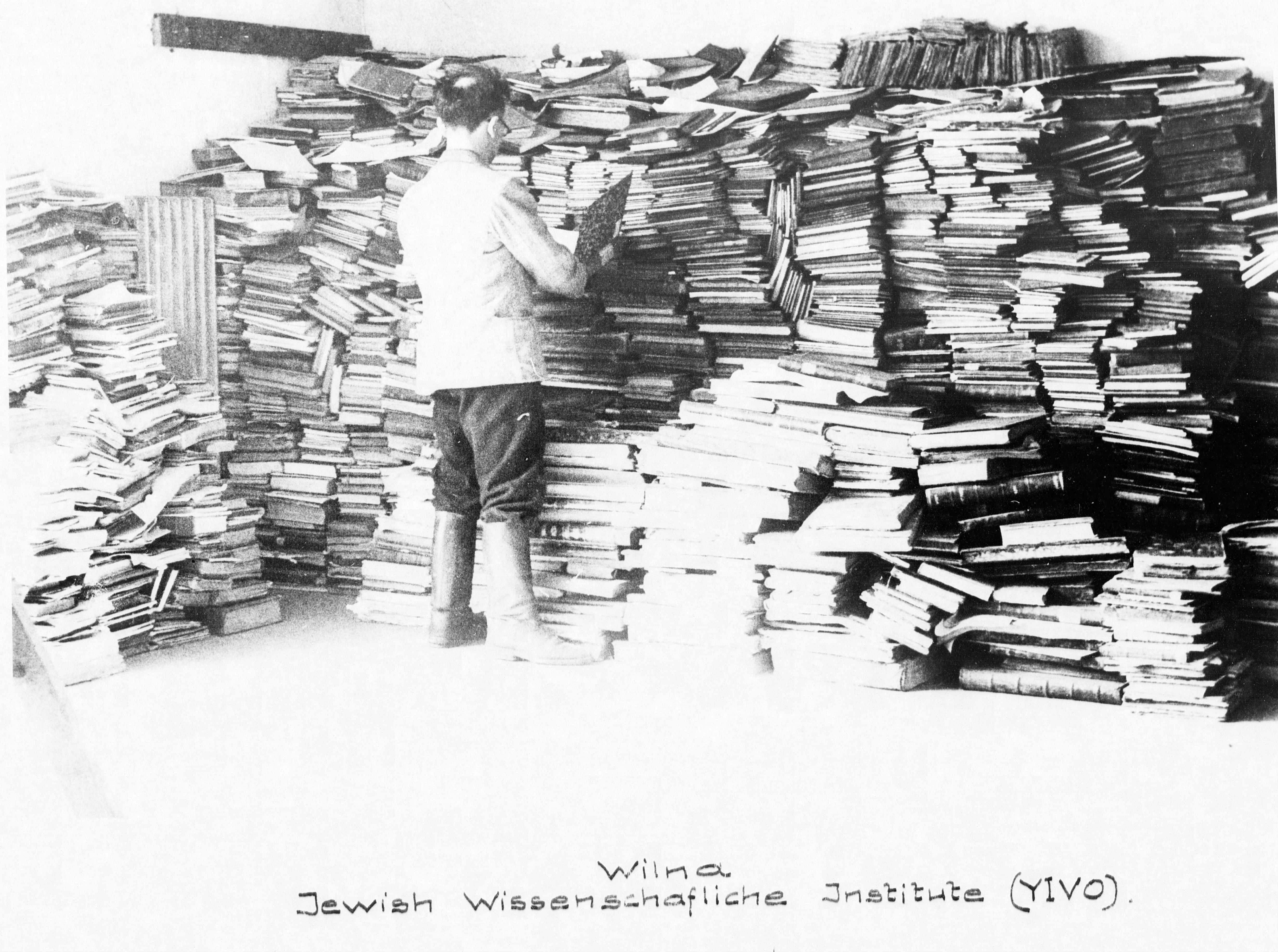
Vilna Library During German Occupation, in the files of the Offenbach Archival Depot

Vilna Library During German Occupation, in the files of the Offenbach Archival Depot

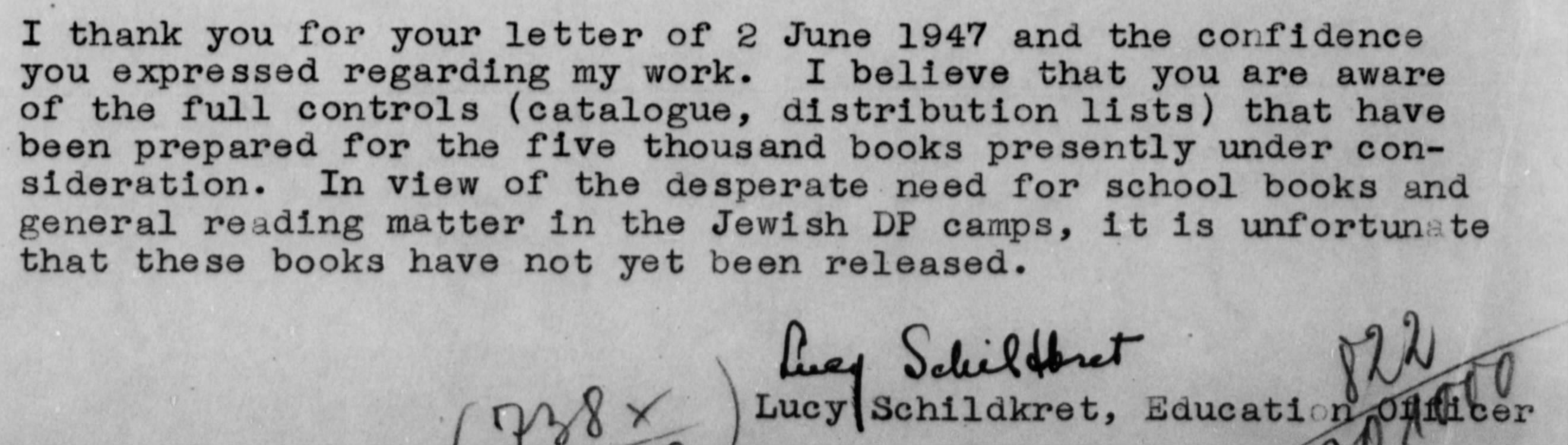
In 1938, Lucy Schildkret had studied in Vilna and worked at the YIVO.  Prior to the war, she would return to the U.S. and work as assistant to the research director at the YIVO headquarters in New York.  In 1946 she journeyed to Europe as an educational worker with the American Jewish Joint Distribution Committee (AJDC), the largest Jewish relief organization in America. Through this organization she was able to work with displaced persons in the camps.  With her skills in Yiddish and time at YIVO, she was able to discern that books that had been labeled as unidentifiable were indeed identifiable.  But even as she acquired the authority to help identify the YIVO library, she maintained her focus of serving the people housed in the displacement camps, and she would do so with a tenacity that would characterize her career for decades to come.

Schildkret responds two weeks later with a letter that concludes:

Her memoir presents a powerful account of the emotions stirred by working with the contents of the library from a place that she had called home and knowing what had happened to the people she’d called friends as the Nazis destroyed the city.

Eventually, with the combined effort of many individuals in several countries, over 90,000 items would be returned to the YIVO.  Seymour Pomrenze who had been pivotal in streamlining systems at the depot would be brought back to help shepherd the return of these items.  In 1998, Pomrenze shared his personal reminiscences of his experience with the Offenbach Archival Depot and the depot’s considerable achievements restituting and distributing millions of Nazi-looted materials including the YIVO library.

Mr. Horne, the person with whom we are taking this walk through history, would wrap up his tenure at Offenbach in 1948 though files show that he continued to support depot activities until its closure.  In the Cold War world, he would, strangely enough, continue to work with books and even return to his earlier interests in music and photography as he embarked upon a new journey.  One world war had ended. A new type of world war had begun. A new weapon in that war was the exchange of culture and what better place to share all that made up culture — from art to music to literature — than in a library.

More to follow …

Sources and Additional Readings

Cultural Plunder by the Einsatzstab Reichsleiter Rosenberg (ERR)

What Became of the Jewish Books? (New Yorker, February 2014)

U.S. Holocaust Memorial Museum — Offenbach Archival Depot

Pomrenze Personal Reminiscence about Offenbach

Mapping the Offenbach Archival Depot

Returning Looted European Library Collections

YIVO Digital Archive on Jewish Life in Poland

YIVO Institute

From That Place and Time: A Memoir, 1938-1947 by Lucy S. Davidowicz and Professor Nancy Sinkoff

Article – Dutch Jewish Ex-Libris Found among Looted Books in the Offenbach Archival Depot (1946) by F. J. Hoogewoud

1939 Photo of Lucy Schildkret in Vilna


Read Full Post »

Previous Interludes

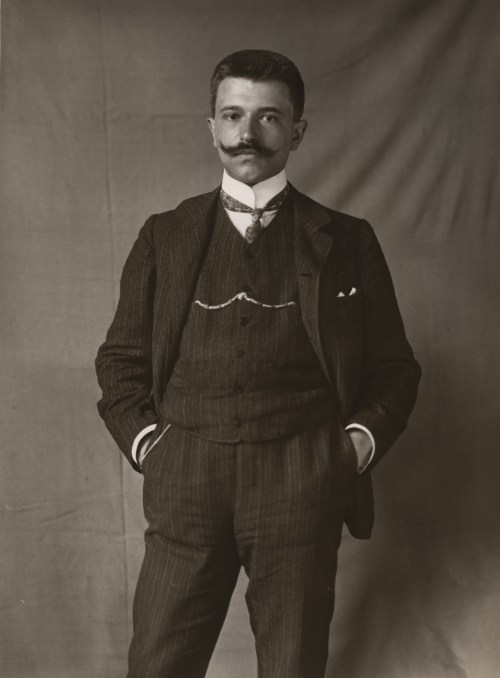
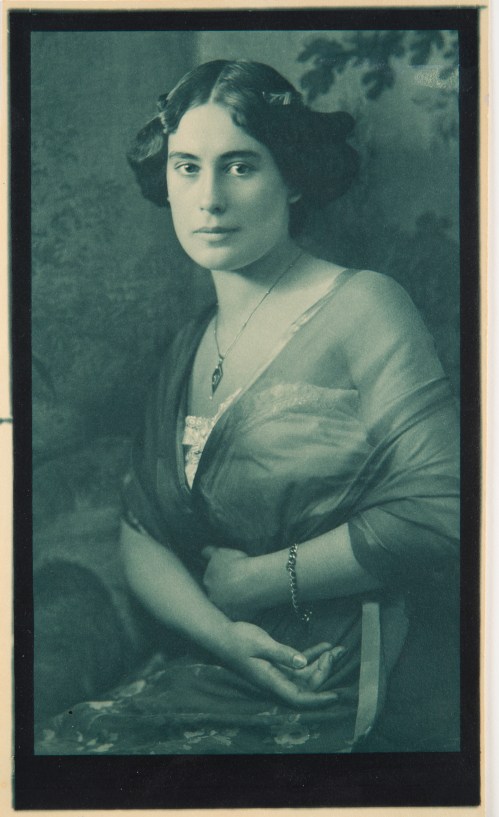
Portrait Eric Stenger, 1906, Museum Ludwig, Foto (c) Rheinisches Bildarchiv

Portrait Eric Stenger, 1906, Museum Ludwig, Foto (c) Rheinisches Bildarchiv

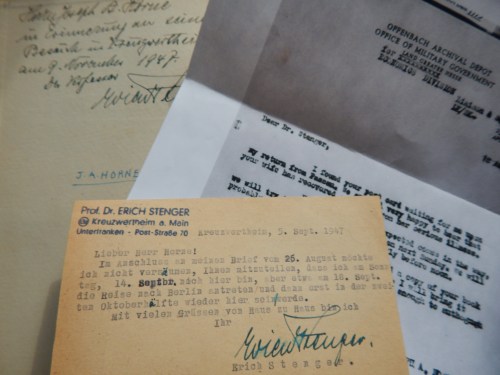
At the end of one letter, Dr. Erich Stenger writes, “I am up to my neck in work again and often regret that we did not get together more while you were here. There would have been so much more to show and to discuss. The director of the Kodak Museum B. Newhall has announced his visit. And when will YOU be returning to Germany?” (excerpt from 1950 letter from Stenger to Joseph A. Horne)

Erich Stenger (1878-1957) was a noted photographic historian and collector.  He trained as a chemist.  He worked during the early days of photography when photography was viewed more as a science rather than art.  In 1905, he would join the faculty of the Technische Hochschule in Berlin as an assistant instructor in the photographic department.  In the early 1900s, he co-wrote papers on The Fundamental Principles of Three-Colour Photography, and Radiation Sensitiveness of Silver Bromide Gelatin for White, Green and Orange Light.  By 1934, he was named to the chair of photography founded in 1864 by Hermann Wilhelm Vogel, a post he would retain until his retirement as Professor Emeritus in 1945.  He began building his photography collection as a student and would do so until the end of his days.

Portrait Franz Grainer, 1920er Jahre, Museum Ludwig, FH 2438, Foto: © Rheinisches Bildarchiv

Portrait Franz Grainer, 1920er Jahre, Museum Ludwig, FH 2438, Foto: © Rheinisches Bildarchiv

His collection was diverse, from landscapes to portraits, to decorative framed items to caricatures about photography.  Beaumont Newhall wrote that “At the time of World War II, his collection was said to be the largest in private hands anywhere in the world.”

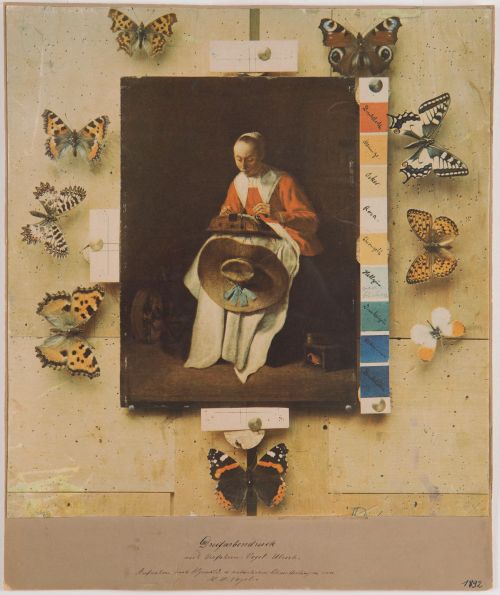
Hermann Wilhelm Vogel: Dreifarbendruck nach Verfahren: Vogel-Ulrich. Aufnahme nach Ölgemälde und natürlichen Schmetterlingen 1892 Museum Ludwig, FH 10248, Foto: © Rheinisches Bildarchiv

Hermann Wilhelm Vogel: Dreifarbendruck nach Verfahren: Vogel-Ulrich.
Aufnahme nach Ölgemälde und natürlichen Schmetterlingen 1892
Museum Ludwig, FH 10248, Foto: © Rheinisches Bildarchiv

Beaumont Newhall (1908-1993), referred to in Stenger’s letter, was a pioneering historian and first curator of photography at the Museum of Modern Art in New York.

Self Portrait at the Museum of Modern Art, New York, 1970.

Beaumont Newhall, Self Portrait, Museum of Modern Art, New York, 1970.

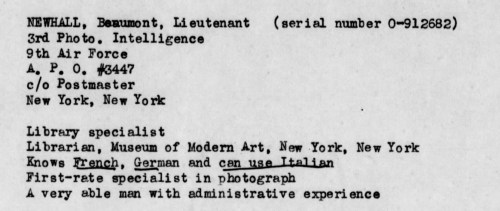
Over his career, he would write five editions of the signature work, The History of Photography.  In 1945-1946, the Roberts Commission would recommend him as a good candidate for the Monuments, Fine Arts and Archive unit.  Paul J. Sachs described Newhall “as one of the best men for library work.”

Newhall’s name appeared on one of the last lists of qualified officer personnel that the Roberts Commission presented to the War Department, indicating that “the only alternative after this is enlisted men.”  Newhall would not be assigned to the unit.  After discharge, Newhall returned to the U.S., continuing his research, lecturing, and curating photography exhibits.  In 1948, he became the first Curator of Photography at the Kodak Eastman House in Rochester, NY and would serve as its director from 1958-1971.

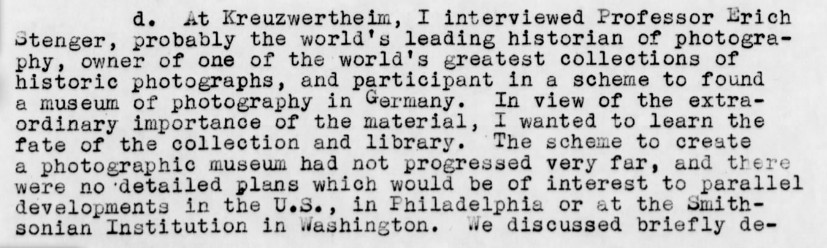
One of those enlisted men who would join the Monuments, Fine Arts and Archive unit was Joseph Anthony Horne.  And as part of that unit, Horne would meet Dr. Erich Stenger and learn of his unique photographic collection. Exactly when and where Horne first met Stenger in postwar Germany is unclear but the friendship they developed, as indicated through correspondence about everything from photography to family, would endure for a decade. That friendship must have stemmed from a mutual love of photography. Horne had been a photographer with the Farm Security Administration – Office of War Information (FSA-OWI).

Horne’s MFA&A colleague Paul Vanderbilt, during an Investigation Trip to Interview German Authorities and Inspect Private Papers, reports meeting Stenger in September 1946:

Vanderbilt recommended:

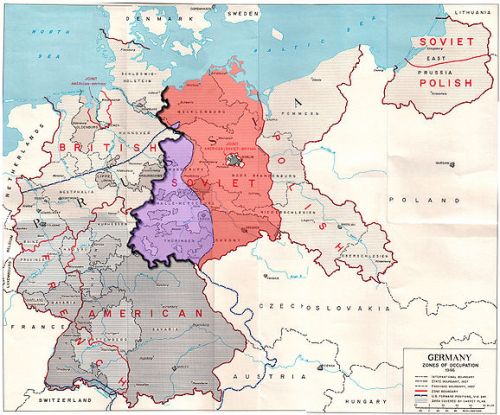
Horne certainly met Stenger at a December 1946 meeting of photographers and photographic scientists “to discuss the present situation of the photographic trade and industry in Germany.” Mr. Horne had been invited to attend by the Berlin Press Photographers Guild.  In his report following the meeting, he echoed Vanderbilt’s recommendations that Stenger be aided in reassembling his photographic collection, a collection spread across a divided postwar Germany.

"Germany occupation zones with border" by US Army - Modified version of http://www.globalsecurity.org/military/library/report/other/us-army_germany_1944-46_map3.htm. Licensed under Public Domain via Wikimedia Commons - http://commons.wikimedia.org/wiki/File:Germany_occupation_zones_with_border.jpg#mediaviewer/File:Germany_occupation_zones_with_border.jpg

Germany Occupation Zones 1946

It is unclear from available records how helpful Horne, Vanderbilt and the other Monuments Men were in helping Dr. Stenger rebuild his collection in a post-war, rapidly becoming Cold War, world. What is clear is that this unit of librarians, archivists and those dedicated to preserving and sharing knowledge, felt strongly about helping this gentleman as much as they could.

As the socio-political landscape of Europe changed, and with it the U.S. presence, Horne prepared to move on to other positions within the U.S. foreign services.  Regardless, he and Stenger stayed in touch, corresponding about family and photography, and perhaps even their shared interest in stamp collecting.  Horne would highlight opportunities for Stenger to exhibit photography, and Stenger provided updates on the health of his collection.

“The day after tomorrow I will be going to Switzerland, where I have been asked to come to deliver a few scientific lectures. I will be back home in mid-November. While in Switzerland, where I used to make annual purchases from merchants who knew what I was collecting, I will once again be on the look-out for my collection. Not having been back in eleven years, most of the merchants won’t remember me. Recently I was able to acquire some very special objects here in Germany; considering the awful destruction, I marvel that here and there something useful still pops up.” (excerpt from 1950 letter from Stenger to Joseph A. Horne)

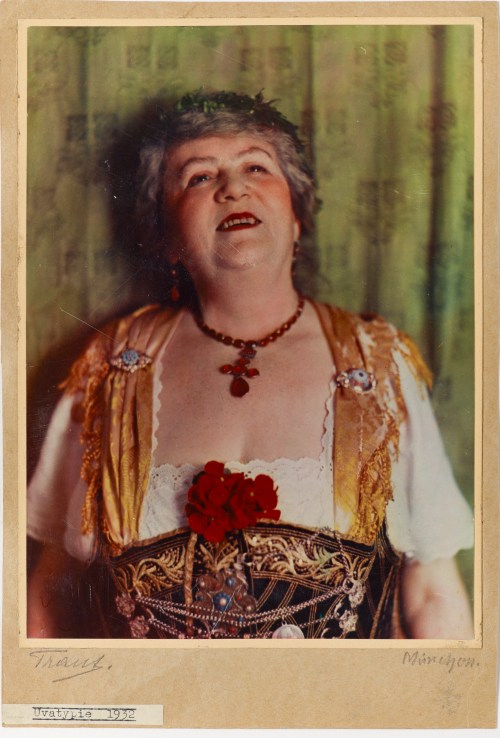
Henry Traut Porträt, München, Museum Ludwig, FH 11936 1932 Foto: Rheinisches Bildarchiv, rba_d036895

Henry Traut, Porträt, München, Museum Ludwig,
1932, Foto: Rheinisches Bildarchiv

In 1955, Stenger’s diverse collection was purchased by the company Agfa, and today it complements a number of other collections as part of the Photographic Collection of the Museum Ludwig in Cologne.  Stenger died in September 1957, and as Beaumont Newhall states in a later editorial, the world of photography lost a foremost historian and collector.


 Sources and Additional Readings

The Photographic Collection of the Museum Ludwig

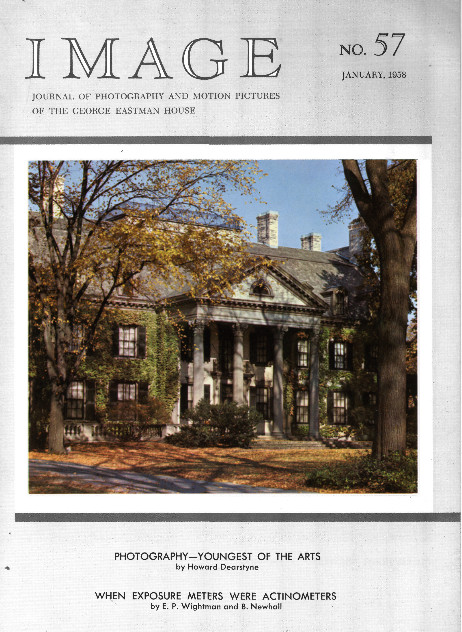
Image Magazine, 1958, incl. editorial on Dr. Erich Stenger

press page about the Stenger Collection

About Beaumont Newhall (International Photography Hall of Fame and Museum)

Beaumont Newhall (Scheinbaum & Russek LTD)

Oral History Interview Beaumont Newhall

More about Paul Vanderbilt

Source of historical military records

Read Full Post »

There’s always a tension in creating a product online.  Will the tangible reality be as nice?  Dublin Green exceeded all expectations.  You can read more in this prior post about why I created the book, the second in what may become a series. You never know what a year will hold. 😉

Dublin Green

Read Full Post »
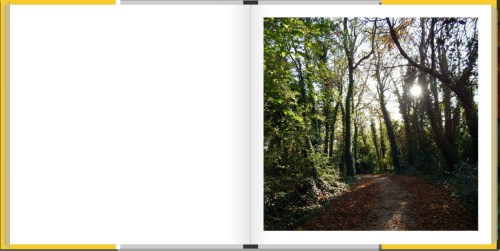
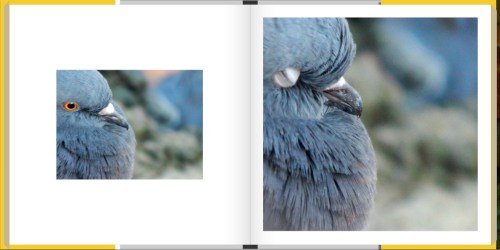
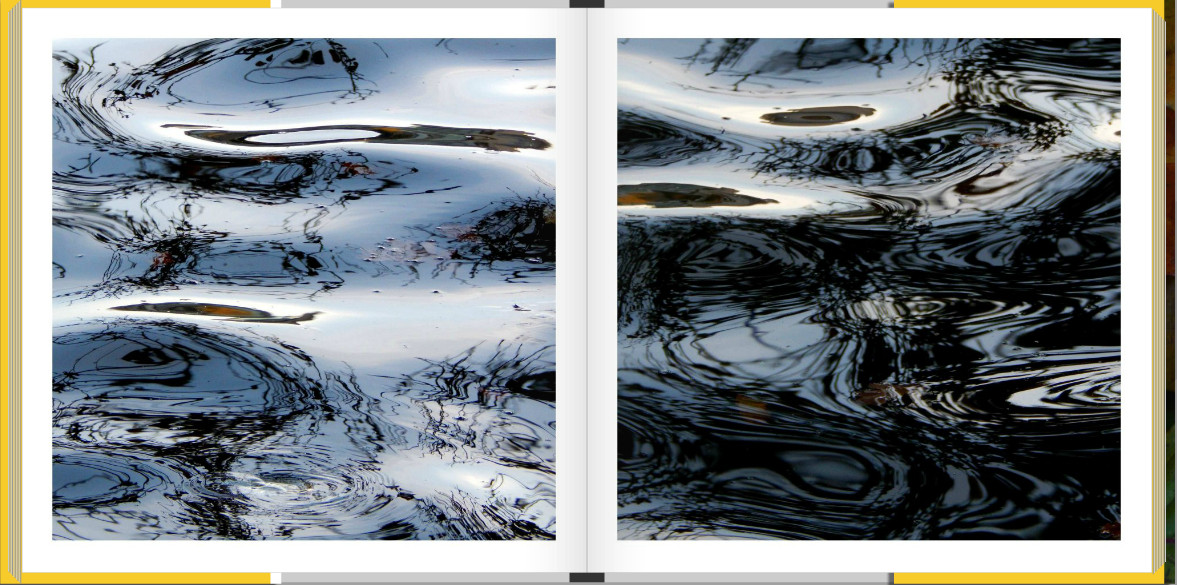
Last year, I created a “book of thanks” for folks who made me feel very welcome in my travels around Dublin.  As simply the guest of one of the conference speakers, I was free to ramble about the city and especially St. Stephen’s Green.  This year, I was lucky enough to attend again (and even visit Galway). I decided I should do another book, to thank folks, and to highlight just a tiny bit of the beauty I saw as I meandered, this time, about the UCD Belfield Campus and its wonderful system of walking paths.  The images are sorted into three sections:  Amidst the Trees and in the Fields, Among the Birds, and Reflected in the Many Waters.  Below are a few excerpts and the entire book is available via this link.


Read Full Post »

Recently, a friend invited me to join her for an “art-in,” and there she provided me with paper, pens and watercolors and encouraged me to paint whatever came to mind.  I decided to paint what I call a little somerset sky.

a somerset sky

a somerset sky

Its origin is this:  Of late, W. Somerset Maugham’s  Of Human Bondage has found its way into my hands, and there is a particular color-filled passage that I return to.  It is near the end of the book.  After an eventful night, Philip Carey, the main character …

“He leaned against the parapet and looked toward the morning.  At that hour the great city was like a city of the dead. The sky was cloudless, but the stars were dim at the approach of day; there was a light mist on the river, and the great buildings on the north side were like palaces in an enchanted island.  … It was all of an unearthly violet, troubling somehow and awe-inspiring; but quickly everything grew pale, and cold, and grey.  Then the sun rose, a ray of yellow gold stole across the sky, and the sky was iridescent .”

Thanks, Carol, for the opportunity to put brush to paper.  More about Carol’s beautiful artwork later this summer.

Have a good day, folks. 😉

Read Full Post »

« Newer Posts - Older Posts »