 A rather unique bird swimming in the frigid waters of the Mystic River. A red-breasted merganser, perhaps?
Posts Tagged ‘Inspiration’
a unique beauty
Posted in Inspiration, Nature Notes, tagged beauty, ducks, Inspiration, merganser, Mystic River, nature, Photography, urban landscape, waterfowl on February 5, 2018| 1 Comment »
purple
Posted in Inspiration, tagged color, Inspiration, Photography, purple, sunlight, whimsy on February 5, 2018| 2 Comments »

timely and timeless, the words of dudley tyng
Posted in Inspiration, tagged Charles Sumner, civil war, Dudley A. Tyng, faith, free press, history, Inspiration, Kansas-Nebraska Act, Phillips Brooks, politics, religion, resistance, slavery, states rights, storytelling, voting on February 4, 2018| 5 Comments »

Dudley A. Tyng, 1855
In 1856 Reverend Dudley A. Tyng delivered the sermon, Our Country’s Troubles, before the congregation of the Church of the Epiphany in Philadelphia, Pennsylvania. Times were indeed quite troubled in the country. As he began he acknowledged the general disdain of discussing politics in the pulpit: “It is undoubtedly a great evil when the teachers of religion forsake their appropriate themes to mingle in all the heated controversies of the day.” But then he goes on to say, “But may there not be also an opposite extreme? May there not be silence when great principles are at stake? … May not the dread of offence be carried so far as to put the pulpit in bondage? Society can suffer in no member without a true-hearted Christian’s ministry suffering with it. … At such times the Christian ministry may be criminal if it does not speak out boldly in behalf of right … It seems to me that we have now reached such a time.”

1856 map showing the slave states (gray), free states (pink), U.S. territories (green), and Kansas in center (white)
Kansas was bleeding. Two years earlier, Congress had passed the Kansas-Nebraska Act which allowed people in these two territories to decide for themselves, at the polls, whether or not they would allow slavery within their borders. The Act nullified the Missouri Compromise of 1820 which had prohibited slavery north of latitude 36 30′. Corruption and coercion were widespread as people tried to control the polls and the spread of slavery. Conflict erupted between anti-slavery and pro-slavery interests. Thousands poured into the state to sway the voting through rhetoric and violent intimidation.

Abolitionist John Brown, 1856
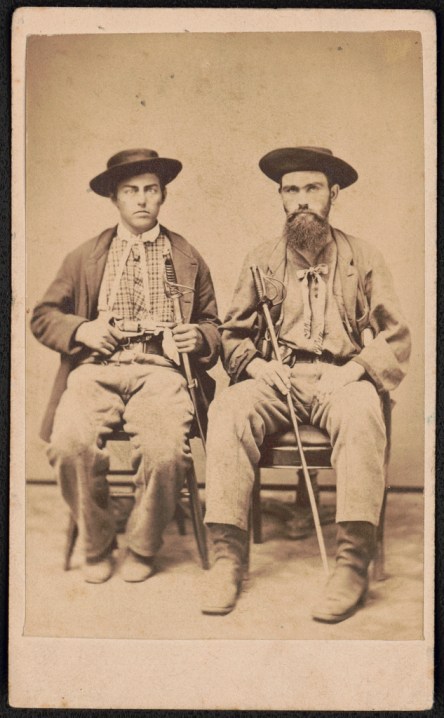
Pro-slavery Border Ruffians
Violence would erupt within the walls of Congress as well. In May 1856, anti-slavery Massachusetts Senator Charles Sumner delivered an address titled The Crime Against Kansas. He’d written and memorized 112 pages of text. It took him five hours over two days to share it. He focused his carefully crafted ire at two pro-slavery Democratic senators, Stephen A. Douglas of Illinois and Andrew Butler of South Carolina, authors of the Act.

Stephen A. Douglas and Andrew Butler
Butler was not present in Congress during the address but his cousin House member Preston Brooks of South Carolina was in attendance. Two days after Sumner spoke, Brooks entered the Senate chamber and severely beat him with a heavy cane. It is considered one of the precipitating events of the Civil War. And it certainly must have inspired Tyng to write his sermon, Our Country’s Troubles, one month later.
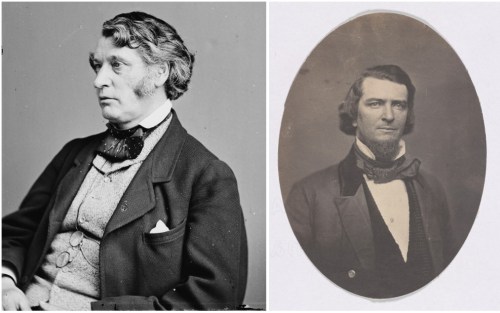
Charles Sumner and Preston Brooks
“I claim a patient hearing…,” Tyng beseeched the congregation as he brought the issues of the day into the pulpit. “For the first time in this country it is the scene of civil war. Armed men, in battle array, are marching on its soil and carrying with them all the horrors of a hostile invasion. Towns are sacked, houses pillaged … Society is in confusion, public security at an end … Families are driven out from lands which they have tilled, and houses which they have built, and warned to leave the country or be hung. … Hardly a day passes without bringing telegraphic news of some new outrage, so dreadful that we can scarce realize its possibility, or arouse ourselves to feel as the occasion demands.” As for the author of these outrages, our “own countrymen, citizens of our own free and happy land, imbuing their hands in brother’s blood! And what is the crime … Merely difference of opinion. Merely assertion of their right to think, speak, write and act according to their own conscience and interests …”

Tyng outlined the strategic construction of the Kansas-Nebraska Act and how ultimately its purpose, and the ensuing violence in Kansas, was to give slave-holding interests control of Congress. He describes voter fraud involved with election of a Territorial legislature, a legislature that would go on to pass laws that not only enabled slavery but penalized those who were anti-slavery including preventing them from sitting as jurors, and “That writing, printing or circulating anything against slavery should be punished with five years’ imprisonment at hard labor.”

With regard to the attack on Sumner he asks, “Without the right of freedom of speech, neither our liberties or our religion are secure. If the bludgeon is to be the ruling power in our country, where will be our boasted freedom and national Christianity? If the flag of our country and the symbols of her liberty cannot protect the members of her government within the walls of her Capitol … what is to become of our republic? … The act itself itself is not so ominous of evil as its endorsement. To hear it defended and eulogized [throughout the Southern states] by public assemblies giving votes of thanks to [Brooks’s] iniquities, by the press almost unanimously holding it up as worthy of imitation, and by fellow representatives who screen the offender from punishment, may well make one feel sadly apprehensive for our country.” …

“…why are Southern men so madly resolved that Kansas shall be thrown open to slavery? Is it because they desire to be residents of the country? Very few of them have any such idea. But it will give them first an increase in political power. It will wheel another state into the phalanx, and give them two more Senatorial votes for the control of the government which the far swifter progress of the free states has taken from them in the House of Representatives. Few among us have reflected on the political power given by slavery to the few.

“Three-fifths of all the slaves are counted in with the whites as the basis of representation, largely increasing the political importance of the white person at the South over the white person at the North. … [Southern] Political honors and influence are confined to a few. … these are the persons who control the policies of [the sixteen slave holding states] and by their influence at home and at the North have controlled the policy and monopolized the honors of General Government. …”
“Doubtless one sin for which we are suffering is the base spirit of truckling and pandering to sectional interests … Vainly do we look for patriotism in the wire-working of our political parties. The whole government is administered upon the principle of the division of the spoils. There has been no prejudice so opposed to the spirit of our institutions, no sectional interest so degrading, that political leaders, low and high were not willing to sell themselves to it for votes.”
Tyng held everyone culpable, from Northern politicians courting slaveholder votes to the people sitting in the pews before him.

As Mark Twain is thought to have said, history doesn’t repeat itself but it often rhymes. How prescient are Tyng’s words for this day in these United States about people and politics?
Well, in his day, Tyng did not completely leave his audience in despair with his sermon. He left them with what I describe as not so much a call to action as a list of action steps including the following:
“Ours is a government of opinion. To public opinion every party and coalition is compelled to bow. It is mightier than bayonets. … There is freer circulation of news in this country than in any other, and yet there is surprising ignorance and unconcern in what is taking place in the country. … Very few of the political journals have reported a faithful report of facts. They have been advocates not witnesses, catching up events for special pleading for party effect, instead of relating the whole truth before the tribunal of the people. … Now let every person seek to inform himself and his neighbors of events as they are. Put the facts before the people. … Let them be taught to view the facts and principles of the present crisis, irrespective of party affinities. … Our first duty, therefore, is to enlighten the public mind. …”
Now, I’m not sure if it was this sermon or if this was simply one of a series of sermons that would so disgruntle the congregation of Church of the Epiphany but it was in the same year as this sermon, 1856, that Tyng would resign and take his followers to form Church of the Convenant in Philadephia. He would die in a tragic farming accident just two years later.
Now the only reason I learned of Tyng and his horribly timeless yet wonderfully timely sermon is through a reference made by Phillips Brooks.

Phillips Brooks in Philadelphia
While more well-known for his later work as Rector of Trinity Church in the City of Boston, prior to that placement Brooks served as rector at two Philadelphia churches including Church of the Holy Trinity. On Thanksgiving Day in 1863, just three years after it had become an official holiday, Brooks delivered a renowned sermon, Our Mercies of Re-Occupation. Preaching during the midst of the Civil War, like Tyng, Brooks chose to bring the issues of the day into the pulpit. He spoke during a time when people questioned the economics of ending slavery, whether or not slavery was in the bible and so on.

For Brooks there was but one answer:

Brooks known for his whirlwind sermons that carried listeners away would touch upon many subjects in his sermon and always remind people, no matter their position, that they could do better. For instance, he states, “If the negro is a man, and we have freed him in virtue of his manhood, what consistency or honor is it which still objects to his riding down the street in the same car with us if he is tired, or sitting in the same pew with us if he wants to worship God.”

While Tyng’s sermon(s) forced him to leave his church and start anew, Brooks “only” lost a few parishioners and there were many ready to join his church. Self-deprecating, in a letter home, he simply says, “I am glad you liked my sermon. … I have just been reading over Dudley Tyng’s famous sermon from seven years ago. What a brave thing it was to do! Thank God anybody can do it now.”
Who in the world was Tyng, I wondered, to have touched Brooks so.
I subtracted 7 from 1863 and did a little search for Dudley Tyng 1856 sermon. And that was how I learned of a young man who wrote some timeless yet still timely words. By the way if you do a search for just Dudley Tyng (and not his sermons), you’ll most often find references to him being the inspiration for the hymn, Stand Up! Stand Up for Jesus!
Sources & Additional Reading
Dudley A. Tyng’s Our Country’s Troubles (1856) – http://deila.dickinson.edu/cdm/ref/collection/slaverya/id/64330
Charles Sumner’s The Crime Against Kansas (1856) – https://www.senate.gov/artandhistory/history/resources/pdf/CrimeAgainstKSSpeech.pdf
Bleeding Kansas – https://en.wikipedia.org/wiki/Bleeding_Kansas
http://www.ohiohistorycentral.org/w/Bleeding_Kansas
The Miriam and Ira D. Wallach Division of Art, Prints and Photographs: Print Collection, The New York Public Library. “Southern chivalry – argument versus club’s.” The New York Public Library Digital Collections. 1856. http://digitalcollections.nypl.org/items/6232540d-9d12-b4e8-e040-e00a18061bf0
Schomburg Center for Research in Black Culture, Manuscripts, Archives and Rare Books Division, The New York Public Library. “”The same chain that passes around the slave’s neck is fastened to the white man’s heel.” Par. XXVII.” The New York Public Library Digital Collections. 1856. http://digitalcollections.nypl.org/items/510d47da-75da-a3d9-e040-e00a18064a99
Schomburg Center for Research in Black Culture, Photographs and Prints Division, The New York Public Library. “Young boys.” The New York Public Library Digital Collections. http://digitalcollections.nypl.org/items/510d47dc-4926-a3d9-e040-e00a18064a99
Schomburg Center for Research in Black Culture, Jean Blackwell Hutson Research and Reference Division, The New York Public Library. “Commissioner’s sale in 1863.” The New York Public Library Digital Collections. 1940. http://digitalcollections.nypl.org/items/510d47dc-9f9a-a3d9-e040-e00a18064a99
[Two unidentified Border Ruffians with swords / Blackall, photographer, Clinton, Iowa]. [Clinton, iowa: blackall, between 1854 and 1860] Photograph. Retrieved from the Library of Congress, <https://www.loc.gov/item/2016646192/>.
Our Mercies of Re-Occupation by Phillips Brooks. https://ia802305.us.archive.org/33/items/ourmerciesofreoc00broo/ourmerciesofreoc00broo.pdf
orange
Posted in Inspiration, Nature Notes, tagged beauty, flowers, Inspiration, orange, Photography, ranunculus on January 28, 2018| Leave a Comment »

a butterfly with wings of sunlight
Posted in Inspiration, Nature Notes, tagged beauty, butterflies, caustics, fun, Inspiration, patterns, Photography, silhouettes, sunlight on January 18, 2018| 2 Comments »

At least that’s what I decided to create in GIMP after watching sunlight shine through my water glass.


from concept to execution and recreation
Posted in Inspiration, tagged American history, art, black history, faith, hope, Inspiration, Katherine Lamb Tait, music, Singing Window, spirituals, stained glass windows, storytelling, Tuskegee on January 15, 2018| 3 Comments »
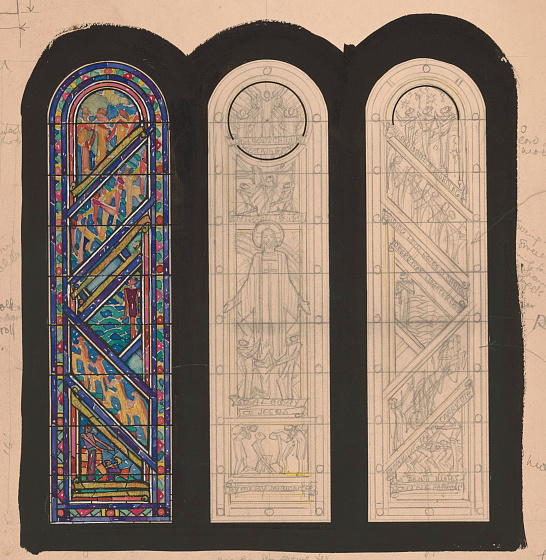
Today I was browsing the online archives of the Library of Congress and chanced upon this 1930s drawing by Katherine Lamb Tait. Though it is not labeled as such, I realized it was an early rendition of her design for the unique stained glass windows at Tuskegee University known as The Singing Window.

About two years ago, I wrote an article describing the story behind the windows. You can read it online here in Deep South Magazine and learn how Tait collaborated with Robert Moton, President of Tuskegee, to produce what would be a visual expression of eleven spirituals.

Installed in 1933, the original windows would only be in place for about twenty years before a fire destroyed the chapel where they were located. But because Tait’s final design survived …

… when a new chapel was built in the 1960’s, architects were able to recreate and include the new Singing Window as well.

I hope to see it in person one day. This photo of the window can be found on the Library of Congress website courtesy of photographer Carol M. Highsmith.
sunlight on the mystic
Posted in Branches, Inspiration, Nature Notes, tagged Inspiration, Mystic River, nature, Photography, trees on January 15, 2018| Leave a Comment »
![DSCN9581[1]](https://wordsandimagesbycynthia.com/wp-content/uploads/2018/01/dscn95811.jpg?w=500)
telling a story in color
Posted in Guest Contributor, Inspiration, tagged architecture, art, color blocking, gift shop, Inspiration, merchandising, Photography, stained glass windows, trinity church boston on January 12, 2018| 1 Comment »

The versatility of white: Postcards, t-shirt and ornament with details from David’s Charge to Solomon, a stained glass window by Edward Burne-Jones and William Morris paired with a silk chiffon scarf featuring swaying tree branches
It has been my pleasure over the past few years to work with Donna Stenwall, Manager of Visitor Services at Trinity Church in Boston. While I think I have a pretty good grasp of color, one of the things I continually learn from Donna is how to put those colors together to create “visual eye candy” on the shelves of the shop at Trinity. Having previously worked for Laura Ashley for 35 years, she has a command not only of color but of style. The vignettes that she puts together whether based on motif or, in these examples, on color, truly captivate the eye. As she says, “There is nothing worse than having a display that is so jarring to the eye that people don’t really know where to look!”
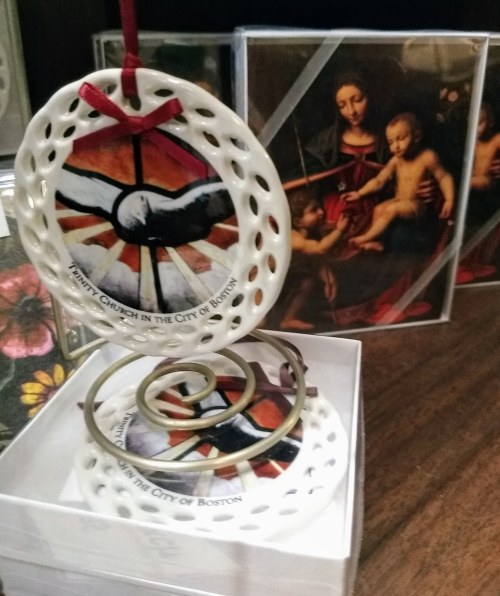
Warm reds, pinks and gold: Boxed note cards featuring 19th century reproduction of a 15th century painting of the Madonna and Child paired with a ceramic ornament with dove motif from The Ascension stained glass window, with just a peek at the flowers from the window The Five Wise Virgins
Visit the shop at Trinity Church and you can see these colorful vignettes for yourself.

Cool blues: A framed watercolor print of Trinity Church at night paired with an oval glass ornament of Jesus from the window The Resurrection by John La Farge and a blue-tinted card featuring an etching of Trinity Church by Henry Blaney
dried flowers
Posted in Branches, Inspiration, Nature Notes, tagged baby's breath, beauty, bouquet, colors, dried flowers, flowers, Inspiration, Photography, white on January 11, 2018| Leave a Comment »

change happens
Posted in Branches, Inspiration, Nature Notes, tagged civil action, hope, immigration, Inspiration, Martin Luther King Jr, musings, Photography, politics, race relations on January 9, 2018| 3 Comments »

I photographed this tree today. It stands in an adjacent property that has been purchased for development. Given the type of development taking place around me and across Boston, I don’t think the tree is part of the developer’s plan. Its roots may be strong but the tree will be cut down and those roots dug up. Change happens.
 Near the tree there is a wild tangle of forsythia branches. For years I’ve watched the brown turn to green and then gold when it fully flowers. A bright sign of spring. I’ve always wanted to sneak onto the property, cut some branches and place them in a vase, like bringing the sunshine indoors. I think they will have the opportunity to bloom one more time before they too are dug up and tossed away. Part of the change.

I think a lot about change and how change happens. I’m not happy about the changes around me. I am at times near paralyzed by the scale of idiocy and inhumanity in the world right now and especially in my own country under what should be an insignificant presidency. I’m not always sure what to do except donate money where I can, give my time when that makes more sense, and send notes of gratitude (and occasionally of protest). One of my greatest regrets during Obama’s tenure is that I never sent a note of thank you. Not because he was a perfect president but because he was (and remains) a good man, an inspirational figure for the ages. Speaking of inspirational figures … I was looking for some words and came across a sermon by Martin Luther King Jr. that seemed relevant.
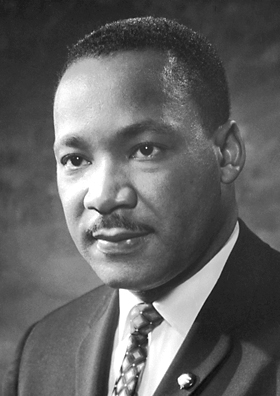
In a 1965 commencement address, Remaining Awake Through a Great Revolution, King spoke to Oberlin graduates about the strides that had been made in this country. “We have come a long, long way since the Negro was first brought to this nation as a slave in 1619. In the last decade we have seen significant developments – the Supreme Court’s decision outlawing segregation in the public schools, a comprehensive Civil Rights Bill in 1964, and, in a few weeks, a new voting bill to guarantee the right to vote. All of these are significant developments, but I would be dishonest with you this morning if I gave you the impression that we have come to the point where the problem is almost solved.”
“Let nobody give you the impression that the problem of racial injustice will work itself out. Let nobody give you the impression that only time will solve the problem. That is a myth, and it is a myth because time is neutral. It can be used either constructively or destructively. And I’m absolutely convinced that the people of ill will in our nation – the extreme rightists – the forces committed to negative ends – have used time much more effectively than the people of good will. It may well be that we will have to repent in this generation, not merely for the vitriolic works and violent actions of the bad people who bomb a church in Birmingham, Alabama, or shoot down a civil rights worker in Selma, but for the appalling silence and indifference of the good people who sit around and say, “Wait on time.”
Well, I do not feel I am silent, nor do I like to wait around, but I do feel a bit stalled at this moment. Stalled and appalled. Appalled at what is taking place in this nation with regard to immigrants. Appalled, when I can stomach it, to view the websites of anti-immigration organizations and to see on their staff and boards people who look like me. And so darned appalled at the petty political games being played with “immigration deals” that leave hundreds of thousands of people in limbo. How are people expected to live with such constant anxiety in their lives? They just do. They live. And they act.
People taking action. That is the key, isn’t?
Today even as I grappled with the overwhelming amount of bad news in the headlines, I found uplift in a little video that was heartbreaking but ultimately so inspiring because it featured two people taking action, in two very different ways, and how those actions galvanized the people around them. Its worth a view when you have the time.
 Words + Images