
I will miss this jewel of the farmers market.
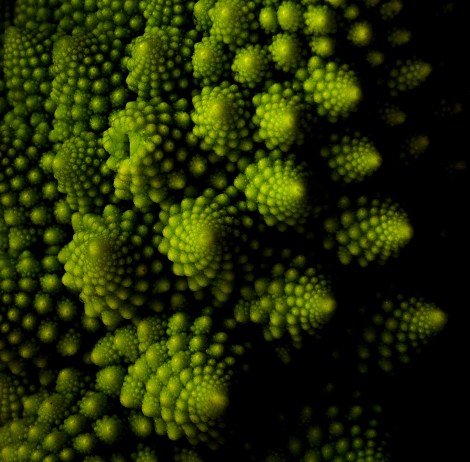
Posted in Inspiration, Kitchen Inspirations, Nature Notes, tagged cauliflower, colors, design, digital photography, farmers market, food, food photography, fractals, green, Inspiration, romanesco broccoli, science on November 18, 2012| 5 Comments »
Posted in Inspiration, Nature Notes, Science, tagged animal species, beauty, bugs, entomology, environment, insects, Inspiration, nature, Photography, science on October 17, 2012| 5 Comments »

I found this fellow as I was opening the window this morning. Just look at those lovely legs. If anyone knows the name of this insect, please share. 😉
Posted in Branches, Guest Contributor, Inspiration, Science, tagged art, colors, creativity, design, exploration, fractals, guest contributor, Inspiration, interviews, mathematics, Photography, science, software on October 11, 2012| 2 Comments »
As I prepare this post, I sit in a hotel room in Dublin, Ireland. Rain falls pretty steadily. The air is chill and the sky is the color of smoke. I should be cold and grumpy and yet I am warmed and made cheerful by the fractal images of Robert Grzybinski.
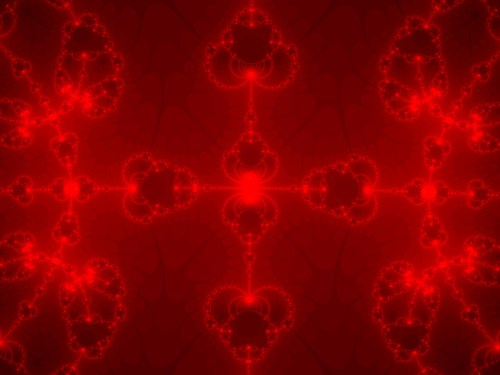
I was first introduced to Mr. Grzybinski at a company picnic. Somewhere in the course of our brief conversation, as I talked about my photography, he shared that he produced fractals. Well, if you follow this blog at all, you know how much I love shapes and colors. I asked if he’d share some of his images with me, and thankfully, he agreed. He also shared the creative process and inspiration behind his work. It is my pleasure to share his words and images with you. Enjoy! 😉
How do you create these images? I use an ancient MS-DOS program to make them. I give the program a bunch of input parameters, and it generates some output, which usually doesn’t look like much. After that the process is a lot like looking at a microscope slide — zooming in, moving around, looking for the interesting bits. You never know what you will find; it just continually amazes me what is hidden in that space of pure mathematics. Then I compose the image and assign the colors, which is sometimes the hardest part.

What’s the difference between these two images?The first image (“emboss”) is kind of a classic fractal – curvy, self-similar, spirally (spirals are very common in fractal patterns). It has a kind of sculptural quality. The second image (“treez”) has a spirally character too, but is made up of angular shapes and is completely flat, like something made out of cut-out paper. I especially love the confetti-like background.
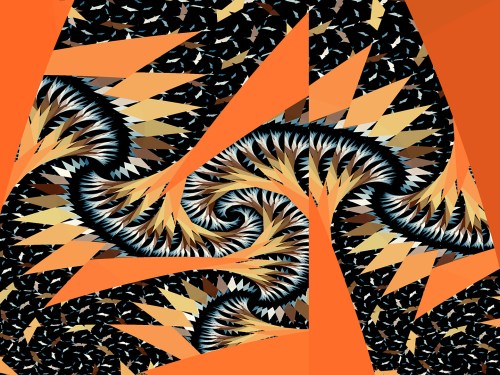
How did you choose the basic algorithm for each? The fractal program has a bunch of built-in functions. From experimenting, I know very roughly what kind of fractal each one will produce. “emboss” was made from one of the built-in functions. The program also gives you the ability to write your own functions, and I have had more fun and mostly more interesting results doing that. The functions are not very complicated, but it is just amazing to see the complexity that results from a few simple lines of code. “treez” was made from one of my own functions.
How many free parameters do the functions have? Depending on the function, there can be up to four or five numerical parameters. It’s usually not obvious or predictable what these parameters do. You have to just stick in some numbers and see the results. There are also many other settings that change the way the image is calculated. Again, you need to play with these to get a feel for what they do.
How did you choose the colors? The programs uses an indexed color system, where each region of the images is represented by a number. You then apply a palette which maps a particular color to each number – so to change the coloration, you just apply a different palette. I created a lot of different palettes with different characteristics (cool, warm, subtle, contrasty, etc.). Sometimes I know what effect I am going for, but sometimes I just try a lot of different palettes and hope something serendipitous happens. “emboss” is an example of that. It was an interesting pattern, and I knew there was something there, but it didn’t really work until I hit on the red/gold palette. Then it just popped out, like something embossed in gold foil.
What inspires you to create new images? What inspires me most is the sense of exploration. It’s a lot like looking through a microscope at a drop of pond water, or maybe exploring the depths of the ocean in a submarine. You just never know what weird and beautiful things will show up next. In a sense, these images already exist somewhere in a mathematical space, and I am just using the computer as a tool to discover them.
View an expansive gallery of Grzybinski Fractals via this link. For more information about Mr. Grzybinski’s fractals, you can contact him directly at cha.otic[at]earthlink.net.
Posted in Nature Notes, tagged art, colors, Galileo Thermometer, glass, Inspiration, nature, Photography, science, water, weather on April 16, 2012| 1 Comment »
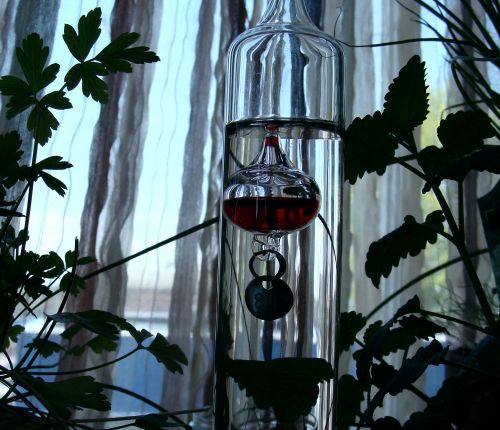
I am constantly reminded that there is a time and place for everything. For several years now, I have noticed and had access to the glass cylinder sitting on top of my science guy’s bookcase. But for the first time, today I photographed it. You see, he bumped the bookcase this morning, knocking the cylinder to the floor. It was a close call but luckily it hit the carpeted part.
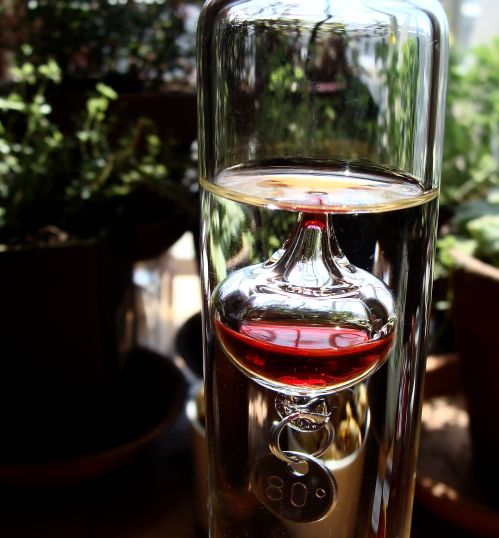
A Galileo thermometer. Read more here. A gift from family. He tried to replace it on top of the shelf, but the morning sunlight hit it and that was that. I gently took it from his hand. At his quizzical look, I said, “I’ll be careful. Promise.”
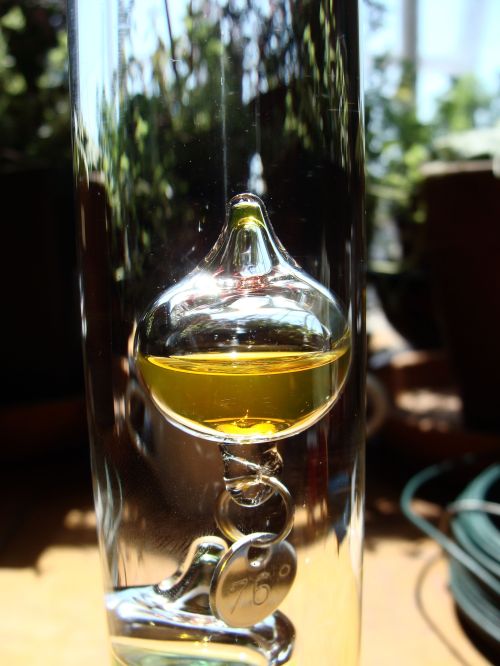
And so far, I have been. 😉

Posted in Inspiration, Nature Notes, tagged art, culture, Inspiration, musings, Photography, rainbows, religion, science on February 29, 2012| 2 Comments »
The man with whom I am involved I tend to describe as a science guy who works with light. He says that’s not quite accurate but it works for me. Since the beginning of our relationship we have shared many an illuminated experience that we have described quite differently. There was the infamous halo around the moon. I will forever describe sunlight on water as “dancing” but now I also see the resulting light-filled ripples as “caustic.” Most recently we have talked of rainbows.

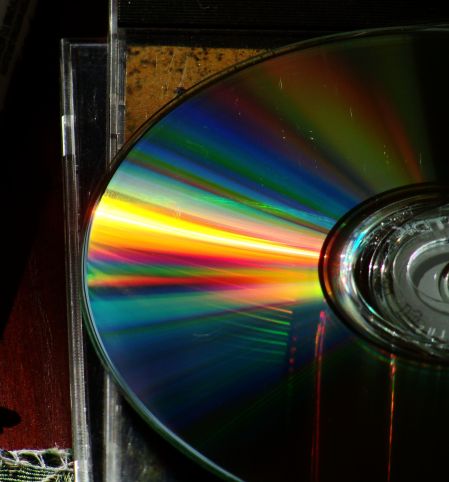
I see rainbows all around on earth. I am amazed at the places I find them like on the back of this silver tray left forgotten in a corner closet. Or the rainbows formed on the surface of CDs left out of their case on a table near a sunny window.
I see them less often in the sky mostly because I usually have my head ducked down in the rain. And that is the source of rainbows in the sky, my science guy reminded me at the dinner table recently, rainbows are formed by sunlight striking raindrops in the air. White light is divided into all its splendid colors. I listened attentively as he described how the water drops act as prisms, how light is refracted not reflected, and so on and so forth. It was like a cool Cliff Notes version of The Science of Rainbows 101.
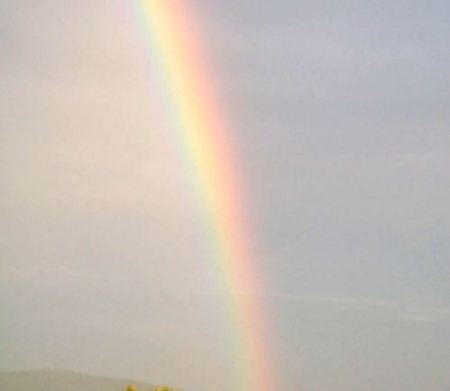
As the lecture wrapped, I stood up, my mind swimming with the science of it all. Suddenly my guy added, “Of course, my dear, you do realize that there were no rainbows before Noah and his ark.” He smiled gently. “Or so that story goes.” With an exaggerated sigh, I sat back down. “Remind me of that story please.” You see, my science guy’s bookshelves are not only filled with the science writings of Feynman and Einstein, they are also filled with the religious writing of Chesterton, Crossan and even a little Thicht Nhact Hanh. It is amazing to walk in this world with this fellow (and with others) and to have my eyes and mind and even on occasion my heart opened to the different ways of experiencing the world, even something so seemingly simple as a rainbow.
Posted in Inspiration, Kitchen Inspirations, tagged eggs, food, Inspiration, Photography, photos, science, steam on December 19, 2011| 3 Comments »
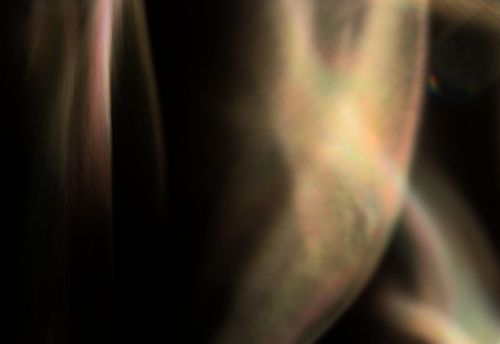
Actually, an image of steam rising from a couple of eggs I boiled for a young friend’s lunch yesterday.

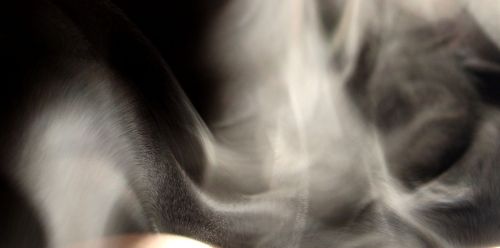
I guess the sun was shining through the kitchen window just right. Or I just happened to look over my shoulder at the right time. I’ve been trying to get better at planning photo shoots and selecting items to photograph. I must say, I would never have thought to photograph steam. Until now.
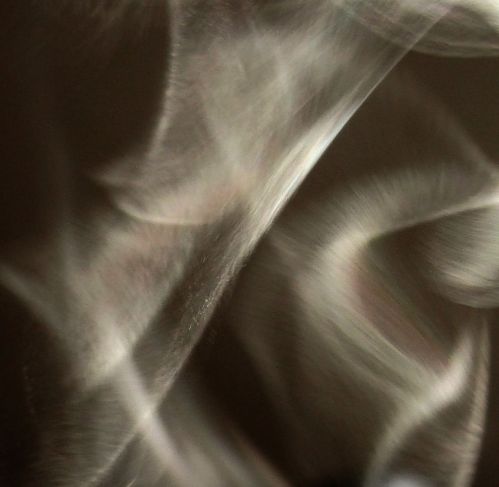

It was captivating to watch the patterns appear and disappear.

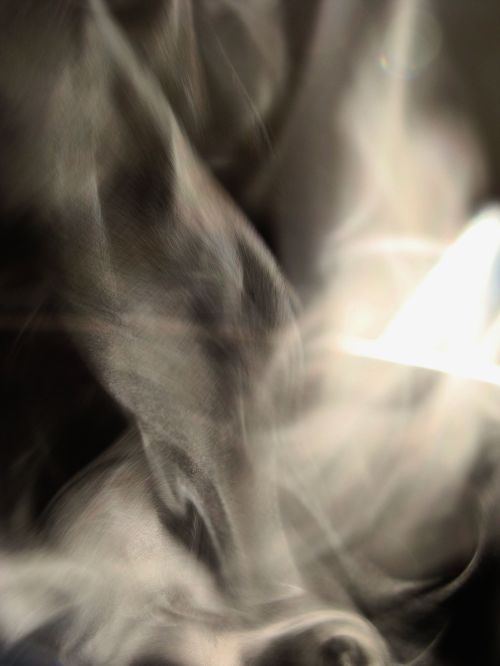
I must say the next time I boil an egg I’ll be curious to see how the light is shining into the room. 😉

Posted in Inspiration, Nature Notes, tagged art, conversation, light, rainbows, science on December 7, 2010| 2 Comments »
One night, feeling restless, I went for a walk. Along a quiet stretch of road I found a bench where I sat for a while, head bowed with thoughts. Finally, I looked up into the night sky and that is where I beheld something I’d never seen before — the full moon surrounded by a rainbow.
Soft rich reds and blues framed a large golden orb. My spirit lifted at such an unexpected sight. I wanted to share the experience so I whipped out my very first cell phone and called a new friend in my life, Steve. It was late. I certainly woke him up but he was polite and simply said, “Hello. Is something wrong?”
I replied, “No, not at all. There’s a rainbow around the moon.” I described the cool lunar light, the rich colors saturating the clouds, the magical picture painted against the sky. “How wonderful is that?”
I expected him to be as awed as I, and perhaps he was, but Steve as I was still learning at the time is a scientist who studies light. There was no exclamation of awe. He made a thoughtful “hmmmm” sound and then proceeded to explain the mechanics behind the rainbow’s appearance using clear, straightforward textbook language about angles and wavelengths and light distribution. Finally, as he grew aware of the sounds I was making, he asked, “Why are you laughing?”
“Well,” I said, “All I was trying to convey to you was the beauty of a rare sight.” With perplexity quite clear in his tone, he replied, “But so was I.”
 Words + Images