Feeds:
Posts
Comments

Posts Tagged ‘black history’

Richard Lonsdale Brown was born in 1892 in Evanston, Illinois. When less than a year old, his parents moved to West Virginia. There he attended public school and then trained as a sign painter. After finishing trade school, he remained in West Virginia for five years, “and then being a journeyman sign painter I traveled through the mining districts of the state … My journeys took me almost altogether through the mountains where, when God made them, He placed scenery the equal of which, I think, cannot be found in all America.”
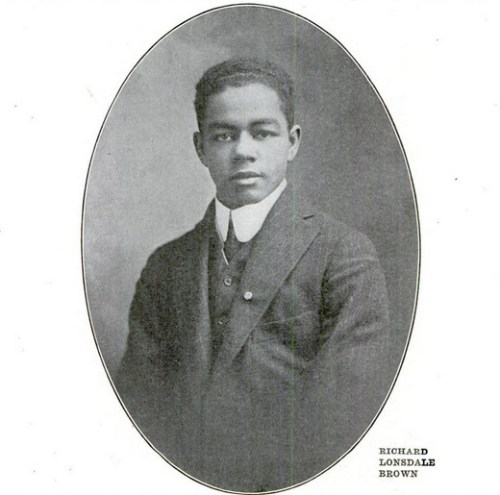
Richard Lonsdale Brown, 1912

“It was there I believe that my love for landscape painting was awakened. When not painting signs I was doing what I could to reproduce the scenery of the mountains and valleys, the rivers and the streams on canvas.” Brown shared those words in a 1913 article that appeared in the New York Sun.
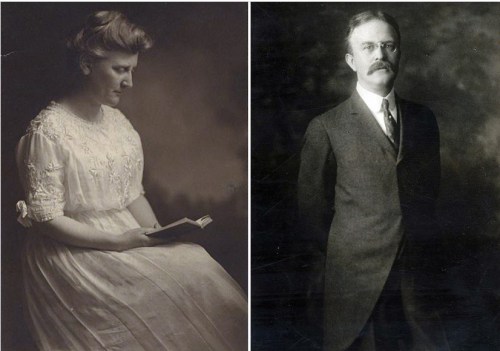
Mary White Ovington and Oswald Garrison Villard, circa 1910-1920

Mary White Ovington and Oswald Garrison Villard, circa 1910-1920

Mary White Ovington (1865-1951), co-founder of the National Association for the Advancement of Colored People, remembered first learning of Richard Lonsdale Brown in 1910.  In her memoirs, she recounts it was during a meeting with Oswald Garrison Villard (1872-1949).”In 1910, when Mr. Villard and I were working in the newly organized NAACP, he gave me a letter from the artist George de Forest Brush, asking me if I would take up the business mentioned in it. It told of a young colored artist, Richard Brown, from Charleston, West Virginia, who had recently come to New York with some excellent sketches.”
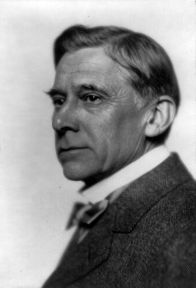
George De Forest Brush

George De Forest Brush

“I called upon Mr. Brush in his picturesque studio on MacDougall Alley and saw his pictures. They were lovely things, trees and melting skies, alive in form and color. Mr. Brush was deeply impressed with them.  ‘He is no more than a boy,’he said, ‘and he came into my studio, shy, discouraged. He had brought his sketches under his arm to New York, and when not in one of our great galleries was spending his time trying to sell them. No one wanted even to look at them. He was poor; he was colored. Could one have greater handicaps?’ Mr. Brush welcomed him to his studio and looked with interest and appreciation at his work. ‘Can I ever be an artist?’ Richard asked when had shown all he had. The answer was, ‘You are an artist.'”

Brown would exhibit his work in the Ovington Brothers Gallery in New York, March 18-23, 1912.  It would showcase paintings done in West Virginia before he was 18 years old and in the hills of New Hampshire while under the tutelage of Mr. Brush. Mary Maclean, a writer with the New York Times wrote a profile of the young artist for the newspaper. The article appeared in March, just before the exhibit, helping to make it a great success.

It was estimated that 2,500 people attended. Twenty-six pictures were for sale and sixteen were sold including little sky sketches. The young man charmed people with his demeanor as well as the quality of his work. Collectors who reportedly purchased his work included Jacob H. Schiff, Edward Warburg, Mr. Coster, and celebrity Miss Mary Garden.

Art Critic Joseph Edgar Chamberlin quoted in the New York Age, March 1912

Maclean’s profile would also be printed in the April 1912 issue of the NAACP’s The Crisis Magazine for which Richard Lonsdale Brown produced the cover.

Cover Art by Richard Lonsdale Brown

Ovington remembered, “Crowds came and he had many purchasers. The prices for most of the pictures were high, and so Richard would paint little cloud sketches in the evening and sell them the next day. He made over a thousand dollars. We all hoped he would use it for study; I had plans for Paris but the money went where his affections dictated. He spent it on a sister, who he used to tell me, was more talented than he, in a vain attempt to cure her of what proved to be an incurable disease.”
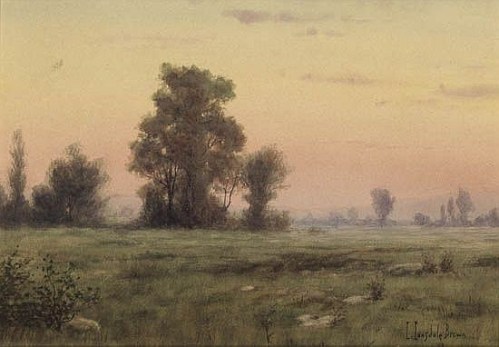
by Richard Lonson Brown

by Richard Lonsdale Brown

White and black publications of the period described him as “the rising young artist.” Instead of Paris, Brown would study in Boston, living at the Robert Gould Shaw House. Ovington remembers him producing posters for W. E. B. Du Bois’s Pageant. He exhibited in private homes. He would eventually travel down South. Before he left, he would confide to Ovington that he could not paint as he used to. He’d begun painting landscapes but was now intrigued by figures. As he studied those figures he was discouraged at how society beat them down. He was excited by what was happening in Harlem and hoped to be a part of it. “Not that I have forgotten what I want to do most of all, ” he would tell her. “Someday, when I am the artist I hope to be, I want to return and paint those West Virginia hills.”

Mt. Monadnock, originally purchased by Jacob H. Schiff

While it is unclear if he returned to those West Virginia hills, he would not be part of what became known as the Harlem Renaissance, nor would Ovington see him again after that last encounter. In 1915, he would exhibit his work in the Washington, DC home of Mrs. Carrie W. Clifford.  He died September 23, 1917. Posted in the March 1918 issue of The Crisis was the following passage: “The parents of the late Richard Lonsdale Brown write us that they are living in Muskogee, Okla, and that the young artist died at their home and under their care.”
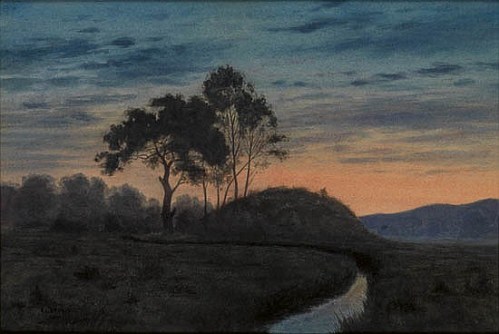
by Richard Lonson Brown

A Bend in the Stream, originally purchased by Albert Andriesse

While it appears that the three paintings above and the 1912 Crisis cover are his only surviving work, clearly he produced many other sketches and paintings during his brief lifetime. So perhaps somewhere out there are Brown’s little cloud sketches, scenes of melting skies and his West Virginia mountains.


Sources and Additional Readings

Negro Youth Amazes Artists By His Talent, New York Times, March 1912

Richard Lonsdale Brown Biography by the Indiana Illustrators and Cartoonists

Black and White Sat Down Together: The Reminiscences of an NAACP Founder (pp. 75-76)

Detailed descriptions of his three known paintings

Read Full Post »

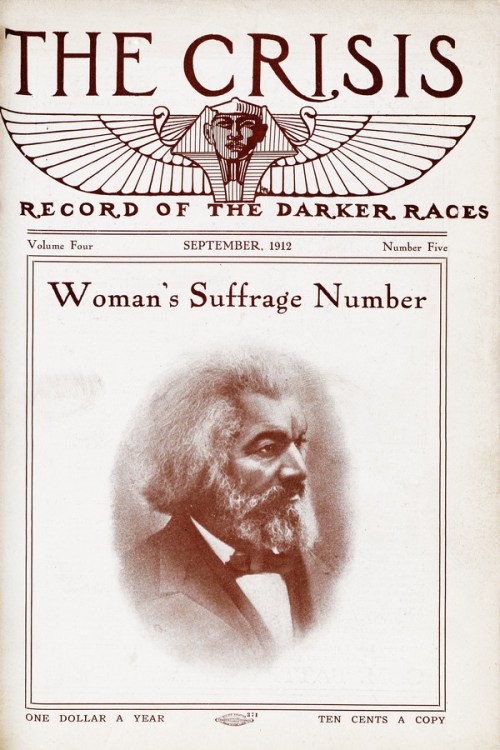
To rediscover the beauty once created like this cover for The Crisis Magazine by artist Laura Wheeler, and …

To remember the struggles we have faced before as a nation and overcome, to a degree, though it is frightening to see how easy it is to regress.

FYI, W. E. B. Du Bois founded The Crisis in 1910.  You can read about the magazine’s origin, and browse issues through 1922, via this link.  You can read the above issue on women’s suffrage online via this link. And the Online Books Page identifies sources for viewing other issues.

Read Full Post »

When do we see ourselves? How do we see ourselves? How is our sense of self shaped by the images of others?  This past year, I spent a lot of time researching U.S. history, mostly pre-Civil War into the early twentieth century.  One of the things that I re-discovered for myself was an evolution in the illustration and other visual representation of African Americans that reflected the sentiments of a rapidly evolving nation.  A nation that had loosely reknit after a Civil War, thirty-years later still in rancorous debate about the “Negro Problem”, and now having to deal with waves of mostly non-English speaking European immigrants making their way to a promised land. Culture clashes took place at every level of society. And those tensions were reflected in the arts and how “others” were represented.

I chanced upon an 1898 issue of the magazine, The Art Amateur: Devoted to Art in the Household, a popular type of magazine at the time.  The article that caught my attention, by E. Day McPherson, focused on Drawings of the Negro Character, an actual tutorial for how to capture the character of your artistic subject.  When reading the text I tried to keep in mind the context of the time. For example … “Character might be defined as the result of emotional habit, and certainly the lines expressive of character are those which show what emotions the person is most frequently subject to and in what degree he is accustomed to repress or hide them.  The negro is much more accustomed to give his emotions free play than white people, and they more than the yellow and the red races. To the Japanese we seem as “funny” as the negro seems to us …”

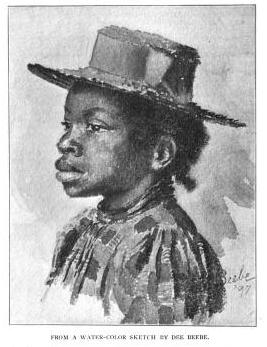
But my focus was not the words but the artist’s work.  Most publications from that time, outside of publications produced by African Americans, were already presenting stereotypical images of African Americans, if any images were being shown at all.  I was struck by Dee Beebe’s portraits of young African Americans, possibly in Galveston, Texas, in the casual clothing of their day.  I don’t know if she captured their character but she captured their beauty for me.

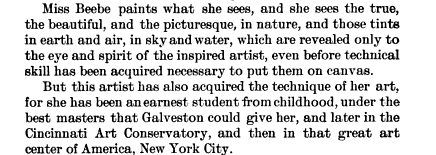
I couldn’t find out much about the artist. She was born in 1870 into a prominent family in Galveston, Texas. Her artistic skills were clear at an early age.  As one writer noted in 1896:

At the Art Academy of Cincinnati, she studied with Frank Duveneck.  In New York, she studied with William Merrit Chase and Kenyon Cox, and later with Theodore Wendel in Gloucester, MA.  Throughout her life she was a teacher while continuing to produce oil and watercolor paintings as well as etchings. The last reference to an exhibit that I could find was 1922.  She exhibited at the Ainslie Galleries in New York, seventy-five watercolors, “including bits of Holland and Switzerland, views of New England, the Arizona desert and around San Francisco and studies of flowers in localities as diversified as Prospect Park, Brooklyn, Los Angeles, Switzerland and Holland.” She died in 1946.

It would be intriguing to see more of the work of this artist. I found a few landscapes online.  The 1898 article says that at one period while back home in Texas she “devoted much time to the portrayal of negro types.” Perhaps those other images, if they still exist I might not like so much, but I am glad she created these images and that they were shared with the public in that popular magazine.

Sources

The Art Amateur: Devoted to Art in Household, Volume 39-40, 1898

Prominent Women of Texas (1896), p. 82

Magazine of Art, 1922


Read Full Post »

The recipes are good. They are simple, elegant and refined, like the family sharing its history through food.  The preface describes the book as telling the story of five kitchens and three generations of women. “Mother-daughter duo” Alice Randall and Caroline Randall Williams use the book to share stories from the kitchen, a place that could be both forboding and a place of great calm, depending upon one’s generation (e.g. slavery) and one’s location (e.g. north vs. south).  Traditional, mostly southern recipes, are reworked.  Flavoring agents like bacon dripping, ham hocks, and butter are replaced by olive oil, or no oil at all.  But fear not.  As I told my big brother, a traditional southern cook, flavors have been retained if not indeed heightened with the liberal use of spices. My favorite recipes were the simplest like the Warm Onion and Rosemary Salad, Herb-Roasted Salmon Fillet, Fiery Green Beans and Links Salad composed of green beans, green peas, cucumber and basil.

There’s a Homemade Peanut Butter recipe. The authors describe peanut butter “as a bass note that can carry a wide variety of top notes” and encourage users, once comfortable with the basic recipe, to add spices. Be creative. Set no limits.  It’s a sentiment that fits the family.

Many of the book’s recipes from Mama’s Tequila Ice to Eggplant Tower with Mashed White Beans open with brief headnotes that describe the family connection to the dish.  Whether its a variation on a meal served while hosting parties during the Harlem Renaissance or a reworking of a meal had as family members traveled overseas in Yugoslavia, each recipe clearly has meaning.

While its an eclectic mix of recipes, overall the book is quite a culinary inspiration.  The recipes don’t begin until page 80.  Those first seventy-nine pages are a poetic examination of five kitchens, and American history, beginning with Minnie Randall (1897-1976) through Caroline Randall Williams (b. 1987).  Reviewing the book has reawakened my desire to ask family members about their memories of food past and what they’d like to cook in the future.  You don’t need to be of African American heritage to enjoy this book.  It’s an American experience that can be shared, quite deliciously, by all.

I received this book from Blogging for Books for this honest review.

More Info …

Author Bios

SoulFoodLove

Read Full Post »

… there was a school and on the campus there was a chapel and inside the chapel there was a stained glass window known as The Singing Window.

photo by Carol M. Highsmith

photo by Carol M. Highsmith


Sources and Additional Readings

Learn more about the photographer Carol M. Highsmith on the Library of Congress website: Carol M. Highsmith Archive.

Learn more about Tuskegee University including its tours and the history of the chapel.

Read Full Post »

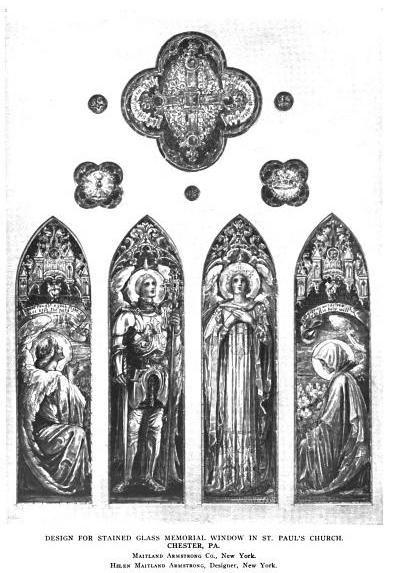
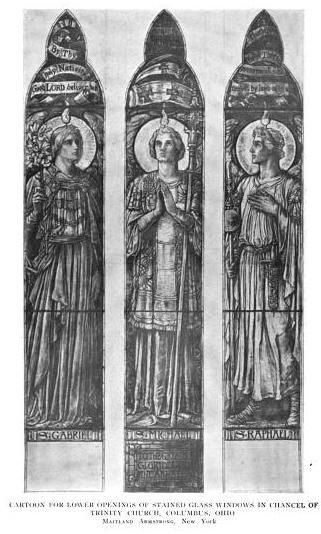
As I read Maitland Armstrong’s words, I heard David McCullough’s voice as he narrated Ken Burn’s The Civil War.  Maitland Armstrong (1836-1918) did many things during his long life but I was particularly interested in his journey as painter and stained glass designer.  I’d first learned about him as part of my research into the artists involved with decorating Trinity Church.  Maitland’s name had surfaced as a friend and contemporary of John LaFarge.

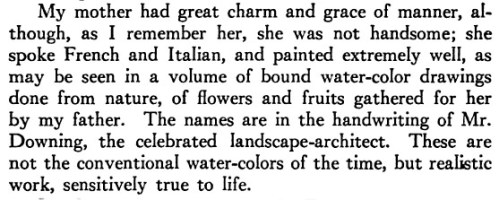
I chanced upon his memoir, Day Before Yesterday: Reminiscences of a Varied Life, published posthumously in 1920.  It opens, “I was born on the 15th of April, 1836, at Danskammer on the Hudson, near Newburgh.” In it he writes with great affection for his family and especially his mother.  He describes her southern roots, how she would sometimes leave New York to winter in Charleston, South Carolina, and how she nurtured his interest in painting before her death in 1853.

I had planned to skim Armstrong’s memoir focusing on his friendships with people like John La Farge and Augustus St. Gaudens.  In the table of contents, there is a chapter, St. Gaudens and Others.  But there was also a chapter, The South Before the War.  What did this artist have to say about such a time and place?

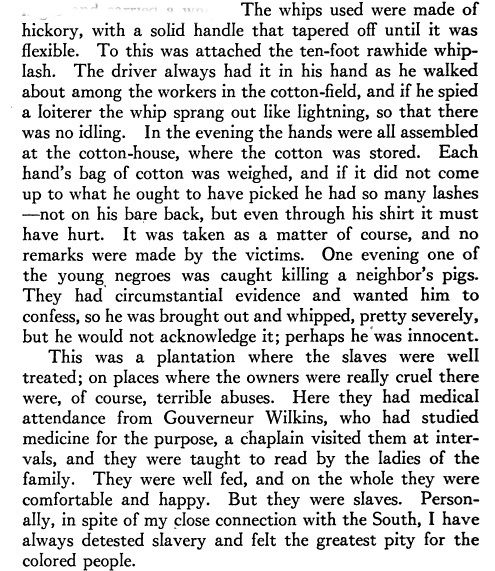
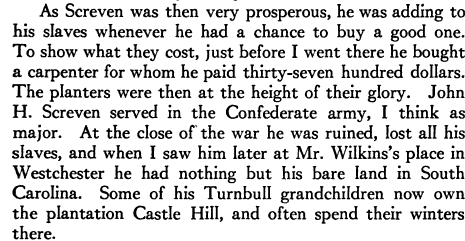
Well, what he does is describe in great detail, by painting with words, life in the south on a small network of plantations and the neighboring environs.  Even with his blood ties to a number of the families, he reports with a northern perspective.  He enjoys the hunting and accepts the slavery.  He learns a new language about the poor whites known as crackers and the slave assigned to him, his little darky.

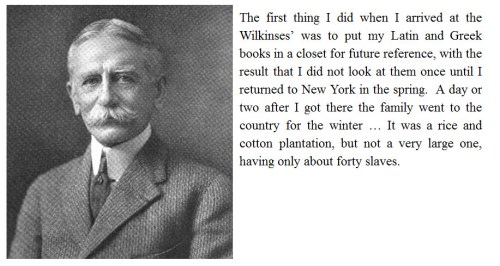
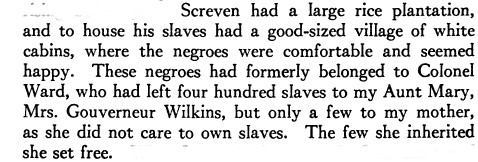
It was in 1853, perhaps after the death of his mother, that Armstrong and his brothers traveled to Charleston.  There, while he is staying with relatives, the Wilkins family, they drive to their plantation Kelvin Grove, where Armstrong describes there was “a nice little village of comfortable white cabins for the negroes. But there always was in evidence a driver, as he was called, who was a superior negro and carried a whip.

He visited several family relations while in the South, from the Wilkins to his cousins, the Screvens.

The detachment with which Armstrong is able to describe the scenes that took place around him in the south (and in a later chapter his description of turmoil in New York) make clear his compassion for others but also his upper class background that separated him from those others.

At the end of the chapter Armstrong describes how that period in the south was one of the most delightful times in his life.  No cares, no worries. He would receive a letter decades letter from a family member describing the loss of the plantations and the slaves, the occupation by Union troops, and the auctioning off of property to pay debts.

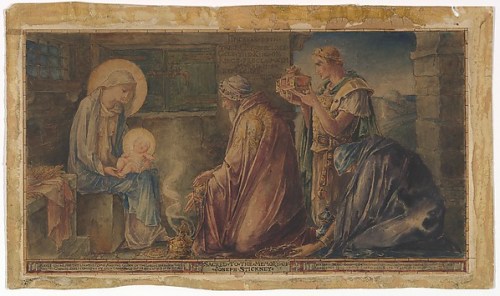
Armstrong would return to New York, attend the very best schools, and travel the world.  His life was truly varied serving as student and teacher in several different fields.  As a stained glass artist he would collaborate on masterpieces with his daughter, Helen Maitland Armstrong.  He would serve as a Consul General in Rome.  And near the end of his days, he decided to chronicle that life.

For anyone researching artists of a particular generation who ran in the same circles – La Farge, St. Gaudens, McKim, White, etc – this book could be an interesting resource. Armstrong describes personal vignettes of how these people interacted socially and appreciated each others work.  You could even completely ignore that chapter about the south.  But I think that chapter is important because, from a different source, it shines a light on life in the past … and it is that past that is the shaky foundation upon which we continue to try to build a brighter future in this country.

Nativity: Design for the Stickney Memorial Window, Faith Chapel, Jekyll Island, Georgia, Metropolitan Museum of Art

Nativity: Design for the Stickney Memorial Window, Faith Chapel, Jekyll Island, Georgia, Metropolitan Museum of Art


Sources/Additional Readings

Day Before Yesterday: Reminiscences of a Varied Life, 1920

Old Glass New Windows by Will H. Low, Scribner’s Magazine, Volume 4, 1888

Metropolitan Museum of Art, The Collection Online

Wikipedia — Maitland Armstrong

Year Books of the Architectural League of New York (late 1800s, early 1900s)


Read Full Post »

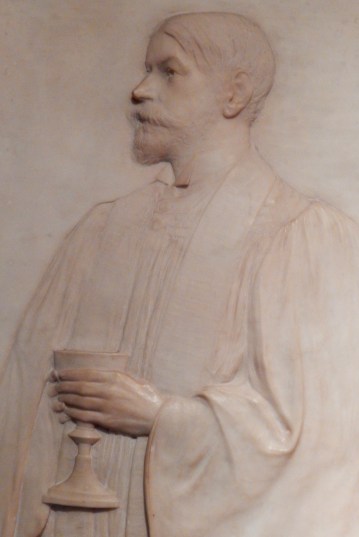
I’d seen the sculpture many times inside Trinity Church but not truly appreciated it. A man holding a cup, a cup-bearer, but the person depicted had no context for me.  I knew nothing of his significance in the past or in the present.  There were too many other visuals capturing my attention, like sunlight through stained glass windows.  Only recently have I returned with greater respect to the relief of Elijah Winchester Donald, Rector of Trinity from 1892 until 1904.

Detail of E. Winchester Donald Sculpture by Bela Pratt

I unexpectedly re-discovered the sculpture, and the man depicted, while researching the history of a church thousands of miles away at what is now known as Tuskegee University in Tuskegee, Alabama.

During my research I came across an issue of The Southern Workman, a publication founded in 1872 by General Samuel Chapman Armstrong of Hampton Institute, Hampton, VA.  Armstrong would leave his mark on American history for many reasons, one of which included founding Hampton just after the Civil War. There, a young Booker T. Washington, formerly a slave, would become a student and eventually a teacher. In 1881, when people in Alabama, wanting to start a new institute for black students, reached out to Armstrong for principal recommendations, Armstrong suggested young Washington who applied for the position and got the job.

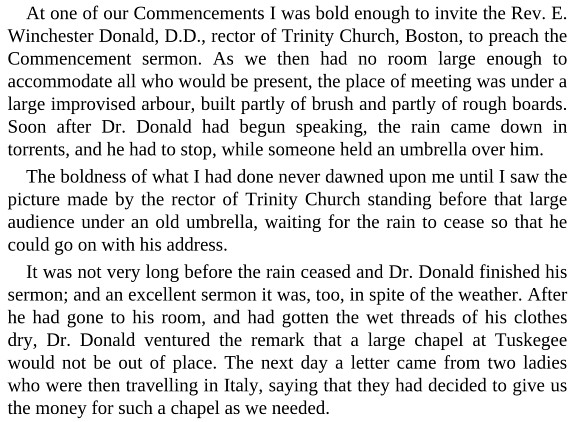
The August 1895 issue of The Southern Workman made note of Tuskegee’s achievements, including recent receipt of anonymous funds to build a new chapel.  But prior to those funds being received graduation commencement services took place and, the journal describes the event in this way:

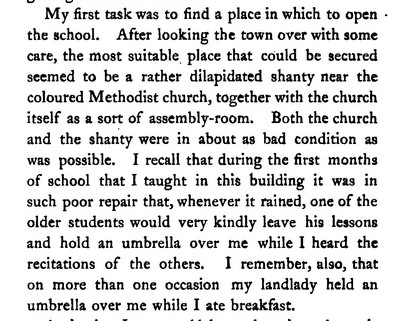
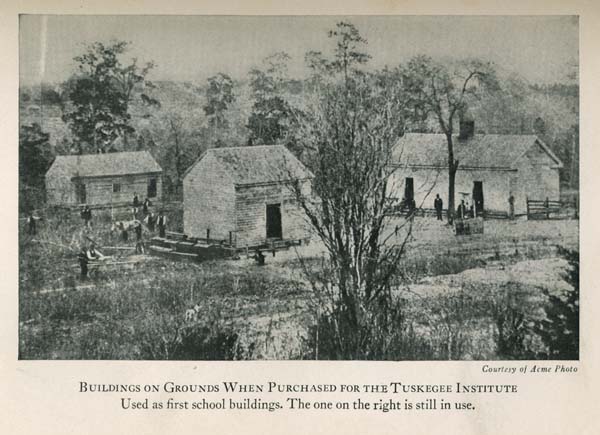
Years late, Booker T. Washington would describe the moment in a slightly different way.  In 1901, Washington wrote Up from Slavery, the chronicle of his journey from slavery, his attendance at Hampton and eventual leadership at Tuskegee and well beyond.  As Washington wrote, money had been found to start Tuskegee, with money set aside to pay future instructors, but no provisions had been made for securing land and buildings.

Later in his autobiography, Washington gives his personal recollection of the 1895 Tuskegee commencement in which Dr. Donald spoke:

The chapel would be built, designed by Robert R. Taylor, the first African American graduate of MIT. The chapel would be erected between 1896 and 1898, a structure some scholars say Taylor considered his masterpiece.

Robert R. Taylor

Robert R. Taylor

In 1900 author Max Thrasher wrote: “The building of this chapel illustrates, as well as any one instance can, the methods of the industrial training at Tuskegee.  The plans for the building were drawn by the school’s instructor in architectural and mechanical drawing.  The bricks, one million two hundred thousand in number, were made by students in the school’s brick yard and laid by the men in the brick-laying classes.  The lumber was was cut on the school’s land and sawed in the saw mill on the grounds.  The various wood-working classes did the work which in their departments.  The floor is of oak; all the rest of the finish in in yellow pine, and the use of this wood … The pews were built after a model designed by one of the students, and another student designed the cornices. The tin and slate roofing was put on by students, and the steam heating and electric lighting apparatus was installed by them …” Before his death in 1904, Donald would have an opportunity to speak in this chapel.

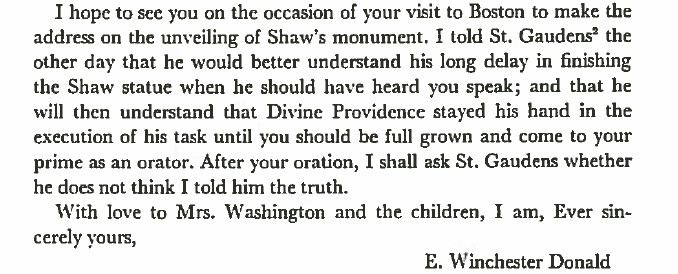
Though from two very different backgrounds, Donald and Washington appear to have greatly respected one another. In 1895  Donald established the Trinity Church Oratorical Prize, an award for the best written and best delivered paper on an assigned subject, a student prize that continues at Tuskegee, with different sources of funding, to this day.  For many reasons, Washington often made his way up North, cultivating philanthropists, accepting honorary degrees, attending national conferences, and speaking in places like Trinity.  In 1897 he was invited to deliver an address at the dedication of the Robert Gould Shaw Monument in Boston.  Prior to his arrival, Donald sent him a letter:

In 1901, Donald presented the dedication address for a new campus building at Tuskegee.  In attendance were noted business leaders and philanthropists including George Foster Peabody and John D. Rockefeller Jr. Before them was a magnificent campus, once a few fragile buildings, transformed by student-labor into a thriving educational institute with over 100 hundred instructors and staff, 50 buildings both functional and aesthetic, over 2500 acres of land with solid farming infrastructure and students applying from around the world.

Chemistry Lab 1902

Chemistry Lab 1902

Instructor George Washington Carver

Tuskegee Instructor George Washington Carver

Donald’s dedication address was made just a few decades after the end of the Civil War.  There was still great philosophical debate about what was to become of the millions of African Americans formerly enslaved.  Like Washington, Donald seemed to believe that education and skill building were the key for black people to let go of the past, achieve success in the present, and build a foundation for future excellence.

During the address, Donald would say: “We are in the presence of a fact. Whether or not the negro can be raised to self-respect, industry, thrift and ethical soundness, let the doctrinaires debate. One thing we know, whereas he was blind to his only chance, now he sees. He has only to keep his eyes open and use his chance to rise clean out of the condition into which 200 years of enforced servitude and thirty-five years of stupid, selfish and merciless political exploitation thrust him down.”  His words would become controversial with statements including “an educated negro without a vote is worth infinitely more than ten illiterate white men who vote as often as the polls are open.

Until the end of his days, in person and in writing, Donald would support the efforts of Washington at Tuskegee and those at other Southern black schools educating new generations.  He supported the efforts of many people inside the U.S. and from abroad trying to make social change.  He may have thought he was being militant.

As was said by the Rector of Grace Church in his memory, “his supreme gift was not militancy,–however it may have seemed to some, as well as to himself,–his supreme gift was not militancy, it was sympathy; he gave drink to the thirsty; he satisfied the longing soul; his true emblem was not the claymore, as he fancied, it was the chalice.”

Others stated, “Some of us disagreed with him, some of us thought his positions untenable, but none of us doubted his fraternal regard.”

His memorial was completed January 27, 1907, the bas relief by sculptor Bela Pratt and its setting designed by Donald’s friend, Charles A. Coolidge.

As for that chapel at Tuskegee, it would continue to evolve but that is a story for another day.

Sources & Additional Reading

Up from Slavery by Booker T. Washington

History of Tuskegee (University Website)

Tuskegee: Its History and its Work (1900)

Samuel Chapman Armstrong (Hampton University Website)

MIT Archives – Robert R. Taylor

Bela Pratt Sculpture of E. Winchester Donald

Trinity Church Art & History

The King’s Cup Bearer, Sermon in Memory of E. Winchester Donald, 1904

Read Full Post »

I chanced upon Kicha’s Black History website while researching an African American architect who lived during the late 1800s into early 1900s. I was finding lots of words providing context about the African American experience during this period but very few images until I came across her galleries.

Her unique collection is a moving reminder of the power of images to document the stories of people and places that might otherwise be forgotten.

I highly recommend taking time to peruse the site  and view the wide range of photos and their accompanying text. You can scroll through individual photos or browse different albums.

The photos were taken by different photographers.  They capture a beauty and dignity as well as diversity not always depicted in today’s historical narratives about the African American experience or in most popular media recreations of the time period.

While I don’t know the website creator’s story, I say bravo to what she has pulled together.  I think the site does something important by presenting pictures of an American experience that many may not know but may be important to rediscover and celebrate as we continue to define who we are in this melting pot of a nation.

View Kicha’s Black History galleries:  http://www.ipernity.com/home/285591

Read Full Post »

« Newer Posts