Creativity-Portal.com is an award-winning site offering a wealth of creative resources to viewers for fifteen years. There you will find my latest photo essay, Sightings. Enjoy.

Posted in Inspiration, tagged creativity, encouragement, family, Inspiration, musings, photo essay, Photography on January 16, 2016| 2 Comments »
Creativity-Portal.com is an award-winning site offering a wealth of creative resources to viewers for fifteen years. There you will find my latest photo essay, Sightings. Enjoy.
Posted in Guest Contributor, Inspiration, Nature Notes, tagged Back Bay Fens, bohemian style, creativity, family, friendship, gifts, Inspiration, Justina Blakeney, life, nature, perspective, Photography, storytelling, the Fens, urban landscape on December 20, 2015| 3 Comments »
Lin A. Nulman is an Adjunct Professor of English at Bunker Hill Community College. Her poetry has appeared in Black Water Review, Tanka Splendor, and the anthology Regrets Only: Contemporary Poets on the Theme of Regret, among others. Lin puts her heart and soul into teaching and while I’ve yet to take a formal class, I have felt a student. In her own unique ways, she has challenged me to both appreciate and expand upon the work that I do as writer and photographer. It’s with pleasure I share Lin’s words and images about her grandmother, a great influence in her life.
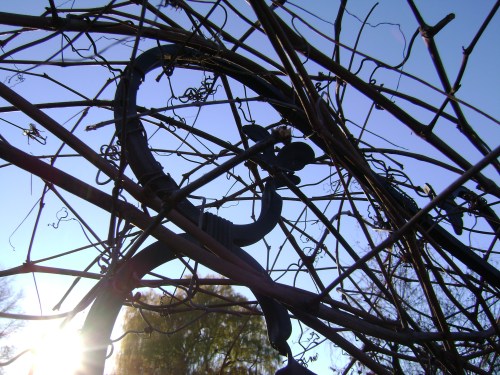
photo by Lin A. Nulman
“Oh, you see one tree, you’ve seen them all,” a woman once said to my grandmother, who had just remarked on a tree she found beautiful. Gram repeated the comment throughout my childhood as “the saddest thing I ever heard anyone say.” I think so, too, and I’m thankful for the gift of knowing why.
We took walks when I was a little girl, and even not so little, in our neighborhoods and on the beach. Often Gram would stop to look at something commonplace, such as weeds in a patch by the side of the road. Isn’t it amazing, she would say, how Nature creates so many shapes of leaves in just this one place?

photo by Lin A. Nulman
Eventually I reached the age of impatience with what grown-ups noticed that wasn’t rare blue beach glass or a good climbing tree. But even when I felt impatient, I knew I could see what she was talking about. I don’t know if Gram believed in God, certainly not in a kindly God, but she did deeply believe in Nature, wonderful and endlessly giving. If you looked at it that way. And I do, and I have to, despite all the other ways my eyes still need to open. Her view was one of my starting places, creatively and spiritually.

photo by Lin A. Nulman
Recently a latent love for bohemian style has sprouted in me, thanks in part to author and blogger Justina Blakeney. I stay up too late turning pages of her new book and feeling out of breath. Justina defines bohemian style as the product of “a creative life and an active engagement in the search for alternative ideals of beauty…Our worldly collections are as eclectic as we are…Decorating is about feeling free, having fun, rejecting traditional notions about what goes with what…and getting a little bit wild.” [I’m quoting from her introduction to The New Bohemians: Cool & Collected Homes. UNputdownable.]
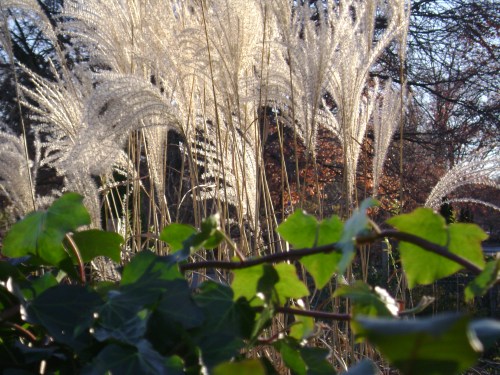
photo by Lin A. Nulman
Even my 1906 copy of Putnam’s Handbook of Etiquette warns New York High Society about the habits of “Bohemia”, over there in Greenwich Village, beyond “the borders of wise convention”, definitely over the edge and unacceptably wild.
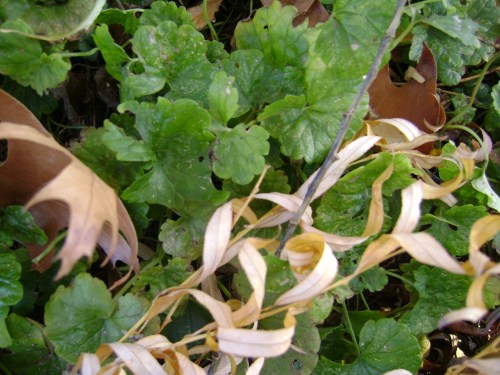
photo by Lin A. Nulman
Her book was in my mind recently on a walk through the Fens, one jewel in the Emerald Necklace of green spaces that loops through Boston. It has a wide area of community gardens, where dozens of people fulfill their own visions with flowers, trees, bushes, berries, vegetables, bamboo, grasses, and leafy plants. It is a wonderful place to open my grandmother’s eyes, to see the shades and shapes Nature creates in just one corner of a park, sometimes helped along by a little human artistry: a painted gate, a statue, a purple disco ball. On this walk, my looking as I was taught to look revealed Nature, to my joy, as The First and Ultimate Bohemian. Everything goes with everything, so feel free and always be a little bit wild.
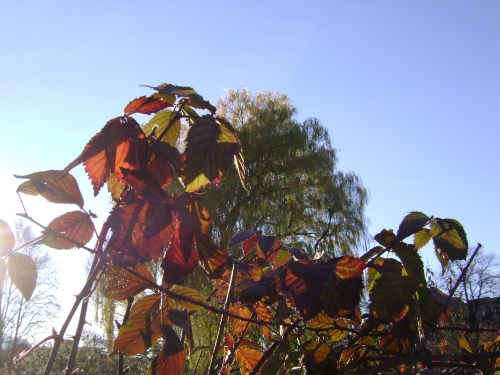
photo by Lin A. Nulman
I challenged myself to photograph the gardens in December, without most of the flowers to help, and still found colors and forms running madly, beautifully together, eye-catching contrasts of silhouette, especially as I lost the light, and small places full of texture and depth. Thanks, Gram.
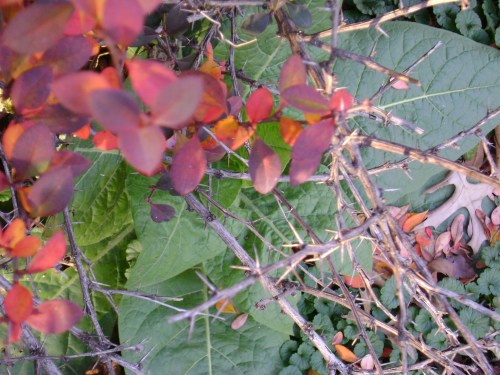
photo by Lin A. Nulman
Please look for my blog, The Creative Part-Timer, in early 2016.
Posted in Inspiration, Kitchen Inspirations, tagged black walnuts, cooking, creativity, food, food photography, Inspiration, Photography, raspberries, recipes on December 15, 2015| 1 Comment »
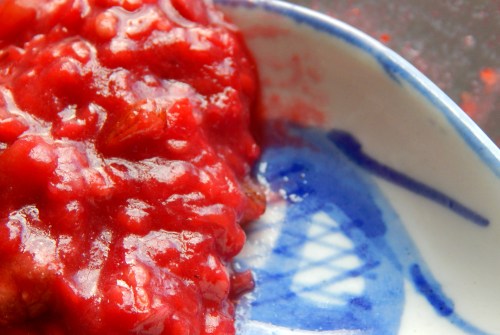
This is what happened when raspberries accidentally got crushed in my house. They’d bounced around a bit too much in their packaging on the way home. Steve took a look at them, rubbed his chin and then with a faraway look in his eyes said, “I have an idea.”

The next morning there was a sweet scent in the air. I made my way into the kitchen, and there on the table next to the plate of hot buttered toast sat a small bowl of warm red sauce. His recipe, more or less: crushed berries cooked with a little butter and brandy, sweetened with a touch of sugar, and flavored with half a teaspoon of crushed black walnuts.
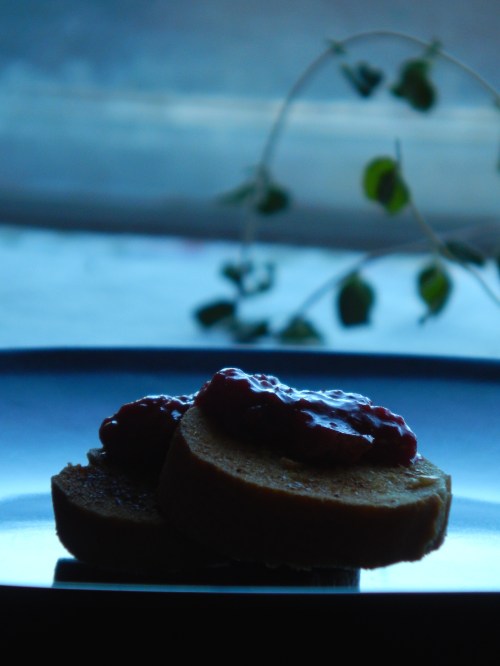
It’s a recipe that will continue to evolve. If we accidentally or on purpose crush anymore raspberries, he’d like to try maple syrup in place of the sugar. And maybe toss in a different nut like crushed hazelnuts. I’ll try any variation on the theme so long as there’s time to photograph the results. Have a good day. 😉
Posted in Books I Love, Inspiration, tagged art, art history, Asian art, beauty, creativity, design, Edmund de Waal, family, fashion, Inspiration, interview, jewelry, Nancy Li, Photography, porcelain, TAO Select, The White Road on December 13, 2015| 1 Comment »

Nancy Li of TAO Selection
Image courtesy of artist.
Believe it or not, porcelain had been on my mind just before my chance encounter with Nancy Li of TAO Selection. I had come across a review of Edmund de Waal’s new book, The White Road. A noted potter, the book chronicles de Waal’s “journey into an obsession” to learn more about the origins and reinvention of porcelain. The prologue opens with de Waal in China: “I’m trying to cross a road in Jingdezhen in Jiangxi Province, the city of porcelain, the fabled Ur where it all starts …” Nancy Li is quick to tell you, and rightfully so, her family is from this region of China and that she is a third generation designer of porcelain.

Image courtesy of artist.
As I later told her, what I most admired about our first brief encounter outside of a church gift shop was her determination to find venues to market her jewelry, and also to share the story of her family and cultural heritage of working with porcelain. In his book de Waal writes of working with porcelain clay to make a jar. Though his studio is in South London, he writes, “… as I make this jar I’m in China. Porcelain is China. Porcelain is the journey to China.” During an interview, Nancy Li made a similar statement.

Image courtesy of artist.
We met briefly in Cambridge during her lunch break. Again, with great passion, she began sharing the story of her family especially of her grandfather, a porcelain master. For three generations the family and 15-20 employees have been working with clay using a proprietary process, molding it in forms from pendants to bowls to large statuary, hand-glazing and then firing the pieces in her family’s kiln. I’ve always thought of porcelain as fragile but porcelain can be strong as Nancy demonstrated by dropping a lovely blue and white bracelet on the floor. It made a beautiful ringing sound and remained unbroken.

On her website, Nancy describes attending the top fashion school in China, Donghua University. In talking with her I learned that six years ago she moved to the U.S. where she also received a Ph.D. in Materials Engineering from Boston University and a Management Degree from the MIT Sloan School of Management, part of her dual efforts to better understand the science behind porcelain and to raise awareness globally about the family business and the high-quality of the artwork produced.

Image courtesy of artist.
On top of her full-time job as a Systems Engineer, Nancy makes time to interact with people around Boston, educating them about porcelain and obtaining feedback about peoples’ fashion interests. She shares the feedback with her family, including producing sketches for alterations and new designs, inspired by what she hears and by her own artistic background.
She describes wanting to help people understand that high-quality porcelain is not only for the wealthy. It is not only something from the past to be found in antique stores. It is contemporary and it is art, an art that represents a culture. “Each piece of art has a story behind it,” she says at one point, holding a necklace in her hand. “It is art that inspires, that’s meant to be shown and shared. I think Americans have a wrong impression that everything made in China is cheap quality. What my family does in its local community, what it has been doing for so long, is of the highest quality and I want to share that work, our work, and help it evolve.”
Following are links to learn more about and connect with designer Nancy Li and to view more of her wearable porcelain art.
Following are links to learn more about artist and writer Edmund de Waal and his passion for porcelain.
Posted in Inspiration, Music, tagged beauty, creativity, Herbert Howells, Inspiration, music, musings, organs, random, Rhapsody No. 1 in D Flat, storytelling on December 7, 2015| 2 Comments »
… I would paint what I hear in this piece of music, Rhapsody No. 1 in D Flat Major by Herbert Howells. The entire piece is only five minutes and 35 seconds long, but it is the segment between 1:30 and 3:00 that moves me most. I first heard it being played a few weeks ago at Trinity Church in Copley Square. The organist, Colin Lynch, was rehearsing for Sunday services. I appreciated the beauty of his playing but at first the music itself did nothing for me … and then something happened. I was hooked. And then released. As he kept rehearsing the piece, I wanted to dash into the church and stop him to ask what in the world was he playing but that seemed inappropriate. I thought I’d catch him at the end of his rehearsal but I missed him.
Time passed, lots of traveling took place but I could still hear that music. I tried to describe the piece to other musicians and people who knew classical music far better than I. Keep in mind I have no language for music (which is why I want to paint what I’m hearing). I kept saying, “It’s the kind of music that, you know, leads you someplace,” and other not especially helpful phrases. I was about to give up my search when I did chance upon the organist. This time I stopped him in his tracks and asked, “Hey, Colin, what was that piece of music you were playing two weeks ago?”
He lifted an eyebrow but he indulged me. He helped me find the language to describe what I’d heard. And as we narrowed down the possibilities of what he may have been playing, he finally asked, “Was it loud? Did it get really loud?” “Yes!” I said, and so he nodded and then wrote down the possibilities.
It was Herbert Howell’s Rhapsody No. 1 in D Flat. Imagine my pleasure when I found this Youtube recording by Nigel Potts. Listen at your leisure. And that’s my random story this bright Monday morning. Have a good day, folks. 😉
Posted in Inspiration, tagged art, colors, creativity, design, Edward Burne-Jones, Inspiration, Photography, pre-raphaelites, stained glass, stained glass windows, storytelling, tapestry, William Morris on July 7, 2015| 5 Comments »
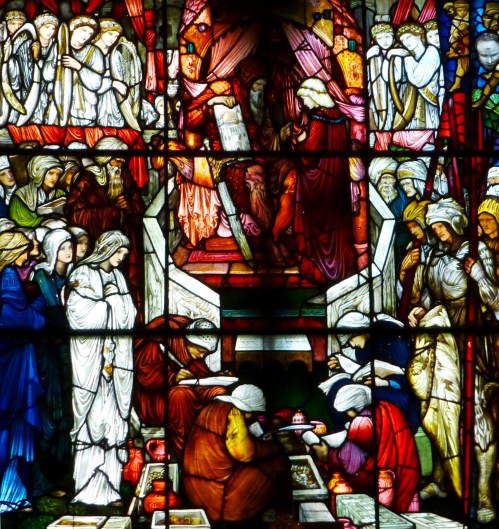
Recently I learned of an image in stained glass also appearing in thread, both based on a design by Burne-Jones. I couldn’t help but do a bit of digging and learned this: the stained glass window, David’s Charge to Solomon, was first commissioned in memory of George Minot Dexter (1802-1872) by his son Frederic Dexter. It is located at Trinity Church in the City of Boston. I’ve had the great pleasure of photographing details over the years.

The window was designed by Edward Burne-Jones, the color harmonies developed by William Morris and the window fabricated in the William Morris & Co studio.


The window was installed at Trinity Church in 1882 in an area known as the baptistry.
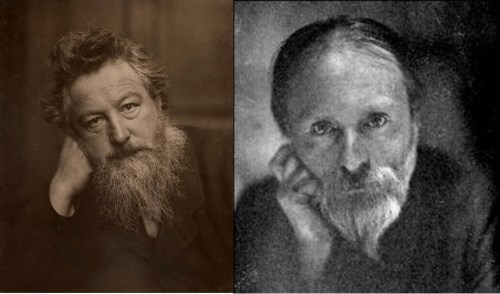
William Morris (1834-1896) and Edward Burne Jones (1833-1898)
While Morris and Burne Jones would both pass away in the late 1890s, Morris & Co.’s design work and manufacturing would continue for decades at Merton Abbey, a village in Surrey, England where textile printing had taken place since the mid-19th Century.

Sir George Brookman c. 1920
While attending an exhibit at the 1900 Paris International Exhibition, and later visiting Merton Abbey in England, Australian mining magnate George Brookman saw Morris tapestries being custom woven for individual and corporate clients. He also saw original designs, still being used, to reproduce artwork. After seeing the Burne-Jones cartoon for David’s Charge to Solomon, he commissioned a tapestry to be made of that image.

Known as David giving Solomon directions for building of the Temple, the tapestry would be described as “a spacious and complex weaving of unusual size. The soft, abundant reds beloved of the [Pre-Raphaelite] Brotherhood were in evidence. Of especial beauty were the figures clad in silver-threaded armor.” Weavers were Walter Taylor, John Martin and Robert Ellis.
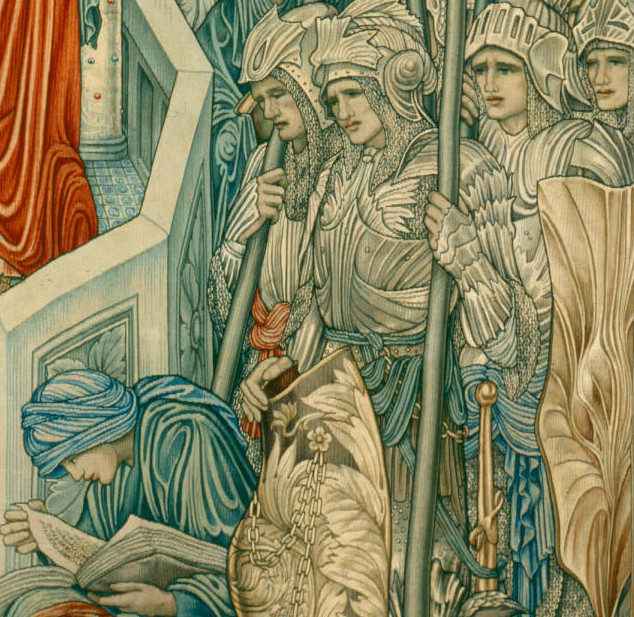
In 1920, Brookman sold the tapestry back to Morris & Co. May Morris, the daughter of William Morris, would exhibit the tapestry along with other Merton Abbey works at the Detroit Society of Art and Crafts Exhibit.

May Morris (1862-1938)

excerpt from International Studio Magazine, 1922
Newspaper businessman, philanthropist and art benefactor George G. Booth and his wife, Ellen Scripps Booth, would purchase the tapestry to hang in Christ Church Cranbrook in Bloomfield Hills, Michigan, where I believe it still hangs to this day.
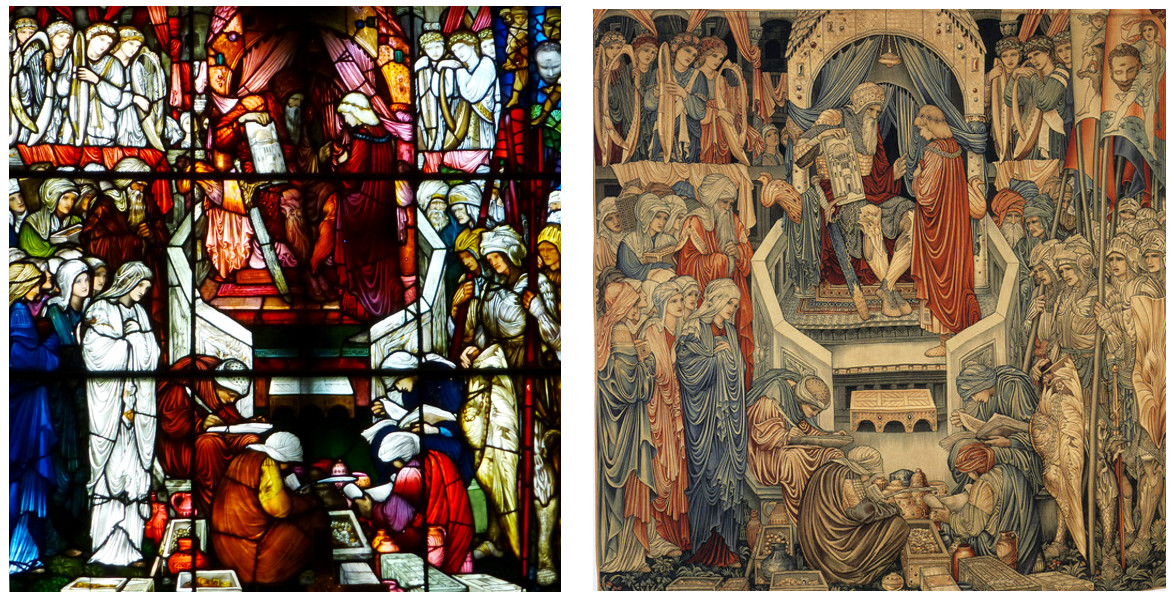 One design expressed in two different ways sharing one of the most influential stories in human history.
Sources/Additional Reading
Details for comparison taken from David giving Solomon directions for building of the Temple, photograph by Jack Kausch, copyright Cranbrook Archives.
The William Morris Society in the United States
Posted in Inspiration, tagged colors, creativity, encouragement, family, flowers, gifts, indoor gardening, Inspiration, Photography, simplicity, storytelling on July 5, 2015| 5 Comments »

Send a single packet of seeds through the mail enclosed in an envelope not much bigger than the seed packet. Include a single slip of paper with words, to the effect of, I can’t wait to see how you photograph these. That’s what my cousin did. A simple gift of great encouragement.
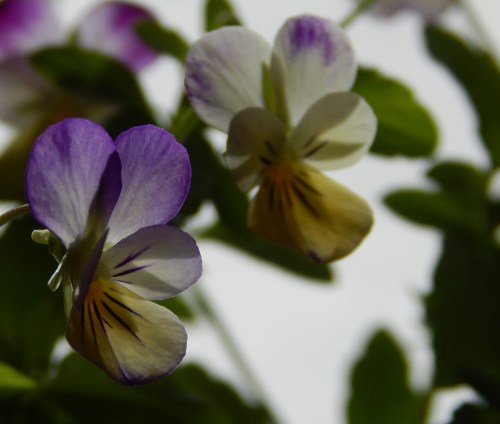
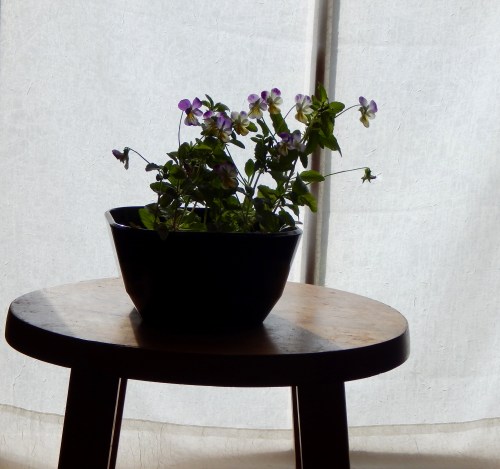
It took me a while, I must admit, to plant the seeds in a cereal bowl. I was lazy on occasion, not watering the dark earth and letting the top get so dry it seemed an errant breath would blow everything away. But I did water, pouring on cups at a time and then walking away.
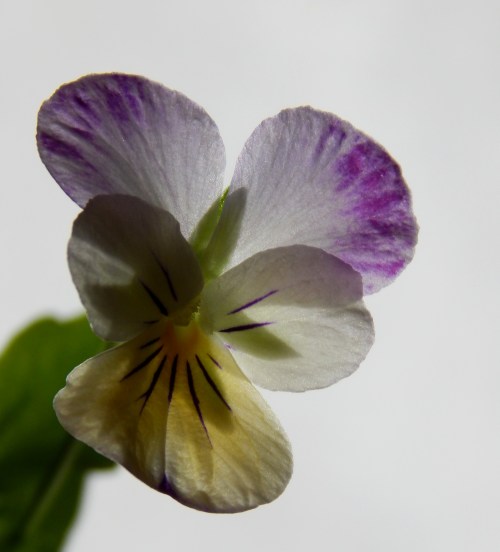
If you follow my blog, you know I grew impatient. I moved the bowl from room to room trying to follow the sun. But then, as happens often in nature, sprouts did appear and then stems and leaves and soon blooms. Beautiful blooms.

I could have eaten them, you know. Violas are edible but now I too wanted to see what would happen over time. The blooms made people who were visiting, who were perhaps not in a happy space, smile as they walked past the bowl. And even I, who can on occasion not find the bright side, they too made me smile as the sun struck the purple and gold.
Then one day as I was sitting in a room staring at the white curtain lit by the sun, and thinking perhaps that curtain was a bit too sheer for that particular room, I was then struck by a new thought: what a wonderful backdrop for Lorraine’s flowers. And that’s how this series of pictures was taken.
Posted in Inspiration, Photography, Publication Updates, tagged colors, cover art, cover image, creativity, Diverse Voices Quarterly, diversity, Inspiration, literary magazines, Photography, writers on June 16, 2015| 6 Comments »
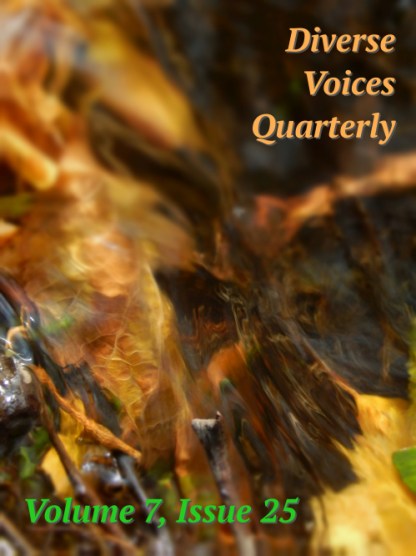
It’s hot off the presses, folks! Diverse Voices Quarterly, Volume 7, Issue 25. I’m honored to have had one of my photos selected as the cover image … water flowing over leaves, a melding of colors. Available online and for the kindle. As always, this issue contains a wonderful selection of poetry, fiction and nonfiction. Brief reads to be savored, like Home by Debonair Oates-Primus and Ancestors by Lee Varon. Enjoy.
Posted in Inspiration, Nature Notes, On the Road, tagged beauty, colors, creativity, Inspiration, music, nature, Photography, urban landscape, videography, water on May 13, 2015| 2 Comments »

There’s an office park in Woburn that has the remnants of a river surfacing here and there running through concrete culverts and pooling in overgrown fields. In the culverts there’s paper blown in from the nearby dumpster but there are also beautiful rocks. In the field, there are branches, dead leaves and green growing stuff.

One windy, partly cloudy day, I was photographing the water and the fall of the light. And then, just to try something different, I decided to record what I saw, in short intervals. With the aid of online tutorials, I managed to figure out how to thread the shorts together. As I watched the scene flow, I could hear background wind and the call of wild geese. But what would it be like with a different sound?

I texted a certain fellow. Now I knew he liked Bach, so I asked, “Is there a piece by Bach that you might pair with scenes of running water?” His reply included Vivaldi, 4 Seasons, Spring, Handel, Water Music. In the end, I selected his suggestion of Faure’s Requiem in Paradesum because he wrote that “It sounds like a waterfall.” Just over three minutes in length. No Oscars to be had just yet, but it is fun to try new things. 😉
Running Waters in Woburn Take Two from Cynthia Staples on Vimeo.
Posted in Inspiration, tagged art, colors, creativity, glass, history, Inspiration, Margaret Redmond, Photography, stained glass, Trinity Church, women artists on April 12, 2015| 4 Comments »
“A plain black gown emphasized her type, which is fine, clean cut and deceptively simple. Her eyes are dark and bright, her hair spun silver and the modulations of her low pitched voice are peculiarly musical. Denying herself color, she is a master of color.”
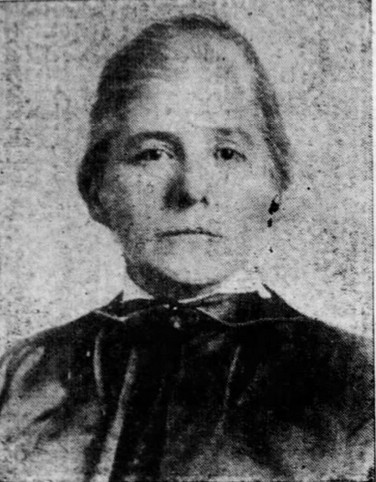
Margaret Redmond, circa 1927
In 1927, artist Margaret Redmond (1867-1948) was interviewed in her studio at 45 Newbury Street, Boston. The interviewer Helen Fitzgerald described the space as, “a veritable treasure trove to the art lover. All about her color glows and flames. On the walls are sketches of colorful places … and the light transmuted by the stained glass of her own making fills the room with rays of gold and ruby, emerald, violet and blue so intense that it stirs in the sensitive observer an emotion akin to ecstasy.”
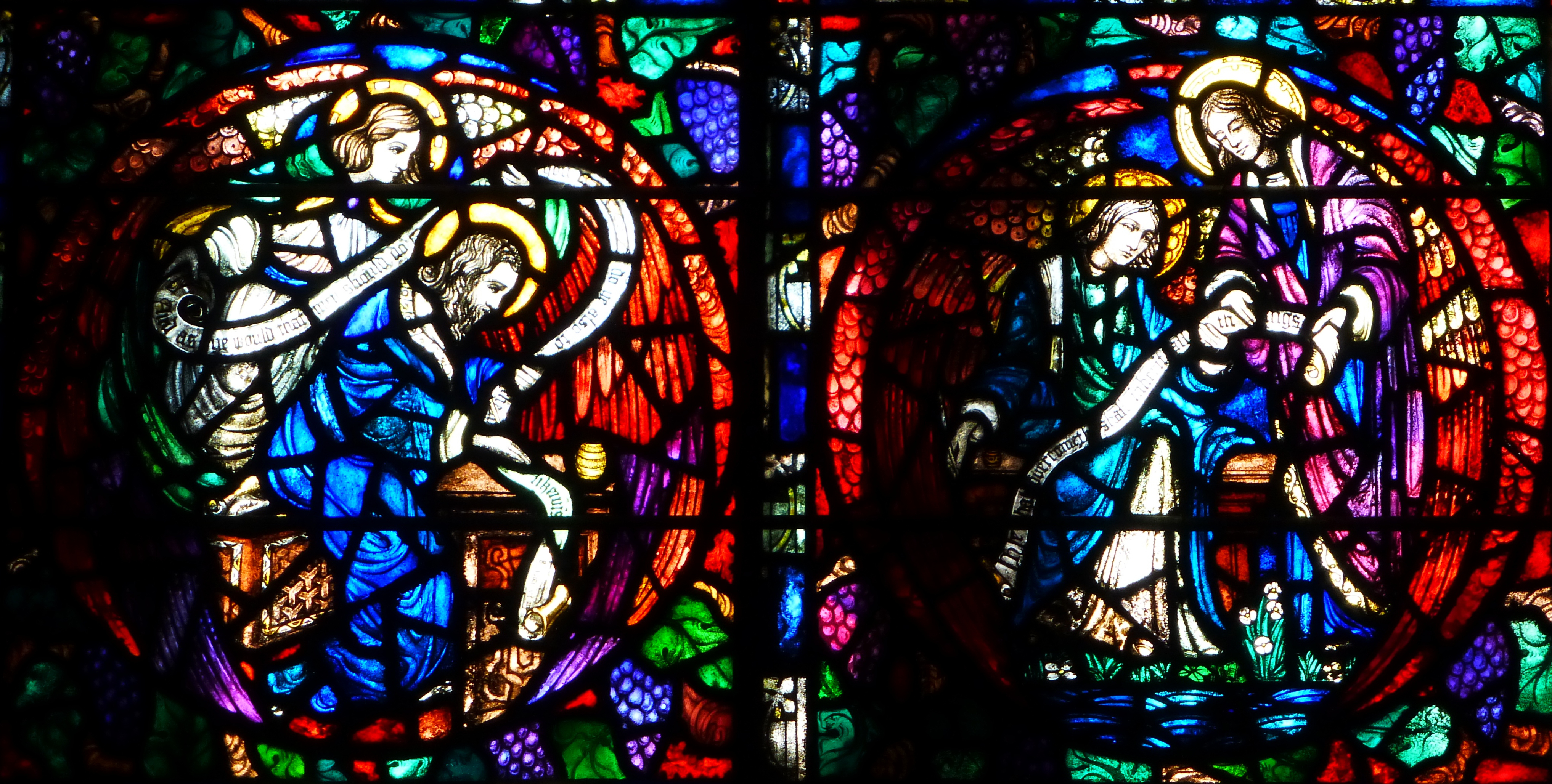
Detail from Evangelists Window, Trinity Church, 1927
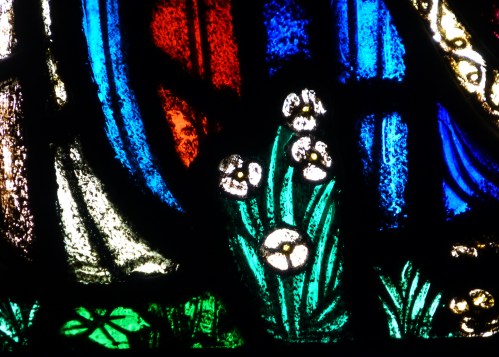
Detail from the Evangelists Window, Trinity Church, 1927
For the 1927 interview and in others, Redmond describes in detail her stained glass technique and why she chose to work with glass quite differently than contemporaries John La Farge or Louis Comfort Tiffany, whose works she admired. As author Elinor Morgan summarized, La Farge and Tiffany designed with glass, whereas Redmond sought to use the glass as her canvas.

Detail from the Evangelists Window, Trinity Church, 1927
Born in Philadelphia, Redmond would study at the Pennsylvania Academy of Fine Arts, travel abroad to study in Europe, before returning to the states. In that 1927 interview, Redmond shared, “I went to England and France, where I spent two years studying the old glass windows in cathedrals, churches and museums. … My studies led me to many old cities and their churches and cathedrals.”
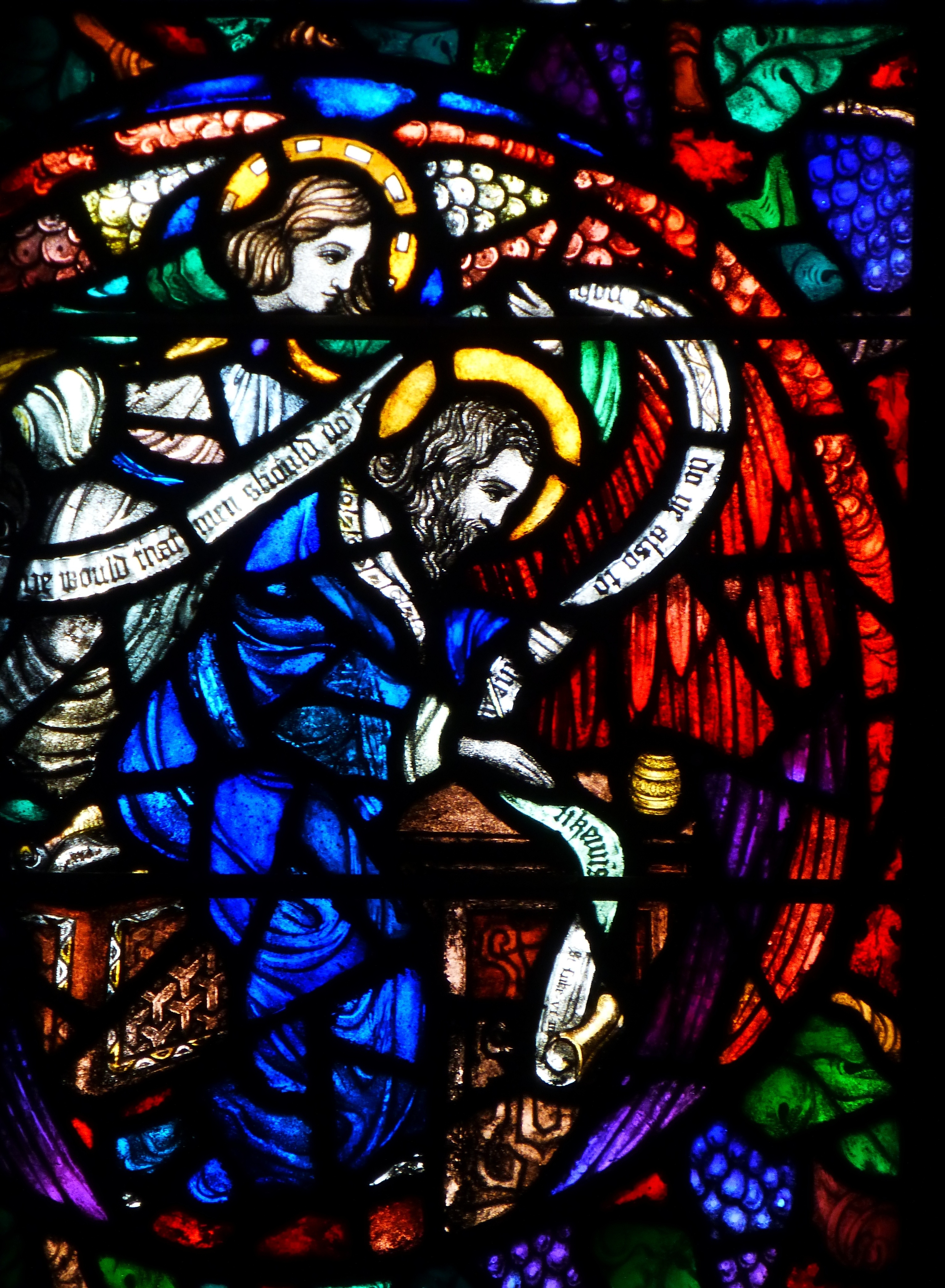
Detail from the Evangelists Window, Trinity Church, 1927
“When I had completed my pilgrimage of the cathedrals, I studied with Simon and Mellard in Paris. Returning to this country, I came to Boston and entered the studio of Connick, the famous maker of stained glass, where I made my first window.”

Charles Jay Connick
Redmond apprenticed with Connick between 1906 and 1910. Prior to that she bought a farm in Nelson, New Hampshire in an area that would become a hub for artists and intellectuals with Pennsylvania roots. Redmond would maintain a summer home and studio there. Examples of her painting and stained glass work can still be found in this community.
Though her medieval inspired style of glassmaking was not in vogue, Redmond received a wide range of commissions for work in churches as well as in private homes and businesses. She exhibited her work, including watercolors and oil paintings as well as stained glass items, at arts and craft shows across the nation.
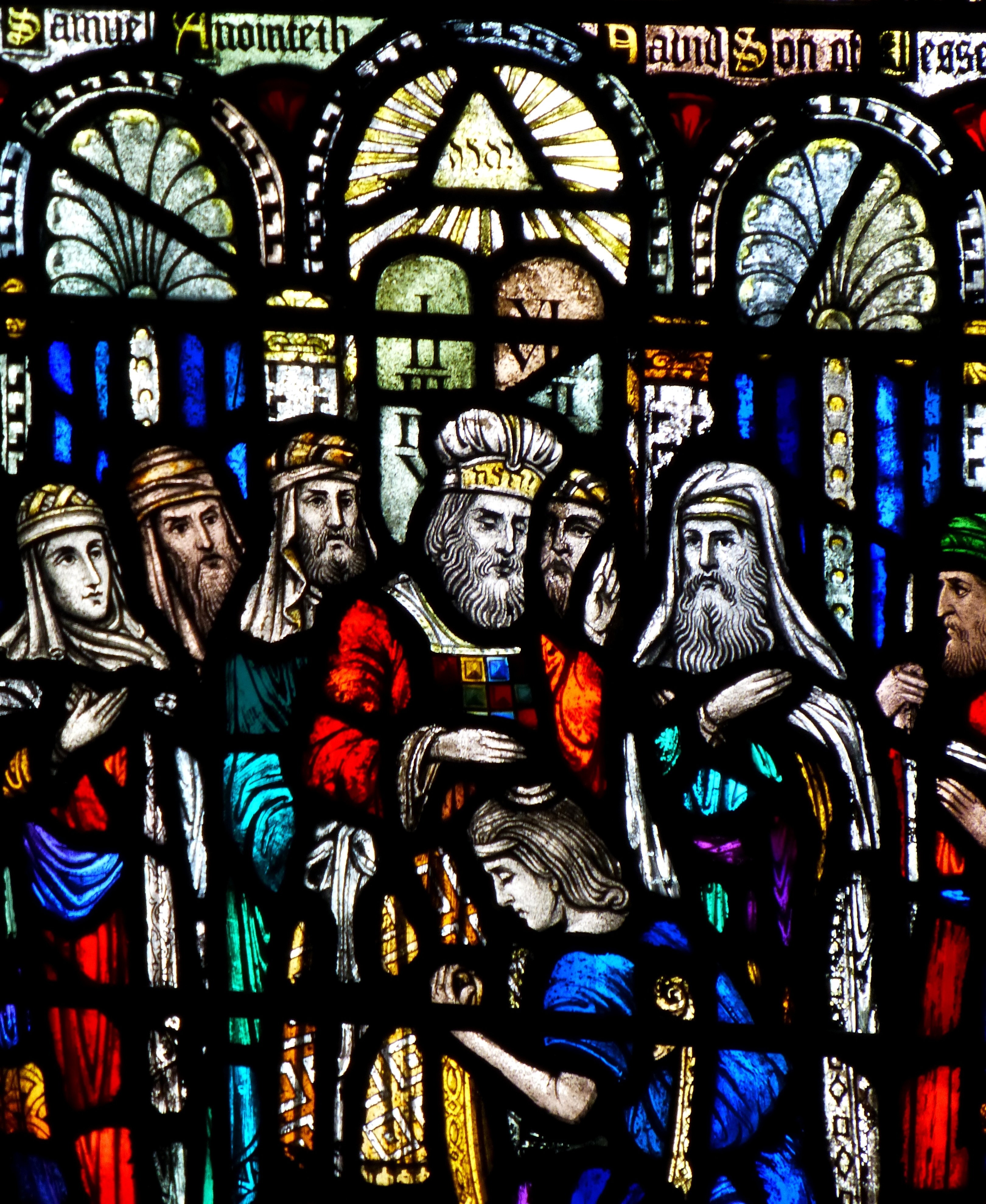
The 1920s and 1930s is considered her most productive period and this is when, for approximately $12,800, she would produce a series of windows for Trinity Church in the City of Boston, from the Apostles to the Evangelists (pictured earlier in this post) to scenes from the life of David and Solomon.

Throughout her career, Redmond was an innovator, for instance, experimenting with different uses for stained glass in the home, including fire screens which were popular in the period. Though respected as an artist, she like many women was too often ostracized in a male-dominated field. But in her studios she worked with both men and women, making a special effort to train young women as assistants in the different phases of the work. In 1931, Connick would ask Redmond to list some of her favorite creations. She would include on the list the windows produced for Trinity Church.

Detail from Tree of Life Window, Trinity Church
I have been unable to find a book solely about Margaret Redmond, or a single listing of her creations, but her papers including contracts are housed in the Smithsonian Archives of American Art. A research project for another day perhaps. 😉
Sources/Additional Reading
Creates Stained Glass Windows, Margaret Redmond Searches Europe for Secrets of her Chosen Art, September 11, 1927 article interview by Helen Fitzgerald, Sunday Eagle Magazine, September 11, 1927
History Written in Glass by Elizabeth B. Prudden, The Christian Science Monitor, June 30, 1931
A Woman in Stained Glass … Against the Odds by Elinor Morgan, Stained Glass Quarterly, 1990
Women Artists at Trinity: Sarah Wyman Whitman and Margaret Redmond, article by Erica E. Hirshler in Makers of Trinity ed. by James F. O’Gorman, 2004
 Words + Images