
I recently visited First Church in Cambridge with my camera. Looking forward to sharing what I saw. Have a good Friday!
Posted in Inspiration, tagged architecture, beauty, churches, faith, Inspiration, Photography, stained glass windows, Tiffany on November 17, 2017| Leave a Comment »
I recently visited First Church in Cambridge with my camera. Looking forward to sharing what I saw. Have a good Friday!
Posted in Inspiration, On the Road, tagged art, beauty, churches, dublin, faith, Inspiration, Photography, St. Teresa, stained glass, stained glass windows, travel on November 13, 2017| 2 Comments »
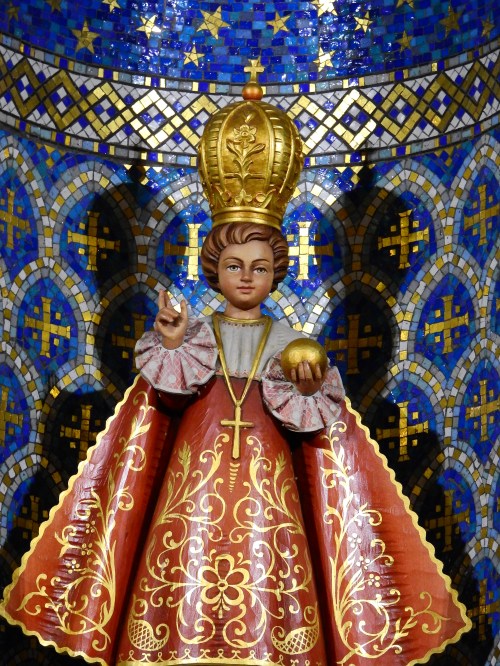
I stepped into another church again. This one also sat in the middle of Dublin’s city centre, this time on Clarendon Street. The website describes St. Teresa’s as a quiet oasis of prayer and that was certainly true. On the streets, people were rushing about but once inside, there was utter quiet.

People entered and wandered into particular chapels to light candles, pray. Perhaps to simply sit and be.
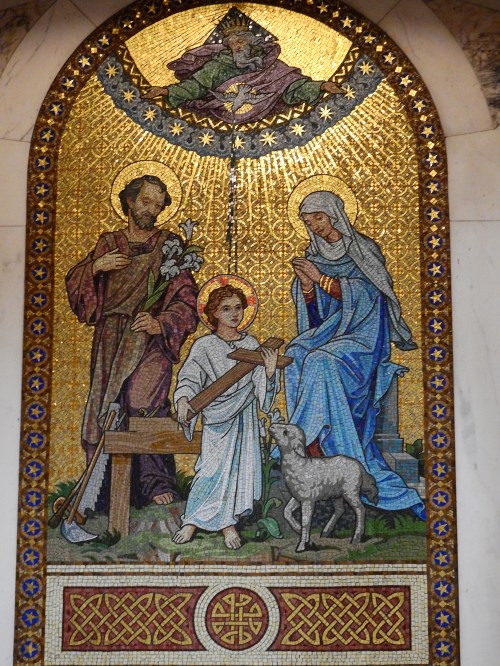
I wandered …

… just enough to “discover” the stained glass.

I didn’t wander long but I didn’t need to in order to see the beauty of the place.

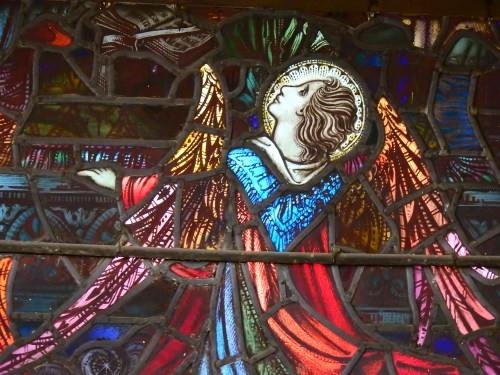
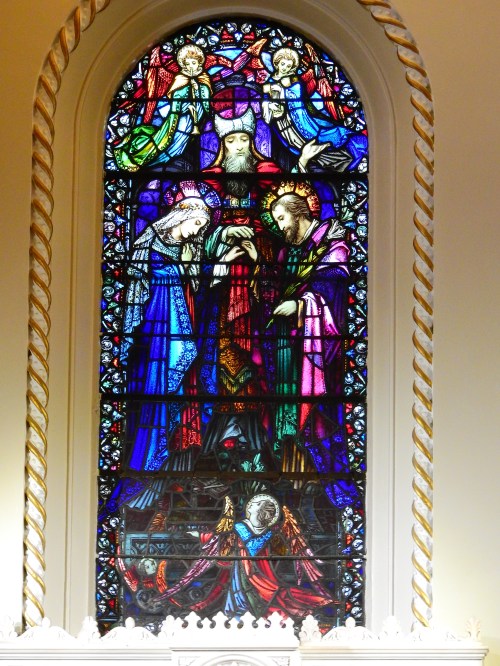
I could find no literature on the tables about the building’s art and architecture.
An eclectic mix of styles accrued over time as tastes vary.

Whatever one’s desire, for prayer, for quiet, to view beautiful art, it is a lovely place for a respite. More about St. Teresa’s on Clarendon Street, Dublin can be found via this link: http://clarendonstreet.com/
Posted in Inspiration, On the Road, tagged architecture, art, beauty, faith, Inspiration, ireland, Photography, stained glass, stained glass windows, travel, travel photography on November 4, 2017| Leave a Comment »
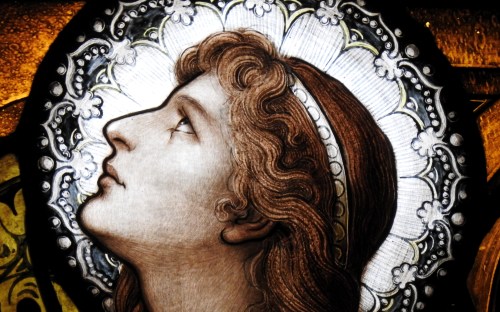
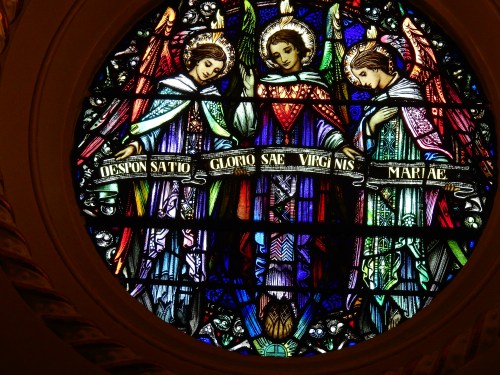
… and so we walked into the Church of the Assumption Howth. Howth is a fishing village east of Dublin and easily accessible via DART, the public rail transportation system. We were walking, quite frankly trying to find another destination, when we noticed a church and though there did not immediately appear to be stained glass inside we took a chance and entered. Built in 1899, the church was designed by William H. Byrne. Not every church needs stained glass windows but it was a pleasant surprise to venture far enough inside to see the three apse windows dedicated to the Virgin Mary.
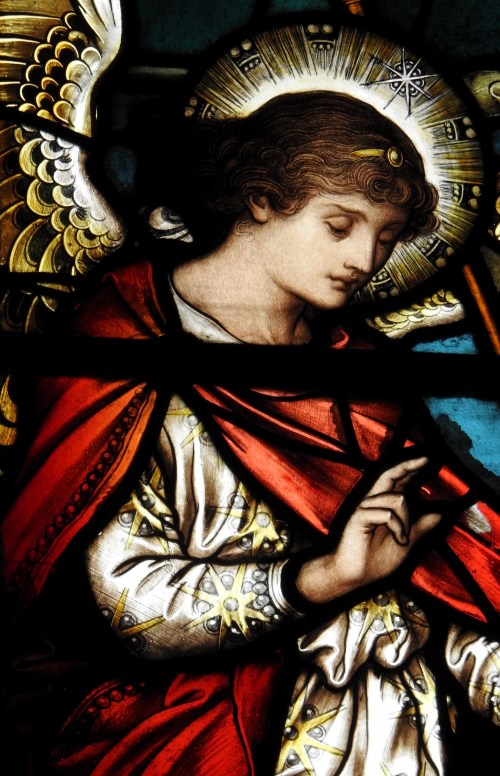
The sequence begins with the angel Gabriel announcing to Mary that she is bear a son.

The next features the Assumption of Mary into heaven, based on text from Revelation 12, her body and soul raised up to heaven.
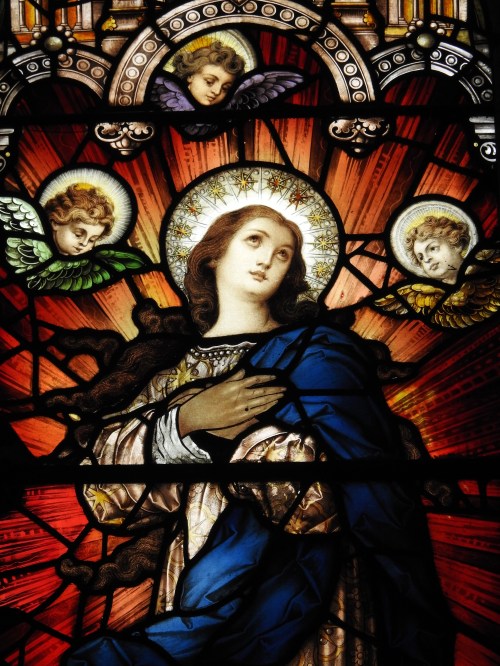
And finally Jesus placing the crown of Queen of Heaven on Mary’s head. She gazes down on humanity while angels keep watch from a sky full of stars.

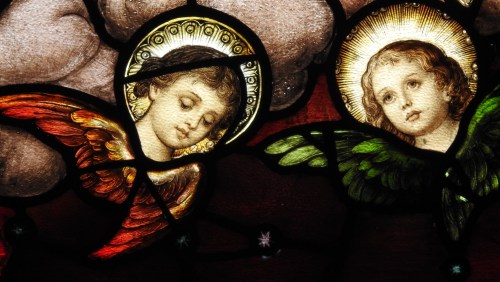
A quick, lovely, unexpected visit. You can read more about the village of Howth here: https://en.wikipedia.org/wiki/Howth
You can learn more about the church here: http://www.howthparish.ie/heritage
Posted in Inspiration, tagged charity, compassion, faith, Inspiration, life, Pine Street Inn, shelter, storytelling on October 8, 2017| 1 Comment »
I think the lady meant Jesus, but in any case …
I heard her coming before I saw her. She made her way up the ramp with an awkward sliding gait, using a cane for additional support. I walked over to greet her. A small woman — a good wind could blow her down — but she exuded presence even when she wasn’t talking. Now when you enter the building where I was that day one of the first things you might see is the No Public Restroom sign, a not uncommon sight in the heart of Boston. And it was when she saw that sign that she made her declaration about God and peeing but she quickly moved on from that topic to talk about life more generally. And as the air around me became lightly perfumed by the scent of alcohol, I gently interjected to ask, “Ma’am, I see, but how can we help you today?” She seemed perplexed by the question so I added, “Would you like to sit in the sanctuary for a bit and maybe pray or something like that?” She looked me straight in the eye and said, “Of course!” Now when she went in, I did peer through the window to make sure that that was all that she was doing. She sat with head bowed and I let her be. Eventually she did come out and as I held the door for her — she was trying to coordinate handling several bags as well as her cane — she asked, “Now where’s the bathroom?”
After letting my colleague know I was going to be occupied for a while, I guided her to the restroom. It was a long walk because as she explained several times, she can’t walk fast anymore. As we came to the stairs, she held onto the railing for support. At one juncture, I took one of her bags. And all the while she talked to me, telling me of her daughters, her son out west who was buying a house where she might stay one day. As for today, she was waiting for a bus. “And I planned it just right,” she explained, “so that I have time to come here to pray and then go to the bathroom and then get to the bus stop. I got plenty of time. Cause you see I don’t like to be rushed.”
“Where are you going on the bus?” I asked. And when she said to the shelter, I asked which one and she said Pine Street Inn. I could only say, “I’ve only heard good things about Pine Street.” And she nodded.
Now by the time we make our way down the stairs, there is no railing for support and so I say, “If you need to, you can hold my arm.”
She leaned her whole self against my side and took my hand.
Resuming our slow walk toward the bathroom, she apologized, “I don’t walk fast anymore.” I said, “That’s okay.”
Eventually we made our ascent from the restroom, back up the stairs.
She said, “You’re a lot like my friend Sue. She doesn’t mind that I’m slow. She never rushes me. Sometimes she lets me stay at her place. I can take the bus there too. She’s got her own place you see. She’s the best friend I ever made at Pine Street.”
Finally back in the lobby she adjusts her bags and we agree after looking at the wall clock that she still has plenty of time to make it to the bus top for her journey to the shelter.
“What’s your name?” she asked. I told her and then I asked her name. With a big smile she said, “It’s Theresa. Like Mother Theresa. Maybe I’ll be a saint one day too.”
And then she was gone.
Posted in Inspiration, Uncategorized, tagged architecture, arlington street church, art, beauty, churches, faith, Inspiration, Photography, stained glass windows, tiffany studios on June 14, 2017| 2 Comments »
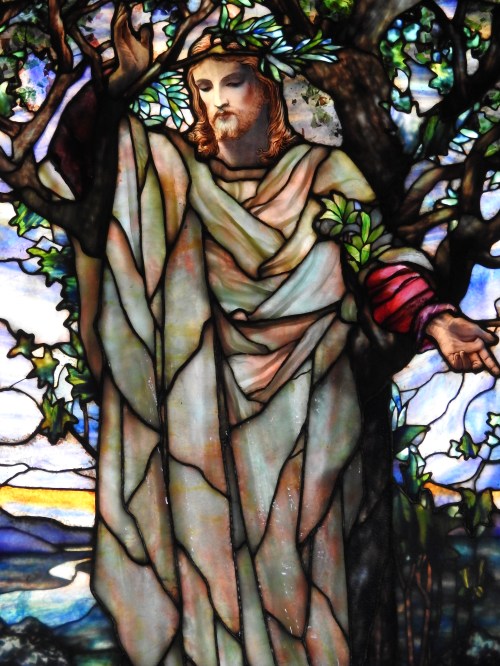
detail from sermon on the mount, 1902
It was a quick visit but well worth it to see the interior of Arlington Street Church in Boston. The church has sixteen stained glass windows designed by Tiffany Studios of New York at the turn of the 20th century. Here are details from just a few.

detail from john the baptist, 1905

detail from jesus in the temple, 1903

detail from the good shepherd, 1900-1905
More pictures in the future. View for yourself generally between 10-3. Learn more online at http://www.ascboston.org/about/building.html
Posted in Inspiration, Uncategorized, tagged architecture, art, beauty, churches, faith, Inspiration, John La Farge, religion, stained glass windows on February 21, 2017| 1 Comment »
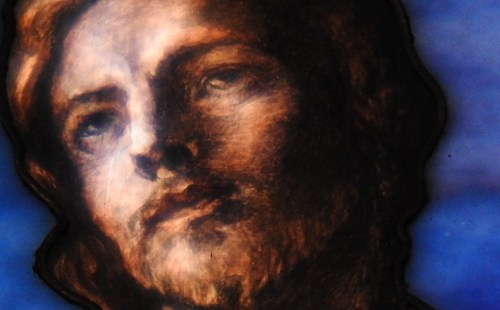
Detail from stained glass window, The Resurrection, by John La Farge (1902) at Trinity Church in the City of Boston.
Posted in Inspiration, tagged American history, art, art history, beauty, emigration, faith, Henry Ossawa Tanner, Inspiration, race relations, religion, storytelling on February 9, 2017| 13 Comments »
Editorial note: This post was written in part in response to the current Presidential administration’s recent remarks this Black History Month, and its seeming lack of knowledge regarding black history in this country. It is also written to share in brief the life and work of an artist whose work I have always admired.
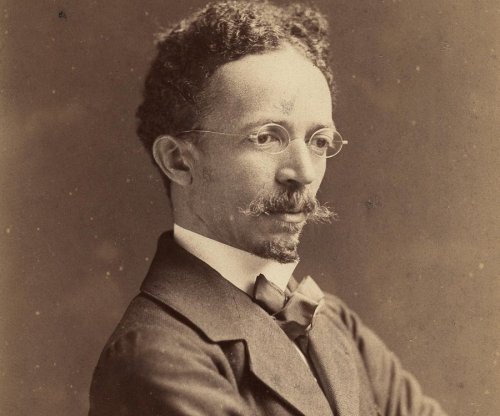
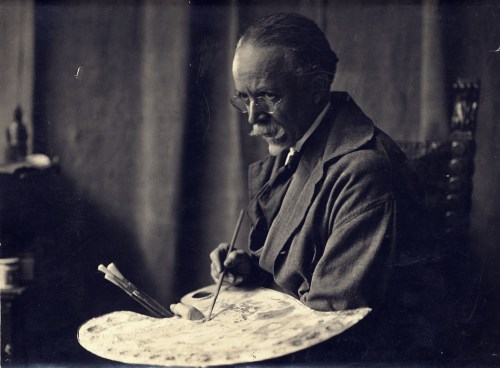
Henry Ossawa Tanner 1859-1937
Henry Ossawa Tanner was born in Pittsburgh, Pennsylvania in 1859 and grew up in Philadelphia. Tanner’s father, who happened to be a friend of Frederick Douglass, was a bishop in the African Methodist Episcopal church. Tanner’s mother, who had escaped slavery in Virginia via the Underground Railroad, taught private school in the home. Both staunch believers in education, they made sure their son, the eldest in a large family, was well-educated and prepared for a successful career in a conventional job.

The Tanner Family
Tanner had a slightly alternative idea. He too wanted to be successful and he wanted to be a painter. He’d known since the age of 13 after watching an artist at work in a Philadelphia park. Eventually, his father relented and he was allowed to pursue his artistic calling. In 1879 he was admitted into the Pennsylvania Academy of Fine Art, the first African American student to attend full-time.
Biographers refer to the fact that Tanner would write little about his time at the academy, mostly focusing on what he learned from Thomas Eakins with whom he studied. Regardless, it was an important period in Tanner’s life, not only for what he learned about art but also about human nature.

Already in attendance at the academy prior to Tanner’s arrival was student Joseph Pennell who would one day be recognized as a great American illustrator. In his 1925 memoir Pennell makes note of Tanner’s arrival at the school in a chapter titled, The Coming of the Nigger.

Ship in a Storm, 1879
“There was no dissenting voice in the academy against Tanner’s presence. He came, he was young, an octoroon, very well dressed, far better than most of us. His wool, if he had any, was cropped so short you could not see it, and he had a nice mustache. … he drew very well. He was quiet and modest, and he “painted too” it seemed “among his other accomplishments.” We were interested at first but he soon passed almost unnoticed … Little by little however we were conscious of a change. I can hardly explain, but he seemed to want things; we seemed in the way, and the feeling grew.”

Seascape – Jetty, 1876-1879
One night while out on the town with Pennell and other students, Tanner was mocked by other African Americans for being with the white students. Pennell recalls, “Then he began to assert himself and, to cut a long story short, one night his easel was carried out into the middle of Broad Street, and though not painfully crucified, he was firmly tied to it and left there. And that is my only experience of my colored brothers in a white school. Curiously there has never been a great Negro or great Jew artist in the history of the world. …”
Tanner studied at the academy through 1885. By 1889 he moved to Atlanta. He was unsuccessful in a photography business venture. During this period he made the acquaintance of Bishop Joseph Hartzell of the Methodist Episcopal Church. Hartzel and his wife became patrons, helping Tanner secure a teaching position at Clark College, encouraging him to exhibit his work and eventually funding a trip for him to Europe. In Europe, Tanner discovered an environment where he was not a “negro painter,” he was simply an American painter. In 1891, he emigrated to Paris where he would study at the Academie Julian.

The Banjo Lesson. 1893
After contracting typhoid fever, he returned briefly to the U.S. to recuperate. During this period he delivered a speech at The Chicago Congress on Africa at the 1893 World’s Columbian Exposition about negro artists and sculptors. In 1893 he would also complete one of his most iconic works, The Banjo Lesson. Tanner had originally sketched this scene in the late 1880s while traveling in the Blue Ridge Mountains of North Carolina.

The Thankful Poor, 1894
In two paintings, Tanner portrays the beauty and dignity of African Americans, and does so in a way that is purposefully counter to the increasingly derogatory depictions of African Americans in art, newspapers and other consumer publications. Numerous prints of these paintings were made and hung in the homes of African Americans as a source of pride and inspiration. Tanner would produce few, if any other, such paintings of African Americans. Regardless, wherever Tanner traveled in the world, he captured the vibrancy of the people he saw around him.
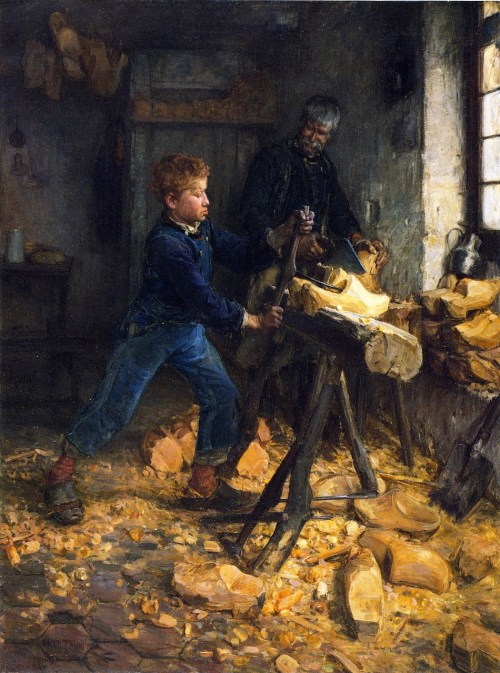
The Young Sabot Maker
With his religious paintings, he especially played with color and light.

Resurrection of Lazarus
After being moved by Tanner’s Resurrection of Lazarus, department store magnate and art critic Rodman Wanamaker offered to sponsor a trip to Palestine. Tanner traveled throughout North Africa and the Near East. The journey further informed Tanner’s work with religious narrative.

Mosque in Cairo
Aside from The Banjo Lesson, Tanner is now most often remembered for the breadth and beauty of his religious themed works.
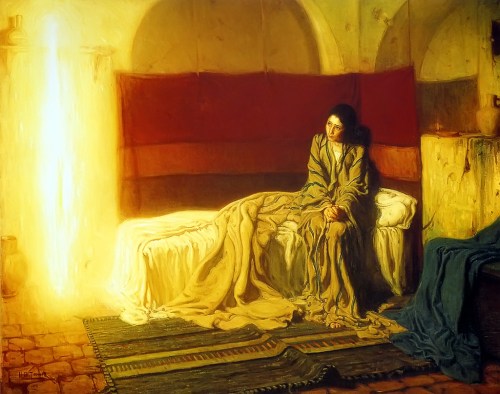
The Anunciation, 1897

Jesus Visiting Nicodemus, 1899

The Disciples See Christ Walking on the Water, 1907

Daniel in the Lion’s Den

Flight into Egypt, 1923
In 1899, Tanner married Swedish-American opera singer Jessie Olsson. They had one child, Jesse. Tanner continued to paint, exhibiting internationally. He expanded his list of patrons. In 1902, over the course of four months, four of his paintings – Sarah, Hagar, Rachel and Mary – were reproduced in the Ladies’ Home Journal. He became renowned though he would always struggle financially.

As World War I broke out in Europe, Tanner became depressed. He was unable to paint. Or what he painted while respected was not being purchased. He wanted to serve in some way but he was too old to enlist. He shared an idea with the U.S. Ambassador to the United Kingdom Walter Hines Page. His idea: turn the unused fields around the base hospital in Vittel, France into a vegetable garden and organize the convalescing soldiers as a work force. Provide food. Build morale. Page reached out to his counterpart in France and soon after Tanner was attached to the American Red Cross as a Lieutenant in the Farm Services Bureau. In 1919, for his efforts, Tanner received a Foreign Service certificate signed by Woodrow Wilson.
Postwar, Tanner would resume painting and once more receive accolades for his work. In 1923 Tanner was made a chevalier of the Legion of Honour for his work as an artist. In 1927 he became the first African American to be granted full membership in the National Academy of Design in New York.
Tanner lived during one of the most contentious periods in U.S. race relations. While he chose to emigrate to France, he always considered himself an American. He was a mentor and adviser to artists of all races studying in Europe. He was vocal in print and in person in support of equal opportunity for artists of all backgrounds. On May 27, 1937, he died at his home in Paris.
Today, Tanner is most often referenced as one of the great African American painters. I suspect he would simply like to be known as a great American artist. His painting, Sand Dunes at Sunset, Atlantic City was the first work of art by an African-American artist to be added to the White House Permanent Collection. It was acquired in 1996 from Dr. Rae Alexander-Minter, grandniece of the artist.

Sand Dunes at Sunset, Atlantic City, 1886
Sources & Additional Reading
Treasures of the White House: Sand Dunes at Sunset, Atlantic City
Henry Ossawa Tanner Wikipedia Page
A Missing Question Mark: The Unknown Henry Ossawa Tanner by Will Smith
http://americanart.si.edu/collections/search/artist/?id=4742
Khan Academy Course on Tanner’s Banjo Lesson
The Adventures of an Illustrator by Joseph Pennell
Photograph of the Extended Tanner Family, 1890
Henry Ossawa Tanner| Realist/Symbolist painter
Henry Ossawa Tanner: Race, Religion and Visual Mysticism by Kelly J. Baker
Henry Ossawa Tanner: American Artist by Marcia M. Mathews
Posted in Inspiration, tagged architecture, art, beauty, faith, Inspiration, Jewish history, judaism, Old Testament, stained glass windows, storytelling, Sumter, synagogue, temple, travel on October 6, 2016| 9 Comments »

While traveling in Sumter, South Carolina it was my pleasure to visit the Temple Sinai, founded as a Reform Jewish Congregation. The history of Sumter’s Jewish community dates back to 1815. The first Jews who settled in Sumter were Sephardic and came from Charleston, SC. The current congregation was formed in 1895 by the merger of the Hebrew Cemetery Society and the Sumter Hebrew Benevolent Society. Construction of the congregration’s present temple was begun in 1912 and completed in 1913.
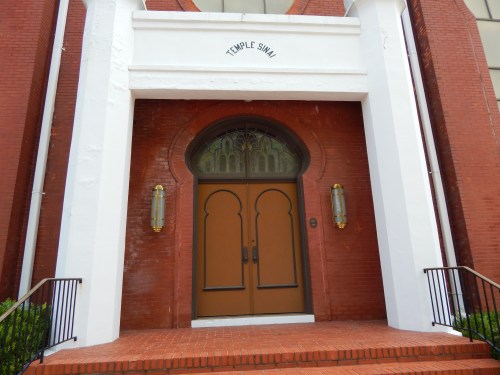
A feature article in the March 1913 Sumter newspaper The Watchman and Southron notes “The Temple is situated on the corner of Church street and Hampton avenue and is an imposing structure of red brick with domed roof … The architectural lines are simple, but the proportions are so good and so well harmonized that the general impression is one of beauty, allied to strength and permanence. As impressive as is the exterior of the Temple, it is the interior that is its chief beauty and glory …”

In terms of architectural style the brick building is Moorish Revival. Eleven stained glass windows grace the interior. Ten of the windows are 5 feet wide by 20 feet high and their shape mimic the building’s moorish towers, each a tall window illustrating a story surmounted by a half-window with further decorative detail. The eleventh window is round and is located high on a back wall. While the specifics of the window designer and makers are elusive, the windows are thought to be handmade in Germany. Installation began in 1912 as indicated in a local newspaper article from September 1912, “The beautiful stained glass windows of Temple Sinai have arrived and are being placed in position.” One month earlier, the same publication had noted, “The work is winding up on the new Jewish synagogue in this city and it will be only a short time now before the remodeled Temple Sinai will be one of the most beautiful places of worship in the city.”
At age 95, Sumter native Robert Moses, a descendant of one of the first Jewish families to settle in Charleston and then in Sumter, is one of the last active members of Temple Sinai. As part of an educational presentation, he describes the windows as late Victorian in style, with rounded tops and interlacing borders giving them an eastern/Moorish look. Known as drapery glass due to the folding of the glass to add depth and color, the brilliant blues have cobalt added and gold was added to brighten the reds.
Each window depicts a scene from the Old Testament including as described in a 1913 newspaper article:
The Test of Faith, involving Abraham and Isaac …

The Blessing – Isaac Blesses Jacob …

detail from isaac blesses jacob
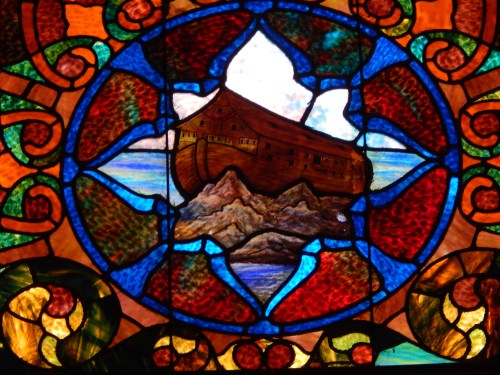
detail from isaac blesses jacob – the ark on ararat

Jacob’s Dream …

detail from jacob’s dream
Vision of Moses when he sees the burning bush …
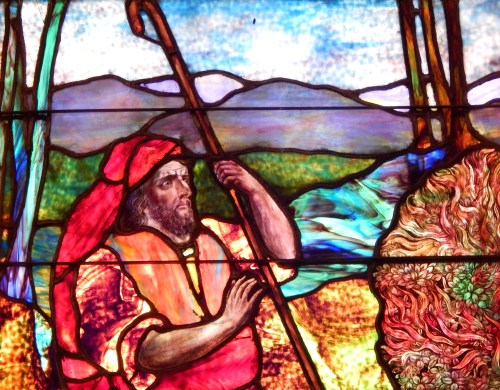

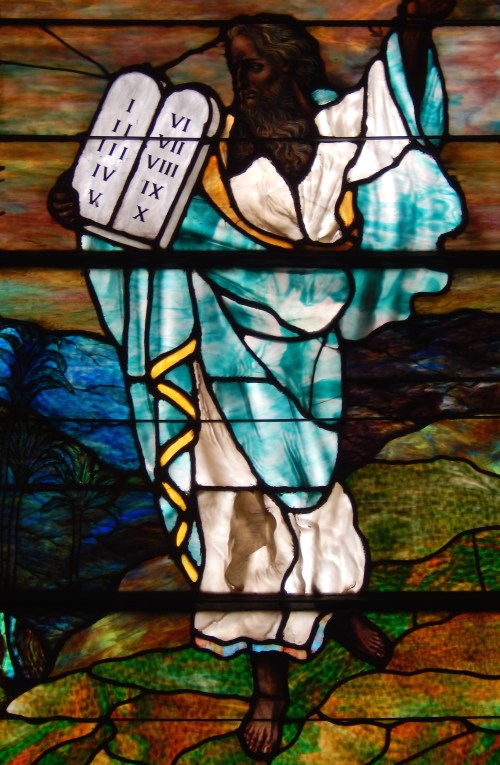
Moses on Sinai with the Ten Commandments …
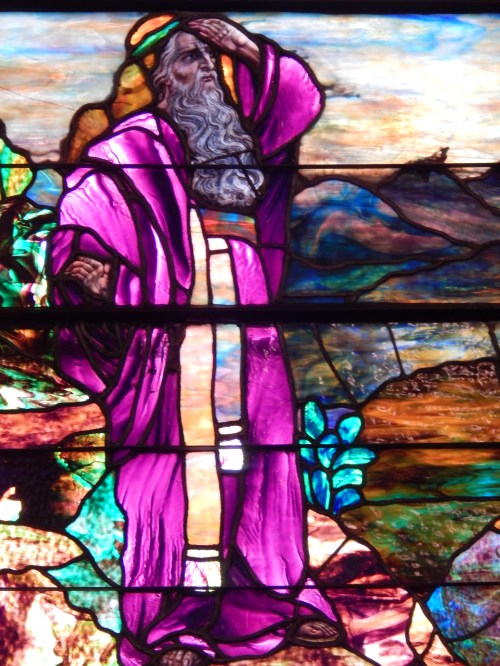
Moses on Nebo overlooking the promised land which he is forbidden to enter …
Moses Delivering Laws to Joshua …
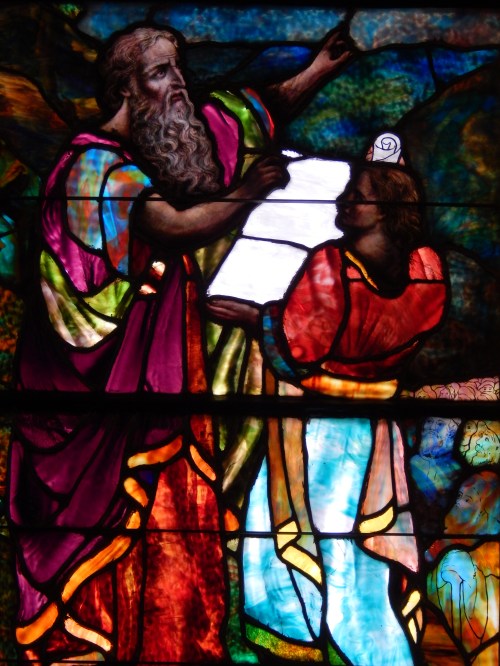
Samuel Before Eli …

detail from samuel before eli
Elijah in Solitude …

detail from elijah in solitude, also known as elijah and the ravens
David the Shepherd Boy …

and Solomon at the Dedication of the Temple.

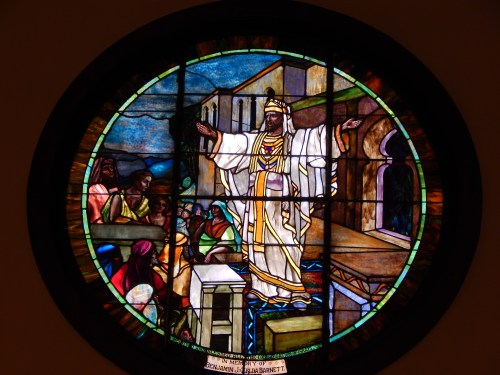
Members of the Moses family were kind enough to allow me entrance into the Temple to photograph details of the windows and share just a bit of the history of people and place. The windows of this place are unique for their pictoral illustration.
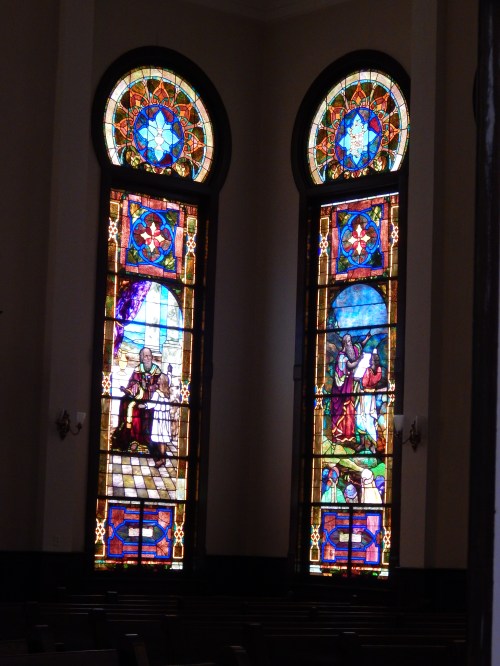
Temple Sinai is listed on the National Register of Historic Places. For more information, or to inquire how you can help preserve this historic structure, contact Temple Sinai, 11-13 Church Street, P. O. Box 1673, Sumter, South Carolina 29151 or call (803) 773-2122.
Sources and Additional Reading
(1) “House of Worshop of Jewish Congregation to be Dedicated on March 28th, ” The Watchman and Southron, March 8, 1913.
(2) The Watchman and Southron, September 21, 1912.
(3) The Watchman and Southron, August 10, 1912.
Encyclopedia of Southern Jewish Communities – Temple Sinai
Posted in Inspiration, tagged art, beauty, faith, fine art, Inspiration, painting, Photography, Raphael, religion, transfiguration on September 15, 2016| Leave a Comment »

to photograph its stained glass windows and along the way I stumbled upon Raphael’s Transfiguration (1516-1520). Not the original of course. That’s in the Vatican. This painting, which my guide at the time knew little about, appears to be a 19th century reproduction. The history of this particular painting – its creation and who gave it to the church – may be lost to history. However, I’ve since learned from a research fellow at the Boston Museum of Fine Arts that such reproductions were popular and prints being produced as early as the 16th century.

Transfiguration was Raphael’s last painting. He died at the age of 37 leaving the painting incomplete. It is considered one of his most beautiful works out of a very large body of work. It was a treat to chance upon the reproduction and perhaps one day I will see the actual painting in person. Meanwhile, below is a photograph of Raphael’s handiwork and you can read details on the Vatican Museums website here.

Raphael’s Transfiguration, photo by Alvesgaspar, CC BY-SA 4.0, https://commons.wikimedia.org/w/index.php?curid=43522641
Additional Reading
https://en.wikipedia.org/wiki/Raphael
http://www.mfa.org/collections/object/the-transfiguration-of-christ-31006
Posted in Inspiration, tagged architecture, art, beauty, churches, colors, design, diversity, faith, Inspiration, Photography, religion, stained glass, stained glass windows on May 11, 2016| 2 Comments »

one of the two windows depicting, “pentacost,” by daniel maher stained glass
These windows at St. James’s Episcopal Church by local artisans Daniel Maher and Lyn Lovey express a creativity and diversity that is very modern. It is almost startling to look up and see them in the clerestory after viewing older works by Tiffany, Clayton & Bell, Goodhue and others in other parts of the building. In part that’s because of my own ignorance around stained glass making today and how churches continue to commission their design and installation. Working with glass remains a popular and contemporary art. And in places like St. James, the past and present harmonize quite nicely.

one of a pair of windows designed by lyn hovey stained glass
I’ve lived in Boston for almost twenty years and I can’t even imagine how many times I’ve walked along Massachusetts Ave past this church. When I’ve been tired I’ve stepped into its adjacent garden and sat on the church steps. I’ve always wondered, what was behind the red stone? I’m grateful to the rector, sexton and other staff for allowing me to appease my curiosity and glimpse the beauty inside. Until you can make your visit, below are a few images for you to enjoy. And there’s also a link to a very interesting overview of the windows available online.
Detail from chancel windows …


Detail from one of the choir angel windows …
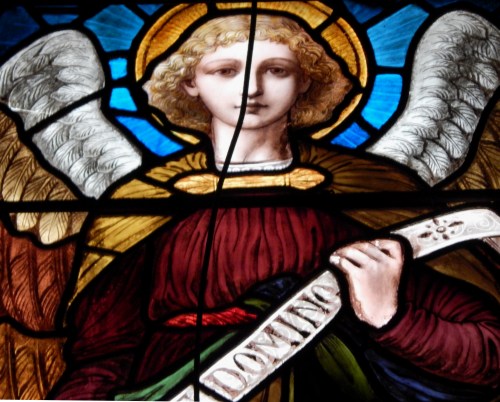
Detail from the Resurrection window…

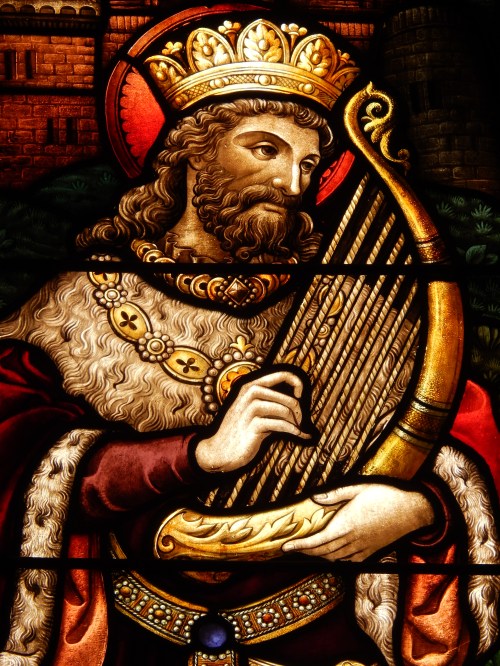
Detail from David with Harp …

Detail from Dorcas window …

Detail from Saint Dorothea window …

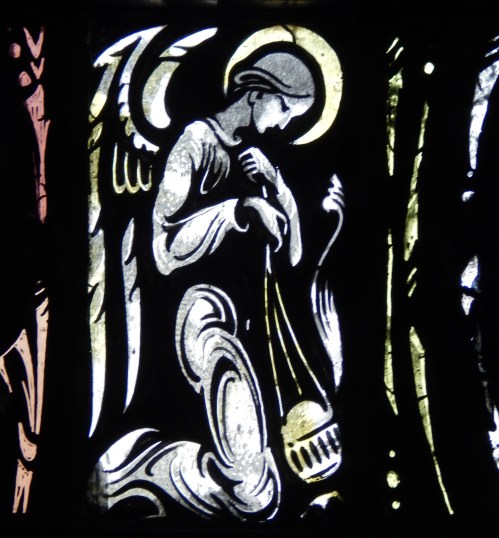
Detail from the Greenleaf window …
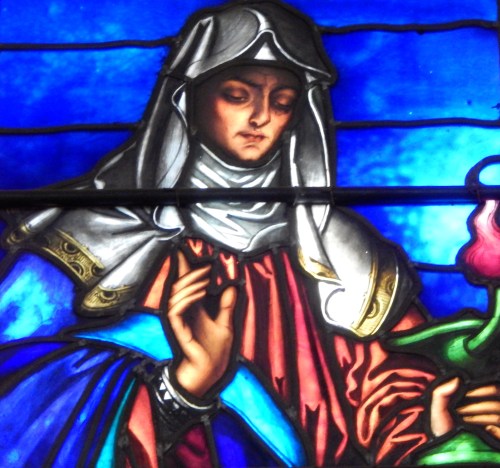
Detail from the Nativity window …

Additional Reading and Links
Overview of St. James Stained Glass Windows
 Words + Images