Feeds:
Posts
Comments

Posts Tagged ‘painting’

Happy New Year! No doubt it will be an interesting one.

Best wishes for peace and prosperity and an awareness of the beauty in the world around us.

Strength and courage will be necessary I suspect. As for New Year goals …

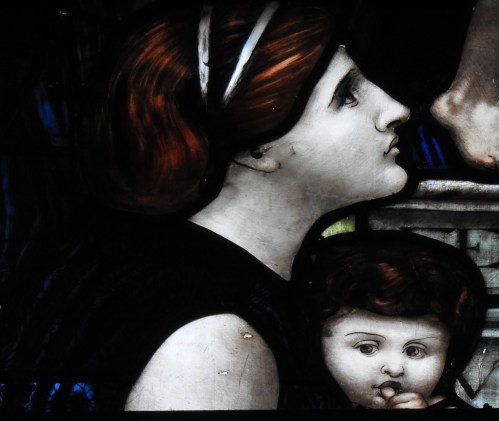
… I’ve made none, not really, except perhaps a commitment to continue to pause and to pause without expectation. These photos I took while pausing inside Trinity Church.

It has been my pleasure to photograph there many times over the years.

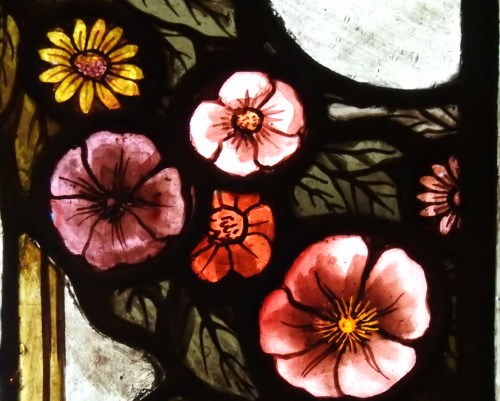
Each time there is always something new to see in the tower, on the walls, in the windows and even on the doors.

We’ll see what 2017 holds. 🙂

http://trinitychurchboston.org/visit/tours

Read Full Post »

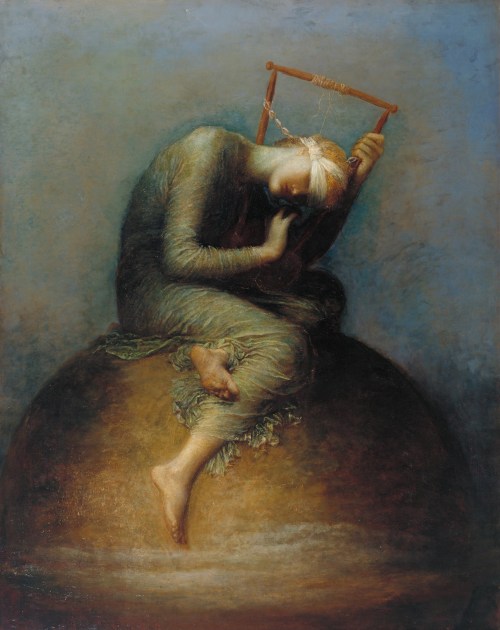
Hope by George Frederick Watts

In 1959, Martin Luther King Jr would open a sermon with these words about shattered dreams, “Our sermon today brings us face to face with one of the most agonizing problems of human experience. Very few, if any, of us are able to see all of our hopes fulfilled. So many of the hopes and promises of our mortal days are unrealized. Each of us, like Shubert, begins composing a symphony that is never finished. There is much truth in George Frederick Watts’ imaginative portrayal of Hope in his picture entitled Hope. He depicts Hope as seated atop our planet, but her head is sadly bowed and her fingers are plucking one unbroken harp string. Who has not had to face the agony of blasted hopes and shattered dreams’?

English painter George Frederick Watts (1817-1904) would paint the first of several versions of Hope in 1885. Its symbolism would prove very popular and over time it would be massively reproduced. I read that by the 1930s however his work fell out of fashion and major galleries like The Tate removed his work from permanent display. So I do wonder when, where and how Martin Luther King first saw Hope. I do know when a young Barack Obama learned of the painting. It was in 1990. Pastor Jeremiah Wright would deliver a sermon, The Audacity to Hope. Wright’s words would move the young student who would eventually rouse a whole nation (mostly) with a notion that he would call, The Audacity of Hope.

So where is hope these days? In part its a personal question that we each have to grapple with on any given day depending on what’s happening in our lives.

sir_edward_coley_burne-jones_-_hope_-_google_art_project

Hope by Edward Burne-Jones, 1896

Watts and later his friend Edward Burne-Jones each painted variations of Hope during dark periods in their lives. For Watts that period included the death of his adopted daughter’s child. Burne-Jones had been commissioned by a wealthy American to paint a dancing figure but as he dealt with the death of his friend and colleague William Morris he asked if instead he might paint Hope. I think of hope as something you hold on to or reach out for. And sometimes it even settles around you like a warm blanket when you least expect it. Or, as Emily Dickinson wrote,

“Hope” is the thing with feathers –
That perches in the soul –
And sings the tune without the words –
And never stops – at all –
And sweetest – in the Gale – is heard –
And sore must be the storm –
That could abash the little Bird
That kept so many warm –
I’ve heard it in the chillest land –
And on the strangest Sea –
Yet – never – in Extremity,
It asked a crumb – of me.

Sources & Additional Reading

http://www.thekingcenter.org/archive/document/shattered-dreams

Click to access July1962-March1963DraftofChapterX,ShatteredDreams.pdf

http://www.nydailynews.com/news/politics/victorian-painting-g-f-watts-inspired-obama-harp-hope-article-1.358686

Watts Magazine, p.14+

https://www.poetryfoundation.org/poems-and-poets/poems/detail/42889

Read Full Post »

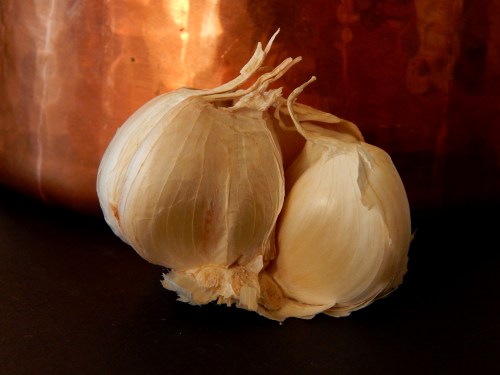
The inspiration was William Merritt Chase’s Just Onions painting now on view at the Boston Museum of Fine Arts. It is a lovely still life of a few onions next to a copper pitcher. Given that I know a certain fellow who is currently obsessed with collecting and restoring copper pots, I figured why not try my own series of “just[fill in the blank]” with the copper pots in the background.

Who knows? This may turn out to be a fun winter project, to sketch out still lives with these refinished copper pots, and then to see if I can bring these ideas to life.

Just Onions by William Merritt Chase, 1912

Just Onions by William Merritt Chase, 1912

Learn more about the actual painting here. And visit my JustFood shop for other food images.

Read Full Post »

to photograph its stained glass windows and along the way I stumbled upon Raphael’s Transfiguration (1516-1520). Not the original of course. That’s in the Vatican. This painting, which my guide at the time knew little about, appears to be a 19th century reproduction. The history of this particular painting – its creation and who gave it to the church – may be lost to history.  However, I’ve since learned from a research fellow at the Boston Museum of Fine Arts that such reproductions were popular and prints being produced as early as the 16th century.

Transfiguration was Raphael’s last painting. He died at the age of 37 leaving the painting incomplete. It is considered one of his most beautiful works out of a very large body of work. It was a treat to chance upon the reproduction and perhaps one day I will see the actual painting in person. Meanwhile, below is a photograph of Raphael’s handiwork and you can read details on the Vatican Museums website here.

Raphael’s Transfiguration, photo by Alvesgaspar, CC BY-SA 4.0, https://commons.wikimedia.org/w/index.php?curid=43522641

Additional Reading

https://en.wikipedia.org/wiki/Raphael

http://www.mfa.org/collections/object/the-transfiguration-of-christ-31006

Read Full Post »

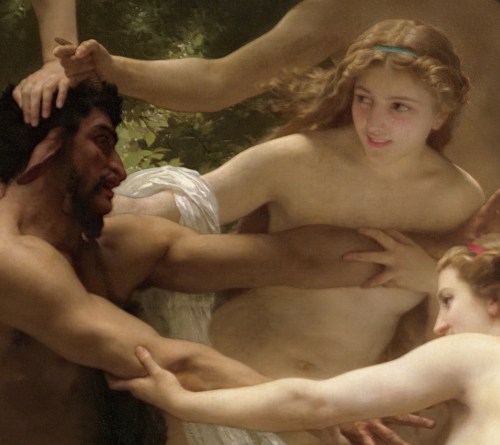
i keep sitting down to write you about this painting… and each time i draw a blank… it is a favorite of mine… a poster of it welcomes you into my studio …” — Donald Langosy, 2016

detail from nymphs and satyr by bouguereau

detail from nymphs and satyr by bouguereau

Of late I’ve become quite bold in asking people to share with me in words and sometimes images the beauty that they experience. I want to understand why a certain piece of music heard, a poem read, or a moment in a certain field can move them so deeply. In painter Donald Langosy’s case, I wanted to know why he was so moved by Bouguereau’s Nymphs and Satyr (1873), a painting held in the collection of the Clark Art Institute in Williamstown, MA. I’d learned from Langosy’s daughter that, as with Titian, it was a work of art Langosy might like to see in person one day.  And so I asked him to please tell me why, and as I waited for his words, I did a little bit of my own research into this Bouguereau.

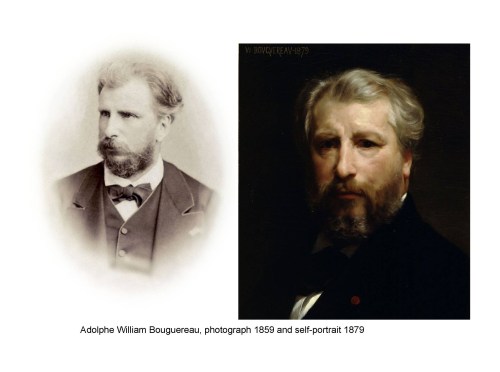
Adolphe William Bouguereau (1825-1905) was a French figurative painter noted for producing rather luminous works with Classical, mythological and religious themes. His work was very popular with the European and American public during his lifetime. He received top prices for his work. He not only painted portraits, but he also decorated private homes, churches and public buildings.

Pieta, 1876

pieta, 1876

Quite prolific, he apparently produced over 800 finished paintings. In addition, beginning in the 1860s he taught at the Academie Julian in Paris. Among his many students over the years he would teach Henry Ossawa Tanner and Ellen Day Hale. As I read criticism about his work from across the different decades, both the words beautiful and escapist were applied. During the height of Bouguereau’s career there was a new movement starting in the French art scene, Impressionism. Many within this new school were not enamored of Bouguereau’s work and actively belittled it. Despite the controversy surrounding his subject matter, so polished and dreamy during an age of great turmoil, few denied the mastery of his technique.

sadly,” notes Langosy, “Bouguereau is remembered for his unending number of paintings of little girls and poetically posed young virginal women…. which is unfortunate… for it distracts from his many accomplishments…like this one, which is among the finest masterpieces ever painted…

…compositionally outstanding…. but outstanding because of the remarkable brush work… which is brilliant because of his command of color and line….. the sensual twirl feeling of the nymphs… the satyr in a diagonal angle attempting to brace himself against their attempts to over power him… Bouguereau’s subtle sense of line accenting the individual rhythms of the different poses…

…rhythm of line is what creates three dimension on a two dimensional plane…. and then there are the leaves and grass and the water… egads!….i’m speechless… i haven’t written enough about this painting… but now you will understand why it took me this long to write

And that is how I came to learn of nymphs, satyrs and appreciate the work of Bouguereau through the words of Donald Langosy.


Additional Readings & Images

http://www.clarkart.edu/Art-Pieces/6158

http://www.bouguereau.org/

http://www.getty.edu/art/collection/artists/780/william-adolphe-bouguereau-french-1825-1905/

https://commons.wikimedia.org/wiki/William-Adolphe_Bouguereau


Save

Read Full Post »

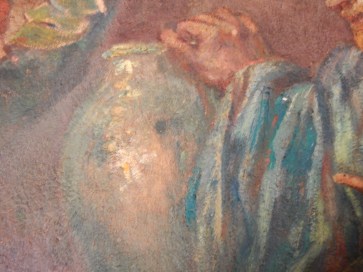
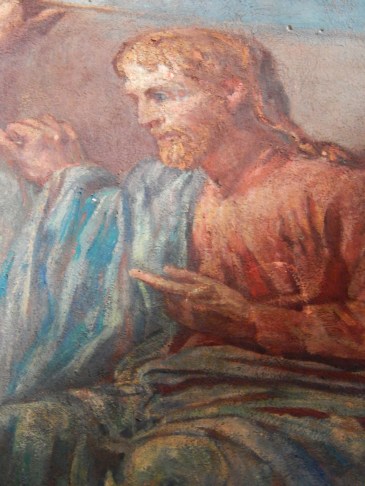
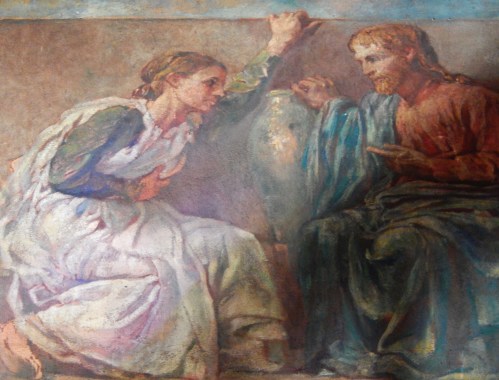
When I first photographed the John La Farge mural Christ Woman at the Well inside Trinity Church in the City of Boston it was late afternoon and I had a much simpler point and shoot camera. The photograph turned out just fine. As I progress as a photographer though it has been fun to revisit works photographed in the past. These photos were taken with a more advanced camera and in the light of the early morning sun shining onto the mural.


Read Full Post »

Titian, active about 1506; died 1576 Bacchus and Ariadne 1520-3 Oil on canvas, 176.5 x 191 cm Bought, 1826 NG35 http://www.nationalgallery.org.uk/paintings/NG35

Bacchus and Ariadne, 1520-3, by Titian

In Titian’s painting of Bacchus and Ariadne, Bacchus, god of wine, emerges with his followers from the landscape. Falling in love with Ariadne, he leaps from his chariot, drawn by two cheetahs. Ariadne had been abandoned on the Greek island of Naxos by Theseus, whose ship is shown in the distance. Initially she is fearful. Eventually Bacchus raises her to heaven and turns her into a constellation, represented by the stars above her head. So the story is told on the website of the UK National Gallery where the painting is now housed. While wonderful to see such a work in a book or on the computer screen, it is a whole other experience to view it in person.

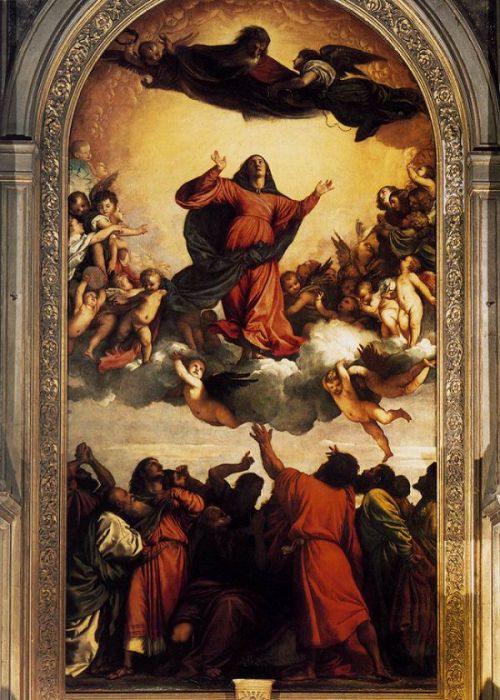
Painter Donald Langosy wrote about such an experience. He was a young poet chasing Ezra Pound around Venice. “But my meeting with Pound was overshadowed, quite unexpectedly, by entering the Frari church one day and finding myself facing Titian’s Assumption. … My encounter with Titian’s painting was an aesthetic epiphany.”

Assumption of the Virgin, by Titian

Assumption of the Virgin, by Titian

From Titian and other Venetian masters, Langosy would begin to understand how artistic technique was the servant of ideas.  He would share their work with his daughter, Zoe. “I learned what it meant when my father pointed to the sky and said, “It’s a Titian blue.”

Diana and Callisto by Titian

Diana and Callisto by Titian

Viewing Titian’s painting in person certainly influenced Langosy’s early work.

Detail from Flora by Langosy

Detail from Flora by Langosy

Pucinello by Langosy

Seeing Titian in later years would become an unexpected opportunity for two artists, father and daughter, to focus on the beauty to be found even during challenging times. In Zoe’s own words:

“Over the years, my father developed multiple sclerosis, and our once-frequent visits to the Boston Museum of Fine Arts or the Gardner Museum became increasingly rare. Shortly before my father lost the ability to walk entirely, he and my mother traveled to London, where I was living at the time. Walking with a cane and with great difficulty, he set out one day with one purpose: to see Titian’s Bacchus and Ariadne at the National Gallery. It was a masterwork that he had never before seen in person and, of all the great works of art in London, it was the one he refused to miss.  While my mother and I wandered through the nearby exhibits, he sat studying that single painting for nearly an hour.”

Detail from Bacchus and Ariadne by Titian

Detail from Bacchus and Ariadne by Titian

“As the years progressed, my father’s MS caused physical discomfort and fatigue that made it increasingly difficult for him to travel even as far as the local art museums we had enjoyed together. Our conversations about art never took place outside the comfort of the studio, living room, or kitchen at my parent’s home in the Boston suburb of Medford. Then, one day, we read in the newspaper about the “Rivals of Renaissance Venice” show at the MFA. That moment created a breakthrough. My father knew this was a show that he could not and would not miss.”

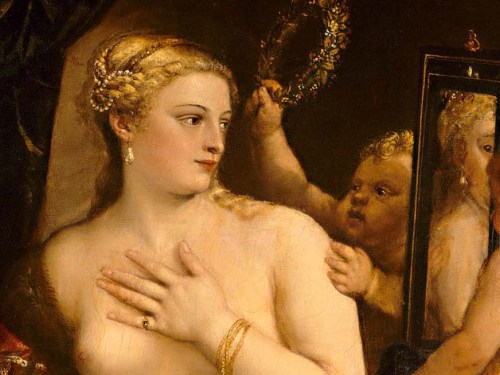
Detail from Venus with a Mirror by Titian, at the MFA 2009 Exhibit

Detail from Venus with a Mirror by Titian, at the MFA 2009 Exhibit

“We chose a time when we knew the museum would be quiet, and, on a hot summer morning, my father, mother, and I traveled into Boston to see the exhibit. Above all, we went to see the Titians. As I pushed my father in his wheelchair, we stopped for a long time at each painting. Sometimes we would quietly look at the art, while other times we would talk about what we saw. For the first time in many years, I was given the gift of being able to walk through a museum with my father again and share with him one of the things that we both love most: art. Visiting the show was highly enriching for all of us.  Since then, my father has found renewed strength to combat the hold that MS had placed on his activities, and he is determined to attempt such outings on a more regular basis.”

Zoe with her father's portrait of Elizabeth

Zoe with her father’s portrait of Elizabeth

Want to learn more?

View Langosy’s The Story of My Art: 1, 2, 3, 4, 5 and 6.

View four decades of Langosy’s work at http://www.donald.langosy.net/

See what’s current on Langosy’s Facebook page.

His contact: Zoe Langosy at zlangosy@me.com.

Read Full Post »

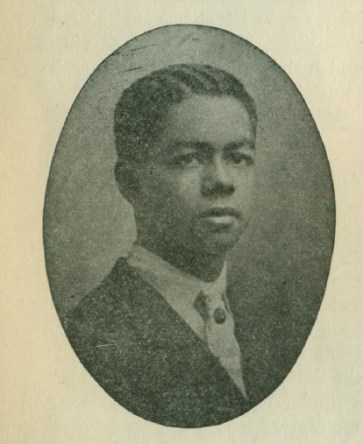
Richard Lonsdale Brown, Class of 1910

Richard Lonsdale Brown 1910

In January, I posted the story of an African American artist named Richard Lonsdale Brown (1892-1917). Recently I came across new information that inspired me to revisit his life.  Raised in West Virginia, he traveled to New York City where his talent was recognized. He was featured in the New York Times.  As was often the case for young fine artists, supporters hoped he’d continue his artistic studies in Paris. The trip would never take place. Brown died at the age of 26. Few of his watercolor or oil paintings survive today but he may have left an unexpected legacy in the impact he made upon W. E. B. Du Bois.

W. E. B. Du Bois

W. E. B. Du Bois 1868-1963

The two men would meet shortly after Brown graduated from West Virginia Collegiate Institute, earlier known as the West Virginia Colored Institute. There “In connection with his academic studies he took painting as a trade, under the late George Collins of South America, who was quite an artist. In addition to house painting and interior decoration, the boy showed wonderful aptitude for artistic painting, and was encouraged to paint the hills and scenery along the Great Kanawha River near the institution.” (1)

Brown would eventually make his way to New York City where he would share his portfolio with artist George De Forest Brush. Brown would later share in an interview that he remembered walking up and down Fifth Avenue trying to sell his pictures to galleries to pay for food and rent. He was about to give in to despair when …

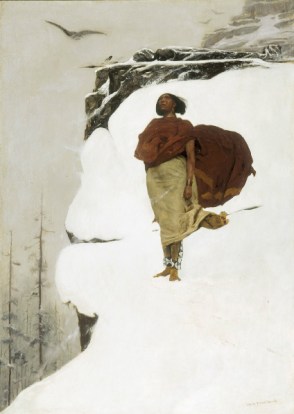
Mourning her Brave by George de Forest Brush, 1883

Mourning her Brave by George de Forest Brush, 1883

Brown found the artist’s studio and knocked at his door. Brush answered. He listened and then he reviewed the modest portfolio. An internationally renowned artist, Brush recognized the young man’s talent and invited him to study for a summer in Keene, New Hampshire.  Afterward he studied at the American Academy of Design.  Through Brush, Brown’s work would catch the attention of the founders of the newly formed National Association for Colored People (NAACP), including W. E. B. Du Bois and Mary Ovington. He became their protege.

On January 1912, his artwork was exhibited during the first annual meeting of the NAACP, and would be exhibited during future annual meetings as well.  In March, with Ovington’s aid, his work was exhibited in a NYC gallery. The press was spectacular. The turnout was great. Brown’s works were purchased by collectors from around the world.  Later in the year, his artwork would grace at least two covers of The Crisis, the national magazine published by the NAACP.

In 1913, he would turn his attention from painting landscapes to design and decoration as he worked with Du Bois to execute The Star of Egypt.  In 1911, Du Bois had written The Star of Egypt, a historical pageant presenting the history of African Americans over time. Brown would serve as set decorator, along with Lenwood Morris. He would travel with Du Bois as they met with both blacks and whites in an effort to raise funds. An elaborate production involving casts of thousands, it was well-received though struggled with financing. The pageant would be staged in three cities during Brown’s life, New York in 1913, Washington, DC in 1915, and Philadelphia in 1916.

December 1915 Cover by Richard L. Brown
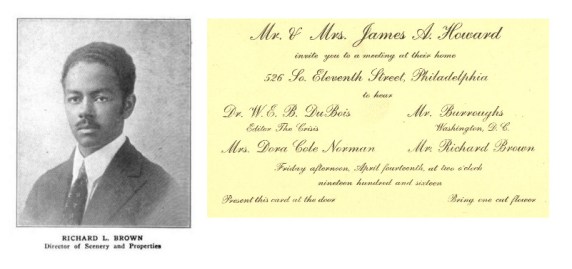
December 1915 Cover by Richard L. Brown

His time in the northeast studying art, his work with W. E. B. Du Bois, the changing landscape of America and a world that was on the brink of war, all of these things were influencing Brown’s artistic aspirations. In a 1913 interview about his art, he tentatively but determinedly brings up the question of race.

A few years later he would confide in Mary Ovington about his changing perspective. She shares in her memoir:

That trip South she refers to would take Richard Brown to his parent’s home in Muskogee, Oklahoma.  The year was 1917.  On his World War I draft registration card, completed in Muskogee in June,  he notes his occupation as artist and his race as African. He died of pneumonia in September of that year.

While it is unclear why Brown returned to his parents, it is clear from subsequent editorials by W. E. B. Du Bois in The Crisis that Brown, like many black artists in that time, was not making a living as an artist. Always a proponent for nurturing art within the black community, Du Bois took pride in showcasing the talent of young artists like Richard Brown. As he refers to Brown in editorials over the next few years it is with an underlying note of frustration if not outright anger at the loss of this young man’s talent from the world. Those feelings are directed at the white community and at the black community for not financially supporting the creativity within its midst.

An obituary for Brown in the January 1918 issue of The Crisis states “he started on a trip to see what beauty he might find in the South. … Some of us, perhaps all of us, are to blame that Richard Brown was not given a better chance to develop a gift which some of the greatest artists called wonderful.

In a May 1922 editorial in The Crisis titled Art for Nothing, Du Bois writes:

There is a deep feeling among many people and particularly among colored people that Art should not be paid for. The feeling is based on an ancient and fine idea of human Freedom in the quest of Beauty and on a dream that the artist rises and should rise above paltry considerations of dollars and food. At the same time everybody knows that artists must live if their art is to live. Everybody knows that if the people who enjoy the artist’s work do not pay for it, somebody else must or his work cannot go on. Despite this practical, obvious fact, we are united with singular unity to starve colored artists.

He proceeds to list a series of living artists from Meta Warrick Fuller to William A. Scott all struggling to make a living but he concludes the list with his lost protege, “Richard Brown died of privation while yet a boy.

In another essay about art, in October 1926, he says, “There was Richard Brown. If he had been white he would have been alive today instead of dead of neglect. Many helped him when he asked but he was not the kind of boy that always asks. He was simply one who made colors sing.

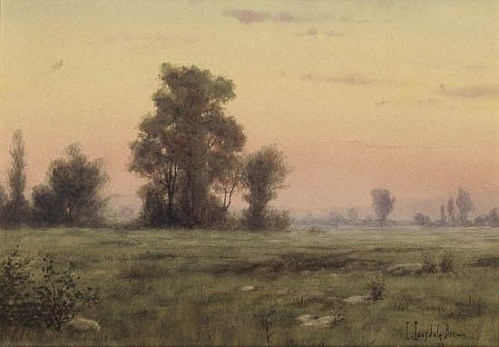
Landscape by Richard Lonsdale Brown

Landscape by Richard Lonsdale Brown

In 1928, Mary Brown, Richard Brown’s mother, wrote to Du Bois. She had a dozen of his paintings and sought his aid in selling them in New York. With the money raised she hoped to create a monument for her son. They were all unframed, she said, and encouraged him to deduct the expense of framing from the sell of the paintings and also to deduct a stipend for his time. He took on the task but was unsuccessful. Even with the aid of Mary Beattie Brady of The Harmon Foundation, he could find no one willing to spend more than few dollars per painting. Brady and he agreed that they should not be sold for so little.  In the last letter between Du Bois and Brown’s mother, dated April 1931, Du Bois expresses his regrets and asks if she’d like him to return the paintings or to hold on to them in hopes that the New York scene might improve.

Today Brown’s paintings sell for thousands of dollars.

Sources and Additional Reading

West Virginia Collegiate Institute Monthly, December 1917, p. 3

The Sun Newspaper, October 5, 1913, p. 39

Star of Ethiopia Photograph, The Crisis Magazine, August 2016

Black and White Sat Down Together: The Reminiscences of an NAACP Founder (pp. 75-76)

Letters of W. E. B. Du Bois, UMASS Special Collections – http://credo.library.umass.edu/

W. E. B. Du Bois

Save

Read Full Post »
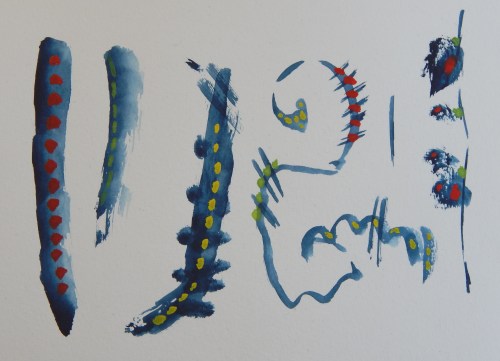
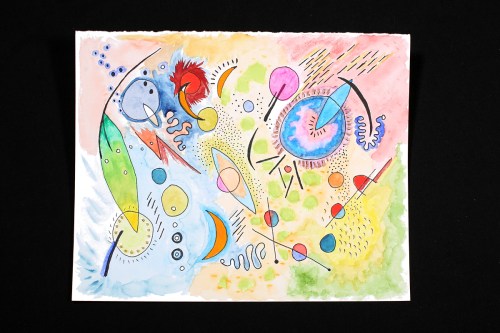
artwork by carol moses

artwork by carol moses

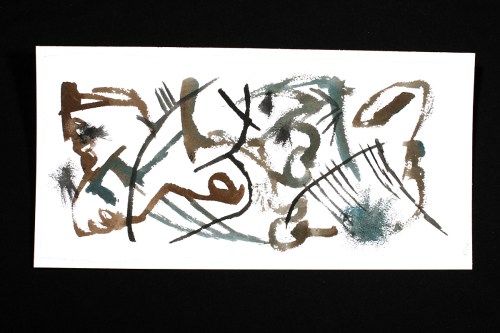
I still have the postcard. Artist Carol Moses gave it to me years ago at a show. A postcard of one of her watercolor prints. White background, dark lines, red circles. An untitled piece, I think, but it didn’t really need a title. For me, it was like a scene that one could fall into and create one’s own story.  I am not a formal student of fine art but her paintings and drawings reminded me of what I’d seen of Joan Miro, and later of Wassily Kandinsky. At a recent exhibit, I heard Carol mention that when she’d learned of Kandinsky and seen his body of work, years after she’d already been producing art, it was like a validation of her work.

artwork by carol moses

artwork by carol moses

It has been my pleasure to interact with Carol at various shows over the years. She is a dynamo. She seems never at rest … until she is making art. No boundaries does she set for herself. She works in watercolor, drawing, printmaking and photography.

artwork by carol moses

artwork by carol moses

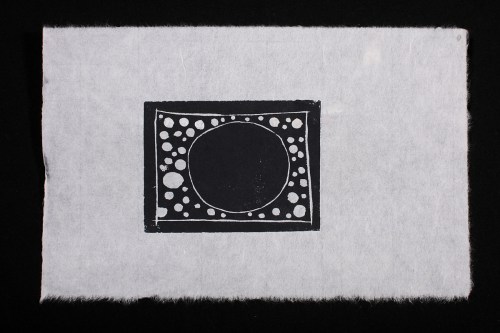
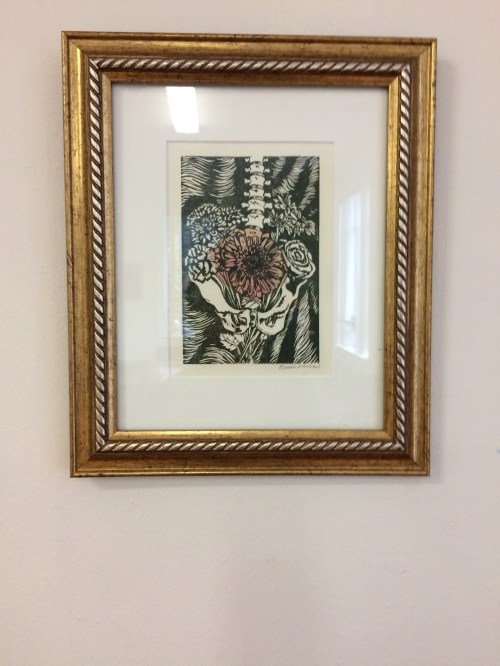
linoprint by carol moses

linoprint by carol moses

artwork by carol moses

artwork by carol moses

As a child she was into science and mathematics. Art and its freedom of expression would come later in her life as an adult.  As she produces these striking works, there is no particular intention, no concept in mind.  With a blank piece of paper before her and with brush or pen in hand, “The spigot just opens,” she said. “It is an unconscious thing.”

artwork by carol moses

artwork by carol moses

A private person, Carol is also one of the most giving people I know. She mentors artists of all media at all stages in their path even as she continues to explore and expand upon her artistic career.  If you have the opportunity to view her work firsthand at an exhibit or in a gallery, you’ll notice that most of her works are small. “When I began working, I didn’t have a formal studio. I had a kitchen table. I work small because I am used to being close to my work.”

artwork by carol moses

artwork by carol moses, “appreciatively, after visiting kandinsky”

View more of this artist’s beautiful work at http://carolmoses.com/

Save

Save

Save

Read Full Post »
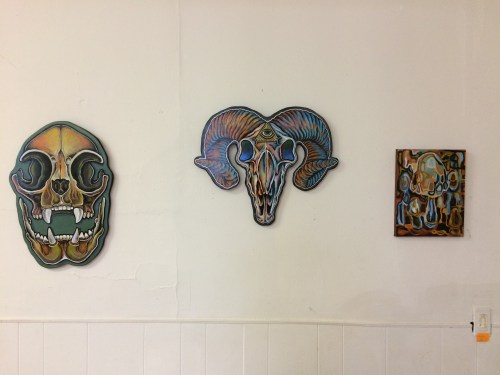
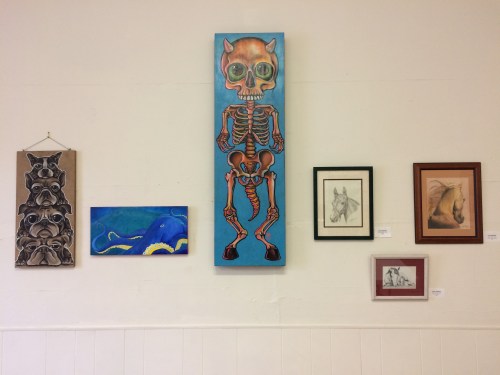
all images courtesy of exhibit curator jeffrey nowlin

Flora+Fauna presents a bold collection of 2D works celebrating the natural world and diverse visual aesthetics. On view July 10-August 7 in the Riverside Gallery at the Cambridge Community Center. Don’t miss the closing reception scheduled for Sunday, August 7th, 3:00-5:00 PM.


Contributing artists include:
Aaron Brown * Bradley Chapman * Asher Discala * Will Ferguson * Carol Galayda * Jeffrey Nowlin


Learn more about this lovely exhibit and other upcoming Riverside Gallery shows at the Riverside Gallery Facebook page.  Learn more about curator Jeffrey Nowlin at http://jeffreynowlin.weebly.com/

Read Full Post »

« Newer Posts - Older Posts »