There’s one positive to the long winter/long early spring commutes in Boston when your primary form of transportation is the train and bus. Plenty of time to read. Two books have been in my bag of late that I’d like share in some fashion. Very different books, indeed, but there is a common thread of poetry and the poetic. First up, Army Life in a Black Regiment, first published in 1869.

In November 1861, shortly after the start of the U.S. Civil War, the Union fleet took command of Port Royal, South Carolina and neighboring sea islands including St. Helena and Hilton Head. Plantation owners fled leaving behind 10,000 slaves, and a bumper crop of sea island cotton.
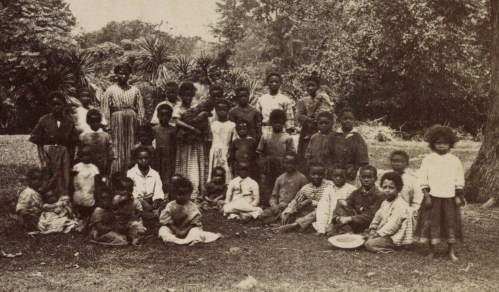

A project was conceived known as the Port Royal Experiment. Its purpose? By working with this group of 10,000 freed slaves, in a relatively contained area, perhaps solutions could be found for the greater looming challenge of how to integrate into society millions of emancipated slaves.
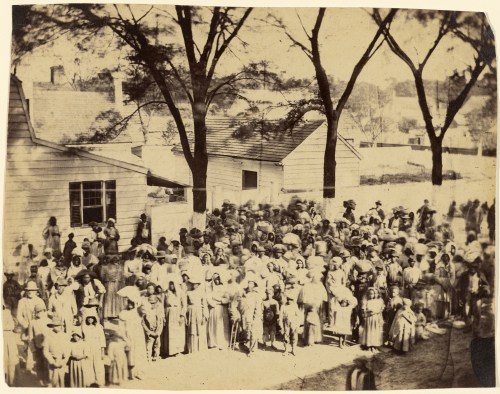
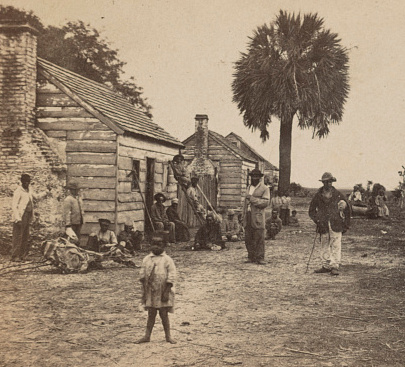
At least three different groups were involved in the experiment, including Northern missionaries who focused on education and training, entrepreneurs who wanted to show the profitability of free labor versus slave labor, and the U.S. government which, most immediately, needed more men on the battlefield. These groups sometimes worked together but were more often at odds. For an excellent scholarly analysis of the Port Royal Experiment, please read Willie Lee Rose’s Rehearsal for Reconstruction: The Port Royal Experiment.
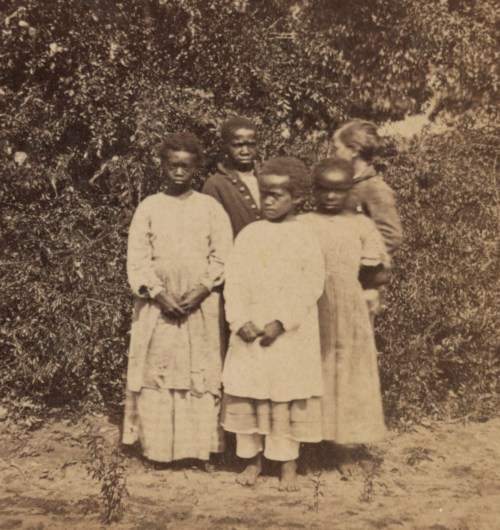
port royal students
Teachers immediately went to work setting up schools. Entrepreneurs began implementing their free labor experiment offering to pay the former slaves to cultivate the cotton. But as for volunteering to fight for the military?

escaped slaves wearing old union uniforms
Since the beginning of the war, Union officers in the field saw the need for trained black troops. Early attempts to recruit had met with poor results and had little initial support from Lincoln’s White House. But finally, with Port Royal, a new more coordinated effort was to be made. In November 1862, Thomas Wentworth Higginson received a letter from Brigadier General Rufus Saxton. “I am organizing the First Regiment of South Carolina Volunteers, with every prospect of success. Your name has been spoken of, in connection with the command of this regiment, by some friends in whose judgement I have confidence. I take great pleasure in offering you the position of Colonel in it … I shall not fill the place until I hear from you …”
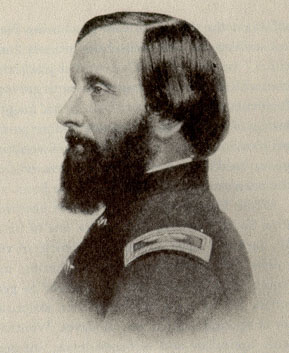
Thomas Wentworth Higginson
Higginson was a poet, biographer and novelist as well as a Unitarian minister. From a prominent, wealthy New England family, he had long been a staunch abolitionist, social reformer and a major supporter of John Brown. Once the Civil War began, he joined the Union Army. Though he already served another regiment, he accepted Saxton’s invitation to visit Port Royal. He doubted he would accept the commission but, after meeting the people, he accepted his new role without hesitation.
During his time with the regiment he would record detailed entries in his diary about the people, the Sea Island landscape, and of course about the regiments military actions. After becoming ill, in 1864, he would return to New England, resign his commission, and resume researching and writing. Essays about his wartime experiences with the First Regiment appeared infrequently in the Atlantic. By 1869, he compiled the essays, diary excerpts and other work into the book, Army Life in a Black Regiment and Other Writings.

First South Carolina Volunteer Infantry
In the introduction to his diary entries, Higginson tells the reader:
“I am under pretty heavy bonds to tell the truth, and only the truth; for those who look back to the newspaper correspondence of that period will see that this particular regiment lived for months in the glare of publicity, such as tests any regiment severely, and certainly prevents all subsequent romancing in its historian. As the scene of the only effort on the Atlantic coast to arm the negro, our camp attracted a continuous stream of visitors, military and civil. A battalion of black soldiers, a spectacle since so common, seemed then the most daring of innovations, and the whole demeanor of the particular regiment was watched with microscopic scrutiny by friends and foes. I felt sometimes as if we were a plant trying to take root, but constantly pulled up to see if we were growing.”
“Of discipline there was great need … Some of the men had already been under fire but they were very ignorant of drill and camp duty. The officers, being appointed from a dozen different States … had all that diversity of methods which so confused our army in those early days. The first need, therefore, was an unbroken interval of training. During this period, which fortunately lasted nearly two months, I rarely left camp … Camp life was a wonderfully strange sensation to almost all volunteer officers, and mine lay among eight hundred men suddenly transformed from slaves into soldiers …”

Infantry Members
Each subsequent diary entry reveals Higginson’s poetic nature. “Yesterday afternoon we were steaming over a summer sea, the deck level as a parlor-floor, no land in sight, no sail, until at last appeared one light-house … The sun set, a great illuminated bubble, submerged in one vast bank of rosy suffusion; it grew dark; after tea all were on deck, the people sang hymns; then the moon set, a moon two days old, a curved pencil of light, reclining backwards on a radiant couch which seemed to rise from the waves to receive it…”(November 24, 1862)

Dress Parade of the First South Carolina Volunteer Infantry
“… One adapts one’s self so readily to new surroundings that already the full zest of the novelty seems passing away from my perceptions, and I write these lines in an eager effort to retain all I can. Already I am growing used to the experience, at first so novel, of living among five hundred men, and scarce a white face to be seen, — of seeing them go through all their daily processes, eating, frolicking, talking, just as if they were white. Each day at dress-parade I stand with the customary folding of the arms before a regimental line of countenances so black that I can hardly tell whether the men stand steadily or not; black is every hand which moves in ready cadence as I vociferate, “Battalion! Shoulder arms!” nor is it till the line of white officers move forward, as parade is dismissed, that I am reminded that my own face is not the color of coal.” (November 27, 1862)
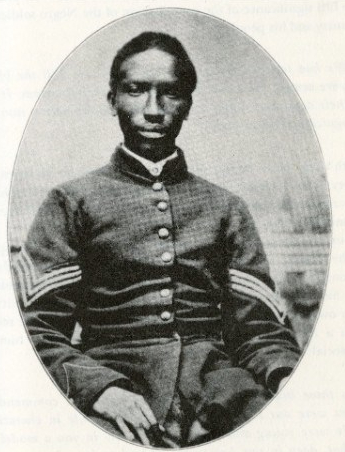
Infantry Member Henry Williams
Higginson paints a poetic picture of both people and place. “All the excitements of war are quadrupled by darkness; and as I rode along our outer lines at night, and watched the glimmering flames which at regular intervals starred the opposite river-shore, the longing was irresistible to cross the barrier of dusk, and see whether it were men or ghosts who hovered round those dying embers. I had yielded to these impulses in boat-adventures by night … and fascinating indeed it was to glide along, noiselessly paddling, with a dusky guide, the reed-birds, which wailed and fled away into the darkness, and penetrating several miles into the interior, between hostile fires, where discovery might be death.”
The book is a time capsule chronicling an important period in American history. These soldiers predated the more famous Massachusetts 54th regiment led by Robert Gould Shaw. Higginson brings to life the courage, the ingenuity and discipline of these early troops. He shows them to be as human as their white counterparts, their brothers in arms. And though the people of the Sea Islands, for the most part, had known nothing other than slavery, they were prepared with the right training to fight for and defend their freedom and that abstract thing known as “the Union” that their labor had sustained for generations.

Higginson’s book reminded me of the unique nature of the Sea Islands, a uniqueness that Higginson remarks upon in a post-war essay about the Negro as a Soldier. “I had not allowed for the extreme remoteness and seclusion of their lives, especially among the Sea Island. Many of them had literally spend their whole existence on some lonely island or remote plantation, where the master never came, and the overseer only once or twice a week.”
Under these conditions the slaves developed a patois that is now known as Gullah, a blending of standard English and its Southern regionalisms with different West African languages. By the time the Civil War began, there were over 400,000 slaves in South Carolina alone. Such a large investment in labor was needed for the labor intensive yet highly profitable cultivation of cotton and especially rice.

During one expedition along the Edisto River with his now-trained troops, Higginson confronts the enemy near some of these rice fields.
“The battery — whether fixed or movable we knew not — met us with a promptness that proved very short-lived. After three shots it was silent, but we could not tell why. The bluff was wooded, and we could see but little. The only course was to land, under cover of the guns. As the firing ceased and the smoke cleared away, I looked across the rice-fields which lay beneath the bluff. The first sunbeams glowed upon their emerald levels, and on the blossoming hedges along the rectangular dikes. What were those black dots which everywhere appeared? Those meadows had become alive with human heads, and along each narrow path came a straggling file of men and women, all on a run for the riverside. I went ashore with a boat-load of troops at once. The landing was difficult and marshy. The astonished negroes tugged us up the bank …They kept arriving by land much faster than we could come by water … What a scene it was! With the wild faces, eager figures, strange garments, it seemed, as one of the poor things reverently suggested, [like judgment day]. “
“Bless you” and “Bless the Lord,” were the exclamations Higginson remembers hearing over and over again. “Women brought children on their shoulders; small black boys carried on their backs little brothers … Never had I seen human beings so clad, or rather so unclad … How weak is imagination, how cold is memory, that I ever cease, for a day of my life, to see before me the picture of that astounding scene!” That day they rescued approximately two hundred slaves.

escaped slaves 1862
Higginson, with his Boston Brahmin background, was an outsider looking into another culture. There is condescension on occasion but while he may refer to the former slaves as docile, he makes clear he knew they were not mentally deficient as so many others would report in northern publications. “I cannot conceive what people at the North mean by speaking of the negroes as a bestial or brutal race. … I learned to think that we abolitionists had underrated the suffering produced by slavery among the negroes, but had overrated the demoralization.”
Higginson viewed his troops as human beings who had been denied basic human privileges, privileges he had literally fought for long before the Civil War. Throughout the book he presents the former slaves as active participants in shaping their own destiny.”One half of military duty lies in obedience, the other half in self-respect,” Higginson writes. “A soldier without self-respect is useless.” Recognizing what he describes as the bequest of slavery, Higginson worked with his officers to “impress upon [the troops] they did not obey their officers because they were white, but because they were their officers, just as the Captain must obey me, and I the general; that we were all subject to military law, and protected by it in turn.”
Over time, more black regiments were formed. In 1864 the First South Carolina Volunteer Infantry’s name was changed to the Thirty-Third United States Colored Troops. The men served until February 1866 when the troop was finally mustered out. “It is not my province to write their story, not to vindicate them … Yet this, at least, may be said. The operation on the South Atlantic coast, which long seemed a merely subordinate and incidental part of the great contest, proved to be one of the final pivots on which it turned. All now admit that the fate of the Confederacy was decided by Sherman’s march to the sea. Port Royal was the objective point to which he marched, and he found the Department of the South, when he reached it, held almost exclusively by colored troops. Next to the merit of those who made the march was that of those who held open the door. That service will always remain among the laurels of the black regiments.”
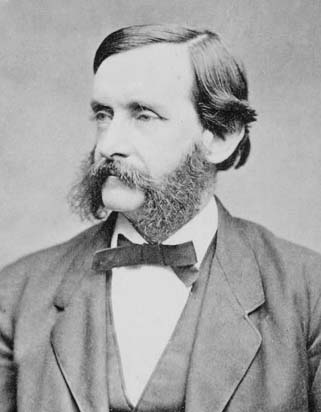
Thomas Wentworth Higginson
“… we who served with the black troops,” Higgins writes, “have this peculiar satisfaction, that, whatever dignity or sacredness the memories of the war may have to others, they have more to us. … We had touched upon the pivot of the war. Whether this vast and dusky mass should prove the weakness of the nation or its strength, must depend in great measure, we knew, upon our efforts. Till the blacks were armed, there was no guaranty of their freedom. It was their demeanor under arms that shamed the nation into recognizing them as men.”
Sources and Additional Reading
https://en.wikipedia.org/wiki/1st_South_Carolina_Volunteers
https://en.wikipedia.org/wiki/Thomas_Wentworth_Higginson
Army Life in a Black Regiment (Amazon)
https://www.emilydickinsonmuseum.org/thomas_wentworth_higginson
https://opinionator.blogs.nytimes.com/2011/11/06/rehearsal-for-reconstruction/
https://www.lowcountryafricana.com/project/history-of-the-33rd-united-states-colored-troops-usct/
http://www.drbronsontours.com/bronsonportroyalexperiment.html
https://www.sciway.net/afam/slavery/population.html
Art and Picture Collection, The New York Public Library. (1862).Bombardment of Port Royal, S.C. Retrieved from http://digitalcollections.nypl.org/items/510d47e0-f9a8-a3d9-e040-e00a18064a99
The Miriam and Ira D. Wallach Division of Art, Prints and Photographs: Photography Collection, The New York Public Library. (1861 – 1865).Two views. Dress parade of the First South Carolina Regiment (Colored), near Beaufort, S.C. Retrieved from http://digitalcollections.nypl.org/items/510d47e0-c8e9-a3d9-e040-e00a18064a99
Please note that the Library of Congress has an extensive collection of photographs available online from this period in U.S. history.