Feeds:
Posts
Comments

Posts Tagged ‘stained glass windows’

transfigurationdetail

Three years ago on this blog, I wrote about Henry Holiday’s depiction of the Transfiguration in the stained glass window located at Trinity Church in the City of Boston. At the time I was particularly interested in the position of the hands in his window though my research revealed to me that he was especially noted for his execution of drapery.

transfigurationdetail2

With a new lens and new perspective I’ve been revisiting the window, and I begin to understand what I read about his work with cloth in glass.

transfigurationdetail3

These images are from the top of the window. What’s amazing to me is that much of this detail you cannot see with the naked eye.

transfigurationdetail4

And yet the whole of what you see from the ground is quite stunning.

transfiguration

Read an earlier post here: https://wordsandimagesbycynthia.com/2013/10/07/holidays-tranfiguration/

View the window for yourself at Trinity Church: http://trinitychurchboston.org/art-and-architecture


Read Full Post »

Happy New Year! No doubt it will be an interesting one.

Best wishes for peace and prosperity and an awareness of the beauty in the world around us.

Strength and courage will be necessary I suspect. As for New Year goals …

… I’ve made none, not really, except perhaps a commitment to continue to pause and to pause without expectation. These photos I took while pausing inside Trinity Church.

It has been my pleasure to photograph there many times over the years.

Each time there is always something new to see in the tower, on the walls, in the windows and even on the doors.

We’ll see what 2017 holds. 🙂

http://trinitychurchboston.org/visit/tours

Read Full Post »

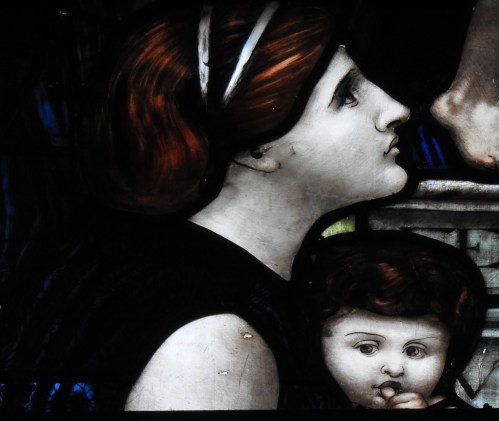
Detail from Presentation of the Virgin (after Titian) by John La Farge, 1888

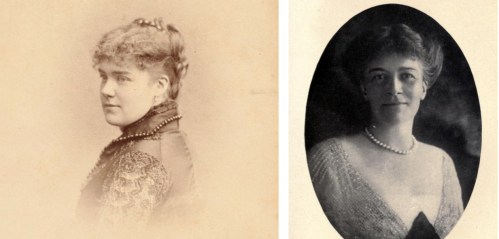
At Trinity Church in the City of Boston, there is the stained glass window, Faith, by Burlison & Grylls of London, installed in 1877-1878. It was given in memory of Charles Hook Appleton and Isabella Mason by their teenaged daughters Julia and Marian Alice, known as The Appleton Sisters.  The two sisters were extremely close. They lived together on Beacon Street and purchased adjoining property in Lenox, MA. 

Julia and Marian Alice Appleton

Julia and Marian Alice Appleton

Eventually, the oldest daughter Julia would meet and marry noted architect Charles McKim, a colleague and friend of the artist John La Farge.  Sister Alice would marry George Von Lengerke Meyer. As did many families of their social circle the McKims traveled extensively and often throughout Europe. In Venice they visited the galleries and in that city one of Julia’s favorite paintings was Titian’s Presentation of the Virgin, 1534-1538.

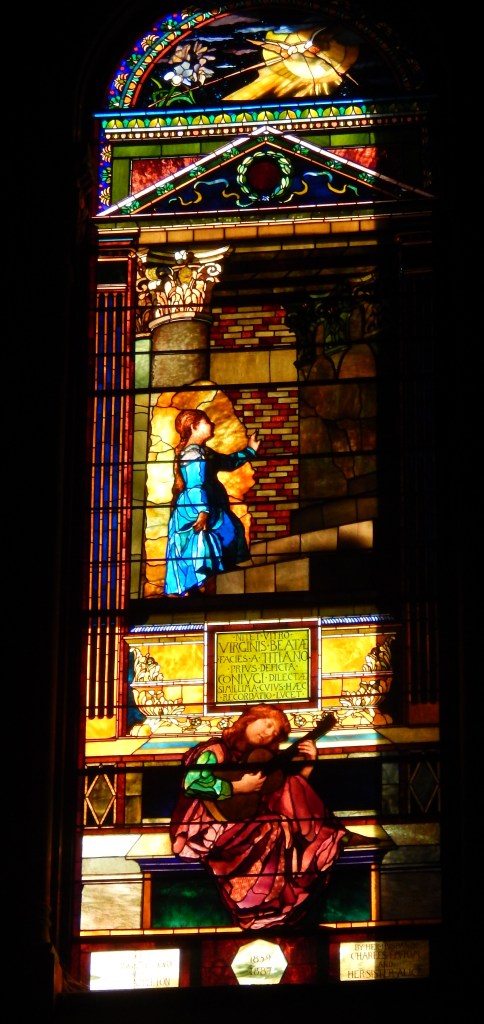
In 1887, Julia would unexpectedly die during childbirth. The grieving McKim, along with sister Alice, would commission John La Farge to create a window in Julia’s memory.  La Farge would select as focus a small portion of Titian’s large canvas. The window would be designed and completed within five months.

The window depicts a young girl climbing steps and symbolizes Julia’s climb toward heaven.  Below this image and considered separate from the story is the image of an angel playing a musical instrument. It is a spectacular window at any time of day but especially when the sun is shining just right through the opalescent and painted glass. For this series of images, that perfect time was approximately 1pm on a sunny day.

La Farge’s early sketch can be found at the Boston Museum of Fine Arts, and the actual window is located on the south wall of Trinity Church located in Boston’s Copley Square.

Sources & Additional Reading

Trinity Church Tours

http://library.bc.edu/lafargeglass/exhibits/show/descriptions/all-saints/trinity-boston

Presentation of the Virgin

early sketch by La Farge


Read Full Post »

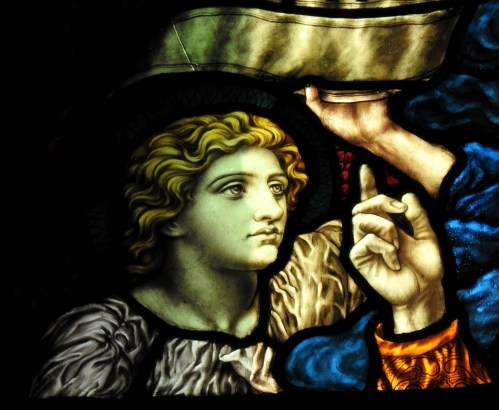
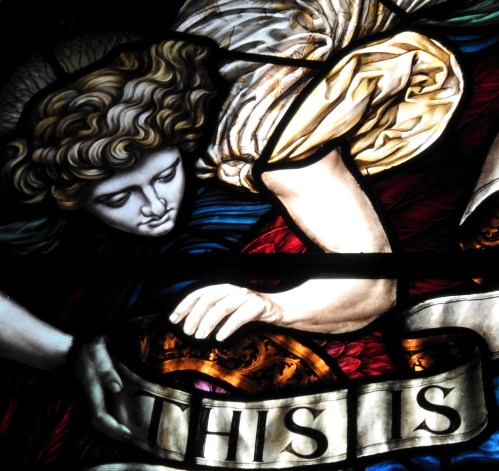
In time for the holidays, at the gift shop located at Trinity Church in Copley Square, you will soon find items featuring one of the most striking and provocative images that I have ever taken … probably because the source of the image is so striking and provocative. I think of them as angels though they are harpists robed in white in one corner of the stained glass window, David’s Charge to Solomon, by Edward Burne-Jones and William Morris & Co.

Detail from David’s Charge to Solomon by Burne-Jones and Morris

The women stand in a gallery at the rear of King David’s throne as the aged King delivers his charge to young Prince Solomon, and resting upon the King’s knees are the plans of the future Temple that he will not live to see. The window was presented to Trinity Church in the City of Boston by Frederic Dexter in memory of his father George Minot Dexter (1802-1872). As described in an 1888 church description, “the design is considered especially appropriate as Mr. Dexter lived but just long enough to see the plans of the new church completed and the work begun.”

George Minot Dexter was member of a prominent New England family that traced its roots to England and Ireland. It was a family of farmers, merchants, ministers, doctors and politicians. Dexter would become an architect and civil engineer. In 1836, he was commissioned to design the houses for Boston’s Pemberton Square and all of the accompanying ironwork. Today, 1300 of his architectural drawings for 85 different projects can be found at the Boston Athenaeum, in a building he would help to erect between 1847-1849.

In 1863 Dexter, then senior warden of Trinity Church, would call upon Phillips Brooks. Brooks, the descendant of several New England families of note, was a young minister attracting great attention as he served a Philadelphia parish. The young minister was in demand by many parishes across the nation and Trinity Church was especially active in its attempt to acquire him. It would take six years, in 1869, before Brooks would accept the call.

The church at that time was located on Summer Street in downtown Boston. Forward thinking, Brooks determined that it was time for the church to move to a new location, Boston’s Back Bay. Land had been bought and a building committee had already been formed when Boston’s Great Fire of 1872 destroyed the Summer Street church.

Dexter served on the building committee that selected the design of architect Henry Hobson Richardson. The building, which revolutionized American architecture, would be constructed between 1872-1877. Dexter would not live to see the building’s consecration in February 1877. He died November 26, 1872.

In addition to what has been referred to as The Dexter Window, his service to his church is also featured on a wall tablet, with the inscription by Honorable Robert C. Winthrop. It is located in the North Transept. Winthrop refers to Dexter’s self-sacrificing nature and how he remained “active to the last in good works and particularly in his tender care for the interest of the living and the remains of the dead during the trying scenes which attended the burning of our old house of worship in Summer St …”

He refers to the fact that beneath the Summer Street church was a crypt with family vaults. That crypt was laid bare by the destruction of the building overhead. Dexter would tend to those remains until he lost his life.  In a letter to his friend Miss Mitchell, Phillips Brooks would write:

If you have the opportunity to tour Trinity Church, you’ll notice not only magnificent stained glass windows like David’s Charge to Solomon but also wonderfully decorated tablets with words that provide just a glimpse into the lives of people who considered that space their home. Well worth taking a moment to read. Enjoy!

Sources, Additional Reading and Opportunities

Trinity Church Art & History Tour Information

The Garden Square of Boston by Phebe S. Goodman

http://cdm.bostonathenaeum.org/cdm/ref/collection/p15482coll1/id/839

Life and Letters of Phillips Brooks

Read Full Post »

Trinity Church in the City of Boston has produced a new guidebook that highlights and explores the art and architectural features of this historic gem. The 48-pages feature information about the principal makers of the building, its design and construction which primarily took place between 1872-1877, interior and exterior decorations, and much more. It is a visual treat with reproductions of original sketches, early watercolor paintings, as well as interior and exterior images by many fine local photographers. I am honored to have two photos in this book including this detail from John La Farge’s Purity stained glass window.

As noted at the end of the publication, the guidebook is dedicated to Edward Earl Duffy (1960-2012), a Trinity Church parishioner and tour guide who loved the building’s art and architectural legacy. The book is available for $11.95 in the church gift shop. Enjoy!

Save

Read Full Post »

While traveling in Sumter, South Carolina it was my pleasure to visit the Temple Sinai, founded as a Reform Jewish Congregation. The history of Sumter’s Jewish community dates back to 1815. The first Jews who settled in Sumter were Sephardic and came from Charleston, SC. The current congregation was formed in 1895 by the merger of the Hebrew Cemetery Society and the Sumter Hebrew Benevolent Society. Construction of the congregration’s present temple was begun in 1912 and completed in 1913.
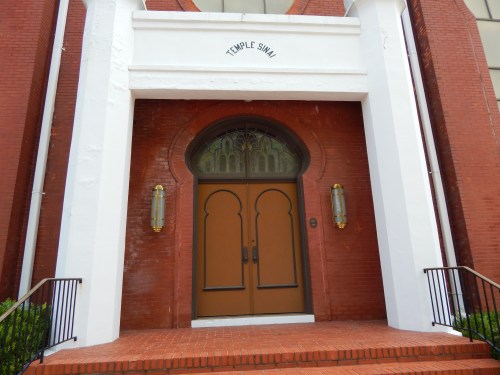
A feature article in the March 1913 Sumter newspaper The Watchman and Southron notes “The Temple is situated on the corner of Church street and Hampton avenue and is an imposing structure of red brick with domed roof … The architectural lines are simple, but the proportions are so good and so well harmonized that the general impression is one of beauty, allied to strength and permanence. As impressive as is the exterior of the Temple, it is the interior that is its chief beauty and glory …”

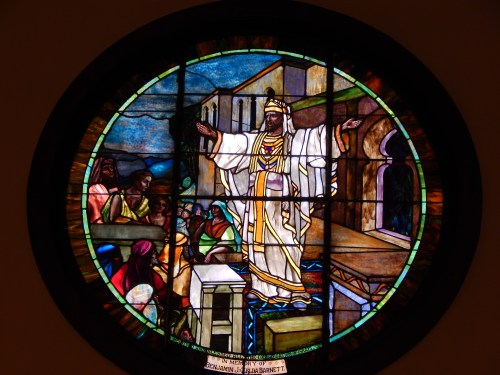
In terms of architectural style the brick building is Moorish Revival. Eleven stained glass windows grace the interior. Ten of the windows are 5 feet wide by 20 feet high and their shape mimic the building’s moorish towers, each a tall window illustrating a story surmounted by a half-window with further decorative detail. The eleventh window is round and is located high on a back wall.  While the specifics of the window designer and makers are elusive, the windows are thought to be handmade in Germany. Installation began in 1912 as indicated in a local newspaper article from September 1912, “The beautiful stained glass windows of Temple Sinai have arrived and are being placed in position.”  One month earlier, the same publication had noted, “The work is winding up on the new Jewish synagogue in this city and it will be only a short time now before the remodeled Temple Sinai will be one of the most beautiful places of worship in the city.

At age 95, Sumter native Robert Moses, a descendant of one of the first Jewish families to settle in Charleston and then in Sumter, is one of the last active members of Temple Sinai. As part of an educational presentation, he describes the windows as late Victorian in style, with rounded tops and interlacing borders giving them an eastern/Moorish look. Known as drapery glass due to the folding of the glass to add depth and color, the brilliant blues have cobalt added and gold was added to brighten the reds.

Each window depicts a scene from the Old Testament including as described in a 1913 newspaper article:

The Test of Faith, involving Abraham and Isaac …

The Blessing – Isaac Blesses Jacob …

detail from isaac blesses jacob
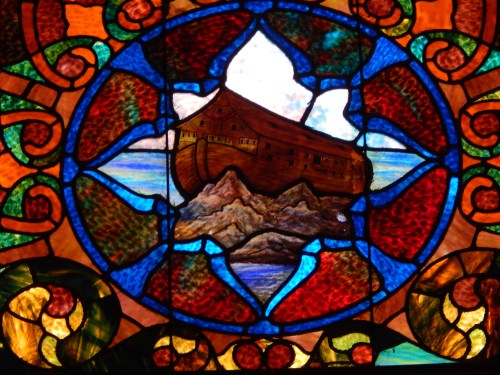
detail from isaac blesses jacob - the ark on ararat

detail from isaac blesses jacob – the ark on ararat

Jacob’s Dream …

detail from jacob's dream

detail from jacob’s dream

Vision of Moses when he sees the burning bush …
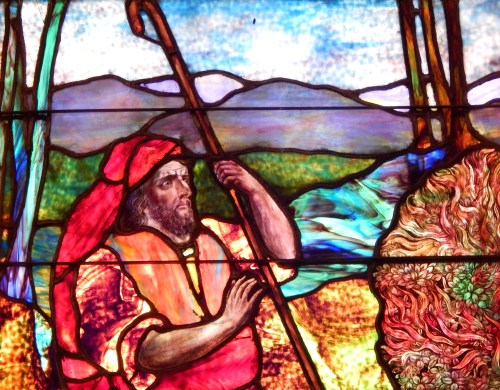
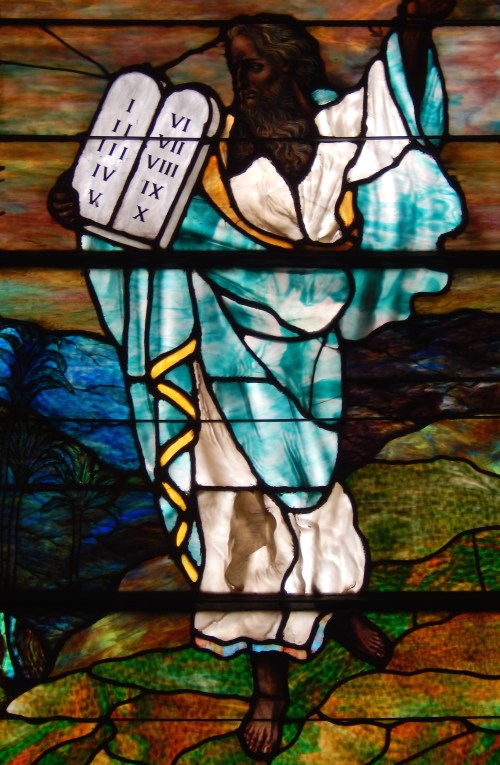
Moses on Sinai with the Ten Commandments …
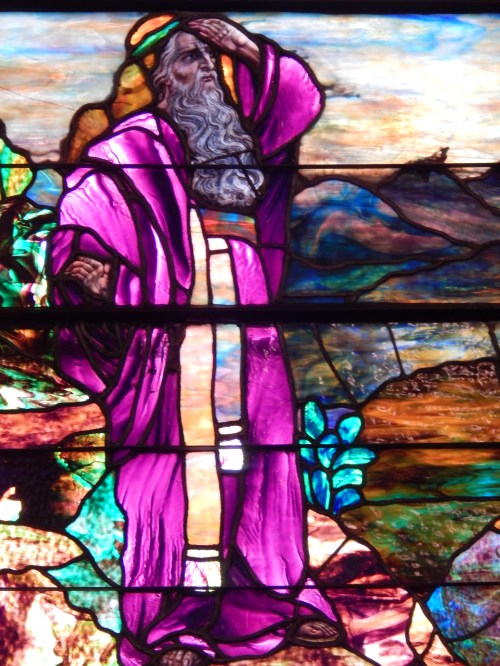
Moses on Nebo overlooking the promised land which he is forbidden to enter …
Moses Delivering Laws to Joshua …
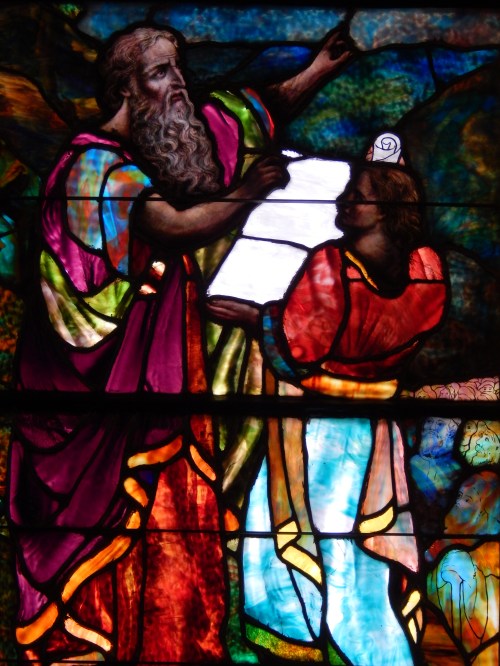
Samuel Before Eli …

detail from samuel before eli

detail from samuel before eli

Elijah in Solitude …

detail from elijah in solitude, also known as elijah and the ravens

detail from elijah in solitude, also known as elijah and the ravens

David the Shepherd Boy …

and Solomon at the Dedication of the Temple.

Members of the Moses family were kind enough to allow me entrance into the Temple to photograph details of the windows and share just a bit of the history of people and place. The windows of this place are unique for their pictoral illustration.
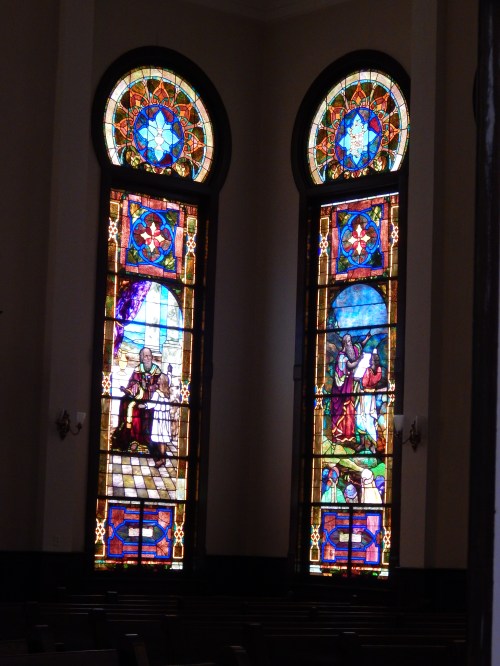
Temple Sinai is listed on the National Register of Historic Places. For more information, or to inquire how you can help preserve this historic structure, contact Temple Sinai, 11-13 Church Street, P. O. Box 1673, Sumter, South Carolina 29151 or call (803) 773-2122.

Sources and Additional Reading

(1) “House of Worshop of Jewish Congregation to be Dedicated on March 28th, ” The Watchman and Southron, March 8, 1913.

(2) The Watchman and Southron, September 21, 1912.

(3) The Watchman and Southron, August 10, 1912.

Temple Sinai Wikipedia page

Encyclopedia of Southern Jewish Communities – Temple Sinai

Records of Temple Sinai


Save

Save

Read Full Post »

I don’t just challenge others and reap the culinary rewards, I also try to challenge myself and so in the coming weeks I am challenging myself to photograph and research two different sets of stained glass windows (at least).  The first will involve some travel as I make my way to South Carolina to visit with relatives and en route may have the opportunity to photograph stained glass windows in a historic synagogue.  The other involves researching this window (above) I noticed in a building while walking in the Back Bay of Boston. Stay tuned for future updates, and meanwhile, here’s a window located in a place I write about often, Trinity Church in the City of Boston. It is Hope by Burlison & Grylls.

Read Full Post »

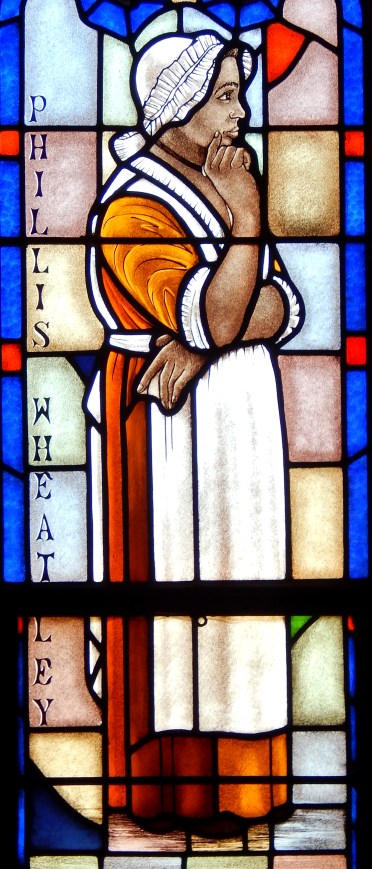
Before I began photographing the stained glass windows of St. Cyprian’s Episcopal Church in Roxbury, MA, the Rector Monrelle Williams invited a longtime parishoner, Ms. Leslie Gore, to share the church history with me. An active member since a child in the 1950s, she described Sunday School classes of 300-500 children, the different guilds, the cotillions that took place, the plays produced in the lower parish hall, and much more. Finally, I asked her, if there was one thing that she wanted people outside of her congregation to know about St. Cyprian’s what would it be. With a beautiful smile, she said, “I’d want them to know that this place is home. A beautiful place to be. A place where people encompass you.” As I photographed the stained glass windows, I thought of the children she described including her own. As they raced about the church, sang in the choir, and participated in other social and cultural activities, around them they would have seen themselves and learned about their history, American history, rather uniquely.

St. Cyprian’s is located at 1073 Tremont Street. While the physical structure was built between 1922 and 1924, the actual coming together of people for worship began much earlier. They were people who had emigrated to the U.S. from the former British West Indies and African Americans migrants from the southern states. Those who moved to Massachusetts primarily settled in Boston and Cambridge. It was the first decade of the 20th Century. It was a period of great change, opportunity and of racism. While many of these peoples wanted to attend existing Episcopal churches, they were rebuffed both overtly and subtly. In May 1910, a group of people decided to meet for worship in a private home. As numbers grew, they began to worship in other churches when those churches were not holding service. It was a nomadic existence, and again one where things were done – e.g. the fumigation of one church after they had left – thus spurring people, under the leadership of Reverend David Leroy Ferguson to raise the funds to buy land and build their own church. A home was created. And in that home there is lovely stained glass with traditional Christian imagery depicting figures from the bible …

… and then at some point the community of St. Cyprian’s made a decision to depart from the traditional practice of using biblical figures and to instead highlight black people, men and women, “who have made significant contributions to the liberation and empowerment of our people. … Our stained glass windows, therefore do not serve to beautify the building or to enhance its ambience, rather they serve to educate us about the outstanding contribution of men and women to the betterment of our community.” “It is my hope,” a former rector concludes in a descriptive pamphlet, “that as we celebrate their lives and deeds that we may be inspired to follow their blessed footsteps to make our community and nation a better place for all.

Sojourner Truth and Harriet Tubman

Mary McLeod Bethune

Phyllis Wheatley

Phyllis Wheatley

The images span the past into the present.

Richard Allen and James Forten

Richard Allen and James Forten

Prince Hall

Prince Hall

A booklet titled Voices and Victors in the Struggle features the biographies of each of these people. And thanks to physical libraries and of course the internet, if you are unfamiliar with the historical significance of these folks you can choose to discover why they have been recognized in this church.

Marcus Garvey

Martin Luther King Jr and Frederick Douglass

Martin Luther King Jr and Frederick Douglass

Absalom Jones

Alexander Crumwell

Alexander Crumwell

The Rt. Rev. John Melville Brugess

The Rt. Rev. John Melville Burgess

St. Cyprian’s was built by a people rising above discrimination. Over time and deliberately, members sought to use design as a tool for empowerment and celebration of the achievements of people of color from many different backgrounds.

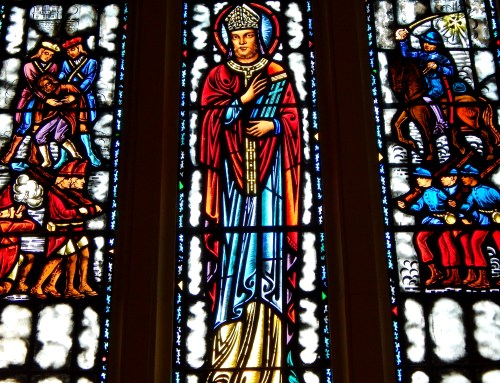
St. Cyprian

St. Cyprian

It was inspiring to learn of this church and its founders, and to see firsthand the beauty and history shared through its windows.

Sources & Additional Reading

About St. Cyprian’s


Save

Save

Read Full Post »
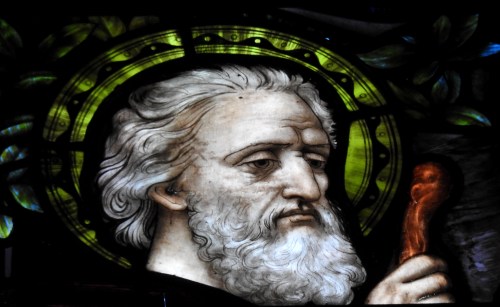
one of two stained glass windows by daniel maher stained glass

one of the two windows depicting, “pentacost,” by daniel maher stained glass

These windows at St. James’s Episcopal Church by local artisans Daniel Maher and Lyn Lovey express a creativity and diversity that is very modern. It is almost startling to look up and see them in the clerestory after viewing older works by Tiffany, Clayton & Bell, Goodhue and others in other parts of the  building. In part that’s because of my own ignorance around stained glass making today and how churches continue to commission their design and installation. Working with glass remains a popular and contemporary art. And in places like St. James, the past and present harmonize quite nicely.

one of a pair of windows designed by lyn hovey stained glass

I’ve lived in Boston for almost twenty years and I can’t even imagine how many times I’ve walked along Massachusetts Ave past this church. When I’ve been tired I’ve stepped into its adjacent garden and sat on the church steps. I’ve always wondered, what was behind the red stone? I’m grateful to the rector, sexton and other staff for allowing me to appease my curiosity and glimpse the beauty inside. Until you can make your visit, below are a few images for you to enjoy. And there’s also a link to a very interesting overview of the windows available online.

Detail from chancel windows …

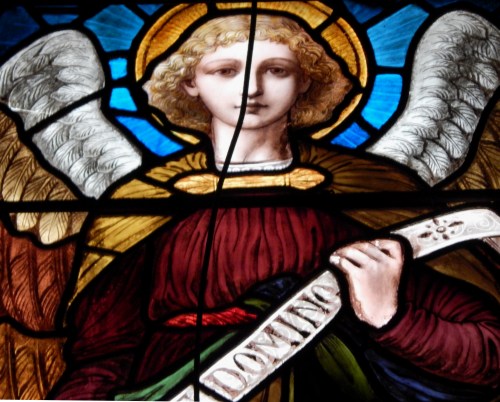
Detail from one of the choir angel windows …

Detail from the Resurrection window…

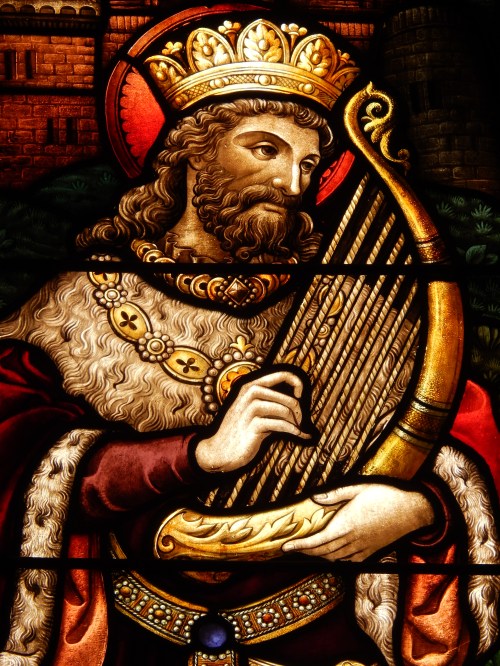
Detail from David with Harp …

Detail from Dorcas window …

Detail from Saint Dorothea window …

Detail from the Greenleaf window …

Detail from the Nativity window …


Additional Reading and Links

St. James’s Episcopal Church

Overview of St. James Stained Glass Windows

Daniel Maher Stained Glass

Lyn Hovey Stained Glass


Read Full Post »

detail from rice memorial window “christ the light of the world”

As you travel along Massachusetts Avenue in Cambridge, just outside of Porter Square, you will find St. James’s Episcopal Church, a beautiful stone structure designed by Henry Martyn Congdon in a Richardsonian Romanesque style. While the church was founded in 1864, the cornerstone of the particular building in which I peered today was laid in 1888.  Inside is quite a variety of stained and painted glass (and a bell re-cast by Paul Revere!).

While I visited at the wrong time of day and time of year for the best effect, the opalescent windows along the west wall still caught my attention. I visited in early morning in spring but for the windows to be seen as their designers — John La Farge and possibly Tiffany — intended, I will need to visit again in winter in the late afternoon just before sunset.

detail from "jesus the good shepherd"by john la farge

detail from “jesus the good shepherd” by john la farge

I’ve already marked my calendar. 🙂

detail from the batchelder-dexter window, “the mission of the seventy”

I’m still sorting through pictures and their stories. More to come from my delightful visit. Meanwhile you can learn more about the church, its people and the history of the building here: http://www.stjames-cambridge.org/

Read Full Post »

« Newer Posts - Older Posts »