Feeds:
Posts
Comments

Archive for the ‘Books I Love’ Category

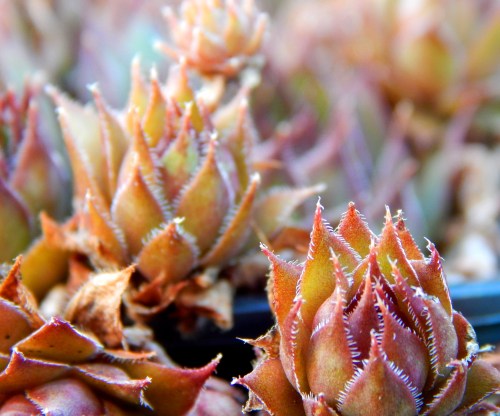
My mother kept a bucket of chickens next to the back porch.  It was a big white bucket like an old stew pot.  Hens and chicks was what she called the little spiky plants growing in there. No matter how hot the summers, no matter how many other flowers and vegetables died in the baking Virginia sun, those plants survived to flourish the following year. They were easy to transplant. I remember picking up the little ones … they just popped right up out of the soil … and tossing them into another little cup of dirt. My mom told me to stop doing that because she’d specifically positioned her pot of chickens. Their singular location, next to the porch, was part of her garden design.

photo by cynthia staples

Now my mom and I did not formally speak of things like garden design and water-saving plants like her cacti. My dad did not discuss these things either though I remember he kept a barrel to collect rainwater and that he rotated crops in our little vegetable garden. He didn’t really explain the why of his actions. It was just what you did if you understood the system of which you were a part.

photo by cynthia staples

That’s what stands out for me in books like The Water-Saving Garden by Pam Penick.  Penick invites readers who are interested in gardening to deepen their understanding of how their world works.  My parents grew up in a time and place and were of a generation that knew the sources of their water and understood that those sources were not guaranteed. For all sorts of reasons that knowledge was lost as human ingenuity and engineering made water readily available in many places and seemingly endless.  Today, people are aware that engineering is not enough. We are a part of a complicated system. Water is not endlessly available for our needs. But what if you really want a garden?

It almost seems selfish but I have to admit I’m one of those people. If at all possible, for my peace of mind, I like to see something green growing around me and know I had something to do with it. And despite my fond memories of my mother’s chickens, I don’t necessarily want to grow them. What are my other choices in a water-saving garden?

photo by cynthia staples

photo by cynthia staples

Pennick’s book stretches one’s imagination about what form that garden can take. She reminds and encourages people to take the time to understand the landscape and climate particular to their region. Humor is sprinkled throughout the book (e.g. “Think of your plants as astronaut-explorers, boldly going where no plant has gone before.”) as well as lovely and informative pictures.

The Water-Saving Garden is content rich and makes a nice addition to the reference shelf. Every idea can’t be tried all at once. It’s a resource I can imagine filling the margins with notes of lessons learned as I try to garden more wisely while still having fun.

You can learn more about this book via the following links. I received this book from Blogging for Books for this honest review.

Additional Links

About Pam Penick: http://www.penguinrandomhouse.com/authors/152546/pam-penick/

http://www.penguinrandomhouse.com/books/246914/the-water-saving-garden-by-pam-penick/

Read Full Post »

Bees are not the only pollinators in this world but they are a major one. There are many different species of bees. Growing up in Virginia, I’d heard of sweat bees, and knew bumblebees on sight, but it was the honeybee with its soft gold and black coloring that I most thought of when I heard the word bee. I took for granted its production of honey and the wax harvested from colonies for my candles.  And I was quick to bat the insect away when I walked through a field of flowers. As for its role as pollinator, I didn’t think too much about that nor did many until reports of colony collapse disorder made national and international news.

photo by cynthia staples

As noted in the introduction of The Bee-Friendly Garden, “over 70 percent of the world’s plants depend on the pollination services of bees, including many nuts, fruits, tomatoes, peppers, or berries.” While the world might survive without bees, it would be a very different place to say the least.

One of the delights of this book is that the authors, a professional garden designer and an ecologist, educate, inspire and encourage.  Regarding the U.S., they describe the difference between native bee species and honeybees, and how bees and wasps look similar but behave very differently.  Honeybees with their yellow and black banded bodies are probably the most common image of bees, but native bees come in many shapes, sizes and colors, their bodies evolved to collect the pollen from a wide variety of plants, shrubs and trees.  Lists are provided by region of bee-friendly garden compositions, and in turns out that many of those same gardens — a mix of annuals, perennials and more — can attract and support other important pollinators like bats, butterflies and hummingbirds.

The book is an incredible resource and reference guide and I would suggest it as a wonderful addition to one’s gardening library.  The authors make clear with straightforward content that you don’t need to be a master gardener or landscape designer in order to create beauty around you and do some good in the world as well. As some of you know, I love to give seeds and plants to friends and family who live across the U.S.  This year I will certainly be using this book’s regional plants lists to help guide my selection of seeds.

photo by cynthia staples

I received this book from Blogging for Books for this honest review.  Detailed book information available via this link: http://www.penguinrandomhouse.com/books/243475/the-bee-friendly-garden-by-kate-frey-and-gretchen-lebuhn/

Read Full Post »

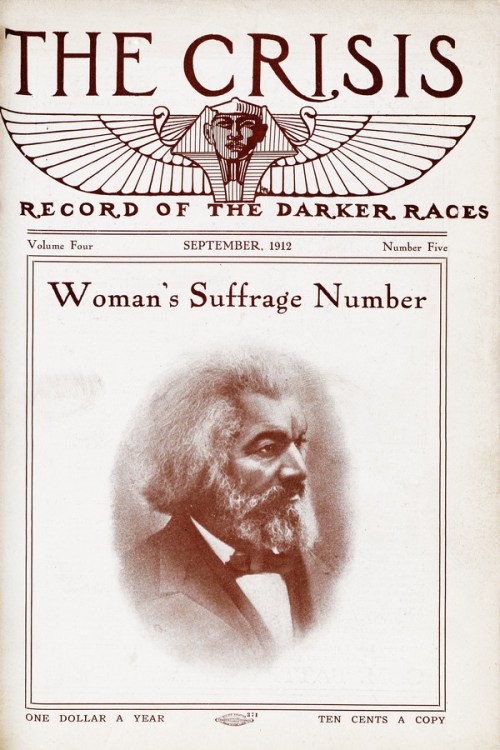
To rediscover the beauty once created like this cover for The Crisis Magazine by artist Laura Wheeler, and …

To remember the struggles we have faced before as a nation and overcome, to a degree, though it is frightening to see how easy it is to regress.

FYI, W. E. B. Du Bois founded The Crisis in 1910.  You can read about the magazine’s origin, and browse issues through 1922, via this link.  You can read the above issue on women’s suffrage online via this link. And the Online Books Page identifies sources for viewing other issues.

Read Full Post »

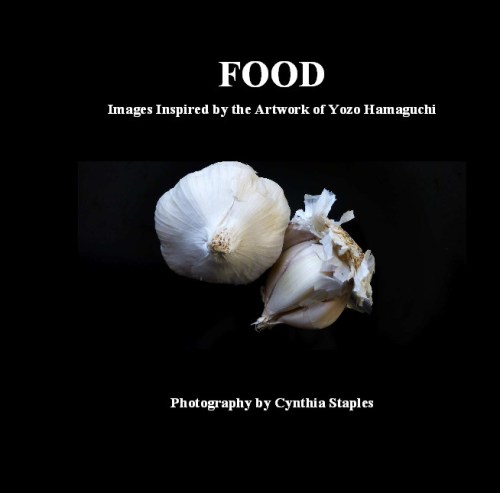
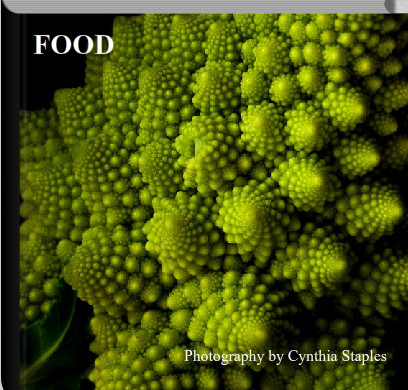
Now available in print and as a PDF in my bookstore.

FOOD

Read Full Post »

Nancy Li, owner of TAO Select Image courtesy of artist.

Nancy Li of TAO Selection
Image courtesy of artist.

Believe it or not, porcelain had been on my mind just before my chance encounter with Nancy Li of TAO Selection.  I had come across a review of Edmund de Waal’s new book, The White Road.  A noted potter, the book chronicles de Waal’s “journey into an obsession” to learn more about the origins and reinvention of porcelain.  The prologue opens with de Waal in China: “I’m trying to cross a road in Jingdezhen in Jiangxi Province, the city of porcelain, the fabled Ur where it all starts …” Nancy Li is quick to tell you, and rightfully so, her family is from this region of China and that she is a third generation designer of porcelain.

Image courtesy of artist.

As I later told her, what I most admired about our first brief encounter outside of a church gift shop was her determination to find venues to market her jewelry, and also to share the story of her family and cultural heritage of working with porcelain. In his book de Waal writes of working with porcelain clay to make a jar. Though his studio is in South London, he writes, “… as I make this jar I’m in China. Porcelain is China. Porcelain is the journey to China.” During an interview, Nancy Li made a similar statement.

Image courtesy of artist.

We met briefly in Cambridge during her lunch break.  Again, with great passion, she began sharing the story of her family especially of her grandfather, a porcelain master.  For three generations the family and 15-20 employees have been working with clay using a proprietary process, molding it in forms from pendants to bowls to large statuary, hand-glazing and then firing the pieces in her family’s kiln.  I’ve always thought of porcelain as fragile but porcelain can be strong as Nancy demonstrated by dropping a lovely blue and white bracelet on the floor. It made a beautiful ringing sound and remained unbroken.

On her website, Nancy describes attending the top fashion school in China, Donghua University.  In talking with her I learned that six years ago she moved to the U.S. where she also received a Ph.D. in Materials Engineering from Boston University and a Management Degree from the MIT Sloan School of Management, part of her dual efforts to better understand the science behind porcelain and to raise awareness globally about the family business and the high-quality of the artwork produced.

Image courtesy of artist.

On top of her full-time job as a Systems Engineer, Nancy makes time to interact with people around Boston, educating them about porcelain and obtaining feedback about peoples’ fashion interests.   She shares the feedback with her family, including producing sketches for alterations and new designs, inspired by what she hears and by her own artistic background.

She describes wanting to help people understand that high-quality porcelain is not only for the wealthy.  It is not only something from the past to be found in antique stores.  It is contemporary and it is art, an art that represents a culture.  “Each piece of art has a story behind it,” she says at one point, holding a necklace in her hand.  “It is art that inspires, that’s meant to be shown and shared. I think Americans have a wrong impression that everything made in China is cheap quality. What my family does in its local community, what it has been doing for so long, is of the highest quality and I want to share that work, our work, and help it evolve.”

Following are links to learn more about and connect with designer Nancy Li and to view more of her wearable porcelain art.

TAO Selection Etsy Shop

TAO Selection Website

Following are links to learn more about artist and writer Edmund de Waal and his passion for porcelain.

http://www.edmunddewaal.com/

The White Road

Read Full Post »

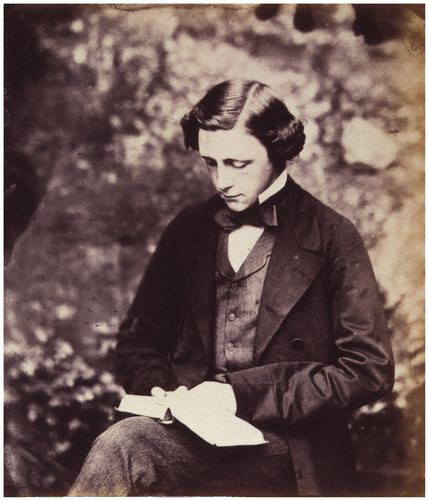
This year marked the 150th anniversary of Lewis Carroll’s Alice’s Adventures in Wonderland.  There have been many articles and books written in celebration of this brilliant work.  David Day’s Alice’s Adventures in Wonderland Decoded (2015) must be one of the most unique explorations of the book’s creation.  Day pairs the full text of the novel with a detailed analysis of how Charles Lutwidge Dodgson (aka Lewis Carroll) tapped his interests in mathematics, literature, religion, music and more to build a complex world for a curious little girl named Alice.

by Lewis Carroll (Charles Lutwidge Dodgson),photograph,2 June 1857

by Lewis Carroll (Charles Lutwidge Dodgson),photograph,2 June 1857

It is widely believed that the character Alice is based on Alice Liddell. Alice and her sisters Lorina, Edith and brother Harry were the children of Henry George Liddell, dean of Christ Church College, Oxford where Hodgson had been studying mathematics. He would befriend the family and especially the sisters and the rest is literary history.

Alice Liddel, photograph by ,1860

Alice Liddel, photograph by Lewis Carroll,1860

A few years ago I had the opportunity to meander around Christ Church, Oxford and there I photographed a stained glass window by Edward Burne-Jones. His model was Edith Liddell.  That image appears in Mr. Day’s book for which I am grateful because the book is filled with beautiful illustrations, photography and reproductions of engraving and paintings.  And then there’s the mathematical diagram of Fibonacci’s rabbits and the explanation of how that rule applies to the story.  The book truly is a treat for people of wide-ranging interests.

Highly recommend this article by Katherine Dedyna in the Times Colonist and Nathan Whitlock’s review on the Quill and Quire.

The book is available for purchase via the following link: http://www.amazon.com/Alices-Adventures-Wonderland-Decoded-Carrolls/dp/0385682263

Read Full Post »

When I received Owls by Matt Sewell, I quickly flipped through the small hardback book, chuckling unexpectedly at some of the wide-eyed illustrations.  But I was in a rush, you see, and so I tossed the book on the coffee table intending to do a thorough inspection and review later in the day. Having been introduced to Blogging for Books by a friend, I wanted to do a good job.  Well, I can honestly say that it is a wonderful book to share with an inquisitive young reader.  My young friend whom I have mentioned often in this blog, now eight-years old, was visiting and she found the book.  I came upon her sitting quietly reading it on the couch. I watched as she sounded out Latin text and she also chuckled at the illustrations of owls each with a distinctive character.  When she saw me watching her, she waved me over to sit beside her and so we read the book together.  Each reading a page out loud about a different owl.

The author and illustrator is ornithologist Matt Sewell and I keep reading that he is described as the Banksy of the bird world.  Now, I just barely know who Banksy is (you can read more about him here https://en.wikipedia.org/wiki/Banksy ) but you don’t need to know Banksy to enjoy this book with or without a little reader by your side.

Yes, I received this book from Blogging for Books for this review.  A good deal but the best part was watching the joy the book brought to a young reader who is still learning about the world.  As my friend likes to say when she is happy with something, two thumbs up!

Learn more about the author here http://www.penguinrandomhouse.com/authors/152488/matt-sewell/.

Read Full Post »

Here is a link to previous Interludes in our walk though history with Mr. Horne.


Walter Ings Farmer, Director, Wiesbaden Collecting Point

Walter Farmer, Director, Wiesbaden Collecting Point

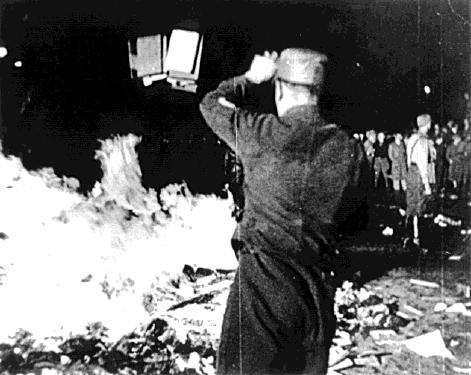
In his book, The Safekeepers: Memoir of the Arts at the End of World War II (2000), Walter Ings Farmer writes that “The story of the Offenbach Archival Depot has never received the attention given to restoration of monuments … Nevertheless an account of MFA&A activities in the Frankfurt area would be incomplete without a description of the rescue of the literary and scriptural treasures that the Nazis had looted with the same nefarious purposes they applied to art collections. … Looting of libraries became as integral to the Nazis plan for cultural domination as the looting of art collections.

1933 Berlin Book Burning

1933 Berlin Book Burning

He describes how Nazi actions escalated from the 1930s public burnings of the authors they wanted to discredit to “a program of search and seizure among the libraries and archives of the nations that they sought to conquer. … These activities established a pattern which resulted in the eventual accumulation in Germany of storehouses full of other nation’s libraries.

Millions of books would be accumulated, along with a stunning amount of other cultural and religious items collected from across Europe.  Farmer writes of being introduced to Offenbach by “his boss” Captain James Rorimer in the fall of 1945.

James Rorimer

James Rorimer

He took me with him to inspect an abandoned warehouse within the I.G. Farben plant at Offenbach,” remembers Farmer. “This building was under consideration to become to repository primarily for Jewish libraries, archives and the Torahs.” Prior to the warehouse in Offenbach being established as a collecting point, library collections were being stored at the Rothschild Library in Frankfurt. Over time it was clear that infrastructure at the Rothschild Library was inadequate.

Based on his and others assessment of the situation, librarian and MFA&A officer Lt. Leslie Poste suggested that detailed cataloging of the items be stopped at Rothschild and that operations be relocated across the river to the I.G. Farben plant, the site of a five-story, reinforced concrete loft building.

Seymour Pomrenze (center)
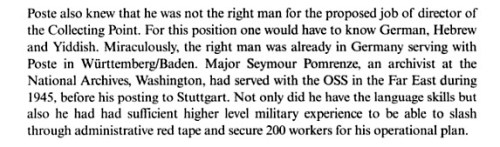
Seymour Pomrenze (center)

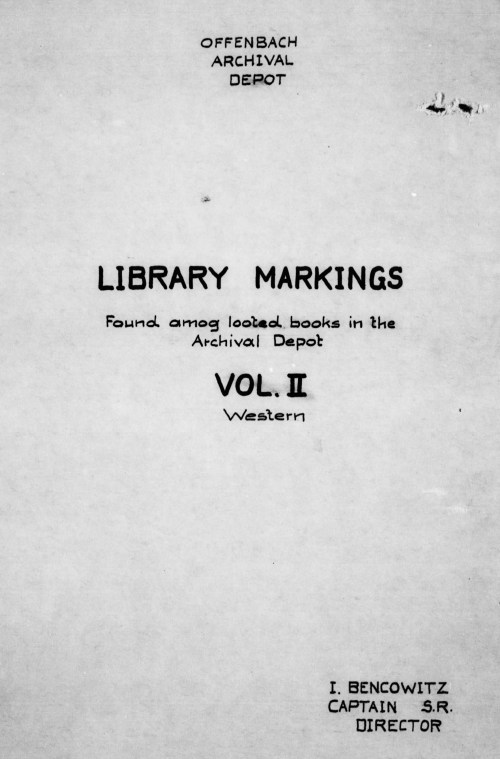
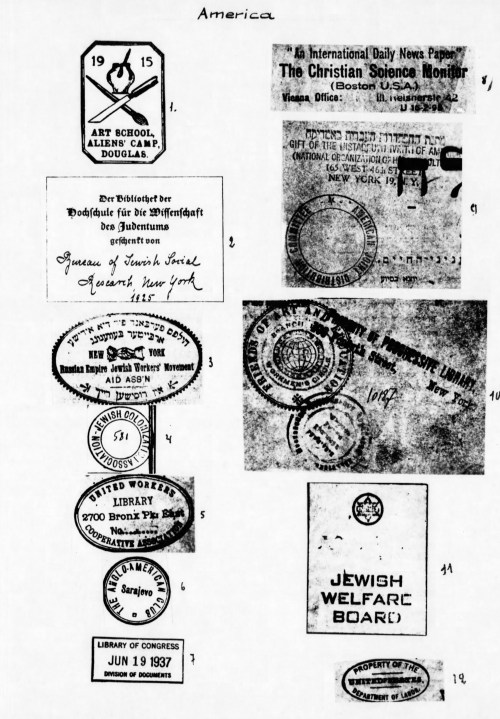
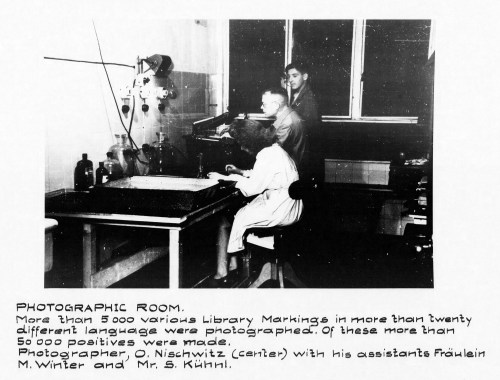
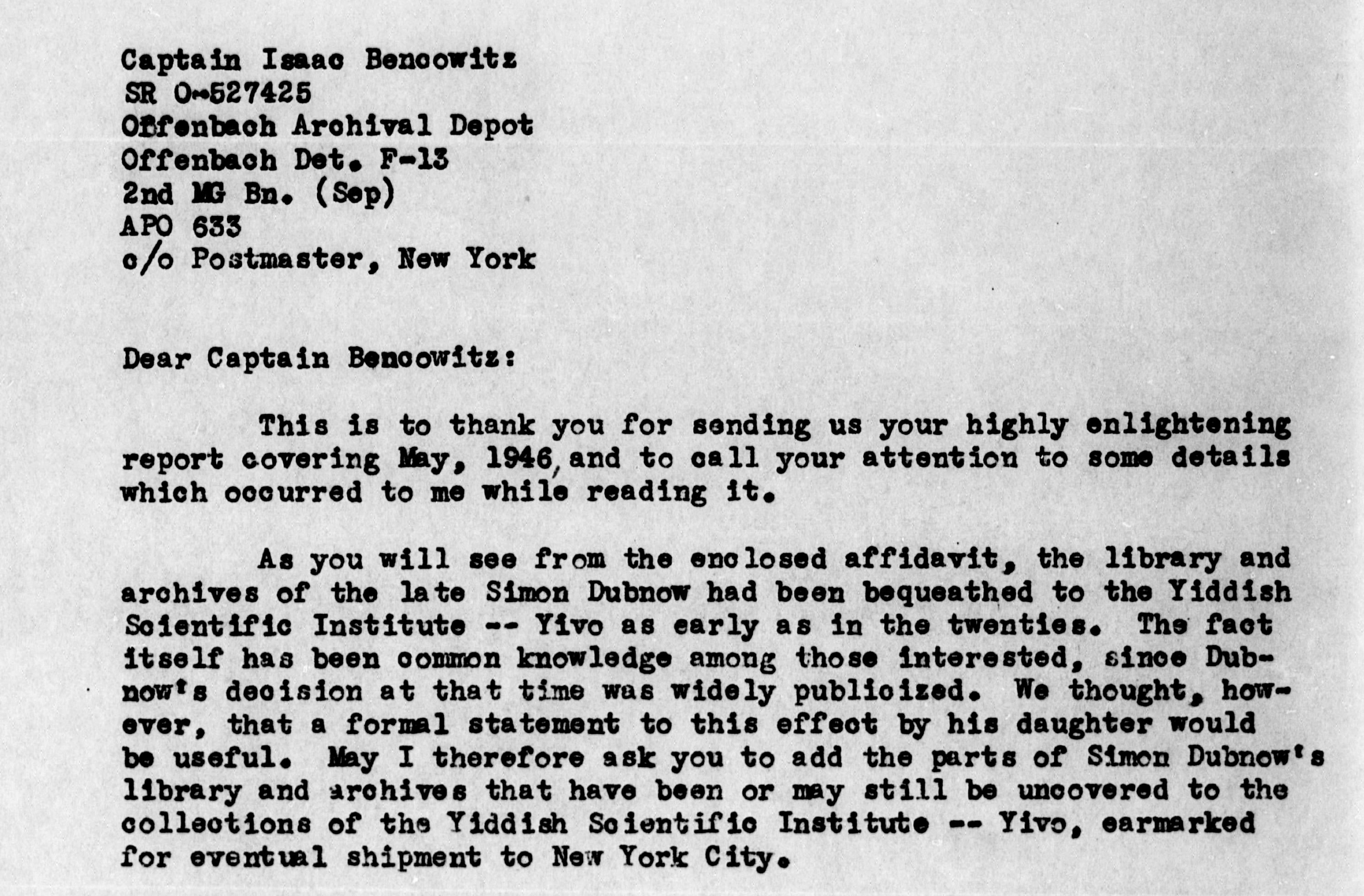
Pomrenze put into place necessary administrative, transportation, cataloging and storage systems enabling the depot to operate much more effectively.  Professional conservation and preservation labs, a photographic studio and other needed infrastructure was created.  His successor, Captain Isaac Bencowitz, refined a system for photographing ex-libris and library markings found in books.

Isaac Bencowitz

Isaac Bencowitz

The resulting cataloging system would significantly increase staff ability to identify and sort items, identifying country of origin and other markers of ownership .  In the end Bencowitz and his team would complete “two volumes with reproductions of library markings belonging to 4,105 libraries of individuals and institutions in Western and Eastern Europe

and two volumes with more than 1,300 bookplates or ex-libris, including 1,200 German-Jewish, German-Masonic and probably German non-Jewish plates as well as over 100 mostly Dutch-Jewish bookplates.” (F. J. Hoogewoud)

As requests were submitted by individuals, families and nation states seeking missing items, MFA&A staff were able to use the catalogs to help them search through the millions of books and cultural items that would eventually be stored at Offenbach.

Bencowitz, during his tenure as director, used photography to document the operations of the depot and its staff and volunteers.

Staffing the depot was a mix of U.S. military, Allied and civilian personnel, as well as German civilians, and scholars from around the world. In October 1946, Bencowitz received orders for redeployment.  The imminent nature of his departure and shifting priorities in the region for policy and decision-making made selecting a new director difficult.  As an “emergency measure,” archivist Major Lester K. Born and his assistant, Joseph A. Horne, were sent to Offenbach for temporary duty.  Born was to develop an interim plan for continued operation of the depot, a plan that Mr. Horne was to implement.  In short, a plan was finally developed and by January 1947, Horne became the third director of the Offenbach Archival Depot.

Exactly what Horne was doing prior to assuming his new role remains opaque without futher research.  Archival records show him often assisting MFA&A colleagues like Gordon Gilkey, Leslie Post, Lester Born and Paul Vanderbilt with the acquisition of information about available artwork and cultural items.  His fluency in German, facility with “dead languages,” appreciation and knowledge of the arts, and photographic skills would have made him invaluable in the field.  He produced numerous reports about his trips across Germany about what he was seeing and hearing from locals. People were often very open with him.  Following is an excerpt from a field report after visiting libraries in over a dozen landkreise or rural districts:

By 1947, relations with the Russians had deteriorated significantly, adversely affecting the restitution of items to individuals and institutions in Russian-controlled territories, and the exchange of items between the Russian Zone and other Allied Zones.  With plans well underway to revitalize German economy and culture (including denazification), military and intelligence priorities shifted to stopping the Russians.  And so Horne like many within the MFA&A unit followed orders as high level officials made clear that those in the U.S. intelligence sector had full access to depot materials and freedom to act as they deemed necessary.

In February 1947, one month after Horne became director of Offenbach, Lucy Schildkret arrived.  She would later write, “his friends called him Tony. Before the war, he’d been on the staff of the Library of Congress’s photographic division.  Transferred from the MFA&A in Berlin, he was then new to the Depot, having taken over his duties barely two weeks before my visit.  About thirty, very tall, thin, lanky, and blond, he was the only American there.  He was in charge of a staff of some forty Germans.”

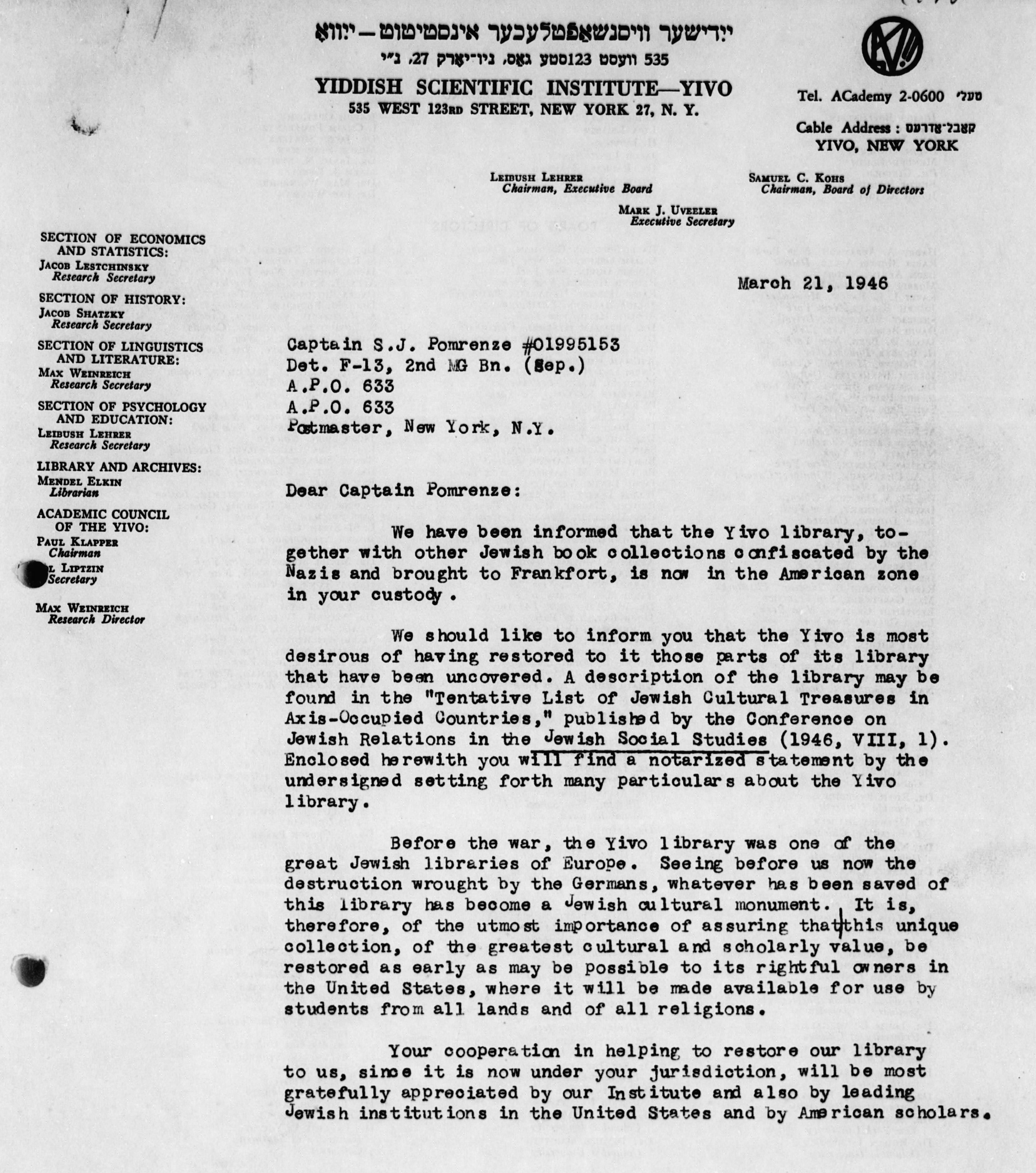
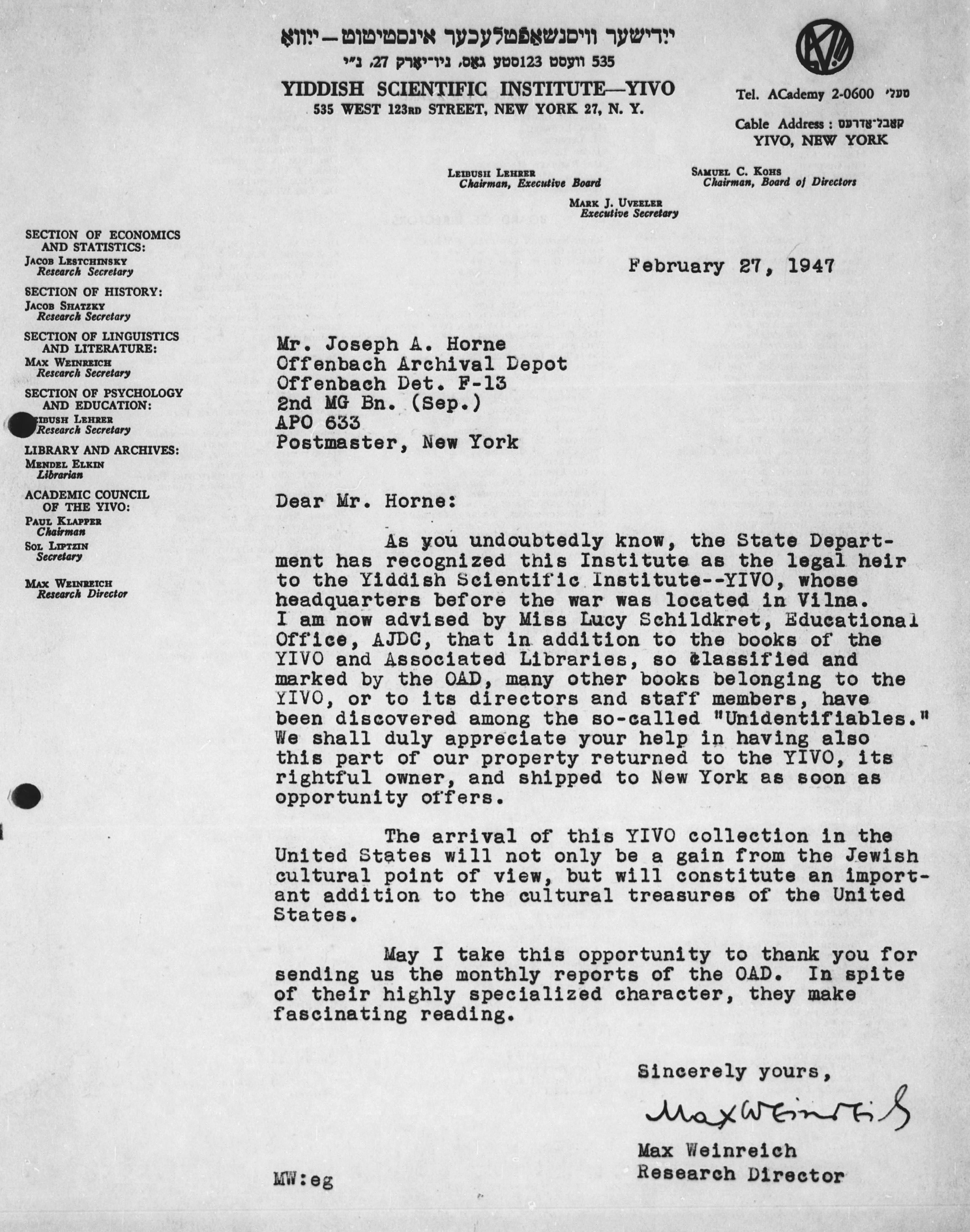
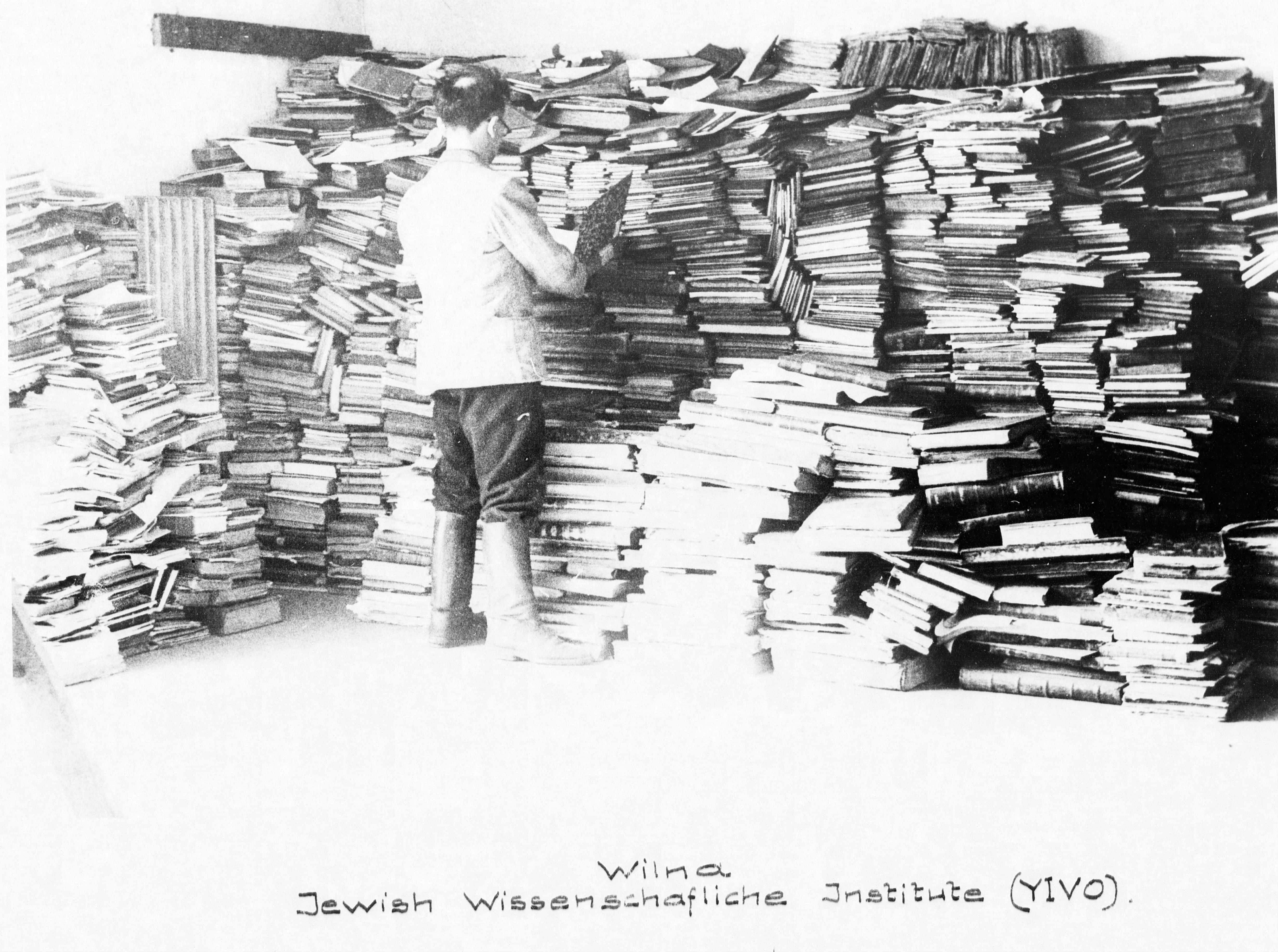
In her memoir, From That Place and Time, Lucy Schildkret describes her encounter with Horne as she works to sort, identify and return the YIVO library of Vilna, Poland.  The Yiddish Scientific Institute (YIVO) was founded in 1925 for the scientific study of Jewish life.  Headquartered in Vilna, the institute had branches around the world including the United States. At the start of the war its headquarters were transferred to New York City.

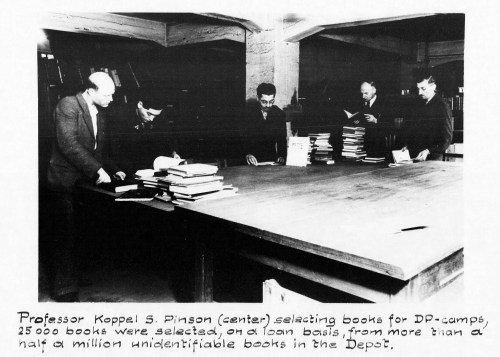
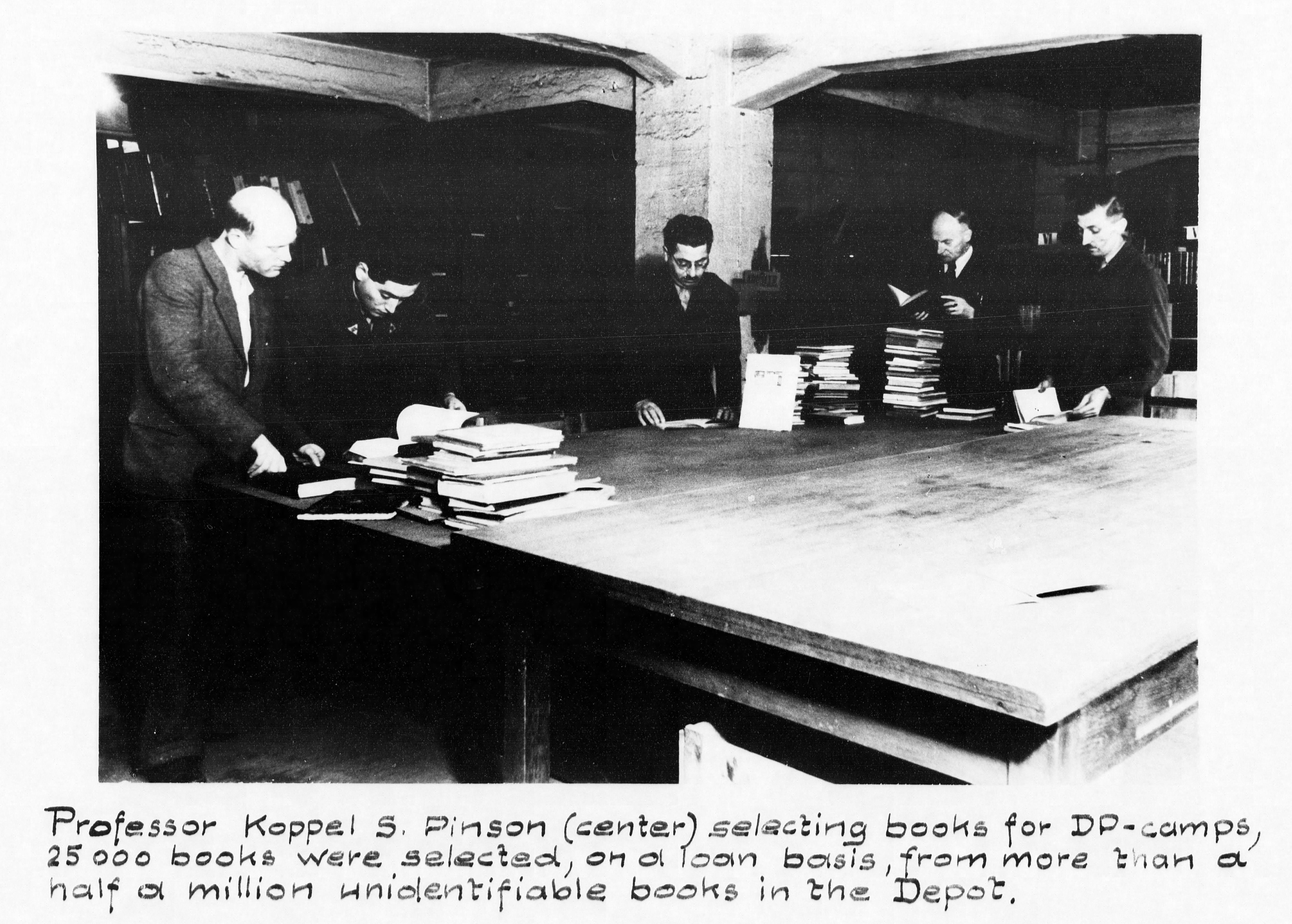
In late 1945, when the YIVO library was identified as being in Frankfurt, visiting Jewish scholar, Prof. Koppel S. Pinson sought permission from the YIVO leadership in New York to distribute, like a lending library, some of the unidentifiable books to Jews living in the Displacement Camps.  It would take time but he would be granted such authority.

A year later, Lucy Schildkret would also be granted authority to work with the books.

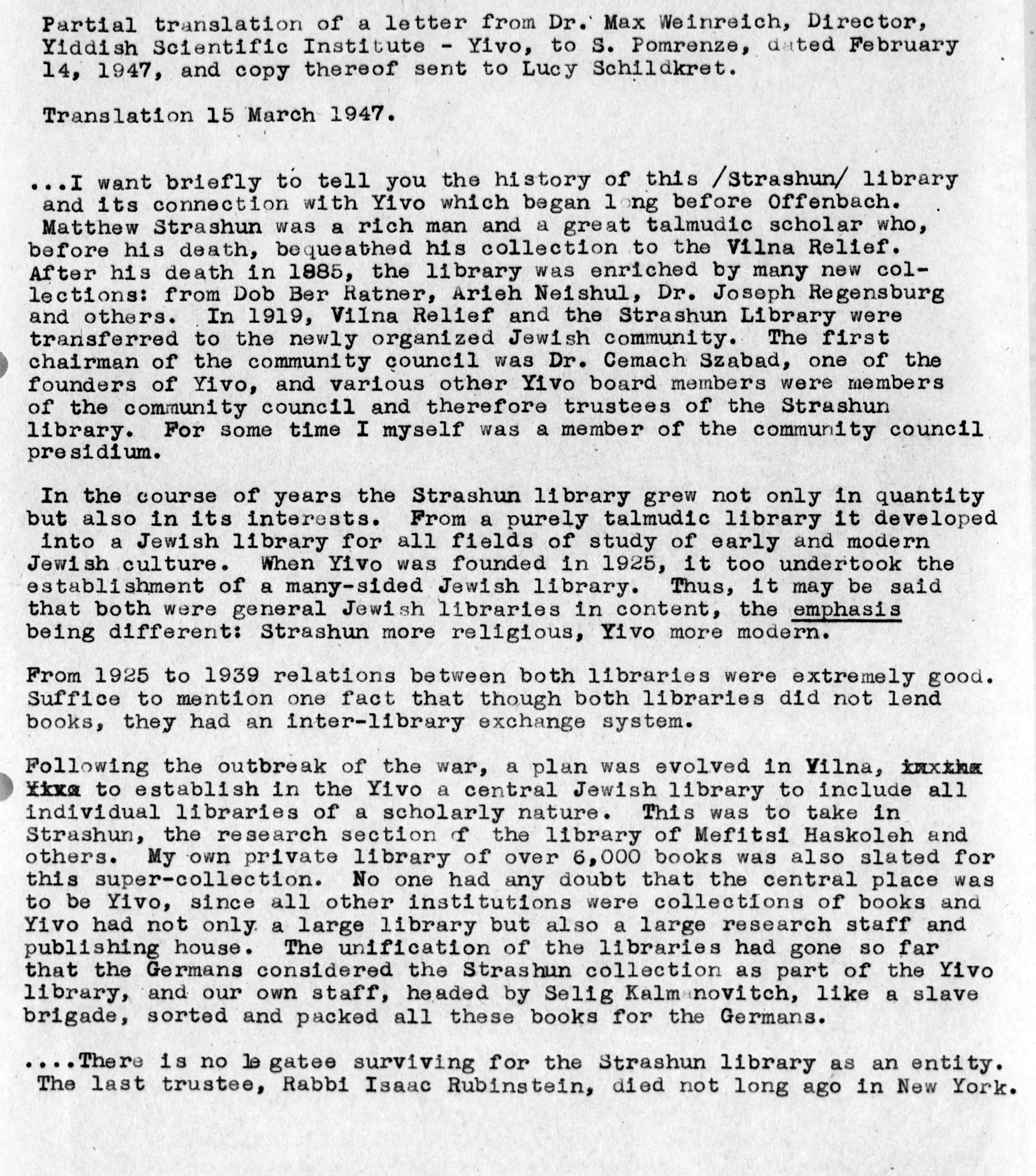
The complexities of sorting, identifying and returning books at the scale demanded of the Offenbach Archival Depot become clearer when reading through the declassified documents relating to what happened with just the YIVO library.  For instance, YIVO like many libraries of its size and mission had been the repository of family libraries.  Books at Offenbach were being identified by ex-libris and other markings as belonging to individuals and/or their families but they had in fact been donated to YIVO (or other institutions) by family members.  There are numerous letters between YIVO administrators with U.S. military officials trying to prove the ownership of items.
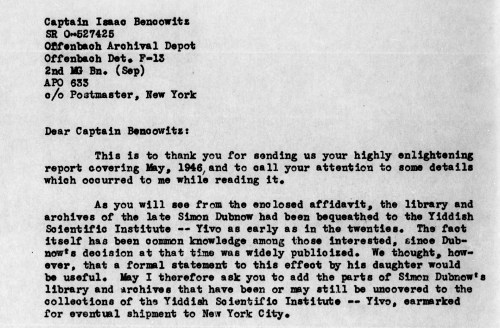
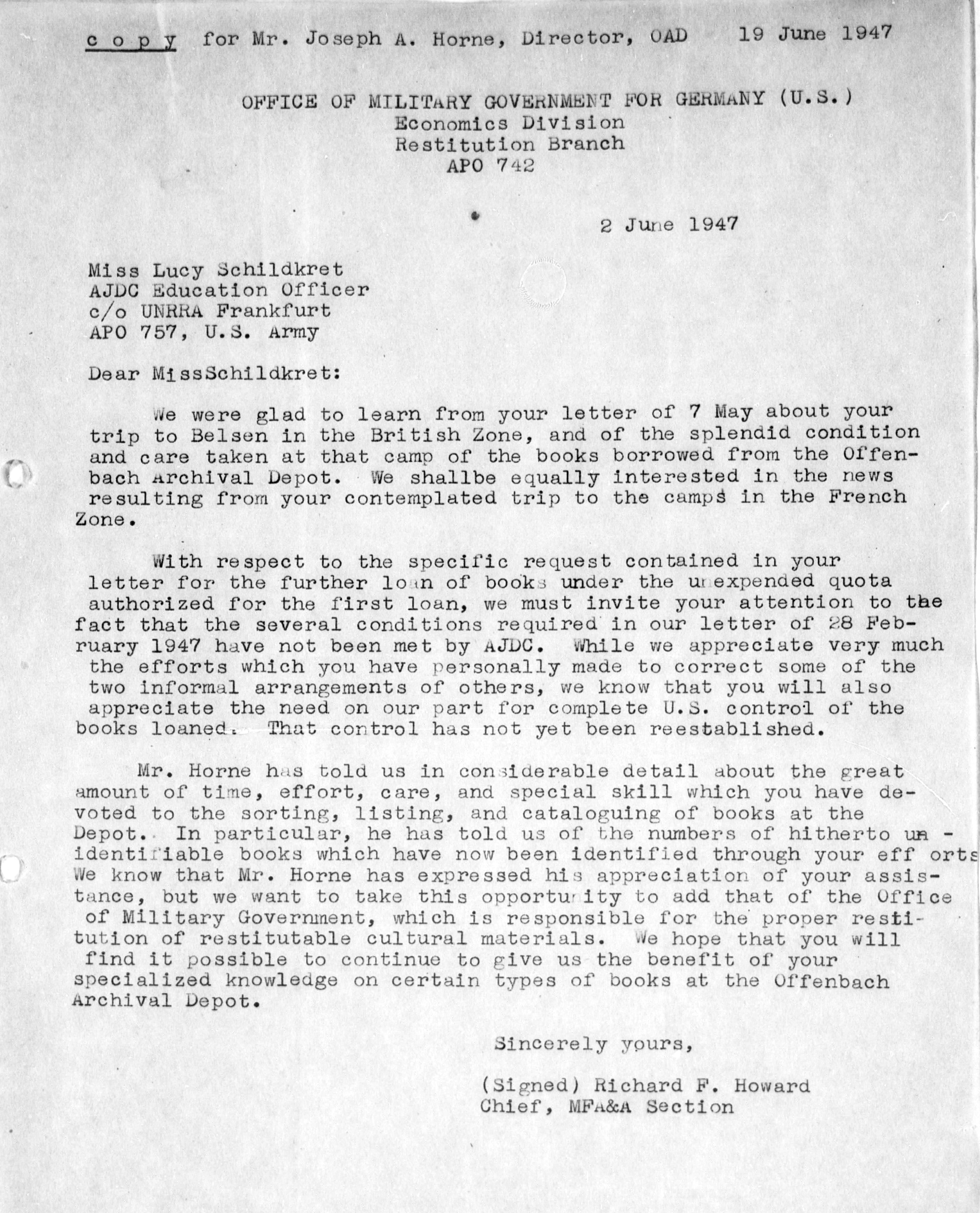
Though correspondence about the YIVO library begins in 1945, by early 1947 the vast library had yet to be shipped to YIVO in New York.  The reasons include continual reduction in manpower, both skilled and unskilled, at the depot and complex, bureaucratic chains of command within the U.S. military, between the Allied zones and even within the YIVO organization.  In a March 1947 document, Horne reports to his superiors that Miss Schildkret has been unable to examine several hundred thousand unidentified books because she had yet to receive authorization.
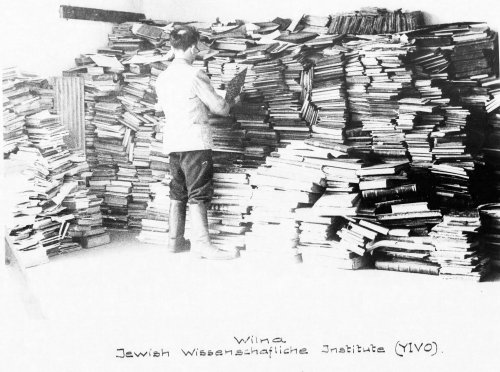
Vilna Library During German Occupation, in the files of the Offenbach Archival Depot

Vilna Library During German Occupation, in the files of the Offenbach Archival Depot

In 1938, Lucy Schildkret had studied in Vilna and worked at the YIVO.  Prior to the war, she would return to the U.S. and work as assistant to the research director at the YIVO headquarters in New York.  In 1946 she journeyed to Europe as an educational worker with the American Jewish Joint Distribution Committee (AJDC), the largest Jewish relief organization in America. Through this organization she was able to work with displaced persons in the camps.  With her skills in Yiddish and time at YIVO, she was able to discern that books that had been labeled as unidentifiable were indeed identifiable.  But even as she acquired the authority to help identify the YIVO library, she maintained her focus of serving the people housed in the displacement camps, and she would do so with a tenacity that would characterize her career for decades to come.
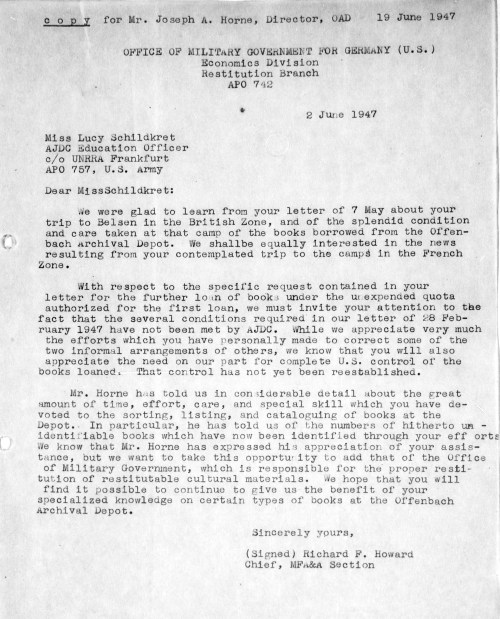
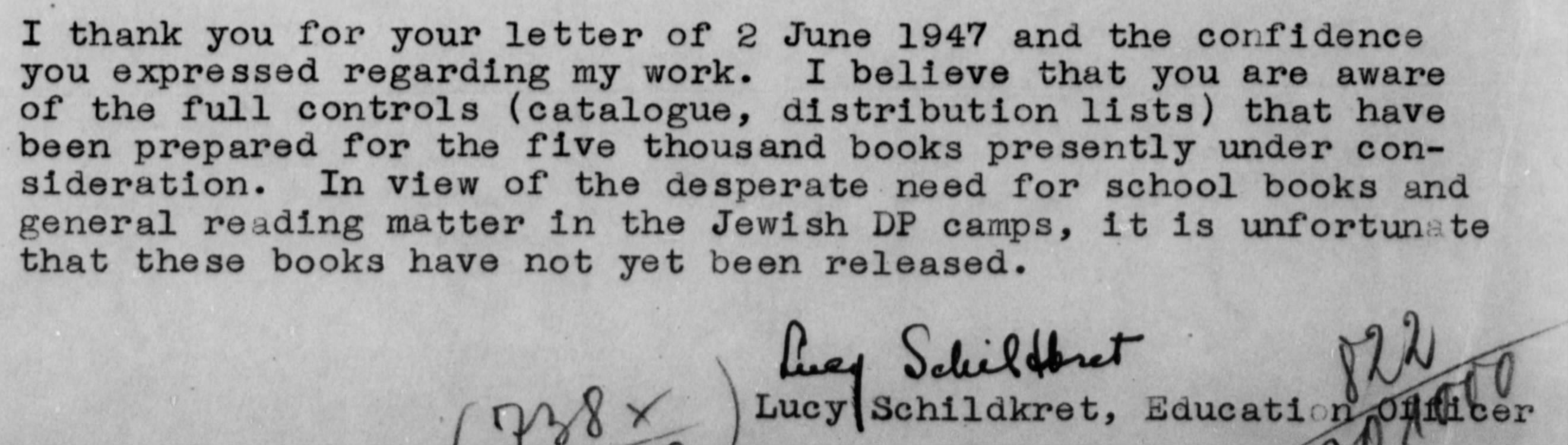
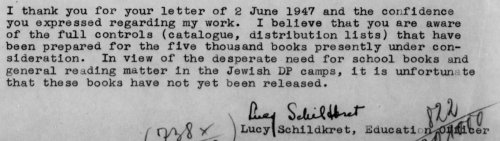
Schildkret responds two weeks later with a letter that concludes:
Her memoir presents a powerful account of the emotions stirred by working with the contents of the library from a place that she had called home and knowing what had happened to the people she’d called friends as the Nazis destroyed the city.
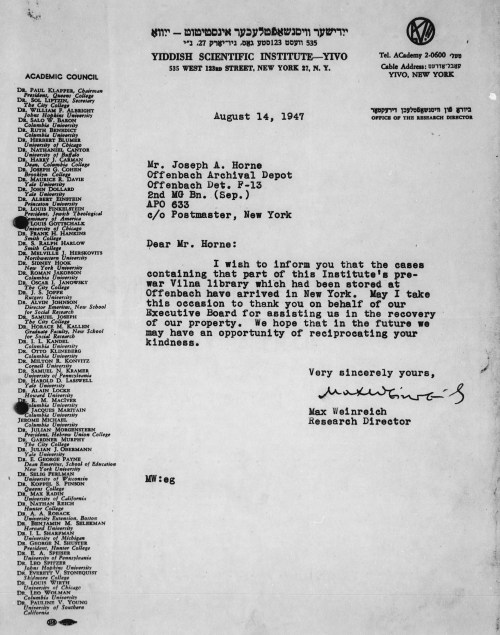
Eventually, with the combined effort of many individuals in several countries, over 90,000 items would be returned to the YIVO.  Seymour Pomrenze who had been pivotal in streamlining systems at the depot would be brought back to help shepherd the return of these items.  In 1998, Pomrenze shared his personal reminiscences of his experience with the Offenbach Archival Depot and the depot’s considerable achievements restituting and distributing millions of Nazi-looted materials including the YIVO library.

Mr. Horne, the person with whom we are taking this walk through history, would wrap up his tenure at Offenbach in 1948 though files show that he continued to support depot activities until its closure.  In the Cold War world, he would, strangely enough, continue to work with books and even return to his earlier interests in music and photography as he embarked upon a new journey.  One world war had ended. A new type of world war had begun. A new weapon in that war was the exchange of culture and what better place to share all that made up culture — from art to music to literature — than in a library.

More to follow …

Sources and Additional Readings

Cultural Plunder by the Einsatzstab Reichsleiter Rosenberg (ERR)

What Became of the Jewish Books? (New Yorker, February 2014)

U.S. Holocaust Memorial Museum — Offenbach Archival Depot

Pomrenze Personal Reminiscence about Offenbach

Mapping the Offenbach Archival Depot

Returning Looted European Library Collections

YIVO Digital Archive on Jewish Life in Poland

YIVO Institute

From That Place and Time: A Memoir, 1938-1947 by Lucy S. Davidowicz and Professor Nancy Sinkoff

Article – Dutch Jewish Ex-Libris Found among Looted Books in the Offenbach Archival Depot (1946) by F. J. Hoogewoud

1939 Photo of Lucy Schildkret in Vilna


Read Full Post »

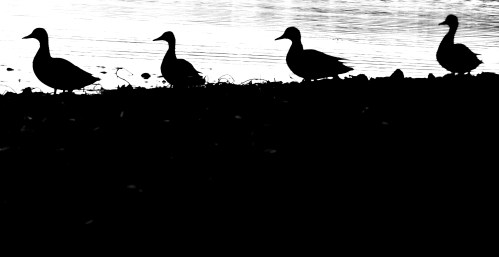
Four ducks making their way along Shannon Beach.  I must say, if there is one animal that I have had much photographic-interaction with this year, it is the mallard duck. No matter where I find myself, in the mountains or in the heart of Boston, so long as I am near a body of water of any size, there will be a duck or two or four.  The Make Way for Duckings reference is to this famous book.

Read Full Post »

Where do you find beauty?  I find it in the strangest, most wonderful of places, like peering through the window glass.  I hope you enjoy the following essay, Finding Beauty, now appearing at Creativity-Portal.com, an award-winning website that helps one explore, nurture and express creativity.

a neighboring tree

a neighboring tree

Read Full Post »

« Newer Posts - Older Posts »