
an orange and a lemon in a bowl
an orange and a lemon in a bowl
Posted in Inspiration, Kitchen Inspirations | Tagged colors, fruit, Inspiration, lemon, orange, Photography, still life | 6 Comments »

Posted in Inspiration, Nature Notes | Tagged beauty, colors, Inspiration, nature, Photography, texture, urban landscape | 3 Comments »

Recently I was walking through the reference section of the Boston Public Library in Copley Square. Though I had a specific destination, probably trying to find a book on stained glass, my eyes kept raking the shelves and a book title made me pause. I pulled the book from the shelf, randomly flipped it open and began to read.
Willis Cofer, seventy-eight years old, a former slave in Georgia, was recounting his memories of how the cook fed the slave children. They were fed all the time, he said, feeding them bread and milk for breakfast, mostly peas and cornbread for dinner, and then milk and bread for supper. There were so many children on the plantation that “dey fed us in a trough. Dey jes’ poured de peas on the de chunks of cornbread what dey had crumbled in de trough, and us had to mussel ’em out. Yessum, I said mussel. De only spoons us had wuz mussel shells what us got out of de branches.”

Strangely enough I had been pondering what to do with my growing collection of mussel shells. I often pick them up when I’m walking along Revere Beach. Sometimes I keep a few shells if we cook some up for dinner. They have always been a treat. I’d never thought of them as a necessary utensil. Just like I’d never thought of children being fed in a trough, like the rest of the farm stock.
The book I’d picked up was called Slave Culture, a 2014 series of books that present excerpts from slave narratives. The narratives were collected starting in 1935. It was at that time that the Federal Writers’ Project, one of Franklin Roosevelt’s New Deal programs, was established. The program provided jobs for unemployed writers, researchers, historians and others. One of those jobs included interviewing more than 2000 former slaves across seventeen states like Willis Cofer.
Sometimes the stories captured were kept in the vernacular, like Willis Cofer’s childhood memories and those of Adeline Cunningham, 85, of Texas. She shared, “Dey feds us well sometimes, if dey warn’t mad at us. Dey has a big trough jes’ like de trough for de pigs and dey has a big gourd and dey totes de gourd full of milk and dey breaks de bread in de milk. Den my mammy takes a gourd and fills it and give it to us chillun. How’s we eat it? We had oyster shells for spoons and de slaves come in from de fields and dey hands is all dirty, and dey is hungry. Dey dips de dirty hands right in de trough and we can’t eat none of it.”
Sallie Crane, at least 90 years old when interviewed in Arkansas, remembered eating out of a trough “with a wooden spoon, mush and milk. Cedar trough and long-handled cedar spoons.” Her owner’s children would taunt the slave children with their leftover school lunches, “Hold it out and snatch it back! Finally, they’d give it us, after they got tired of playing.”
Other narratives were “cleaned up” by the interviewer or the former slave had received an education dependent upon the whims of his or her previous owners. Mary Anderson of North Carolina recalled in her 1937 interview:

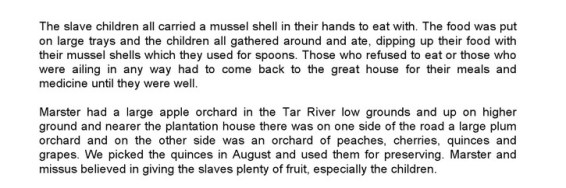
The narratives are in the public domain. They can be found on the Library of Congress website. Universities in many states, especially in the southern states, have made them available in their libraries and online. So why read them? Institutionalized slavery in the U.S. was ended over 150 years ago. People of all shades fought and died to see passage of the Civil Rights Act of 1964 to end segregration and discrimination. Why revisit the past?

Well, at one point, I believe that there were six million people enslaved in this country and many of those people had been enslaved over successive generations. To oversimplify, they were purposefully denigrated, treated like animals, and considered less than human. They were bred, fed and fattened to be sold and purposefully kept uneducated to dampen any dreams of a different life. And some of the people who suffered were my ancestors, and I’m fairly sure that some of the people cracking literal and figurative whips were my ancestors too. All of that history forms the foundation of this country. The seeds of fear, hate, discrimination that were planted so long ago have not disappeared. They can too easily sprout again and in some places they clearly have.
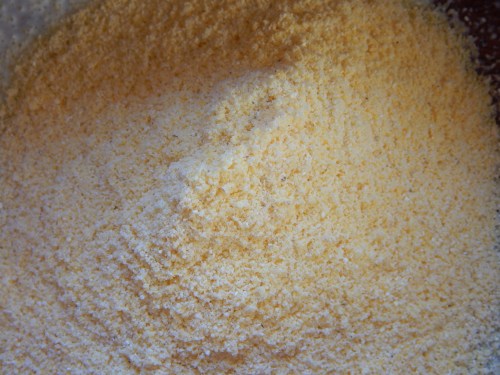
I’d say revisit the slave narratives as a way to get a sense of what happened, the impressions made upon a people and upon a country, and to then reflect upon what has changed and what has not. I was moved by Willie Cofer’s words to consider something I’ve never done before, to create an art installation. I wanted to … and perhaps I will do it … to find a cedar trunk and carve it into a rough-hewn trough. To place nearby a tree and from its bare branches hang mussel shells. To fill the trough with milk and torn up pieces of bread and peas. I did find a little wooden box and one of my mussel shells and a wooden spoon. I poured in some milk and sprinkled in some corn meal. I would do a little photo shoot, you see. It was only when I tore up the bread and tossed it into the box that I began to cry.
Posted in Inspiration | Tagged art project, black history, food history, history, Inspiration, mussels, oral history, Photography, slave narrative, slavery, still life, storytelling | 5 Comments »

Posted in Inspiration | Tagged beauty, black and white, blooms, flowers, indoor gardening, Inspiration, paperwhites, Photography | 1 Comment »
My brother described a scene that I wish someone would paint.
He lives in Virginia, not in a rural place, but not an urban megalopolis either. A plain old city with a crumbling downtown and further out global firms building plants, and the accompanying fancy housing for their management, on lands that used to be working farms, if not outright plantations if you go back far enough.
It’s a city near the river and crisscrossed by highways but in the beginning it was the railroads that allowed this city to make its fortune, bridging north and south, a passage way for goods of all sorts.
It was on a literal bridge that the incident took place.
My brother was driving home on a nice new road. He was recounting stories of his day to me when he said, “Oh my God. You won’t believe …” I reacted thinking at first he was seeing a roadside accident. He calmed me down and then explained, “Overhead, the bridge that crosses the road, there are deer passing by in the night. They are walking on the railroad tracks on the bridge overhead fading in and out of the mist.”
A number of people pulled off the road to watch, like my brother, hoping no train would come before the animals could walk into the surrounding fields and woods. Nothing happened. Just the lingering memories of a beautiful sight.
Posted in Inspiration, Nature Notes | Tagged family, imagination, Inspiration, musings, nature, painting prompt, storytelling | Leave a Comment »

The feather became wet as I watered the plants. Yes, I have feathers in my garden. 😉
Posted in Inspiration, Nature Notes | Tagged color, feather, indoor gardening, Inspiration, nature, Photography, water | 1 Comment »
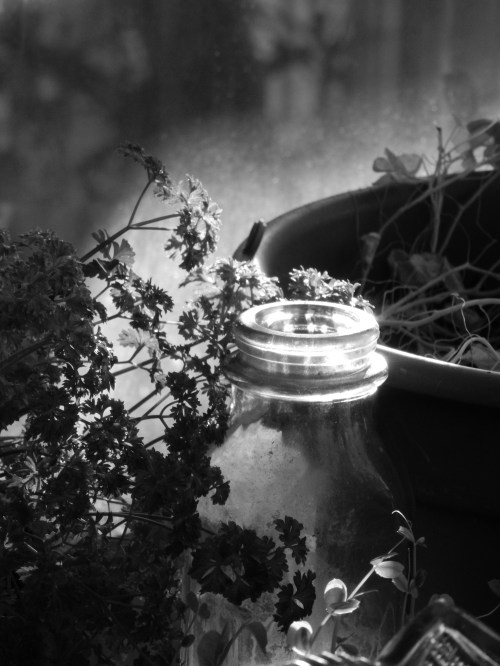
Posted in Inspiration | Tagged abstract, black and white, Inspiration, light, Photography | 3 Comments »

Make your way to Cambridge this winter to view a unique printmaking exhibit at the Cambridge Center for Adult Education (CCAE) in the heart of Harvard Square. Curated by Anulfo Baez, the exhibit features the work of artists who are also faculty with the CCAE. On view is the most recent work by the six artists — Jason Asselin, Selma Bromberg, Janet Campbell, Susan Paladino, Susan Rice and Vinicius Sanchez. Their prints, showcasing a range of techniques including intaglio, relief printing, encaustic collagraphs, pianographic printing and more, are arranged on walls throughout the center. It’s a small space so you can get delightfully up close and personal with the artwork.

I appreciated the exhibit labeling, not only providing basic information like name of the artist, print title, etc., but also QR codes that link to detailed artist interviews. If you’re unfamiliar with using QR codes, simple instructions are provided for how to use your smart phone to download an appropriate app. And if you are without smartphone, you can read the interviews online at The Evolving Critic, Baez’s well-respected arts and culture blog.
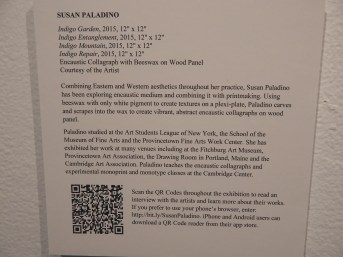
Unable to visit the show firsthand? Then I highly recommend reading the insightful interviews that Baez conducted with each artist. The artists discuss specific printmaking techniques but its especially interesting to read about each individual’s distinct journey to becoming artist and teacher. Interview links can be found at the bottom of this post: http://evolvingcritic.net/2015/12/17/new-project-an-exhibit-on-printmaking-at-the-cambridge-center/
The show has been up and running since January 11th. An opening reception is scheduled for this Thursday, January 28th, 5:30-7:30 and an artist talk is scheduled for Wednesday, February 3rd, at 11am. Please note that some of these original works are available for purchase. Enjoy!
Posted in Inspiration | Tagged art, art exhibit, artists, beauty, colors, creativity, Inspiration, printmaking | 2 Comments »
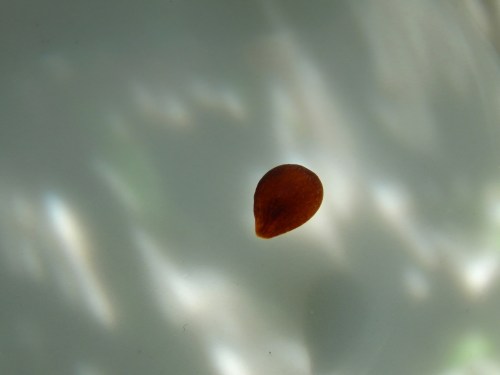
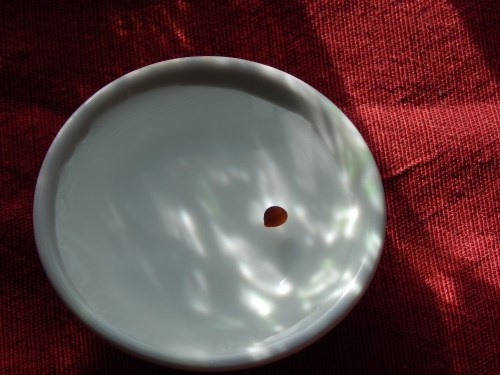
I found the seed on the table this morning. I placed it in a little dish because you never know what you might do with a seed, right?
Posted in Inspiration, Kitchen Inspirations | Tagged abstract, apples, fun, Inspiration, Photography, seeds | 6 Comments »

The paperwhites are doing well. I took one bag of bulbs and have them growing in all manner of vessels on two floors. They are a contemplative treat as I go up and down the stairs.
Posted in Inspiration | Tagged beauty, colors, flowers, growth, indoor gardening, Inspiration, paperwhites, Photography | 2 Comments »

