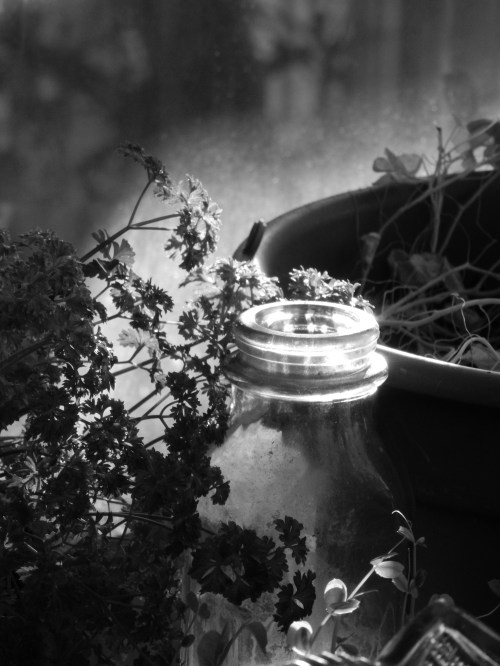
or I may move into a modern home where the glass will be quite clear without an imperfection to be found. But until then what pleasure to pause and peer out, as I did this sunny day, and never truly know what will be seen.


or I may move into a modern home where the glass will be quite clear without an imperfection to be found. But until then what pleasure to pause and peer out, as I did this sunny day, and never truly know what will be seen.


Posted in Inspiration | Tagged abstract, Branches, glass, Inspiration, perspective, Photography, trees, urban landscape, windows | 2 Comments »

dried blossoms on the ground

and Zoe’s leaves still kicking around

Posted in Inspiration | Tagged abstract, colors, flowers, Inspiration, leaves, Photography | 1 Comment »

Not sure what the neighbor has still growing in his garden but it is lovely up close and through the rippled glass. Happy holidays, folks.


Posted in Inspiration, Nature Notes | Tagged abstract, colors, Inspiration, nature, Photography, rippled glass, urban landscape | 2 Comments »
This too is a story about gifts.

watercolor by ludwig a. joutz
Ludwig Aloysius Joutz (1910 – 1998) was an architect noted for his work with religious and educational institutions primarily in the Washington, DC area. I learned of this gentleman while researching Joseph Anthony Horne as part of my Interlude Series.
By the time Horne meets Joutz, Joutz had already earned his doctorate. His 1936 thesis is still referenced with regard to medieval church architecture. In 1939/40 he was awarded a travel grant from the German Archaeological Institute but was perhaps unable to use it because of the outbreak of World War II. He would be drafted into the German army and become a prisoner of war.
Exactly how he and Horne originally met is unclear. It might have been as early as the Invasion of Italy where Joutz was captured but certainly by the end of the war they were fast friends. The earliest document that I’ve been able to find so far is dated May 1947. In that year, Horne was working with the Monuments, Fine Arts & Archives unit.
As the Monuments Men continued their efforts to find, catalog and restitute items looted by the Nazis and others during the war, Joutz would become a valuable resource. German-born, he was fluent in English and several other languages and knowledgeable about the art and literary worlds. Horne, American-born and fluent in German thanks to his immigrant parents, was culturally sensitive and knowledgeable about the arts. They apparently worked well as a team.
Between June 1, 1947 and March 1948, Joutz would serve as an operations specialist on books and archives at the Offenbach Archival Depot. During that period, he and Horne, by then director of the Depot, would become great friends. Horne would aid Joutz in resettling in the U.S. where he would establish himself as architect. They would become godparents to each other’s children and remain friends until the end of their days.

joseph and elsie horne and ludwig and lucy joutz
Throughout out his personal and professional life, Joutz would travel around the world. As part of those travels, whether for work or for pleasure, he would view his surroundings with an artist’s eye and try to capture what he saw. Yes, with a camera like his friend Horne, but Joutz would also explore many different forms and techniques of art. He experimented with pen and ink, pastels, watercolor, woodblock prints, papercutting and more. How do I know this? By a gift he painstakingly assembled for his son.

When visiting Joutz’s son, Frederick, a noted economist, I noticed a stack of suitcases tucked in a corner. Now these suitcases were the old-school, at least 1950’s if not earlier, kind of suitcases that are deep enough to curl up and go to sleep in and strong enough to, well, last a lifetime. Frederick explained that they contained his father’s artwork. Now at first I thought he meant prints related to his father’s architectural practice, photos of completed projects, etc. But that was not so.

artwork by ludwig joutz

artwork by ludwig joutz
Inside the suitcases was artwork spanning nearly five decades. Joutz had carefully organized his artwork, everything from sketches on the back of used envelopes to sweeping washes of color applied to delicate Japanese papers. It was all layered in stacks in these deep suitcases. The son remembered his father engaged in the process and how he culled items along the way. One can only imagine what the father may have considered not worth saving.

artwork by ludwig joutz
What I managed to see, the content of only two of the many suitcases, was breathtaking in its scope, in the diversity of imagery, and the range of techniques attempted. Each image suggested a story. On some of the pages were notes. What did they mean?

artwork by ludwig joutz

artwork by ludwig joutz
Some of the works were clearly copies of masterpieces, as done by any art student spending a day in an art gallery might do, but many images appeared to be of ordinary people. Perhaps seen in European town squares or along desert routes when he traveled in Egypt?

artwork by ludwig joutz

artwork by ludwig joutz

artwork by ludwig joutz?
Then there are the images that are ecclesiastical in nature … were they the early concepts or cartoons for church murals? Did the murals still exist or had they become lost and all that remains are these vestiges?


Those are stories that others may choose to research and tell one day. I am grateful that his son allowed me to see just a fraction of what is contained in those suitcases. And a salute to Mr. Joutz for preserving his own artwork as he helped to preserve the works of others throughout his career.

artwork by ludwig joutz
Sources and Additional Readings …
Fold3.com Holocaust Collection
Posted in Inspiration | Tagged architecture, art, beauty, colors, family, family archives, gifts, history, illustration, Inspiration, Monuments Men, Photography, sketching, storytelling | 5 Comments »

I will not likely make my goal of photographing by Christmas day all eighteen Burne-Jones angels in the stained glass windows known as the Christmas Windows at Trinity Church in the City of Boston. The logistics are just not going to work out. But …

… it has been a delightful exercise. As I review what I did accomplish, new ideas are forming.

I think I shall consider this attempt a “first draft.” We’ll see what unfolds in the new year. 😉

You can read more about this personal project here: https://wordsandimagesbycynthia.com/2015/11/02/as-for-those-angels/
You can view the gallery of angels here: https://photosbycynthia.smugmug.com/ArchitectureDesign/Burne-Jones-Angels/

Posted in Inspiration | Tagged angels, architecture, art, beauty, colors, Edward Burne-Jones, Inspiration, Photography, stained glass, Trinity Church, William Morris | 8 Comments »

Even on a gray day in Cambridge and Somerville, the colors were popping out.


Posted in Branches, Inspiration, Nature Notes, On the Road | Tagged beauty, colors, Inspiration, nature, Photography, urban landscape | 3 Comments »

A friend traveled to Turkey and returned with a gift, a hand-painted bowl. The bowl inspired me to change my tablecloth from paisley to red to accent the bowl and then the colors of the bowl inspired me to buy clementines. Cherries came to mind as well except I don’t really like cherries. This morning, with light filling the bowl, I was able to reach for the fruit. As I ate the fruit and the air filled with the scent of oranges, I thought of gifts. My aunt told stories of post-Depression Virginia where her Christmas present was an orange and peppermint candies. Of late I’ve been on the cusp of worrying about all the Christmas cards not mailed, the presents not bought but as I held the fruit in my hand I let go of a bit of the guilt.

I’ve received lots of gifts this late autumn edging into winter. A shell from a young man as I walked along Revere Beach. He saw me stopping to collect and inspect and occasionally photograph, and so he came over to me and held out a speciman and simply said, “This one is beautiful.” I agreed. He kept standing there, shell in hand. “Is this for me?” I finally asked. He nodded. I took it. We separated and spoke no more.

A woman I’ve met on occasion, who can come across as rather brusque, she stopped to talk with me. As I helped her make a purchase, I admired a bracelet she wore. “It’s tiger agate,” she said, sliding it off of her wrist. I held it and then tried to give it back. She refused. “It is yours, “she snapped. “See? It does not match any of the other jewelry I wore. Clearly God made me wear this today for you. You are a tiger.” I must say, I’ve been called many things, but that may have been the first time I’ve been called a tiger.

Gifts come in many forms. I will treasure the bracelet but mostly because of the memory it will evoke. I will treasure the shell, and all the shells given. And, of course, the bowl and the oranges and other fruits it will hold, and the memories that rise with their fragrance.
Posted in Inspiration, Kitchen Inspirations | Tagged clementine, colors, food, food photography, gifts, Inspiration, memories, Photography, storytelling | 7 Comments »
Lin A. Nulman is an Adjunct Professor of English at Bunker Hill Community College. Her poetry has appeared in Black Water Review, Tanka Splendor, and the anthology Regrets Only: Contemporary Poets on the Theme of Regret, among others. Lin puts her heart and soul into teaching and while I’ve yet to take a formal class, I have felt a student. In her own unique ways, she has challenged me to both appreciate and expand upon the work that I do as writer and photographer. It’s with pleasure I share Lin’s words and images about her grandmother, a great influence in her life.

photo by Lin A. Nulman
“Oh, you see one tree, you’ve seen them all,” a woman once said to my grandmother, who had just remarked on a tree she found beautiful. Gram repeated the comment throughout my childhood as “the saddest thing I ever heard anyone say.” I think so, too, and I’m thankful for the gift of knowing why.
We took walks when I was a little girl, and even not so little, in our neighborhoods and on the beach. Often Gram would stop to look at something commonplace, such as weeds in a patch by the side of the road. Isn’t it amazing, she would say, how Nature creates so many shapes of leaves in just this one place?

photo by Lin A. Nulman
Eventually I reached the age of impatience with what grown-ups noticed that wasn’t rare blue beach glass or a good climbing tree. But even when I felt impatient, I knew I could see what she was talking about. I don’t know if Gram believed in God, certainly not in a kindly God, but she did deeply believe in Nature, wonderful and endlessly giving. If you looked at it that way. And I do, and I have to, despite all the other ways my eyes still need to open. Her view was one of my starting places, creatively and spiritually.

photo by Lin A. Nulman
Recently a latent love for bohemian style has sprouted in me, thanks in part to author and blogger Justina Blakeney. I stay up too late turning pages of her new book and feeling out of breath. Justina defines bohemian style as the product of “a creative life and an active engagement in the search for alternative ideals of beauty…Our worldly collections are as eclectic as we are…Decorating is about feeling free, having fun, rejecting traditional notions about what goes with what…and getting a little bit wild.” [I’m quoting from her introduction to The New Bohemians: Cool & Collected Homes. UNputdownable.]

photo by Lin A. Nulman
Even my 1906 copy of Putnam’s Handbook of Etiquette warns New York High Society about the habits of “Bohemia”, over there in Greenwich Village, beyond “the borders of wise convention”, definitely over the edge and unacceptably wild.

photo by Lin A. Nulman
Her book was in my mind recently on a walk through the Fens, one jewel in the Emerald Necklace of green spaces that loops through Boston. It has a wide area of community gardens, where dozens of people fulfill their own visions with flowers, trees, bushes, berries, vegetables, bamboo, grasses, and leafy plants. It is a wonderful place to open my grandmother’s eyes, to see the shades and shapes Nature creates in just one corner of a park, sometimes helped along by a little human artistry: a painted gate, a statue, a purple disco ball. On this walk, my looking as I was taught to look revealed Nature, to my joy, as The First and Ultimate Bohemian. Everything goes with everything, so feel free and always be a little bit wild.

photo by Lin A. Nulman
I challenged myself to photograph the gardens in December, without most of the flowers to help, and still found colors and forms running madly, beautifully together, eye-catching contrasts of silhouette, especially as I lost the light, and small places full of texture and depth. Thanks, Gram.

photo by Lin A. Nulman
Please look for my blog, The Creative Part-Timer, in early 2016.
Posted in Guest Contributor, Inspiration, Nature Notes | Tagged Back Bay Fens, bohemian style, creativity, family, friendship, gifts, Inspiration, Justina Blakeney, life, nature, perspective, Photography, storytelling, the Fens, urban landscape | 3 Comments »

The recipes are good. They are simple, elegant and refined, like the family sharing its history through food. The preface describes the book as telling the story of five kitchens and three generations of women. “Mother-daughter duo” Alice Randall and Caroline Randall Williams use the book to share stories from the kitchen, a place that could be both forboding and a place of great calm, depending upon one’s generation (e.g. slavery) and one’s location (e.g. north vs. south). Traditional, mostly southern recipes, are reworked. Flavoring agents like bacon dripping, ham hocks, and butter are replaced by olive oil, or no oil at all. But fear not. As I told my big brother, a traditional southern cook, flavors have been retained if not indeed heightened with the liberal use of spices. My favorite recipes were the simplest like the Warm Onion and Rosemary Salad, Herb-Roasted Salmon Fillet, Fiery Green Beans and Links Salad composed of green beans, green peas, cucumber and basil.
There’s a Homemade Peanut Butter recipe. The authors describe peanut butter “as a bass note that can carry a wide variety of top notes” and encourage users, once comfortable with the basic recipe, to add spices. Be creative. Set no limits. It’s a sentiment that fits the family.
Many of the book’s recipes from Mama’s Tequila Ice to Eggplant Tower with Mashed White Beans open with brief headnotes that describe the family connection to the dish. Whether its a variation on a meal served while hosting parties during the Harlem Renaissance or a reworking of a meal had as family members traveled overseas in Yugoslavia, each recipe clearly has meaning.
While its an eclectic mix of recipes, overall the book is quite a culinary inspiration. The recipes don’t begin until page 80. Those first seventy-nine pages are a poetic examination of five kitchens, and American history, beginning with Minnie Randall (1897-1976) through Caroline Randall Williams (b. 1987). Reviewing the book has reawakened my desire to ask family members about their memories of food past and what they’d like to cook in the future. You don’t need to be of African American heritage to enjoy this book. It’s an American experience that can be shared, quite deliciously, by all.
I received this book from Blogging for Books for this honest review.
More Info …
Posted in Inspiration, Kitchen Inspirations | Tagged African American history, black history, book review, cookbooks, cooking, culture, family, food, healthy eating, Inspiration | Leave a Comment »

This is what happened when raspberries accidentally got crushed in my house. They’d bounced around a bit too much in their packaging on the way home. Steve took a look at them, rubbed his chin and then with a faraway look in his eyes said, “I have an idea.”

The next morning there was a sweet scent in the air. I made my way into the kitchen, and there on the table next to the plate of hot buttered toast sat a small bowl of warm red sauce. His recipe, more or less: crushed berries cooked with a little butter and brandy, sweetened with a touch of sugar, and flavored with half a teaspoon of crushed black walnuts.

It’s a recipe that will continue to evolve. If we accidentally or on purpose crush anymore raspberries, he’d like to try maple syrup in place of the sugar. And maybe toss in a different nut like crushed hazelnuts. I’ll try any variation on the theme so long as there’s time to photograph the results. Have a good day. 😉
Posted in Inspiration, Kitchen Inspirations | Tagged black walnuts, cooking, creativity, food, food photography, Inspiration, Photography, raspberries, recipes | 1 Comment »