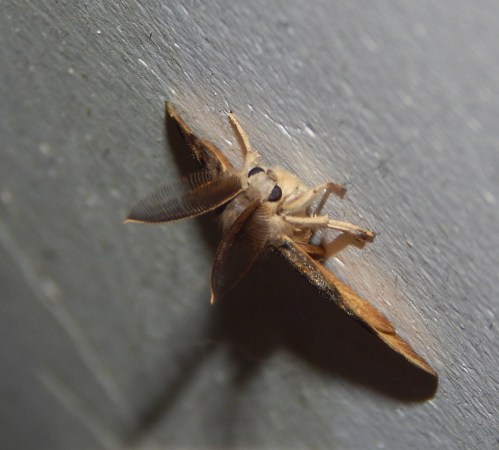
It was hot yesterday. All the windows were open so I wasn’t too surprised to discover this moth flying about in the kitchen. It got stuck for awhile, unsure how to depart. It rested low on the wall and by leaning over a radiator and twisting a bit (and carefully) I was able to get this one shot. Not too long after, it arose from the shadows and made its way out into the night.
Posted in Inspiration, Nature Notes | Tagged insects, Inspiration, moth, Photography, urban landscape | 1 Comment »
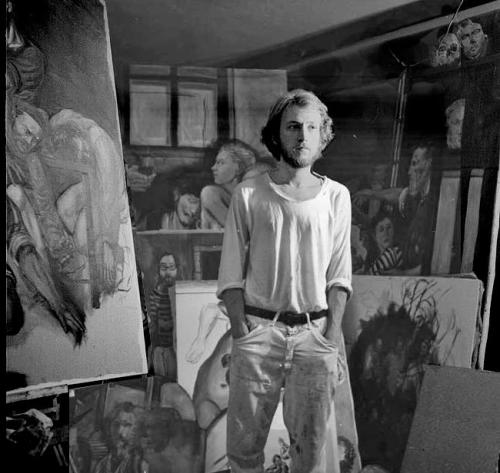
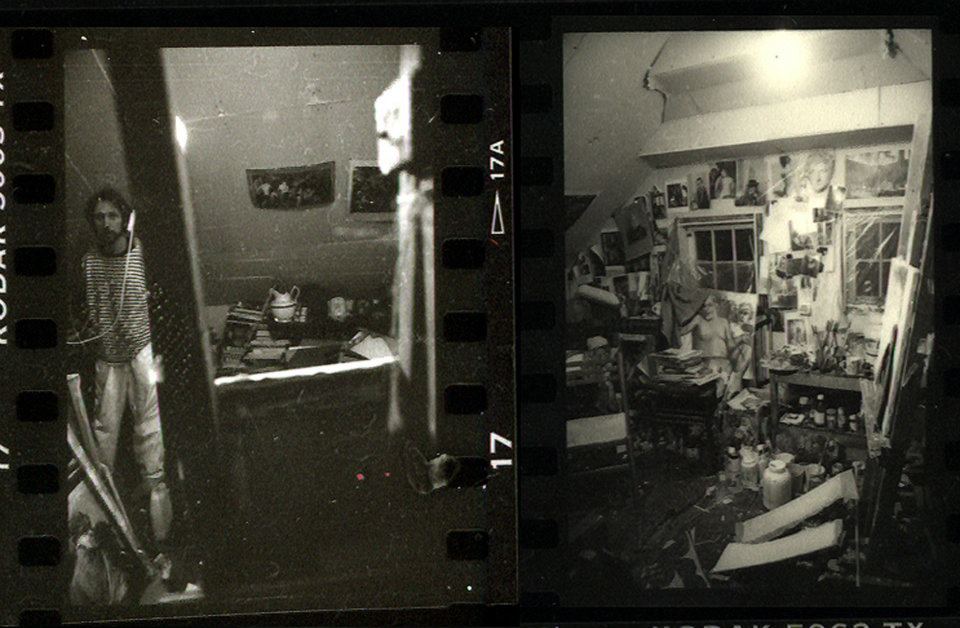
donald langosy in a studio from the early days
For the past six Thursdays it has been been my pleasure to share the words and images of painter Donald Langosy. In collaboration with his daughter, he produced a unique 14-page memoir visually chronicling his evolution as an artist. I was allowed to share that memoir on this blog interspersed with additional words and images by Langosy.
Last Thursday’s post – story of my art – shakespeare and the joy of being, revealed that Mr. Langosy was diagnosed with multiple sclerosis in 2003. Has it affected how he expresses himself as an artist? Of course. But decrease in mobility and even fine motor skills has in no way decreased his creativity or even his productivity. As he has stated he does not allow MS into his studio, but he has welcomed visitors on occasion.

donald langosy still in the studio present day
I have been lucky enough to sit in his space and at his side and see his works-in-progress upon the easel, the canvases stacked against the wall, his sculptures tucked in high nooks, and what I especially love (and I tell him each time) the books, the books, the books, on so many different subjects, collected over the years! And no matter how crammed the space becomes with paintings and books and new technologies to enable him in his work, there is always space for the grandchildren.

grandchildren in the studio
Below are a few more images. Please enjoy this virtual peek inside the studio, present and past, of Donald Langosy.


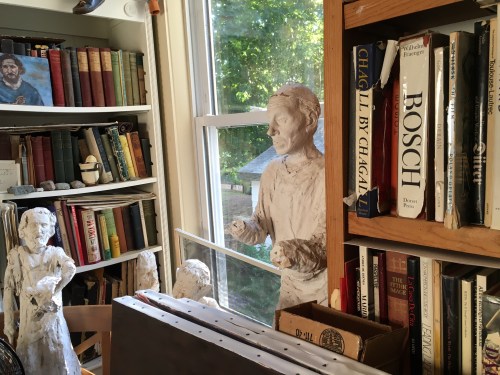
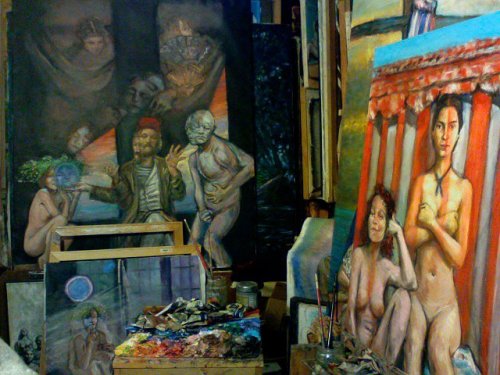
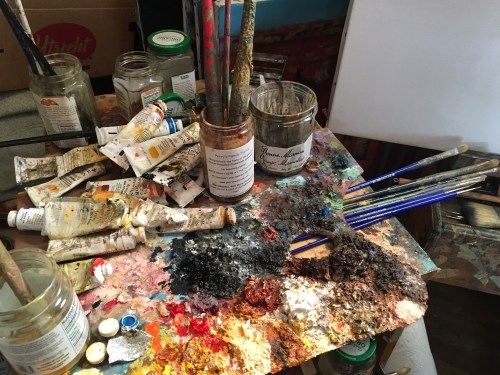

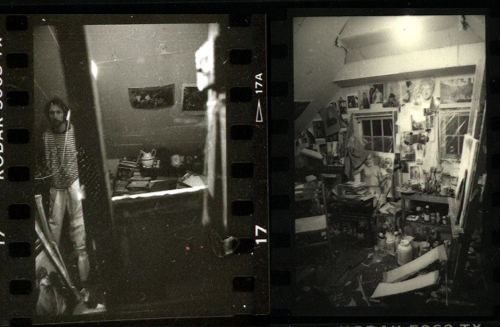
Photos provided by Zoe Langosy.
—
View The Story of My Art: 1, 2, 3, 4, 5 and 6.
View four decades of Langosy’s work at http://www.donald.langosy.net/
See what’s current on Langosy’s Facebook page.
His contact: Zoe Langosy at zlangosy@me.com.
Posted in Guest Contributor, Inspiration | Tagged art, artists, beauty, books, contemporary art, creativity, Donald Langosy, family, fine art, Inspiration, memoir, multiple sclerosis, painting, Photography, storytelling, studio | 4 Comments »

I heard it before I saw it. Thump, thump, thump, thump, thump. Pause. Repeat.

Posted in Branches, Inspiration, Nature Notes | Tagged animals, birds, Inspiration, nature, nature photography, Photography, woodpecker | 2 Comments »
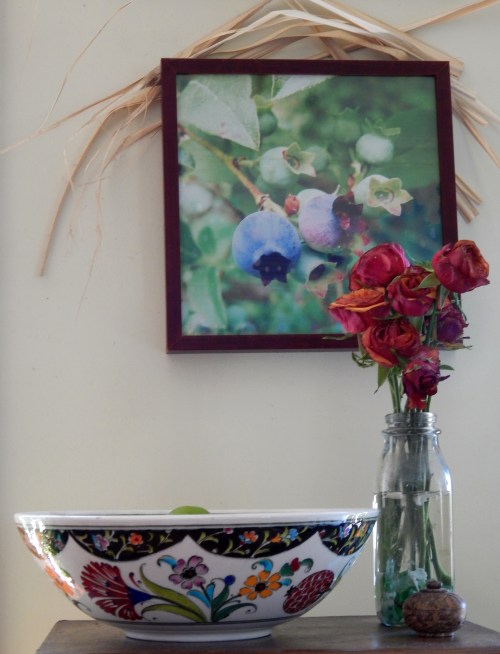
Posted in Inspiration, Kitchen Inspirations | Tagged ceramics, colors, decor, flowers, fruits, gifts, Inspiration, interior decoration, kitchen, Photography | 2 Comments »
No picture this week but I can share this …
I’ve picked up a few things about him. He’s Haitian and speaks Creole. He joined the neighborhood maybe two years ago. He’s slender, and his skin is like black walnut. Smooth and dark. He’s rather ageless — he could be 40 or he could be 70. Is he good or bad? That I do not know. He does seem to move with grace through the world from my vantage point. I live along a main thoroughfare and along this thoroughfare he walks with an easy gait. And when he walks he sings. Operatically.
Even when I am not peering out of a window, I know that he is near by the song in the air as he moves. I know so little about opera (and that little is thanks mostly to PBS and to Bugs Bunny) and yet when he sings I can recognize what little I have heard. La Traviata. La Boheme. Wagner. And then during a recent rainstorm, when I left the windows a little cracked to let in the wonderful fresh air, I heard his voice.
I looked out a window and there he was, walking along nonchalantly, with his bags from the local grocery store, dark skin and hair, white shirt plastered against his whippet form, and those khaki pants. His shoes I could not see in the shadows of the looming night. His voice filled the air. This time it was Ave Maria.
His head was tilted back, and when he stepped beneath the glow of the street light, I could see the white of his teeth and eyes. I’d just heard Ave Maria sung at a funeral a week or so before. So solemn that day. This man, my unnamed fellow, sang it with such joy.
We have yet to actually meet. I figure I should not rush out of my home, make him stop his song, to accost him with my questions of “who are you” and “what is your story” or “may I snap your portrait.”
At least, not yet. 🙂
Posted in Inspiration | Tagged Ave Maria, beauty, Inspiration, music, opera, portraits, Schubert, storytelling | 1 Comment »

artwork by asher discala, image courtesy of jeffrey nowlin
One of the great pleasures of the past year has been joining the Steering Committee of the Riverside Arts Group and working alongside creative people like Jeffrey Nowlin, a painter, sculptor and mixed media artist. He is curating a July exhibit at the Riverside Gallery. The theme will be Flora+Fauna.
Nowlin says, “the show is a celebration not only of the diversity and beauty of our natural world, but the diversity of visual aesthetics. All of the artists that I have on the roster will be contributing widely differing works. I think this will be a great mix.”
Tentative date for the reception is Sunday August 7th, 3:00-5:00 PM. Location will be the Riverside Gallery located in the Cambridge Community Center. Stay tuned for further details! Meanwhile here’s a sneak peek at the work of several participating artists including Nowlin whose work you can also view at http://jeffreynowlin.weebly.com/

artwork by carol galayda, image courtesy of jeffrey nowlin

artwork by jeffrey nowlin, image courtesy of artist

artwork by jeffrey nowlin, image courtesy of artist
Save
Posted in Inspiration | Tagged aesthetics, art, art exhibit, colors, contemporary art, creativity, fauna, fine art, flora, Inspiration, mixed media, nature, painting, Riverside Gallery | Leave a Comment »

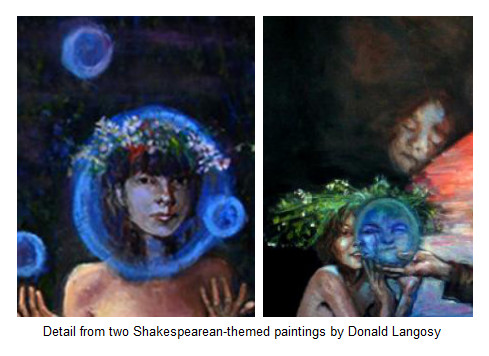
detail from isle of prospero by langosy
Editorial note: Throughout this unique sharing of his life as an artist, Mr. Langosy has focused on the influence of poets like Ezra Pound, painters like Titian, and underscoring everything, the influence of his muse, Elizabeth. In the following pages, he describes and depicts the influence of Shakespeare. But in the 1990s something else also affected his artistic journey.
“… my mobility inexplicably became impaired. As I gradually lost the ability to walk and became increasingly fatigued, I was no longer able to pursue connections in the art world or mount exhibits as I had in the past. I was told that my disability had psychiatric origins and that I would walk again when I was ready to do so. Over time, my paintings became as small as my housebound universe, sometimes shrinking to the size of a postage stamp. In October 2003, I collapsed and was taken to a hospital, where I was finally diagnosed with secondary progressive multiple sclerosis. Once I knew that I wasn’t crazy after all and began targeted treatments … I am convinced that a huge factor in my remission was my decision to not allow MS to enter my studio.”
And now …


View preceding episodes in The Story of My Art: 1, 2, 3, 4, 5
View four decades of his work at http://www.donald.langosy.net/
See what’s current, as well as wonderful old photos of the artist at work, via Langosy’s Facebook page.
His contact: Zoe Langosy at zlangosy@me.com.
Save
Save
Posted in Inspiration | Tagged art, artists, beauty, bohemian, contemorary art, creativity, fine art, Inspiration, joy, memoir, multiple sclerosis, muse, nudes, painting, William Shakespeare | 3 Comments »
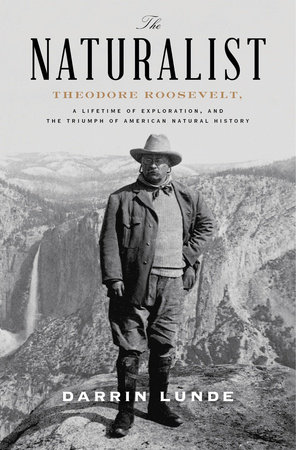
The Naturalist by Darrin Lunde presents yet another side of the complicated Theodore Roosevelt (1858-1919). Scion of a wealthy New York family, sickly as a child, Roosevelt’s enduring image is that of a rough and tumble soldier, a politician with a big stick foreign policy and a big game hunter extraordinaire. Lunde’s book focuses on Roosevelt the naturalist.
In 1867, just a couple years before his father Theodore Roosevelt Sr invested in the creation of the American Museum of Natural History in New York City, Roosevelt started his own natural history museum in the family house. Twelve specimen would soon grow to include hundreds of mice, shrews and birds. Though the museum would soon be relocated by family decree especially after “he acquired a live snapping turtle – an aggressive pond-dweller covered in algae and decorated with a gruesome frill of leeches,” a passion had been borne that would stay with Roosevelt throughout his life.
Roosevelt lived during the Victorian Age. Nature study was common and encouraged especially among his social class. Never formally trained, he would teach himself the necessary skills, including taxidermy. The Naturalist provides unflinching accounts of how natural history museums of that era built their vast animal collections, collections that are scientific boons for researchers today but at what cost? Even then, ethical and moral questions arose around the killing of animals. Though museums in general collected far more animals than he did, Roosevelt took the brunt of criticism later in his life from animal rights advocates as the media reported graphic details of Roosevelt’s big game hunts in Africa.
Lunde is a Supervisory Museum Specialist in the Division of Mammals at the Smithsonian’s National Museum of Natural History. He’s clear in his affinity for Roosevelt the naturalist and also in his concern about the growing disconnect between people and nature. At the end of the book he raises questions about the changing perception of what it means to be a naturalist. He points out that “To really understand Roosevelt the naturalist, we need to locate him in the naturalists’ world that he knew — a world that wholeheartedly embraced guns, hunting, and taxidermy as equally important to the naturalist’s craft.”
The book reads like an American Experience documentary and I mean that in the best possible way. The book is chock full of historical facts and details and yet it is not in anyway overwhelming. The narrative flows carrying the reader along on a thought-provoking journey in the life of one of America’s great iconic figures.
I received this book from Blogging for Books for this honest review.
Additional Links …
The Naturalist
Darrin Lunde
Save
Posted in Nature Notes | Tagged book review, books, history, hunting, nature, the naturalist, theodore roosevelt | Leave a Comment »
« Newer Posts - Older Posts »