Feeds:
Posts
Comments

Posts Tagged ‘architecture’

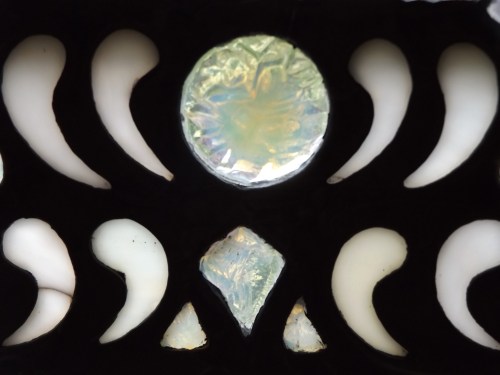
You’ll find  Ieposolyma-The New Jerusalem in an area known as the north transept of Trinity Church in Copley Square.  It is an upper level window that rests beside another John La Farge masterpiece, The Resurrection (1902).  The New Jerusalem was completed and installed eight years earlier in 1884.

As described by scholar James L. Yarnall in his biographical study of John La Farge, this window depicts “the vision of the New Jerusalem described in the book of Revelation. The design fused Byzantine architecture and Mannerist figures from Correggio with a dazzling array of jeweled opalescent glasses.”

If you’re in Boston, see firsthand how the sunlight shines through all of this magnificent glass — this window apparently contains every kind of glass La Farge ever used including pressed jewels, confetti glass, and opalescent glass.  Tour information available here.

I tend to focus on the pieces that make up the whole, but if you search online you’ll find some photographs of the whole window, like this one.

Read Full Post »

Read Full Post »

These are the hands of St. Paul, St. Peter and Jesus as painted by John La Farge in the murals for Trinity Church.  I was inspired to create this compilation by the moving images and words in Steve McCurry’s recent post, The Language of Hands. I may write more about hands in the future, but for now, I hope you enjoy these images.

St. Paul’s hands

St. Peter, the key in his hand

Jesus with Nicodemus, hands resting

Hands of Christ and Woman at the Well

St. Paul Mural by John La Farge, 1877

St. Paul

The Visit of Nicodemus to Christ by John La Farge, 1878

The Visit of Nicodemus to Christ


Read Full Post »

statue of St. Paul on the west porch of Trinity Church in Copley Square, Boston

Read Full Post »

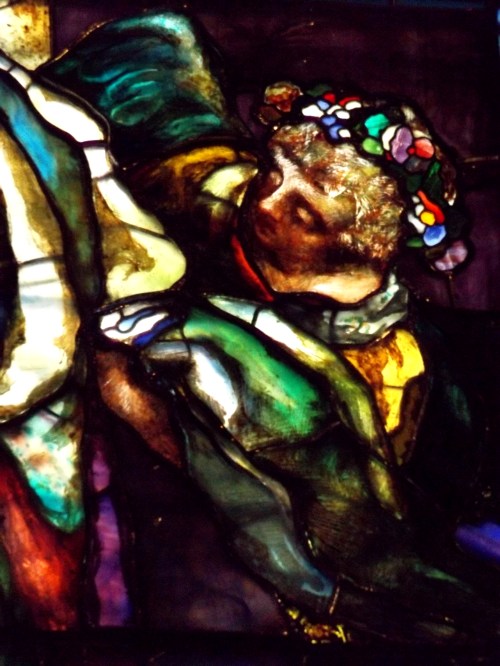
Detail from Purity by John La Farge, 1885

Detail from Purity by John La Farge

Designed and executed by artists and stained glass manufacturers like John La Farge, Clayton and Bell, Burlison and Grylls, and others, these particular stained glass windows at Trinity Church in the City of Boston are “hidden gems.”

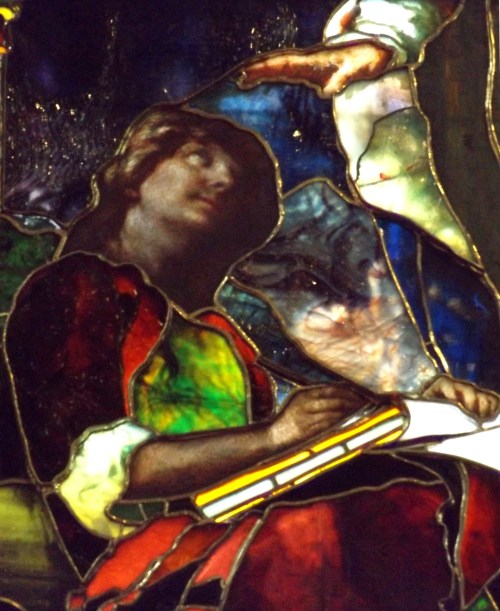
Detail 2 from Purity by John La Farge, 1885

Detail 2 from Purity by John La Farge

They are located in the Parish House. In part, due to renovation activities at different times over the past 100 years, some of the windows are now in stairwells, like Purity as well as John Hardman and Company’s Woods Window

The Woods Window, executed by John Hardman and Company

The Woods Window, executed by John Hardman and Company

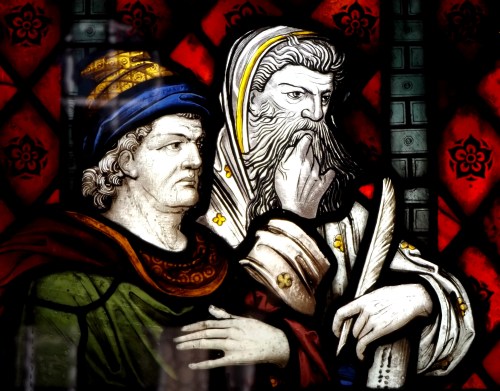
others are in restricted areas like Ephphatha by Burlison and Grylls …

Detail from Ephphatha by Burlison and Grylls

Detail from Ephphatha by Burlison and Grylls


and others in areas dedicated to use by parishoners of all ages like The Sunday-School Windows by Clayton & Bell.  

They are not windows accessible as part of a traditional art and architecture tour of the sanctuary, but it has been my pleasure this summer to roam the halls a bit with my camera and to share this glimpse of details from some of the windows. Postcards and prints, and information about tours, are available at the Trinity Book Shop.

Interior of Trinity Church in the City of Boston, Copley Square

Interior of Trinity Church in the City of Boston, Copley Square


Read Full Post »

In The Art and Thought of John La Farge, author Katie Kresser writes that John La Farge (1835-1910) completed his first sketch of Nicodemus and Christ in 1874.  That biblical encounter is a subject that La Farge would depict in several different forms over time.  Here is a sketch dated 1877 in the Yale University Art Gallery, and here is an oil painting completed in 1880, now housed at the Smithsonian.  He would also create a stained glass window for the Church of the Ascension in New York.  The following image, The Visit of Nicodemus to Christ, is a photograph of the mural La Farge painted on the walls of Trinity Church in Boston.
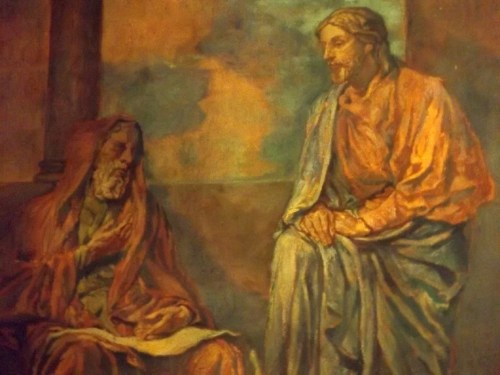
The Visit of Nicodemus to Christ, mural by John La Farge

The Visit of Nicodemus to Christ, mural by John La Farge, 1878

It is one of several murals that La Farge painted inside the building with the aid of assistants like Augustus Saint-Gaudens, Francis D. Millet and Francis Lathrop.  I keep photographing them because I think that there is always something new to see and experience.

In the literature of the time period critiquing his work, there is often reference to La Farge’s use of color in the murals that borders on the poetic.  For example, “In his “Christ and Nicodemus,” … we find the color quality strongly dominant. … the rich blues vein the draperies and background like the threads in a Flemish tapestry …” (The Churchman newspaper, July 6, 1901).
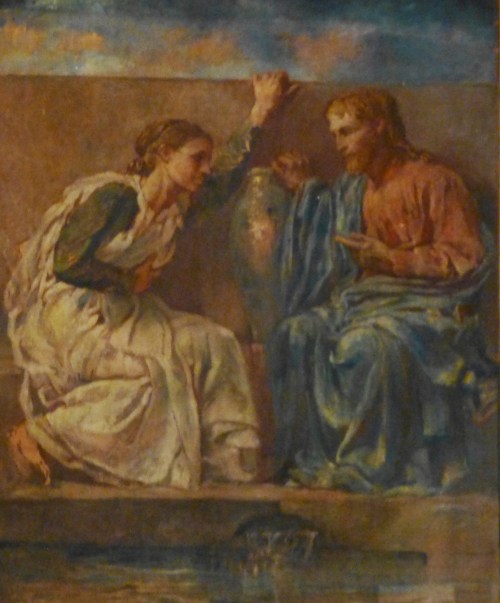
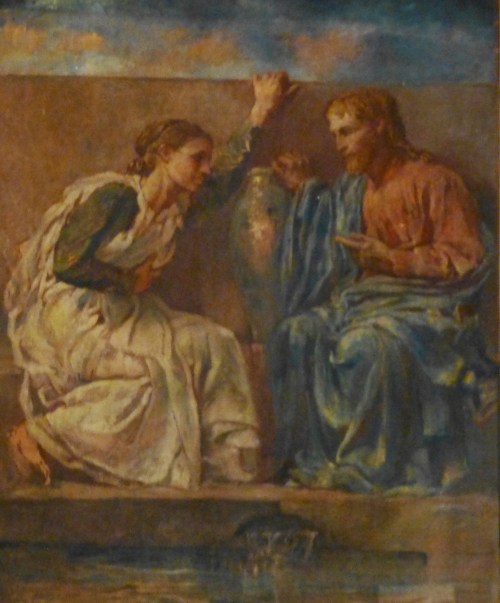
Christ Woman at Well, mural in Trinity Church by John La Farge

Christ Woman at Well, mural by John La Farge, 1877

The beauty of La Farge’s murals is constant but their colors do shift in the light.  Different details become present depending upon where one stands and at what time of day.

David, mural by John La Farge

David, mural by John La Farge, 1877

My favorite is perhaps the painting of David, because of the colors and especially for the expression on the young man’s face.

I had originally titled this post “in his own words” because I came across John La Farge: A Memoir and a Study compiled by Roy Cortissoz, literary and art critic for the New York Tribune, and La Farge’s friend.  In the book, completed in 1911 shortly after La Farge’s death in 1910, La Farge reminisces about what it was like painting the murals at Trinity under tight time constraints, in poor health, up high on scaffolding.  Reading the words made me appreciate the skills of all the artists even more.  If you’d like to read La Farge’ account, begin at the end of page 31 of the book, available online here.

Learn how you can see these murals and other architectural and design features at Trinity Church first hand here. Postcards of some of these images available via The Shop.

Read Full Post »

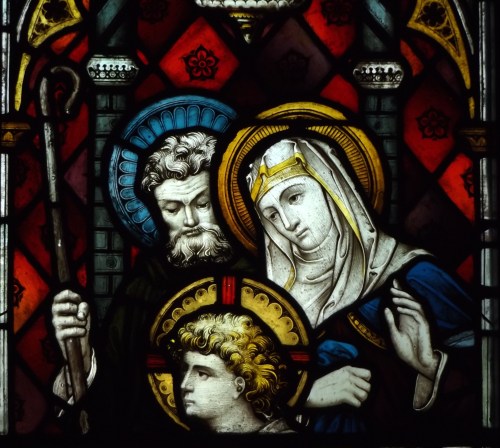
It is another one of those hidden gems in an architectural masterpiece that sits in the heart of the city of Boston.  The Sunday School Windows were designed by Clayton & Bell of London, England.  The left window depicts the story of the Presentation of Jesus, with Simeon holding the baby in his arms …

while standing nearby are Mary and Joseph.

The right window tells the story of Jesus in the Temple, with the doctors in the room …

as a young Jesus both listens and asks questions …

with two little children beside him.

Most captivating to me are the hands and the eyes, and the mix of colors and patterns within the glass, and how all of these components are pulled together to tell stories without words.

While these windows, a gift of the Children of Trinity Sunday School, are not viewable as a part of a traditional tour of Trinity Church in Copley Square, many other beautiful works can be seen as part of a tour of this historic landmark.  Learn more here.  Meanwhile, I look forward to sharing more images from this building and other structures in the future.

Read Full Post »

Like Lucy R. Woods, mentioned in a prior post, Sarah Wyman Whitman (1842-1904) taught Bible class at Trinity Church in Boston for over thirty years.  She was also an accomplished artist working in multiple media, from painting to glasswork to book cover design.

She was friends with Phillips Brooks, the rector of Trinity Church.  Upon his passing, she and her Sunday Bible class gifted the church with a window in his memory.

It was begun in 1895 and installed Easter, March 1896.  In a letter dated March 12, 1896, Whitman writes:

“The little memorial to Mr Brooks which my Bible Class has long dreamed of, is now finished and waiting to be put up at Easter. Someday I will show you this, and meantime send a little rough sketch. The three windows are in the Parish Room where the Class meets, and as it is also used for many practical purposes,

the windows (three giving on the cloister to the south) are kept in clear glass with jewelled flowers at the intersecting of the little frames …and then the middle one with a single device. 

In the glass of course there is a depth and richness that this paper sketch little conveys.”

The window is located in the parish library, and is another hidden gem of an architectural masterpiece.  If you would like to learn more about Sarah Wyman Whitman, there are some great resources available online including her letters.  The Boston Public Library has put together a gallery of her book cover designs.  Learn more about Trinity Church architectural tours here.


Read Full Post »
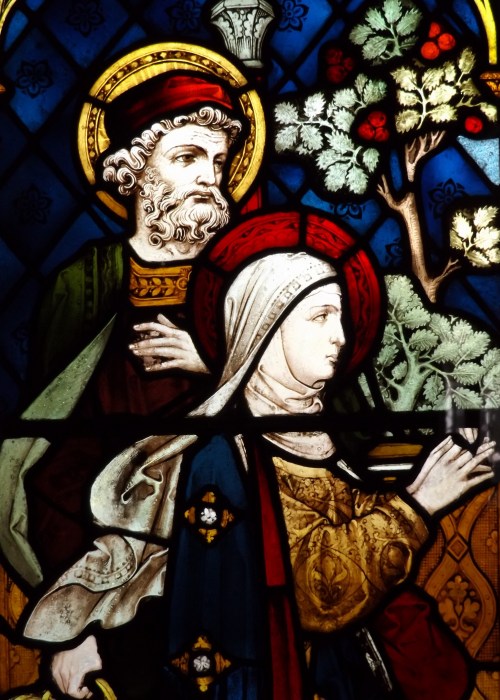
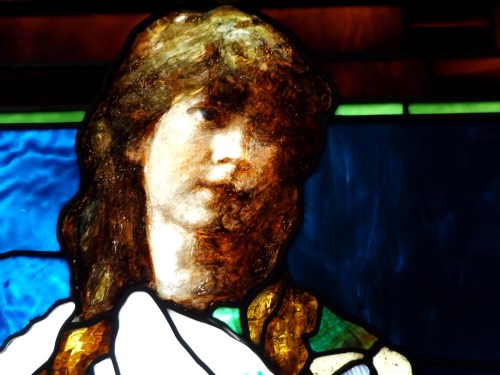
Detail from the Lucy R. Woods Window, Trinity Church, Boston

Detail from the Lucy R. Woods Window, Trinity Church, Boston

It is one of the many hidden gems of Trinity Church in the City of Boston.  According to archival records, the Woods Window was commissioned in memory of Miss Lucy R. Woods (1847-1904).  Miss Woods taught the Young Ladies’ Bible Class in the church Sunday School for thirty-three years, beginning in 1871.

The window was executed by John Hardman and Company, Birmingham, England, and designed by Dunstan John Powell, grandson of noted English architect and artist Augustus Pugin.

The window is located in a stairwell not easily accessible to the public but postcards and prints will soon be coming to the Book Shop.

Until then, you can read more about the original 1906 unveiling of the window here.  Hope to share more information about this window, and other hidden gems, in the near future.


Read Full Post »
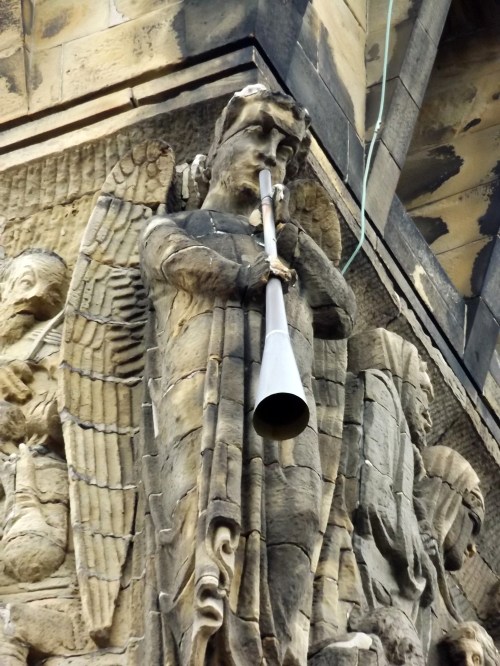
In the Back Bay, I’ve been walking past the First Baptist Church of Boston for years, but, today, for the first time, I trained my camera up to the top of the building tower.  And what an amazing sight.

Designed by Henry Hobson Richardson, “… its square tower is 176 feet high. At the top of the tower … is a frieze of sculpted figures representing baptism, communion, marriage and death. The frieze was designed by Frederic Auguste Bartholdi, famous for the Statue of Liberty, and was carved by Italian artists after the stones were set in place. It includes the faces of Sumner, Longfellow, Emerson, Hawthorne, Lincoln, Lafarge, and his comrade Garibaldi, and other prominent Bostonians …” (History of the First Baptist Church of Boston)  I hope to learn more about this amazing building, and take more photos, over the summer.

Read Full Post »
« Newer Posts - Older Posts »