Feeds:
Posts
Comments

Posts Tagged ‘art’

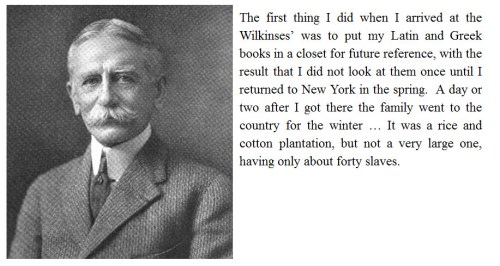
As I read Maitland Armstrong’s words, I heard David McCullough’s voice as he narrated Ken Burn’s The Civil War.  Maitland Armstrong (1836-1918) did many things during his long life but I was particularly interested in his journey as painter and stained glass designer.  I’d first learned about him as part of my research into the artists involved with decorating Trinity Church.  Maitland’s name had surfaced as a friend and contemporary of John LaFarge.

I chanced upon his memoir, Day Before Yesterday: Reminiscences of a Varied Life, published posthumously in 1920.  It opens, “I was born on the 15th of April, 1836, at Danskammer on the Hudson, near Newburgh.” In it he writes with great affection for his family and especially his mother.  He describes her southern roots, how she would sometimes leave New York to winter in Charleston, South Carolina, and how she nurtured his interest in painting before her death in 1853.
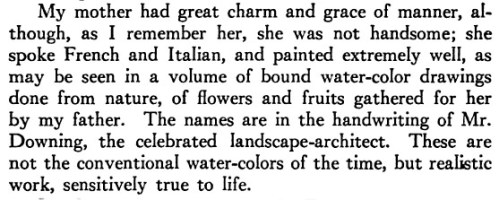
I had planned to skim Armstrong’s memoir focusing on his friendships with people like John La Farge and Augustus St. Gaudens.  In the table of contents, there is a chapter, St. Gaudens and Others.  But there was also a chapter, The South Before the War.  What did this artist have to say about such a time and place?

Well, what he does is describe in great detail, by painting with words, life in the south on a small network of plantations and the neighboring environs.  Even with his blood ties to a number of the families, he reports with a northern perspective.  He enjoys the hunting and accepts the slavery.  He learns a new language about the poor whites known as crackers and the slave assigned to him, his little darky.
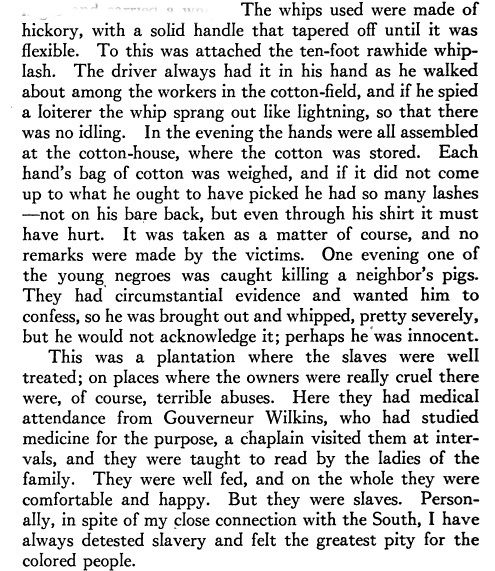
It was in 1853, perhaps after the death of his mother, that Armstrong and his brothers traveled to Charleston.  There, while he is staying with relatives, the Wilkins family, they drive to their plantation Kelvin Grove, where Armstrong describes there was “a nice little village of comfortable white cabins for the negroes. But there always was in evidence a driver, as he was called, who was a superior negro and carried a whip.

He visited several family relations while in the South, from the Wilkins to his cousins, the Screvens.
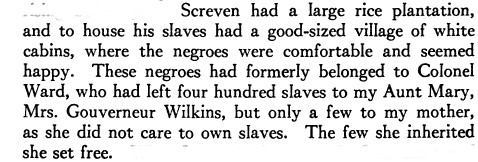
The detachment with which Armstrong is able to describe the scenes that took place around him in the south (and in a later chapter his description of turmoil in New York) make clear his compassion for others but also his upper class background that separated him from those others.
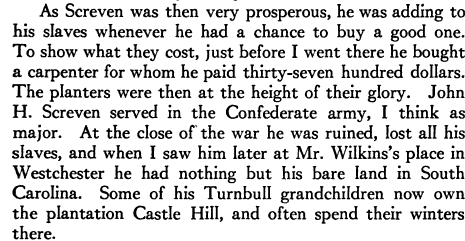
At the end of the chapter Armstrong describes how that period in the south was one of the most delightful times in his life.  No cares, no worries. He would receive a letter decades letter from a family member describing the loss of the plantations and the slaves, the occupation by Union troops, and the auctioning off of property to pay debts.

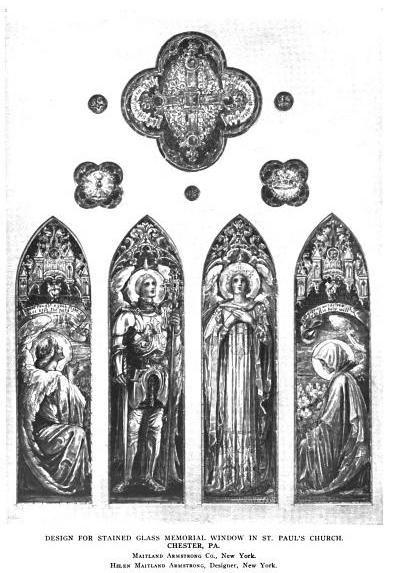
Armstrong would return to New York, attend the very best schools, and travel the world.  His life was truly varied serving as student and teacher in several different fields.  As a stained glass artist he would collaborate on masterpieces with his daughter, Helen Maitland Armstrong.  He would serve as a Consul General in Rome.  And near the end of his days, he decided to chronicle that life.
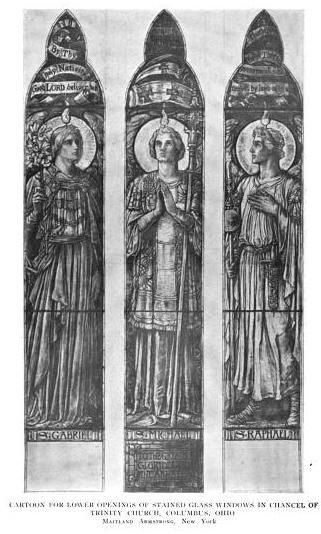
For anyone researching artists of a particular generation who ran in the same circles – La Farge, St. Gaudens, McKim, White, etc – this book could be an interesting resource. Armstrong describes personal vignettes of how these people interacted socially and appreciated each others work.  You could even completely ignore that chapter about the south.  But I think that chapter is important because, from a different source, it shines a light on life in the past … and it is that past that is the shaky foundation upon which we continue to try to build a brighter future in this country.
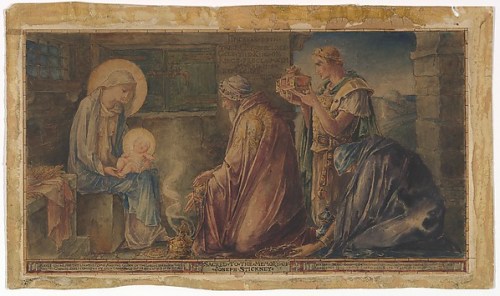
Nativity: Design for the Stickney Memorial Window, Faith Chapel, Jekyll Island, Georgia, Metropolitan Museum of Art

Nativity: Design for the Stickney Memorial Window, Faith Chapel, Jekyll Island, Georgia, Metropolitan Museum of Art


Sources/Additional Readings

Day Before Yesterday: Reminiscences of a Varied Life, 1920

Old Glass New Windows by Will H. Low, Scribner’s Magazine, Volume 4, 1888

Metropolitan Museum of Art, The Collection Online

Wikipedia — Maitland Armstrong

Year Books of the Architectural League of New York (late 1800s, early 1900s)


Read Full Post »

All three postcards depict beautiful fine art details found at historic Trinity Church in the City of Boston and are available in the church Book ShopPeace, Be Still is also available online via this link.

Read Full Post »

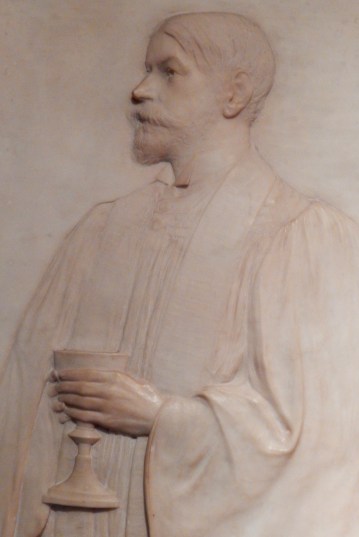
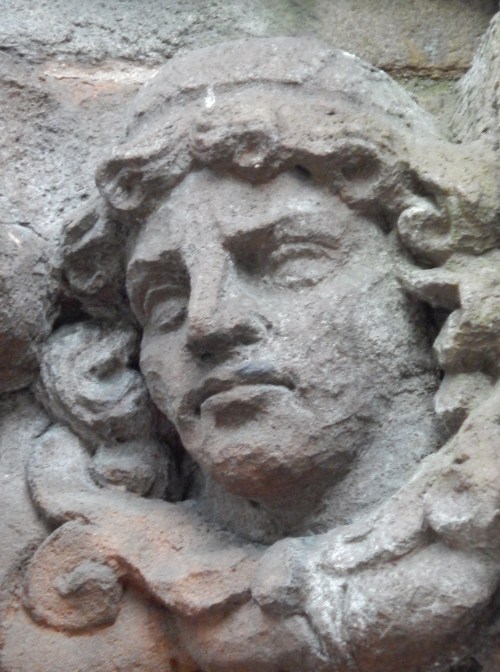
I’d seen the sculpture many times inside Trinity Church but not truly appreciated it. A man holding a cup, a cup-bearer, but the person depicted had no context for me.  I knew nothing of his significance in the past or in the present.  There were too many other visuals capturing my attention, like sunlight through stained glass windows.  Only recently have I returned with greater respect to the relief of Elijah Winchester Donald, Rector of Trinity from 1892 until 1904.

Detail of E. Winchester Donald Sculpture by Bela Pratt

I unexpectedly re-discovered the sculpture, and the man depicted, while researching the history of a church thousands of miles away at what is now known as Tuskegee University in Tuskegee, Alabama.

During my research I came across an issue of The Southern Workman, a publication founded in 1872 by General Samuel Chapman Armstrong of Hampton Institute, Hampton, VA.  Armstrong would leave his mark on American history for many reasons, one of which included founding Hampton just after the Civil War. There, a young Booker T. Washington, formerly a slave, would become a student and eventually a teacher. In 1881, when people in Alabama, wanting to start a new institute for black students, reached out to Armstrong for principal recommendations, Armstrong suggested young Washington who applied for the position and got the job.

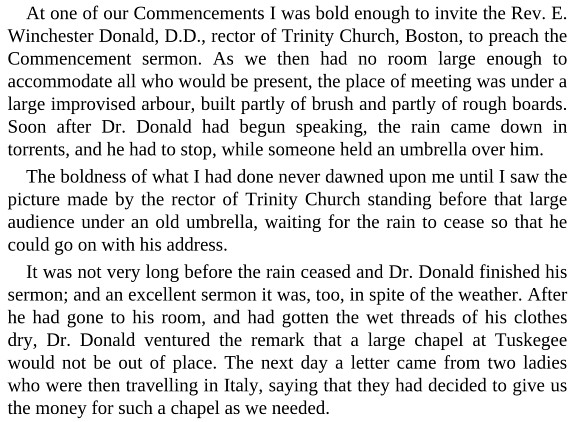
The August 1895 issue of The Southern Workman made note of Tuskegee’s achievements, including recent receipt of anonymous funds to build a new chapel.  But prior to those funds being received graduation commencement services took place and, the journal describes the event in this way:

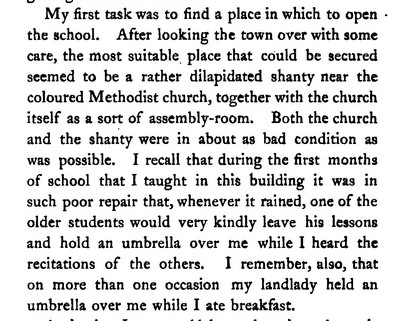
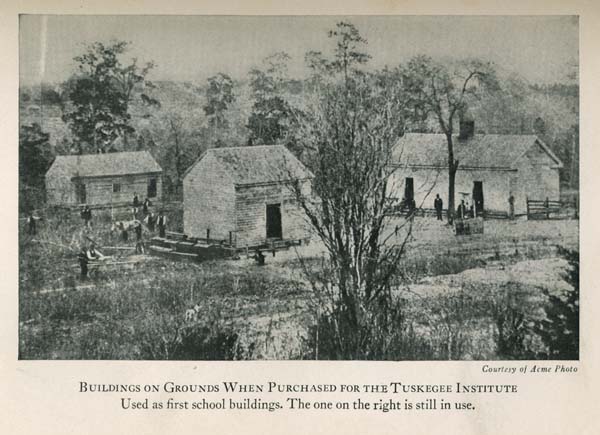
Years late, Booker T. Washington would describe the moment in a slightly different way.  In 1901, Washington wrote Up from Slavery, the chronicle of his journey from slavery, his attendance at Hampton and eventual leadership at Tuskegee and well beyond.  As Washington wrote, money had been found to start Tuskegee, with money set aside to pay future instructors, but no provisions had been made for securing land and buildings.

Later in his autobiography, Washington gives his personal recollection of the 1895 Tuskegee commencement in which Dr. Donald spoke:

The chapel would be built, designed by Robert R. Taylor, the first African American graduate of MIT. The chapel would be erected between 1896 and 1898, a structure some scholars say Taylor considered his masterpiece.

Robert R. Taylor

Robert R. Taylor

In 1900 author Max Thrasher wrote: “The building of this chapel illustrates, as well as any one instance can, the methods of the industrial training at Tuskegee.  The plans for the building were drawn by the school’s instructor in architectural and mechanical drawing.  The bricks, one million two hundred thousand in number, were made by students in the school’s brick yard and laid by the men in the brick-laying classes.  The lumber was was cut on the school’s land and sawed in the saw mill on the grounds.  The various wood-working classes did the work which in their departments.  The floor is of oak; all the rest of the finish in in yellow pine, and the use of this wood … The pews were built after a model designed by one of the students, and another student designed the cornices. The tin and slate roofing was put on by students, and the steam heating and electric lighting apparatus was installed by them …” Before his death in 1904, Donald would have an opportunity to speak in this chapel.

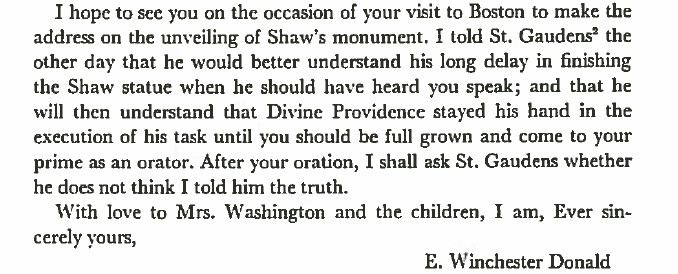
Though from two very different backgrounds, Donald and Washington appear to have greatly respected one another. In 1895  Donald established the Trinity Church Oratorical Prize, an award for the best written and best delivered paper on an assigned subject, a student prize that continues at Tuskegee, with different sources of funding, to this day.  For many reasons, Washington often made his way up North, cultivating philanthropists, accepting honorary degrees, attending national conferences, and speaking in places like Trinity.  In 1897 he was invited to deliver an address at the dedication of the Robert Gould Shaw Monument in Boston.  Prior to his arrival, Donald sent him a letter:

In 1901, Donald presented the dedication address for a new campus building at Tuskegee.  In attendance were noted business leaders and philanthropists including George Foster Peabody and John D. Rockefeller Jr. Before them was a magnificent campus, once a few fragile buildings, transformed by student-labor into a thriving educational institute with over 100 hundred instructors and staff, 50 buildings both functional and aesthetic, over 2500 acres of land with solid farming infrastructure and students applying from around the world.

Chemistry Lab 1902

Chemistry Lab 1902

Instructor George Washington Carver

Tuskegee Instructor George Washington Carver

Donald’s dedication address was made just a few decades after the end of the Civil War.  There was still great philosophical debate about what was to become of the millions of African Americans formerly enslaved.  Like Washington, Donald seemed to believe that education and skill building were the key for black people to let go of the past, achieve success in the present, and build a foundation for future excellence.

During the address, Donald would say: “We are in the presence of a fact. Whether or not the negro can be raised to self-respect, industry, thrift and ethical soundness, let the doctrinaires debate. One thing we know, whereas he was blind to his only chance, now he sees. He has only to keep his eyes open and use his chance to rise clean out of the condition into which 200 years of enforced servitude and thirty-five years of stupid, selfish and merciless political exploitation thrust him down.”  His words would become controversial with statements including “an educated negro without a vote is worth infinitely more than ten illiterate white men who vote as often as the polls are open.

Until the end of his days, in person and in writing, Donald would support the efforts of Washington at Tuskegee and those at other Southern black schools educating new generations.  He supported the efforts of many people inside the U.S. and from abroad trying to make social change.  He may have thought he was being militant.

As was said by the Rector of Grace Church in his memory, “his supreme gift was not militancy,–however it may have seemed to some, as well as to himself,–his supreme gift was not militancy, it was sympathy; he gave drink to the thirsty; he satisfied the longing soul; his true emblem was not the claymore, as he fancied, it was the chalice.”

Others stated, “Some of us disagreed with him, some of us thought his positions untenable, but none of us doubted his fraternal regard.”

His memorial was completed January 27, 1907, the bas relief by sculptor Bela Pratt and its setting designed by Donald’s friend, Charles A. Coolidge.

As for that chapel at Tuskegee, it would continue to evolve but that is a story for another day.

Sources & Additional Reading

Up from Slavery by Booker T. Washington

History of Tuskegee (University Website)

Tuskegee: Its History and its Work (1900)

Samuel Chapman Armstrong (Hampton University Website)

MIT Archives – Robert R. Taylor

Bela Pratt Sculpture of E. Winchester Donald

Trinity Church Art & History

The King’s Cup Bearer, Sermon in Memory of E. Winchester Donald, 1904

Read Full Post »

Bust of Dean Stanley at Trinity Church

I took the picture, I did the research and this is what I learned:  On Easter Monday in 1877, Rev. Phillips Brooks was given leave by his parish, Trinity Church in the City of Boston, to take a sojourn to Europe.  While in England, he spent time with Arthur Stanley, Dean of Westminster Abbey. Brooks was invited to preach at Westminster in July, and it is written that Dean Stanley listened with delight to a doctrine after his own heart.  Brooks would later share in a letter, “Last Sunday I preached for Mr. Stanley at his church in London, and William and I were much in the little man’s company while we were in his town.  He is very pleasant and entertaining, but much changed since his wife’s [Lady Augusta Stanley] death. He has grown old and fights hard to keep up an interest in things.”(1)


In the autumn of 1878, Dean Stanley traveled to America. In Boston he preached for the Rev. Phillips Brooks at Trinity Church.  Brooks would later write that no one who heard the benediction at the close of the service would ever forget it. “He had been but a few days in America. It was the first time he had looked an American congregation in the face. The church was crowded with men and women of whom he knew that to him they represented the New World. He was for a moment a representative of English Christianity. And as he spoke the solemn words, it was not a clergyman dismissing a congregation, it was the Old World blessing the New; it was England blessing America.  The voice trembled while it grew rich and deep, and took every man’s heart into the great conception of the act that filled itself.”


In 1881, following Dean Stanley’s death, Phillips Brooks would write a 12-page retrospective for The Atlantic Monthly.  In conclusion Brooks would highlight lessons of faith and good will he thought taught by Stanley’s life, and then end with these words:

“These lessons will be taught by many lives in many languages before the end shall come; but for many years years yet to come there will be men who will find not the least persuasive and impressive teachings of them in Dean Stanley’s life. The heavens will still be bright with stars, and younger men will never miss the radiance which they never saw. But for those who once watched for his light there will always be a special darkness in the heavens, where a star of special beauty went out when he died.” (3)

Miss Mary Grant, an eminent British sculptor and Stanley’s niece by marriage, would execute a memorial bust.  That bust would be given to Trinity Church to commemorate his visit.  It is located in an area that I believe is known as the baptistry.  His visage “stands upon a bracket of Sienna marble … beneath which is a tablet of Mexican onyx, on which is engraved a tribute by Robert C. Winthrop.” (4) And sitting across from him?  A bust of Phillips Brooks.

Bust of Phillips Brooks by Daniel Chester French

Bust of Phillips Brooks by Daniel Chester French

Learn more about Trinity stories in stone and glass with a tour: http://trinitychurchboston.org/art-history/tours

Sources for this post …

(1) Phillips Brooks, 1835-1893: Memories of his life … by Alexander Viets Griswold Allen (1907)

(2) Life and Correspondence of Arthur Penrhyn Stanley, Volume 2 by Rowland Edmund Prothero (1893)

(3) The Atlantic Monthly, Volume 48, October 1881

(4) Trinity Church in the City of Boston, 1888, pp. 31-32

(5) Mary Grant

(6) Phillips Brooks Bust image is from Wiki Commons

Save

Read Full Post »

At some point, I’ll set myself up in Copley Square with a tripod, and photograph the church’s whole West Porch.  At least I will do my best.  Meanwhile, I am having great fun photographing the porch details.

Read Full Post »

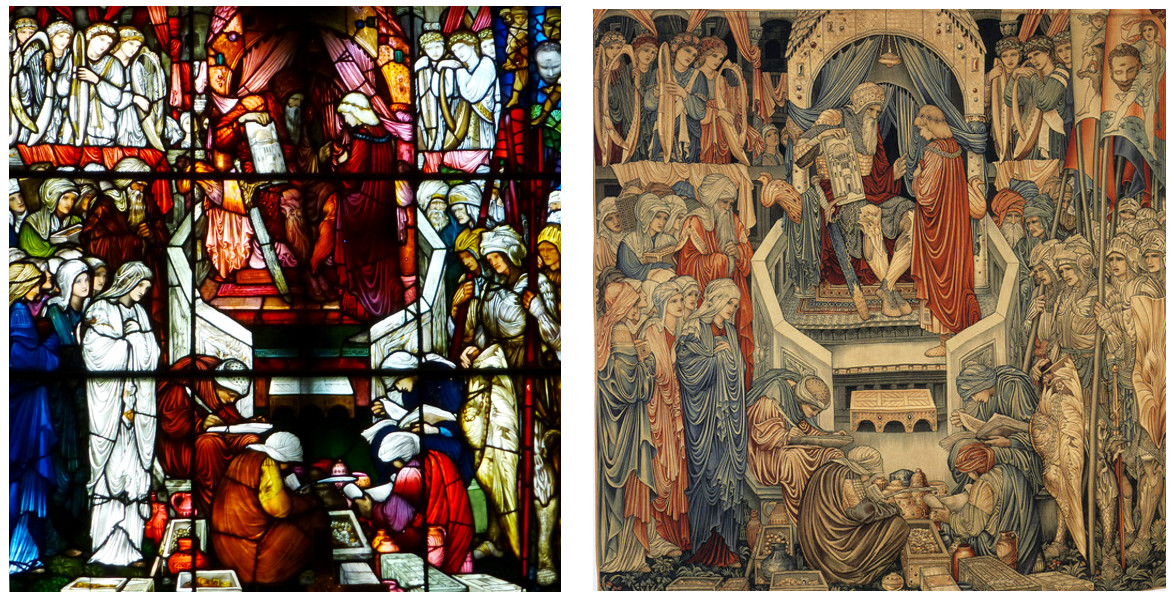
Recently I learned of an image in stained glass also appearing in thread, both based on a design by Burne-Jones.  I couldn’t help but do a bit of digging and learned this:  the stained glass window, David’s Charge to Solomon, was first commissioned in memory of George Minot Dexter (1802-1872) by his son Frederic Dexter. It is located at Trinity Church in the City of Boston.  I’ve had the great pleasure of photographing details over the years.

The window was designed by Edward Burne-Jones, the color harmonies developed by William Morris and the window fabricated in the William Morris & Co studio.

The window was installed at Trinity Church in 1882 in an area known as the baptistry.

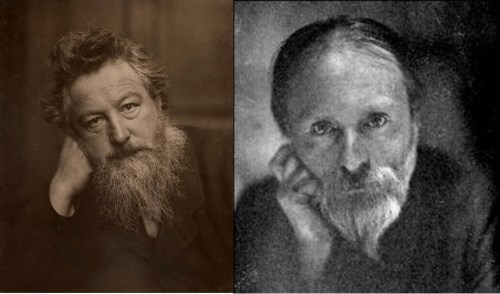
William Morris (1834-1896) and Edward Burne Jones (1833-1898)

William Morris (1834-1896) and Edward Burne Jones (1833-1898)

While Morris and Burne Jones would both pass away in the late 1890s, Morris & Co.’s design work and manufacturing would continue for decades at Merton Abbey, a village in Surrey, England where textile printing had taken place since the mid-19th Century.

Sir George Brookman c. 1920

Sir George Brookman c. 1920

While attending an exhibit at the 1900 Paris International Exhibition, and later visiting Merton Abbey in England, Australian mining magnate George Brookman saw Morris tapestries being custom woven for individual and corporate clients.  He also saw original designs, still being used, to reproduce artwork.  After seeing the Burne-Jones cartoon for David’s Charge to Solomon, he commissioned a tapestry to be made of that image.

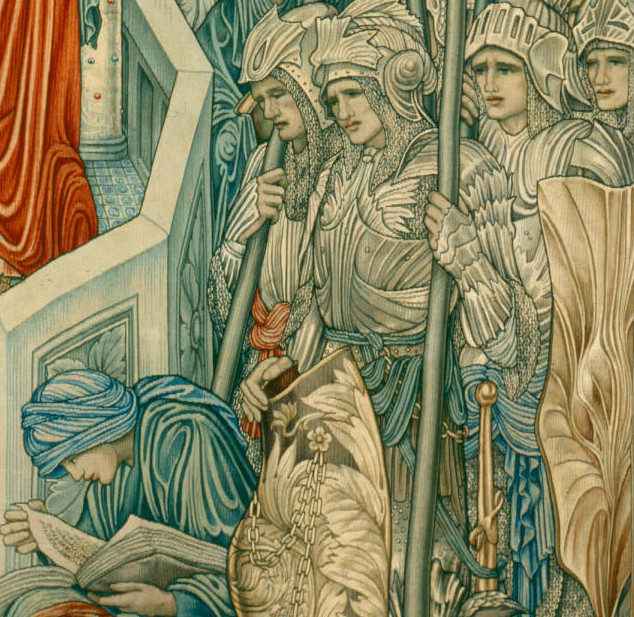
Known as David giving Solomon directions for building of the Temple, the tapestry would be described as “a spacious and complex weaving of unusual size.  The soft, abundant reds beloved of the [Pre-Raphaelite] Brotherhood were in evidence.  Of especial beauty were the figures clad in silver-threaded armor.” Weavers were Walter Taylor, John Martin and Robert Ellis.

In 1920, Brookman sold the tapestry back to Morris & Co.  May Morris, the daughter of William Morris, would exhibit the tapestry along with other Merton Abbey works at the Detroit Society of Art and Crafts Exhibit.

May Morris (1862-1938)

May Morris (1862-1938)

excerpt from International Studio Magazine, 1922

excerpt from International Studio Magazine, 1922

Newspaper businessman, philanthropist and art benefactor George G. Booth and his wife, Ellen Scripps Booth, would purchase the tapestry to hang in Christ Church Cranbrook in Bloomfield Hills, Michigan, where I believe it still hangs to this day.

One design expressed in two different ways sharing one of the most influential stories in human history.

Sources/Additional Reading

Cranbrook Digital Archives

Details for comparison taken from David giving Solomon directions for building of the Temple, photograph by Jack Kausch, copyright Cranbrook Archives.

The William Morris Society in the United States


Read Full Post »

Charles R. Lamb, photo by Doris Ulmann

Charles R. Lamb, photo by Doris Ulmann

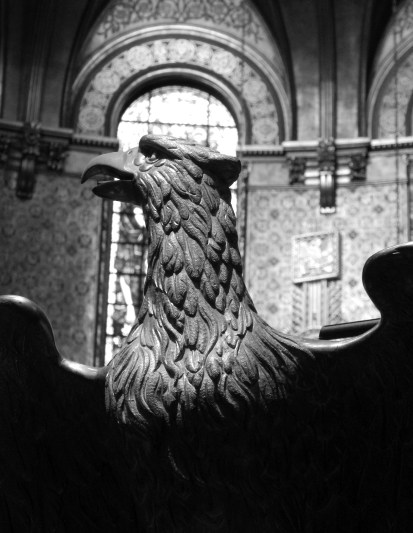
Recently I photographed the eagle lectern at Trinity Church in Copley Square, Boston.  That day I had grown impatient with color and switched to black and white.  And thankfully so because  the play of light and shadows across the bird’s form revealed wonderful details. That lectern, original to the historic landmark (1877), was designed by Charles R. Lamb of J & R Lamb Studios of New York.

J & R Lamb Studios, established by brothers Joseph and Richard Lamb in 1857 and still in operation today, is most well-known for its stained glass creations. In fact, the company’s artists produced designs for a range of furnishings, metalwork and interior architecture as well.  Charles Lamb (1860-1942), son of Joseph, left school at 16 to join his father and uncle at the studio.  He would eventually take over management of the company.

Design drawing for metalwork: Chiro chalice with grapevines

Design drawing for metalwork: Chiro chalice with grapevines, by Charles R. Lamb

His brother Frederick Stymetz Lamb would become head designer and oversee the studio’s artists who included Charles Lamb’s wife, Ella Condie Lamb.  Charles’s daughter Katherine Lamb Tait would become head designer after WWII.

Katherine Lamb Tait

Katherine Lamb Tait

Over the course of his individual career, Charles Lamb would focus on urban planning and help pioneer the concept of City Beautiful.  Most of the short biographies I found describe him as an innovator with ideas ahead of their time.  Though during his professional life, he enabled the creation of much bright beauty, the latter part of his life may have been a bit dark. On February 22, 1942 he passed away at his home, Lamb’s Lane, in Cresskill, NJ. He was 82.

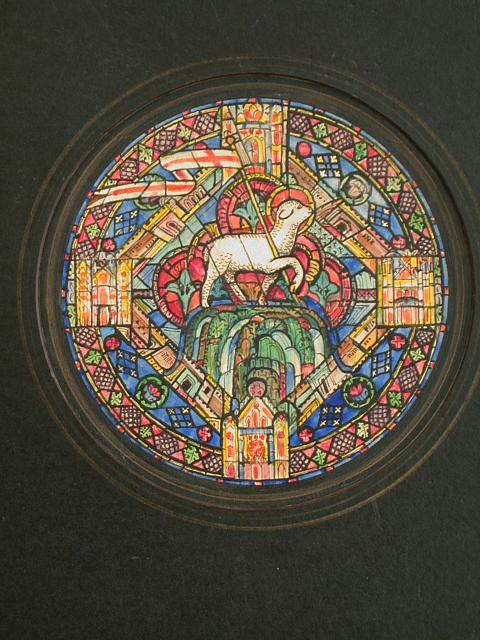
Design drawing for stained glass tondo window "The Lamb on Mount Zion and Four-Square City of New Jerusalem" showign lamb with and elaborate detailing including grape/leaf border and Jerusalem/architectural motif

Design drawing for stained glass window “The Lamb on Mount Zion and Four-Square City of New Jerusalem” showing lamb with and elaborate detailing including grape/leaf border and Jerusalem/architectural motif

In 2003 and 2004, the Library of Congress acquired nearly 2500 drawings and sketches as well business records and photographs from the Lamb Studios.  They are accessible to the public via this link: http://www.loc.gov/pictures/collection/lamb/.  An incredible resource for artists and historians.

Design drawing for two stained glass windows with grapevine vegetal design

Design drawing for two stained glass windows with grapevine vegetal design

Sources & Additional Reading

J & R Lamb Studios

Lamb Studios Archive at Library of Congress

Lamb Studios History by Barea Lamb Seeley

City Beautiful Movement

Corning Museum of Glass – Historical Perspectives: Katherine Lamb Tait

Charles R. Lamb image courtesy of Doris Ulmann Photographic Collection, 1915-1925, University of Kentucky

Read Full Post »

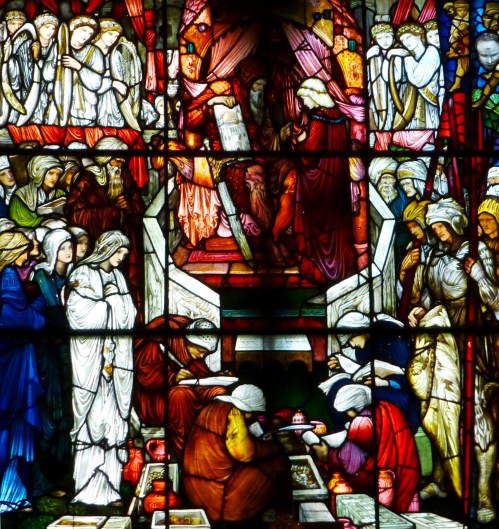
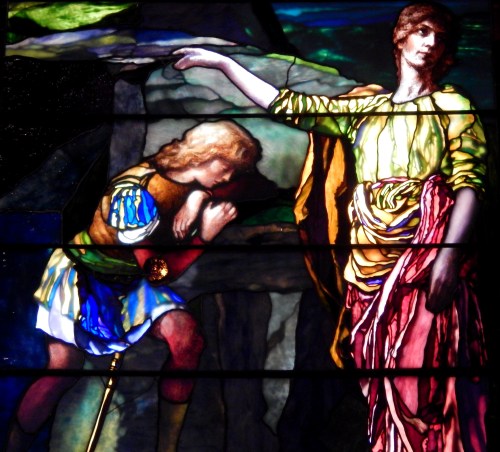
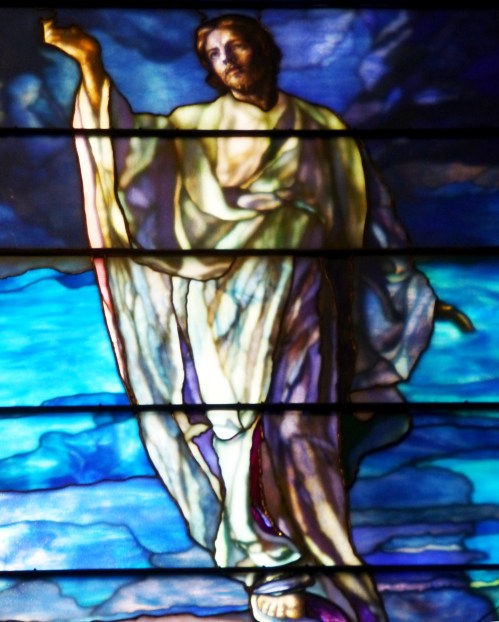
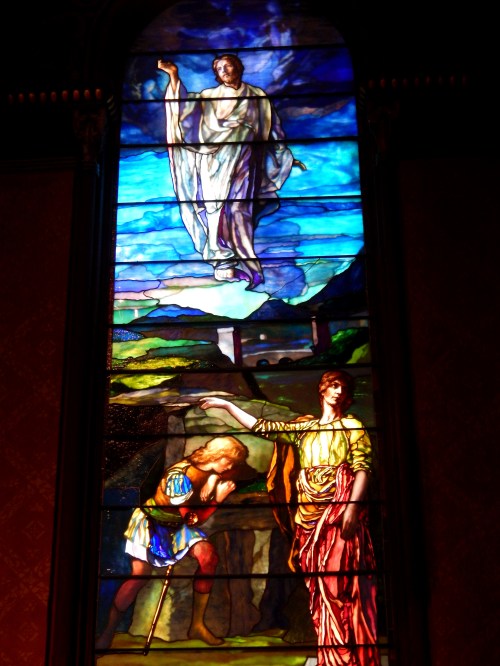
More details from the interior of Trinity Church in the City of Boston. Here we have a close up of the messenger in the stained glass window, The Resurrection, by John LaFarge.

In the March 1902 issue of The Church Standard, the window was described in this way:  “A beautiful memorial window has been added to the group in the north transept of Trinity Church.  It tells the story of the first easter morning.  In the background the purple clouds of morning are hanging, growing lighter as they seem to touch the low lying hills to the rear of the empty sepulchre, and their tints show the approaching dawn.  The flowing white garments of the risen Christ reflect the purple tints of the darker clouds … Upon the ground, reclining his head against the tomb, is the sleeping guard whose uniform makes a bright touch of coloring against the sombre hues of the walls.  A messenger nearby … [his] graceful garments of crimson and gold stand out in deep and inviting contrast.”

That same month, a reporter for the Boston Evening Transcript newspaper also notes the color: “The color is in the artist’s strongest and most brilliant vein, and is especially remarkable for its aerial tones of graduated blues and greens … In no stained glass work by LaFarge has he carried his extraordinary personal sense of color to a more complete measure of depth and significance.  It will, therefore, rank among his most important and characteristic work in this congenial medium.”  The window was commissioned by Charles A. Welch in memory of his wife Mary Love Boott Welch who died in 1899.

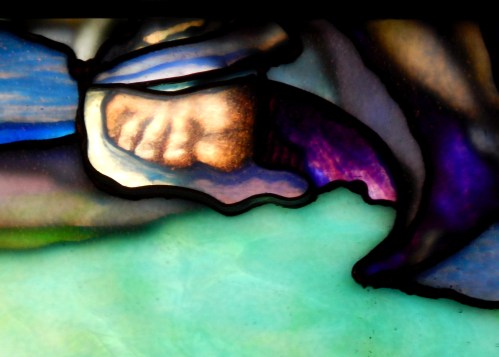
I’ve had the opportunity to photograph this window several times over the years.  But this particular day was special.  A friend had let me borrow her tripod and another friend had unexpectedly allowed me to access a place not often accessible so I could have new vantage points where I could focus on details I’d never focused on before … like five toes on a foot.

Of course, the whole is magnificent as well.

Whatever one’s vantage point, it is a lovely window to behold.  Learn more here:  Trinity Church Art & History

Read Full Post »

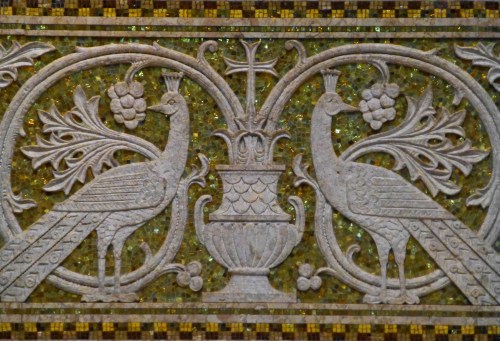
… particularly at certain times of day is the altar inside Trinity Church in Copley Square.  This altar is not part of the original construction and furnishings that took place between 1872-1877.  As described in a 1952 publication, The Story of Trinity Church in the City of Boston, by Rev. Edward Dutcher Romig, it was designed by Charles D. Maginnis as part of a 20th Century redesign of the chancel.  He writes of a giant block of Montenelle marble quarried near Trieste, and covered with carved faces and inserted borders of Venetian gold glass and colored glass mosaics. “The peacocks on the face of the altar symbolize eternal life, and the grapevine represents the wine used at the Communion Service. Thus the whole composition tells us that Christians who devoutly partake of the Lord’s Supper share in Christ’s promise of eternal life.”

You can learn more in a variety ways including Art & Architecture tours.  Another excellent resource is the book The Makers of Trinity available at the Trinity Book Shop.


Read Full Post »

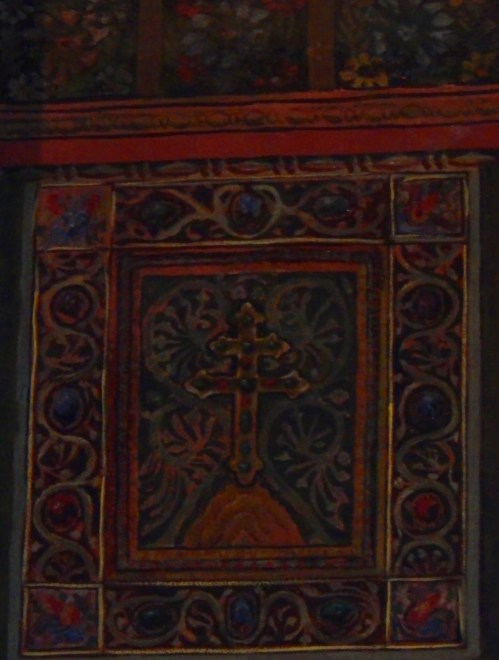
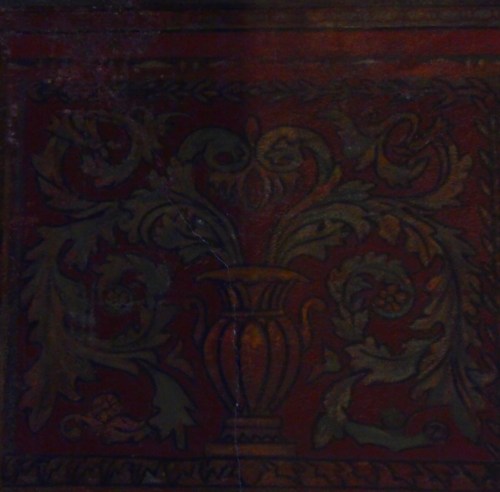
… I just make myself sit in a place, for just a few moments, and watch where the sunlight falls. And sometimes I notice that there are places where I have to shine my own light into a shadowed nook to appease my curiosity.  One day recently, while shining such a light, this is what I saw at Trinity Church.

Read Full Post »

« Newer Posts - Older Posts »