That is what I encourage you to do if you choose to view the poem, Refugee, written by Miki Byrne and beautifully illustrated by Podessto:
Posts Tagged ‘art’
read the words out loud
Posted in Books I Love, Uncategorized, tagged art, beauty, humanity, illustration, Inspiration, Miki Byrne, Podesto, poetry, Popshot Magazine, refugees, storytelling on March 2, 2017| 1 Comment »
close up
Posted in Inspiration, Uncategorized, tagged architecture, art, beauty, churches, faith, Inspiration, John La Farge, religion, stained glass windows on February 21, 2017| 1 Comment »
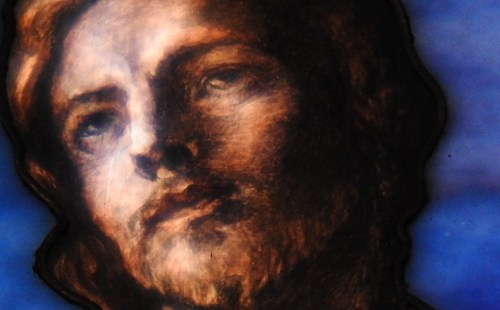
Detail from stained glass window, The Resurrection, by John La Farge (1902) at Trinity Church in the City of Boston.
just two minutes plus
Posted in Inspiration, Uncategorized, tagged Alvin Ailey, art, beauty, Black History Month, dance, Inspiration, music, storytelling, urban life on February 19, 2017| 2 Comments »
I was seeking not so much inspiration as simple background music to help me stay focused on my writing. In my usual meandering way I chanced upon this video and in reading about the origins of the video I learned about an award winning movie that probably most other people already know about called Moonlight. I hope to see it one day but meanwhile here is, in just over two minutes, a film from director Anna Rose Holmer capturing a powerful collaboration between the Alvin Ailey American Dance Theater and the movie composer Nicholas Britell. Choreography is by the theater’s artistic director Robert Battle.
Additional Reading – https://en.wikipedia.org/wiki/Moonlight_(2016_film)
just under 8 minutes
Posted in Inspiration, Uncategorized, tagged American history, art, immigration, Inspiration, Kennedy Center, Leonard Bernstein, music, National Cultural Center, Pablo Casals, Yo Yo Ma on February 12, 2017| 2 Comments »
Recently I “challenged” viewers to watch a video that was less than four minutes long featuring the dancer known as L’il Buck. This week I challenge you to view this video. On November 29, 1962 a benefit concert took place called The American Pageant of the Arts. In attendance was President and Mrs. Kennedy, Marion Anderson, Robert Frost, Van Cliburn, and many other stars of stage and screen. Leonard Bernstein was Master of Ceremonies. In this particular concert excerpt he introduces to America a 7-year old cellist named Yo-Yo Ma and his sister Yeou-Cheng Ma.
The benefit performance was to raise funds toward the creation of a National Cultural Center.
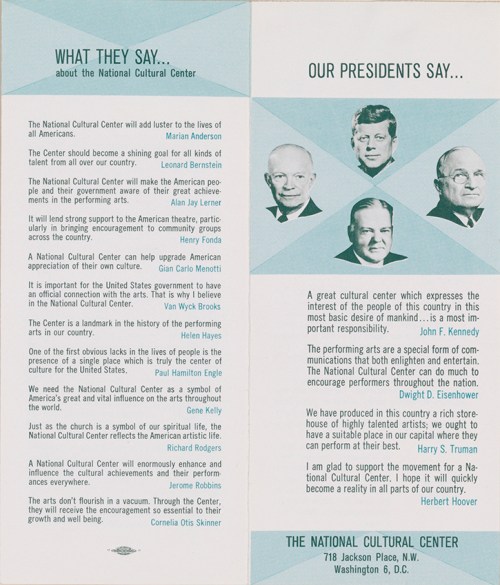
Today the National Cultural Center is known as the John F. Kennedy Center for the Performing Arts.
Sources & Additional Reading
https://en.wikipedia.org/wiki/Pablo_Casals
Hope for America/Government Support for the Arts – https://www.loc.gov/exhibits/hope-for-america/government-support-for-the-arts.html
https://en.wikipedia.org/wiki/John_F._Kennedy_Center_for_the_Performing_Arts
do you know … henry ossawa tanner
Posted in Inspiration, tagged American history, art, art history, beauty, emigration, faith, Henry Ossawa Tanner, Inspiration, race relations, religion, storytelling on February 9, 2017| 13 Comments »
Editorial note: This post was written in part in response to the current Presidential administration’s recent remarks this Black History Month, and its seeming lack of knowledge regarding black history in this country. It is also written to share in brief the life and work of an artist whose work I have always admired.
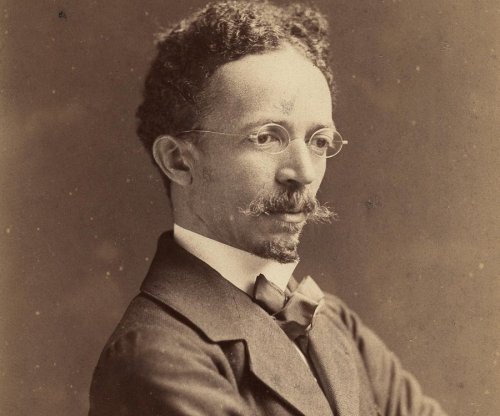
Henry Ossawa Tanner 1859-1937
Henry Ossawa Tanner was born in Pittsburgh, Pennsylvania in 1859 and grew up in Philadelphia. Tanner’s father, who happened to be a friend of Frederick Douglass, was a bishop in the African Methodist Episcopal church. Tanner’s mother, who had escaped slavery in Virginia via the Underground Railroad, taught private school in the home. Both staunch believers in education, they made sure their son, the eldest in a large family, was well-educated and prepared for a successful career in a conventional job.

The Tanner Family
Tanner had a slightly alternative idea. He too wanted to be successful and he wanted to be a painter. He’d known since the age of 13 after watching an artist at work in a Philadelphia park. Eventually, his father relented and he was allowed to pursue his artistic calling. In 1879 he was admitted into the Pennsylvania Academy of Fine Art, the first African American student to attend full-time.
Biographers refer to the fact that Tanner would write little about his time at the academy, mostly focusing on what he learned from Thomas Eakins with whom he studied. Regardless, it was an important period in Tanner’s life, not only for what he learned about art but also about human nature.

Already in attendance at the academy prior to Tanner’s arrival was student Joseph Pennell who would one day be recognized as a great American illustrator. In his 1925 memoir Pennell makes note of Tanner’s arrival at the school in a chapter titled, The Coming of the Nigger.

Ship in a Storm, 1879
“There was no dissenting voice in the academy against Tanner’s presence. He came, he was young, an octoroon, very well dressed, far better than most of us. His wool, if he had any, was cropped so short you could not see it, and he had a nice mustache. … he drew very well. He was quiet and modest, and he “painted too” it seemed “among his other accomplishments.” We were interested at first but he soon passed almost unnoticed … Little by little however we were conscious of a change. I can hardly explain, but he seemed to want things; we seemed in the way, and the feeling grew.”
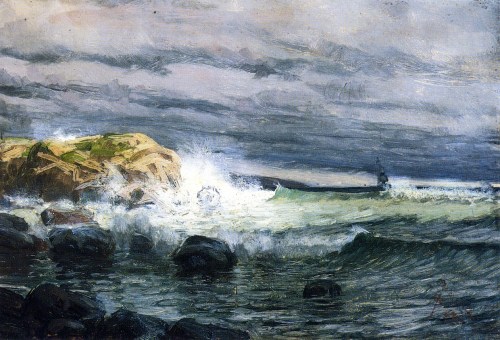
Seascape – Jetty, 1876-1879
One night while out on the town with Pennell and other students, Tanner was mocked by other African Americans for being with the white students. Pennell recalls, “Then he began to assert himself and, to cut a long story short, one night his easel was carried out into the middle of Broad Street, and though not painfully crucified, he was firmly tied to it and left there. And that is my only experience of my colored brothers in a white school. Curiously there has never been a great Negro or great Jew artist in the history of the world. …”
Tanner studied at the academy through 1885. By 1889 he moved to Atlanta. He was unsuccessful in a photography business venture. During this period he made the acquaintance of Bishop Joseph Hartzell of the Methodist Episcopal Church. Hartzel and his wife became patrons, helping Tanner secure a teaching position at Clark College, encouraging him to exhibit his work and eventually funding a trip for him to Europe. In Europe, Tanner discovered an environment where he was not a “negro painter,” he was simply an American painter. In 1891, he emigrated to Paris where he would study at the Academie Julian.

The Banjo Lesson. 1893
After contracting typhoid fever, he returned briefly to the U.S. to recuperate. During this period he delivered a speech at The Chicago Congress on Africa at the 1893 World’s Columbian Exposition about negro artists and sculptors. In 1893 he would also complete one of his most iconic works, The Banjo Lesson. Tanner had originally sketched this scene in the late 1880s while traveling in the Blue Ridge Mountains of North Carolina.

The Thankful Poor, 1894
In two paintings, Tanner portrays the beauty and dignity of African Americans, and does so in a way that is purposefully counter to the increasingly derogatory depictions of African Americans in art, newspapers and other consumer publications. Numerous prints of these paintings were made and hung in the homes of African Americans as a source of pride and inspiration. Tanner would produce few, if any other, such paintings of African Americans. Regardless, wherever Tanner traveled in the world, he captured the vibrancy of the people he saw around him.
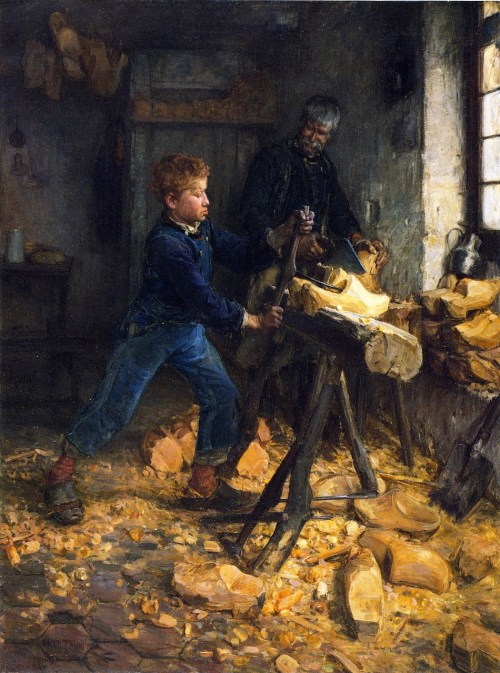
The Young Sabot Maker
With his religious paintings, he especially played with color and light.

Resurrection of Lazarus
After being moved by Tanner’s Resurrection of Lazarus, department store magnate and art critic Rodman Wanamaker offered to sponsor a trip to Palestine. Tanner traveled throughout North Africa and the Near East. The journey further informed Tanner’s work with religious narrative.

Mosque in Cairo
Aside from The Banjo Lesson, Tanner is now most often remembered for the breadth and beauty of his religious themed works.
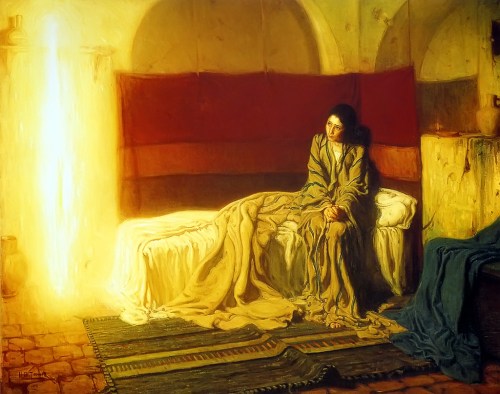
The Anunciation, 1897

Jesus Visiting Nicodemus, 1899

The Disciples See Christ Walking on the Water, 1907

Daniel in the Lion’s Den

Flight into Egypt, 1923
In 1899, Tanner married Swedish-American opera singer Jessie Olsson. They had one child, Jesse. Tanner continued to paint, exhibiting internationally. He expanded his list of patrons. In 1902, over the course of four months, four of his paintings – Sarah, Hagar, Rachel and Mary – were reproduced in the Ladies’ Home Journal. He became renowned though he would always struggle financially.

As World War I broke out in Europe, Tanner became depressed. He was unable to paint. Or what he painted while respected was not being purchased. He wanted to serve in some way but he was too old to enlist. He shared an idea with the U.S. Ambassador to the United Kingdom Walter Hines Page. His idea: turn the unused fields around the base hospital in Vittel, France into a vegetable garden and organize the convalescing soldiers as a work force. Provide food. Build morale. Page reached out to his counterpart in France and soon after Tanner was attached to the American Red Cross as a Lieutenant in the Farm Services Bureau. In 1919, for his efforts, Tanner received a Foreign Service certificate signed by Woodrow Wilson.
Postwar, Tanner would resume painting and once more receive accolades for his work. In 1923 Tanner was made a chevalier of the Legion of Honour for his work as an artist. In 1927 he became the first African American to be granted full membership in the National Academy of Design in New York.
Tanner lived during one of the most contentious periods in U.S. race relations. While he chose to emigrate to France, he always considered himself an American. He was a mentor and adviser to artists of all races studying in Europe. He was vocal in print and in person in support of equal opportunity for artists of all backgrounds. On May 27, 1937, he died at his home in Paris.
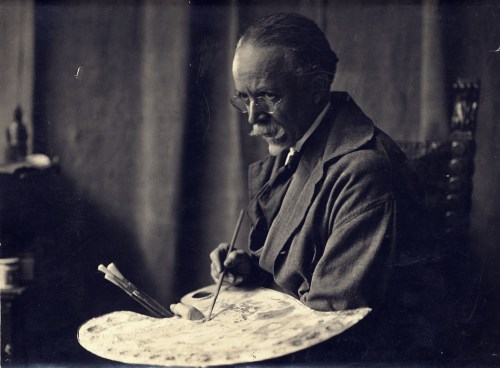
Today, Tanner is most often referenced as one of the great African American painters. I suspect he would simply like to be known as a great American artist. His painting, Sand Dunes at Sunset, Atlantic City was the first work of art by an African-American artist to be added to the White House Permanent Collection. It was acquired in 1996 from Dr. Rae Alexander-Minter, grandniece of the artist.

Sand Dunes at Sunset, Atlantic City, 1886
Sources & Additional Reading
Treasures of the White House: Sand Dunes at Sunset, Atlantic City
Henry Ossawa Tanner Wikipedia Page
A Missing Question Mark: The Unknown Henry Ossawa Tanner by Will Smith
http://americanart.si.edu/collections/search/artist/?id=4742
Khan Academy Course on Tanner’s Banjo Lesson
The Adventures of an Illustrator by Joseph Pennell
Photograph of the Extended Tanner Family, 1890
Henry Ossawa Tanner| Realist/Symbolist painter
Henry Ossawa Tanner: Race, Religion and Visual Mysticism by Kelly J. Baker
Henry Ossawa Tanner: American Artist by Marcia M. Mathews
unconventional growth
Posted in Inspiration, Kitchen Inspirations, Uncategorized, tagged architecture, art, colors, design, indoor gardening, John La Farge, Photography on February 4, 2017| 1 Comment »

There is no vessel in which I will not try to plant seeds. Or a seedling. Maybe a bulb. As a reminder that spring is coming, and to give myself a bit of peace of mind, I’ve decided to do some planting this weekend. I’ve yet to decide what this mug will hold. If it stays in the kitchen, it has to hold something edible. We’ll see … I may sip tea from it as I decide its fate.

The design of the mug was inspired by John La Farge and his decoration of Trinity Church in Boston. The geometric pattern is an adaptation of stained glass found on one of the interior doors. The sun was shining bright the day of the photo. The final pattern was translated onto a mug, magnet, and bookmark that can be purchased at the shop at Trinity Church. You can learn more about La Farge and his decoration on one of the superb guided tours. More information available here: http://trinitychurchboston.org/visit/tours
less than four minutes
Posted in Inspiration, tagged art, beauty, black dancer, creativity, dance, Inspiration, Lil Buck, music, Nowness, performing arts, video on January 28, 2017| 4 Comments »
When I first saw this video, my first thought was I must share this with my young nieces and nephews. From dancer Lil Buck’s words about his life journey, his grace amidst the works of Matisse and other masters, and the lovely soundtrack, this short video is a gentle respite. I hope you enjoy.
floral detail
Posted in Inspiration, Uncategorized, tagged art, beauty, design, floral inspiration, glass, Inspiration, Photography, stained glass windows on January 26, 2017| 1 Comment »

Detail from the stained glass window Purity by John La Farge
langston hughes says it best
Posted in Inspiration, Uncategorized, tagged america's future, American history, art, black history, immigration, Inspiration, Langston Hughes, Photography, poetry on January 25, 2017| 4 Comments »

a wall I saw today
Let America Be America Again
Let America be America again.
Let it be the dream it used to be.
Let it be the pioneer on the plain
Seeking a home where he himself is free.
(America never was America to me.)
Let America be the dream the dreamers dreamed–
Let it be that great strong land of love
Where never kings connive nor tyrants scheme
That any man be crushed by one above.
(It never was America to me.)
O, let my land be a land where Liberty
Is crowned with no false patriotic wreath,
But opportunity is real, and life is free,
Equality is in the air we breathe.
(There’s never been equality for me,
Nor freedom in this “homeland of the free.”)
Say, who are you that mumbles in the dark?
And who are you that draws your veil across the stars?
I am the poor white, fooled and pushed apart,
I am the Negro bearing slavery’s scars.
I am the red man driven from the land,
I am the immigrant clutching the hope I seek–
And finding only the same old stupid plan
Of dog eat dog, of mighty crush the weak.
I am the young man, full of strength and hope,
Tangled in that ancient endless chain
Of profit, power, gain, of grab the land!
Of grab the gold! Of grab the ways of satisfying need!
Of work the men! Of take the pay!
Of owning everything for one’s own greed!
I am the farmer, bondsman to the soil.
I am the worker sold to the machine.
I am the Negro, servant to you all.
I am the people, humble, hungry, mean–
Hungry yet today despite the dream.
Beaten yet today–O, Pioneers!
I am the man who never got ahead,
The poorest worker bartered through the years.
Yet I’m the one who dreamt our basic dream
In the Old World while still a serf of kings,
Who dreamt a dream so strong, so brave, so true,
That even yet its mighty daring sings
In every brick and stone, in every furrow turned
That’s made America the land it has become.
O, I’m the man who sailed those early seas
In search of what I meant to be my home–
For I’m the one who left dark Ireland’s shore,
And Poland’s plain, and England’s grassy lea,
And torn from Black Africa’s strand I came
To build a “homeland of the free.”
The free?
Who said the free? Not me?
Surely not me? The millions on relief today?
The millions shot down when we strike?
The millions who have nothing for our pay?
For all the dreams we’ve dreamed
And all the songs we’ve sung
And all the hopes we’ve held
And all the flags we’ve hung,
The millions who have nothing for our pay–
Except the dream that’s almost dead today.
O, let America be America again–
The land that never has been yet–
And yet must be–the land where every man is free.
The land that’s mine–the poor man’s, Indian’s, Negro’s, ME–
Who made America,
Whose sweat and blood, whose faith and pain,
Whose hand at the foundry, whose plow in the rain,
Must bring back our mighty dream again.
Sure, call me any ugly name you choose–
The steel of freedom does not stain.
From those who live like leeches on the people’s lives,
We must take back our land again,
America!
O, yes,
I say it plain,
America never was America to me,
And yet I swear this oath–
America will be!
Out of the rack and ruin of our gangster death,
The rape and rot of graft, and stealth, and lies,
We, the people, must redeem
The land, the mines, the plants, the rivers.
The mountains and the endless plain–
All, all the stretch of these great green states–
And make America again!
by Langston Hughes (1902-1967)
Read more Langston Hughes and find other poems for inspiration, reflection and perhaps even motivation at https://www.poets.org/
details from st. paul church, cambridge
Posted in Inspiration, Uncategorized, tagged architecture, art, beauty, churches, colors, design, Inspiration, Photography, religious art, sacred spaces, stained glass windows on January 23, 2017| Leave a Comment »
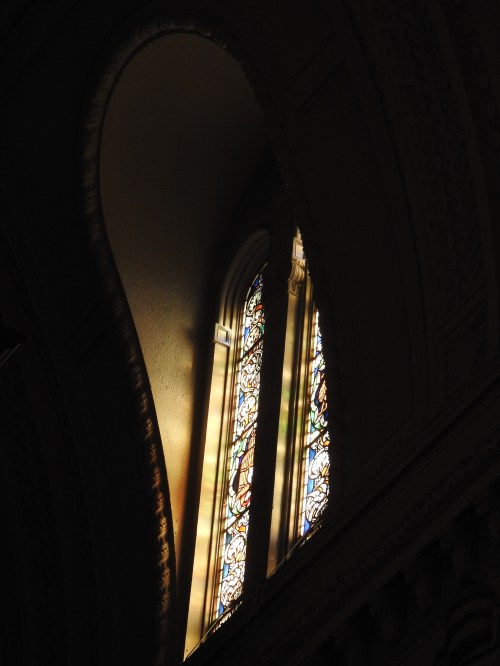
When walking toward St. Paul Church, the exterior conveys a sense of simplicity as well as sturdiness, which makes sense given that the building’s design is romanesque in style. Its red brick facade blends into the surrounding historic landscape of Cambridge, MA. As it is an active Catholic church, I knew I had a short window of time to take photos before the midday mass. I felt like I had prepared myself to be focused in my photography by reading the in-depth online building tour found on the church website. Still, reading the words can never really prepare one for the actual firsthand experience of stepping into a sacred space.

As noted on the website, “An oblong hall is divided by matching rows of columns, surmounted by a barrel-vaulted ceiling and rounded arches. Since the weight is supported by the walls, the windows are small. St. Paul’s, designed by architect Edward Graham, is modeled after the Church of San Zeno Maggiore in Verona, Italy.”

I was ready to deal with “small windows.” I was caught off guard by the beauty of the encompassing friezes and statues.


Eventually my attention did return to the windows, of course. There are three stained glass windows near the choir stalls including John the Baptist, St. Elizabeth (his mother) and St. John the Evangelist.
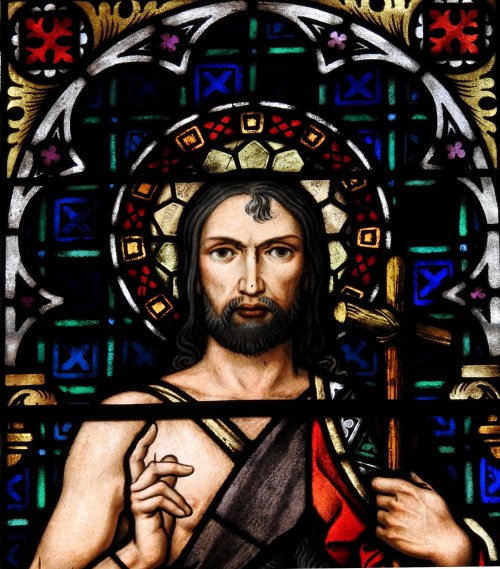
John the Baptist
The windows are narrow but their content looms large like these windows tucked in an alcove.


There are 10 windows in the lower part of the nave patterned after Renaissance images of the saints …

St. Jerome
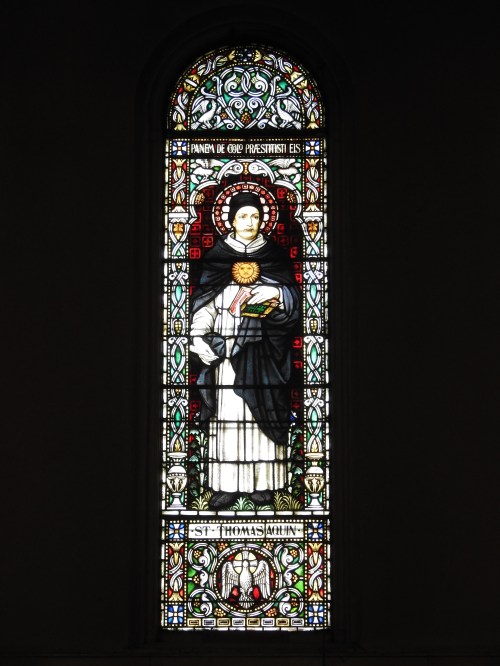
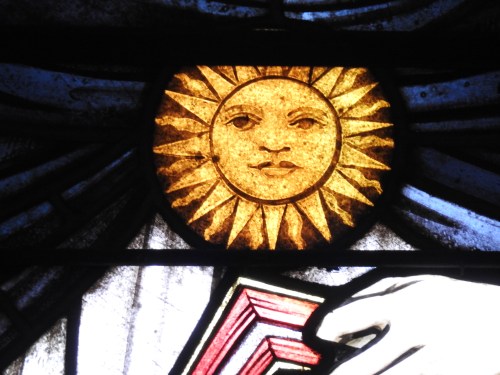
… and windows up high. Way up high.


These upper story windows were hardest to see but they glowed in the late morning light.
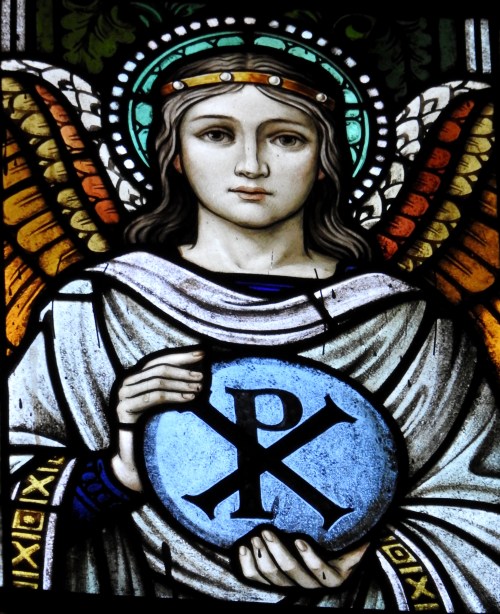
The church is an unexpected riot of color softened by the surrounding wood and marble. I’ve passed by the church for many years without ever stepping inside. I’m grateful to the staff for allowing me entry to photograph this very special place. You can read more about the interior of this historic building and find links for more information about its parish activities here: http://stpaulparish.org/building-tour/
 Words + Images