Feeds:
Posts
Comments

Posts Tagged ‘culture’

Here is a link to previous Interludes in our walk though history with Mr. Horne.


Walter Ings Farmer, Director, Wiesbaden Collecting Point

Walter Farmer, Director, Wiesbaden Collecting Point

In his book, The Safekeepers: Memoir of the Arts at the End of World War II (2000), Walter Ings Farmer writes that “The story of the Offenbach Archival Depot has never received the attention given to restoration of monuments … Nevertheless an account of MFA&A activities in the Frankfurt area would be incomplete without a description of the rescue of the literary and scriptural treasures that the Nazis had looted with the same nefarious purposes they applied to art collections. … Looting of libraries became as integral to the Nazis plan for cultural domination as the looting of art collections.

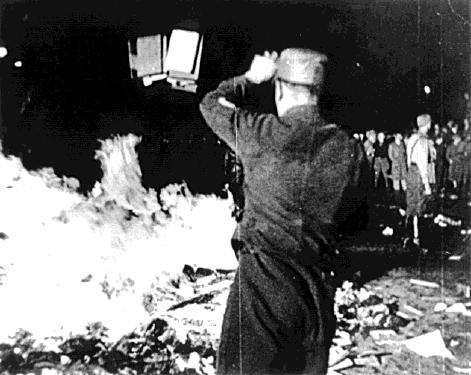
1933 Berlin Book Burning

1933 Berlin Book Burning

He describes how Nazi actions escalated from the 1930s public burnings of the authors they wanted to discredit to “a program of search and seizure among the libraries and archives of the nations that they sought to conquer. … These activities established a pattern which resulted in the eventual accumulation in Germany of storehouses full of other nation’s libraries.

Millions of books would be accumulated, along with a stunning amount of other cultural and religious items collected from across Europe.  Farmer writes of being introduced to Offenbach by “his boss” Captain James Rorimer in the fall of 1945.

James Rorimer

James Rorimer

He took me with him to inspect an abandoned warehouse within the I.G. Farben plant at Offenbach,” remembers Farmer. “This building was under consideration to become to repository primarily for Jewish libraries, archives and the Torahs.” Prior to the warehouse in Offenbach being established as a collecting point, library collections were being stored at the Rothschild Library in Frankfurt. Over time it was clear that infrastructure at the Rothschild Library was inadequate.

Based on his and others assessment of the situation, librarian and MFA&A officer Lt. Leslie Poste suggested that detailed cataloging of the items be stopped at Rothschild and that operations be relocated across the river to the I.G. Farben plant, the site of a five-story, reinforced concrete loft building.

Seymour Pomrenze (center)
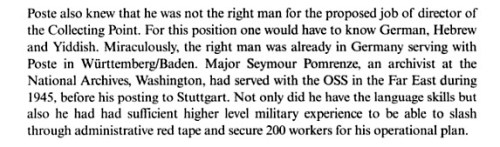
Seymour Pomrenze (center)

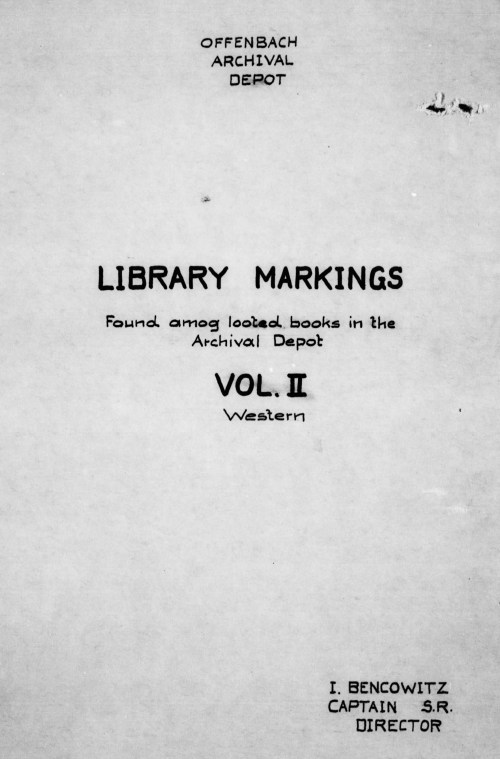
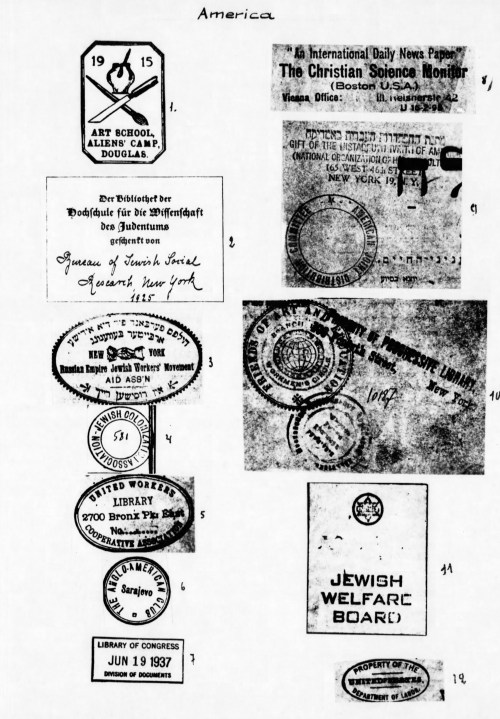
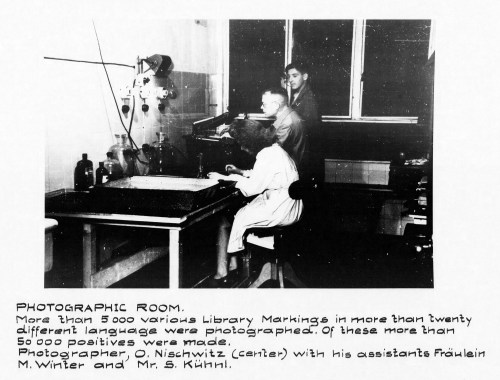
Pomrenze put into place necessary administrative, transportation, cataloging and storage systems enabling the depot to operate much more effectively.  Professional conservation and preservation labs, a photographic studio and other needed infrastructure was created.  His successor, Captain Isaac Bencowitz, refined a system for photographing ex-libris and library markings found in books.

Isaac Bencowitz

Isaac Bencowitz

The resulting cataloging system would significantly increase staff ability to identify and sort items, identifying country of origin and other markers of ownership .  In the end Bencowitz and his team would complete “two volumes with reproductions of library markings belonging to 4,105 libraries of individuals and institutions in Western and Eastern Europe

and two volumes with more than 1,300 bookplates or ex-libris, including 1,200 German-Jewish, German-Masonic and probably German non-Jewish plates as well as over 100 mostly Dutch-Jewish bookplates.” (F. J. Hoogewoud)

As requests were submitted by individuals, families and nation states seeking missing items, MFA&A staff were able to use the catalogs to help them search through the millions of books and cultural items that would eventually be stored at Offenbach.

Bencowitz, during his tenure as director, used photography to document the operations of the depot and its staff and volunteers.

Staffing the depot was a mix of U.S. military, Allied and civilian personnel, as well as German civilians, and scholars from around the world. In October 1946, Bencowitz received orders for redeployment.  The imminent nature of his departure and shifting priorities in the region for policy and decision-making made selecting a new director difficult.  As an “emergency measure,” archivist Major Lester K. Born and his assistant, Joseph A. Horne, were sent to Offenbach for temporary duty.  Born was to develop an interim plan for continued operation of the depot, a plan that Mr. Horne was to implement.  In short, a plan was finally developed and by January 1947, Horne became the third director of the Offenbach Archival Depot.

Exactly what Horne was doing prior to assuming his new role remains opaque without futher research.  Archival records show him often assisting MFA&A colleagues like Gordon Gilkey, Leslie Post, Lester Born and Paul Vanderbilt with the acquisition of information about available artwork and cultural items.  His fluency in German, facility with “dead languages,” appreciation and knowledge of the arts, and photographic skills would have made him invaluable in the field.  He produced numerous reports about his trips across Germany about what he was seeing and hearing from locals. People were often very open with him.  Following is an excerpt from a field report after visiting libraries in over a dozen landkreise or rural districts:

By 1947, relations with the Russians had deteriorated significantly, adversely affecting the restitution of items to individuals and institutions in Russian-controlled territories, and the exchange of items between the Russian Zone and other Allied Zones.  With plans well underway to revitalize German economy and culture (including denazification), military and intelligence priorities shifted to stopping the Russians.  And so Horne like many within the MFA&A unit followed orders as high level officials made clear that those in the U.S. intelligence sector had full access to depot materials and freedom to act as they deemed necessary.

In February 1947, one month after Horne became director of Offenbach, Lucy Schildkret arrived.  She would later write, “his friends called him Tony. Before the war, he’d been on the staff of the Library of Congress’s photographic division.  Transferred from the MFA&A in Berlin, he was then new to the Depot, having taken over his duties barely two weeks before my visit.  About thirty, very tall, thin, lanky, and blond, he was the only American there.  He was in charge of a staff of some forty Germans.”

In her memoir, From That Place and Time, Lucy Schildkret describes her encounter with Horne as she works to sort, identify and return the YIVO library of Vilna, Poland.  The Yiddish Scientific Institute (YIVO) was founded in 1925 for the scientific study of Jewish life.  Headquartered in Vilna, the institute had branches around the world including the United States. At the start of the war its headquarters were transferred to New York City.

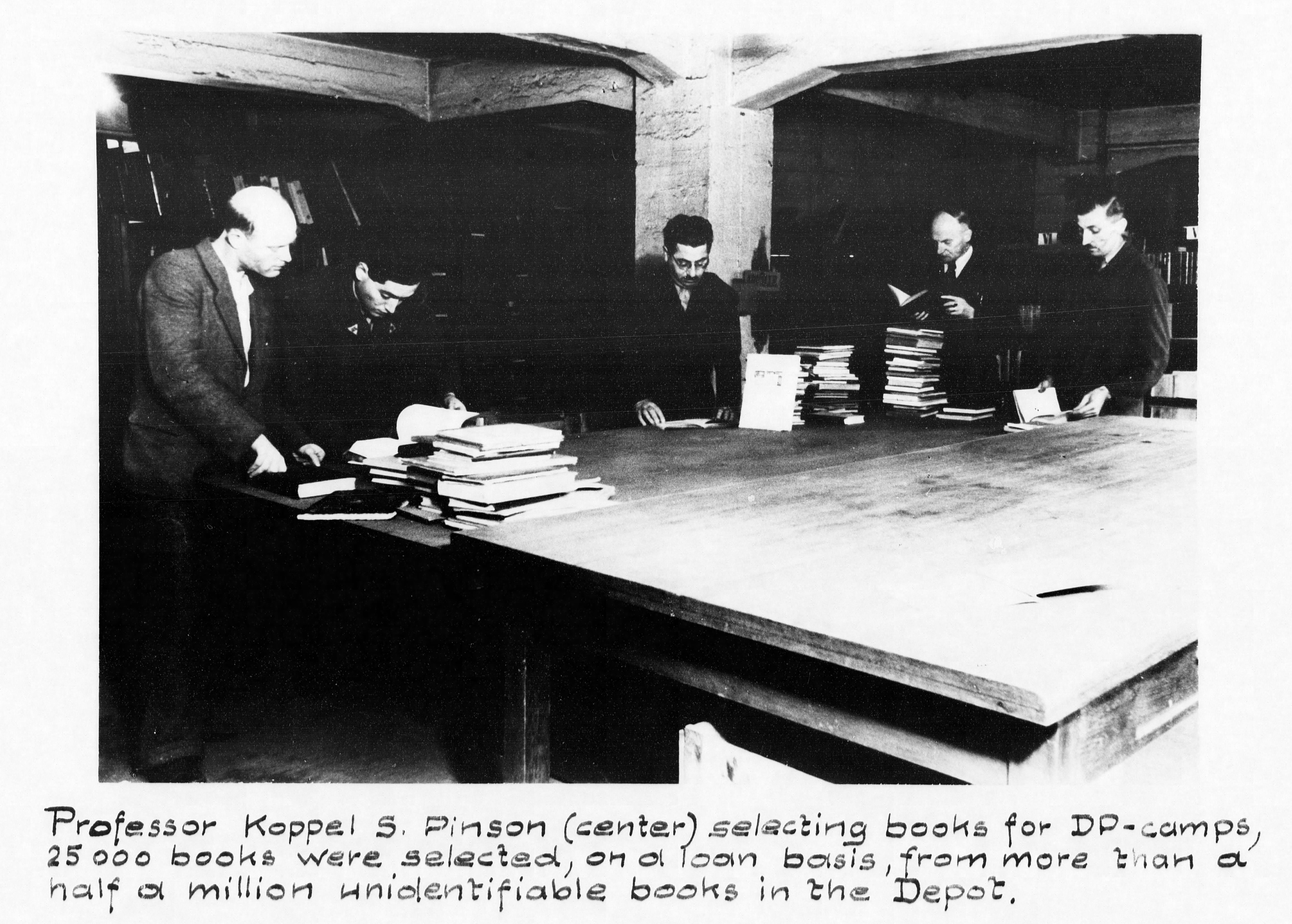
In late 1945, when the YIVO library was identified as being in Frankfurt, visiting Jewish scholar, Prof. Koppel S. Pinson sought permission from the YIVO leadership in New York to distribute, like a lending library, some of the unidentifiable books to Jews living in the Displacement Camps.  It would take time but he would be granted such authority.
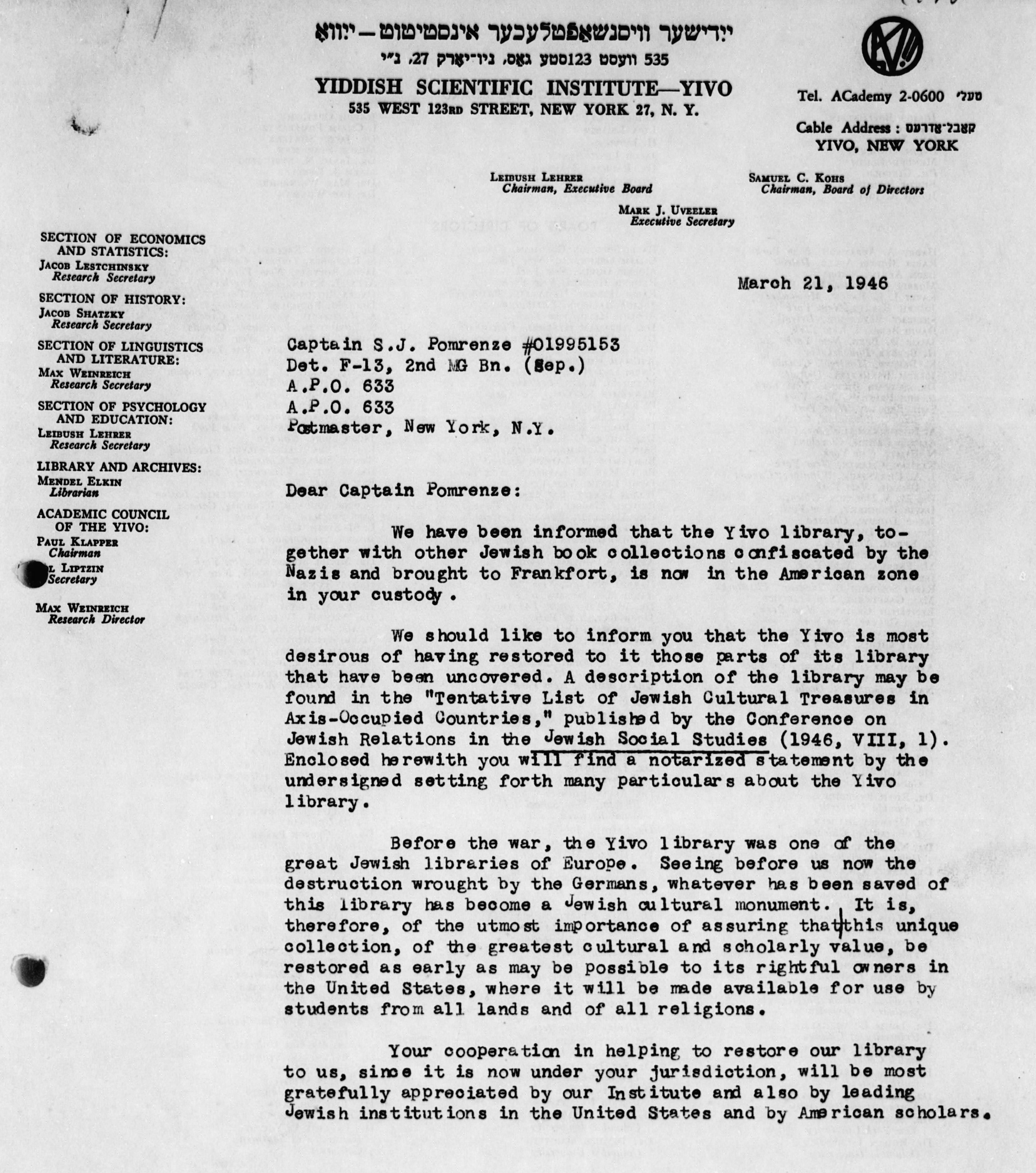
A year later, Lucy Schildkret would also be granted authority to work with the books.
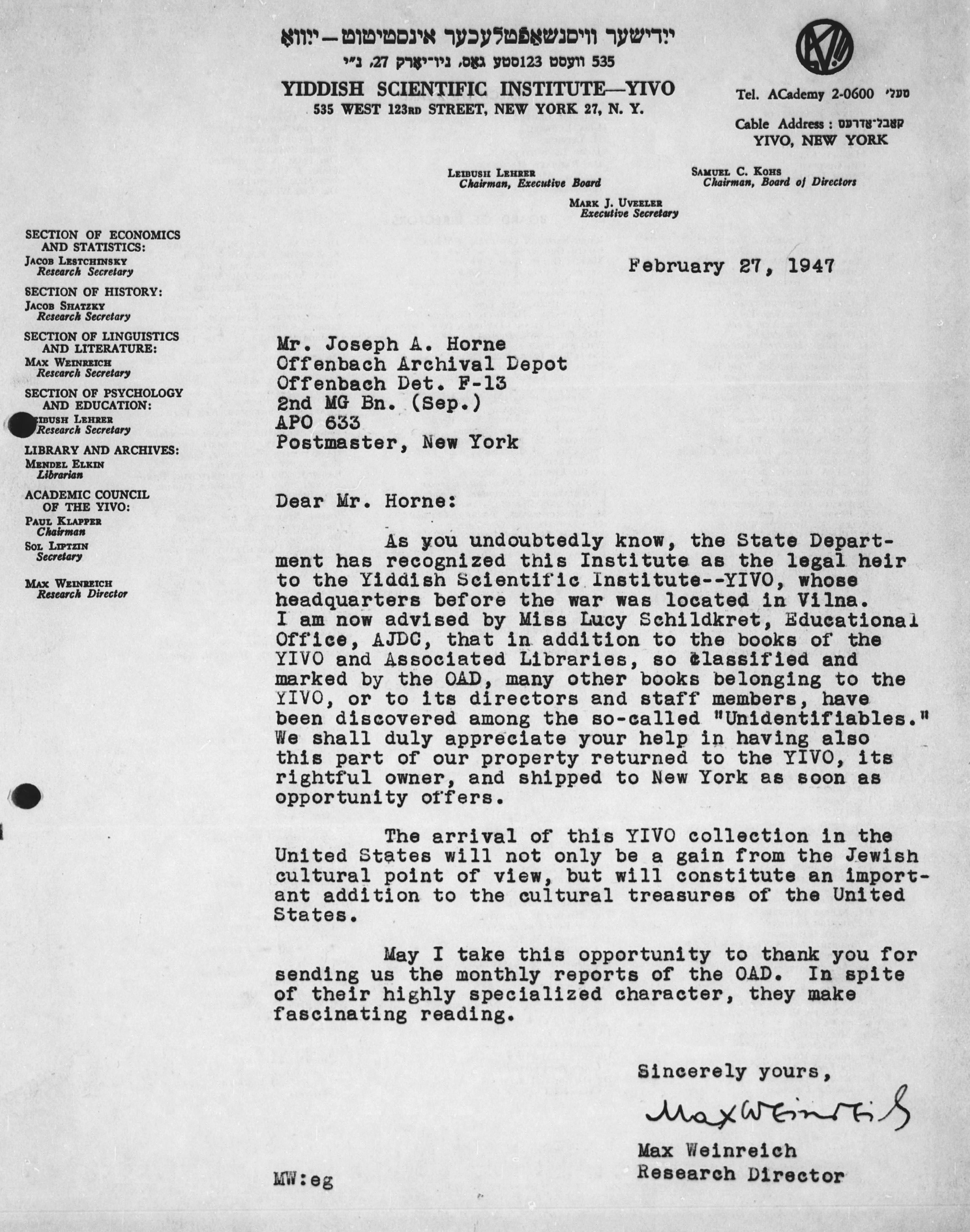
The complexities of sorting, identifying and returning books at the scale demanded of the Offenbach Archival Depot become clearer when reading through the declassified documents relating to what happened with just the YIVO library.  For instance, YIVO like many libraries of its size and mission had been the repository of family libraries.  Books at Offenbach were being identified by ex-libris and other markings as belonging to individuals and/or their families but they had in fact been donated to YIVO (or other institutions) by family members.  There are numerous letters between YIVO administrators with U.S. military officials trying to prove the ownership of items.
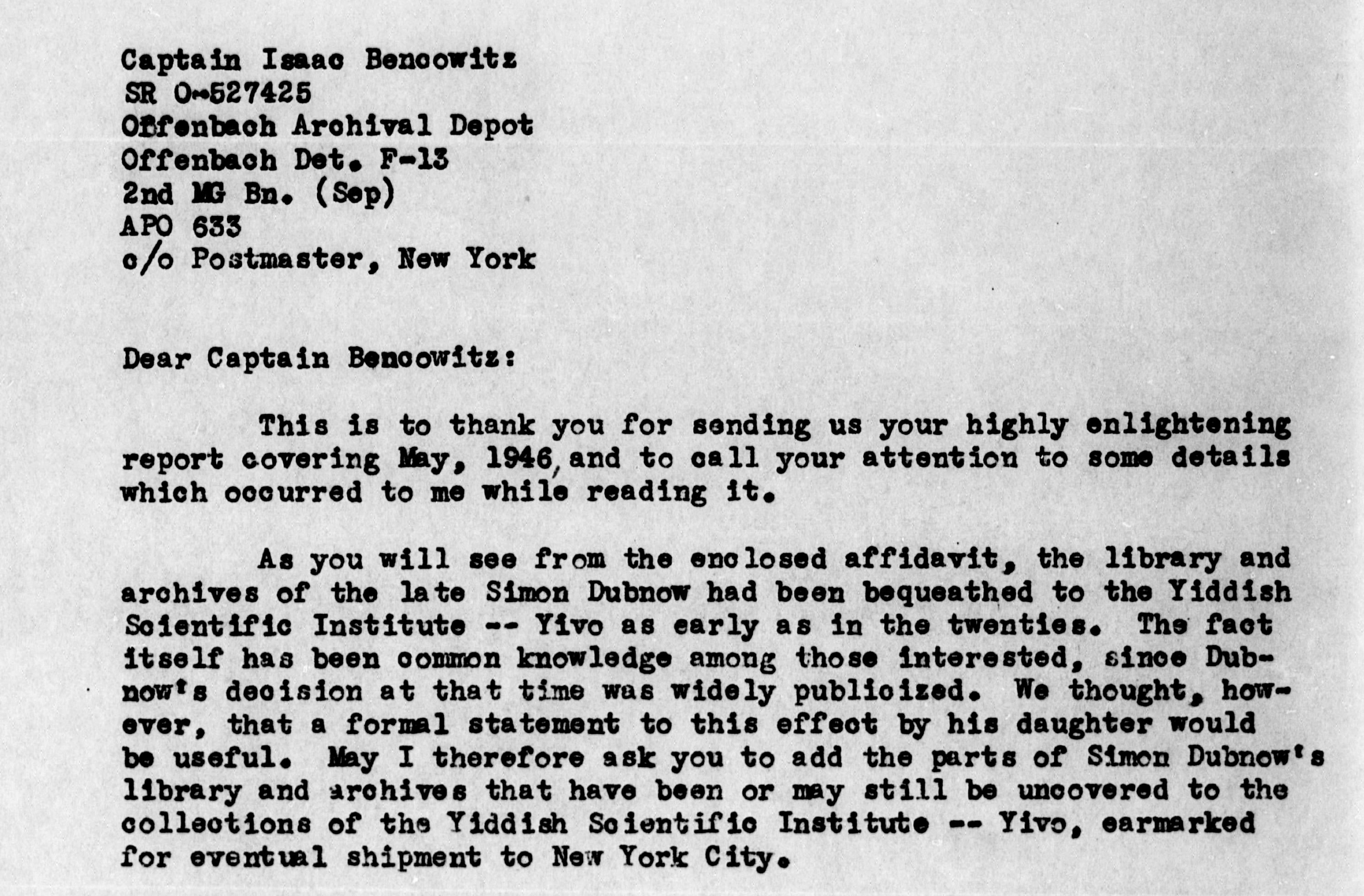
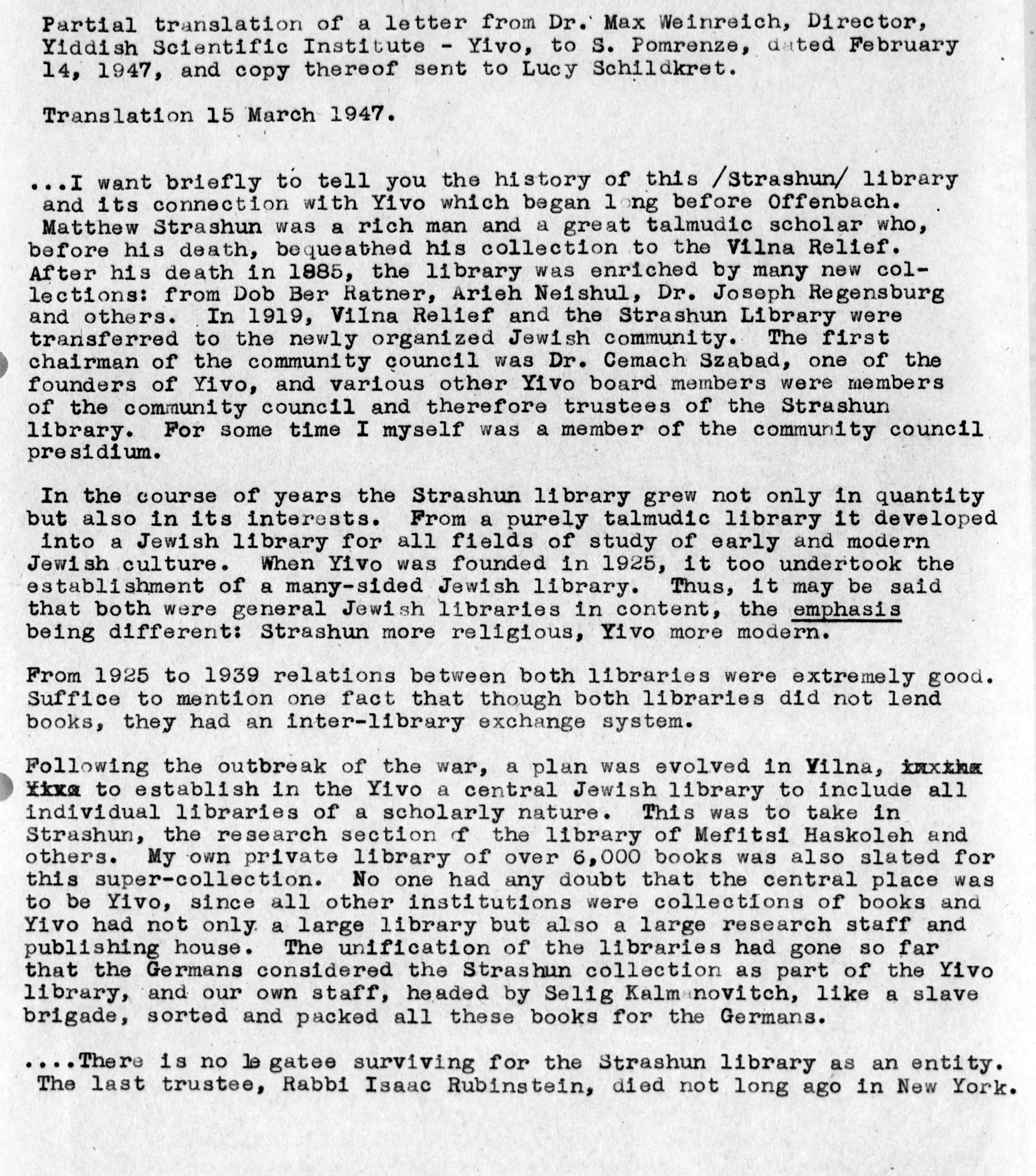
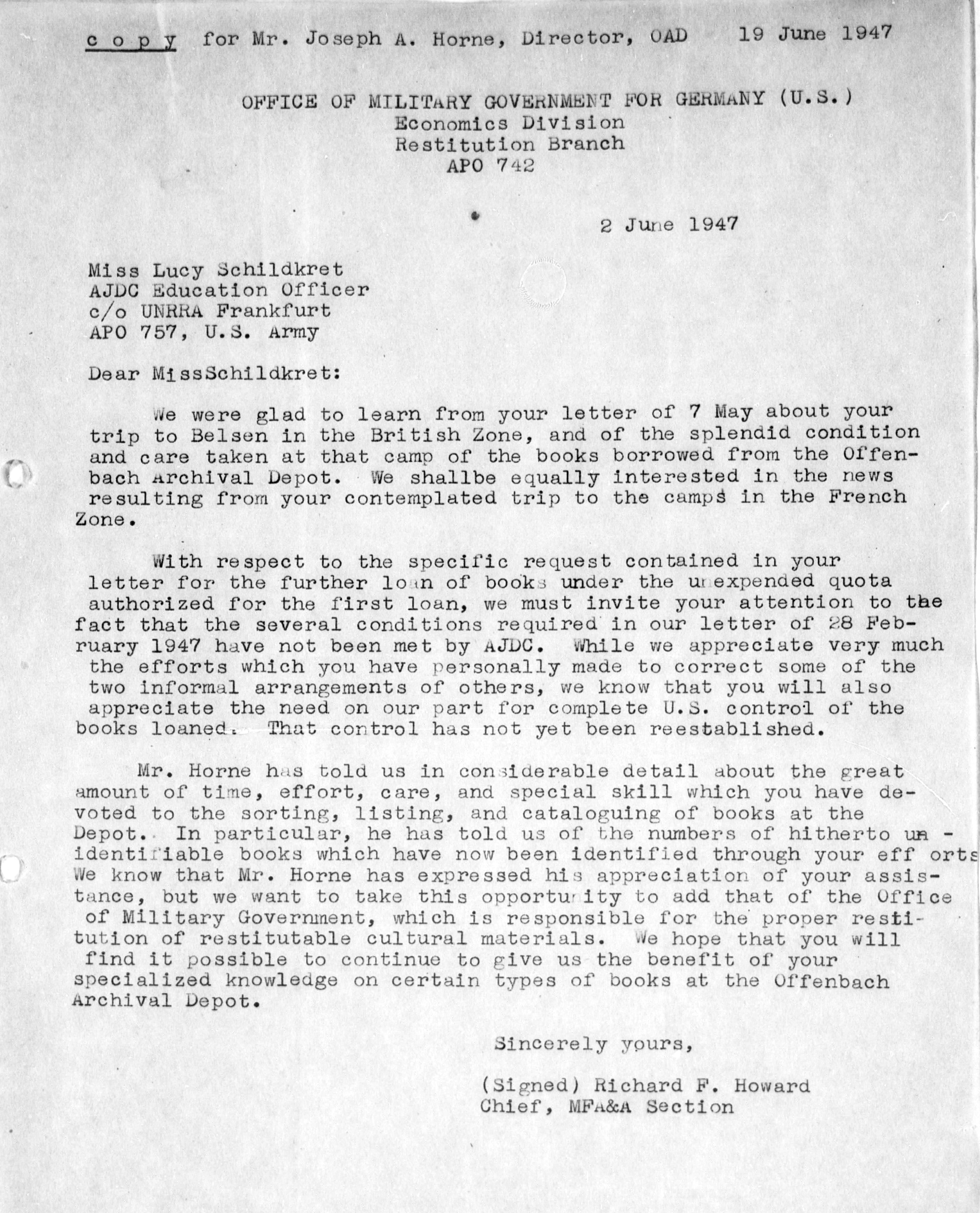
Though correspondence about the YIVO library begins in 1945, by early 1947 the vast library had yet to be shipped to YIVO in New York.  The reasons include continual reduction in manpower, both skilled and unskilled, at the depot and complex, bureaucratic chains of command within the U.S. military, between the Allied zones and even within the YIVO organization.  In a March 1947 document, Horne reports to his superiors that Miss Schildkret has been unable to examine several hundred thousand unidentified books because she had yet to receive authorization.
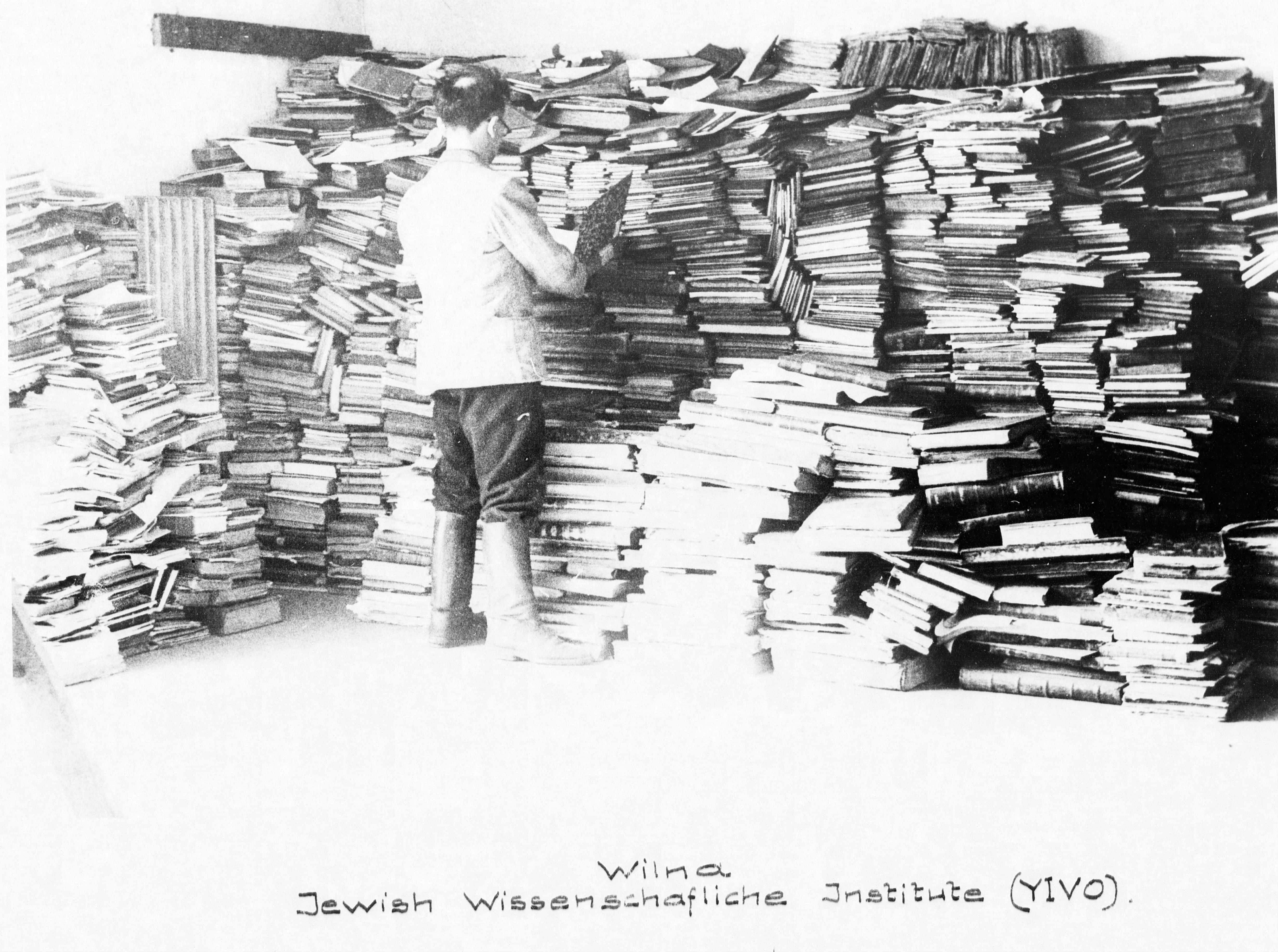
Vilna Library During German Occupation, in the files of the Offenbach Archival Depot

Vilna Library During German Occupation, in the files of the Offenbach Archival Depot

In 1938, Lucy Schildkret had studied in Vilna and worked at the YIVO.  Prior to the war, she would return to the U.S. and work as assistant to the research director at the YIVO headquarters in New York.  In 1946 she journeyed to Europe as an educational worker with the American Jewish Joint Distribution Committee (AJDC), the largest Jewish relief organization in America. Through this organization she was able to work with displaced persons in the camps.  With her skills in Yiddish and time at YIVO, she was able to discern that books that had been labeled as unidentifiable were indeed identifiable.  But even as she acquired the authority to help identify the YIVO library, she maintained her focus of serving the people housed in the displacement camps, and she would do so with a tenacity that would characterize her career for decades to come.
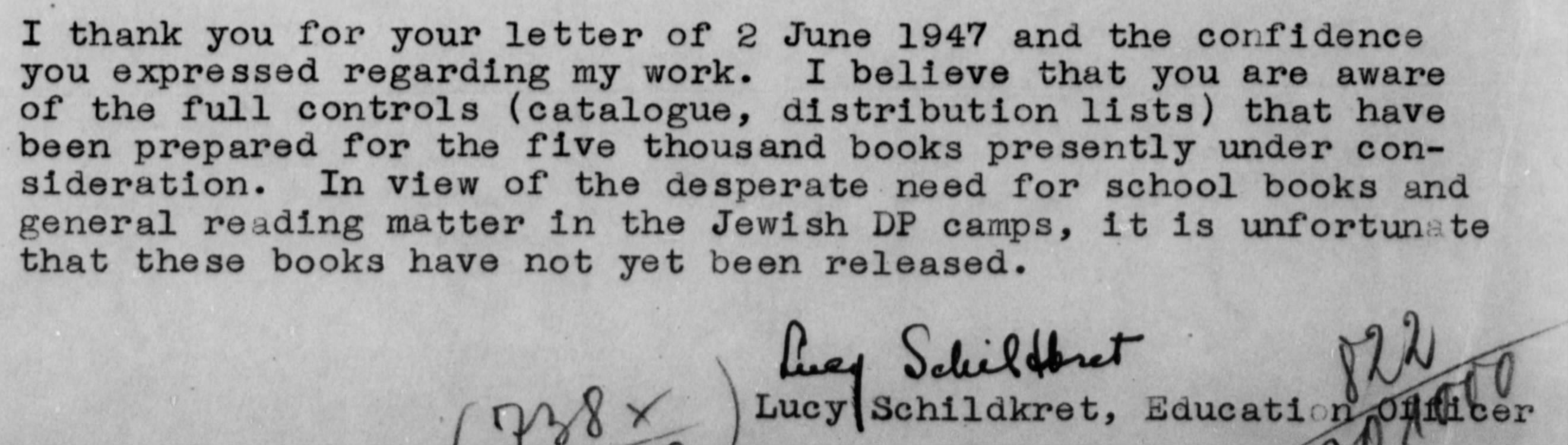
Schildkret responds two weeks later with a letter that concludes:
Her memoir presents a powerful account of the emotions stirred by working with the contents of the library from a place that she had called home and knowing what had happened to the people she’d called friends as the Nazis destroyed the city.

Eventually, with the combined effort of many individuals in several countries, over 90,000 items would be returned to the YIVO.  Seymour Pomrenze who had been pivotal in streamlining systems at the depot would be brought back to help shepherd the return of these items.  In 1998, Pomrenze shared his personal reminiscences of his experience with the Offenbach Archival Depot and the depot’s considerable achievements restituting and distributing millions of Nazi-looted materials including the YIVO library.

Mr. Horne, the person with whom we are taking this walk through history, would wrap up his tenure at Offenbach in 1948 though files show that he continued to support depot activities until its closure.  In the Cold War world, he would, strangely enough, continue to work with books and even return to his earlier interests in music and photography as he embarked upon a new journey.  One world war had ended. A new type of world war had begun. A new weapon in that war was the exchange of culture and what better place to share all that made up culture — from art to music to literature — than in a library.

More to follow …

Sources and Additional Readings

Cultural Plunder by the Einsatzstab Reichsleiter Rosenberg (ERR)

What Became of the Jewish Books? (New Yorker, February 2014)

U.S. Holocaust Memorial Museum — Offenbach Archival Depot

Pomrenze Personal Reminiscence about Offenbach

Mapping the Offenbach Archival Depot

Returning Looted European Library Collections

YIVO Digital Archive on Jewish Life in Poland

YIVO Institute

From That Place and Time: A Memoir, 1938-1947 by Lucy S. Davidowicz and Professor Nancy Sinkoff

Article – Dutch Jewish Ex-Libris Found among Looted Books in the Offenbach Archival Depot (1946) by F. J. Hoogewoud

1939 Photo of Lucy Schildkret in Vilna


Read Full Post »

Blues 1

Blue Rose in the Hall

Maybe it was fear that made the young men shout “Nooooo!” as I stood next to a For Sale sign in front of a house in a suburb outside of Boston.  Fear of change, fear of something different coming into their midst.  And maybe it was fear that made a woman look me up and down as I questioned her entrance into a building (part of my job at the time).  As she left the building she made sure to look at me in that same way and I had to think, “Well, if looks could kill, I’d be six feet under.” And maybe it was fear that made the waitress do some things during a meal, such that once I’d left the restaurant with my friend (whose favorite restaurant it was), she said, “I’m sorry.  I didn’t expect that to happen.”

Now if I were to say that all of those fairly recent events happened, in part, because all the other individuals were white and I am black … well, I think there are folks who might say, as is often said today, why does everything have to be attributed to race?  Because race does matter.  As does class, gender, and economics. It all matters.  But here’s why race stands out for me:  slavery. “Slavery ended,” someone said to me once. “Why keep bringing that up?”

Born in the 1970s USA, I have never been a slave.  I have never been shackled or forced to give up a child or beaten if I tried to put pen to paper or pick up a book.  I’ve never stood in a market while an overseer pointed out my attributes so that someone might buy me as a companion for their children or an extra servant in the kitchen.  Never needed to carry papers proving freedom (or ownership), nor been branded, or had to hope that my master would free our children in his will.

As former slaves did about 150 years ago, I’ve never been in a position of celebrating freedom and, on the other hand, having to deal with the realities of having little but the clothes on my back and waiting for forty acres and a mule.  Never had to deal with “separate but equal” or segregated schools (my older brothers did who were born in the 1950s and 1960s).  Never been in a position or location where I had the right to vote but other forces, those perhaps suffering from fear of change, were putting strategies into place to prevent me from voting (my parents dealt with that).

Nor have I had to watch a loved one (or even a stranger) brutally beaten, mutilated, hung from a tree or a telephone pole, and burned.  I’ve heard a few stories from older family, watched the documentaries and read quite a few articles.  When I read the stories of lynching, especially in old newspapers recently digitized, and see the images, I cry.  I cry for the people who died, the people who watched and tried to help, and even for the people who watched and did nothing.  I did wonder what the people who did nothing were thinking? And what about the people who sang and danced and even cut off parts for souvenirs or mailed those parts to white politicians trying to effect some change?

For some, did the actions they witnessed mean nothing because the people to whom the deeds were done looked nothing like them?  Or was it just that they did not know what to do? Were some people truly scared or were they simply seeking pleasure in establishing control over another?  All of those incidents are part of the fabric of this country, as are the people, of all races and backgrounds, who fought to end slavery, the people who fought to end routine lynchings and the people who continue to fight for economic and voting rights for all people.

Yes, I do indeed bring up slavery and other injustices from the so-called past because of present-day incidents like in Ferguson.   Slavery is an institution, one of many, that this country has yet to deal with. I don’t care about politics or how people choose to identify themselves in this country as Republican, Democrat, Tea Party, Libertarian and so on.   Political labels and tenets change over time.  But what about human behavior?  How has that changed over time?  Or has it?  Why do we treat people the way that we do?

You can “follow the money” in terms of why slavery was entrenched in this country for so long.  Economics, economics, economics.  In too many venues of late, I have read people saying stop talking about race and focus on the economic issues in a Ferguson.  Of course, economics is an issue and powerful factor leading to injustices happening in many communities.  But it comes down to a bit more than money to treat people as inferior or to hear their screams of pain and laugh or to make assumptions about their children’s ability to learn regardless of resources provided for education.  And it is about more than economics to see all those things taking place around you and to do nothing. To some extent, I feel little right to judge others because I do not always know what to do as I learn about the horrors around me, in this country and abroad.  I do know with regard to slavery and the seeds that were planted that continue to sprout, I do not want to forget.

I’ve been researching the past, including slave times, quite a bit of late for various projects as well as to better understand current events.  In the remembering, and rediscoveries, I don’t come to hate people who look different than me.  Not at all.  A part of me mourns.  I mourn the horrors, and I also celebrate the courage of so many different peoples, their hopes, their activism and their creativity in finding the beauty in this life.  And I celebrate such in the people who are active today.

As a final note in my Sunday ramblings, if you chose to read so far, … I came upon a 1920s newspaper article about a lynching. The reporter recounted that witnesses heard the dying man sing a song with his last breaths as the flames consumed him.  I looked up the song and came upon the following 1950s rendition by Sam Cooke.  A powerful piece.


Read Full Post »

Spring will come! Meanwhile, here are a few projects that I’m working on.

1. New postcards coming to the Trinity Church Bookshop.  Most of my previous images have focused on details of the stained glass windows.  These new images highlight the wall paintings, murals and the interesting play of winter light across the unique architectural features of the building.

2. Moving forward with the InterludesInterludes is a collection of historical vignettes composed of words and images relating in someway to the life journey of Joseph A. Horne (1911-1987).  My research into his life began, in part, out of curiosity sparked by stories that he’d told his son and his son would later share with me.

Researching his life became a walk through history as I learned about orphan trains, immigration, the Depression, the Farm Security Administration, photography used at home and in war, and then there was the Monuments, Fine Arts & Archives program.  What a delight to share with his son, “Hey, did you know your dad was one of the Monuments Men?”

In addition to my main chapters, there are “interlude extras.”  Please check out previous posts here:  interludes TOC.  Coming soon Mr. Horne’s correspondence in the 1940s and 1950s with photographic historian and collector, Dr. Erich Stenger, and the complexities of operating the Offenbach Archival Depot.

3. Collecting and Sharing “Lost” Stories. It’s not so much that most of the stories are lost.  I just think that some portions of these stories could be more widely known.

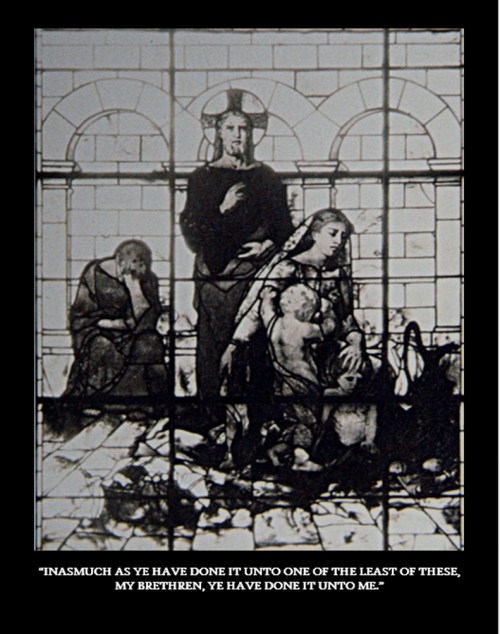
For instance, it’s not so much sharing the technical story of this stained glass window designed by Frederic Crowninshield in the 1880s (which was sadly dismantled in the 1950s).  What I’m looking forward to sharing is the story of the remarkable Bostonian for whom the window was created and whose legacy is still being felt today.

I’m also looking forward to sharing even a small portion of the story of an African American architect who started out designing stained glass in the late 1800s before moving on to design buildings, and even starting an architecture department, before his death in the late 1920s.  Researching this man’s life has opened my eyes to the role of African Americans in architecture.  It has also given me a new perspective on the complexities of life, within and across ethnicities, as America forever dances (and fences) with the idea of becoming a “melting pot.” Stay tuned.

4. More Food Photography.  Well, when you’re stuck in a “snow globe” after many successive snowstorms, and your favorite place to work at home is the warm kitchen, you can start to have a lot of fun photographing food.  We’ll see what the rest of this wintry culinary season has to hold for me and my camera.

chive sprouts

chive sprouts

Moro

Moro

That’s the scoop. Stay warm!

Read Full Post »

My mother had a drawer full of scarves, of every size and color imaginable.  The textures tended toward silky or the fine sandy grain of those materials that were sheer.  My scarves are more dispersed throughout my environment, possibly because, in a way, I have more personal space than my mother ever had.

She would have been a teen and partying young woman in the 1950s and 1960s when scarves were a fashionable part of the ensemble.  By the time I came along in the 1970s, my mother wasn’t partying so much but she still had that drawer full of scarves, and I remember my father still buying her scarves throughout much of my childhood.

Whether for elementary school or high school, when I left the house in the morning for my journey, if the wind was blowing fiercely, if she’d done my hair the night before, if there was even a chance of sprinkles … she’d wrap one of her colorful scarves around my head and tie it beneath my chin.  In elementary school, I may have looked cute.  In high school, when scarves were not fashionable … well, I once passed by a group of girls and one of them said, “What is she wearing?!” But, even as I felt bad, I heard another girl say, “Leave her alone.”  What I remember from that moment, this day, is the care of my mother and the care of that stranger.

My small scarves I keep in a little gold box on a book shelf.  I rarely use them or even look at them but I’m not ready to part with them.  Long, narrow scarves I keep in a basket, and when I am too lazy to track down my leather belt, I’ll pull out one of those scarves to hold up my pants.  Large, square scarves I learned to wrap around my head using techniques my mother did not know.  Those I’ve tucked away in a drawer.  I mostly wear long, oblong scarves, especially the ones given in recent years by friends and family.  I wear them to freshen up an outfit.  And, of course, I photograph them as they are or use them to serve as background for a leaf.  And, in this house, with so many windows, I sometimes hold them up to see what happens when the light shines through.

These musing of the morning were inspired by a link recently shared by a friend, a Salon interview by Edwidge Danticat of Katia D. Ulysse.  As my friend described to me, it is a thought-provoking, poetic exchange between two writers of Haitian heritage.  An excellent read.  At some point there is reference to scarves, and that was all the inspiration needed for me to crack open a box.  Have a good day.

Read Full Post »

Following is an updated table of contents (TOC) for the series of interludes, a collection of historical vignettes, threaded together by following in the footsteps of one gentleman, Joseph A. Horne (1911-1987). It’s a glimpse into history that continues to shape this world.  It’s been a wonderful, sometimes surprising, experience for me. The interludes will conclude over the next few months including a few more “interlude extras.”  I hope you enjoy this journey of words and images.

I. interludes TOC

i. foreward to the interludes

ii. interlude: genesis

iii. interlude: exodus, part 1

iv. interlude: exodus, part 2

v. interlude: dust in the wind

vi. interlude: lamentations

vii. interlude: to protect, preserve, and return … if possible

viii. interlude: offenbach archival depot

ix.  interlude: amerika haus

II. interlude extras

interlude extra: arnold genthe

interlude extra: edward gordon craig

interlude extra: carl hofer

interlude extra: washington labor canteen, eleanor roosevelt and race relations

interlude extra: erich stenger

interlude extra: ludwig aloysius joutz

Read Full Post »

Nearly one-year after U.S. entry into World War II, after the bombing of Pearl Harbor, President Franklin Delano Roosevelt would receive a letter from Harlan F. Stone, Chief Justice of the United States.  He shared the concerns of many in the art and architectural fields at the destruction taking place in Europe.

Bombing of Hamburg, 1943

Bombing of Hamburg, 1943

While Germany must, of course, be defeated, Stone and the others were urging the development of an organization charged with the protection and conservation of European works of art. The organization would aid “in the establishment of machinery to return to the rightful owners works of art and historic documents appropriated by the Axis Powers.”

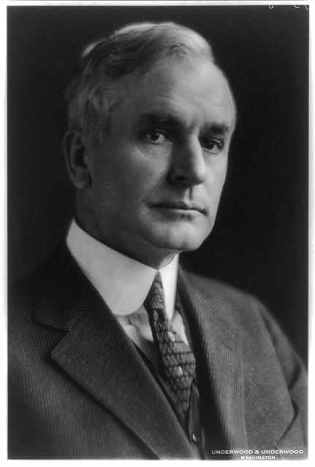
Cordell Hull, U.S. Secretary of State

Cordell Hull, U.S. Secretary of State

By 1943, FDR would establish this American Commission for the Protection and Salvage of Artistic and Historic Monuments in Europe, its intent to operate for three years and to cooperate with the appropriate branches of the Army, Department of State and civilian agencies. Secretary of State Cordell Hull recommended that it be headquartered at the National Gallery of Art in Washington, DC.

Archibald MacLeish, 1944

Archibald MacLeish, 1944

The Commission would include Archibald MacLeish, Librarian of Congress, Paul J. Sachs, Asst. Director of the Harvard Fogg Museum, and Francis Henry Taylor, Director of the Metropolitan Museum of Art.  Using this group’s networks of former students, colleagues and peers, experts would be sought to volunteer and help the Commission complete two functions:

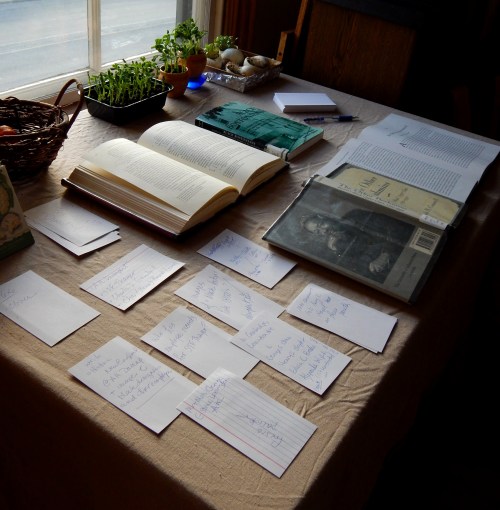
Even prior to U.S. involvement in the war, efforts had been made to catalog endangered art and historic monuments. Card files were also compiled of scholars and specialists in the Fine Arts, Books and Manuscripts.  All information was considered significant, from scholarly skills to possible political leanings.

Detailed maps were created and/or collected showing areas to be spared, if at all possible, and aerial photographs were taken.

Example of Map Noting Cultural Areas to Protect in France

Example of Map Noting Cultural Areas to Protect in France

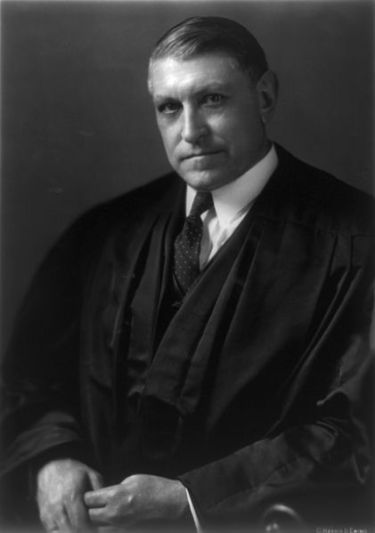
By April 1944, recognizing the need to prepare maps for the protection of art and historic monuments in Asia, as well, the Commission’s name would be altered, and the words “War Areas” would replace “Europe.”  In August, Supreme Court Justice Owen Roberts would become Commission chair.  Roberts was one of three Supreme Court Justices to vote against the plan for internment of Japanese Americans during the war.  Over time the Commission would simply be referred to as the Roberts Commission.

Supreme Court Justice Owen J. Roberts

Supreme Court Justice Owen J. Roberts

The Roberts Commission would establish the Monuments, Fine Arts and Archives Unit (MFA&A) within the Civil Affairs and Military Government Sections of the Allied Armies. Eventually numbering over 300 men and women, the unit’s “Monuments Men” included architects, archaeologists, art historians, artists, curators, and librarians.  During the war, they would be assigned in small numbers to Allied troops in the field.

George Stout

George Stout

Monuments Men had to be fluent in the languages of the places where they were to be assigned.  And to appease concerns about shifting manpower away from fighting forces, they had to be older than the age for fighting eligibility, so most were in their thirties or older. Early days for the Monuments Men, as they traveled with Allied troops, were difficult since they had little authority or supports in place.  That would change somewhat over time as Allied leadership including MacArthur in the Pacific and Eisenhower in Europe made clear that cultural preservation was a priority, though never one to outweigh the protection of soldiers’ lives.

American Zone Poster

American Zone Poster

The preservation and protection of artistic and historic monuments would take place differently in the two different theaters of World War II — Europe and the Pacific.  In Europe, even before the war ended, there would be a focus by Monuments Men like Mason Hammond, George Stout and others on recovering the artwork and cultural items taken by Hitler and the Nazis from wealthy Jewish families, museums, university libraries and religious institutions. The goal:  to protect and preserve these cultural assets, and to prevent the Germans from using the stolen loot to fund German war efforts.

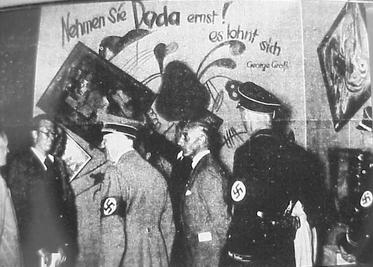
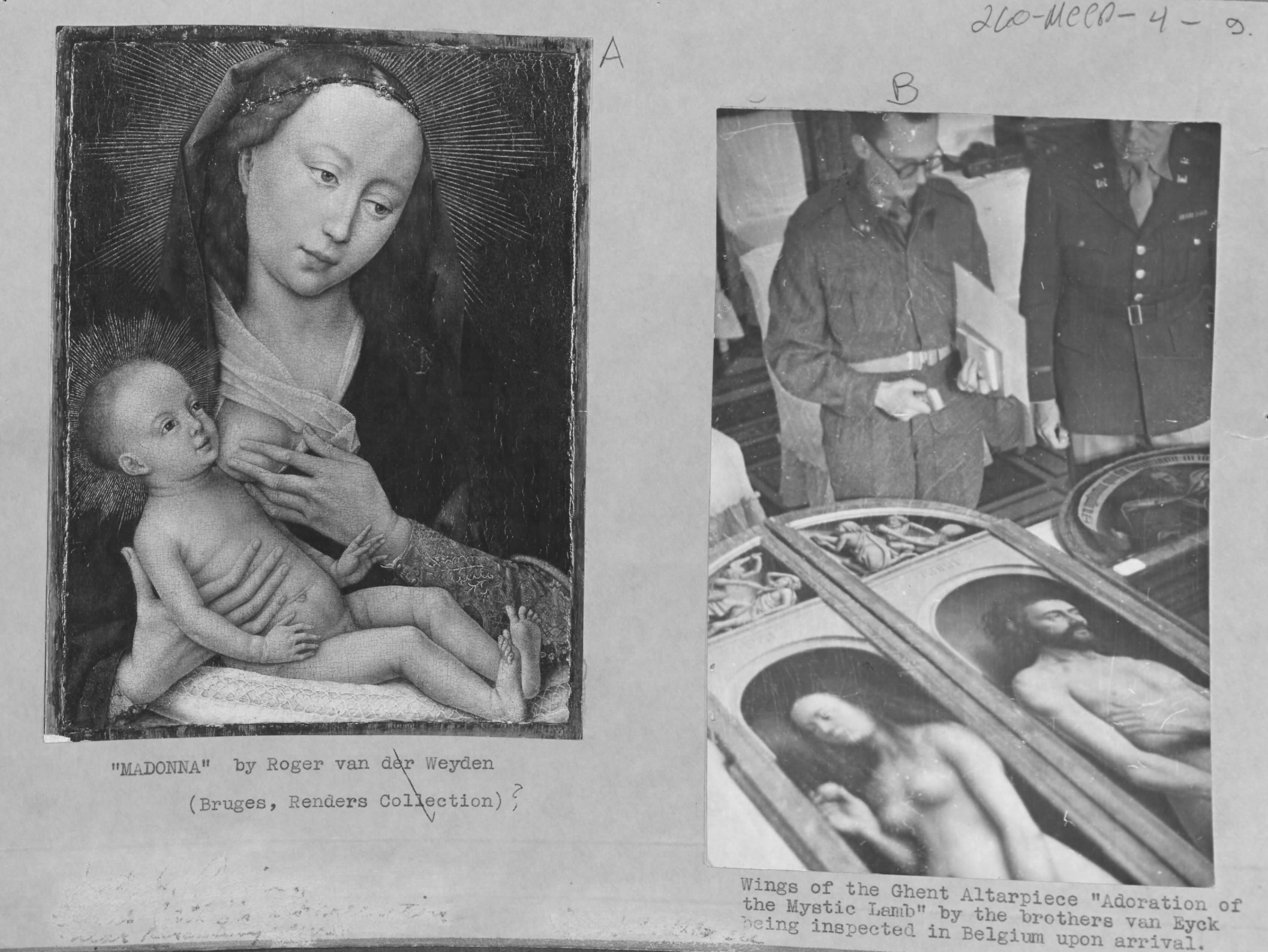
As early as 1937, Hitler’s intentions to use art as propaganda had been clear.  Expressionist and modern art was labeled as degenerate.  Those works not sold or destroyed outright were paraded for years in exhibits extolling their worthlessness. Less than a decade later, these same works would be celebrated in the U.S. National Gallery and other museums around the world.

MFAA_Officer_James_Rorimer_supervises_U.S._soldiers_recovering_looted_paintings_from_Neuschwanstein_Castle

MFAA Officer James Rorimer supervises U.S. soldiers recovering looted paintings from Neuschwanstein Castle

But before those works of art and their creators would be celebrated, the war in Europe had to end which it did in May 1945. As the Allied forces settled in, the Monuments Men continued to fan out, recovering art, and beginning the long process of cataloging and restitution.  In the Pacific theater, the war would end in August.

Hiroshima 1945

Hiroshima 1945

On August 6, 1945, the U.S. dropped the first atomic bomb over Hiroshima. “The explosion wiped out 90 percent of the city and immediately killed 80,000 people; tens of thousands more would later die of radiation exposure. Three days later, a second B-29 dropped another A-bomb on Nagasaki, killing an estimated 40,000 people.”  On August 15th, Emperor Hirohito would announce surrender.

Nagasaki Under Atomic Bomb, 1945

Nagasaki Under Atomic Bomb, 1945

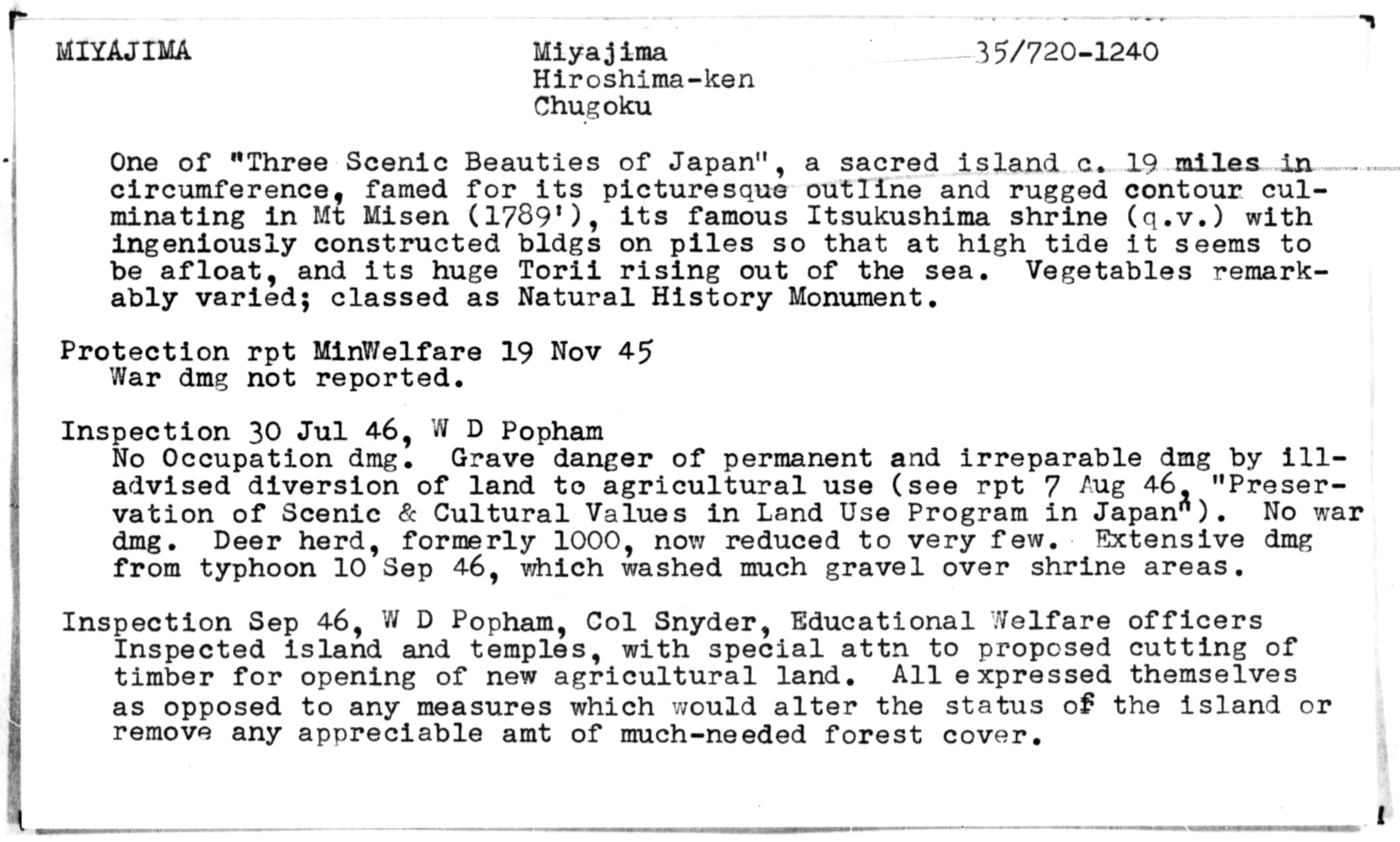
Into this devastated, postwar landscape, Monuments Men like Lt. Walter D. Popham would document damage done by the war and make suggestions for recovery and future protection of cultural assets.  Popham was a noted landscape architect and professor prior to the war.  He’d written books on the gardens of Asia including the tree-lined strees of Tokyo.  George Stout, respected for his work as a Monuments Man in Europe, was especially pleased to learn of Popham’s Japan assignment.  Stout had been one of several Monuments Men to recommend deploying the Monuments Men in Japan after its surrender.

The effort of the Monuments Men in Japan and across Asia is one that remains to be shared more widely.  Peruse just a few of the catalog cards, filed in the National Archives, in which Popham and others describe their perceptions of the postwar Japanese landscape, and their interactions with the populace, it is clear that many stories remain to be told.

With the war’s end, in both Europe and Asia, the role of the Monuments Men would shift.  Governments mobilized to literally rebuild whole nations.  How could one balance (and budget for) the collection, preservation and restitution of artwork while meeting the immediate needs of feeding, clothing and housing millions of displaced peoples?   Former allies were clearly becoming enemies.  What role could art have, if any, in forging new bonds or cementing old ties?

artwork collected at wiesbaden collection point

photographs of artwork collected at wiesbaden collection point

In Europe, by the spring of 1946, three central collection points were firmly established in Germany, in Wiesbaden, Munich and Offenbach.  The Offenbach Archival Depot would specialize in collecting and cataloging Jewish cultural items, books and archives.  The establishment of Offenbach was led by archivist Lt. Leslie Poste.  One of his assistants was Joseph A. Horne.

Joseph A. Horne, 1940s

Joseph A. Horne, 1940s

By February 1947, Horne would become the depot’s third director.  According to the memoirs of Lucy Dawidowicz, his friends called him Tony. “Before the war, he’d been on the staff of the Library of Congress’s photographic division.  Transferred from the MFA&A in Berlin, he was then new to the Depot, having taken over his duties barely two weeks before my visit.  About thirty, very tall, thin, lanky, and blond, he was the only American there.  He was in charge of a staff of some forty Germans.”

His tenure would coincide with one of the worst winters to strike Europe in recent memory.  The Cold War with the Russians was dawning.  The restitution (or not) of artwork and cultural items was to become a strategic tool used by military intelligence and policymakers on all sides.  Individuals, including war survivors as well as surviving relatives of those killed by the Nazis, universities and museums whose collections had been sacked … their demands for restitution and return of art, books and cultural items poured in.  Horne, like many others, would deal with these requests as respectfully as he could even as events unfolded around him that would place Offenbach at the center of one of the most unexpected efforts to return looted cultural items to Jewish communities around the world.

More to follow in July…


Sources/Additional Reading

World War II records from the National Archives searchable here

More information about Hamburg photo

Bombing of Hiroshima and Nagasaki, History.Com

About George L. Stout

About Mason Hammond, First Monuments Man in the Field 

About Ernst Barlach

About Lt. Leslie Poste

World War II Photography Database

2014 Degenerate Art Exhibit


Read Full Post »

Photographer Arnold Genthe

Photographer Arnold Genthe

One of the unexpected gifts of researching the life of Joseph Anthony Horne has been exposure to photographers from the late 19th and early 20th centuries whose work and craftsmanship are no longer that widely known outside of scholarly circles.  Via the Library of Congress Prints & Photographs Online Catalog, I’ve most recently enjoyed learning about Arnold Genthe.  Born in Germany in 1869, by 1895 he would be living in San Francisco, California, serving as the tutor to a Baron’s son.  There, he would gain access to a camera, become adept at its use and begin documenting his travels around the city, especially in Chinatown.

Friends, Chinatown, San Francisco by Arnold Genthe. taken between 1896 and 1906

Friends, Chinatown, San Francisco by Arnold Genthe. taken between 1896 and 1906

Eventually he would become a famed photographer for the wealthy elite, politicians, artists and to budding movie stars like Greta Garbo.

Portrait of Greta Garbo, taken July 1925

Portrait of Greta Garbo, taken July 1925

His earliest photographs, with the exception of photos he took in Chinatown, would be destroyed by the city’s devastating 1906 earthquake and fire.  But with a successful career that spanned three decades, the Library of Congress has archived thousands of his photographic images — the negatives and other materials were purchased from his estate after his death in 1943.  During his lifetime, like many people of his generation with his financial resources, Genthe would spend time traveling throughout Africa and Asia.

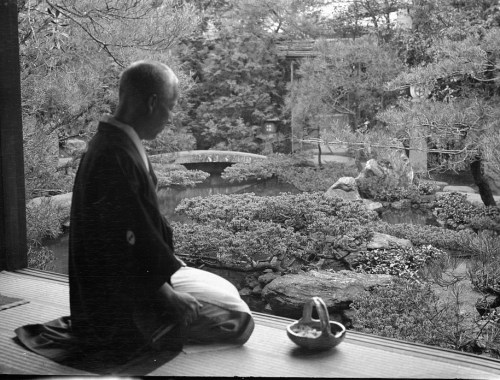
It is his images taken in Asia during a several month sojourn in 1908 that I find especially captivating.  Collectively titled, Travel Views of Japan and Korea, the breadth of imagery is extensive.

No city names are cited or any geographic locations given.  There are certainly clues to be gleaned from the landscape (e.g. an image of a giant buddha that may be in Kamakura and images of the Itsukushima Shinto Shrine).

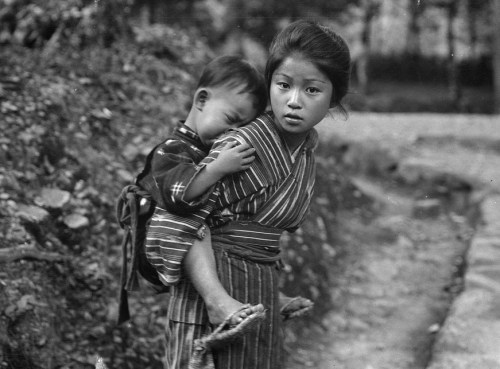
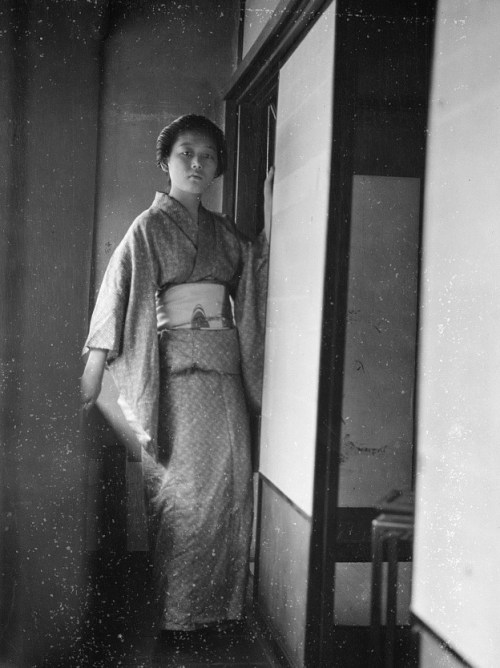
I am particularly fascinated by his photographs of the people.

Each image holds a story in the expressions captured on faces over a hundred years ago, in the clothing worn, in the backgrounds of each scene.

Genthe seemed particularly drawn to photographing how, rich or poor, young or old, everyone took care of the babies.

The images are a dream in terms of capturing a very specific moment in time.

The Genthe Collection at the Library of Congress can be viewed via this link: http://www.loc.gov/pictures/collection/agc/

If you’re particularly interested in the photographs of Old Chinatown, there’s a book available here.

And it appears that at least one chapter of his 1936 memoir, As I Remember, is available online here.

Read Full Post »

foreword to the interludes

interlude: genesis

interlude: exodus, part 1

interlude: exodus, part 2

Son of farmer in dust bowl area. Cimarron County, Oklahoma , photo by Arthur Rothstein, 1936.

Son of farmer in dust bowl area. Cimarron County, Oklahoma , photo by Arthur Rothstein, 1936.

“A gentle wind followed the rain clouds, driving them on northward, a wind that softly clashed the drying corn. A day went by and the wind increased, steady, unbroken by gusts. The dust from the roads fluffed up and spread out …  Now the wind grew strong and hard …  the dust lifted up out of the fields and drove gray plumes into the air like sluggish smoke. The corn threshed the wind and made a dry, rushing sound. The finest dust did not settle back to earth now, but disappeared into the darkening sky.”  — in the opening chapter of The Grapes of Wrath by John Steinbeck.

Liberal (vicinity), Kan. Soil blown by dust bowl winds piled up in large drifts on a farm, photo by Arthur Rothstein, 1936.

Liberal (vicinity), Kan. Soil blown by dust bowl winds piled up in large drifts on a farm, photo by Arthur Rothstein, 1936.

In April 1935, as Joseph A. Horne was teaching music in West Virginia, President Franklin Delano Roosevelt was creating the Resettlement Administration (RA) in Washington, D.C.  Guided by Rexford G. Tugwell, the agency intent was to help farmers and other rural poor suffering from the economic impacts of the Great Depression and the devastation of dust storms and other ecological events.   A Historical Section was created within the agency to document existing poverty as well as report the benefits of the agency’s work.  This section would be led by Roy E. Stryker.

Rexford Tugwell and Roy Stryker

Rexford Tugwell and Roy Stryker

In the 1920s, Tugwell and Stryker, both economists, had taught at Columbia University.  While there, they had collaborated on the book, American Economic Life. Stryker’s contribution included using photography to complement the text, something he also did as part of his lectures at the university.  He was not a photographer but he, and Tugwell, recognized photography as a useful, illustrative tool to convey and strengthen information.

Farmer and sons walking in the face of a dust storm. Cimarron County, Oklahoma, photo by Arthur Rothstein, 1936.

Farmer and sons walking in the face of a dust storm. Cimarron County, Oklahoma, photo by Arthur Rothstein, 1936.

Stryker left academic life to follow his friend and mentor to the Resettlement Administration. Three decades later, Stryker would recount that “Tugwell never said, “Take pictures.”  He said, “We need pictures.”  He never said how to take them.  He said, “Remember,” — and this is the only thing I can remember — “remember that the man with the holes in his shoes, the ragged clothes, can be just as good a citizen as the man who has the better shoes and the better clothes.” (Interview, June 13, 1964)

Farmer, local type, Brown County, Indiana, photo by Theodor Jung, 1935.

Farmer, local type, Brown County, Indiana, photo by Theodor Jung, 1935.

The agency’s original focus was on Rural Rehabilitation, Rural Resettlement, Land Utilization and Suburban Resettlement.  Activities included purchasing exhausted farmlands from farmers to convert the land into pastures or parks, for instance, and providing training for farmers to rehabilitate their farms through refinancing and other debt adjustments.  Out of work farmers were given jobs.  Building projects were begun.  The most controversial feature of the agency’s efforts was relocation.

Scottsboro (vicinity), Alabama. Farmers who have been resettled at work in a sand pit at Cumberland Mountain Farms, a U.S. Resettlement Administration project, photo by Arthur Rothstein, 1935.

Scottsboro (vicinity), Alabama. Farmers who have been resettled at work in a sand pit at Cumberland Mountain Farms, a U.S. Resettlement Administration project, photo by Arthur Rothstein, 1935.

From the beginning, the agency did not have much Congressional support.  Part of it was political.  Tugwell was considered to be one of the most radical of FDR’s New Dealers.  Plus the idea of relocating nearly a million farmers and other rural poor off the land into cities that they’d helped to build seemed too socialistic.

Rehabilitation client, Garrett County, Maryland, photo by Theodor Jung, 1935.

Rehabilitation client, Garrett County, Maryland, photo by Theodor Jung, 1935.

With funding limited by Congress, the Resettlement Administration would eventually dramatically narrow its efforts and focus on building relief camps in California for migratory farm workers.  One of these relief camps would inspire John Steinbeck’s The Grapes of Wrath.

All races serve the crops in California, photo by Dorothea Lange, 1935

All races serve the crops in California, photo by Dorothea Lange, 1935

Faced with rising criticism for his management, Tugwell resigned from the Resettlement Admininistration in 1936.  By September 1937, the agency was folded into a new federal entity, the Farm Security Administration (FSA).  The FSA, with its mandate to help the rural poor, would complete some of the Resettlement Administration’s original projects as well as embark upon a whole other series of financial and technical assistance programs.  Roy Stryker was given the greenlight to continue his documentary photography program.

Negro field worker. Holtville, Imperial Valley, California. He has just made himself shoes out of that old tire, photo by Dorothea Lange, 1935.

Negro field worker. Holtville, Imperial Valley, California. He has just made himself shoes out of that old tire, photo by Dorothea Lange, 1935.

He directed his photographers to take the best picture possible and to capture the story behind the image.  He could not tell them how to use their cameras, but he did suggest themes to focus on.

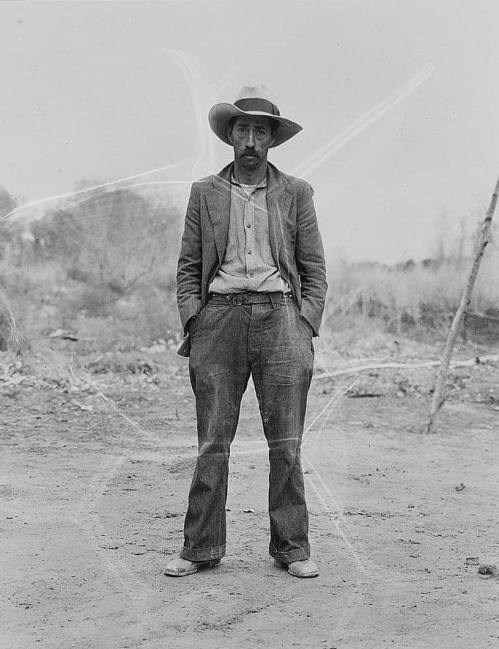
Imperial Valley, California, Mexican. He tells his story: he helped drive the French out of Mexico, fought against Maximilian, and he has, by serving the crops for many years, help build up Imperial Valley, photo by Dorothea Lange, 1935.

Imperial Valley, California, Mexican. He tells his story: he helped drive the French out of Mexico, fought against Maximilian, and he has, by serving the crops for many years, help build up Imperial Valley, photo by Dorothea Lange, 1935.

Based on how they operated in the field, these early documentary photographers, including Dorothea Lange, Walker Evans, Ben Shahn and Arthur Rothstein, were sometimes described as “sociologists with cameras.”

Mexican field worker, father of six. Imperial Valley, Riverside County, California, photo by Dorothea Lange, 1935.

Mexican field worker, father of six. Imperial Valley, Riverside County, California, photo by Dorothea Lange, 1935.

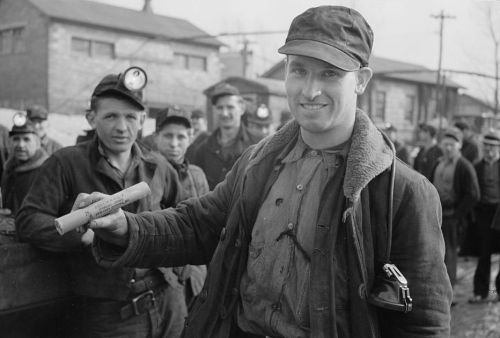
The photographers traveled across the nation, by assignment, sometimes alone and sometimes in groups, to areas of economic challenge, capturing dramatic hardships and also simply documenting people living their daily lives.

Untitled photo, possibly related to: Miners at American Radiator Mine, Mount Pleasant, Westmoreland County, Pennsylvania, photo by Carl Mydans, 1936.

Untitled photo, possibly related to: Miners at American Radiator Mine, Mount Pleasant, Westmoreland County, Pennsylvania, photo by Carl Mydans, 1936.

Farmer and sons walking in the face of a dust storm. Cimarron County, Oklahoma, photo by Arthur Rothstein, 1936.

Warm Springs Indian boy. Molalla, Oregon photo by Arthur Rothstein, 1936.

The FSA would operate from 1937 – 1942, with its photography unit capturing the diversity of the United States.

Negro boys on Easter morning. Southside, Chicago, Illinois, photo by Russell Lee, 1941.

Negro boys on Easter morning. Southside, Chicago, Illinois, photo by Russell Lee, 1941.

That diversity would be represented in the ranks of the photographers that Stryker brought together, men and women of different backgrounds, interests, and photographic skill.

Westmoreland project, Pennsylvania. Westmoreland County. Construction worker on the Westmoreland subsistence homestead project, photo by Walker Evans, 1935.

Westmoreland project, Pennsylvania. Westmoreland County. Construction worker on the Westmoreland subsistence homestead project, photo by Walker Evans, 1935.

In 1942, the photography unit moved into the Office of War Information (OWI)The OWI was created shortly after U.S. entry into World War II as an effort to consolidate existing government information services.

Two children in Anacostia, Washington, D.C. at the Frederick Douglass Housing Project, photo by Gordon Parks, 1942.

Two children in Anacostia, Washington, D.C. at the Frederick Douglass Housing Project, photo by Gordon Parks, 1942.

By 1943, another federal agency, the Office for Emergency Management, would  also be brought under the OWI umbrella, and its activities and some of its staff would merge with Roy Stryker’s photographic unit.  One of those staff would be Joseph A. Horne.

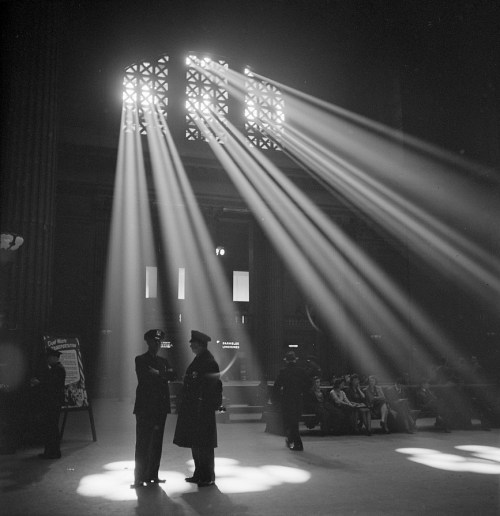
Chicago, Illinois. In the waiting room of the Union Station, photo by Jack Delano, 1943.

Chicago, Illinois. In the waiting room of the Union Station, photo by Jack Delano, 1943.

As these many agencies consolidated into one, the Farm Security Administration-Office of War Information (FSA-OWI), the nature of the photographs taken by its photographers changed to some degree as did the purpose of the images.

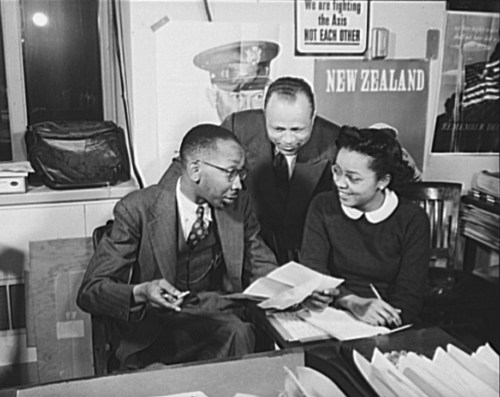
Office of War Information news bureau. Ted Poston, Negro desk editor of the Office of War Information (OWI), discusses a letter from one of the 240 Negro editors to which he sends war news from Washington, with William Clark and Harriette Easterlin, his assistants, photo by Alfred T. Palmer, 1943.

Office of War Information news bureau. Ted Poston, Negro desk editor of the Office of War Information (OWI), discusses a letter from one of the 240 Negro editors to which he sends war news from Washington, with William Clark and Harriette Easterlin, his assistants, photo by Alfred T. Palmer, 1943.

Documenting American life was still important but now with an emphasis on framing the images so that they would inspire patriotism, educate people about how to live and act during war time,  and evoke a sense of national pride in the strength, good humor and resilience of the American people.

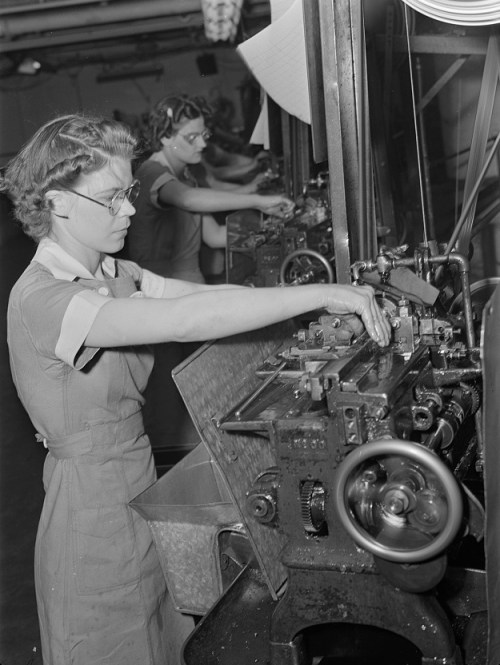
Women in industry. Tool production. Arms for the love of America! The capable young woman whose strong hands guide this cutoff machine is one of a Midwest drill and tool factory's many women employees. Almost 1,000 women have recently been employed in this comparatively new plant; sole men workers, other than foreman, are those in the heat treating department. Republic Drill and Tool Company, Chicago, Illinois, photo by Ann Rosener, 1942.

Women in industry. Tool production. Arms for the love of America! The capable young woman whose strong hands guide this cutoff machine is one of a Midwest drill and tool factory’s many women employees. Almost 1,000 women have recently been employed in this comparatively new plant; sole men workers, other than foreman, are those in the heat treating department. Republic Drill and Tool Company, Chicago, Illinois, photo by Ann Rosener, 1942.

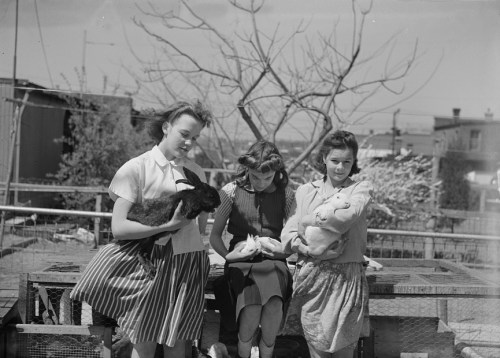
Joseph Horne’s photos that appear in the FSA-OWI Collection, now housed in the Library of Congress, focused on the Washington, D.C. area where he had settled with his family.  His images include the crafting of victory gardens and urban farms.

Washington, D.C. Children with rabbits which were formerly kept as pets, but now are being raised for food, photo by Joseph A. Horne, 1943.

Washington, D.C. Children with rabbits which were formerly kept as pets, but now are being raised for food, photo by Joseph A. Horne, 1943.

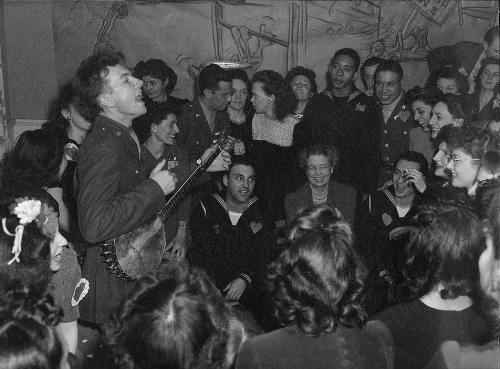
He also photographed the unique monuments located in the Congressional Cemetery, and the mix of peoples who made their way through Washington’s Franklin Park. And then there was that night in February 1944, when he photographed the opening of a new labor canteen.

Washington, D.C. Pete Seeger, noted folk singer entertaining at the opening of the Washington labor canteen, sponsored by the United Federal Labor Canteen, sponsored by the Federal Workers of American, Congress of Industrial Organizations (CIO), photo by Joseph A. Horne, 1944

Washington, D.C. Pete Seeger, noted folk singer entertaining at the opening of the Washington labor canteen, sponsored by the United Federal Labor Canteen, sponsored by the Federal Workers of American, Congress of Industrial Organizations (CIO), photo by Joseph A. Horne, 1944

The photography unit was only one part of the FSA-OWI but it was one of the most successful units.  Through domestic and overseas operations, the  agency had sought to excite and educate Americans at home, and inform (or intimidate) allies and foes abroad, using radio broadcasts (e.g. Voice of America), newspapers, posters, film and photography. But as World War II progressed, conflicts arose around agency management and how to balance civilian and military interests.  Soon, Congress would severely cut the organization’s budget. By 1944, the enormous collection of FSA-OWI photos, black and white and color, would be transferred to the Library of Congress where they remain a valuable resource to this day.

Negro boy near Cincinnati, Ohio, photo by John Vachon, 1942 or 1943.

Negro boy near Cincinnati, Ohio, photo by John Vachon, 1942 or 1943.

By 1945, the Office of War Information as an organization was no more.  Any relevant international activities were transferred to the U. S. State Department, while relevant information gathering and related responsibilities were handed over to the intelligence agencies like the Office of Strategic Services/Central Intelligence Agency.

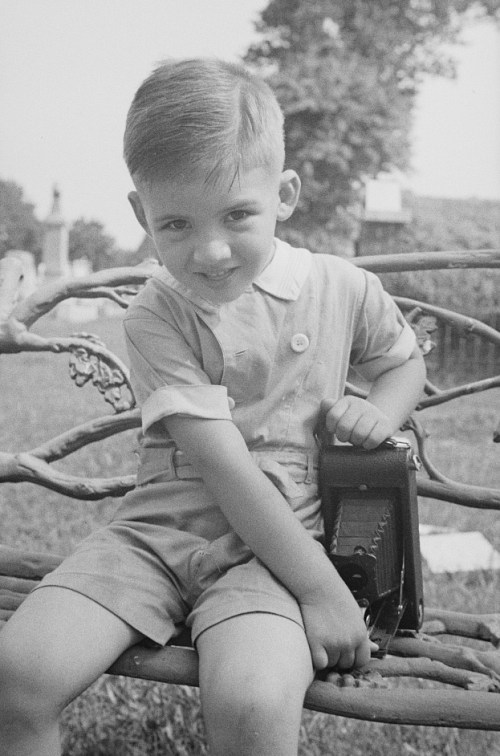
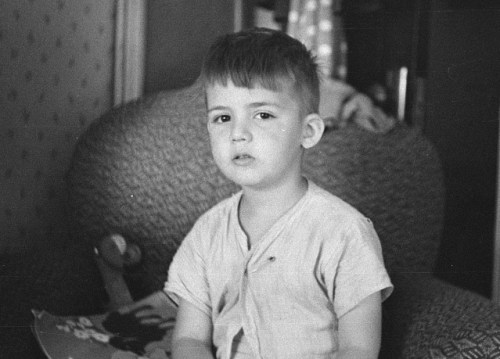
Joseph Jr. with Camera, photo by Joseph A. Horne.

Joseph Jr. with Camera, photo by Joseph A. Horne.

By the spring of 1944, Joseph A. Horne, the fellow with whom we are walking through history, had enlisted in the U.S. Army.  Soon he would be off to Europe where photography would remain an important feature of his life.  But before he traveled overseas, he would let his son play with one of his cameras.

Additional Reading/Sources …

Library of Congress Prints and Online Catalog

Stryker’s Shooting Scripts

Resettlement Administration

Farm Security Administration

Office of War Information

Oral Interviews with Roy E. Stryker

About Roy E. Stryker

Out of One, Many:  Regionalism in FSA Photography

Stryker and the FSA

John Steinbeck

FDR Presidential Library and Museum


Read Full Post »

foreword to the interludes

interlude: genesis

interlude: exodus, part 1

Photographers shooting cherry blossoms in Washington, D.C., 1922.

Photographers shooting cherry blossoms in Washington, D.C., 1922.

In early 1920s America, “a return to normalcy” was the popular catchphrase. People were weary from war and desiring to pull back from engagement in world affairs. With the support of business and promotion of isolationism, the Republicans would hold the White House throughout the decade.

Five sisters working for congressmen in Washington, 1926

Five sisters working for congressmen in Washington, 1926

Throughout most of the decade, the economy improved in the U.S. and in many parts of the world.  At the same time, countries like Germany were still dealing with the debts and damages of war, and in many countries, there were rising tides of nationalism — and resulting conflicts — as people sought independence from colonial powers.  In the U.S. wages were increased by some industry leaders.  Tax rates were lowered for the wealthy.  It was a bullish stock market.  In general, people had more money.  Some invested in stocks for the first time.  A consumer culture evolved.

Flapper 1922

Flapper 1922

In some agricultural areas, like Nebraska where Joseph lived, the situation was a bit different.  The postwar economics were not as kind.  The technological advances (e.g. electricity, telephone infrastructure, etc.) were taking place at a much slower rate in rural areas. The rural exodus to cities increased dramatically as people searched for new opportunities.

Inauguration of the garter flask in Washington, DC, 1926.

Inauguration of the garter flask in Washington, DC, 1926.

The 18th Amendment to the U.S. Constitution was still in place.  Prohibition would not be repealed until the 21st Amendment was ratified in 1931. Al Capone would become notorious during the 1920s, and he wouldn’t be the only one trying to find creative ways around the law. The era would be remembered by many names, from the Roaring Twenties to the Jazz Age.

F. Scott Fitzgerald, 1921

F. Scott Fitzgerald, 1921

In his book The Great Gatsby, Fitzgerald would capture the beauty and excesses of the period.  In his book The Sun Also Rises, Ernest Hemingway would popularize the term the lost generation, describing the young men who’d returned from World War I.  In 1925, folklorist  Zora Neal Hurston would arrive in New York during the height of the Harlem Renaissance where African American intellectuals like Langston Hughes and artists like Romare Bearden were redefining and celebrating what it meant to be black in America.

Zora Neale Hurston

Zora Neale Hurston

It was a period of innovation and of expansion of mass production.  People indulged in wonderful new technologies like radio and greater access to automobiles.  By 1928, Velveeta cheese was crafted, so to speak, for the first time and sliced bread made its debut.  Charles Lindbergh had flown his Spirit of St. Louis non-stop from New York to Paris.  Sports figures were celebrities.  Lou Gherig, Ty Cobb and Babe Ruth were hitting baseballs out of stadiums across the country.  Cinema expanded.   Mickey Mouse made his debut in a Disney animated short. Charlie Chaplin became an independent producer at this time.  In 1928, he films The Circus, a movie that brought Chaplin a special trophy at the very first Academy Awards (1929).

Charlie Chaplin

Charlie Chaplin

Such prosperity would not last, of course.  By the time seventeen-year old Joseph arrives in Washington, D.C., in 1928, financial collapse was imminent.  He didn’t share many stories of that time in his life so there’s no way to know what he was thinking or what he did on a daily basis.  We know the following based on notes written by Joseph later in his life, and the few stories he did tell his children.

Catholic University, between 1910-1926

Catholic University, between 1910-1926

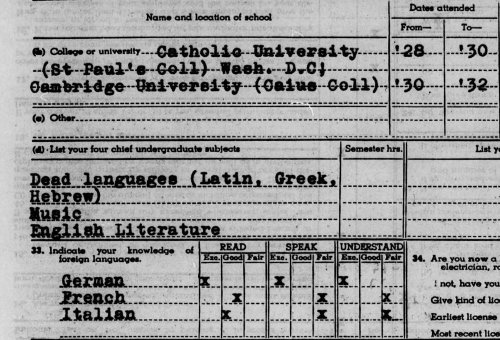
He arrived in Washington in 1928 to attend either Immaculate Conception College or St. Paul’s College.  St. Paul’s College is the house of studies for Paulist Seminarians who then complete their graduate studies in theology at Catholic University.

In a different document then the above, Joseph mentions attending Immaculate Conception College, also located in Washington, D. C.   Immaculate Conception (also known as the Dominican House of Studies) is the theological school for candidates for the priesthood in the Dominican Province of St. Joseph, which in the 1920s and ‘30s included all of the U.S. except for the West Coast. He may have studied there before transferring to Catholic University.

So far none of the schools can find record of his attendance.  I suspect some of the difficulty has to do with Joseph’s last name.  At some point in the 1920s, as he traveled from Nebraska to Washington, D. C., Joseph changes his last name.  He may have changed it more than once, but by the time he is in attendance at Caius College in Cambridge, England his last name is definitively Horne.  He will later recall an incident at the school when a professor would say, ” Mr. Horne, will you tell us, please, in your rude, crude, inimitable manner, all that you know of the Peloponnesian War.

Joseph also describes hearing, during this period, the writer, Christian apologist and famed orator G. K. Chesterton (1874-1936).  Chesterton was known for great intellectual debates with friends and colleagues George Bernard Shaw, H.G. Wells, and Hillaire Belloc.  Their debating spans the time Joseph was studying in Cambridge (1930-1932).  Mr. Chesterton was also debating on both sides of the Atlantic during this time.  In January 1931 in New York City, he debated with Clarence Darrow about whether or not the world would return to religion (read more here).  If indeed Mr. Horne was in England during this time he missed the beginning of the Great Depression in the U.S. though eventually the whole world would be affected.  In 1932, Joseph would have returned to see Hooverville’s springing up, the shantytowns named for President Hoover who had so misjudged the financial crisis.  He may have returned just in time to vote in the 1932 election in which New York Governor Franklin Delano Roosevelt would win in a landslide with his promise of A New Deal for the country.  He would have returned with the knowledge and skills of what he later characterized as “dead languages,” literature, and music.  He would not return with clerical robes.

President-Elect Roosevelt traveling to inauguration with President Hoover

President-Elect Roosevelt traveling to inauguration with President Hoover

By June 1933 he was teaching  music for the Pennsylvania-based Smith Williams Institute of Music. He would teach music and music appreciation to classes in Clarksburg, WVa and environs.  When I mentioned to Horne’s son that the institute apparently gave away free violins to students and instructors, he remarked, “Maybe that’s where my father got that beat-up violin he carried around.”  Horne would make $40/week until December 1935.

Smith Williams Institute of Music Advertisement

Smith Williams Institute of Music Advertisement

He ceased to teach in the Clarksburg vicinity after economic conditions became very bad.  He made his way back to the Washington, D. C. area and there, in his own words:

In other documents, he describes in greater details the different jobs held in the D.C. area. What becomes increasingly clear is his growing interest and skill in photography as a tool.  He also becomes interested in a young woman. Elsie was beautiful with a keen mind.  The two soon married and, in 1937, Joseph Jr. was born.

Though he clearly stayed in touch with is parents back in Nebraska, Joseph’s home was now in the Washington area.  He would continue to take on any job to provide for his new family, and to buy his cameras.

Elsie would later recall that he  always had to have the best camera, and that one year the family ate an awful lot of oatmeal so that they could pay for their son’s orthopedic shoes and still buy such an instrument. By 1941, Joseph would provide clinical photography for the Vets Administration, Mt. Alto Hospital in D.C.  In that same year, the U.S. would enter its second World War.

Washington D. C. Photo by Joseph A. Horne

Washington D. C. Photo by Joseph A. Horne

Priorities across the nation would shift.  Joseph Horne with his rural American roots, his knowledge of multiple languages, world literature, and music, and his facility with a camera would find himself in the U.S. and especially abroad at the crossroads of arts, culture and, perhaps most unexpectedly to him, of politics.

Stay tuned for the next Interlude in April.

Additional Reading/Sources …

1920s Farm Life in Nebraska

Radio in 1920s America

Prohibition: A Film by Ken Burns & Lynn Novick

Jazz: A Film by Ken Burns

Wall Street Crash of 1929

Library of Congress Prints and Photographs Online Catalog

Read Full Post »

Spring is in the air in many places and in one of those places a man decided to invest some time and energy into washing the winter salts off his car and polishing the exterior bright.  He even added a few shiny details so that the vehicle sparkled like brand new.  That night, he and his teenage step-daughter made a late night food run for the family.  As they walked toward the car, the man looked closely at the vehicle.  Once they were safely buckled inside, he made a choice.  He decided that here was a teachable moment.

a view through that rippled glass window

today’s view through that rippled glass window

He said, “You know that area where we go to get fast food, right?  Well, at night and especially on the weekends, there is a police car in one of the parking lots.  Their goal is to reduce crime.  One way they think they are doing that is by profiling people.  Look at me and look at what we’re driving.  Okay, let’s see what happens.”  They pulled into the restaurant drive-thru, placed their order and then pulled over to wait.  The man chatted with the girl about school and what music she was listening to these days. When they received their food, he started to drive home.

yesterday's view through the rippled glass window

yesterday’s view through the rippled glass window

After a while he told the girl, “Okay, take a look in the mirror.  Can you see him? He’ll probably stay about 4-5 seconds behind to see if we do anything out of the ordinary like suddenly speeding up or weaving across the yellow line … anything that will give him cause to pull me over.  But we haven’t done anything wrong and so we just stay calm even if he were to pull us over.”  They made it home and as they pulled into the driveway the man told the skeptical girl,  “I know, I know.  I could be wrong.  People call me a worrier and even paranoid.  But, let’s see.  If I’m even half-way right, he’ll shortly drive down this street, pass our house, do a scan and then at the bottom of the street do a u-turn and drive back up the street. And then since we are clearly just fine, he’ll drive away into the night.”  They waited.  The car drove past, did a u-turn at the bottom of the street and then drove away into the night.  The man and girl went into the house with their fries and other food items to share.

impurities in and on the glass window

impurities in and on the glass window

When my brother began relating this recent experience with me, I thought he was just going to share the continuing adventures of teaching a teenage girl to drive.  When the story concluded, I could not help but ask, “Of all the things you thought you’d be teaching the children in your life, did you ever think you’d be teaching them about profiling?”  All he could say was, “Nope.”

Read Full Post »

« Newer Posts - Older Posts »