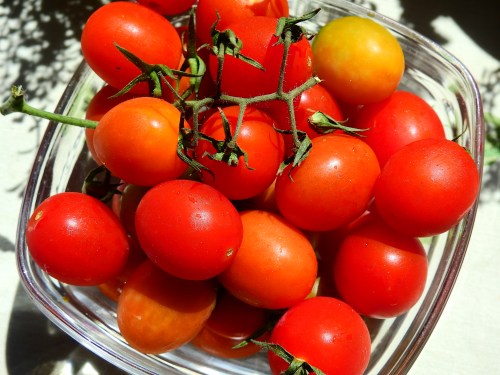
From her lovely garden in Brooklyn. These that weren’t eaten on the road back to Boston were sliced up with some cucumbers and celery and tossed with oil and vinegar. Good stuff! 🙂
Posted in Inspiration, Kitchen Inspirations, tagged beauty, family, food photography, gardening, gifts, Inspiration, Photography, red, tomatoes on August 27, 2017| 1 Comment »
From her lovely garden in Brooklyn. These that weren’t eaten on the road back to Boston were sliced up with some cucumbers and celery and tossed with oil and vinegar. Good stuff! 🙂
Posted in Branches, Inspiration, Nature Notes, tagged family, figs, green, Inspiration, leaves, nature, Photography, tea, trees on October 19, 2016| 1 Comment »

I finally found the leaf, curled but not crumbled, at the bottom of a bag. It survived the trip from South Carolina through three states before returning to Massachusetts. It came from a tree in my uncle’s yard originally planted by his wife. One day at the kitchen table she mentioned making a cup of fig tea. I’d never heard of such a thing.
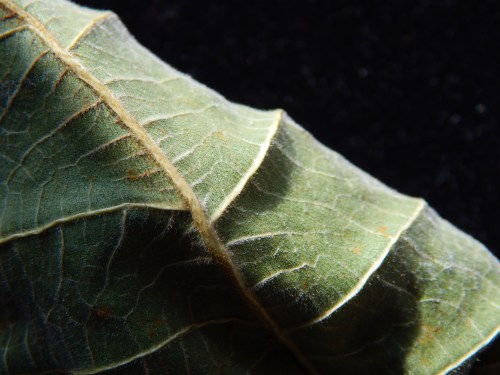
She pointed to the tree outside, wide canopied with dark flat leaves, and said it was too bad we hadn’t been visiting when the branches had been weighted down with fruit and the birds were all about. She sometimes made a jam, she said, but this year she just pulled off some leaves to dry and make tea. As I snapped off my leaf, I promised to photograph it as it dried and then its final journey into tea. She laughed.
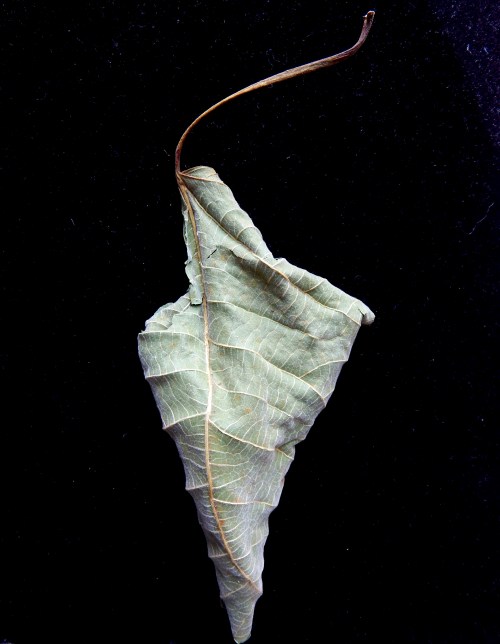
I think this leaf has a bit more drying to do and until then makes a fun photographic subject.
Posted in Inspiration, Nature Notes, On the Road, tagged art, art therapy, beauty, birds, family, Inspiration, nature, Photography, prints, silk screen, silkscreen, storytelling, travel on October 9, 2016| 1 Comment »
My earliest memories of my uncle are of a dapper man from New York visiting his big sister (my mother) in Virginia during the summers. He would hang out with my dad drinking my dad’s homemade wine. Then in later years I remember that we would receive beautifully printed Christmas cards that were unlike anything my younger brother and I had ever seen. Several decades have passed since then. My parents have passed away. He’s since moved from New York to settle in South Carolina. Now that travel is difficult for him visiting him was the primary impetus for my recent southern travels.

Uncle Freeman was a silkscreen printer in New York who, while employed at institutions like American Image Editions, printed the works of Andy Warhol, Larry Rivers, Robert Indiana, Ed Paschke and many other artists. Once he’d learned the art of screen printing he informally taught others including Isabelle Collin Dufresne, known as Ultra Violet. A signed copy of her memoir sits on his bookshelf. “She was famous, right?” I asked my uncle. He said, “She wanted to be.”
When we went to visit my uncle, now 80 years old, I was anticipating an interview where I’d collect tawdry details of Warhol and his parties, the lowdown on the New York arts scene of the 80s and 90s, and so on. But my uncle, ever the gentleman, would only chuckle or smile as we queried him relentlessly. He did share some of the prints he still has in his possession and would describe the techniques used to produce the colors and shading on the page. His wife, who loves butterflies, mentioned accidentally cutting up a Salvador Dali screen print because she was so intent on obtaining the butterflies at the top of the page she did not notice Dali’s signature at the bottom. The altered print hangs quite lovely on a bedroom wall.
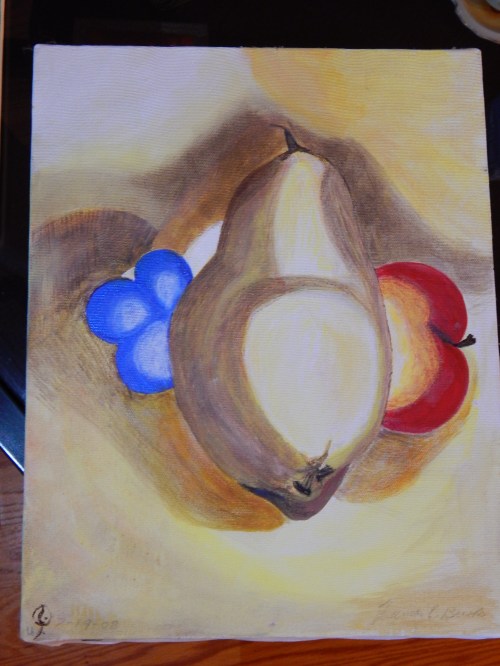
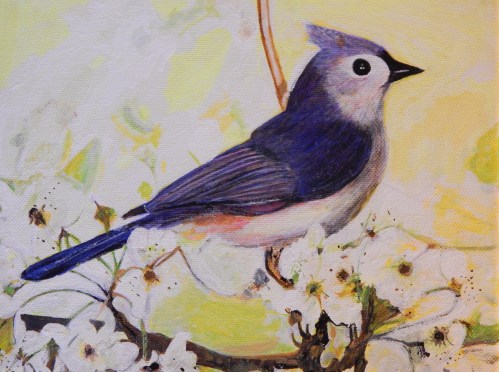
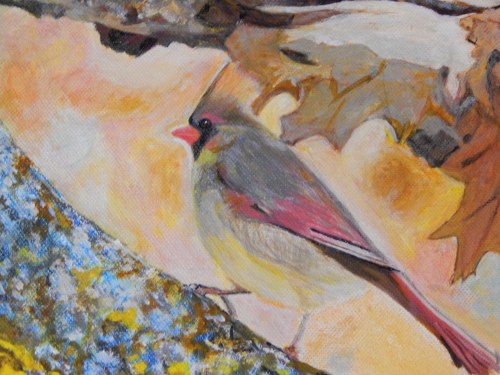
It was the art on the walls that kept drawing my attention in my uncle’s modest home. A few screen prints hung, but mostly the walls were lined with canvas paintings. I began to notice artwork outside as well, paintings on trees and wooden panels. Finally I asked who did all of the paintings and he said, “I did.” His wife pulled more from under a bed and those tucked away in closets. As for when he did them, he said the majority were done while recovering from prostate cancer. As he received treatment, “I couldn’t do much but I could paint.”
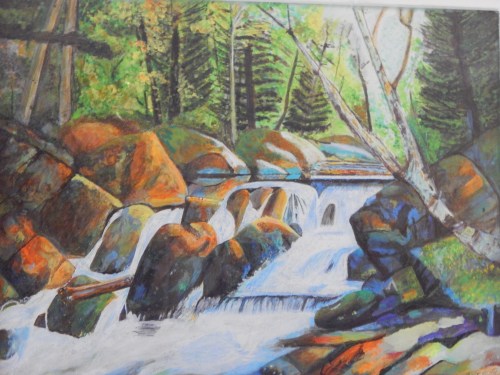
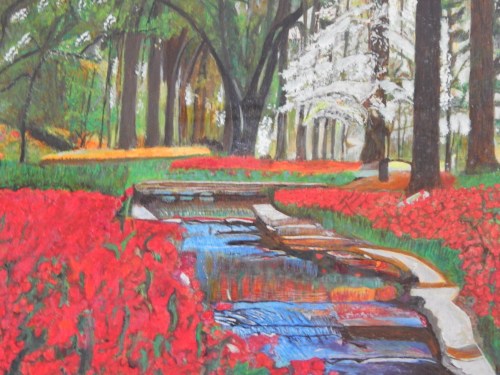
He shared no rhyme or reason for his subjects. “Just whatever came to mind and whatever pens and paints I had available.”

Birds seemed to be a favorite theme.


And then there was Obama. Born in the south in the 1930s, having experienced the realities of racism firsthand, Obama’s election meant a great deal. “I have a better painting of him,” he said as I gazed at this one on the wall, but we never got around to finding it.
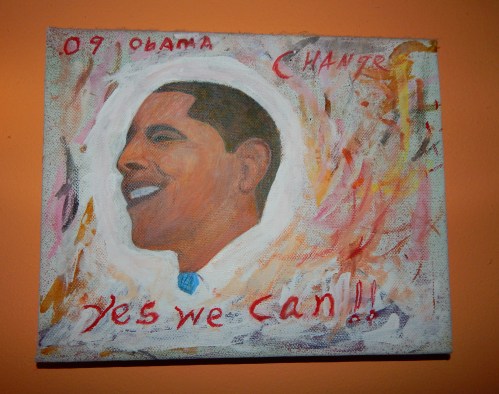
He hadn’t painted before the cancer, he said, and he hasn’t really painted since his recovery. But I have encouraged him to do so. In fact I suggested a subject.
In the evenings as we sat down to dinner he would make his way slowly to the front door and open it wide. For the first few days that we visited, there was nothing to see but then the final evening, he said, “Cynthia, come over here.” And there they were, this magnificent flock of birds flying overhead, filling the sky with their dark silhouettes. They all seemed to settle in one far distant tree. My uncle said, “Sometimes there are so many in the canopy they turn the tree into a square.” “That’s it!” I said. “That’s what you should paint next. The birds in the sky.” He listened patiently as I described my vision but in the end he just shook his head and chuckled. 🙂
Posted in Guest Contributor, Inspiration, tagged art, beauty, colors, creativity, family, fine art, healing, Inspiration, memoir, multiple sclerosis, painting, storytelling, Titian on July 21, 2016| 2 Comments »

Bacchus and Ariadne, 1520-3, by Titian
In Titian’s painting of Bacchus and Ariadne, Bacchus, god of wine, emerges with his followers from the landscape. Falling in love with Ariadne, he leaps from his chariot, drawn by two cheetahs. Ariadne had been abandoned on the Greek island of Naxos by Theseus, whose ship is shown in the distance. Initially she is fearful. Eventually Bacchus raises her to heaven and turns her into a constellation, represented by the stars above her head. So the story is told on the website of the UK National Gallery where the painting is now housed. While wonderful to see such a work in a book or on the computer screen, it is a whole other experience to view it in person.
Painter Donald Langosy wrote about such an experience. He was a young poet chasing Ezra Pound around Venice. “But my meeting with Pound was overshadowed, quite unexpectedly, by entering the Frari church one day and finding myself facing Titian’s Assumption. … My encounter with Titian’s painting was an aesthetic epiphany.”
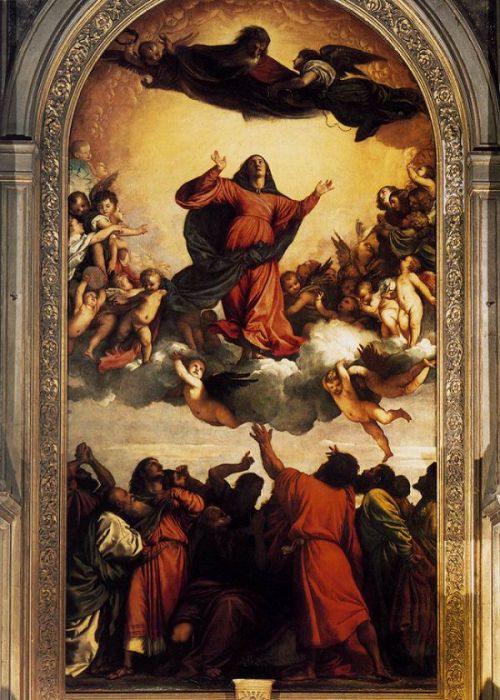
Assumption of the Virgin, by Titian
From Titian and other Venetian masters, Langosy would begin to understand how artistic technique was the servant of ideas. He would share their work with his daughter, Zoe. “I learned what it meant when my father pointed to the sky and said, “It’s a Titian blue.”

Diana and Callisto by Titian
Viewing Titian’s painting in person certainly influenced Langosy’s early work.

Detail from Flora by Langosy

Pucinello by Langosy
Seeing Titian in later years would become an unexpected opportunity for two artists, father and daughter, to focus on the beauty to be found even during challenging times. In Zoe’s own words:
“Over the years, my father developed multiple sclerosis, and our once-frequent visits to the Boston Museum of Fine Arts or the Gardner Museum became increasingly rare. Shortly before my father lost the ability to walk entirely, he and my mother traveled to London, where I was living at the time. Walking with a cane and with great difficulty, he set out one day with one purpose: to see Titian’s Bacchus and Ariadne at the National Gallery. It was a masterwork that he had never before seen in person and, of all the great works of art in London, it was the one he refused to miss. While my mother and I wandered through the nearby exhibits, he sat studying that single painting for nearly an hour.”

Detail from Bacchus and Ariadne by Titian
“As the years progressed, my father’s MS caused physical discomfort and fatigue that made it increasingly difficult for him to travel even as far as the local art museums we had enjoyed together. Our conversations about art never took place outside the comfort of the studio, living room, or kitchen at my parent’s home in the Boston suburb of Medford. Then, one day, we read in the newspaper about the “Rivals of Renaissance Venice” show at the MFA. That moment created a breakthrough. My father knew this was a show that he could not and would not miss.”
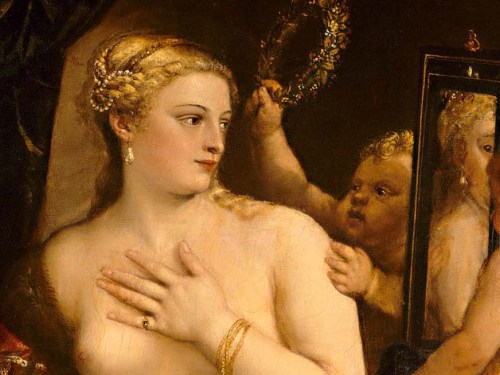
Detail from Venus with a Mirror by Titian, at the MFA 2009 Exhibit
“We chose a time when we knew the museum would be quiet, and, on a hot summer morning, my father, mother, and I traveled into Boston to see the exhibit. Above all, we went to see the Titians. As I pushed my father in his wheelchair, we stopped for a long time at each painting. Sometimes we would quietly look at the art, while other times we would talk about what we saw. For the first time in many years, I was given the gift of being able to walk through a museum with my father again and share with him one of the things that we both love most: art. Visiting the show was highly enriching for all of us. Since then, my father has found renewed strength to combat the hold that MS had placed on his activities, and he is determined to attempt such outings on a more regular basis.”

Zoe with her father’s portrait of Elizabeth
—
Want to learn more?
View Langosy’s The Story of My Art: 1, 2, 3, 4, 5 and 6.
View four decades of Langosy’s work at http://www.donald.langosy.net/
See what’s current on Langosy’s Facebook page.
His contact: Zoe Langosy at zlangosy@me.com.
Posted in Guest Contributor, Inspiration, tagged art, artists, beauty, books, contemporary art, creativity, Donald Langosy, family, fine art, Inspiration, memoir, multiple sclerosis, painting, Photography, storytelling, studio on July 7, 2016| 4 Comments »
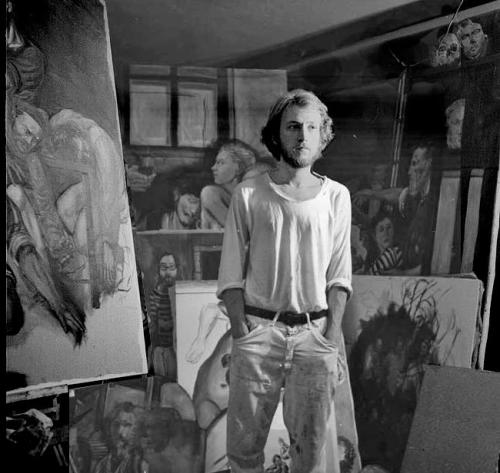
donald langosy in a studio from the early days
For the past six Thursdays it has been been my pleasure to share the words and images of painter Donald Langosy. In collaboration with his daughter, he produced a unique 14-page memoir visually chronicling his evolution as an artist. I was allowed to share that memoir on this blog interspersed with additional words and images by Langosy.
Last Thursday’s post – story of my art – shakespeare and the joy of being, revealed that Mr. Langosy was diagnosed with multiple sclerosis in 2003. Has it affected how he expresses himself as an artist? Of course. But decrease in mobility and even fine motor skills has in no way decreased his creativity or even his productivity. As he has stated he does not allow MS into his studio, but he has welcomed visitors on occasion.

donald langosy still in the studio present day
I have been lucky enough to sit in his space and at his side and see his works-in-progress upon the easel, the canvases stacked against the wall, his sculptures tucked in high nooks, and what I especially love (and I tell him each time) the books, the books, the books, on so many different subjects, collected over the years! And no matter how crammed the space becomes with paintings and books and new technologies to enable him in his work, there is always space for the grandchildren.

grandchildren in the studio
Below are a few more images. Please enjoy this virtual peek inside the studio, present and past, of Donald Langosy.


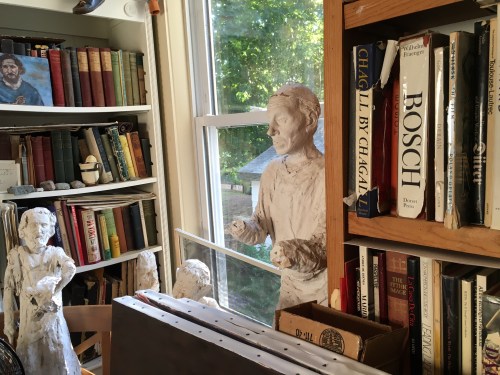
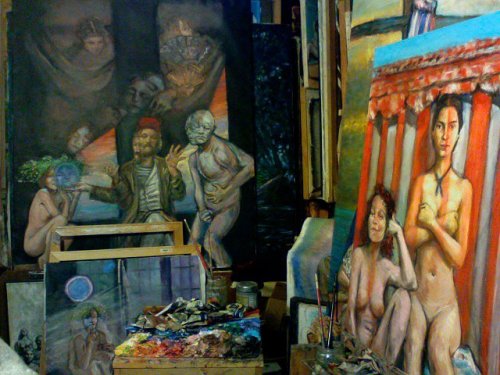
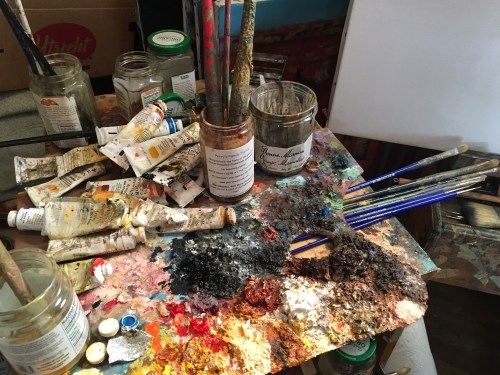

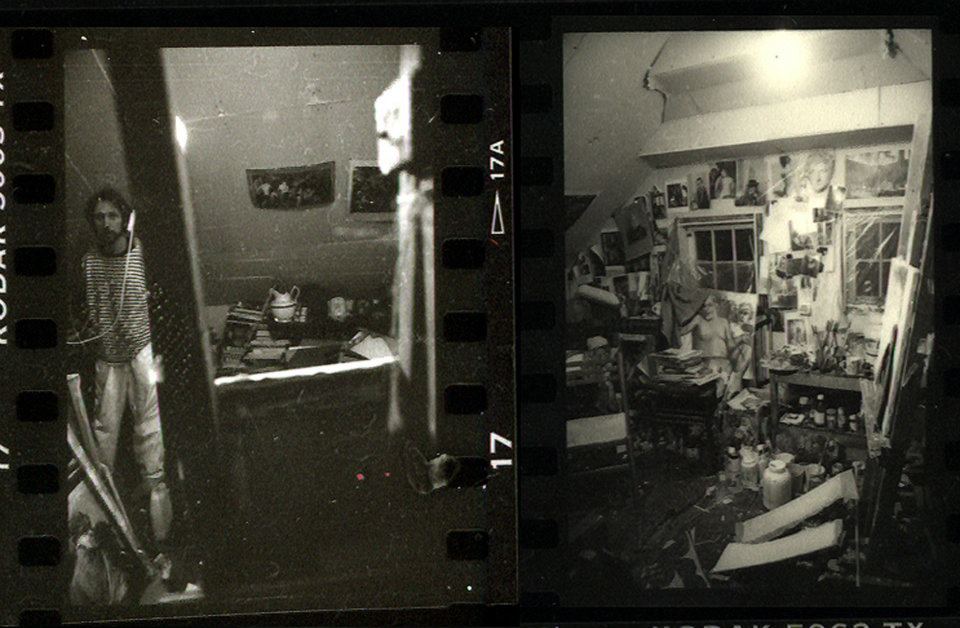
Photos provided by Zoe Langosy.
—
View The Story of My Art: 1, 2, 3, 4, 5 and 6.
View four decades of Langosy’s work at http://www.donald.langosy.net/
See what’s current on Langosy’s Facebook page.
His contact: Zoe Langosy at zlangosy@me.com.
Posted in Inspiration, tagged art, artists, bohemian, contemporary art, creativity, Donald Langosy, family, fine art, Inspiration, Marilyn Monroe, memoir, muse, nudes, painting, romance, storytelling on June 16, 2016| 4 Comments »
Previously in The Story of My Art: “painting with the moments”
And now (click on images for larger view) …


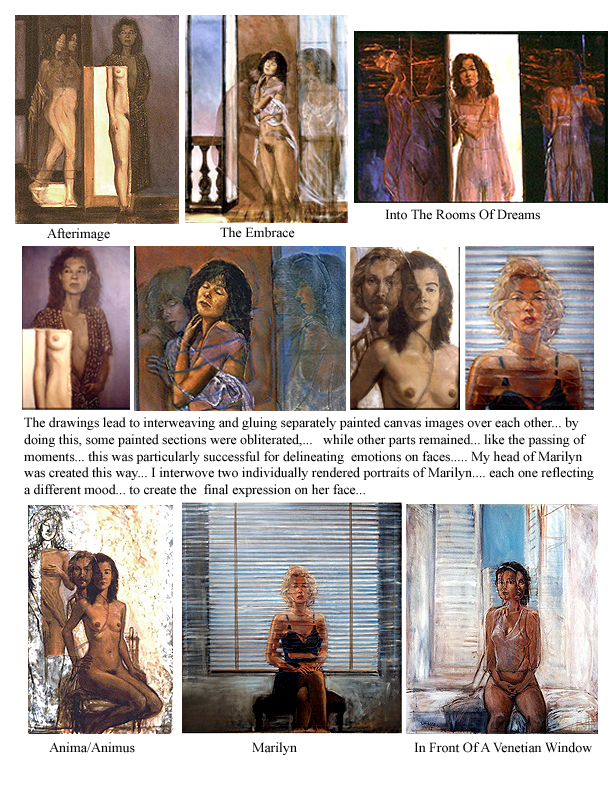
images of elizabeth

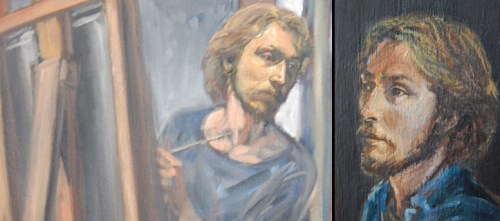
self-portraits of donald
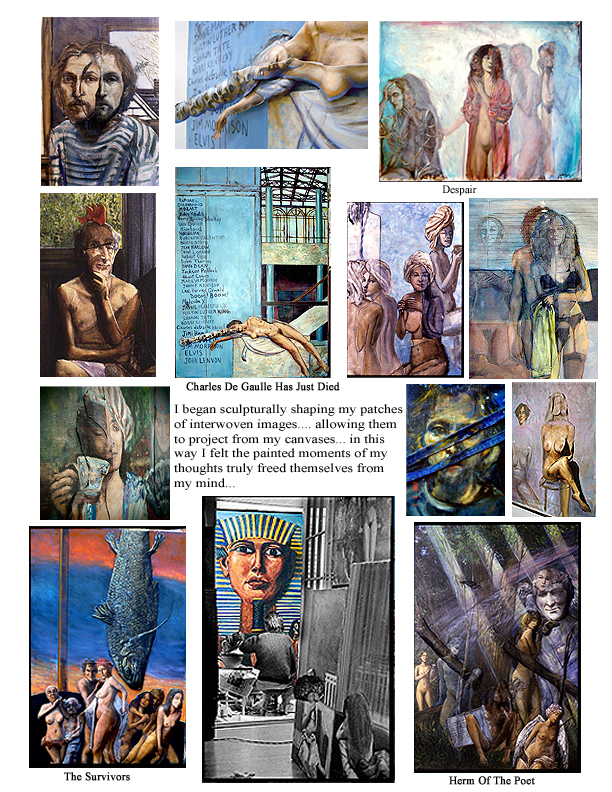
And once freed, what happened? Find out in the next chapters of this artistic journey on Thursday June 23rd.
Meanwhile, view details of the Marilyn Monroe painting here and view Mr. Langosy’s art at http://www.donald.langosy.net/ and https://www.facebook.com/The-Art-of-Donald-Langosy-270498092961524/photos/?tab=album&album_id=442071359137529
Contact: Zoe Langosy at zlangosy@me.com.
Posted in Inspiration, tagged art, artists, beauty, bohemian, contemporary art, creativity, Donald Langosy, family, fine art, Inspiration, love, muse, painting, romance on June 9, 2016| 4 Comments »
Previously in The Story of My Art: “becoming an artist confident”
And now (click on image for larger view) …


The next chapter in this artistic journey is Thursday June 16th.
Meanwhile, view Mr. Langosy’s art at http://www.donald.langosy.net/ and https://www.facebook.com/The-Art-of-Donald-Langosy-270498092961524/photos/?tab=album&album_id=442071359137529
Interested in his work? Please contact his daughter Zoe at zlangosy@me.com.
Posted in Inspiration, tagged architecture, art, beauty, Boston, churches, Emmanuel Church, family, flowers, grief, history, Lindsey Chapel, Lucitania, Photography, stained glass windows, weddings on April 16, 2016| 4 Comments »
The church was decorated with Easter lilies and pink roses and the entrance to each pew marked by a cluster of lilies. Palms were placed in pew openings and stood at various points to create a natural chapel. Upon the altar more lilies and roses. The war had limited the number of guests in attendance but even so Emmanuel Church on April 21, 1915 was filled with those wishing well the bride and groom, Leslie Hawthorne Lindsey of Boston and Stewart Southam Mason of England.
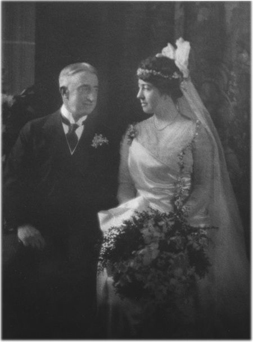
william lindsey, father of the bride, and daughter leslie lindsey
The bride wore white satin made with rose point lace and garnitures of small clusters of orange blossoms. The flowers held in place a veil of Limerick lace made especially for Miss Lindsey in Ireland the previous year. She carried a bouquet of white orchids and jasmine. Her wedding party wore shades of blue and pink silk, their gowns adorned by rosebuds. The bride maids carried baskets of pink sweet peas.
After the ceremony, there was a reception in the Bay State Road home of the bride’s father, William Lindsey. The bride’s mother now wore blue silk in a shade known as moonlight embroidered with baskets of silver. Flowers prevailed, decorating each room, smilax in the hallway, greenery entwining railings and baskets of roses on the stairs. Bells rung in celebration on both sides of the Atlantic as everyone knew that soon the bride and groom would return to his home in England and all they need do was board the Lusitania.
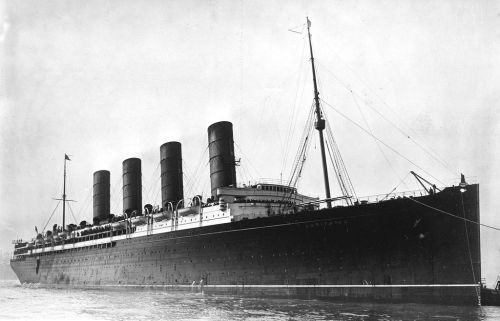
rms lusitania
The RMS Lusitania would depart New York for Liverpool on May 1, 1915. On May 7, it would be torpedoes and sunk by a German U-boat. At least 1, 198 passengers and crew would die, including newlyweds Leslie Lindsey and Stewart Mason. When the body of Leslie was returned to her father she wore the jewels that her father had given her.

A heartbroken father would do several things over the years in memory of his lovely daughter, one of which was to buy a piece of property adjacent to that of Emmanuel Church in 1919. A chapel would be built. Begun in 1920, the structure would be finished in 1924.

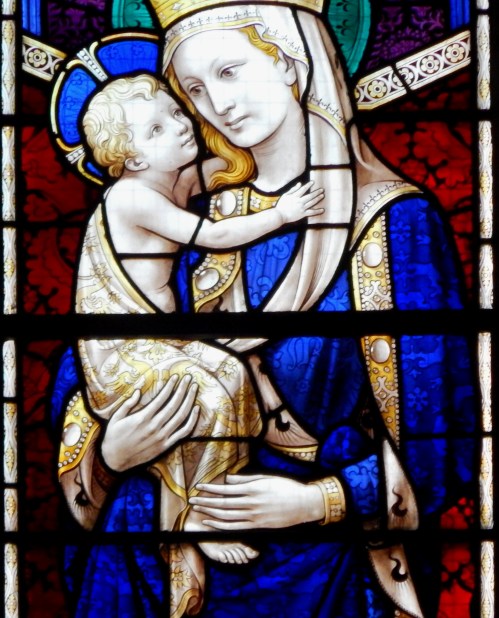
The chapel was designed by the architectural firm Allen & Collins. John Ninian Comper (1864-1960) designed the chapel’s decorative scheme from the altar to the chapel’s signature stained glass windows. Sadly, William Lindsey did not see the finished chapel. His youngest daughter shared memories of seeing her father sitting across the street watching the building’s construction and knowing he would not live to see it completed.
Sources and Further Reading
History of Lindsey Chapel on Emmanuel Church website
Boston Evening Transcript, April 21, 1915
Posted in Inspiration, Nature Notes, tagged family, imagination, Inspiration, musings, nature, painting prompt, storytelling on January 30, 2016| Leave a Comment »
My brother described a scene that I wish someone would paint.
He lives in Virginia, not in a rural place, but not an urban megalopolis either. A plain old city with a crumbling downtown and further out global firms building plants, and the accompanying fancy housing for their management, on lands that used to be working farms, if not outright plantations if you go back far enough.
It’s a city near the river and crisscrossed by highways but in the beginning it was the railroads that allowed this city to make its fortune, bridging north and south, a passage way for goods of all sorts.
It was on a literal bridge that the incident took place.
My brother was driving home on a nice new road. He was recounting stories of his day to me when he said, “Oh my God. You won’t believe …” I reacted thinking at first he was seeing a roadside accident. He calmed me down and then explained, “Overhead, the bridge that crosses the road, there are deer passing by in the night. They are walking on the railroad tracks on the bridge overhead fading in and out of the mist.”
A number of people pulled off the road to watch, like my brother, hoping no train would come before the animals could walk into the surrounding fields and woods. Nothing happened. Just the lingering memories of a beautiful sight.
Posted in Inspiration, tagged creativity, encouragement, family, Inspiration, musings, photo essay, Photography on January 16, 2016| 2 Comments »
Creativity-Portal.com is an award-winning site offering a wealth of creative resources to viewers for fifteen years. There you will find my latest photo essay, Sightings. Enjoy.

 Words + Images