Feeds:
Posts
Comments

Posts Tagged ‘religion’

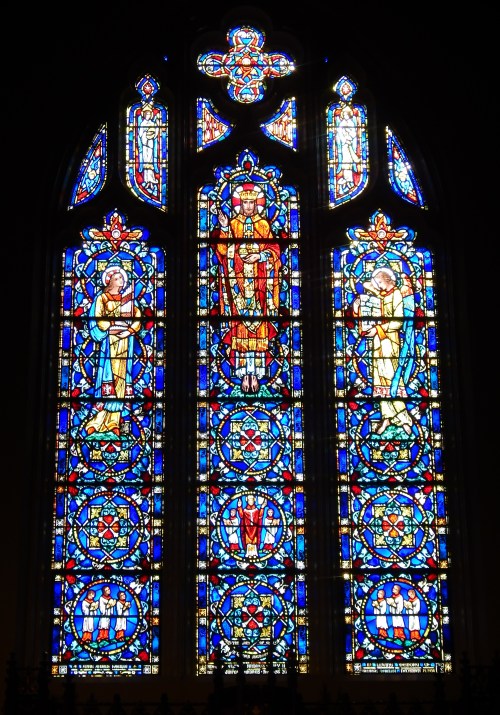
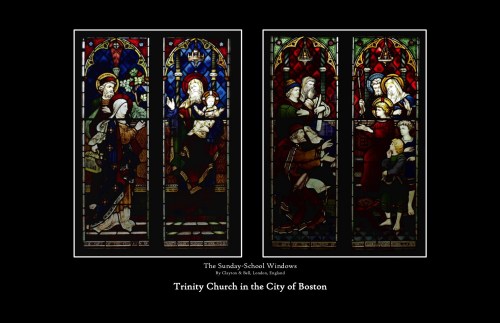
Coming soon to the Book Shop at Trinity Church will be this postcard depicting The Sunday-School Windows designed and made by Clayton & Bell in 1874.

You can read an earlier post I wrote about these windows, a hidden gem, via this link: https://wordsandimagesbycynthia.com/2014/07/13/sunday-school-windows-at-trinity-church/


Additional Readings

https://en.wikipedia.org/wiki/Clayton_and_Bell

http://printscharmingsoho.com/collections/clayton-bell-stained-glass-window-master-drawings

www.nytimes.com/2014/11/14/arts/design/conserving-stained-glass-records-at-corning-museum-.html


Read Full Post »

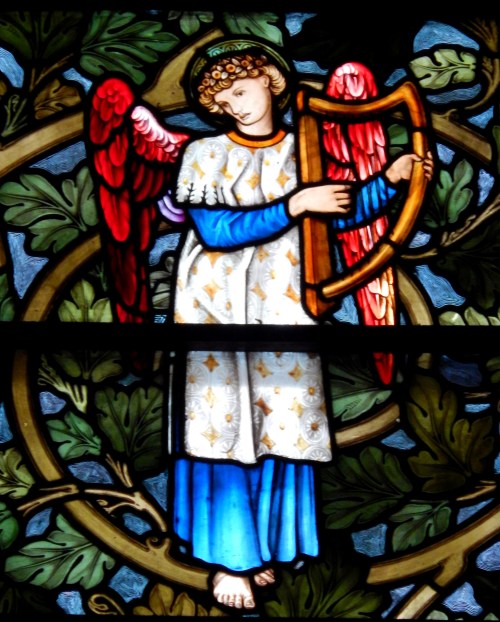
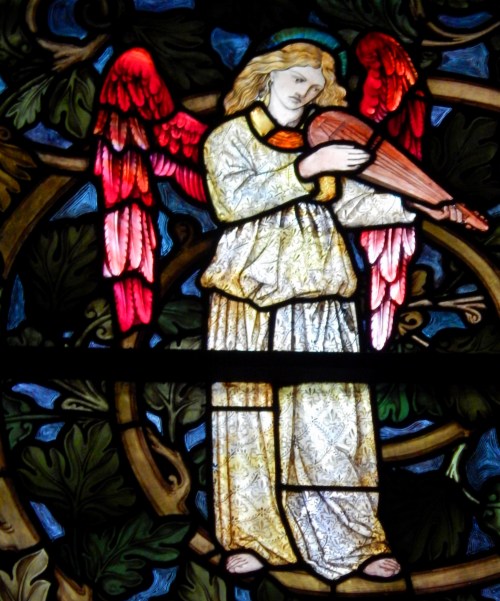
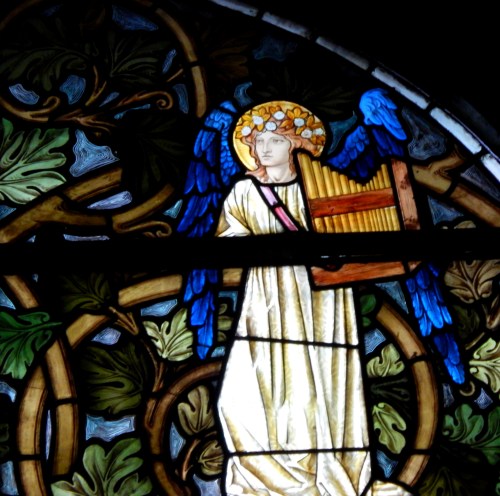
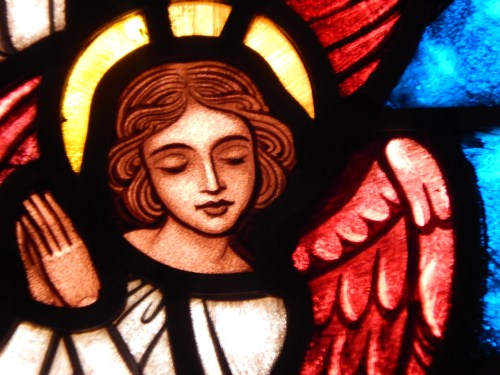
… they are Edward Burne-Jones angels.  Eighteen of them in a series of windows that are often referred to as the Christmas Windows, located inside Trinity Church in the City of Boston.  As I’ve written about before on this blog, these windows depict The Journey into Egypt, Worship of the Magi, and Wonder of the Shepherds.  The windows were designed by Burne-Jones and executed by William Morris in 1882.

Photographing these angels is very much a work in progress.  I’ve only captured eight so far and not all to my satisfaction.  British historian Fiona McCarthy once wrote what would Christmas be without a Burne-Jones angel.

Maybe that is the goal I can set for myself.  Before Christmas to have photographed all eighteen angels.  Wouldn’t that be something? We’ll see.  You know I’ll share if I succeed. 😉

Meanwhile, learn more about visiting Trinity Church and seeing the angels for yourself via this link: http://trinitychurchboston.org/art-history/tours

Read Full Post »

… there was a school and on the campus there was a chapel and inside the chapel there was a stained glass window known as The Singing Window.

photo by Carol M. Highsmith

photo by Carol M. Highsmith


Sources and Additional Readings

Learn more about the photographer Carol M. Highsmith on the Library of Congress website: Carol M. Highsmith Archive.

Learn more about Tuskegee University including its tours and the history of the chapel.

Read Full Post »

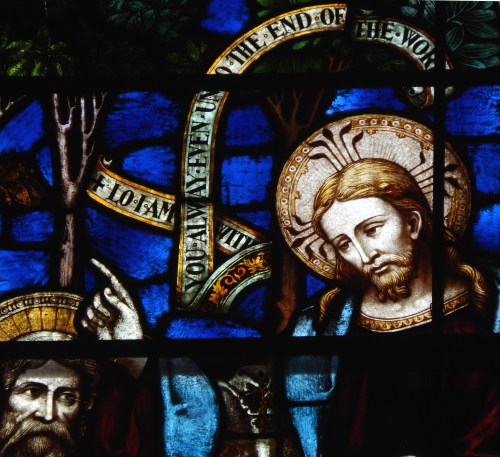
Detail from The Baptism

Detail from The Baptism

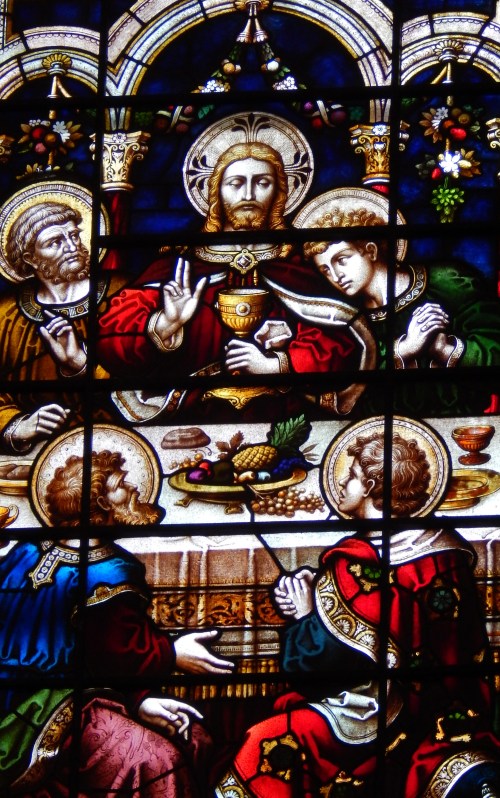
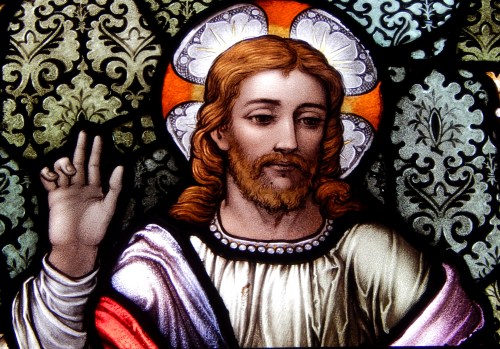
When Trinity Church was consecrated in 1877, there was only one stained glass window in place, The Baptism, in the chancel, designed by Clayton & Bell of London.  The rest was all clear glass.  By the end of 1878, there would be seven windows in the chancel marking a life: The Nativity, Jesus in the Temple with the Doctors, The Baptism, The Preacher, The Last Supper, The Resurrection, and The Commission to the Apostles.

Detail from The Last Supper

Detail from The Last Supper

I’ve not photographed the chancel very much.  But with the seasons changing and the light falling just a little differently, I’ve been focusing my camera on those windows again. Not focusing so much on trying to capture the whole window, but especially zooming in on the face.

Detail from The Commission to the Apostles

Detail from The Commission to the Apostles

New details are always being revealed.

Detail from The Resurrection

Detail from The Resurrection

I’m curious what else the autumn light will reveal.  You know I will be sure to share.  😉  Meanwhile, if you’re in the area you can check it out for yourself.  Learn more via the church website –http://trinitychurchboston.org/  – and here’s specific information about art & architecture tours http://trinitychurchboston.org/art-history

Have a good day, folks!


Read Full Post »

Detail from Baptism Window

There are thirteen stained glass windows inside St. Peter’s Episcopal Church in Central Square, Cambridge, MA. And I had the wonderful opportunity to stand before them all thanks to the kind gentleman, Rector Brocato, who let me through the door.

Detail from St. John the Baptist Window

Detail from St. John the Baptist Window

He took me on a brief and informative tour of his church and provided me with detailed literature.  The parish was founded in 1842. The current building was constructed in 1867.  The first stained glass window was added in 1917, designed by Wilbur Herbert Burnham.

AAA_wilbhbur_27920

Wilbur Herbert Burnham designing a stained glass window, ca. 1940 / Paul Davis, photographer. Wilbur H. Burnham Studios records, circa 1904-1991. Archives of American Art, Smithsonian Institution.

Burnham is one of two stained glass designers highlighted in the church’s guidebook.  He designed several windows for the church.

Detail from St. Anne Window designed by Burnham

Detail from St. Anne Window designed by Burnham

Detail from St. Anne

Detail from St. Anne Window

In the 1930s, two windows were added from the Charles J. Connick Stained Glass Studios, most noted of which may the High Altar Window.

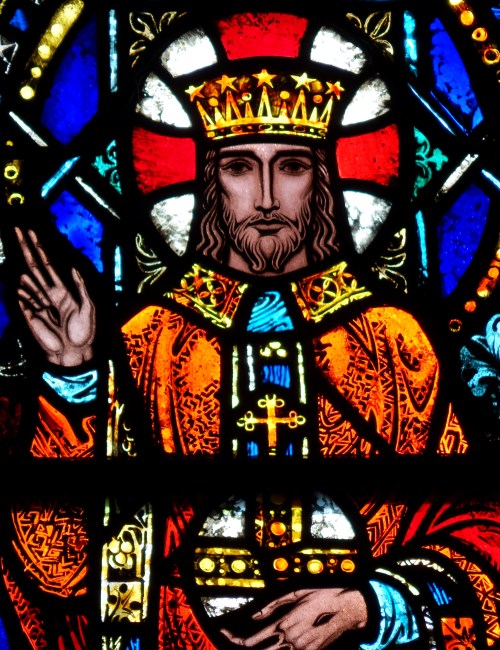
Detail from High Altar Window, by Connick Studios

Detail from High Altar Window, by Connick Studios

High Altar Window by Connick Studios

High Altar Window

Detail from High Altar Window

Detail from High Altar Window

Detail from High Altar

Detail from High Altar

The current guide book is being revised to include the names of all the designers.

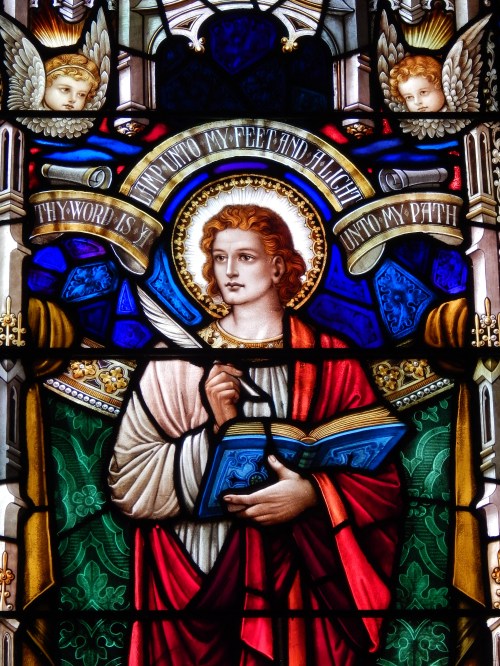
Detail from St. John Window

Detail from St. John Window

Even so, the current guide book provides a wonderful historical summary of the of the parish and detailed description of the biblical and secular symbolism in each window.

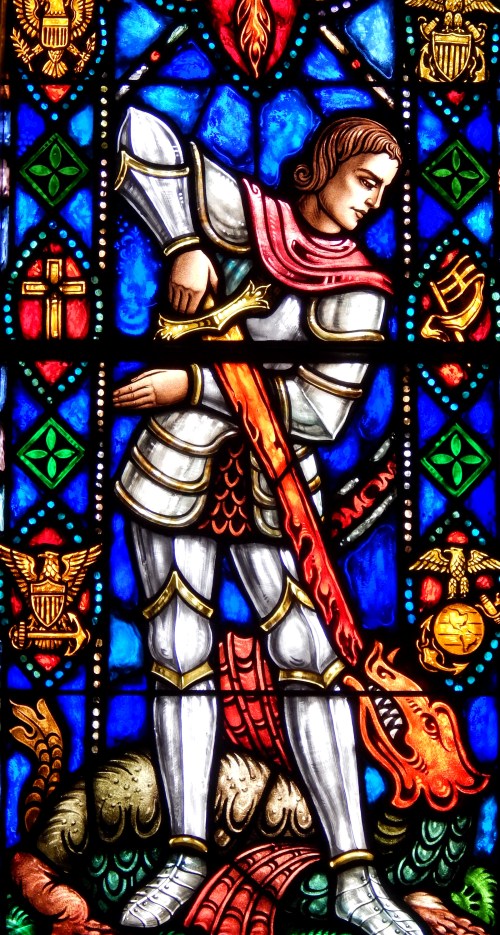
Detail from St. George Window

You can find out more about this welcoming place, from services and tours to community outreach, via the church website: http://www.saintpeterscambridge.org/

Detail from Nativity Window

Detail from Nativity Window

Sources/Additional Reading

Learn more about Wilbur Herbert Burnham in the Archives of American Art via this link.

Learn more about Charles J. Connick in the Archives of American Art via this link.

The Charles J. Connick Stained Glass Foundation is also a wonderful resource.

Read Full Post »

All three postcards depict beautiful fine art details found at historic Trinity Church in the City of Boston and are available in the church Book ShopPeace, Be Still is also available online via this link.

Read Full Post »

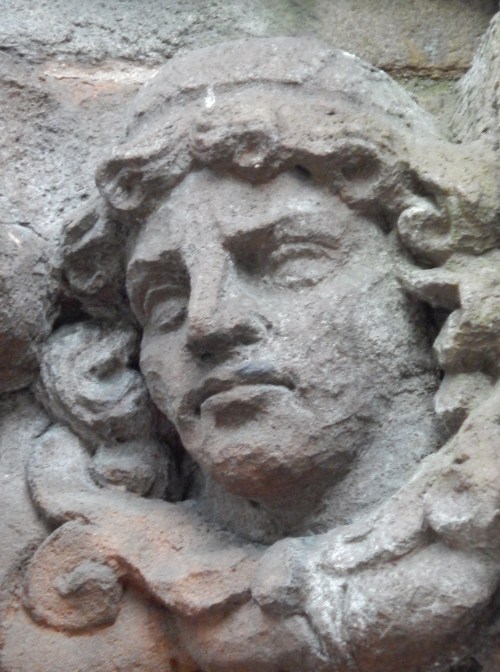
I’d seen the sculpture many times inside Trinity Church but not truly appreciated it. A man holding a cup, a cup-bearer, but the person depicted had no context for me.  I knew nothing of his significance in the past or in the present.  There were too many other visuals capturing my attention, like sunlight through stained glass windows.  Only recently have I returned with greater respect to the relief of Elijah Winchester Donald, Rector of Trinity from 1892 until 1904.
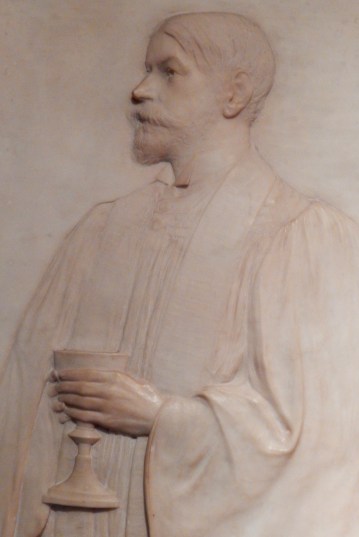
Detail of E. Winchester Donald Sculpture by Bela Pratt

I unexpectedly re-discovered the sculpture, and the man depicted, while researching the history of a church thousands of miles away at what is now known as Tuskegee University in Tuskegee, Alabama.

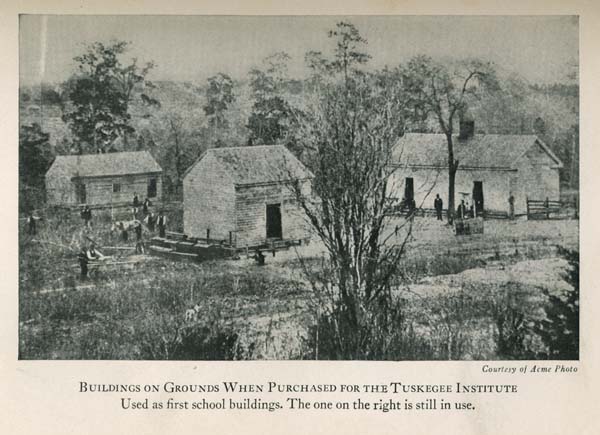
During my research I came across an issue of The Southern Workman, a publication founded in 1872 by General Samuel Chapman Armstrong of Hampton Institute, Hampton, VA.  Armstrong would leave his mark on American history for many reasons, one of which included founding Hampton just after the Civil War. There, a young Booker T. Washington, formerly a slave, would become a student and eventually a teacher. In 1881, when people in Alabama, wanting to start a new institute for black students, reached out to Armstrong for principal recommendations, Armstrong suggested young Washington who applied for the position and got the job.

The August 1895 issue of The Southern Workman made note of Tuskegee’s achievements, including recent receipt of anonymous funds to build a new chapel.  But prior to those funds being received graduation commencement services took place and, the journal describes the event in this way:

Years late, Booker T. Washington would describe the moment in a slightly different way.  In 1901, Washington wrote Up from Slavery, the chronicle of his journey from slavery, his attendance at Hampton and eventual leadership at Tuskegee and well beyond.  As Washington wrote, money had been found to start Tuskegee, with money set aside to pay future instructors, but no provisions had been made for securing land and buildings.
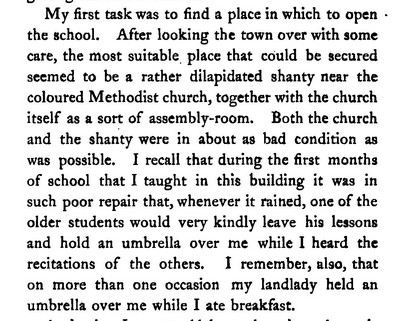
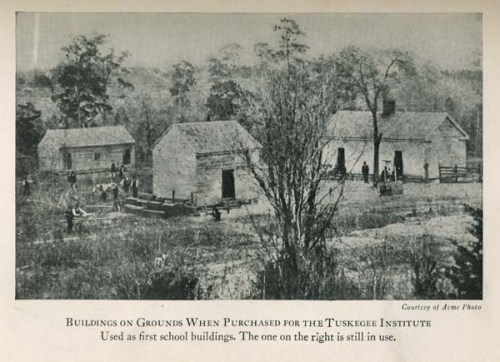
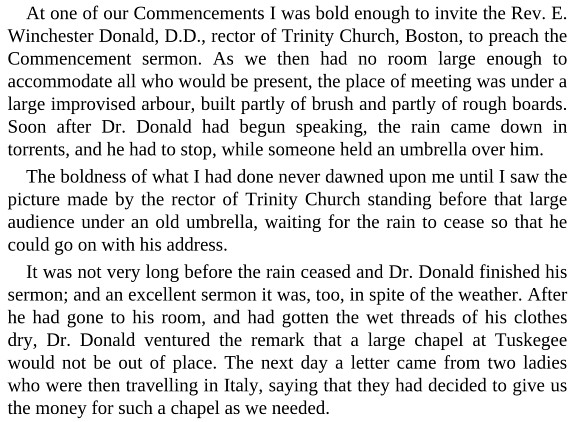
Later in his autobiography, Washington gives his personal recollection of the 1895 Tuskegee commencement in which Dr. Donald spoke:

The chapel would be built, designed by Robert R. Taylor, the first African American graduate of MIT. The chapel would be erected between 1896 and 1898, a structure some scholars say Taylor considered his masterpiece.

Robert R. Taylor

Robert R. Taylor

In 1900 author Max Thrasher wrote: “The building of this chapel illustrates, as well as any one instance can, the methods of the industrial training at Tuskegee.  The plans for the building were drawn by the school’s instructor in architectural and mechanical drawing.  The bricks, one million two hundred thousand in number, were made by students in the school’s brick yard and laid by the men in the brick-laying classes.  The lumber was was cut on the school’s land and sawed in the saw mill on the grounds.  The various wood-working classes did the work which in their departments.  The floor is of oak; all the rest of the finish in in yellow pine, and the use of this wood … The pews were built after a model designed by one of the students, and another student designed the cornices. The tin and slate roofing was put on by students, and the steam heating and electric lighting apparatus was installed by them …” Before his death in 1904, Donald would have an opportunity to speak in this chapel.

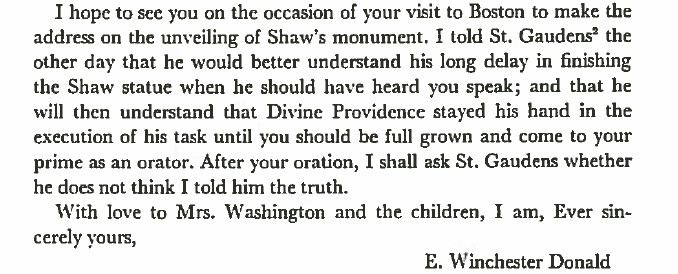
Though from two very different backgrounds, Donald and Washington appear to have greatly respected one another. In 1895  Donald established the Trinity Church Oratorical Prize, an award for the best written and best delivered paper on an assigned subject, a student prize that continues at Tuskegee, with different sources of funding, to this day.  For many reasons, Washington often made his way up North, cultivating philanthropists, accepting honorary degrees, attending national conferences, and speaking in places like Trinity.  In 1897 he was invited to deliver an address at the dedication of the Robert Gould Shaw Monument in Boston.  Prior to his arrival, Donald sent him a letter:
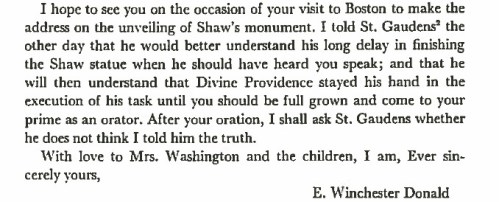
In 1901, Donald presented the dedication address for a new campus building at Tuskegee.  In attendance were noted business leaders and philanthropists including George Foster Peabody and John D. Rockefeller Jr. Before them was a magnificent campus, once a few fragile buildings, transformed by student-labor into a thriving educational institute with over 100 hundred instructors and staff, 50 buildings both functional and aesthetic, over 2500 acres of land with solid farming infrastructure and students applying from around the world.

Chemistry Lab 1902

Chemistry Lab 1902

Instructor George Washington Carver

Tuskegee Instructor George Washington Carver

Donald’s dedication address was made just a few decades after the end of the Civil War.  There was still great philosophical debate about what was to become of the millions of African Americans formerly enslaved.  Like Washington, Donald seemed to believe that education and skill building were the key for black people to let go of the past, achieve success in the present, and build a foundation for future excellence.

During the address, Donald would say: “We are in the presence of a fact. Whether or not the negro can be raised to self-respect, industry, thrift and ethical soundness, let the doctrinaires debate. One thing we know, whereas he was blind to his only chance, now he sees. He has only to keep his eyes open and use his chance to rise clean out of the condition into which 200 years of enforced servitude and thirty-five years of stupid, selfish and merciless political exploitation thrust him down.”  His words would become controversial with statements including “an educated negro without a vote is worth infinitely more than ten illiterate white men who vote as often as the polls are open.

Until the end of his days, in person and in writing, Donald would support the efforts of Washington at Tuskegee and those at other Southern black schools educating new generations.  He supported the efforts of many people inside the U.S. and from abroad trying to make social change.  He may have thought he was being militant.

As was said by the Rector of Grace Church in his memory, “his supreme gift was not militancy,–however it may have seemed to some, as well as to himself,–his supreme gift was not militancy, it was sympathy; he gave drink to the thirsty; he satisfied the longing soul; his true emblem was not the claymore, as he fancied, it was the chalice.”

Others stated, “Some of us disagreed with him, some of us thought his positions untenable, but none of us doubted his fraternal regard.”

His memorial was completed January 27, 1907, the bas relief by sculptor Bela Pratt and its setting designed by Donald’s friend, Charles A. Coolidge.

As for that chapel at Tuskegee, it would continue to evolve but that is a story for another day.

Sources & Additional Reading

Up from Slavery by Booker T. Washington

History of Tuskegee (University Website)

Tuskegee: Its History and its Work (1900)

Samuel Chapman Armstrong (Hampton University Website)

MIT Archives – Robert R. Taylor

Bela Pratt Sculpture of E. Winchester Donald

Trinity Church Art & History

The King’s Cup Bearer, Sermon in Memory of E. Winchester Donald, 1904

Read Full Post »
Bust of Dean Stanley at Trinity Church

I took the picture, I did the research and this is what I learned:  On Easter Monday in 1877, Rev. Phillips Brooks was given leave by his parish, Trinity Church in the City of Boston, to take a sojourn to Europe.  While in England, he spent time with Arthur Stanley, Dean of Westminster Abbey. Brooks was invited to preach at Westminster in July, and it is written that Dean Stanley listened with delight to a doctrine after his own heart.  Brooks would later share in a letter, “Last Sunday I preached for Mr. Stanley at his church in London, and William and I were much in the little man’s company while we were in his town.  He is very pleasant and entertaining, but much changed since his wife’s [Lady Augusta Stanley] death. He has grown old and fights hard to keep up an interest in things.”(1)


In the autumn of 1878, Dean Stanley traveled to America. In Boston he preached for the Rev. Phillips Brooks at Trinity Church.  Brooks would later write that no one who heard the benediction at the close of the service would ever forget it. “He had been but a few days in America. It was the first time he had looked an American congregation in the face. The church was crowded with men and women of whom he knew that to him they represented the New World. He was for a moment a representative of English Christianity. And as he spoke the solemn words, it was not a clergyman dismissing a congregation, it was the Old World blessing the New; it was England blessing America.  The voice trembled while it grew rich and deep, and took every man’s heart into the great conception of the act that filled itself.”


In 1881, following Dean Stanley’s death, Phillips Brooks would write a 12-page retrospective for The Atlantic Monthly.  In conclusion Brooks would highlight lessons of faith and good will he thought taught by Stanley’s life, and then end with these words:

“These lessons will be taught by many lives in many languages before the end shall come; but for many years years yet to come there will be men who will find not the least persuasive and impressive teachings of them in Dean Stanley’s life. The heavens will still be bright with stars, and younger men will never miss the radiance which they never saw. But for those who once watched for his light there will always be a special darkness in the heavens, where a star of special beauty went out when he died.” (3)

Miss Mary Grant, an eminent British sculptor and Stanley’s niece by marriage, would execute a memorial bust.  That bust would be given to Trinity Church to commemorate his visit.  It is located in an area that I believe is known as the baptistry.  His visage “stands upon a bracket of Sienna marble … beneath which is a tablet of Mexican onyx, on which is engraved a tribute by Robert C. Winthrop.” (4) And sitting across from him?  A bust of Phillips Brooks.

Bust of Phillips Brooks by Daniel Chester French

Bust of Phillips Brooks by Daniel Chester French

Learn more about Trinity stories in stone and glass with a tour: http://trinitychurchboston.org/art-history/tours

Sources for this post …

(1) Phillips Brooks, 1835-1893: Memories of his life … by Alexander Viets Griswold Allen (1907)

(2) Life and Correspondence of Arthur Penrhyn Stanley, Volume 2 by Rowland Edmund Prothero (1893)

(3) The Atlantic Monthly, Volume 48, October 1881

(4) Trinity Church in the City of Boston, 1888, pp. 31-32

(5) Mary Grant

(6) Phillips Brooks Bust image is from Wiki Commons

Save

Read Full Post »
At some point, I’ll set myself up in Copley Square with a tripod, and photograph the church’s whole West Porch.  At least I will do my best.  Meanwhile, I am having great fun photographing the porch details.

Read Full Post »
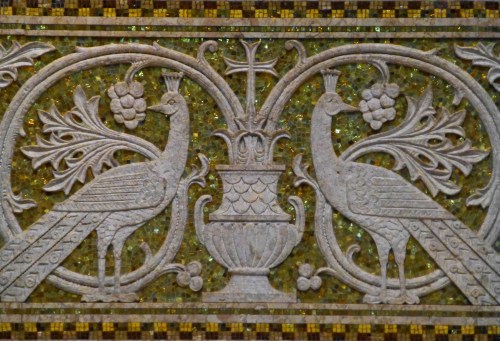
… particularly at certain times of day is the altar inside Trinity Church in Copley Square.  This altar is not part of the original construction and furnishings that took place between 1872-1877.  As described in a 1952 publication, The Story of Trinity Church in the City of Boston, by Rev. Edward Dutcher Romig, it was designed by Charles D. Maginnis as part of a 20th Century redesign of the chancel.  He writes of a giant block of Montenelle marble quarried near Trieste, and covered with carved faces and inserted borders of Venetian gold glass and colored glass mosaics. “The peacocks on the face of the altar symbolize eternal life, and the grapevine represents the wine used at the Communion Service. Thus the whole composition tells us that Christians who devoutly partake of the Lord’s Supper share in Christ’s promise of eternal life.”

You can learn more in a variety ways including Art & Architecture tours.  Another excellent resource is the book The Makers of Trinity available at the Trinity Book Shop.


Read Full Post »

« Newer Posts - Older Posts »