Feeds:
Posts
Comments

Posts Tagged ‘architecture’

In time for the holidays, at the gift shop located at Trinity Church in Copley Square, you will soon find items featuring one of the most striking and provocative images that I have ever taken … probably because the source of the image is so striking and provocative. I think of them as angels though they are harpists robed in white in one corner of the stained glass window, David’s Charge to Solomon, by Edward Burne-Jones and William Morris & Co.

Detail from David’s Charge to Solomon by Burne-Jones and Morris

The women stand in a gallery at the rear of King David’s throne as the aged King delivers his charge to young Prince Solomon, and resting upon the King’s knees are the plans of the future Temple that he will not live to see. The window was presented to Trinity Church in the City of Boston by Frederic Dexter in memory of his father George Minot Dexter (1802-1872). As described in an 1888 church description, “the design is considered especially appropriate as Mr. Dexter lived but just long enough to see the plans of the new church completed and the work begun.”

George Minot Dexter was member of a prominent New England family that traced its roots to England and Ireland. It was a family of farmers, merchants, ministers, doctors and politicians. Dexter would become an architect and civil engineer. In 1836, he was commissioned to design the houses for Boston’s Pemberton Square and all of the accompanying ironwork. Today, 1300 of his architectural drawings for 85 different projects can be found at the Boston Athenaeum, in a building he would help to erect between 1847-1849.

In 1863 Dexter, then senior warden of Trinity Church, would call upon Phillips Brooks. Brooks, the descendant of several New England families of note, was a young minister attracting great attention as he served a Philadelphia parish. The young minister was in demand by many parishes across the nation and Trinity Church was especially active in its attempt to acquire him. It would take six years, in 1869, before Brooks would accept the call.

The church at that time was located on Summer Street in downtown Boston. Forward thinking, Brooks determined that it was time for the church to move to a new location, Boston’s Back Bay. Land had been bought and a building committee had already been formed when Boston’s Great Fire of 1872 destroyed the Summer Street church.

Dexter served on the building committee that selected the design of architect Henry Hobson Richardson. The building, which revolutionized American architecture, would be constructed between 1872-1877. Dexter would not live to see the building’s consecration in February 1877. He died November 26, 1872.

In addition to what has been referred to as The Dexter Window, his service to his church is also featured on a wall tablet, with the inscription by Honorable Robert C. Winthrop. It is located in the North Transept. Winthrop refers to Dexter’s self-sacrificing nature and how he remained “active to the last in good works and particularly in his tender care for the interest of the living and the remains of the dead during the trying scenes which attended the burning of our old house of worship in Summer St …”

He refers to the fact that beneath the Summer Street church was a crypt with family vaults. That crypt was laid bare by the destruction of the building overhead. Dexter would tend to those remains until he lost his life.  In a letter to his friend Miss Mitchell, Phillips Brooks would write:

If you have the opportunity to tour Trinity Church, you’ll notice not only magnificent stained glass windows like David’s Charge to Solomon but also wonderfully decorated tablets with words that provide just a glimpse into the lives of people who considered that space their home. Well worth taking a moment to read. Enjoy!

Sources, Additional Reading and Opportunities

Trinity Church Art & History Tour Information

The Garden Square of Boston by Phebe S. Goodman

http://cdm.bostonathenaeum.org/cdm/ref/collection/p15482coll1/id/839

Life and Letters of Phillips Brooks

Read Full Post »

Trinity Church in the City of Boston has produced a new guidebook that highlights and explores the art and architectural features of this historic gem. The 48-pages feature information about the principal makers of the building, its design and construction which primarily took place between 1872-1877, interior and exterior decorations, and much more. It is a visual treat with reproductions of original sketches, early watercolor paintings, as well as interior and exterior images by many fine local photographers. I am honored to have two photos in this book including this detail from John La Farge’s Purity stained glass window.

As noted at the end of the publication, the guidebook is dedicated to Edward Earl Duffy (1960-2012), a Trinity Church parishioner and tour guide who loved the building’s art and architectural legacy. The book is available for $11.95 in the church gift shop. Enjoy!

Save

Read Full Post »

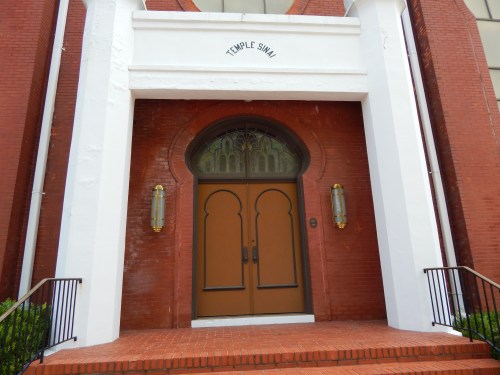
While traveling in Sumter, South Carolina it was my pleasure to visit the Temple Sinai, founded as a Reform Jewish Congregation. The history of Sumter’s Jewish community dates back to 1815. The first Jews who settled in Sumter were Sephardic and came from Charleston, SC. The current congregation was formed in 1895 by the merger of the Hebrew Cemetery Society and the Sumter Hebrew Benevolent Society. Construction of the congregration’s present temple was begun in 1912 and completed in 1913.

A feature article in the March 1913 Sumter newspaper The Watchman and Southron notes “The Temple is situated on the corner of Church street and Hampton avenue and is an imposing structure of red brick with domed roof … The architectural lines are simple, but the proportions are so good and so well harmonized that the general impression is one of beauty, allied to strength and permanence. As impressive as is the exterior of the Temple, it is the interior that is its chief beauty and glory …”

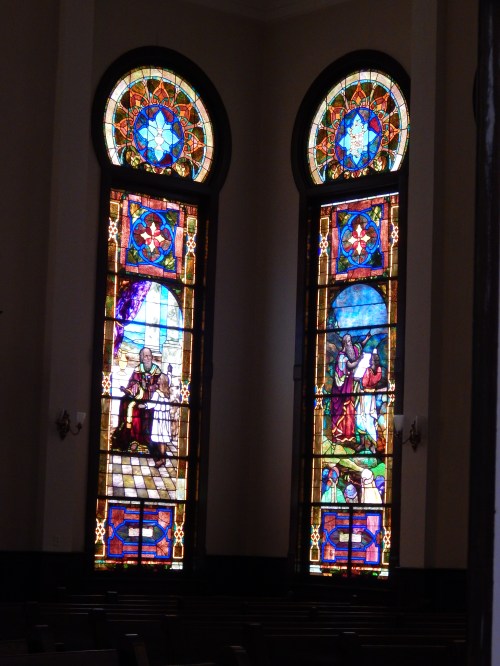
In terms of architectural style the brick building is Moorish Revival. Eleven stained glass windows grace the interior. Ten of the windows are 5 feet wide by 20 feet high and their shape mimic the building’s moorish towers, each a tall window illustrating a story surmounted by a half-window with further decorative detail. The eleventh window is round and is located high on a back wall.  While the specifics of the window designer and makers are elusive, the windows are thought to be handmade in Germany. Installation began in 1912 as indicated in a local newspaper article from September 1912, “The beautiful stained glass windows of Temple Sinai have arrived and are being placed in position.”  One month earlier, the same publication had noted, “The work is winding up on the new Jewish synagogue in this city and it will be only a short time now before the remodeled Temple Sinai will be one of the most beautiful places of worship in the city.

At age 95, Sumter native Robert Moses, a descendant of one of the first Jewish families to settle in Charleston and then in Sumter, is one of the last active members of Temple Sinai. As part of an educational presentation, he describes the windows as late Victorian in style, with rounded tops and interlacing borders giving them an eastern/Moorish look. Known as drapery glass due to the folding of the glass to add depth and color, the brilliant blues have cobalt added and gold was added to brighten the reds.

Each window depicts a scene from the Old Testament including as described in a 1913 newspaper article:

The Test of Faith, involving Abraham and Isaac …

The Blessing – Isaac Blesses Jacob …

detail from isaac blesses jacob

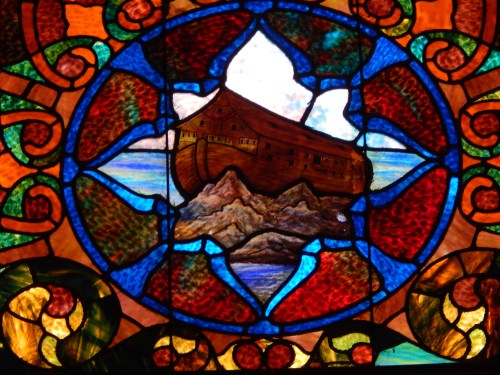
detail from isaac blesses jacob - the ark on ararat

detail from isaac blesses jacob – the ark on ararat

Jacob’s Dream …

detail from jacob's dream

detail from jacob’s dream

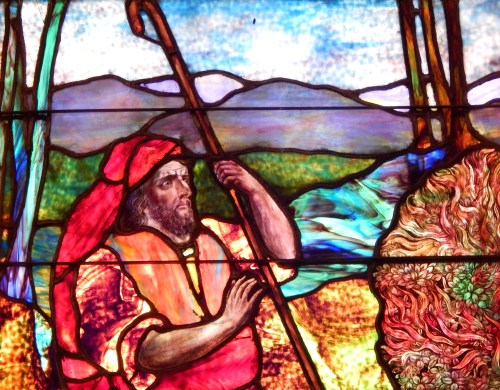
Vision of Moses when he sees the burning bush …

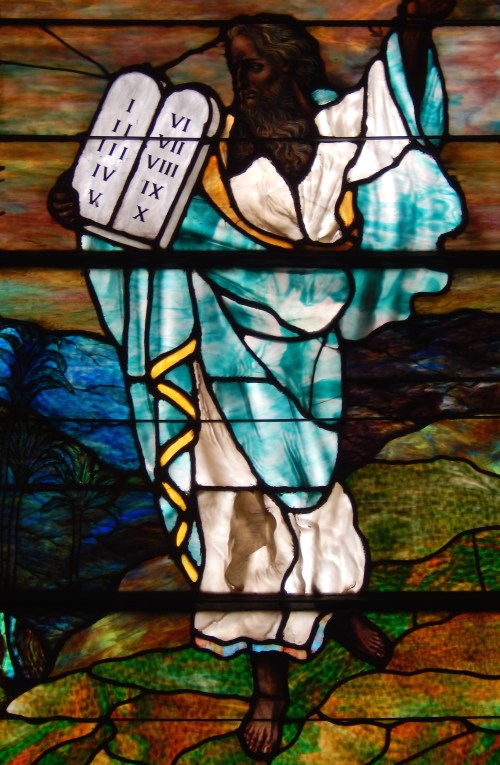
Moses on Sinai with the Ten Commandments …

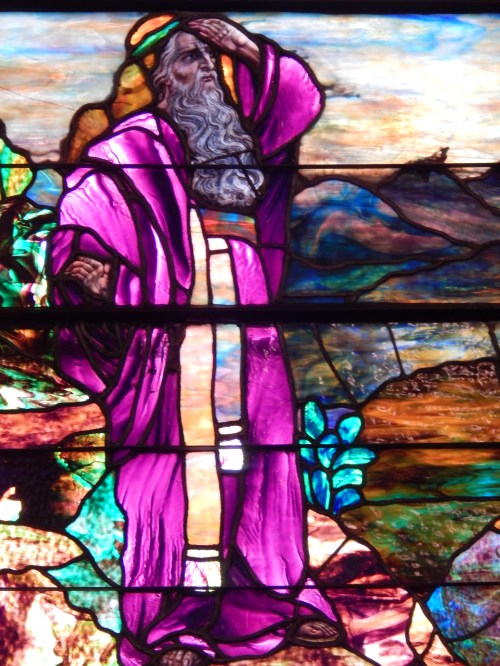
Moses on Nebo overlooking the promised land which he is forbidden to enter …

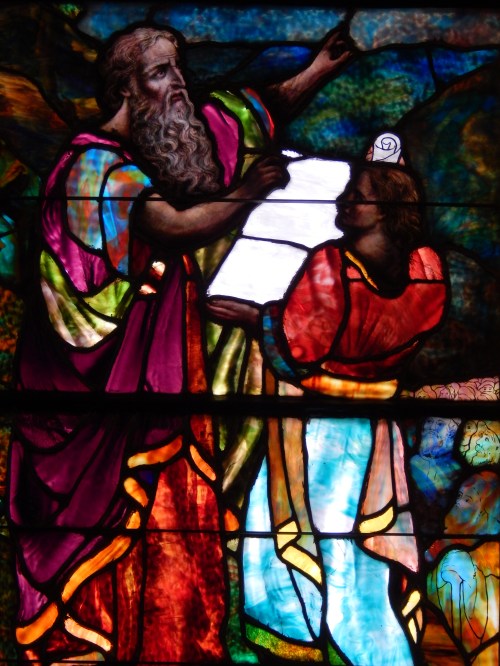
Moses Delivering Laws to Joshua …

Samuel Before Eli …

detail from samuel before eli

detail from samuel before eli

Elijah in Solitude …

detail from elijah in solitude, also known as elijah and the ravens

detail from elijah in solitude, also known as elijah and the ravens

David the Shepherd Boy …

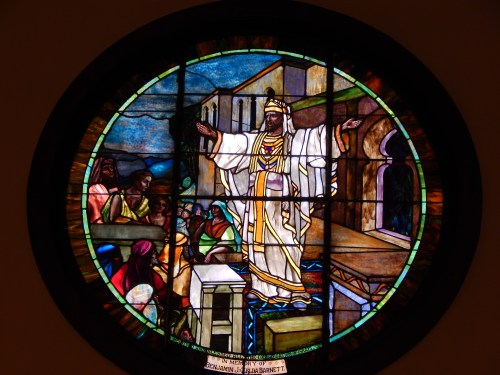
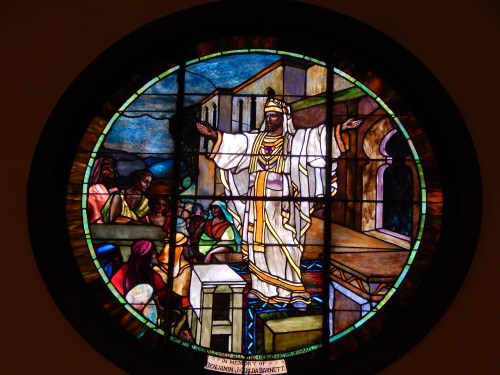
and Solomon at the Dedication of the Temple.

Members of the Moses family were kind enough to allow me entrance into the Temple to photograph details of the windows and share just a bit of the history of people and place. The windows of this place are unique for their pictoral illustration.

Temple Sinai is listed on the National Register of Historic Places. For more information, or to inquire how you can help preserve this historic structure, contact Temple Sinai, 11-13 Church Street, P. O. Box 1673, Sumter, South Carolina 29151 or call (803) 773-2122.

Sources and Additional Reading

(1) “House of Worshop of Jewish Congregation to be Dedicated on March 28th, ” The Watchman and Southron, March 8, 1913.

(2) The Watchman and Southron, September 21, 1912.

(3) The Watchman and Southron, August 10, 1912.

Temple Sinai Wikipedia page

Encyclopedia of Southern Jewish Communities – Temple Sinai

Records of Temple Sinai


Save

Save

Read Full Post »

Details from two of the eleven stained glass windows in Temple Sinai in Sumter, SC. Stay tuned for more photos and the history of this beautiful historic structure in the near future.

Read Full Post »

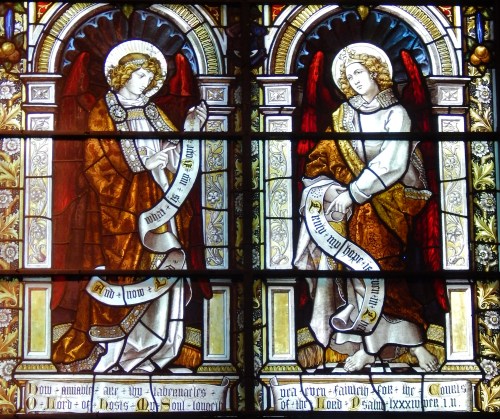
I don’t just challenge others and reap the culinary rewards, I also try to challenge myself and so in the coming weeks I am challenging myself to photograph and research two different sets of stained glass windows (at least).  The first will involve some travel as I make my way to South Carolina to visit with relatives and en route may have the opportunity to photograph stained glass windows in a historic synagogue.  The other involves researching this window (above) I noticed in a building while walking in the Back Bay of Boston. Stay tuned for future updates, and meanwhile, here’s a window located in a place I write about often, Trinity Church in the City of Boston. It is Hope by Burlison & Grylls.

Read Full Post »

detail from stained glass window christ preaching by john la farge (1883)

Christ Preaching is a three story clerestory window located on the west end of Trinity Church in the City of Boston.  Beautiful at any time of day, because of its location, it especially comes to life as the sun begins to set.

Sometimes when tourists enter Trinity the first words they literally ask is, “Are there any Tiffany windows here?” When they learn that the answer is no, they will shrug, albeit politely, and walk away. And I can only shake my head, knowing firsthand what they are walking away from.

Learn more …

http://trinitychurchboston.org/art-history/windows-slideshow

http://library.bc.edu/lafargeglass/exhibits/show/descriptions/all-saints/trinity-boston

Read Full Post »

… you will find the works of over a dozen photographers. From night blooming cereus, spring buds and insects draped in pollen to statuary, historic architecture and rooftop views of cities, Eyes On: Nature || the Urban Landscape is an eclectic yet cohesive expression of nature and the urban landscape. Please join the Riverside Arts Group at the Riverside Gallery, hosted at the Cambridge Community Center, in celebrating these unique thematic explorations.

Opening Reception, Sunday September 11, 3:00-5:00 PM

Closing Party, Sunday October 9, 3:00 – 5:00 PM

Music and tasty snacks provided at each of these two events. Please drop by, meet the photographers and view these wonderful works. Located at 5 Callendar Street, Cambridge, MA.  Co-curated by Derrick Z. Jackson, Carol E. Moses and Cynthia Staples.

https://www.facebook.com/events/550765988457447/

Read Full Post »

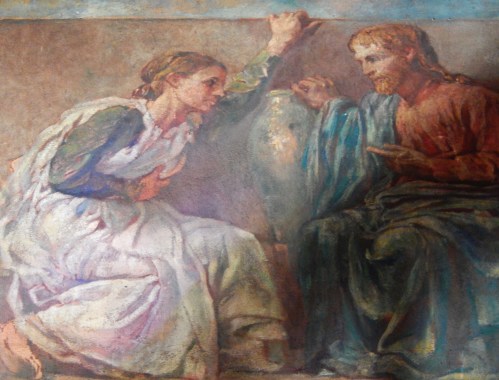
When I first photographed the John La Farge mural Christ Woman at the Well inside Trinity Church in the City of Boston it was late afternoon and I had a much simpler point and shoot camera. The photograph turned out just fine. As I progress as a photographer though it has been fun to revisit works photographed in the past. These photos were taken with a more advanced camera and in the light of the early morning sun shining onto the mural.


Read Full Post »

Morning light falling on the north wall of the nave in Trinity Church in the City of Boston. It has been my pleasure to photograph the stained glass windows over the years but this particular morning I focused my camera on the decorative features of one wall.  Zooming in you can see the elegance of the design orchestrated by John La Farge. The ravages of time are present and so is the enduring beauty of an architectural masterpiece.

This slideshow requires JavaScript.

Learn more about Trinity’s Art and History tours at trinitychurchboston.org/art-history/tours

Read Full Post »

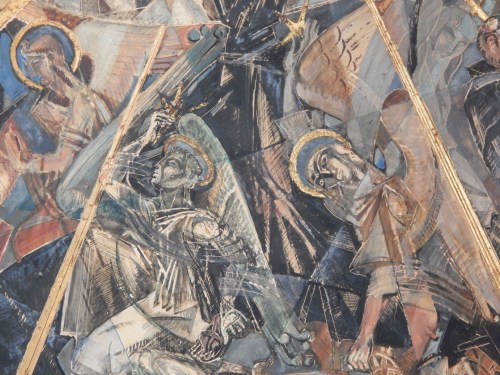
St. Dominic’s life is on display in Stephen’s living room. Grand in its expression, it appears in a small painting on paper, only slightly larger than 2′ x 2′ unframed. It is in fact the colorful sketch for a much larger work — a mural on the wall of St. Dominic’s Priory in Washington, D.C.

Each section of the painting, and of the final mural, has meaning. The image is divided into seven parts, depicting seven scenes from Dominic’s life, from the center upper part where “God’s Hand puts halo around St. Dominic and drops into beggar’s bowl a star …” to the center lower part where “Two Angels lift the saintly pilgrim by his bleeding feet toward the stars in heaven.

The painting was in the possession of Ludwig Joutz (1910-1998), an architect with the D.C. based firm, Thomas H. Locraft and Associates, noted for what today is often described as sacred architecture. In 1960, his company designed a new priory for St. Dominic’s Church. Construction was completed in 1962.  On a lined office pad Joutz sketched the initial concept for the mural. That yellowing piece of paper remains with the painting, a painting that is signed and dated by artist Pierre Bourdelle (1901-1966).

Loutz must have treasured Bourdelle’s work.  After he retired, he and his wife moved to Florida and with him he carried Bourdelle’s painting. Loutz, himself an artist, would sketch the interior of his home in Florida. In one drawing there on the wall is the same painting that Loutz’s son would eventually give to Stephen after his father’s death.

artwork by ludwig joutz

artwork by ludwig joutz

Ludwig’s son remembered his father meeting with Bourdelle as he worked on the mural but little else could he tell me and so my research began. Thankfully, there was quite a bit of information to be found online and in newspaper archives.

Born in Paris, France, Pierre Bourdelle was the son of famed sculptor Antoine Bourdelle.  He studied under Auguste Rodin in whose studio his father worked from 1893-1908. During his time as Rodin’s chief assistant, his father taught the likes of Henry Matisse and Alberto Giacometti. One biographer notes that with Rodin, a young Bourdelle visited Europe’s great Cathedrals.

rodin by edward steichen, 1911

rodin by edward steichen, 1911

Eventually Pierre would move to the United States and set up a studio in New York. In effect, he stepped out of his father’s shadow.

antoine bourdelle, 1925

antoine bourdelle, 1925

In a 1934 interview, he expressed: “In France, a man is judged by what his father did or by his family tree. In the United States a man is judged by himself, his personality, his own work. In France, they offered me mural jobs because my father was a well-known artist. They did not even look at my work.

pierre bourdelle, 1934

pierre bourdelle, 1934

A man of diverse interests and talents, he’d traveled the world studying the art of different cultures, observing the nature of different places.  Over time, based on some of the things he’d seen, he developed a new technique that set him apart as a muralist.

excerpt from 1934 article

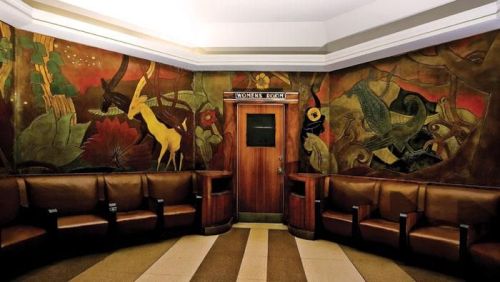
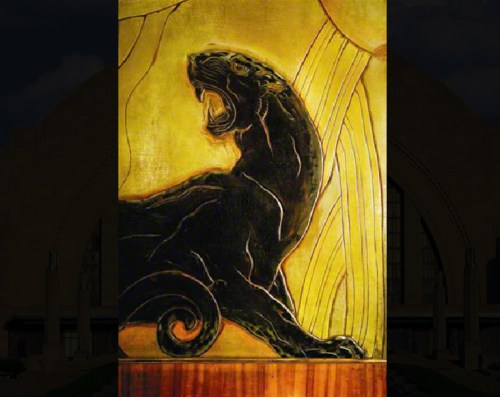
Search online and you’ll find a wealth of information about his Art Deco paintings and sculptures from the 1930s and 1940s. His bold and vibrant work adorned the interiors of ocean liners, railway lines like the California Zephyr, and the walls of institutions like Union Terminal in Cincinnati.

jungle mural by bourdelle for cincinnati terminal

He was a versatile artist capable of working with many media.  For Cincinnati’s Union Terminal, he not only created exotic jungle murals carved in linoleum, he also painted the ceilings of several rooms using an electric spray gun on canvas.

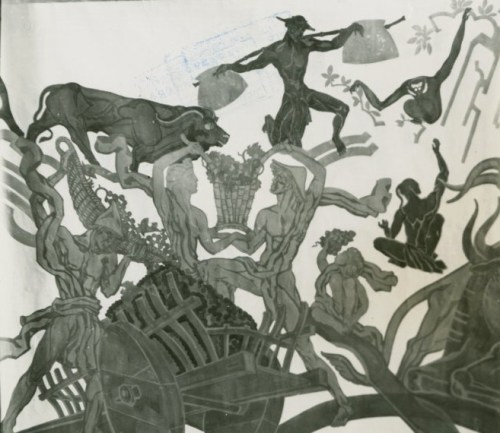
For the 1939-1940 New York World’s Fair, he created murals for Food Building North No. 2.  As described by a journalist covering the fair for Collier’s Magazine in 1939, There was Pierre Bourdelle, stripped to the waist in the hot sun and covered with red plaster dust. Gobs of wet plaster, a good blank wall, tools in his hands. That’s all Bourdelle, pupil of Rodin, asks to make him happy.”

His design motif for the fair was described as low bas-relief representing Bacchantes reveling at a wine-harvest festival, mythological animals, and scenes of beverage-making in various cultures.

sunshine and rain by bourdelle 1939

larger detail of vineyard mural on food building, 1939

Vineyard by Bourdelle 1939

While not everyone appreciated his style, e.g. so many sinuous forms wrapped around each other, few could deny the provocative and captivating nature of his work.

When World War II broke out, Bourdelle felt compelled to join the war effort.  He’d served in France during World War I. He’d been too young, only 15, but he’d lied about his age and was able to join an aviation unit.  When his plane went down, he suffered traumatic ear injuries.  A number of the biographies I found suggest that the horrors of that first war, the so-called Great War, influenced his art as no doubt did his participation in World War II. While unable to enlist because he was considered too old, he did serve in his own way, as a volunteer ambulance driver with the American Field Service at the North African and Italian fronts.

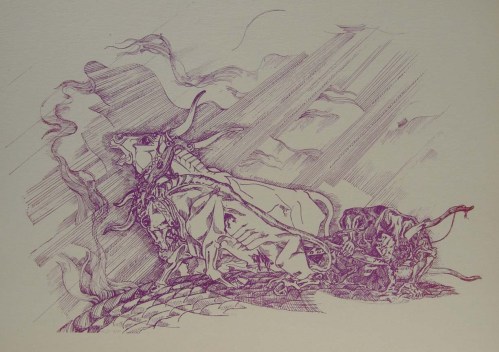
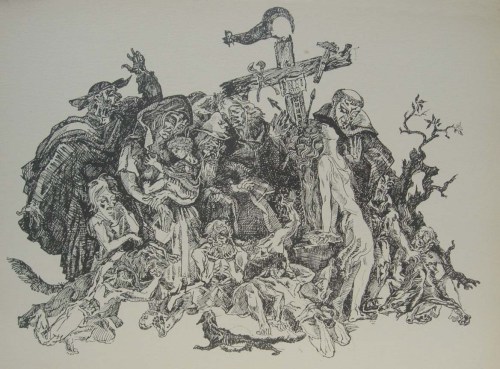
In 1945, upon his return to the U.S., Bourdelle would produce a book of images, simply titled, War. For the foreward, Stephen Galatti , the Director General of the AFS, would write, “Overseas Pierre Bourdelle saw suffering. He did his best to alleviate suffering, driving the wounded soldiers of many Allied armies. Helping staunch and bind their wounds in the field dressing stations. He knows the agony of war. He has no fear of showing war at its useless worst. He is not only a personally brave man who volunteered to go, and went, wherever the wounded were. He is an intellectually brave man, who makes no pretense at hiding the bare hideousness of warfare. … They are not pretty pictures. They show nothing but reality …”

Et Quare Tristis Incedo

They may not be pretty but they are horribly beautiful.  And as I perused all 50+ images, viewable online here, I could not help but be fascinated by Bourdelle’s evolution as an artist …

Land Mine

… seeing these works done in the 1940s and then …

Calvalry

… being able to look at the drawing he did in the early 1960s for the St. Dominic mural.

I suspect I will never see in-person the actual St. Dominic mural.  First of all, it is in a monastery chapel. Second of all, it has been covered in an attempt, I believe, to preserve it from the deterioration of time.

During the latter years of his life, Pierre Bourdelle continued to work as an artist and as a teacher.  He taught at C. W. Post, part of Long Island University, as an artist-in-residence. He died in 1966 while traveling with his family in Switzerland.


Sources and Additional Reading

Bourdelle Family History – http://www.mountharmonyfarm.com/GH-P-BourdelleItems.html

SS America Unique Story of a Great Ocean Liner/Bourdelle Page – http://www.ssamerica.bplaced.net/art2-en.html

Artwork for the California Zephyr – http://calzephyr.railfan.net/artists/bourdelle.html

Manuscripts and Archives Division, The New York Public Library. “Art – Murals – Food Buildings – The Vineyard (Pierre Bourdelle)” The New York Public Library Digital Collections. 1935 – 1945. http://digitalcollections.nypl.org/items/5e66b3e8-7352-d471-e040-e00a180654d7

Collier’s, Volume 103, p. 16

Bourdelle Art for Dallas Fair Park – http://frenchsculpture.org/dallas-fair-park-1

https://en.wikipedia.org/wiki/Cincinnati_Museum_Center_at_Union_Terminal

The Glass Storybook and the Great Menagerie The Art of Winold Reiss and Pierre Bourdelle – http://www.cincymuseum.org/union-terminal/art

History of Cincinnati Union Terminal – http://library.cincymuseum.org/75th-anniversary/main.swf

Bourdelle’s War – http://www.ourstory.info/library/4-ww2/Bourdelle/pbTC.html

Bourdelle Papers at Syracuse Libraries  – http://library.syr.edu/digital/guides/b/bourdelle_p.htm


Read Full Post »

« Newer Posts - Older Posts »