
While traveling in Sumter, South Carolina it was my pleasure to visit the Temple Sinai, founded as a Reform Jewish Congregation. The history of Sumter’s Jewish community dates back to 1815. The first Jews who settled in Sumter were Sephardic and came from Charleston, SC. The current congregation was formed in 1895 by the merger of the Hebrew Cemetery Society and the Sumter Hebrew Benevolent Society. Construction of the congregration’s present temple was begun in 1912 and completed in 1913.
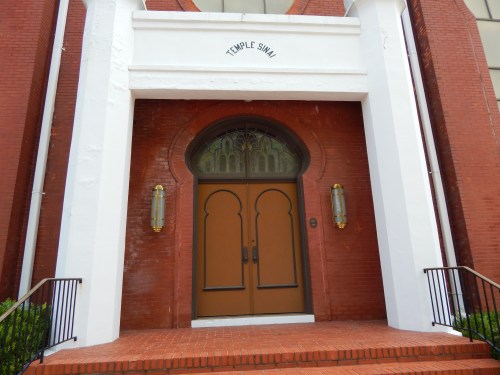
A feature article in the March 1913 Sumter newspaper The Watchman and Southron notes “The Temple is situated on the corner of Church street and Hampton avenue and is an imposing structure of red brick with domed roof … The architectural lines are simple, but the proportions are so good and so well harmonized that the general impression is one of beauty, allied to strength and permanence. As impressive as is the exterior of the Temple, it is the interior that is its chief beauty and glory …”

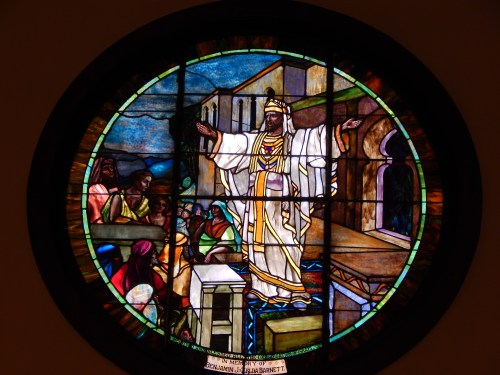
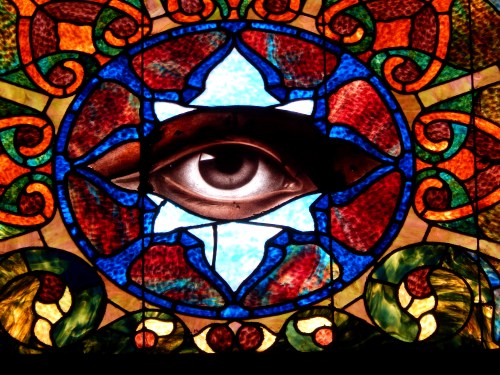
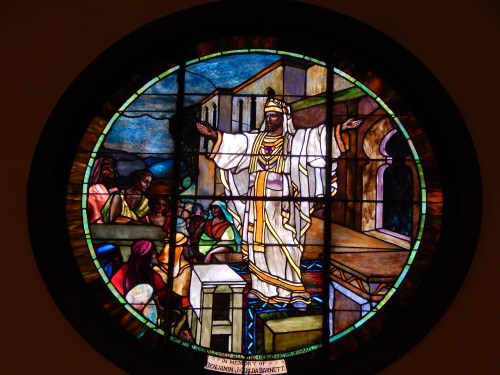
In terms of architectural style the brick building is Moorish Revival. Eleven stained glass windows grace the interior. Ten of the windows are 5 feet wide by 20 feet high and their shape mimic the building’s moorish towers, each a tall window illustrating a story surmounted by a half-window with further decorative detail. The eleventh window is round and is located high on a back wall. While the specifics of the window designer and makers are elusive, the windows are thought to be handmade in Germany. Installation began in 1912 as indicated in a local newspaper article from September 1912, “The beautiful stained glass windows of Temple Sinai have arrived and are being placed in position.” One month earlier, the same publication had noted, “The work is winding up on the new Jewish synagogue in this city and it will be only a short time now before the remodeled Temple Sinai will be one of the most beautiful places of worship in the city.”
At age 95, Sumter native Robert Moses, a descendant of one of the first Jewish families to settle in Charleston and then in Sumter, is one of the last active members of Temple Sinai. As part of an educational presentation, he describes the windows as late Victorian in style, with rounded tops and interlacing borders giving them an eastern/Moorish look. Known as drapery glass due to the folding of the glass to add depth and color, the brilliant blues have cobalt added and gold was added to brighten the reds.
Each window depicts a scene from the Old Testament including as described in a 1913 newspaper article:
The Test of Faith, involving Abraham and Isaac …

The Blessing – Isaac Blesses Jacob …

detail from isaac blesses jacob
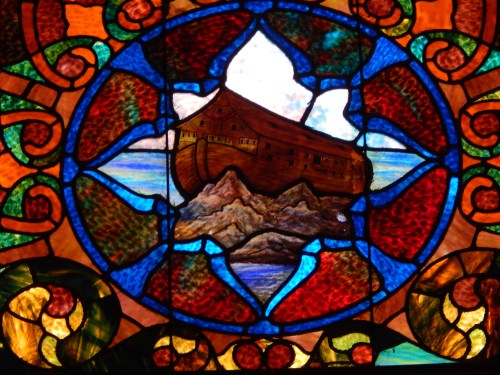
detail from isaac blesses jacob – the ark on ararat

Jacob’s Dream …

detail from jacob’s dream
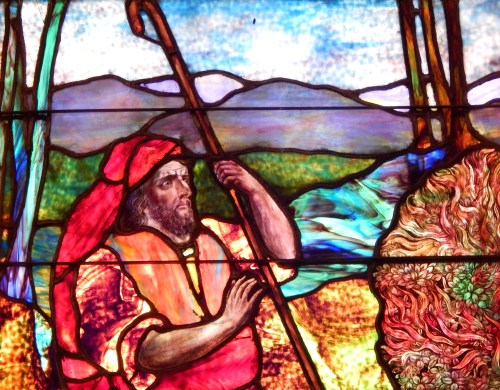
Vision of Moses when he sees the burning bush …

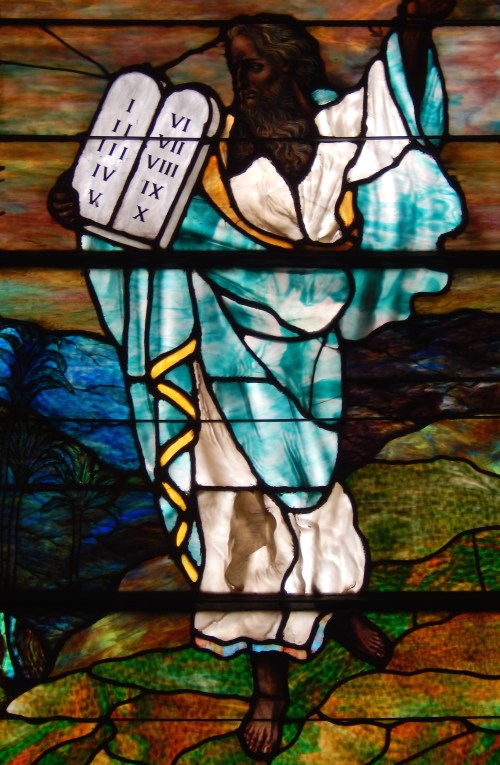
Moses on Sinai with the Ten Commandments …
Moses on Nebo overlooking the promised land which he is forbidden to enter …
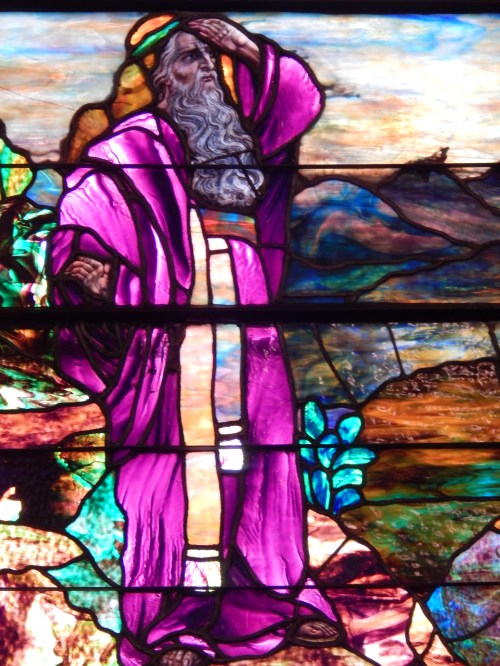
Moses Delivering Laws to Joshua …
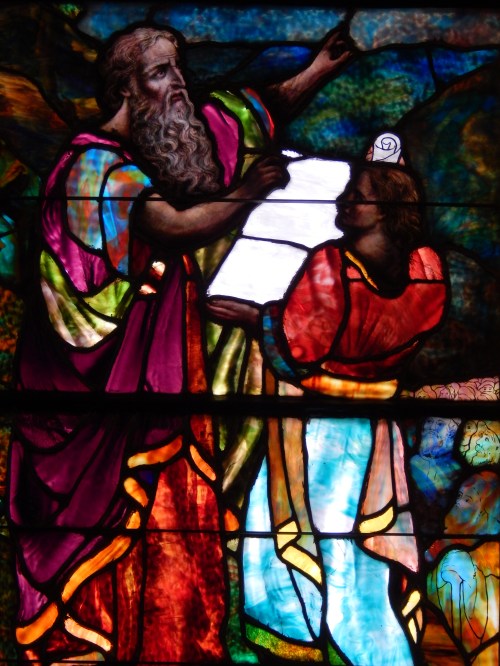
Samuel Before Eli …

detail from samuel before eli
Elijah in Solitude …

detail from elijah in solitude, also known as elijah and the ravens
David the Shepherd Boy …

and Solomon at the Dedication of the Temple.

Members of the Moses family were kind enough to allow me entrance into the Temple to photograph details of the windows and share just a bit of the history of people and place. The windows of this place are unique for their pictoral illustration.
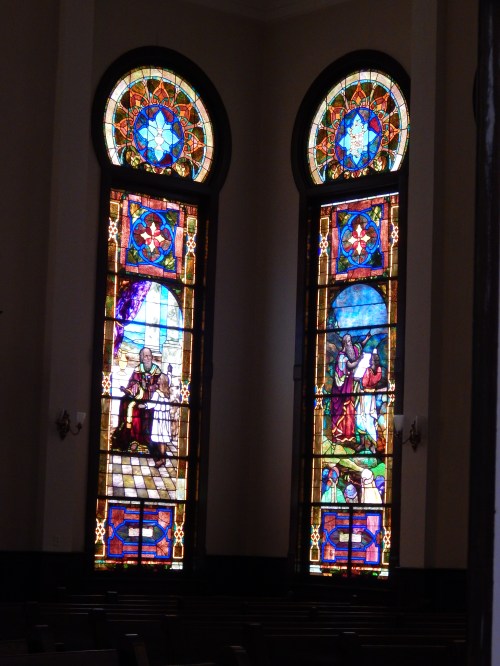
Temple Sinai is listed on the National Register of Historic Places. For more information, or to inquire how you can help preserve this historic structure, contact Temple Sinai, 11-13 Church Street, P. O. Box 1673, Sumter, South Carolina 29151 or call (803) 773-2122.
Sources and Additional Reading
(1) “House of Worshop of Jewish Congregation to be Dedicated on March 28th, ” The Watchman and Southron, March 8, 1913.
(2) The Watchman and Southron, September 21, 1912.
(3) The Watchman and Southron, August 10, 1912.
Temple Sinai Wikipedia page
Encyclopedia of Southern Jewish Communities – Temple Sinai
Records of Temple Sinai
Save
Save
Read Full Post »




















 Words + Images