Feeds:
Posts
Comments

Posts Tagged ‘faith’

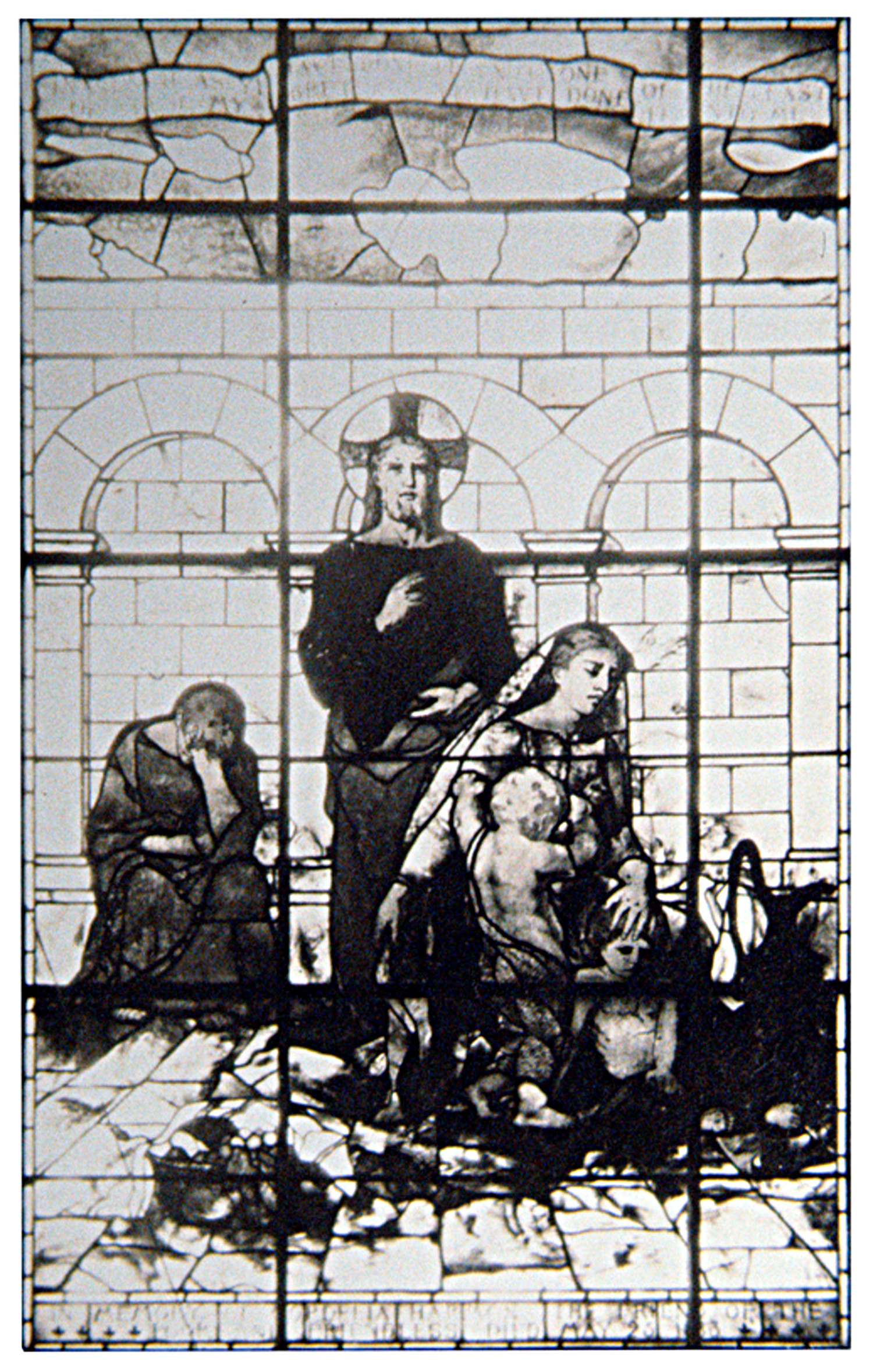
Courtesy of Trinity Archives

Photo of Charity, Courtesy of Trinity Archives

Charity is a stained glass window once located at Trinity Church in the City of Boston. It was designed by Frederic Crowninshield.  The inscription at the bottom of the window, barely legible in the above photo, reads “In memory of Cordelia Harmon, the friend of the poor and friendless. Died May 25, 1883.”  In an 1888 publication providing a descriptive account of the church, including of its windows, Harmon was described as “the Almoner of Trinity Church for many years, and through her good deeds was well known by all the poor in any way connected with the Parish.  The window was a gift of members of the Parish.”

Born in Maine, Cordelia Harmon (1820-1883) spent her adult life in the Boston area.  It is clear from surviving records that she consistently strove to help those who could least help themselves.  Regardless of good deeds done as an elementary school teacher, a nurse at Mass General Hospital or serving people through programs offered by her church, Harmon appears to have never turned her eyes away from the wrongs that remained around her.

One of the church-supported programs that she participated on was The Ladies’ Relief Agency.  As a part of that charity’s design, every application submitted seeking assistance was investigated, including a home visit.  Through such visits, and no doubt her work with other charities, Harmon was able to see firsthand the lack of support for those with chronic diseases, people who were turned away from hospitals, and many of whom had no family to care for them.  She would write:  “How can a man, breathing fetid air, living in the squalor and debasement that abound, where the poor most do congregate and often of necessity, feel hope or courage to rise above his condition?

Harmon imagined creating a home for those people where they could live a good life until the end of their days.  It was an idea that she would discuss with Phillips Brooks, the rector of Trinity Church.  He would help her raise the funds to open The Boston Home for the Incurables in 1881.  Harmon would work at this home until she “died at her post” in 1883.  Phillips Brooks was traveling abroad when he learned of Harmon’s death.  In a letter to his brother he wrote:

Despite his expression of not feeling well-fitted to do the work of Cordelia Harmon, upon his return to Boston, Phillips Brooks did continue her legacy.  In 1883, Trinity formed The Committee for the Establishment of The Boston Home for Incurables to raise funds to expand upon Harmon’s idea.  Funds raised helped the Home to acquire a larger facility and accommodate more patients.  It would continue to expand and refine its services over the next 130 years.  Today, the Boston Home is a respected, model institution serving nearly 100 residents.
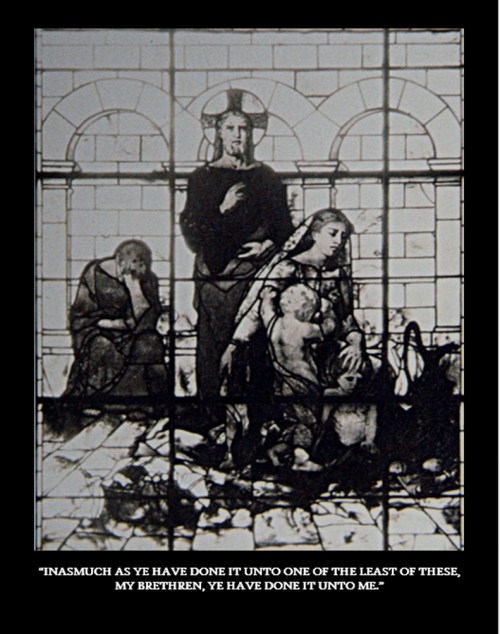
Charity, designed by Frederic Crowninshield,

The only known surviving image of the Harmon window is a black and white photo taken in the 1920s. In the center of the image, a woman and two children, destitute.  To the left, a figure with head bowed, the weight of the world upon his shoulders.  Standing amidst them is Jesus.  And above them all, in capital letters, is the text:  Inasmuch as ye have done it unto one of the least of these, my brethren, ye have done it unto me.  The window did not survive major renovations that took place in the 1950s. The window may be gone but the memory and legacy of Miss Cordelia Harmon lives on and continues to evolve.


Sources, Additional Reading, Etc.

http://www.thebostonhome.org/

https://www.givingcommon.org/profile/1072657/the-boston-home-inc/

September 19, 2014 article with video: http://assistivetech.scripts.mit.edu/blog/finding-a-home/

Charity postcard with insert about Harmon available at Trinity Church Bookshop
Read Full Post »

In the shadow of the Back Bay is how the brochure describes the location of Our Lady of Victories Catholic Shrine.  I chanced upon the church yesterday after a meeting.  Crossing a street, I actually saw the back of the building first, an old brick structure with darkened windows that clearly had to be stained glass.  I made my way to the front of the building, studying the exterior and wondering if I might contact someone, some day, to ask if I might photograph the interior.

“Do you want to go inside the church?” A large man stood across the street.  He seemed to be in a hurry because he didn’t even wait for my answer before saying, “Just go down those stairs over there.” Then he continued on his way.

I went down the stairs into a little alleyway. There were a couple of older gentlemen there having a smoke. They greeted me kindly, and again without really waiting for me to say I wanted to enter the church, they directed me through a side door.

Inside was dark and warm. People moved about a bit in the shadows and I could hear a few sounds.  I could see no stained glass windows though.  Then, to my right, a gentleman walked from a side room.  He smiled and said, “You can come on in.  We’re just watching a movie.”

I thanked him for the offer, and said, “Actually, sir, I was wondering if I could go inside the church upstairs where the windows are.” His grin widened, and he said, “Of course. Just go back outside and up the stairs.  The doors are open.”

That’s what I did and following is a bit of what I saw.  There are quite a few images so please enjoy at your leisure. You can read more about the church’s history via this link.  In the future I hope to post more about the architecture and about the primary window designer, Franz Xaver Zettler.  And, by the way, I believe that the gentlemen who were so kind to me, were themselves being helped.  Located in the basement of the church is the Medeiros Center for Change.

Read Full Post »

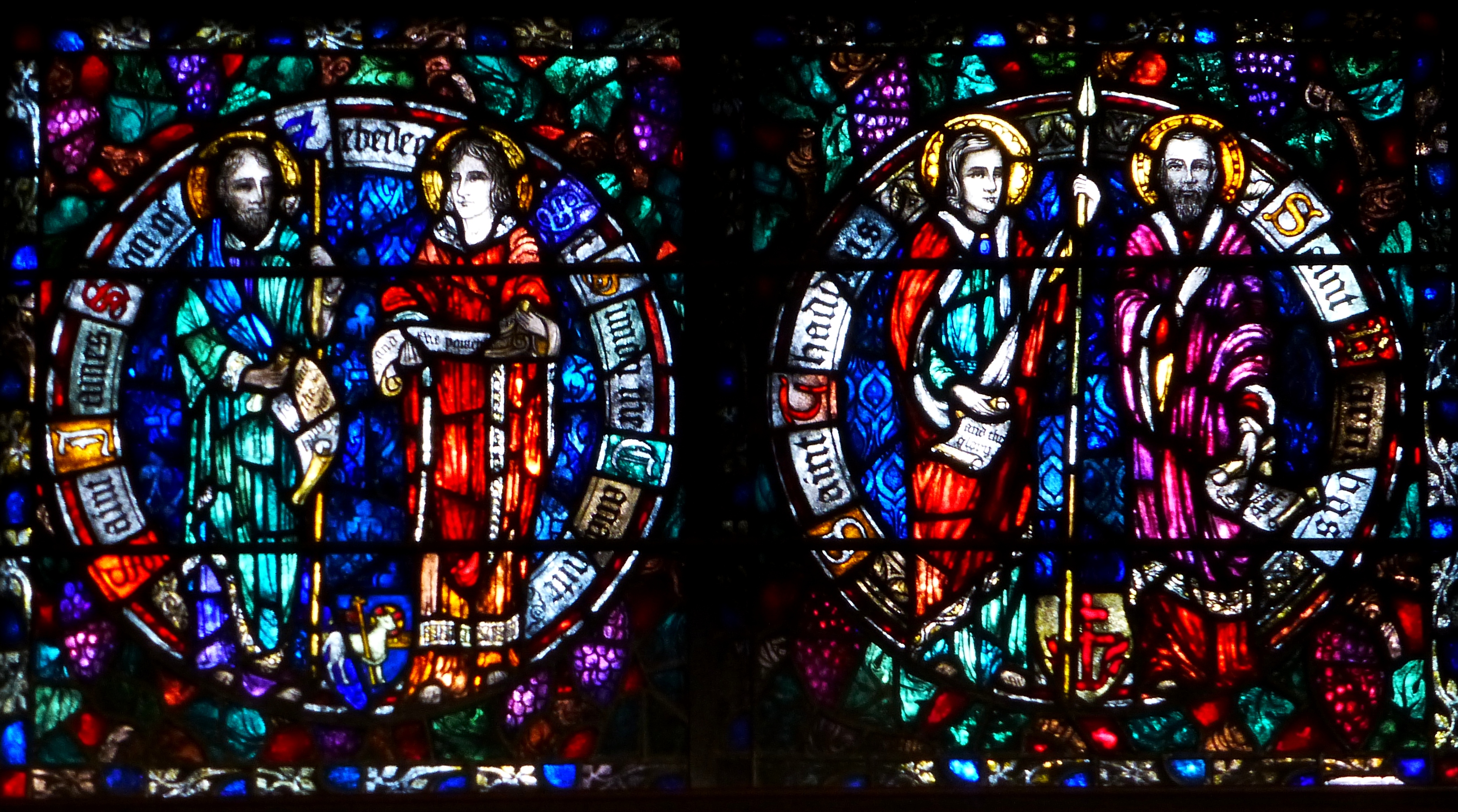
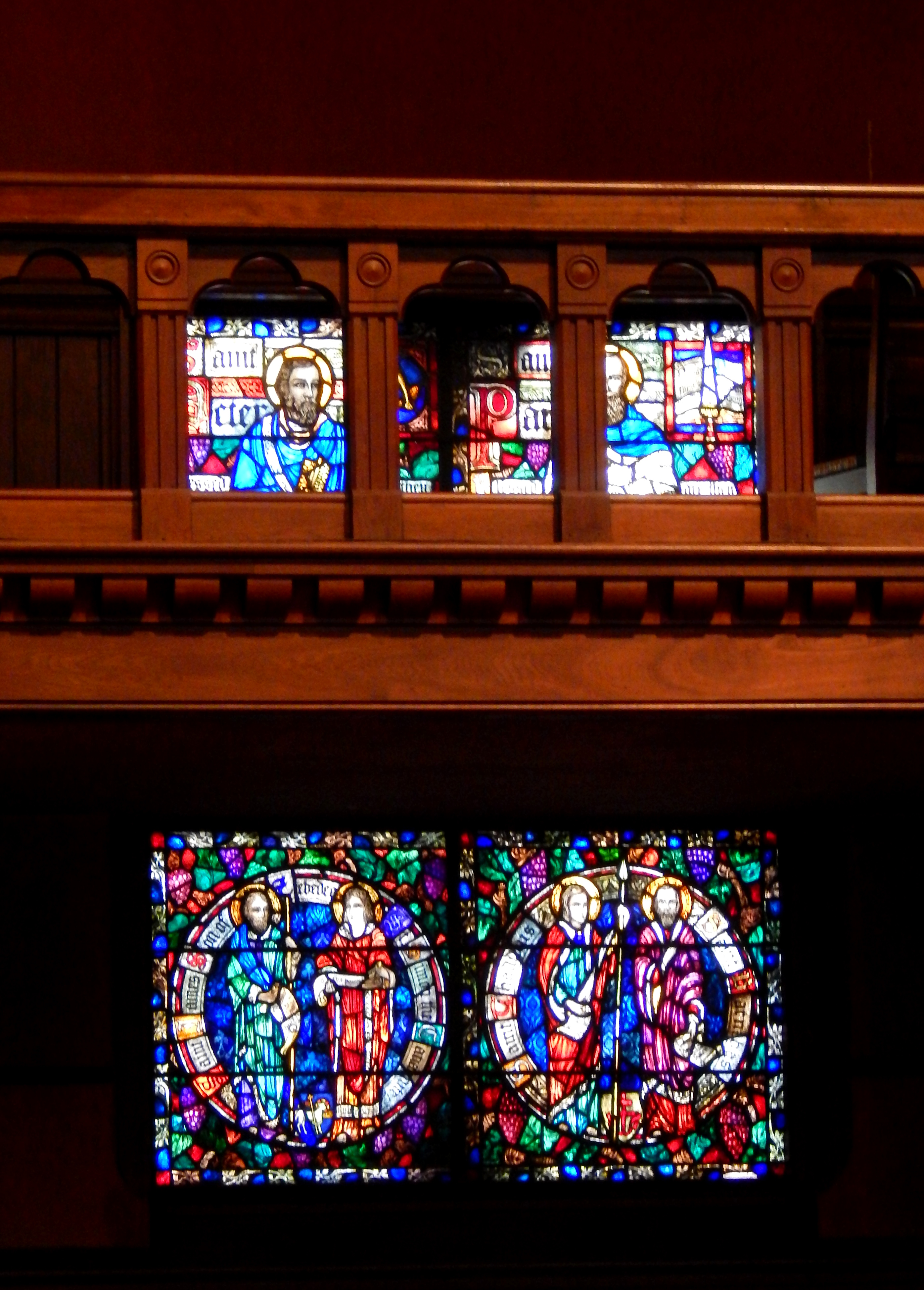
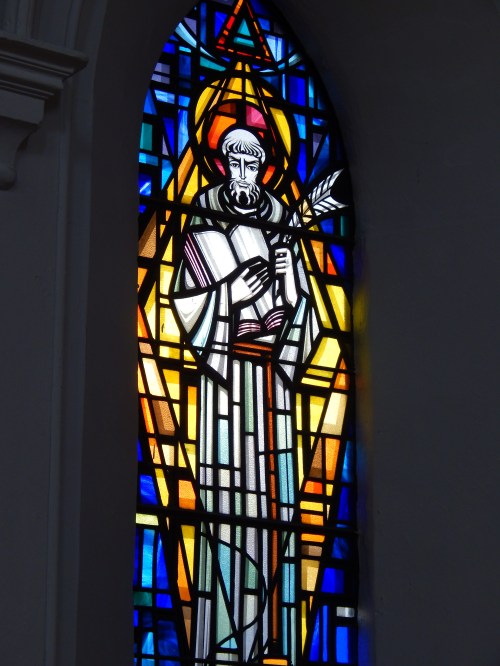
There is a person dear in my life who on occasion drives me crazy because he is compulsively compelled to help other people. As he likes to say, why else were we put here on this earth? A man of deep faith, his favorite saint is James.  I told him to tell me about James.  He shrugged and said, what more is there to say than what is faith without good works.  Indeed.  😉 This image of Saint James is one of two Saint James’s appearing in the the stained glass window designed by Margaret Redmond of Boston (1867-1948).  As you enter the sanctuary of Trinity Church in Copley Square, the windows are located to the left toward the north transept.  In the map one receives when engaged in a tour, the windows are labeled as Eight Apostles (1927).  In fact, all twelve apostles are represented, but only eight are most easily seen from the floor of the church, depicted in sets of four.

These eight apostles are James of Alphaeus, Matthias, Thomas, Bartholomew, James of Zebedee, Simon the Canaanite, Thaddeus and Simon Barnabus.

The other apostles — Andrew, Phillip, Peter and Paul — are paired above each set of four apostles.

A causeway not accessible by the public except during special events obscures their view …

… but assorted postcards and prints capturing their details are available in Trinity’s Book Shop.

What I enjoy about these windows is the explosion of colors.  Regardless of time of day or even season, there is always some new detail to discover.  For many reasons, they are an inspiring sight.

As the spring progresses, I hope to learn more about the artist Margaret Redmond, her life and her work.  As I do, I’ll be sure to share stories. Take care.

Read Full Post »

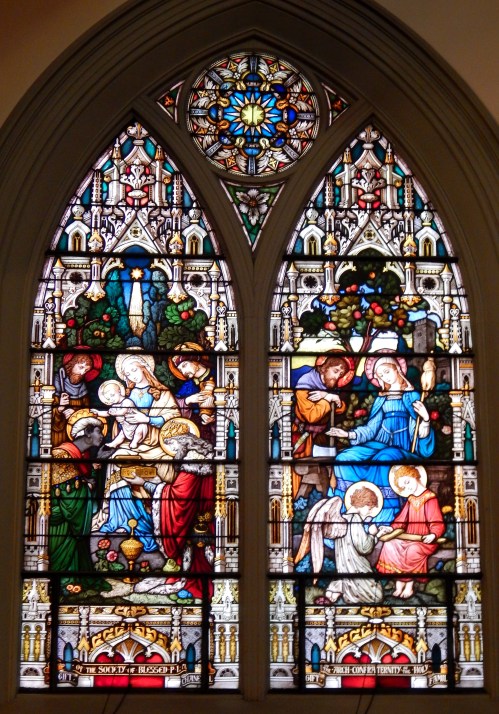
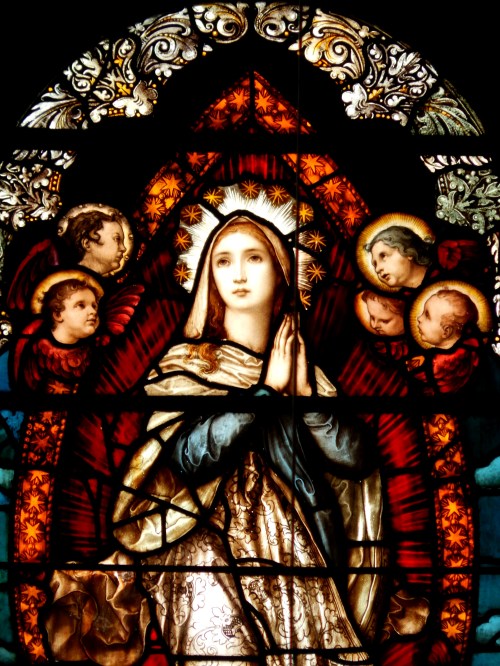
I was racing around the Back Bay of Boston and decided at some point that I needed to rest for a bit and so I stepped inside of the Old South Church at the corner of Boylston and Dartmouth Streets.  There were so many people sitting quietly that I decided that perhaps I should too (especially given the weight of my backpack).  And so I sat and focused my camera mostly on one window.  A large window above the chancel said to illustrate the announcement of the birth of Jesus to the shepherds.  Designed and produced by Clayton & Bell of London and installed in 1875.

Learn more about Old South Church, its history and current activities, via this link.

Read Full Post »

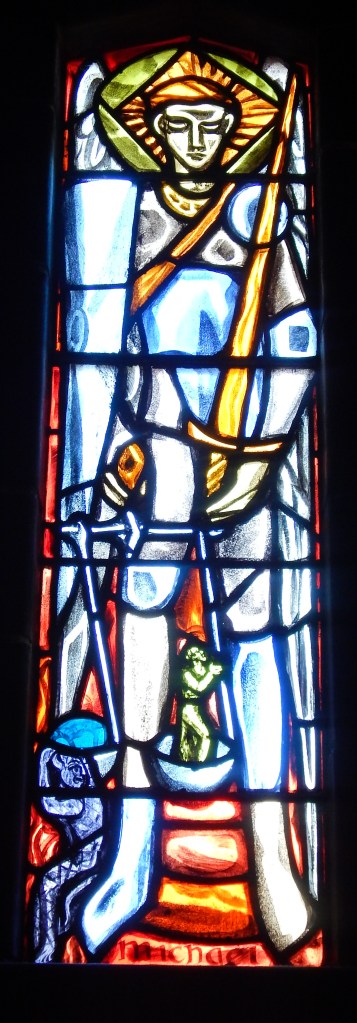
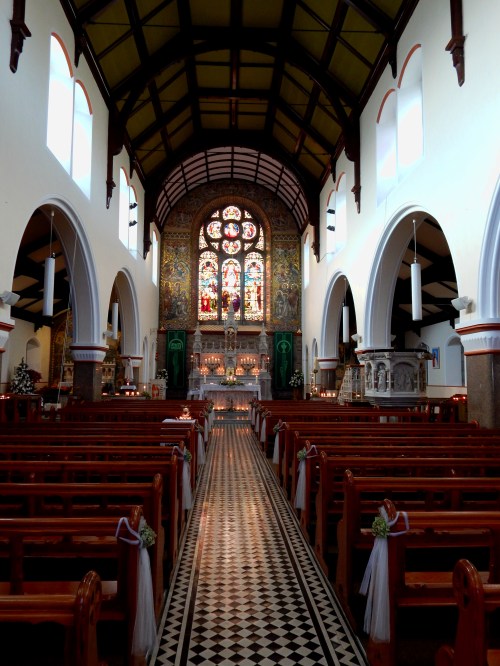
Of all the buildings that I was able to step into in Galway, I was able to spend the most time at the Galway Cathedral.  Dedicated on August 15, 1965 by Cardinal Cushing of Boston, it is noted as the youngest of Europe’s stone cathedrals.  Its art and architecture reflect many different styles and periods from Byzantine to Gothic to Romanesque.

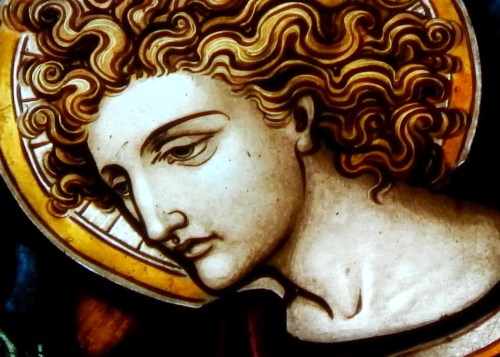
Detail from St. Michael, by Patrick Pollen of Dublin

Detail from St. Michael, by Patrick Pollen of Dublin

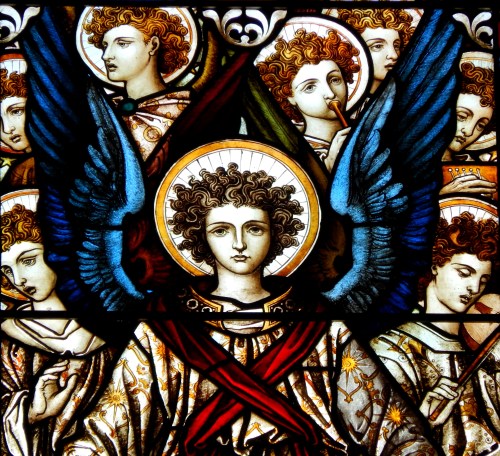
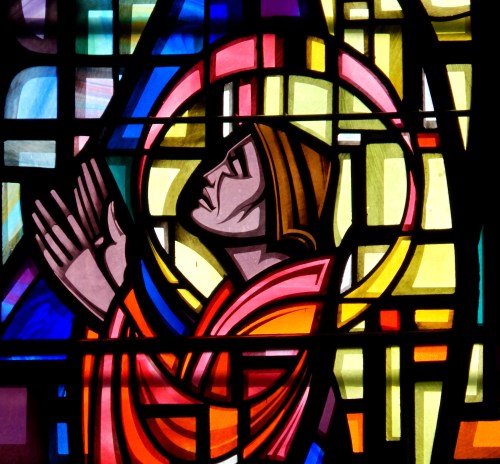
Online, there are many images of the exterior.  My camera tended to focus on the variety of stained glass windows, mosaics and carvings on the interior walls.  In addition to learning the larger story of the building’s creation, it has been a pleasure to research and learn about the individual artists, like Patrick Pollen, who dedicated so many years of their lives to producing artwork for this cathedral.

Detail from St. Gabriel, by Patrick Pollen of Dublin

Detail from St. Gabriel, by Patrick Pollen of Dublin

It will take me a while to sort through the images and continue my research.  There are always stories to discover! Until I pull together my words and images about this beautiful structure, here are few images to peruse.

Read Full Post »

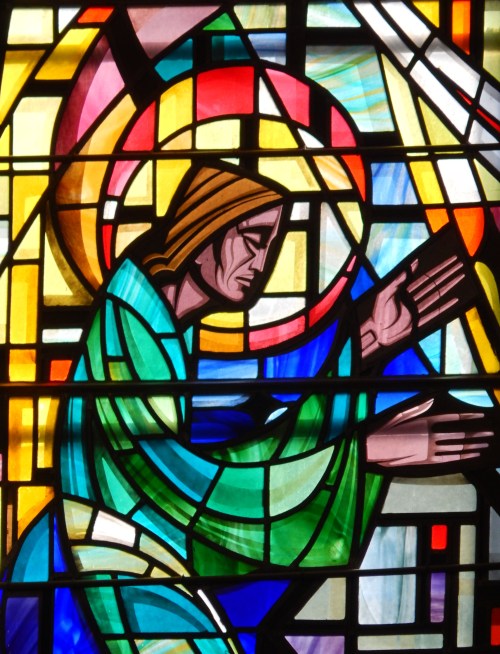
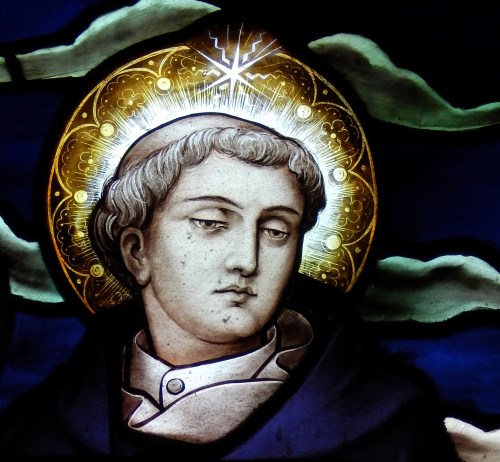
As I’ve written about before, one of the great pleasures for me of stepping into a church is to see the wide variety of artistic expression through stained glass.  Such is certainly the case with a quick visit to St. Augustine’s, a Gothic church in Galway completed in 1859.

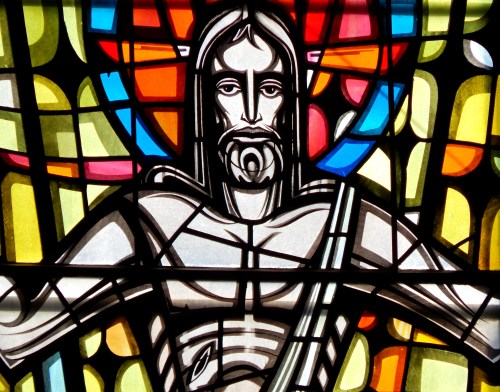
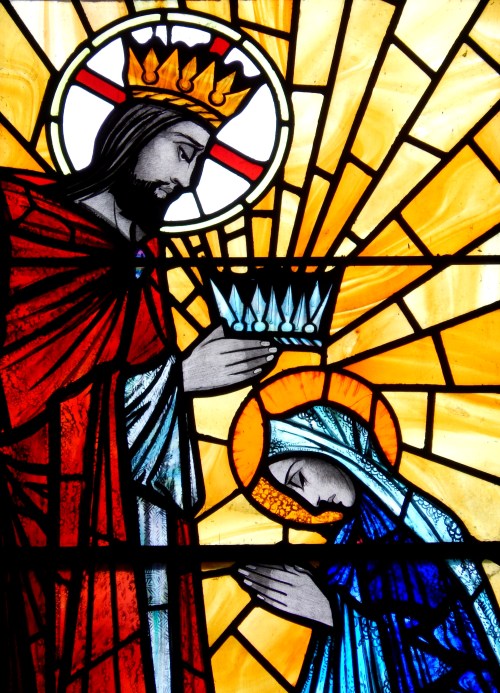
Apparently during renovations in the 1970s, the original window over the main altar was replaced by a new window depicting the Resurrection. The artist is George W. Walsh.You can read a bit more about Mr. Walsh via this link. His father, with whom he apprenticed for several years, was a pupil of stained glass artist and illustrator Harry Clarke.

While no one seemed to mind me meandering about with my camera, I focused mostly on that window above the altar with its many lovely parts making an incredibly beautiful whole.

The other window that caught my attention happened to be a depiction of St. Augustine himself.  Later I discovered that Mr. Walsh also composed and completed that window.

It was a bit rainy that day so I did not take many exterior shots, but via this link you can view the building.  On this webpage, you can read just a bit more about the history of the Augustinians in Galway and more about the construction of this particular building.


Read Full Post »

I’ve been on a bit of whirlwind travel for work and pleasure. In addition to spending time among swans, I managed to step into a few churches along the way.  Here’s a bit of the beauty to be found at the Priory of St. Mary’s, The Claddagh, Galway, Ireland.  I hope I have the opportunity to return one day.

Read Full Post »

Lazarus and the Rich Man by Gustave Dore

Lazarus and the Rich Man by Gustave Dore

“No individual can live alone, no nation can live alone, and anyone who feels that he can live alone is sleeping through a revolution. The world in which we live is geographically one. The challenge that we face today is to make it one in terms of brotherhood. … Through our scientific and technological genius, we have made of this world a neighborhood and yet we have not had the ethical commitment to make of it a brotherhood. But somehow, and in some way, we have got to do this. We must all learn to live together as brothers or we will all perish together as fools.”

Words spoken not today but nearly fifty years ago by Dr. Martin Luther King Jr during  this talk at the National Cathedral in Washington, DC on March 31, 1968.  In this day and age of soundbites and tweets, it might be a challenge to read in entirety but I hope you have the opportunity to do so.  I chanced upon it while researching Dives and Lazarus.  I was curious about the parable that inspired one of my favorite pieces of music.

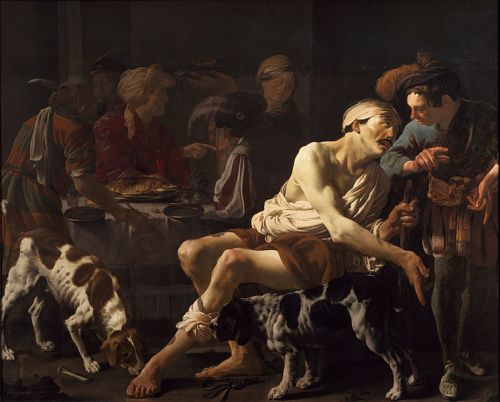
Five Variants of Dives and Lazarus by Ralph Vaughn Williams I play to help me unlock a part of my brain when I am stuck on a writing project.  The music moved me long before I truly understood the story at its core.  A friend explained the story of the rich man, Dives, and the poor man, Lazarus, a parable appearing in the Gospel of Luke.  He recently summed it up as a story of inequality and early trickle down economics.

The Rich Man and the Poor Lazarus by Hendrick ter Brugghen, 1625

The Rich Man and the Poor Lazarus by Hendrick ter Brugghen, 1625

I was curious who else may have used or been inspired by such a perspective of that parable.  Thus, I found Dr. King’s talk from 1968.  During the talk, of Dives and Lazarus he wrote:

“… Because our expressways carry us from the ghetto, we don’t see the poor. … Jesus told a parable one day, and he reminded us that a man went to hell because he didn’t see the poor. His name was Dives. He was a rich man. And there was a man by the name of Lazarus who was a poor man, but not only was he poor, he was sick. Sores were all over his body, and he was so weak that he could hardly move. But he managed to get to the gate of Dives every day, wanting just to have the crumbs that would fall from his table. And Dives did nothing about it. And the parable ends saying, “Dives went to hell, and there were a fixed gulf now between Lazarus and Dives.”

There is nothing in that parable that said Dives went to hell because he was rich. Jesus never made a universal indictment against all wealth. …  Dives didn’t realize that his wealth was his opportunity. It was his opportunity to bridge the gulf that separated him from his brother Lazarus. Dives went to hell because he was passed by Lazarus every day and he never really saw him. He went to hell because he allowed his brother to become invisible. …”

Lazarus and the Rich Man by Fyodor Bronnikov

Lazarus and the Rich Man by Fyodor Bronnikov

Regardless of one’s religious beliefs, throughout the talk there is a sad timelessness to King’s words about racism, injustice, economic inequality, and silence.  But there is also a beautiful timelessness about the power and potential of people to make a difference. Near the end of his talk, he says:

“There is nothing new about poverty. What is new is that we now have the techniques and the resources to get rid of poverty. The real question is whether we have the will.  In a few weeks some of us are coming to Washington to see if the will is still alive or if it is alive in this nation. We are coming to Washington in a Poor People’s Campaign. Yes, we are going to bring the tired, the poor, the huddled masses. We are going to bring those who have known long years of hurt and neglect.  … We are not coming to engage in any histrionic gesture. We are not coming to tear up Washington. We are coming to demand that the government address itself to the problem of poverty. … We are coming to ask America to be true to the huge promissory note that it signed years ago. And we are coming to engage in dramatic nonviolent action, to call attention to the gulf between promise and fulfillment; to make the invisible visible.”


 Sources/Additional Reading

Rich Man and Lazarus

Remaining Awake Through a Great Revolution by Martin Luther King Jr, 1968

More on the March on Washington for Jobs and Freedom 1968

More about Ralph Vaughn Williams and his composition

Five Variants of Dives and Lazarus on Youtube


Read Full Post »

I have thought of my father much this weekend, and mostly when I do, I smile.  I am sure that he would shake his head and possibly chuckle at the new bucket of potatoes I have growing in the hallway.  The stems are thick and the leaves a dark, vibrant green in the morning light.  Planting that bucket was a moment of wonderful calm.  I will always associate the joys of gardening with my father who found his calm in that way. I think he used to find his calm on the water too.  In the garden or on the water, I think one thing he modeled for me was how to take a deep breath and keep moving forward even into the unknown.  Maybe that’s why I thought of him as I read a passage from a sermon about Shores of Light.

“There are people even in this troubled and confused world who are continually like plants reaching upward toward the shores of light.  When those shores are completely hidden from our sight by mist and fog, when we can see nothing but this present world from which time sweeps us away with almost no consideration at all, we look at them and we say, The shores of light must still be there.”  — Theodore P. Ferris


Read Full Post »

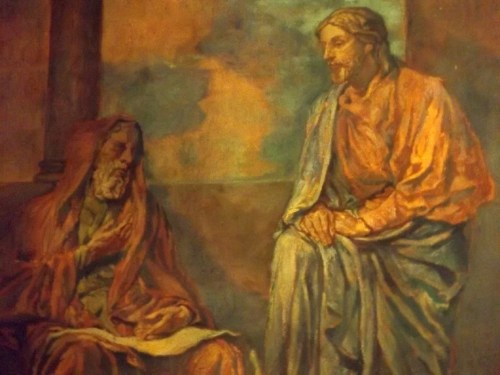
In The Art and Thought of John La Farge, author Katie Kresser writes that John La Farge (1835-1910) completed his first sketch of Nicodemus and Christ in 1874.  That biblical encounter is a subject that La Farge would depict in several different forms over time.  Here is a sketch dated 1877 in the Yale University Art Gallery, and here is an oil painting completed in 1880, now housed at the Smithsonian.  He would also create a stained glass window for the Church of the Ascension in New York.  The following image, The Visit of Nicodemus to Christ, is a photograph of the mural La Farge painted on the walls of Trinity Church in Boston.

The Visit of Nicodemus to Christ, mural by John La Farge

The Visit of Nicodemus to Christ, mural by John La Farge, 1878

It is one of several murals that La Farge painted inside the building with the aid of assistants like Augustus Saint-Gaudens, Francis D. Millet and Francis Lathrop.  I keep photographing them because I think that there is always something new to see and experience.

In the literature of the time period critiquing his work, there is often reference to La Farge’s use of color in the murals that borders on the poetic.  For example, “In his “Christ and Nicodemus,” … we find the color quality strongly dominant. … the rich blues vein the draperies and background like the threads in a Flemish tapestry …” (The Churchman newspaper, July 6, 1901).

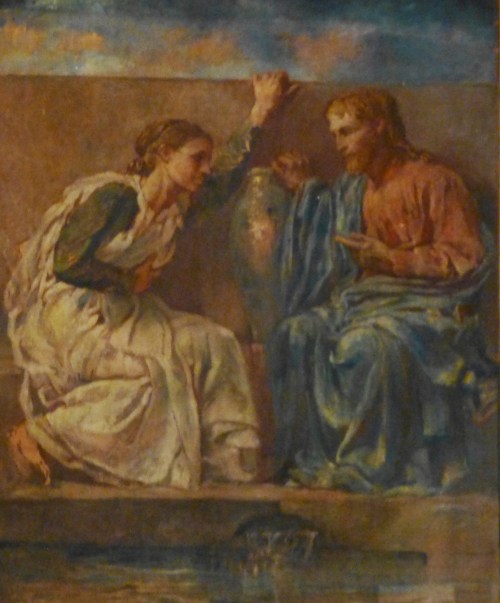
Christ Woman at Well, mural in Trinity Church by John La Farge

Christ Woman at Well, mural by John La Farge, 1877

The beauty of La Farge’s murals is constant but their colors do shift in the light.  Different details become present depending upon where one stands and at what time of day.

David, mural by John La Farge

David, mural by John La Farge, 1877

My favorite is perhaps the painting of David, because of the colors and especially for the expression on the young man’s face.

I had originally titled this post “in his own words” because I came across John La Farge: A Memoir and a Study compiled by Roy Cortissoz, literary and art critic for the New York Tribune, and La Farge’s friend.  In the book, completed in 1911 shortly after La Farge’s death in 1910, La Farge reminisces about what it was like painting the murals at Trinity under tight time constraints, in poor health, up high on scaffolding.  Reading the words made me appreciate the skills of all the artists even more.  If you’d like to read La Farge’ account, begin at the end of page 31 of the book, available online here.

Learn how you can see these murals and other architectural and design features at Trinity Church first hand here. Postcards of some of these images available via The Shop.

Read Full Post »

« Newer Posts - Older Posts »