Feeds:
Posts
Comments

Posts Tagged ‘storytelling’

Prior to my meeting with artist Cedric Harper I had emailed him a list of questions including a query about his sculpture, The Book of Truth. When we later met in a coffee shop, I noticed in his hands two pieces of paper. One was clearly the list of questions. The other I could not identify. A short slip with handwritten script. It didn’t matter. We began talking and what a wonder that was. Read more here.  But as I started to rise that day, thinking our conversation done, he stopped me. “Cynthia, ” he said with a smile.  “You haven’t asked me yet.  You haven’t asked me about the Book of Truth. Not everybody notices that one.”

book of truth sculpture by cedric harper, image courtesy of the artist

image courtesy of the artist

I told him that I had been struck by his use of color, the creaminess of the red, the smooth white upon the branches of the trees. Most of all I was made curious by the concept.  “What’s in that book?” I asked him.  As we began to talk about this book, our conversation ended where it had began, with family.

In Kansas, he’d grown up in a family with a strong oral tradition.  Stories were told often and life lessons emphasized. Those words of wisdom heard as a child and words of wisdom collected throughout adult life infuse his book of truth.

He worked on that sculpture for quite a while.  As he so frankly shared in the previous post, when his lover died in 1994, that was a pivotal moment in his life.  “I was lost. It took 15-18 years to feel like, to know that, I had a future. Part of gaining that future was creating this box of truths, of memories and experiences lived.” He handed me the slip of paper.

We may all have our book of truth. Those words and experiences garnered throughout our lives that guide us in how we try to live each day.  I appreciate the fact that Cedric Harper was moved to turn his book into sculpture. Here are some of his truths he chooses to share:

  1. Love is the escape from everything, an abyss of mind, body and soul.
  2. Every time one experiences a lapse in common sense the result makes them start over.
  3. Faith is to believe in things that we do not see and the reward of this faith is to see in what we believe.
  4. People should fall in love with their eyes closed. Just close your eyes. Don’t look … A. Warhol
  5. If you want to know your past life, look into your present condition. If you want to know your future, look into your present action. Padmasambhava
  6. Free from desire, you realize the mystery. Caught in desire, you only see the manifestations … Lao-Tsu
  7. Power is a drink that few can refuse …
  8. There is a quake that rips the soul asunder. It is the pain of remembering.

Cedric Harper Website

Read Full Post »

Recently I was walking through the reference section of the Boston Public Library in Copley Square. Though I had a specific destination, probably trying to find a book on stained glass, my eyes kept raking the shelves and a book title made me pause. I pulled the book from the shelf, randomly flipped it open and began to read.

Willis Cofer, seventy-eight years old, a former slave in Georgia, was recounting his memories of how the cook fed the slave children.  They were fed all the time, he said, feeding them bread and milk for breakfast, mostly peas and cornbread for dinner, and then milk and bread for supper.  There were so many children on the plantation that “dey fed us in a trough. Dey jes’ poured de peas on the de chunks of cornbread what dey had crumbled in de trough, and us had to mussel ’em out.  Yessum, I said mussel.  De only spoons us had wuz mussel shells what us got out of de branches.

Strangely enough I had been pondering what to do with my growing collection of mussel shells. I often pick them up when I’m walking along Revere Beach. Sometimes I keep a few shells if we cook some up for dinner.  They have always been a treat. I’d never thought of them as a necessary utensil.  Just like I’d never thought of children being fed in a trough, like the rest of the farm stock.

The book I’d picked up was called Slave Culture, a 2014 series of books that present excerpts from slave narratives.  The narratives were collected starting in 1935.  It was at that time that the Federal Writers’ Project, one of Franklin Roosevelt’s New Deal programs, was established. The program provided jobs for unemployed writers, researchers, historians and others.  One of those jobs included interviewing more than 2000 former slaves across seventeen states like Willis Cofer.

Sometimes the stories captured were kept in the vernacular, like Willis Cofer’s childhood memories and those of Adeline Cunningham, 85, of Texas.  She shared, “Dey feds us well sometimes, if dey warn’t mad at us.  Dey has a big trough jes’ like de trough for de pigs and dey has a big gourd and dey totes de gourd full of milk and dey breaks de bread in de milk. Den my mammy takes a gourd and fills it and give it to us chillun.  How’s we eat it? We had oyster shells for spoons and de slaves come in from de fields and dey hands is all dirty, and dey is hungry. Dey dips de dirty hands right in de trough and we can’t eat none of it.”

Sallie Crane, at least 90 years old when interviewed in Arkansas, remembered eating out of a trough “with a wooden spoon, mush and milk. Cedar trough and long-handled cedar spoons.” Her owner’s children would taunt the slave children with their leftover school lunches, “Hold it out and snatch it back! Finally, they’d give it us, after they got tired of playing.

Other narratives were “cleaned up” by the interviewer or the former slave had received an education dependent upon the whims of his or her previous owners. Mary Anderson of North Carolina recalled in her 1937 interview:

The narratives are in the public domain. They can be found on the Library of Congress website. Universities in many states, especially in the southern states, have made them available in their libraries and online. So why read them? Institutionalized slavery in the U.S. was ended over 150 years ago. People of all shades fought and died to see passage of the Civil Rights Act of 1964 to end segregration and discrimination.  Why revisit the past?

Well, at one point, I believe that there were six million people enslaved in this country and many of those people had been enslaved over successive generations. To oversimplify, they were purposefully denigrated, treated like animals, and considered less than human. They were bred, fed and fattened to be sold and purposefully kept uneducated to dampen any dreams of a different life. And some of the people who suffered were my ancestors, and I’m fairly sure that some of the people cracking literal and figurative whips were my ancestors too. All of that history forms the foundation of this country. The seeds of fear, hate, discrimination that were planted so long ago have not disappeared.  They can too easily sprout again and in some places they clearly have.

I’d say revisit the slave narratives as a way to get a sense of what happened, the impressions made upon a people and upon a country, and to then reflect upon what has changed and what has not.  I was moved by Willie Cofer’s words to consider something I’ve never done before, to create an art installation.  I wanted to … and perhaps I will do it … to find a cedar trunk and carve it into a rough-hewn trough. To place nearby a tree and from its bare branches hang mussel shells. To fill the trough with milk and torn up pieces of bread and peas. I did find a little wooden box and one of my mussel shells and a wooden spoon. I poured in some milk and sprinkled in some corn meal.  I would do a little photo shoot, you see.  It was only when I tore up the bread and tossed it into the box that I began to cry.

Read Full Post »

My brother described a scene that I wish someone would paint.

He lives in Virginia, not in a rural place, but not an urban megalopolis either. A plain old city with a crumbling downtown and further out global firms building plants, and the accompanying fancy housing for their management, on lands that used to be working farms, if not outright plantations if you go back far enough.

It’s a city near the river and crisscrossed by highways but in the beginning it was the railroads that allowed this city to make its fortune, bridging north and south, a passage way for goods of all sorts.

It was on a literal bridge that the incident took place.

My brother was driving home on a nice new road. He was recounting stories of his day to me when he said, “Oh my God. You won’t believe …” I reacted thinking at first he was seeing a roadside accident. He calmed me down and then explained, “Overhead, the bridge that crosses the road, there are deer passing by in the night. They are walking on the railroad tracks on the bridge overhead fading in and out of the mist.”

A number of people pulled off the road to watch, like my brother, hoping no train would come before the animals could walk into the surrounding fields and woods. Nothing happened. Just the lingering memories of a beautiful sight.


Read Full Post »

Richard Lonsdale Brown was born in 1892 in Evanston, Illinois. When less than a year old, his parents moved to West Virginia. There he attended public school and then trained as a sign painter. After finishing trade school, he remained in West Virginia for five years, “and then being a journeyman sign painter I traveled through the mining districts of the state … My journeys took me almost altogether through the mountains where, when God made them, He placed scenery the equal of which, I think, cannot be found in all America.”
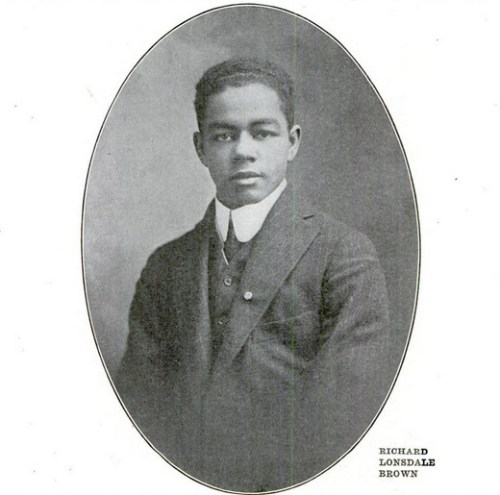
Richard Lonsdale Brown, 1912

“It was there I believe that my love for landscape painting was awakened. When not painting signs I was doing what I could to reproduce the scenery of the mountains and valleys, the rivers and the streams on canvas.” Brown shared those words in a 1913 article that appeared in the New York Sun.
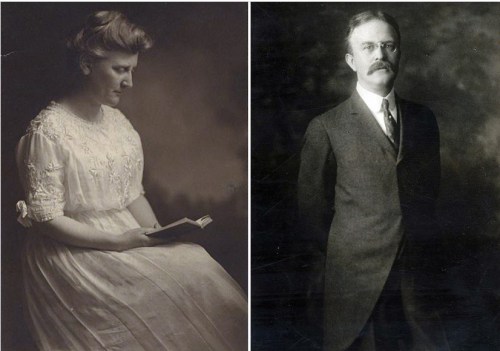
Mary White Ovington and Oswald Garrison Villard, circa 1910-1920

Mary White Ovington and Oswald Garrison Villard, circa 1910-1920

Mary White Ovington (1865-1951), co-founder of the National Association for the Advancement of Colored People, remembered first learning of Richard Lonsdale Brown in 1910.  In her memoirs, she recounts it was during a meeting with Oswald Garrison Villard (1872-1949).”In 1910, when Mr. Villard and I were working in the newly organized NAACP, he gave me a letter from the artist George de Forest Brush, asking me if I would take up the business mentioned in it. It told of a young colored artist, Richard Brown, from Charleston, West Virginia, who had recently come to New York with some excellent sketches.”
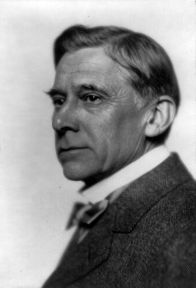
George De Forest Brush

George De Forest Brush

“I called upon Mr. Brush in his picturesque studio on MacDougall Alley and saw his pictures. They were lovely things, trees and melting skies, alive in form and color. Mr. Brush was deeply impressed with them.  ‘He is no more than a boy,’he said, ‘and he came into my studio, shy, discouraged. He had brought his sketches under his arm to New York, and when not in one of our great galleries was spending his time trying to sell them. No one wanted even to look at them. He was poor; he was colored. Could one have greater handicaps?’ Mr. Brush welcomed him to his studio and looked with interest and appreciation at his work. ‘Can I ever be an artist?’ Richard asked when had shown all he had. The answer was, ‘You are an artist.'”

Brown would exhibit his work in the Ovington Brothers Gallery in New York, March 18-23, 1912.  It would showcase paintings done in West Virginia before he was 18 years old and in the hills of New Hampshire while under the tutelage of Mr. Brush. Mary Maclean, a writer with the New York Times wrote a profile of the young artist for the newspaper. The article appeared in March, just before the exhibit, helping to make it a great success.

It was estimated that 2,500 people attended. Twenty-six pictures were for sale and sixteen were sold including little sky sketches. The young man charmed people with his demeanor as well as the quality of his work. Collectors who reportedly purchased his work included Jacob H. Schiff, Edward Warburg, Mr. Coster, and celebrity Miss Mary Garden.

Art Critic Joseph Edgar Chamberlin quoted in the New York Age, March 1912

Maclean’s profile would also be printed in the April 1912 issue of the NAACP’s The Crisis Magazine for which Richard Lonsdale Brown produced the cover.

Cover Art by Richard Lonsdale Brown

Ovington remembered, “Crowds came and he had many purchasers. The prices for most of the pictures were high, and so Richard would paint little cloud sketches in the evening and sell them the next day. He made over a thousand dollars. We all hoped he would use it for study; I had plans for Paris but the money went where his affections dictated. He spent it on a sister, who he used to tell me, was more talented than he, in a vain attempt to cure her of what proved to be an incurable disease.”
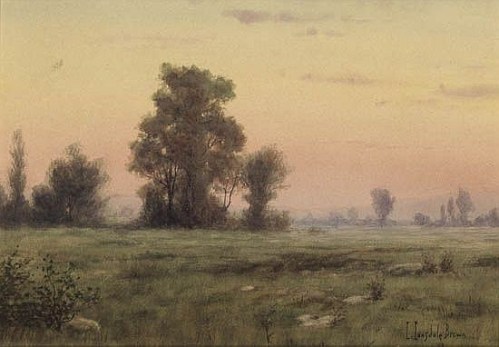
by Richard Lonson Brown

by Richard Lonsdale Brown

White and black publications of the period described him as “the rising young artist.” Instead of Paris, Brown would study in Boston, living at the Robert Gould Shaw House. Ovington remembers him producing posters for W. E. B. Du Bois’s Pageant. He exhibited in private homes. He would eventually travel down South. Before he left, he would confide to Ovington that he could not paint as he used to. He’d begun painting landscapes but was now intrigued by figures. As he studied those figures he was discouraged at how society beat them down. He was excited by what was happening in Harlem and hoped to be a part of it. “Not that I have forgotten what I want to do most of all, ” he would tell her. “Someday, when I am the artist I hope to be, I want to return and paint those West Virginia hills.”

Mt. Monadnock, originally purchased by Jacob H. Schiff

While it is unclear if he returned to those West Virginia hills, he would not be part of what became known as the Harlem Renaissance, nor would Ovington see him again after that last encounter. In 1915, he would exhibit his work in the Washington, DC home of Mrs. Carrie W. Clifford.  He died September 23, 1917. Posted in the March 1918 issue of The Crisis was the following passage: “The parents of the late Richard Lonsdale Brown write us that they are living in Muskogee, Okla, and that the young artist died at their home and under their care.”
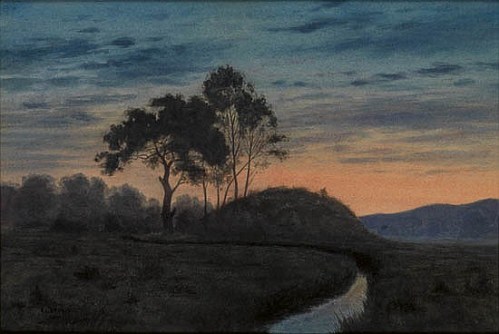
by Richard Lonson Brown

A Bend in the Stream, originally purchased by Albert Andriesse

While it appears that the three paintings above and the 1912 Crisis cover are his only surviving work, clearly he produced many other sketches and paintings during his brief lifetime. So perhaps somewhere out there are Brown’s little cloud sketches, scenes of melting skies and his West Virginia mountains.


Sources and Additional Readings

Negro Youth Amazes Artists By His Talent, New York Times, March 1912

Richard Lonsdale Brown Biography by the Indiana Illustrators and Cartoonists

Black and White Sat Down Together: The Reminiscences of an NAACP Founder (pp. 75-76)

Detailed descriptions of his three known paintings

Read Full Post »

At night, in the winter times, ice forms on the interior of the windows where I live, depending on location of the window, thickness of the glass and so on. By morning, between the household heat cycling on and the heat of the rising sun, the ice melts quickly and forms these interesting patterns. I have learned to grab my camera and walk briskly from window to window knowing I have only a few moments to “see” something before the waters dissipate.  This morning in one room …

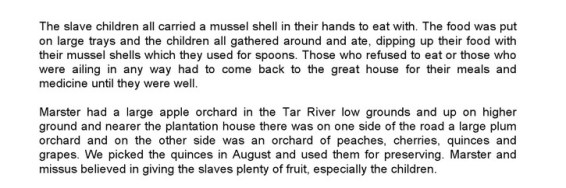
I saw the silhouette of water drops on the sheer white curtain.

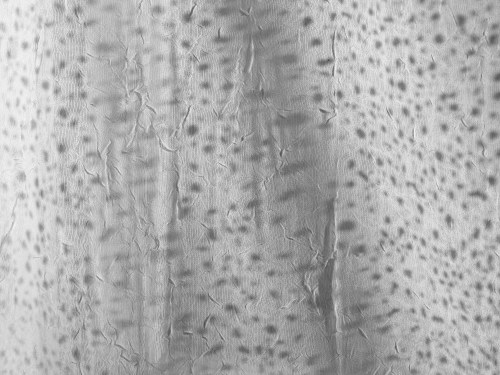
And then I pulled aside the curtain to see the drops themselves and also saw the reflection of the curtain in the glass.  In the hallway there was a tree …

at least that’s how I thought of it because the pattern reminded me of this tree I’d seen recently in Harvard Square.

And in the kitchen …

quite the landscape there had formed on the glass.

But now the temperatures have risen and all this beauty is now gone, at least until tomorrow.

Read Full Post »
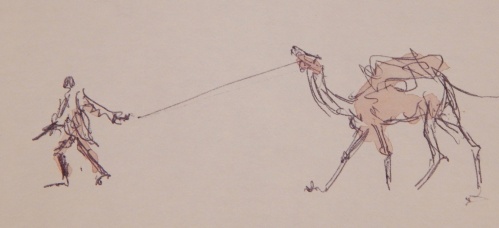
This too is a story about gifts.

watercolor by ludwig a. joutz

Ludwig Aloysius Joutz (1910 – 1998) was an architect noted for his work with religious and educational institutions primarily in the Washington, DC area.  I learned of this gentleman while researching Joseph Anthony Horne as part of my Interlude Series.

By the time Horne meets Joutz, Joutz had already earned his doctorate. His 1936 thesis is still referenced with regard to medieval church architecture.  In 1939/40 he was awarded a travel grant from the German Archaeological Institute but was perhaps unable to use it because of the outbreak of World War II.   He would be drafted into the German army and become a prisoner of war.

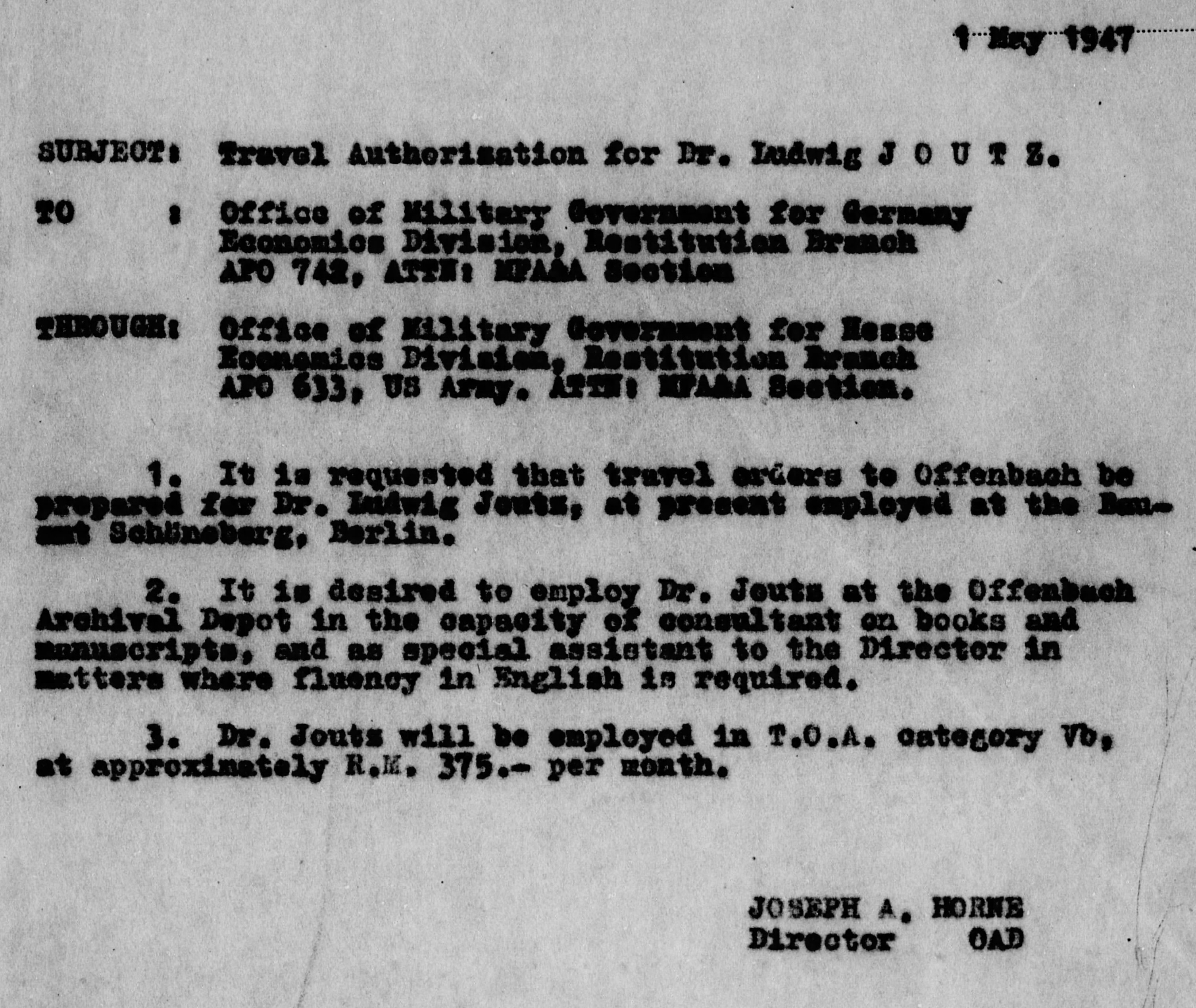
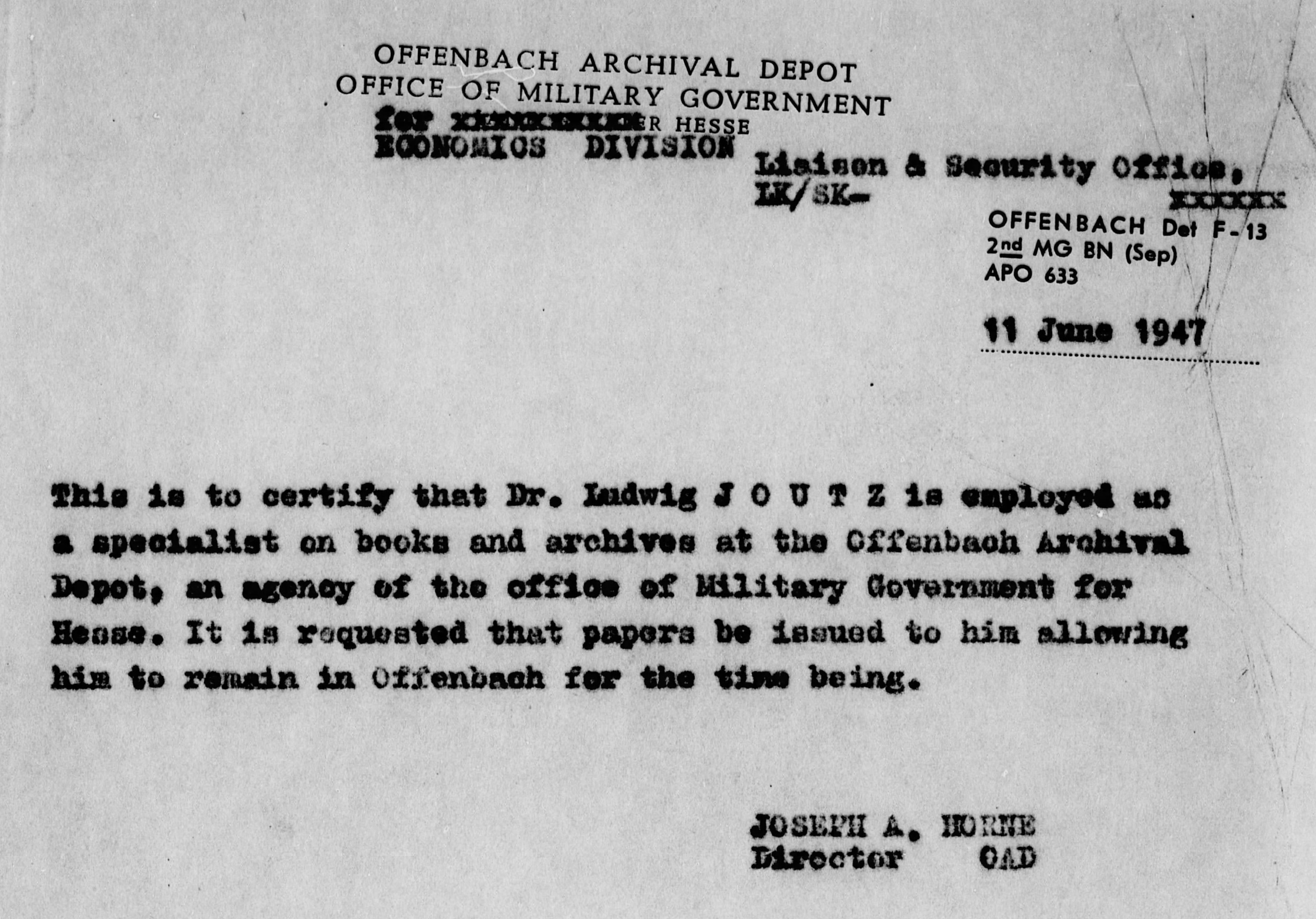
Exactly how he and Horne originally met is unclear.  It might have been as early as the Invasion of Italy where Joutz was captured but certainly by the end of the war they were fast friends.  The earliest document that I’ve been able to find so far is dated May 1947.  In that year, Horne was working with the Monuments, Fine Arts & Archives unit.

As the Monuments Men continued their efforts to find, catalog and restitute items looted by the Nazis and others during the war, Joutz would become a valuable resource.  German-born, he was fluent in English and several other languages and knowledgeable about the art and literary worlds. Horne, American-born and fluent in German thanks to his immigrant parents, was culturally sensitive and knowledgeable about the arts. They apparently worked well as a team.

LJConfirmation

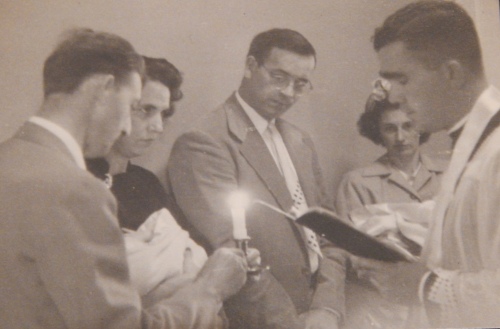
Between June 1, 1947 and March 1948, Joutz would serve as an operations specialist on books and archives at the Offenbach Archival Depot.  During that period, he and Horne, by then director of the Depot, would become great friends. Horne would aid Joutz in resettling in the U.S. where he would establish himself as architect. They would become godparents to each other’s children and remain friends until the end of their days.

familyceremony

joseph and elsie horne and ludwig and lucy joutz

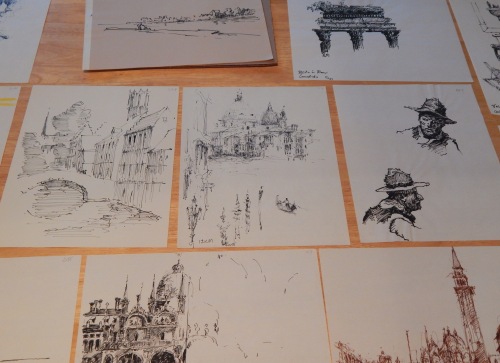
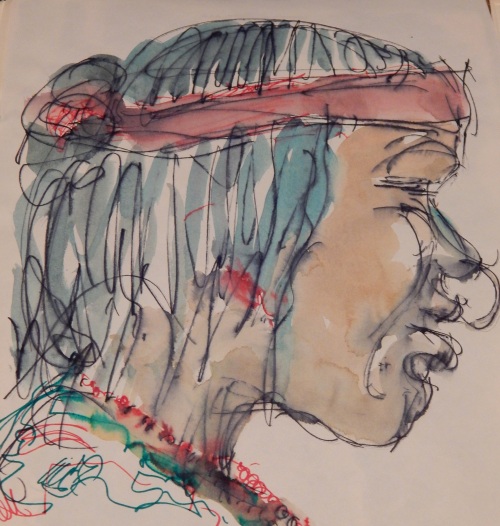
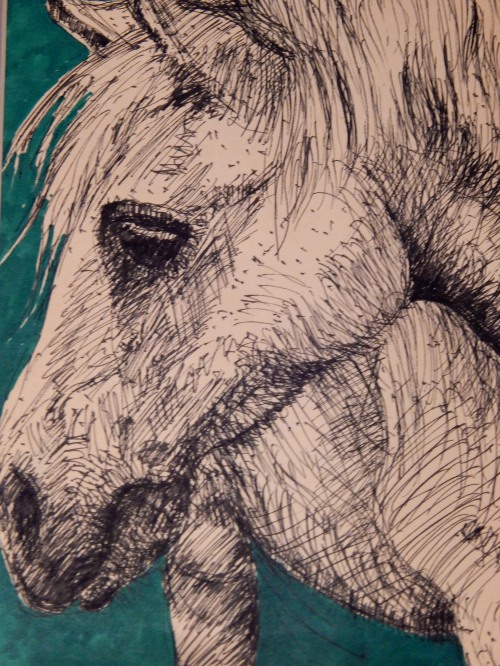
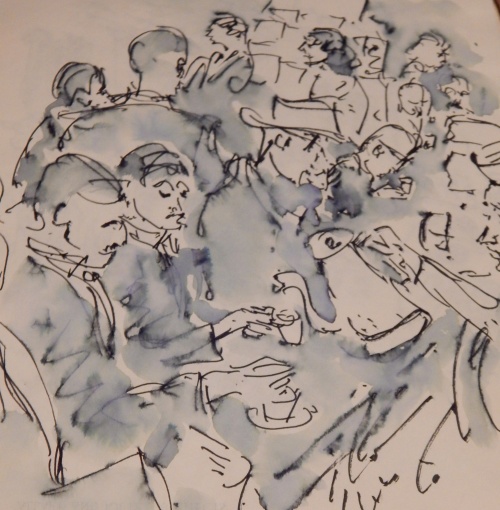
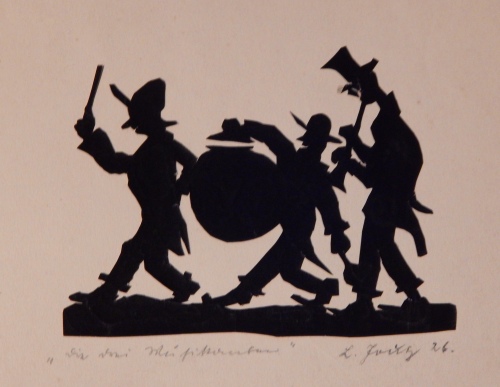
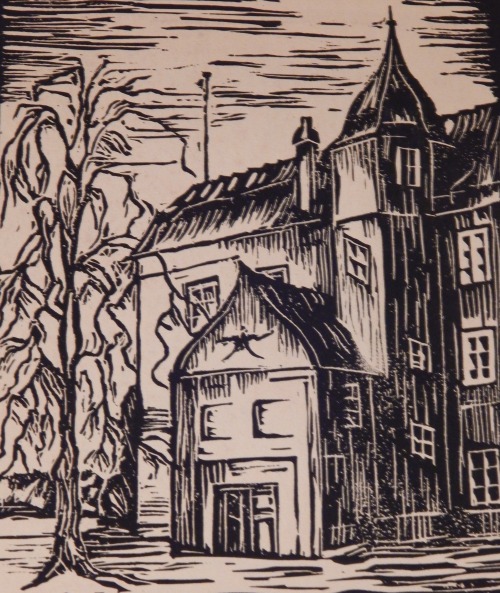
Throughout out his personal and professional life, Joutz would travel around the world.   As part of those travels, whether for work or for pleasure, he would view his surroundings with an artist’s eye and try to capture what he saw.  Yes, with a camera like his friend Horne, but Joutz would also explore many different forms and techniques of art. He experimented with pen and ink, pastels, watercolor, woodblock prints, papercutting and more.  How do I know this? By a gift he painstakingly assembled for his son.

When visiting Joutz’s son, Frederick, a noted economist, I noticed a stack of suitcases tucked in a corner. Now these suitcases were the old-school, at least 1950’s if not earlier, kind of suitcases that are deep enough to curl up and go to sleep in and strong enough to, well, last a lifetime.  Frederick explained that they contained his father’s artwork. Now at first I thought he meant prints related to his father’s architectural practice, photos of completed projects, etc.  But that was not so.

artwork by ludwig joutz

artwork by ludwig joutz

artwork by ludwig joutz

Inside the suitcases was artwork spanning nearly five decades. Joutz had carefully organized his artwork, everything from sketches on the back of used envelopes to sweeping washes of color applied to delicate Japanese papers.  It was all layered in stacks in these deep suitcases.  The son remembered his father engaged in the process and how he culled items along the way. One can only imagine what the father may have considered not worth saving.

artwork by ludwig joutz

What I managed to see, the content of only two of the many suitcases, was breathtaking in its scope, in the diversity of imagery, and the range of techniques attempted. Each image suggested a story. On some of the pages were notes. What did they mean?

artwork by ludwig joutz

artwork by ludwig joutz

Some of the works were clearly copies of masterpieces, as done by any art student spending a day in an art gallery might do, but many images appeared to be of ordinary people.  Perhaps seen in European town squares or along desert routes when he traveled in Egypt?

artwork by ludwig joutz

artwork by ludwig joutz

artwork by ludwig joutz?

Then there are the images that are ecclesiastical in nature … were they the early concepts or cartoons for church murals? Did the murals still exist or had they become lost and all that remains are these vestiges?

Those are stories that others may choose to research and tell one day. I am grateful that his son allowed me to see just a fraction of what is contained in those suitcases.  And a salute to Mr. Joutz for preserving his own artwork as he helped to preserve the works of others throughout his career.

artwork by ludwig joutz


Sources and Additional Readings …

Fold3.com Holocaust Collection


Read Full Post »
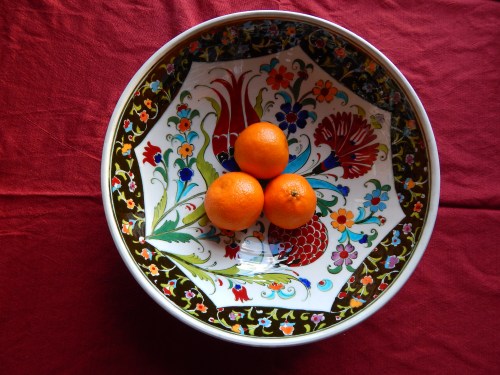
A friend traveled to Turkey and returned with a gift, a hand-painted bowl. The bowl inspired me to change my tablecloth from paisley to red to accent the bowl and then the colors of the bowl inspired me to buy clementines. Cherries came to mind as well except I don’t really like cherries. This morning, with light filling the bowl, I was able to reach for the fruit. As I ate the fruit and the air filled with the scent of oranges, I thought of gifts. My aunt told stories of post-Depression Virginia where her Christmas present was an orange and peppermint candies. Of late I’ve been on the cusp of worrying about all the Christmas cards not mailed, the presents not bought but as I held the fruit in my hand I let go of a bit of the guilt.

I’ve received lots of gifts this late autumn edging into winter. A shell from a young man as I walked along Revere Beach. He saw me stopping to collect and inspect and occasionally photograph, and so he came over to me and held out a speciman and simply said, “This one is beautiful.” I agreed. He kept standing there, shell in hand.  “Is this for me?” I finally asked. He nodded. I took it. We separated and spoke no more.

A woman I’ve met on occasion, who can come across as rather brusque, she stopped to talk with me. As I helped her make a purchase, I admired a bracelet she wore. “It’s tiger agate,” she said, sliding it off of her wrist. I held it and then tried to give it back. She refused. “It is yours, “she snapped. “See? It does not match any of the other jewelry I wore. Clearly God made me wear this today for you. You are a tiger.” I must say, I’ve been called many things, but that may have been the first time I’ve been called a tiger.

Gifts come in many forms. I will treasure the bracelet but mostly because of the memory it will evoke. I will treasure the shell, and all the shells given.  And, of course, the bowl and the oranges and other fruits it will hold, and the memories that rise with their fragrance.

Read Full Post »
Lin A. Nulman is an Adjunct Professor of English at Bunker Hill Community College.  Her poetry has appeared in Black Water Review, Tanka Splendor, and the anthology Regrets Only: Contemporary Poets on the Theme of Regret, among others. Lin puts her heart and soul into teaching and while I’ve yet to take a formal class, I have felt a student. In her own unique ways, she has challenged me to both appreciate and expand upon the work that I do as writer and photographer. It’s with pleasure I share Lin’s words and images about her grandmother, a great influence in her life.

photo by Lin A. Nulman

“Oh, you see one tree, you’ve seen them all,” a woman once said to my grandmother, who had just remarked on a tree she found beautiful. Gram repeated the comment throughout my childhood as “the saddest thing I ever heard anyone say.” I think so, too, and I’m thankful for the gift of knowing why.

We took walks when I was a little girl, and even not so little, in our neighborhoods and on the beach. Often Gram would stop to look at something commonplace, such as weeds in a patch by the side of the road. Isn’t it amazing, she would say, how Nature creates so many shapes of leaves in just this one place?

photo by Lin A. Nulman

photo by Lin A. Nulman

Eventually I reached the age of impatience with what grown-ups noticed that wasn’t rare blue beach glass or a good climbing tree. But even when I felt impatient, I knew I could see what she was talking about. I don’t know if Gram believed in God, certainly not in a kindly God, but she did deeply believe in Nature, wonderful and endlessly giving. If you looked at it that way. And I do, and I have to, despite all the other ways my eyes still need to open. Her view was one of my starting places, creatively and spiritually.

photo by Lin A. Nulman

Recently a latent love for bohemian style has sprouted in me, thanks in part to author and blogger Justina Blakeney. I stay up too late turning pages of her new book and feeling out of breath. Justina defines bohemian style as the product of “a creative life and an active engagement in the search for alternative ideals of beauty…Our worldly collections are as eclectic as we are…Decorating is about feeling free, having fun, rejecting traditional notions about what goes with what…and getting a little bit wild.” [I’m quoting from her introduction to The New Bohemians: Cool & Collected Homes. UNputdownable.]

photo by Lin A. Nulman

photo by Lin A. Nulman

Even my 1906 copy of Putnam’s Handbook of Etiquette warns New York High Society about the habits of “Bohemia”, over there in Greenwich Village, beyond “the borders of wise convention”, definitely over the edge and unacceptably wild.

photo by Lin A. Nulman

photo by Lin A. Nulman

Her book was in my mind recently on a walk through the Fens, one jewel in the Emerald Necklace of green spaces that loops through Boston. It has a wide area of community gardens, where dozens of people fulfill their own visions with flowers, trees, bushes, berries, vegetables, bamboo, grasses, and leafy plants. It is a wonderful place to open my grandmother’s eyes, to see the shades and shapes Nature creates in just one corner of a park, sometimes helped along by a little human artistry: a painted gate, a statue, a purple disco ball. On this walk, my looking as I was taught to look revealed Nature, to my joy, as The First and Ultimate Bohemian. Everything goes with everything, so feel free and always be a little bit wild.

photo by Lin A. Nulman

photo by Lin A. Nulman

I challenged myself to photograph the gardens in December, without most of the flowers to help, and still found colors and forms running madly, beautifully together, eye-catching contrasts of silhouette, especially as I lost the light, and small places full of texture and depth. Thanks, Gram.

photo by Lin A. Nulman

photo by Lin A. Nulman

Please look for my blog, The Creative Part-Timer, in early 2016.

Read Full Post »
… I would paint what I hear in this piece of music, Rhapsody No. 1 in D Flat Major by Herbert Howells.  The entire piece is only five minutes and 35 seconds long, but it is the segment between 1:30 and 3:00 that moves me most. I first heard it being played a few weeks ago at Trinity Church in Copley Square.  The organist, Colin Lynch, was rehearsing for Sunday services. I appreciated the beauty of his playing but at first the music itself did nothing for me … and then something happened. I was hooked.  And then released. As he kept rehearsing the piece, I wanted to dash into the church and stop him to ask what in the world was he playing but that seemed inappropriate.  I thought I’d catch him at the end of his rehearsal but I missed him.

Time passed, lots of traveling took place but I could still hear that music.  I tried to describe the piece to other musicians and people who knew classical music far better than I. Keep in mind I have no language for music (which is why I want to paint what I’m hearing). I kept saying, “It’s the kind of music that, you know, leads you someplace,” and other not especially helpful phrases.  I was about to give up my search when I did chance upon the organist. This time I stopped him in his tracks and asked, “Hey, Colin, what was that piece of music you were playing two weeks ago?”

He lifted an eyebrow but he indulged me.  He helped me find the language to describe what I’d heard. And as we narrowed down the possibilities of what he may have been playing, he finally asked, “Was it loud? Did it get really loud?” “Yes!” I said, and so he nodded and then wrote down the possibilities.

It was Herbert Howell’s Rhapsody No. 1 in D Flat.  Imagine my pleasure when I found this Youtube recording by Nigel Potts. Listen at your leisure. And that’s my random story this bright Monday morning.  Have a good day, folks. 😉


Read Full Post »
This year marked the 150th anniversary of Lewis Carroll’s Alice’s Adventures in Wonderland.  There have been many articles and books written in celebration of this brilliant work.  David Day’s Alice’s Adventures in Wonderland Decoded (2015) must be one of the most unique explorations of the book’s creation.  Day pairs the full text of the novel with a detailed analysis of how Charles Lutwidge Dodgson (aka Lewis Carroll) tapped his interests in mathematics, literature, religion, music and more to build a complex world for a curious little girl named Alice.

by Lewis Carroll (Charles Lutwidge Dodgson),photograph,2 June 1857

by Lewis Carroll (Charles Lutwidge Dodgson),photograph,2 June 1857

It is widely believed that the character Alice is based on Alice Liddell. Alice and her sisters Lorina, Edith and brother Harry were the children of Henry George Liddell, dean of Christ Church College, Oxford where Hodgson had been studying mathematics. He would befriend the family and especially the sisters and the rest is literary history.

Alice Liddel, photograph by ,1860

Alice Liddel, photograph by Lewis Carroll,1860

A few years ago I had the opportunity to meander around Christ Church, Oxford and there I photographed a stained glass window by Edward Burne-Jones. His model was Edith Liddell.  That image appears in Mr. Day’s book for which I am grateful because the book is filled with beautiful illustrations, photography and reproductions of engraving and paintings.  And then there’s the mathematical diagram of Fibonacci’s rabbits and the explanation of how that rule applies to the story.  The book truly is a treat for people of wide-ranging interests.

Highly recommend this article by Katherine Dedyna in the Times Colonist and Nathan Whitlock’s review on the Quill and Quire.

The book is available for purchase via the following link: http://www.amazon.com/Alices-Adventures-Wonderland-Decoded-Carrolls/dp/0385682263

Read Full Post »
« Newer Posts - Older Posts »