Feeds:
Posts
Comments

Archive for the ‘Books I Love’ Category

foreword to the interludes

interlude: genesis

interlude: exodus, part 1

interlude: exodus, part 2

Son of farmer in dust bowl area. Cimarron County, Oklahoma , photo by Arthur Rothstein, 1936.

Son of farmer in dust bowl area. Cimarron County, Oklahoma , photo by Arthur Rothstein, 1936.

“A gentle wind followed the rain clouds, driving them on northward, a wind that softly clashed the drying corn. A day went by and the wind increased, steady, unbroken by gusts. The dust from the roads fluffed up and spread out …  Now the wind grew strong and hard …  the dust lifted up out of the fields and drove gray plumes into the air like sluggish smoke. The corn threshed the wind and made a dry, rushing sound. The finest dust did not settle back to earth now, but disappeared into the darkening sky.”  — in the opening chapter of The Grapes of Wrath by John Steinbeck.

Liberal (vicinity), Kan. Soil blown by dust bowl winds piled up in large drifts on a farm, photo by Arthur Rothstein, 1936.

Liberal (vicinity), Kan. Soil blown by dust bowl winds piled up in large drifts on a farm, photo by Arthur Rothstein, 1936.

In April 1935, as Joseph A. Horne was teaching music in West Virginia, President Franklin Delano Roosevelt was creating the Resettlement Administration (RA) in Washington, D.C.  Guided by Rexford G. Tugwell, the agency intent was to help farmers and other rural poor suffering from the economic impacts of the Great Depression and the devastation of dust storms and other ecological events.   A Historical Section was created within the agency to document existing poverty as well as report the benefits of the agency’s work.  This section would be led by Roy E. Stryker.

Rexford Tugwell and Roy Stryker

Rexford Tugwell and Roy Stryker

In the 1920s, Tugwell and Stryker, both economists, had taught at Columbia University.  While there, they had collaborated on the book, American Economic Life. Stryker’s contribution included using photography to complement the text, something he also did as part of his lectures at the university.  He was not a photographer but he, and Tugwell, recognized photography as a useful, illustrative tool to convey and strengthen information.

Farmer and sons walking in the face of a dust storm. Cimarron County, Oklahoma, photo by Arthur Rothstein, 1936.

Farmer and sons walking in the face of a dust storm. Cimarron County, Oklahoma, photo by Arthur Rothstein, 1936.

Stryker left academic life to follow his friend and mentor to the Resettlement Administration. Three decades later, Stryker would recount that “Tugwell never said, “Take pictures.”  He said, “We need pictures.”  He never said how to take them.  He said, “Remember,” — and this is the only thing I can remember — “remember that the man with the holes in his shoes, the ragged clothes, can be just as good a citizen as the man who has the better shoes and the better clothes.” (Interview, June 13, 1964)

Farmer, local type, Brown County, Indiana, photo by Theodor Jung, 1935.

Farmer, local type, Brown County, Indiana, photo by Theodor Jung, 1935.

The agency’s original focus was on Rural Rehabilitation, Rural Resettlement, Land Utilization and Suburban Resettlement.  Activities included purchasing exhausted farmlands from farmers to convert the land into pastures or parks, for instance, and providing training for farmers to rehabilitate their farms through refinancing and other debt adjustments.  Out of work farmers were given jobs.  Building projects were begun.  The most controversial feature of the agency’s efforts was relocation.

Scottsboro (vicinity), Alabama. Farmers who have been resettled at work in a sand pit at Cumberland Mountain Farms, a U.S. Resettlement Administration project, photo by Arthur Rothstein, 1935.

Scottsboro (vicinity), Alabama. Farmers who have been resettled at work in a sand pit at Cumberland Mountain Farms, a U.S. Resettlement Administration project, photo by Arthur Rothstein, 1935.

From the beginning, the agency did not have much Congressional support.  Part of it was political.  Tugwell was considered to be one of the most radical of FDR’s New Dealers.  Plus the idea of relocating nearly a million farmers and other rural poor off the land into cities that they’d helped to build seemed too socialistic.

Rehabilitation client, Garrett County, Maryland, photo by Theodor Jung, 1935.

Rehabilitation client, Garrett County, Maryland, photo by Theodor Jung, 1935.

With funding limited by Congress, the Resettlement Administration would eventually dramatically narrow its efforts and focus on building relief camps in California for migratory farm workers.  One of these relief camps would inspire John Steinbeck’s The Grapes of Wrath.

All races serve the crops in California, photo by Dorothea Lange, 1935

All races serve the crops in California, photo by Dorothea Lange, 1935

Faced with rising criticism for his management, Tugwell resigned from the Resettlement Admininistration in 1936.  By September 1937, the agency was folded into a new federal entity, the Farm Security Administration (FSA).  The FSA, with its mandate to help the rural poor, would complete some of the Resettlement Administration’s original projects as well as embark upon a whole other series of financial and technical assistance programs.  Roy Stryker was given the greenlight to continue his documentary photography program.

Negro field worker. Holtville, Imperial Valley, California. He has just made himself shoes out of that old tire, photo by Dorothea Lange, 1935.

Negro field worker. Holtville, Imperial Valley, California. He has just made himself shoes out of that old tire, photo by Dorothea Lange, 1935.

He directed his photographers to take the best picture possible and to capture the story behind the image.  He could not tell them how to use their cameras, but he did suggest themes to focus on.

Imperial Valley, California, Mexican. He tells his story: he helped drive the French out of Mexico, fought against Maximilian, and he has, by serving the crops for many years, help build up Imperial Valley, photo by Dorothea Lange, 1935.

Imperial Valley, California, Mexican. He tells his story: he helped drive the French out of Mexico, fought against Maximilian, and he has, by serving the crops for many years, help build up Imperial Valley, photo by Dorothea Lange, 1935.

Based on how they operated in the field, these early documentary photographers, including Dorothea Lange, Walker Evans, Ben Shahn and Arthur Rothstein, were sometimes described as “sociologists with cameras.”
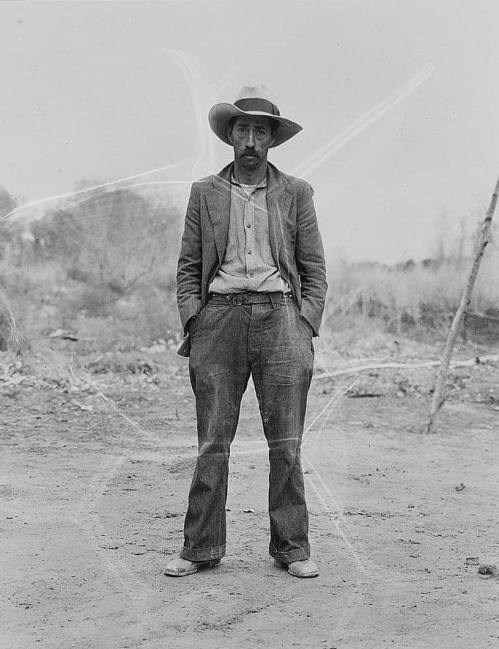
Mexican field worker, father of six. Imperial Valley, Riverside County, California, photo by Dorothea Lange, 1935.

Mexican field worker, father of six. Imperial Valley, Riverside County, California, photo by Dorothea Lange, 1935.

The photographers traveled across the nation, by assignment, sometimes alone and sometimes in groups, to areas of economic challenge, capturing dramatic hardships and also simply documenting people living their daily lives.
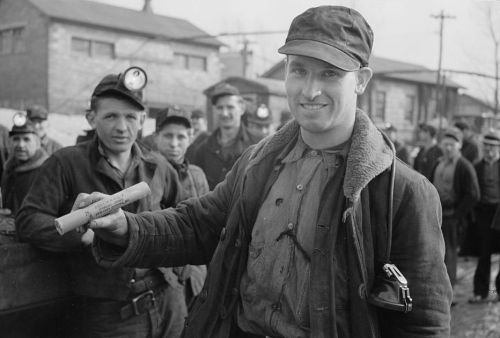
Untitled photo, possibly related to: Miners at American Radiator Mine, Mount Pleasant, Westmoreland County, Pennsylvania, photo by Carl Mydans, 1936.

Untitled photo, possibly related to: Miners at American Radiator Mine, Mount Pleasant, Westmoreland County, Pennsylvania, photo by Carl Mydans, 1936.

Farmer and sons walking in the face of a dust storm. Cimarron County, Oklahoma, photo by Arthur Rothstein, 1936.

Warm Springs Indian boy. Molalla, Oregon photo by Arthur Rothstein, 1936.

The FSA would operate from 1937 – 1942, with its photography unit capturing the diversity of the United States.

Negro boys on Easter morning. Southside, Chicago, Illinois, photo by Russell Lee, 1941.

Negro boys on Easter morning. Southside, Chicago, Illinois, photo by Russell Lee, 1941.

That diversity would be represented in the ranks of the photographers that Stryker brought together, men and women of different backgrounds, interests, and photographic skill.

Westmoreland project, Pennsylvania. Westmoreland County. Construction worker on the Westmoreland subsistence homestead project, photo by Walker Evans, 1935.

Westmoreland project, Pennsylvania. Westmoreland County. Construction worker on the Westmoreland subsistence homestead project, photo by Walker Evans, 1935.

In 1942, the photography unit moved into the Office of War Information (OWI)The OWI was created shortly after U.S. entry into World War II as an effort to consolidate existing government information services.

Two children in Anacostia, Washington, D.C. at the Frederick Douglass Housing Project, photo by Gordon Parks, 1942.

Two children in Anacostia, Washington, D.C. at the Frederick Douglass Housing Project, photo by Gordon Parks, 1942.

By 1943, another federal agency, the Office for Emergency Management, would  also be brought under the OWI umbrella, and its activities and some of its staff would merge with Roy Stryker’s photographic unit.  One of those staff would be Joseph A. Horne.
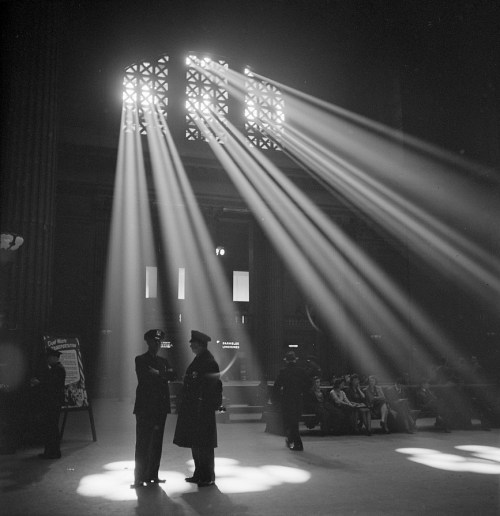
Chicago, Illinois. In the waiting room of the Union Station, photo by Jack Delano, 1943.

Chicago, Illinois. In the waiting room of the Union Station, photo by Jack Delano, 1943.

As these many agencies consolidated into one, the Farm Security Administration-Office of War Information (FSA-OWI), the nature of the photographs taken by its photographers changed to some degree as did the purpose of the images.
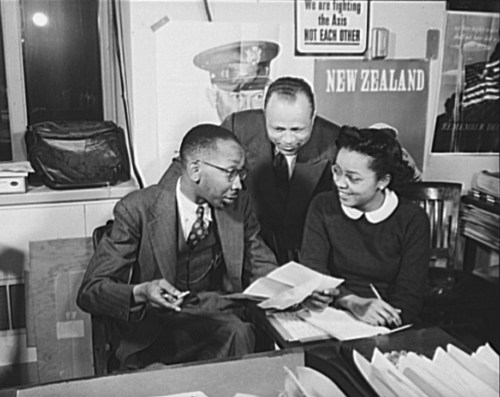
Office of War Information news bureau. Ted Poston, Negro desk editor of the Office of War Information (OWI), discusses a letter from one of the 240 Negro editors to which he sends war news from Washington, with William Clark and Harriette Easterlin, his assistants, photo by Alfred T. Palmer, 1943.

Office of War Information news bureau. Ted Poston, Negro desk editor of the Office of War Information (OWI), discusses a letter from one of the 240 Negro editors to which he sends war news from Washington, with William Clark and Harriette Easterlin, his assistants, photo by Alfred T. Palmer, 1943.

Documenting American life was still important but now with an emphasis on framing the images so that they would inspire patriotism, educate people about how to live and act during war time,  and evoke a sense of national pride in the strength, good humor and resilience of the American people.
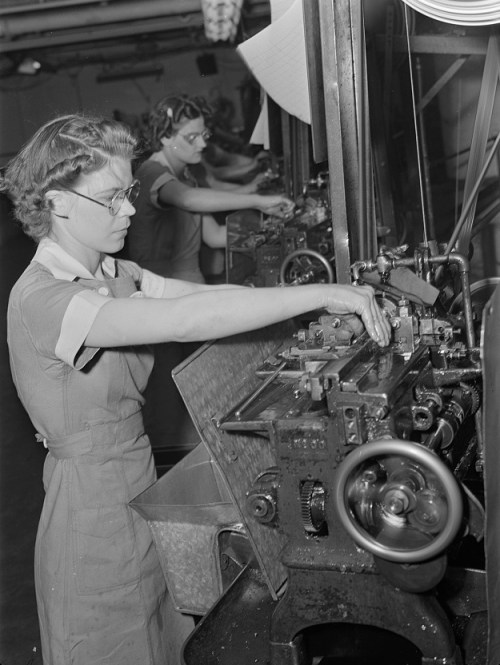
Women in industry. Tool production. Arms for the love of America! The capable young woman whose strong hands guide this cutoff machine is one of a Midwest drill and tool factory's many women employees. Almost 1,000 women have recently been employed in this comparatively new plant; sole men workers, other than foreman, are those in the heat treating department. Republic Drill and Tool Company, Chicago, Illinois, photo by Ann Rosener, 1942.

Women in industry. Tool production. Arms for the love of America! The capable young woman whose strong hands guide this cutoff machine is one of a Midwest drill and tool factory’s many women employees. Almost 1,000 women have recently been employed in this comparatively new plant; sole men workers, other than foreman, are those in the heat treating department. Republic Drill and Tool Company, Chicago, Illinois, photo by Ann Rosener, 1942.

Joseph Horne’s photos that appear in the FSA-OWI Collection, now housed in the Library of Congress, focused on the Washington, D.C. area where he had settled with his family.  His images include the crafting of victory gardens and urban farms.
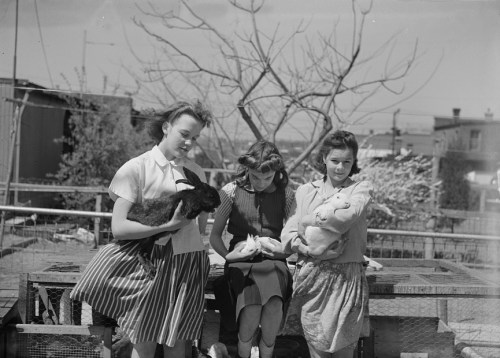
Washington, D.C. Children with rabbits which were formerly kept as pets, but now are being raised for food, photo by Joseph A. Horne, 1943.

Washington, D.C. Children with rabbits which were formerly kept as pets, but now are being raised for food, photo by Joseph A. Horne, 1943.

He also photographed the unique monuments located in the Congressional Cemetery, and the mix of peoples who made their way through Washington’s Franklin Park. And then there was that night in February 1944, when he photographed the opening of a new labor canteen.
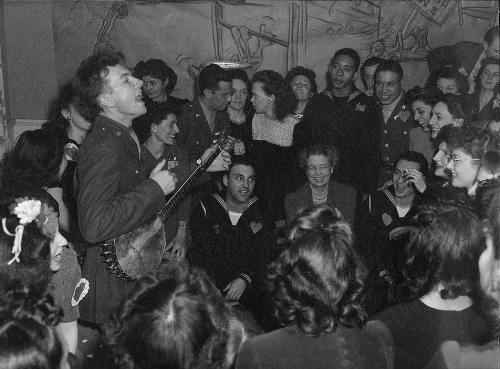
Washington, D.C. Pete Seeger, noted folk singer entertaining at the opening of the Washington labor canteen, sponsored by the United Federal Labor Canteen, sponsored by the Federal Workers of American, Congress of Industrial Organizations (CIO), photo by Joseph A. Horne, 1944

Washington, D.C. Pete Seeger, noted folk singer entertaining at the opening of the Washington labor canteen, sponsored by the United Federal Labor Canteen, sponsored by the Federal Workers of American, Congress of Industrial Organizations (CIO), photo by Joseph A. Horne, 1944

The photography unit was only one part of the FSA-OWI but it was one of the most successful units.  Through domestic and overseas operations, the  agency had sought to excite and educate Americans at home, and inform (or intimidate) allies and foes abroad, using radio broadcasts (e.g. Voice of America), newspapers, posters, film and photography. But as World War II progressed, conflicts arose around agency management and how to balance civilian and military interests.  Soon, Congress would severely cut the organization’s budget. By 1944, the enormous collection of FSA-OWI photos, black and white and color, would be transferred to the Library of Congress where they remain a valuable resource to this day.

Negro boy near Cincinnati, Ohio, photo by John Vachon, 1942 or 1943.

Negro boy near Cincinnati, Ohio, photo by John Vachon, 1942 or 1943.

By 1945, the Office of War Information as an organization was no more.  Any relevant international activities were transferred to the U. S. State Department, while relevant information gathering and related responsibilities were handed over to the intelligence agencies like the Office of Strategic Services/Central Intelligence Agency.
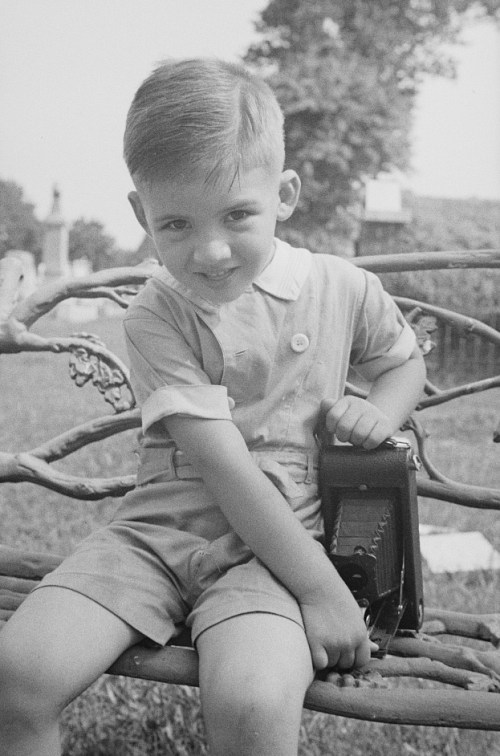
Joseph Jr. with Camera, photo by Joseph A. Horne.

Joseph Jr. with Camera, photo by Joseph A. Horne.

By the spring of 1944, Joseph A. Horne, the fellow with whom we are walking through history, had enlisted in the U.S. Army.  Soon he would be off to Europe where photography would remain an important feature of his life.  But before he traveled overseas, he would let his son play with one of his cameras.

Additional Reading/Sources …

Library of Congress Prints and Online Catalog

Stryker’s Shooting Scripts

Resettlement Administration

Farm Security Administration

Office of War Information

Oral Interviews with Roy E. Stryker

About Roy E. Stryker

Out of One, Many:  Regionalism in FSA Photography

Stryker and the FSA

John Steinbeck

FDR Presidential Library and Museum


Read Full Post »

… but i am happy to be home. Plus we returned just in time to attend a book festival in Boston. No books were bought but I did have the pleasure of meeting some of the people behind 21st Editions, The Art of the Book.  As a press that uniquely marries fine art photography with poetry, it is my dream publisher.  They produce works primarily acquired by libraries and museums.  As I told one of the staff, the newsletter they send out to subscribers is quite inspiring. I’ve been especially fascinated by the short videos produced to highlight upcoming titles.  When asked what I liked about them, I shared that it was the audio element added to the mix of words and images.  Below is one of my favorites — images of 21st Editions books with a poem read by poet John Wood.  Enjoy.

Read Full Post »

That thought crossed my mind this morning as I did everything except the one thing I needed to be doing — write, write, write.  But, eventually, I remembered that part of my creative process, especially when I am feeling stuck on a writing project, is to get up from the computer and to walk toward … something.  In this case it was toward a small table in Steve’s kitchen.

On the table is an eclectic mix of items:  an antique silver pitcher against which leans a postcard of Hiroshige’s Plum Garden, a small pot of basil, two pots of red peppers separated by a pot of Cuban oregano, lavender that needs to be replanted and some lemon verbena.

Nestled amidst all of these herbs are bits of pottery filled with fruits of the season, glass votives, an empty wooden basket, and another postcard, Romare Bearden’s Autumn Lamp (Guitar Player).

Deborah Madison’s Vegetable Literacy sits open upon the table, too.  I think I have it for two more weeks from the library before I have to return it. It’s a good book that I think I am going to add to my Christmas list. I flipped through the book for a bit, letting my eyes dance over her words and images.  And then guess what?

I closed the book (after marking what I intend to try for dinner tonight).  I sat back down at the computer and began to put fingers to the keyboard, feeling just a little bit less stuck.  😉

Read Full Post »

It was the beauty of the artwork on the covers of fantasy and sci-fi novels that used to draw my attention in bookstores.   So many of the illustrations depicted a cloaked figure, partially illuminated.  And then there’s my growing interest in stained glass windows.  The figures in them, whether peasant or angel, wear luminous robes in a rainbow of colors.  With such inspirations in my life, how could I not see a cloaked figure as I zoomed in on this orchid?

Read Full Post »

My first impressions of ancient Japanese warriors were formed by the Akira Kurosawa movies that used to air on Saturday mornings when I was a child.  Later, I read James Clavell’s Shogun.  That was a heavenly experience for someone who had yet to leave her hometown, let alone travel the world.  I haven’t seen the Tom Cruise movie, The Last Samurai, all the way through, though somehow I managed to buy the soundtrack.  All that to say, it was quite the treat to view the current Boston Museum of Fine Arts exhibit, Samurai!

Photo by DL

Photo by DL

As described on the MFA website, samurai were “the military elite led by the shoguns, or warlords, of Japan from the 12th through 19th centuries.”  Through August 4th, the MFA is featuring this exhibit of Samurai armor from the Ann and Gabriel Barbier-Mueller Collection that highlights how armor design and use evolved over time from actual warfare to more showcase.

Photo by DL

Photo by DL

I have to thank my friend, DL, for dragging me out the door to see this exquisite exhibit.  It was quite fascinating to see the layerings of cloth, metal and even paper that formed protective barriers for men (and horses!) — pieces that remain enduring works of great art. Afterwards DL and I wandered over to the Egyptian area but that’s a story for another day.  If you’re in Boston before August 4th, I hope you have a chance to visit.  There’s also fun stuff on the MFA website.

Photo by DL

Photo by DL

Read Full Post »

One of the best job experiences I ever had was working with middle school students as part of an after school writing program.  The children usually engaged in an outdoor activity and then they wrote about the experience.  One of the indoor rainy day activities was to present the children with a folder of images.  Each child selected a photograph that moved him or her in some way.  It was always amazing to read what they wrote.  Their imagination and creativity inspires me to this day.  That’s why I was excited to be part of the book project, Reflect & Write.  I’m honored to have two of my poems included among the nearly 300 poems, photographs and quotations composing this wonderful resource designed to help prompt children to put pen to paper (or fingers to keyboards and touch screens).  Via this link you can take a peek inside the book and see if it is a resource that might be useful for stirring the creativity of the young people in your life.

Read Full Post »

So on Sunday I was walking down the street carrying dirt and clay pots and various seeds.  The sun was beating down.  I was hot and tired and hoping I didn’t trip and break the pots before I reached home which seemed to be a million miles away.  I came to a fork in the road and for whatever reason I took the left fork — a path different than the one I had taken before.  Along the route I passed a table set up on a small front yard, and on the table were those most magic of items — used books.

They were not in great shape to say the least, but there was a lovely antique-ness about the mound on the table and the ones just visible in boxes across the yard.  Most had dark non-descript covers.  A young man kept trying to put books in my hands, flipping to the colorful lithographs inside.  A lot of science scenes.

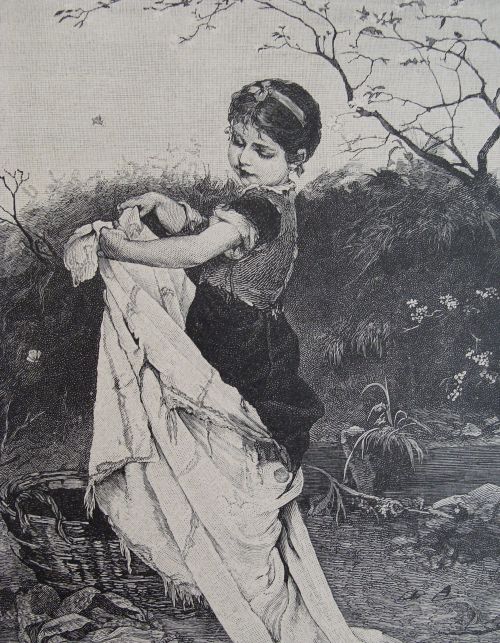
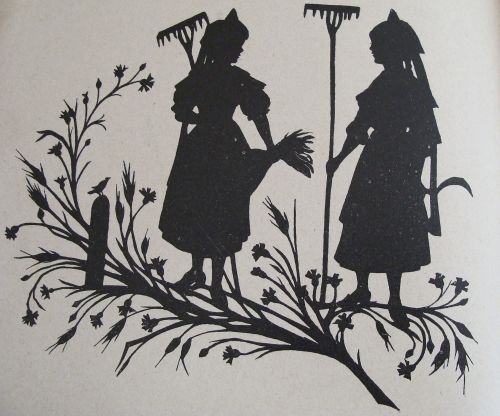
But it was the German children’s book that caught my eyes with its fading colorful cover.  When I cracked its bent frame, crispy yellowed pages slid into my hands, but all the pages appeared to be within.  I tucked them back and flipped through as gently as I could, enchanted by the imagery inside.

German I do not read and so I will have to find a translator to help me make out the title and cover page information.  An 1880’s creation for sure, combining short story and myths, and even a play at the end. Some images are clearly signed like this one by C. W. Allers …

… but most are not.

More research to be done on the contents, and to learn how to conserve such a literary treasure.  I’ll be sure to share what I find. 😉

Read Full Post »

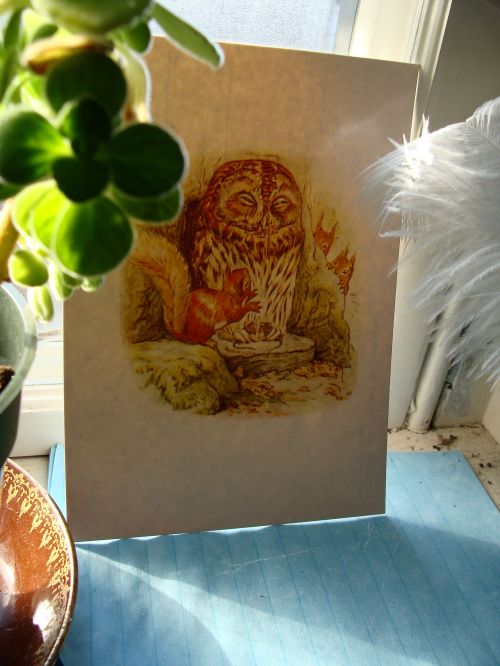
I  have never seen an owl in the wild.  I have heard them though, that distinctive hoo, hoo, hoo.  They have been on my mind of late because of family and friends.   As I worked with a colleague on her daughter’s nursery one day, she shared her fondness for the winged creatures.  So ever since then, for her, I have kept an eye open for small owlish things that can be shared by mother and child.  Sometimes I keep the items for myself like the above postcard tucked in an alcove.  While my brother and I do not share a love of owls, we do share a love for the movie, The Secret of NIMH.

Secret of NIMH Theatrical Poster

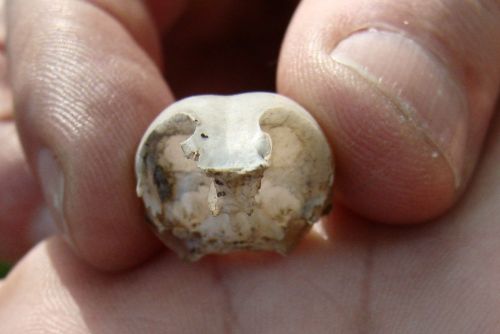
I purchased the movie recently to share with a young friend.  I had not realized how much of the story I had forgotten.  As my friend and I perched on the couch, mesmerized by the story and the jewel-colored artwork, I was surprised with great joy — and my young friend with a bit of fear — as a magnificent Great Owl strode across the screen, his mammoth claws cracking the remains of past dinners, bones in all sorts of shapes and sizes. Such sights do make me wonder if this small bone I found in the woods was left by hawk or owl.

I’m not an especially nocturnal person which is probably why my path does not cross that of the owls and vice versa.   According to Massachusetts Audubon though they are everywhere across my state.  We’ll see what the future holds, especially as daylight saving time soon ends and I find myself out at dusk.  I just hope I have my camera ready so that I may eventually share some images with you.  Meanwhile, here are just a few of the many online sites that already contain wonderful images and information:

Massachusetts Audubon Owls

The Owl Pages

Cornell Lab of Ornithology:  Owls

Animal Planet: Owl Page

Read Full Post »

Several years ago I attended a national conference sponsored by a major environmental organization.  The conference was held in a lovely out of the way place in a southern state.  I and a colleague had petitioned our company to pay for our attendance as part of our professional development.  When we arrived and began to mingle amongst the other 498 guests, I noticed something immediately but I didn’t say anything to my colleague.  However my colleague quickly pointed out the unspoken:  that I was one of just three brown people at the multi-day event.  As I attended the various sessions, I listened as people discussed how to save rainforests and wildlands, and contemplated strategies to bus minority children out of cities to visit green spaces.  I understood the intent behind the words, but I was troubled.  As the days progressed, I felt something building inside me until …

… near the end of the conference, I sat in a small group session.  I don’t remember the session’s focus.  But I remember the look on a well-meaning person’s face as she all but called me “you poor thing” when I admitted out loud that I had never seen the Grand Canyon or Yellowstone.  As someone else went on to raise how do we (as in environmentalists) get more African Americans interested in the environment, I snapped.  Let me tell you, I was much more shy then than I am now.  So it was a big deal for me to open my mouth in that group and give them a piece of my mind about labeling and having narrow views about who was interested in the environment.   Afterwards I raced to the restroom.  I was shaky.  I was new to the environmental field.  Many of the people in that room had been working in the field longer than I had been alive.  What did I know?

As I slowly washed my hands, into the restroom walked Terry Tempest Williams, one of the conference presenters and a well-known writer and activist.  I loved her work but at that moment I just wanted to dash right pass her. However, she held me with her eyes.   “Well said in there.”  That’s it.  That’s all she said, but it was all I needed to hear.  That moment, that encouragement has stayed with me over the years and came to mind this morning as I read one of her recent essays, “A Disturbance of Birds.”  It is a beautifully written piece about her discovery of a brain tumor.  Woven throughout her story are the stories of other people.  Dotting this narrative quilt are birds in all forms.

I highly recommend a read of this essay.  Her words greatly moved me.  At first I found myself thinking of loved ones recently lost and then of loved ones who are currently not in good health.  I thought of loved ones traveling who I wish were home.  And then I thought of birds.  The ones I watched with my mom.  The robin described by my uncle.  The blue herons I see with Steve.   The birdsong I cannot photograph but which inspires me so.   And then finally I was filled with gratitude.  I am grateful for the people I have met throughout my life and hopeful for the ones I have yet to meet.  As the sun shines bright today, I know that I have been lucky. 😉

Read Full Post »

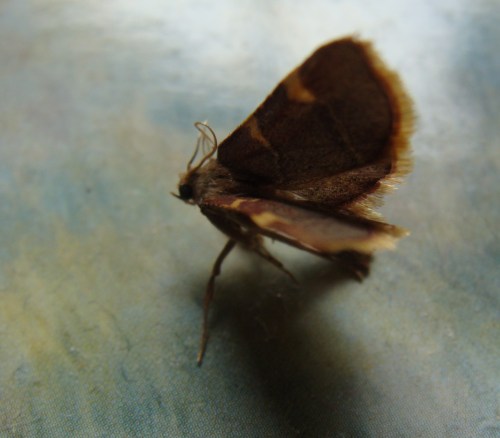
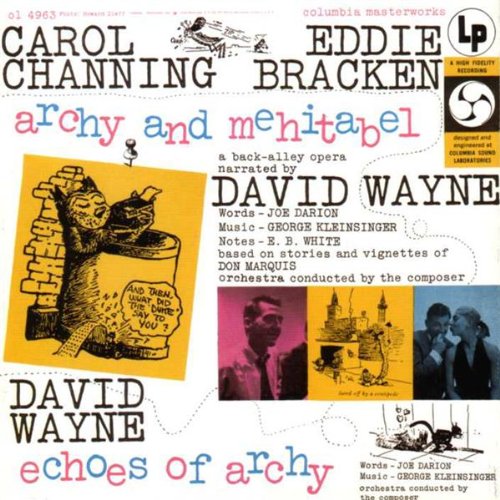
I found this moth on my kitchen table.  I have to admit, thanks to Steve, I see moths just a little bit differently than I did before he and I met.  Because he and I are of different generations, he often introduces me to art and music that I am quite sure I would not chance upon without him.  Most recently he introduced Archy, a philosophical cockroach who used to be a poet in a previous life, and Mehitabel, a wise-talking alley cat who believes she is Cleopatra reincarnated.  Created in 1916 by Don Marquis in his daily column for the New York Evening Sun, the pair share adventures expressed in light verse.  One of Steve’s favorites:  the lesson of the moth. In time, the shorts were compiled into books, and a musical was recorded with Carol Channing voicing Mehitabel.

Steve tracked down a CD containing the original music production.  We listened last night.  It was a treat to hear the actors bringing such unique characters to life.  Now, also found on this CD is the Carnival of Animals, an instrumental work paired with words by Ogden Nash.  When the Carnival music started, it was beautiful … and it was strangely familiar.  I asked Steve who confirmed, “It’s a classic by Saint-Saens.  I first heard it as a child, when my father played it in the 50’s.”  “Hmmm,” I replied.  “I think I first heard it on Bugs Bunny.”  Steve shrugged.  “That’s where you first heard Wagner, isn’t it?”  Well, too true.  Meanwhile …

* You can hear the complete version of the Saint-Saens Carnival of Animals suite via this link.

* Read more about and by Archy & Mehatibel here.

* FYI, Carnival of Animals was featured in a Bug Bunny production which you can read more about at the bottom of this wiki page.  And to learn more about Bugs Bunny as classical music teacher, check out this wonderful page called Bugs Bunny Goes Classical.


Read Full Post »

« Newer Posts - Older Posts »