Feeds:
Posts
Comments

Here is a link to previous Interludes in our walk though history with Mr. Horne.


Walter Ings Farmer, Director, Wiesbaden Collecting Point

Walter Farmer, Director, Wiesbaden Collecting Point

In his book, The Safekeepers: Memoir of the Arts at the End of World War II (2000), Walter Ings Farmer writes that “The story of the Offenbach Archival Depot has never received the attention given to restoration of monuments … Nevertheless an account of MFA&A activities in the Frankfurt area would be incomplete without a description of the rescue of the literary and scriptural treasures that the Nazis had looted with the same nefarious purposes they applied to art collections. … Looting of libraries became as integral to the Nazis plan for cultural domination as the looting of art collections.

1933 Berlin Book Burning

1933 Berlin Book Burning

He describes how Nazi actions escalated from the 1930s public burnings of the authors they wanted to discredit to “a program of search and seizure among the libraries and archives of the nations that they sought to conquer. … These activities established a pattern which resulted in the eventual accumulation in Germany of storehouses full of other nation’s libraries.

Millions of books would be accumulated, along with a stunning amount of other cultural and religious items collected from across Europe.  Farmer writes of being introduced to Offenbach by “his boss” Captain James Rorimer in the fall of 1945.

James Rorimer

James Rorimer

He took me with him to inspect an abandoned warehouse within the I.G. Farben plant at Offenbach,” remembers Farmer. “This building was under consideration to become to repository primarily for Jewish libraries, archives and the Torahs.” Prior to the warehouse in Offenbach being established as a collecting point, library collections were being stored at the Rothschild Library in Frankfurt. Over time it was clear that infrastructure at the Rothschild Library was inadequate.

Based on his and others assessment of the situation, librarian and MFA&A officer Lt. Leslie Poste suggested that detailed cataloging of the items be stopped at Rothschild and that operations be relocated across the river to the I.G. Farben plant, the site of a five-story, reinforced concrete loft building.

Seymour Pomrenze (center)

Seymour Pomrenze (center)

Pomrenze put into place necessary administrative, transportation, cataloging and storage systems enabling the depot to operate much more effectively.  Professional conservation and preservation labs, a photographic studio and other needed infrastructure was created.  His successor, Captain Isaac Bencowitz, refined a system for photographing ex-libris and library markings found in books.

Isaac Bencowitz

Isaac Bencowitz

The resulting cataloging system would significantly increase staff ability to identify and sort items, identifying country of origin and other markers of ownership .  In the end Bencowitz and his team would complete “two volumes with reproductions of library markings belonging to 4,105 libraries of individuals and institutions in Western and Eastern Europe

and two volumes with more than 1,300 bookplates or ex-libris, including 1,200 German-Jewish, German-Masonic and probably German non-Jewish plates as well as over 100 mostly Dutch-Jewish bookplates.” (F. J. Hoogewoud)

As requests were submitted by individuals, families and nation states seeking missing items, MFA&A staff were able to use the catalogs to help them search through the millions of books and cultural items that would eventually be stored at Offenbach.

Bencowitz, during his tenure as director, used photography to document the operations of the depot and its staff and volunteers.

Staffing the depot was a mix of U.S. military, Allied and civilian personnel, as well as German civilians, and scholars from around the world. In October 1946, Bencowitz received orders for redeployment.  The imminent nature of his departure and shifting priorities in the region for policy and decision-making made selecting a new director difficult.  As an “emergency measure,” archivist Major Lester K. Born and his assistant, Joseph A. Horne, were sent to Offenbach for temporary duty.  Born was to develop an interim plan for continued operation of the depot, a plan that Mr. Horne was to implement.  In short, a plan was finally developed and by January 1947, Horne became the third director of the Offenbach Archival Depot.

Exactly what Horne was doing prior to assuming his new role remains opaque without futher research.  Archival records show him often assisting MFA&A colleagues like Gordon Gilkey, Leslie Post, Lester Born and Paul Vanderbilt with the acquisition of information about available artwork and cultural items.  His fluency in German, facility with “dead languages,” appreciation and knowledge of the arts, and photographic skills would have made him invaluable in the field.  He produced numerous reports about his trips across Germany about what he was seeing and hearing from locals. People were often very open with him.  Following is an excerpt from a field report after visiting libraries in over a dozen landkreise or rural districts:

By 1947, relations with the Russians had deteriorated significantly, adversely affecting the restitution of items to individuals and institutions in Russian-controlled territories, and the exchange of items between the Russian Zone and other Allied Zones.  With plans well underway to revitalize German economy and culture (including denazification), military and intelligence priorities shifted to stopping the Russians.  And so Horne like many within the MFA&A unit followed orders as high level officials made clear that those in the U.S. intelligence sector had full access to depot materials and freedom to act as they deemed necessary.

In February 1947, one month after Horne became director of Offenbach, Lucy Schildkret arrived.  She would later write, “his friends called him Tony. Before the war, he’d been on the staff of the Library of Congress’s photographic division.  Transferred from the MFA&A in Berlin, he was then new to the Depot, having taken over his duties barely two weeks before my visit.  About thirty, very tall, thin, lanky, and blond, he was the only American there.  He was in charge of a staff of some forty Germans.”

In her memoir, From That Place and Time, Lucy Schildkret describes her encounter with Horne as she works to sort, identify and return the YIVO library of Vilna, Poland.  The Yiddish Scientific Institute (YIVO) was founded in 1925 for the scientific study of Jewish life.  Headquartered in Vilna, the institute had branches around the world including the United States. At the start of the war its headquarters were transferred to New York City.

In late 1945, when the YIVO library was identified as being in Frankfurt, visiting Jewish scholar, Prof. Koppel S. Pinson sought permission from the YIVO leadership in New York to distribute, like a lending library, some of the unidentifiable books to Jews living in the Displacement Camps.  It would take time but he would be granted such authority.

A year later, Lucy Schildkret would also be granted authority to work with the books.

The complexities of sorting, identifying and returning books at the scale demanded of the Offenbach Archival Depot become clearer when reading through the declassified documents relating to what happened with just the YIVO library.  For instance, YIVO like many libraries of its size and mission had been the repository of family libraries.  Books at Offenbach were being identified by ex-libris and other markings as belonging to individuals and/or their families but they had in fact been donated to YIVO (or other institutions) by family members.  There are numerous letters between YIVO administrators with U.S. military officials trying to prove the ownership of items.

Though correspondence about the YIVO library begins in 1945, by early 1947 the vast library had yet to be shipped to YIVO in New York.  The reasons include continual reduction in manpower, both skilled and unskilled, at the depot and complex, bureaucratic chains of command within the U.S. military, between the Allied zones and even within the YIVO organization.  In a March 1947 document, Horne reports to his superiors that Miss Schildkret has been unable to examine several hundred thousand unidentified books because she had yet to receive authorization.

Vilna Library During German Occupation, in the files of the Offenbach Archival Depot

Vilna Library During German Occupation, in the files of the Offenbach Archival Depot

In 1938, Lucy Schildkret had studied in Vilna and worked at the YIVO.  Prior to the war, she would return to the U.S. and work as assistant to the research director at the YIVO headquarters in New York.  In 1946 she journeyed to Europe as an educational worker with the American Jewish Joint Distribution Committee (AJDC), the largest Jewish relief organization in America. Through this organization she was able to work with displaced persons in the camps.  With her skills in Yiddish and time at YIVO, she was able to discern that books that had been labeled as unidentifiable were indeed identifiable.  But even as she acquired the authority to help identify the YIVO library, she maintained her focus of serving the people housed in the displacement camps, and she would do so with a tenacity that would characterize her career for decades to come.

Schildkret responds two weeks later with a letter that concludes:

Her memoir presents a powerful account of the emotions stirred by working with the contents of the library from a place that she had called home and knowing what had happened to the people she’d called friends as the Nazis destroyed the city.

Eventually, with the combined effort of many individuals in several countries, over 90,000 items would be returned to the YIVO.  Seymour Pomrenze who had been pivotal in streamlining systems at the depot would be brought back to help shepherd the return of these items.  In 1998, Pomrenze shared his personal reminiscences of his experience with the Offenbach Archival Depot and the depot’s considerable achievements restituting and distributing millions of Nazi-looted materials including the YIVO library.

Mr. Horne, the person with whom we are taking this walk through history, would wrap up his tenure at Offenbach in 1948 though files show that he continued to support depot activities until its closure.  In the Cold War world, he would, strangely enough, continue to work with books and even return to his earlier interests in music and photography as he embarked upon a new journey.  One world war had ended. A new type of world war had begun. A new weapon in that war was the exchange of culture and what better place to share all that made up culture — from art to music to literature — than in a library.

More to follow …

Sources and Additional Readings

Cultural Plunder by the Einsatzstab Reichsleiter Rosenberg (ERR)

What Became of the Jewish Books? (New Yorker, February 2014)

U.S. Holocaust Memorial Museum — Offenbach Archival Depot

Pomrenze Personal Reminiscence about Offenbach

Mapping the Offenbach Archival Depot

Returning Looted European Library Collections

YIVO Digital Archive on Jewish Life in Poland

YIVO Institute

From That Place and Time: A Memoir, 1938-1947 by Lucy S. Davidowicz and Professor Nancy Sinkoff

Article – Dutch Jewish Ex-Libris Found among Looted Books in the Offenbach Archival Depot (1946) by F. J. Hoogewoud

1939 Photo of Lucy Schildkret in Vilna


I tried to explain to my brother, who needs an alarm clock in the spring when you have these little fellows singing in the trees outside your window.

perspective

Before I raised the window with the rippled pane of glass …

… and then after, what I saw blossoming next to a different parking lot.

Recently (once again), I was walking down the street, this time in Cambridge, lost in thought, and chanced upon a large white wood building that I’d seen many times. A church.  Its main doors were usually locked midweek. But this day I decided to do something I’d never done before. I went around a corner and knocked at a different door, and this is what I learned.

Now located at 8 Inman Street, Cambridge, MA, in the heart of Central Square, this church was once sited in a different part of Cambridge.  In 1822, the First Universalist Society built a meeting space in Lafayette Square, Cambridge at the corner of what was then known as Main and Front Streets.  In 1858, under the architectural supervision of Thomas Silloway, the Georgian style meeting house was significantly remodeled at a cost of $8,000.

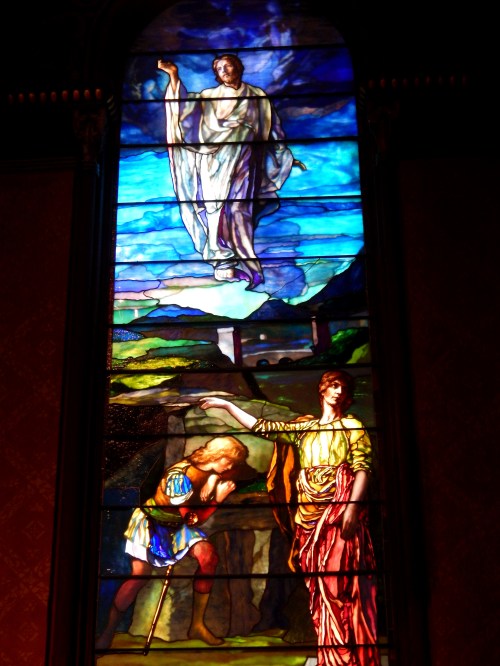
In 1888, part of the church lot was taken by the City of Cambridge for the widening of Front Street (now Massachusetts Avenue).  After careful consideration it was decided to move the building to its present location on Inman Street.  The building was cut into two parts and, as described in the church brochure, “Over a period of five days, men and horses were used to pull the building through the 40-ft. wide streets of Cambridge.  … Telephone and telegraph service were also temporarily interrupted…” When placed in the new location, a middle portion was inserted to increase the length twenty feet.  In addition to other major remodeling efforts, over time, there were at least three series of stained glass window installations. Artisans included Redding, Baird and Co., Belcher Glass Co., and an unnamed student of John LaFarge.

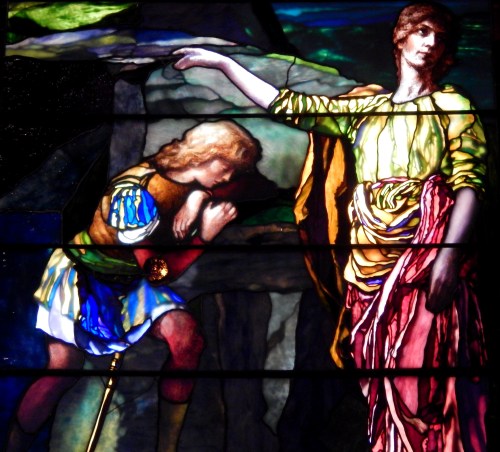
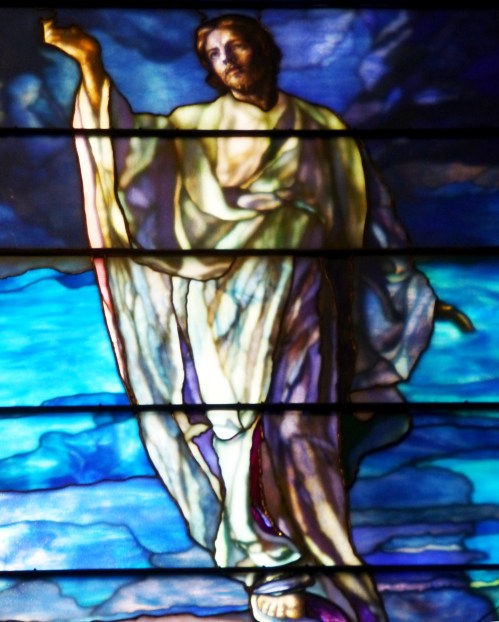
By 1954, the Universalist congregation had diminished to a very small number providing the opportunity for the orthodox parish of St. Mary to obtain the structure.  Later, assessed as part of the process for listing on the National Historic Register, the building was identified to have some of the rarest stained glass in the Northeast.

That particular day, I just took a quick peek, and what a delight.

Across time and despite the change in parishes, great effort has been made to protect, preserve and expand upon the stained glass windows and other interior decoration.

Please note that if you’re in the area, tours may be arranged.

I am thankful for the opportunity to visit so unexpectedly.

And I was reminded once more …you never know what a day will bring.

Sources/Additional Readings

St. Mary Orthodox Church Website

new blooms in the house

… but I usually like to send them off with just a simple word or two like “Hi, how are you?” and conclude with a smiley face.  Okay, sometimes I say a bit more, like “remember to look at the sunset outside your window.” These are a few of the postcards available in my online shop.  You can view the full selection via this link:  ImagesbyCynthia Postcards

http://www.zazzle.com/imagesbycynthia

… when you walk through Ricky’s Flower Market.  Spring has arrived (even if another flake or two might fall before month’s end).  I love my indoor gardening but I do appreciate wandering through this outdoor market. A simple way of finding calm. 😉

enduring legacies

Courtesy of Trinity Archives

Photo of Charity, Courtesy of Trinity Archives

Charity is a stained glass window once located at Trinity Church in the City of Boston. It was designed by Frederic Crowninshield.  The inscription at the bottom of the window, barely legible in the above photo, reads “In memory of Cordelia Harmon, the friend of the poor and friendless. Died May 25, 1883.”  In an 1888 publication providing a descriptive account of the church, including of its windows, Harmon was described as “the Almoner of Trinity Church for many years, and through her good deeds was well known by all the poor in any way connected with the Parish.  The window was a gift of members of the Parish.”

Born in Maine, Cordelia Harmon (1820-1883) spent her adult life in the Boston area.  It is clear from surviving records that she consistently strove to help those who could least help themselves.  Regardless of good deeds done as an elementary school teacher, a nurse at Mass General Hospital or serving people through programs offered by her church, Harmon appears to have never turned her eyes away from the wrongs that remained around her.

One of the church-supported programs that she participated on was The Ladies’ Relief Agency.  As a part of that charity’s design, every application submitted seeking assistance was investigated, including a home visit.  Through such visits, and no doubt her work with other charities, Harmon was able to see firsthand the lack of support for those with chronic diseases, people who were turned away from hospitals, and many of whom had no family to care for them.  She would write:  “How can a man, breathing fetid air, living in the squalor and debasement that abound, where the poor most do congregate and often of necessity, feel hope or courage to rise above his condition?

Harmon imagined creating a home for those people where they could live a good life until the end of their days.  It was an idea that she would discuss with Phillips Brooks, the rector of Trinity Church.  He would help her raise the funds to open The Boston Home for the Incurables in 1881.  Harmon would work at this home until she “died at her post” in 1883.  Phillips Brooks was traveling abroad when he learned of Harmon’s death.  In a letter to his brother he wrote:

Despite his expression of not feeling well-fitted to do the work of Cordelia Harmon, upon his return to Boston, Phillips Brooks did continue her legacy.  In 1883, Trinity formed The Committee for the Establishment of The Boston Home for Incurables to raise funds to expand upon Harmon’s idea.  Funds raised helped the Home to acquire a larger facility and accommodate more patients.  It would continue to expand and refine its services over the next 130 years.  Today, the Boston Home is a respected, model institution serving nearly 100 residents.

Charity, designed by Frederic Crowninshield,

The only known surviving image of the Harmon window is a black and white photo taken in the 1920s. In the center of the image, a woman and two children, destitute.  To the left, a figure with head bowed, the weight of the world upon his shoulders.  Standing amidst them is Jesus.  And above them all, in capital letters, is the text:  Inasmuch as ye have done it unto one of the least of these, my brethren, ye have done it unto me.  The window did not survive major renovations that took place in the 1950s. The window may be gone but the memory and legacy of Miss Cordelia Harmon lives on and continues to evolve.


Sources, Additional Reading, Etc.

http://www.thebostonhome.org/

https://www.givingcommon.org/profile/1072657/the-boston-home-inc/

September 19, 2014 article with video: http://assistivetech.scripts.mit.edu/blog/finding-a-home/

Charity postcard with insert about Harmon available at Trinity Church Bookshop

A plain black gown emphasized her type, which is fine, clean cut and deceptively simple.  Her eyes are dark and bright, her hair spun silver and the modulations of her low pitched voice are peculiarly musical. Denying herself color, she is a master of color.

Margaret Redmond, circa 1927

Margaret Redmond, circa 1927

In 1927, artist Margaret Redmond (1867-1948) was interviewed in her studio at 45 Newbury Street, Boston.  The interviewer Helen Fitzgerald described the space as, “a veritable treasure trove to the art lover.  All about her color glows and flames.  On the walls are sketches of colorful places … and the light transmuted by the stained glass of her own making fills the room with rays of gold and ruby, emerald, violet and blue so intense that it stirs in the sensitive observer an emotion akin to ecstasy.

Detail from Evangelists Window, Trinity Church, 1927

Detail from Evangelists Window, Trinity Church, 1927

Detail from the Evangelists Window, Trinity Church, 1927

Detail from the Evangelists Window, Trinity Church, 1927

For the 1927 interview and in others, Redmond describes in detail her stained glass technique and why she chose to work with glass quite differently than contemporaries John La Farge or Louis Comfort Tiffany, whose works she admired.  As author Elinor Morgan summarized, La Farge and Tiffany designed with glass, whereas Redmond sought to use the glass as her canvas.

Detail from the Evangelists Window, Trinity Church, 1927

Detail from the Evangelists Window, Trinity Church, 1927

Born in Philadelphia, Redmond would study at the Pennsylvania Academy of Fine Arts, travel abroad to study in Europe, before returning to the states. In that 1927 interview, Redmond shared, “I went to England and France, where I spent two years studying the old glass windows in cathedrals, churches and museums. … My studies led me to many old cities and their churches and cathedrals.

Detail from the Evangelists Window, Trinity Church, 1927

Detail from the Evangelists Window, Trinity Church, 1927

When I had completed my pilgrimage of the cathedrals, I studied with Simon and Mellard in Paris.  Returning to this country, I came to Boston and entered the studio of Connick, the famous maker of stained glass, where I made my first window.”

Charles Jay Connick

Charles Jay Connick

Redmond apprenticed with Connick between 1906 and 1910.  Prior to that she bought a farm in Nelson, New Hampshire in an area that would become a hub for artists and intellectuals with Pennsylvania roots.  Redmond would maintain a summer home and studio there. Examples of her painting and stained glass work can still be found in this community.

Though her medieval inspired style of glassmaking was not in vogue, Redmond received a wide range of commissions for work in churches as well as in private homes and businesses. She exhibited her work, including watercolors and oil paintings as well as stained glass items, at arts and craft shows across the nation.

The 1920s and 1930s is considered her most productive period and this is when, for approximately $12,800, she would produce a series of windows for Trinity Church in the City of Boston, from the Apostles to the Evangelists (pictured earlier in this post) to scenes from the life of David and Solomon.

Throughout her career, Redmond was an innovator, for instance, experimenting with different uses for stained glass in the home, including fire screens which were popular in the period.  Though respected as an artist, she like many women was too often ostracized in a male-dominated field.  But in her studios she worked with both men and women, making a special effort to train young women as assistants in the different phases of the work.  In 1931, Connick would ask Redmond to list some of her favorite creations.  She would include on the list the windows produced for Trinity Church.

Detail from Tree of Life Window, Trinity Church

Detail from Tree of Life Window, Trinity Church

I have been unable to find a book solely about Margaret Redmond, or a single listing of her creations, but her papers including contracts are housed in the Smithsonian Archives of American Art.  A research project for another day perhaps. 😉

Sources/Additional Reading

Creates Stained Glass Windows, Margaret Redmond Searches Europe for Secrets of her Chosen Art, September 11, 1927 article interview by Helen Fitzgerald, Sunday Eagle Magazine, September 11, 1927

History Written in Glass by Elizabeth B. Prudden, The Christian Science Monitor, June 30, 1931

A Woman in Stained Glass … Against the Odds by Elinor Morgan, Stained Glass Quarterly, 1990

Women Artists at Trinity: Sarah Wyman Whitman and Margaret Redmond, article by Erica E. Hirshler in Makers of Trinity ed. by James F. O’Gorman, 2004

Redmond Papers at the Archives of American Art