Feeds:
Posts
Comments

Posts Tagged ‘art’

James Weldon Johnson and Aaron Douglas

James Weldon Johnson (1871-1938) and Aaron Douglas (1899-1979)

Originally published in 1927, James Weldon Johnson’s book, God’s Trombones, is a slim volume composed of a prayer and seven poems: Listen, Lord–A Prayer, The Creation, The Prodigal Son, Go Down Death, Noah Built the Ark, The Crucifixion, Let My People Go, and The Judgement Day. The verses were inspired by his experiences attending black churches throughout the American south. The preachers’ oratory inspired Johnson to write these poems and, in the book’s preface, to reflect upon the nature of oration and folk traditions. His poems, I assume, inspired his artistic collaborators, Aaron Douglas and Charles B. Falls. The signature styles of two very different artists were brought together to complement Johnson’s words.

lettering by Charles Buckley Falls

Lettering by Charles Buckley Falls (1874-1960)

A publication was produced that is really quite distinctive with regard to words, images and overall concept. Johnson as scholar as well as poet produced a tome that captured in a unique way the power and importance of religion in the African American experience. He makes real even for those not having attended black churches how the preachers – God’s trombones – used word, rhyme and rhythm to give voice to the stories in the bible even when no bible was present.

Illustration

It would be easy to pick up this book, to skip the preface and go straight to the poems. But don’t. Johnson’s preface is critical, for his brief and cohesive insights into religion and the American experience, and for his guidance in how to truly appreciate what he was attempting to do with this book.

I claim no more for these poems than that I have written them after the manner of the primitive sermons. In the writing of them I have, naturally, felt the influence of the Spirituals. There is, of course, no way of recreating the atmosphere — the fervor of the congregation, the amens and hallelujahs, the undertone of singing which was often a soft accompaniment to parts of the sermon; nor the personality of the preacher — his physical magnetism, his gestures and gesticulations, his changes of tempo, his pauses for effect, and, more than all, his tones of voice. These poems would better be intoned than read; especially does this apply to “Listen, Lord,” “The Crucifixion,” and “The Judgment Day.” But the intoning practiced by the old-time preacher is a thing next to impossible to describe; it must be heard, and it is extremely difficult to imitate even when heard. …

“… The tempos of the preacher I have endeavored to indicate by the line arrangement of the poems, and a certain sort of pause that is marked by a quick intaking and an audible expulsion of the breath I have indicated by dashes. There is a decided syncopation of speech — the crowding in of many syllables or the lengthening out of a few to fill one metrical foot, the sensing of which must be left to the reader’s ear. The rhythmical stress of this syncopation is partly obtained by a marked silent fraction of a beat; frequently this silent fraction is filled in by a hand clap. …

The ensuing poems do read like song and the power of the words are echoed and strengthened by the complementary visusals.

Illustrations by Douglas for the poems, The Creation, The Prodigal Son, and Go Down Death.
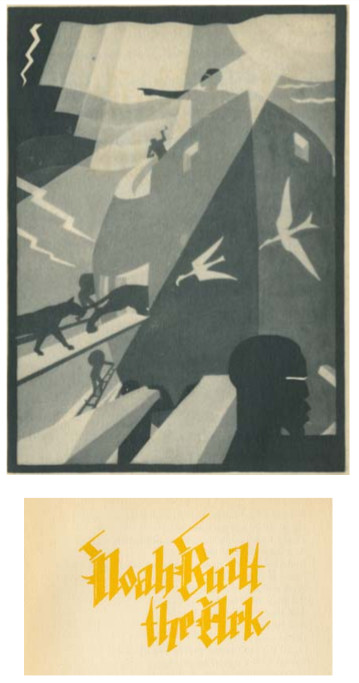
Illustrations by Douglas for the poems, The Creation, The Prodigal Son, and Go Down Death.

Noah Built the Ark

Illustration and complementary chapter head for Noah Built the Ark

Illustration for The Crucifixion
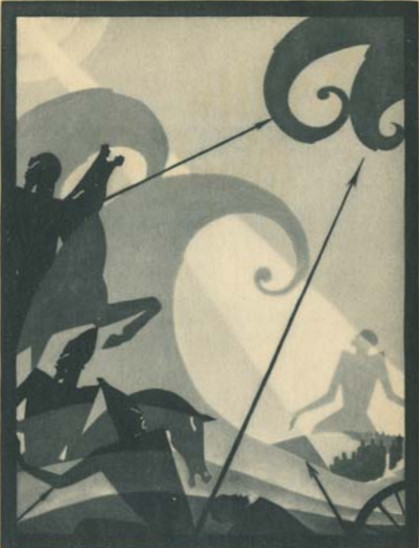
Illustration for The Crucifixion

Illustration for Let My People Go
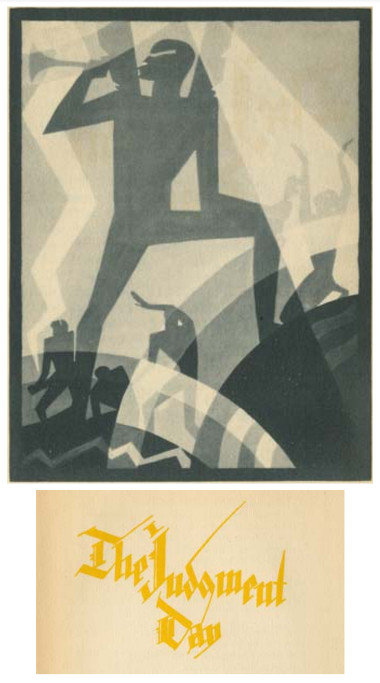
Illustration for Let My People Go


Both Johnson and Aaron Douglas are considered key figures of the Harlem Renaissance. Charles B. Falls was a noted illustrator and designer especially remembered for the posters he created during World War I and II as part of the Victory Books Campaign.

Over time the book has been reprinted numerous times including an edition by Penguin Classics, edited by Henry Louis Gates and with an introduction by Maya Angelou. As Johnson wrote in his preface the poems are really meant to be performed and over the years many individuals and institutions have done just that. Recordings can be found online.  You can also find the book fully digitized and viewable online thanks to the Documenting the American South project at University of North Carolina at Chapel Hill, my primary source for this post. I hope you have the opportunity to view the book in-hand or online: http://docsouth.unc.edu/southlit/johnson/johnson.html


Sources & Additional Readings

God’s Trombones (digitized) – http://docsouth.unc.edu/southlit/johnson/johnson.html

James Weldon Johnson – https://en.wikipedia.org/wiki/James_Weldon_Johnson

Aaron Douglas – https://en.wikipedia.org/wiki/Aaron_Douglas

Charles Buckles Falls – https://en.wikipedia.org/wiki/Charles_Buckles_Falls

The New Negro Renaissance – http://exhibitions.nypl.org/africanaage/essay-renaissance.html

More about the Victory Books Campaign – http://arcweb.sos.state.or.us/pages/exhibits/ww2/services/books.htm
Read Full Post »

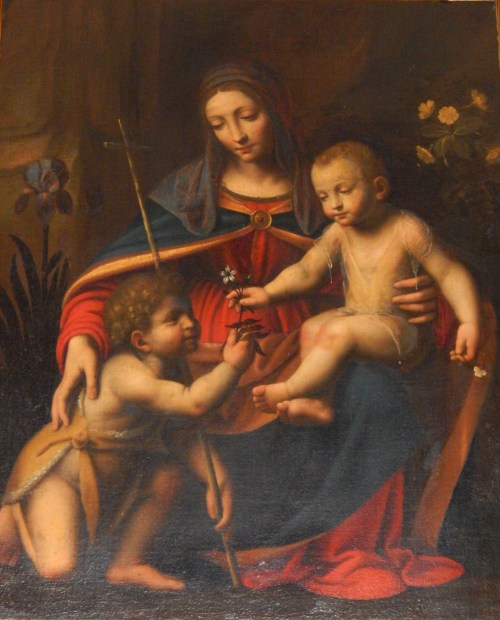
In a church, I walked into a room to photograph a specific set of stained glass windows that were at eye level, and when I turned to walk out I happened to look up and this is what I saw hanging on the wall. I don’t yet know the name of painter or painting. That research continues, and if you have any incites please let me know. I’m not a formal student of fine arts but I can imagine that there are layers upon layers of meaning in the choice of colors, the flowers shown, etc. More information to follow in the near future I hope.

Read Full Post »

Trinity Church in the City of Boston has produced a new guidebook that highlights and explores the art and architectural features of this historic gem. The 48-pages feature information about the principal makers of the building, its design and construction which primarily took place between 1872-1877, interior and exterior decorations, and much more. It is a visual treat with reproductions of original sketches, early watercolor paintings, as well as interior and exterior images by many fine local photographers. I am honored to have two photos in this book including this detail from John La Farge’s Purity stained glass window.

As noted at the end of the publication, the guidebook is dedicated to Edward Earl Duffy (1960-2012), a Trinity Church parishioner and tour guide who loved the building’s art and architectural legacy. The book is available for $11.95 in the church gift shop. Enjoy!

Save

Read Full Post »

My earliest memories of my uncle are of a dapper man from New York visiting his big sister (my mother) in Virginia during the summers. He would hang out with my dad drinking my dad’s homemade wine. Then in later years I remember that we would receive beautifully printed Christmas cards that were unlike anything my younger brother and I had ever seen. Several decades have passed since then. My parents have passed away. He’s since moved from New York to settle in South Carolina. Now that travel is difficult for him visiting him was the primary impetus for my recent southern travels.

Uncle Freeman was a silkscreen printer in New York who, while employed at institutions like American Image Editions, printed the works of Andy Warhol, Larry Rivers, Robert Indiana, Ed Paschke and many other artists. Once he’d learned the art of screen printing he informally taught others including Isabelle Collin Dufresne, known as Ultra Violet. A signed copy of her memoir sits on his bookshelf. “She was famous, right?” I asked my uncle. He said, “She wanted to be.”

When we went to visit my uncle, now 80 years old, I was anticipating an interview where I’d collect tawdry details of Warhol and his parties, the lowdown on the New York arts scene of the 80s and 90s, and so on. But my uncle, ever the gentleman, would only chuckle or smile as we queried him relentlessly. He did share some of the prints he still has in his possession and would describe the techniques used to produce the colors and shading on the page. His wife, who loves butterflies, mentioned accidentally cutting up a Salvador Dali screen print because she was so intent on obtaining the butterflies at the top of the page she did not notice Dali’s signature at the bottom. The altered print hangs quite lovely on a bedroom wall.

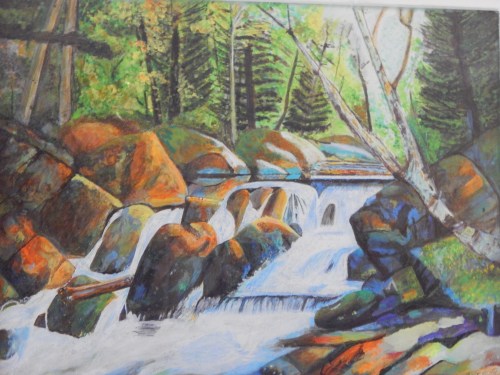
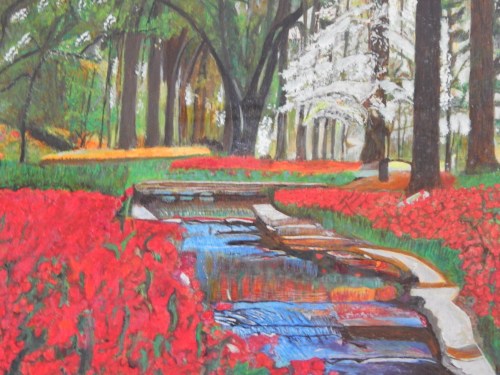
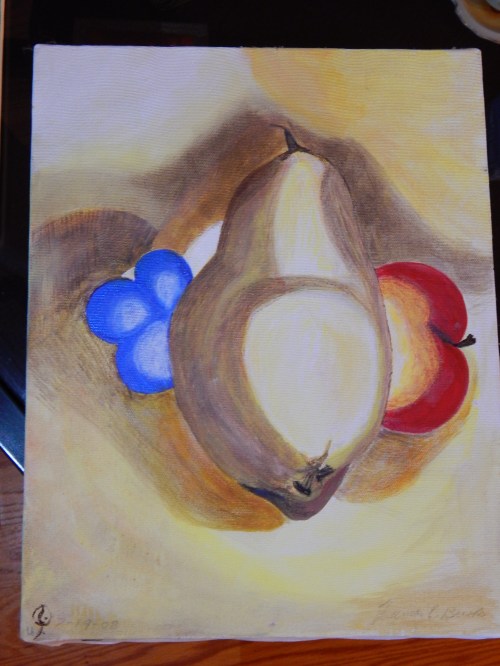
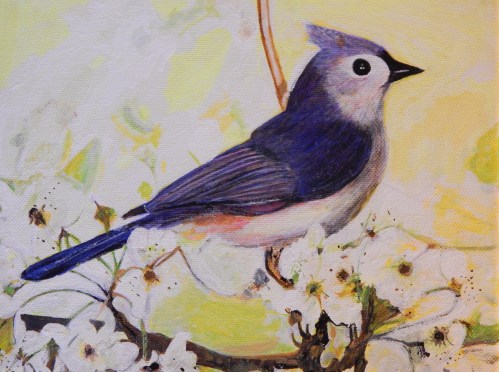
It was the art on the walls that kept drawing my attention in my uncle’s modest home. A few screen prints hung,  but mostly the walls were lined with canvas paintings. I began to notice artwork outside as well, paintings on trees and wooden panels. Finally I asked who did all of the paintings and he said, “I did.” His wife pulled more from under a bed and those tucked away in closets.  As for when he did them, he said the majority were done while recovering from prostate cancer. As he received treatment, “I couldn’t do much but I could paint.”

He shared no rhyme or reason for his subjects. “Just whatever came to mind and whatever pens and paints I had available.”

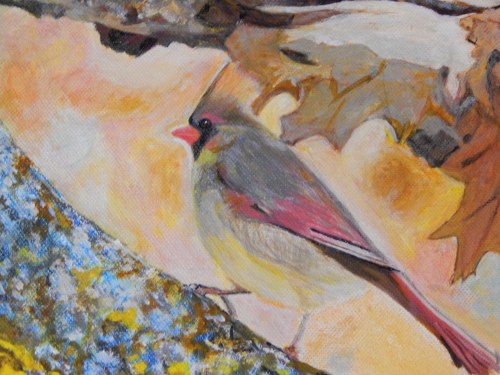
Birds seemed to be a favorite theme.

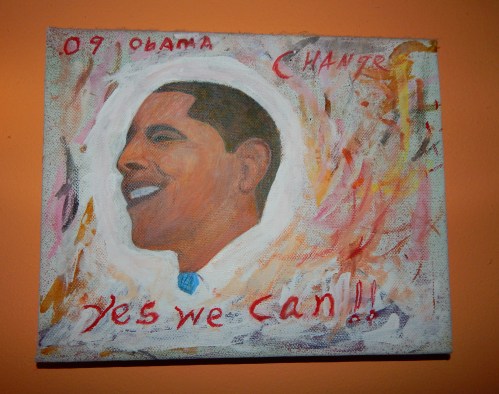
And then there was Obama. Born in the south in the 1930s, having experienced the realities of racism firsthand, Obama’s election meant a great deal. “I have a better painting of him,” he said as I gazed at this one on the wall, but we never got around to finding it.

He hadn’t painted before the cancer, he said, and he hasn’t really painted since his recovery. But I have encouraged him to do so. In fact I suggested a subject.

In the evenings as we sat down to dinner he would make his way slowly to the front door and open it wide. For the first few days that we visited, there was nothing to see but then the final evening, he said, “Cynthia, come over here.” And there they were, this magnificent flock of birds flying overhead, filling the sky with their dark silhouettes. They all seemed to settle in one far distant tree. My uncle said, “Sometimes there are so many in the canopy they turn the tree into a square.” “That’s it!” I said. “That’s what you should paint next. The birds in the sky.” He listened patiently as I described my vision but in the end he just shook his head and chuckled. 🙂

Read Full Post »

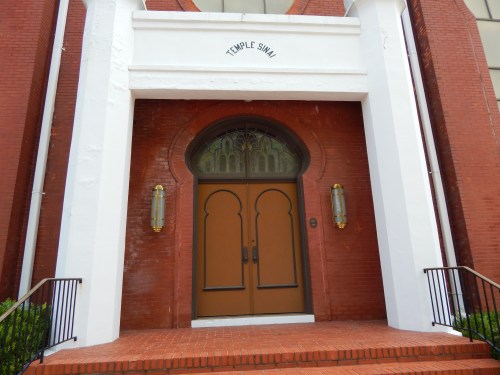
While traveling in Sumter, South Carolina it was my pleasure to visit the Temple Sinai, founded as a Reform Jewish Congregation. The history of Sumter’s Jewish community dates back to 1815. The first Jews who settled in Sumter were Sephardic and came from Charleston, SC. The current congregation was formed in 1895 by the merger of the Hebrew Cemetery Society and the Sumter Hebrew Benevolent Society. Construction of the congregration’s present temple was begun in 1912 and completed in 1913.

A feature article in the March 1913 Sumter newspaper The Watchman and Southron notes “The Temple is situated on the corner of Church street and Hampton avenue and is an imposing structure of red brick with domed roof … The architectural lines are simple, but the proportions are so good and so well harmonized that the general impression is one of beauty, allied to strength and permanence. As impressive as is the exterior of the Temple, it is the interior that is its chief beauty and glory …”

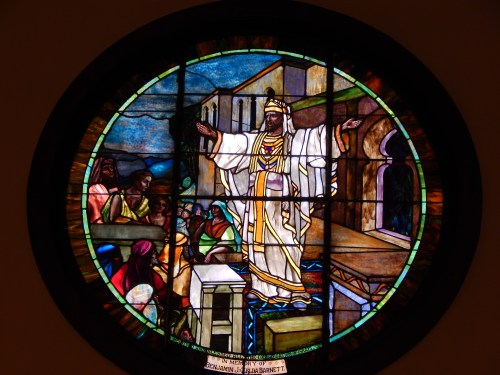
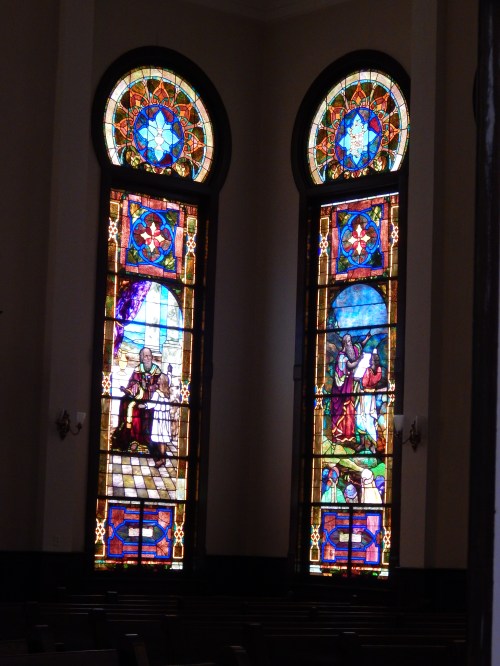
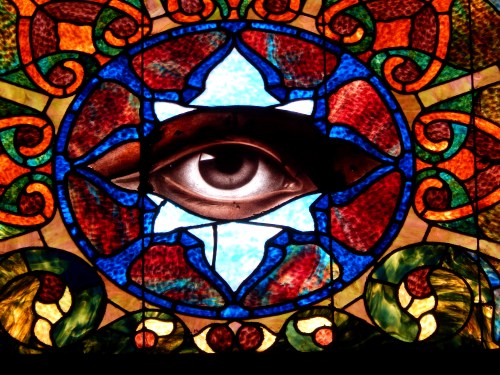
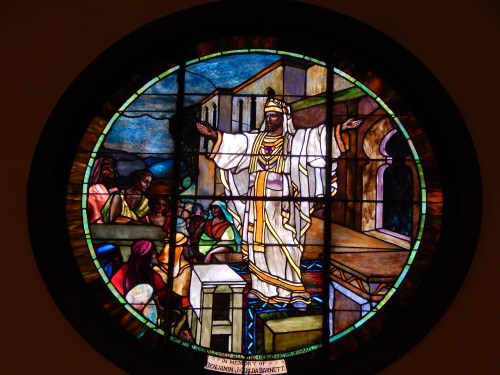
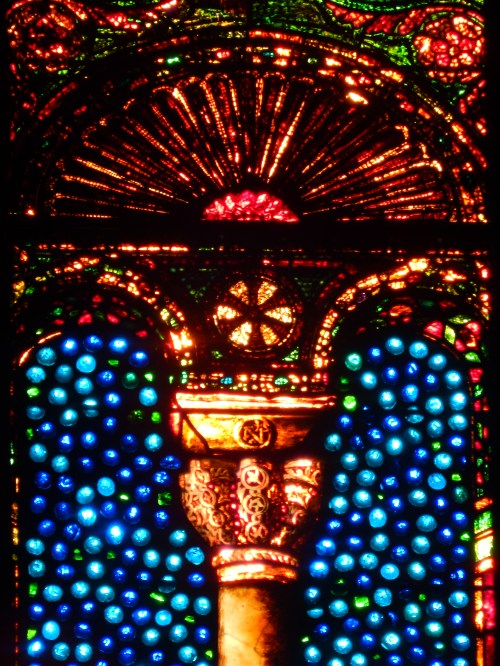
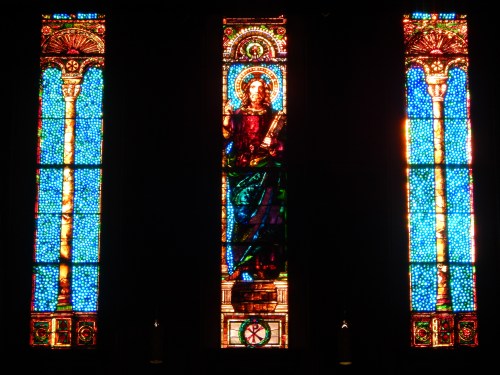
In terms of architectural style the brick building is Moorish Revival. Eleven stained glass windows grace the interior. Ten of the windows are 5 feet wide by 20 feet high and their shape mimic the building’s moorish towers, each a tall window illustrating a story surmounted by a half-window with further decorative detail. The eleventh window is round and is located high on a back wall.  While the specifics of the window designer and makers are elusive, the windows are thought to be handmade in Germany. Installation began in 1912 as indicated in a local newspaper article from September 1912, “The beautiful stained glass windows of Temple Sinai have arrived and are being placed in position.”  One month earlier, the same publication had noted, “The work is winding up on the new Jewish synagogue in this city and it will be only a short time now before the remodeled Temple Sinai will be one of the most beautiful places of worship in the city.

At age 95, Sumter native Robert Moses, a descendant of one of the first Jewish families to settle in Charleston and then in Sumter, is one of the last active members of Temple Sinai. As part of an educational presentation, he describes the windows as late Victorian in style, with rounded tops and interlacing borders giving them an eastern/Moorish look. Known as drapery glass due to the folding of the glass to add depth and color, the brilliant blues have cobalt added and gold was added to brighten the reds.

Each window depicts a scene from the Old Testament including as described in a 1913 newspaper article:

The Test of Faith, involving Abraham and Isaac …

The Blessing – Isaac Blesses Jacob …

detail from isaac blesses jacob

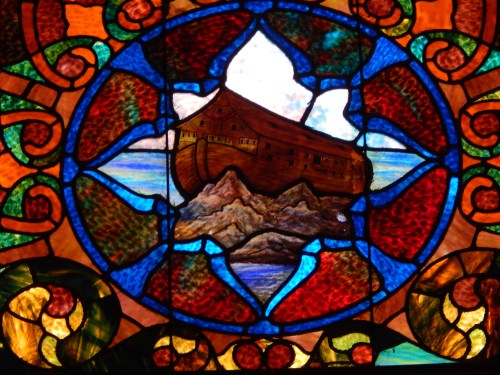
detail from isaac blesses jacob - the ark on ararat

detail from isaac blesses jacob – the ark on ararat

Jacob’s Dream …

detail from jacob's dream

detail from jacob’s dream

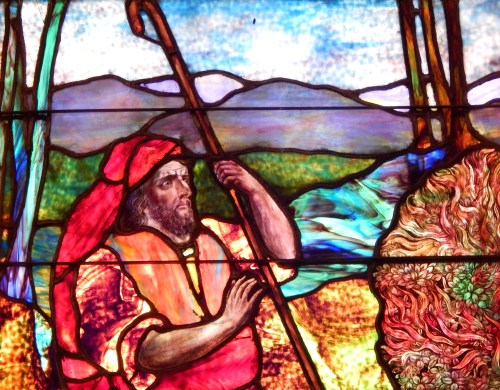
Vision of Moses when he sees the burning bush …

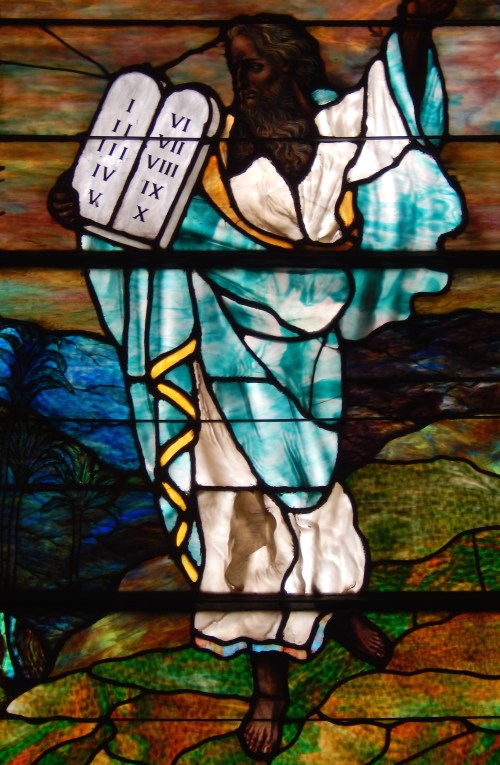
Moses on Sinai with the Ten Commandments …

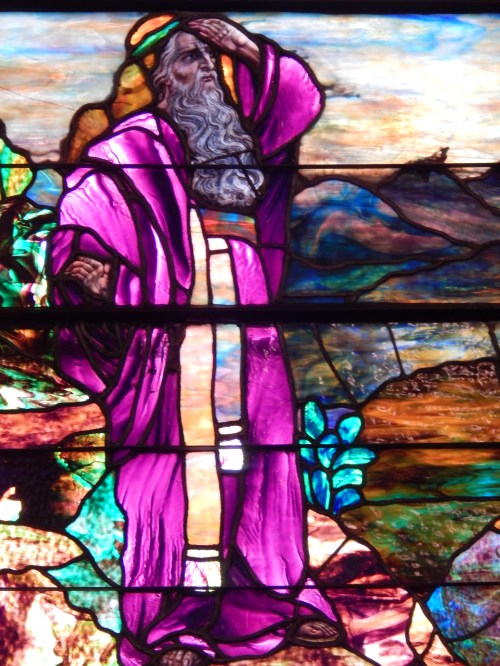
Moses on Nebo overlooking the promised land which he is forbidden to enter …

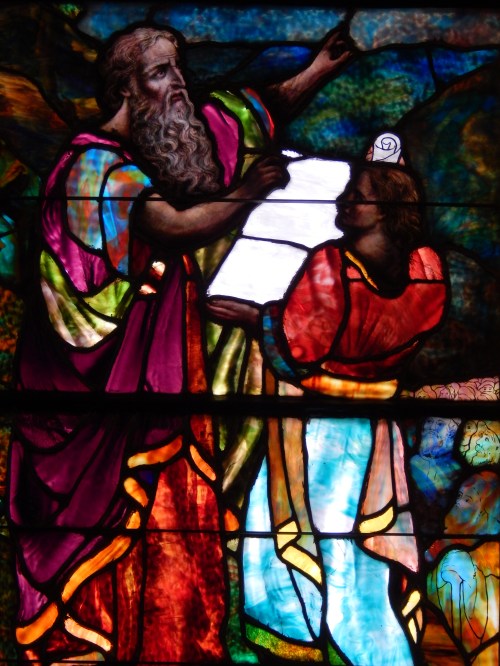
Moses Delivering Laws to Joshua …

Samuel Before Eli …

detail from samuel before eli

detail from samuel before eli

Elijah in Solitude …

detail from elijah in solitude, also known as elijah and the ravens

detail from elijah in solitude, also known as elijah and the ravens

David the Shepherd Boy …

and Solomon at the Dedication of the Temple.

Members of the Moses family were kind enough to allow me entrance into the Temple to photograph details of the windows and share just a bit of the history of people and place. The windows of this place are unique for their pictoral illustration.

Temple Sinai is listed on the National Register of Historic Places. For more information, or to inquire how you can help preserve this historic structure, contact Temple Sinai, 11-13 Church Street, P. O. Box 1673, Sumter, South Carolina 29151 or call (803) 773-2122.

Sources and Additional Reading

(1) “House of Worshop of Jewish Congregation to be Dedicated on March 28th, ” The Watchman and Southron, March 8, 1913.

(2) The Watchman and Southron, September 21, 1912.

(3) The Watchman and Southron, August 10, 1912.

Temple Sinai Wikipedia page

Encyclopedia of Southern Jewish Communities – Temple Sinai

Records of Temple Sinai


Save

Save

Read Full Post »

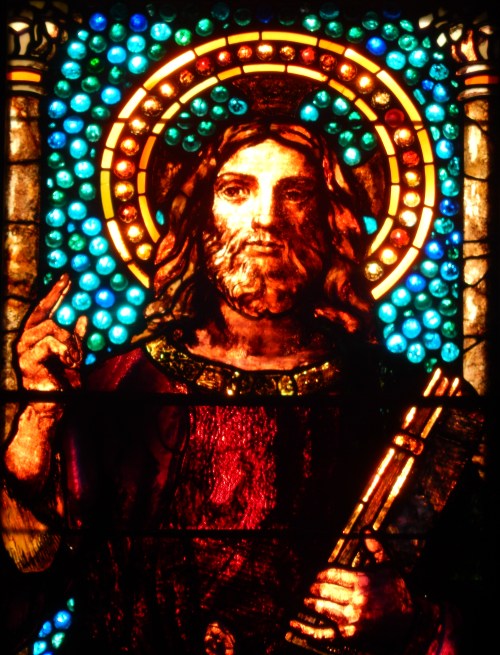
Details from two of the eleven stained glass windows in Temple Sinai in Sumter, SC. Stay tuned for more photos and the history of this beautiful historic structure in the near future.

Read Full Post »

I don’t just challenge others and reap the culinary rewards, I also try to challenge myself and so in the coming weeks I am challenging myself to photograph and research two different sets of stained glass windows (at least).  The first will involve some travel as I make my way to South Carolina to visit with relatives and en route may have the opportunity to photograph stained glass windows in a historic synagogue.  The other involves researching this window (above) I noticed in a building while walking in the Back Bay of Boston. Stay tuned for future updates, and meanwhile, here’s a window located in a place I write about often, Trinity Church in the City of Boston. It is Hope by Burlison & Grylls.

Read Full Post »

to photograph its stained glass windows and along the way I stumbled upon Raphael’s Transfiguration (1516-1520). Not the original of course. That’s in the Vatican. This painting, which my guide at the time knew little about, appears to be a 19th century reproduction. The history of this particular painting – its creation and who gave it to the church – may be lost to history.  However, I’ve since learned from a research fellow at the Boston Museum of Fine Arts that such reproductions were popular and prints being produced as early as the 16th century.

Transfiguration was Raphael’s last painting. He died at the age of 37 leaving the painting incomplete. It is considered one of his most beautiful works out of a very large body of work. It was a treat to chance upon the reproduction and perhaps one day I will see the actual painting in person. Meanwhile, below is a photograph of Raphael’s handiwork and you can read details on the Vatican Museums website here.

Raphael’s Transfiguration, photo by Alvesgaspar, CC BY-SA 4.0, https://commons.wikimedia.org/w/index.php?curid=43522641

Additional Reading

https://en.wikipedia.org/wiki/Raphael

http://www.mfa.org/collections/object/the-transfiguration-of-christ-31006

Read Full Post »

detail from stained glass window christ preaching by john la farge (1883)

Christ Preaching is a three story clerestory window located on the west end of Trinity Church in the City of Boston.  Beautiful at any time of day, because of its location, it especially comes to life as the sun begins to set.

Sometimes when tourists enter Trinity the first words they literally ask is, “Are there any Tiffany windows here?” When they learn that the answer is no, they will shrug, albeit politely, and walk away. And I can only shake my head, knowing firsthand what they are walking away from.

Learn more …

http://trinitychurchboston.org/art-history/windows-slideshow

http://library.bc.edu/lafargeglass/exhibits/show/descriptions/all-saints/trinity-boston

Read Full Post »

i keep sitting down to write you about this painting… and each time i draw a blank… it is a favorite of mine… a poster of it welcomes you into my studio …” — Donald Langosy, 2016

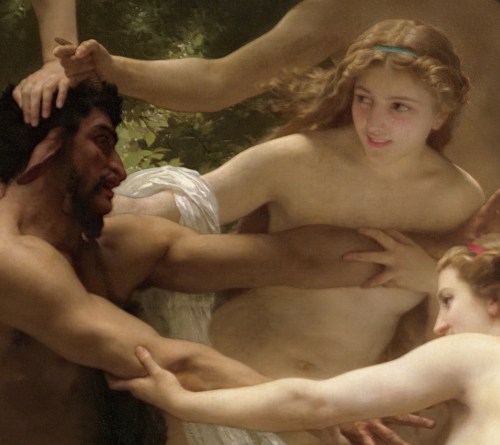
detail from nymphs and satyr by bouguereau

detail from nymphs and satyr by bouguereau

Of late I’ve become quite bold in asking people to share with me in words and sometimes images the beauty that they experience. I want to understand why a certain piece of music heard, a poem read, or a moment in a certain field can move them so deeply. In painter Donald Langosy’s case, I wanted to know why he was so moved by Bouguereau’s Nymphs and Satyr (1873), a painting held in the collection of the Clark Art Institute in Williamstown, MA. I’d learned from Langosy’s daughter that, as with Titian, it was a work of art Langosy might like to see in person one day.  And so I asked him to please tell me why, and as I waited for his words, I did a little bit of my own research into this Bouguereau.

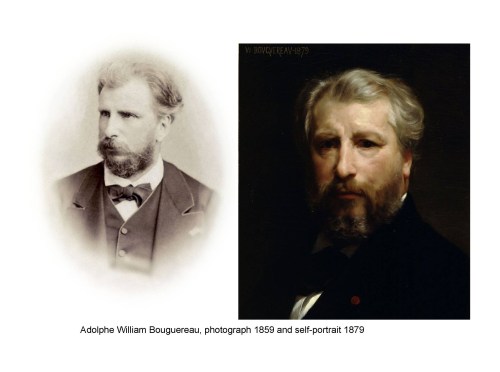
Adolphe William Bouguereau (1825-1905) was a French figurative painter noted for producing rather luminous works with Classical, mythological and religious themes. His work was very popular with the European and American public during his lifetime. He received top prices for his work. He not only painted portraits, but he also decorated private homes, churches and public buildings.

Pieta, 1876

pieta, 1876

Quite prolific, he apparently produced over 800 finished paintings. In addition, beginning in the 1860s he taught at the Academie Julian in Paris. Among his many students over the years he would teach Henry Ossawa Tanner and Ellen Day Hale. As I read criticism about his work from across the different decades, both the words beautiful and escapist were applied. During the height of Bouguereau’s career there was a new movement starting in the French art scene, Impressionism. Many within this new school were not enamored of Bouguereau’s work and actively belittled it. Despite the controversy surrounding his subject matter, so polished and dreamy during an age of great turmoil, few denied the mastery of his technique.

sadly,” notes Langosy, “Bouguereau is remembered for his unending number of paintings of little girls and poetically posed young virginal women…. which is unfortunate… for it distracts from his many accomplishments…like this one, which is among the finest masterpieces ever painted…

…compositionally outstanding…. but outstanding because of the remarkable brush work… which is brilliant because of his command of color and line….. the sensual twirl feeling of the nymphs… the satyr in a diagonal angle attempting to brace himself against their attempts to over power him… Bouguereau’s subtle sense of line accenting the individual rhythms of the different poses…

…rhythm of line is what creates three dimension on a two dimensional plane…. and then there are the leaves and grass and the water… egads!….i’m speechless… i haven’t written enough about this painting… but now you will understand why it took me this long to write

And that is how I came to learn of nymphs, satyrs and appreciate the work of Bouguereau through the words of Donald Langosy.


Additional Readings & Images

http://www.clarkart.edu/Art-Pieces/6158

http://www.bouguereau.org/

http://www.getty.edu/art/collection/artists/780/william-adolphe-bouguereau-french-1825-1905/

https://commons.wikimedia.org/wiki/William-Adolphe_Bouguereau


Save

Read Full Post »

« Newer Posts - Older Posts »