Feeds:
Posts
Comments

Posts Tagged ‘art’

KadirNelsonNYKRcoverJuly2018

One of my favorite New Yorker covers to date, and an uplifting sight to pull from my mailbox at the end of the day. The artist is Kadir Nelson and you can read more about him, and the story behind the painting, on his website: http://www.kadirnelson.com/about

Read Full Post »

IMG_20180710_122232180

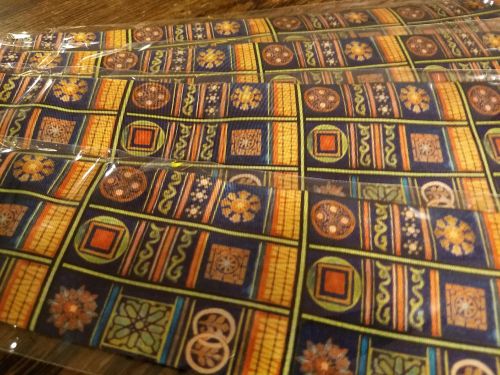
… what do you see? Well when you look up inside Trinity Church in the City of Boston, in the nave, you see a beautiful painted ceiling with abstract patterns and artistically rendered script. I shared a fuzzy photograph with Donna McNett of DonaScarves who then worked her magic to design a stunning menswear collection that includes a necktie, bow tie and pocket square. Available exclusively at Trinity Church. Shipping is available. Send inquiries to artandarchitecture@trinitychurchboston.org. Or leave me a note and I’ll pass your message along. 🙂

IMG_20180710_135502091


Read Full Post »

Like his big brother Phillips Brooks in Boston, the Reverend Frederick Brooks was making a name for himself inside and outside of the pulpit doing good works in Cleveland, Ohio.  In 1874 he returned to the Boston area to find a teacher for a school that he had founded. In the course of his travels, on a stormy night on September 15, he left a disabled train in East Cambridge and decided to walk along the bridge. As his father recounted, “The night being dark, he fell through the draw and was drowned. He was thirty-two years of age. The body was not found until the 20th in the Charles River. Funeral services were held September 24 …” In Cleveland, Frederick Brooks had served as rector of St. Paul’s, a prominent church.  And that may be why Trinity Church vestryman Charles J. Morrill. if he had a hand in the selection of theme, chose to honor the memory of Frederick Brooks by funding a memorial window depicting Three Scenes in St. Paul’s Life. The window is located on the northern wall of the nave, designed by Henry Holiday of London, 1878.

1

The story begins with a young Saul sitting with his teacher Gamaliel.

2

The center picture represents Saul’s conversion to Christianity.

3.JPG

The final image is of Saul, now Saint Paul, preaching to the people of Athens. As a whole the window is almost overwhelming … which makes sense given that it tries to capture one of the most complicated life stories in “just” three scenes. What is it I always say? See for yourself when you have the opportunity.

6

https://trinitychurchboston.org/visit/tours

Read Full Post »

Luke

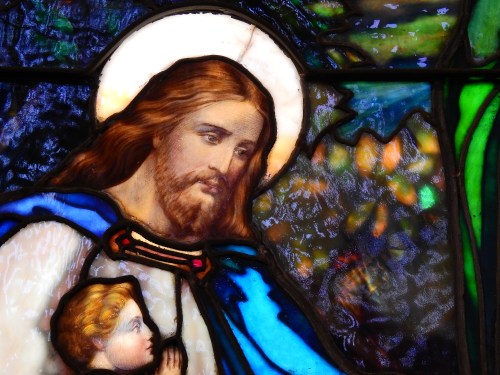
Detail from St. Luke as Physician and Evangelist, a stained glass window located in the south transept of Trinity Church in the City of Boston, designed by Heaton, Butler & Bayne of England, 1920, in memory of James Sullivan Amory (1809-1884) and his son Robert Amory (1842-1910), a noted physician.

Read Full Post »

ChristusConsolator1851Scheffer

Christus Consolator by Ary Scheffer, 1851

Following is the last stanza of a poem by John Greenleaf Whittier written in 1859 but with a relevance for this day as well:

O heart of mine, keep patience! Looking forth,

As from the Mount of Vision, I behold,

Pure, just, and free, the Church of Christ on earth;

The martyr’s dream, the golden age foretold!

And found, at last, the mystic Graal, I see,

Brimmed with His blessing, pass from lip to lip

In sacred pledge of human fellowship;

And over all the songs of angels hear;

Songs of the love that casteth out all fear;

Songs of the Gospel of Humanity!

Lo! in the midst, with the same look He wore,

Healing and blessing on Genesaret’s shore,

Folding together with the all tender might

Of His great love, the dark hands and the white,

Stands the Consoler, soothing every pain,

Making all burdens light, and breaking every chain.

Whittier wrote the poem in response to a publisher producing a book of prayer with a cover image of Ary Scheffer’s painting Christ Consolator … but with the image of the enslaved black man removed.

ChristusConsolatorCropSlave

In preface to the poem, Whittier wrote: “It is hardly to be credited, yet is true, that in the anxiety of the Northern merchant to conciliate his Southern customer, a publisher was found ready thus to mutilate Scheffer’s picture. He intended his edition for use in the Southern States undoubtedly, but copies fell into the hands of those who believed literally in a gospel which was to preach liberty to the captive.

WhittierWarriorPoet

John Greenleaf Whittier (1807-1892) and broadsheet of his poem Our Countrymen in Chains

Described as a Quaker, poet and abolitionist, Whittier wielded words as a warrior poet to fight for the end of slavery. A literary giant and inspiration to many, it was his friendship with two people that enabled me to learn about his poetic response to someone’s efforts to rewrite history by altering a work of art.

LarcomBrooks

Lucy Larcom (1824-1893) and Phillips Brooks (1835-1893)

Lucy Larcom was a respected teacher, poet and author. Based on her letters and biographies, throughout her life, she grappled with spirituality and religion. After hearing Phillips Brooks sermons at Trinity Church in Copley Square, they began a correspondence that developed into a deep friendship. He became a religious guide in her life. She was also close friends with Whittier. In one of her letters to Whittier, in 1892, she wrote:

“I have always thought of thee as a spiritual teacher. And then in late years to have had in addition the teachings and friendship of Phillips Brooks has been a great and true help. I thank God that you two men live and, “will always live,” as he says to you, and that I have known you both. When [Brooks] called at Mrs. Spaulding’s after seeing you, he told us about the Ary Scheffer poem and repeated it to us from the words “O heart of mine,” through to the end, as he went away, standing before the picture — Christus Consolator,” which hangs at her parlor door …”

All three of these literary figures died within a few months of each other. Lucy Larcom was the last and she writes … yes, poetically … about the loss of each of these men and her gratitude for their guidance in her life. It was but random chance finding her letters online that enabled me to revisit Whittier’s works and appreciate how, like Brooks in the pulpit, he used words to make a difference. An endless need across time …

Sources & Additional Reading

Lucy Larcom: Life, Letters, and Diary by Daniel D. Addison, 1894.

https://en.wikipedia.org/wiki/Lucy_Larcom

Full text of On a Prayer Book by John Greenleaf Whittier, 1859.

Our Countrymen in Chains by John Greenleaf Whittier, 1842

Christus Consolator


Read Full Post »

DSCN2116

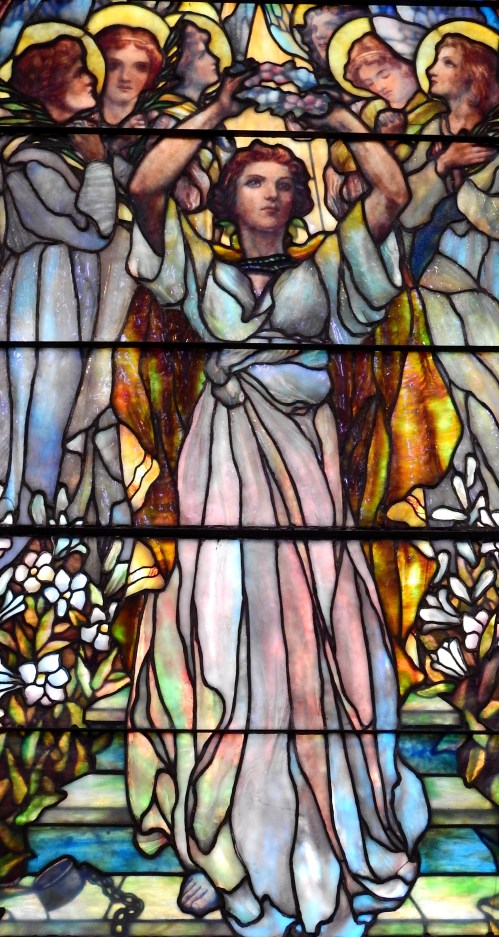
I’m a details oriented person for the most part, in fact so much so, that I know I sometimes miss the big picture. But by being details oriented it becomes easy to recognize things … in this case … As my companion and I walked around the perimeter of Saint Mark’s Episcopal Church I could see the outlines of the stained glass windows. I pointed. “That for sure is Tiffany Studios, and maybe that one, too.”  “You’re sure?” he asked. “Oh, yes,” I said with more confidence than I actually felt. “Look at the faces and the opalescent glass. The drapery. Signature Tiffany.”

DSCN2114

He took me for my word and began helping me tug on doors. A homeless man making himself comfortably in a shady corner waved us over and said, “You need to go to that door.” We thanked him. It was locked but eventually, as service was about to begin, an usher unlocked the door and let us in. He was very kind.

DSCN2117

As my companion talked with him about the organ, I snapped away trying not to disturb parishioners starting to settle in. And this is what I saw …

DSCN2121

DSCN2122

As for if and how many of the windows are actually Tiffany Studios, I don’t know for sure. That would involve a deeper level of research and conversation with the church historian or archivist.

DSCN2123

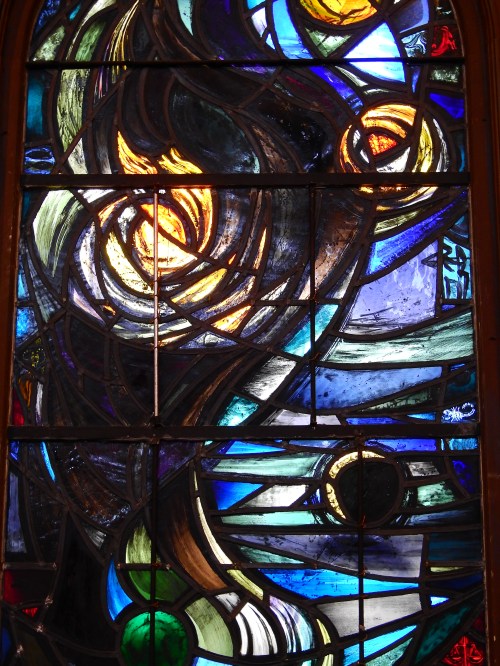
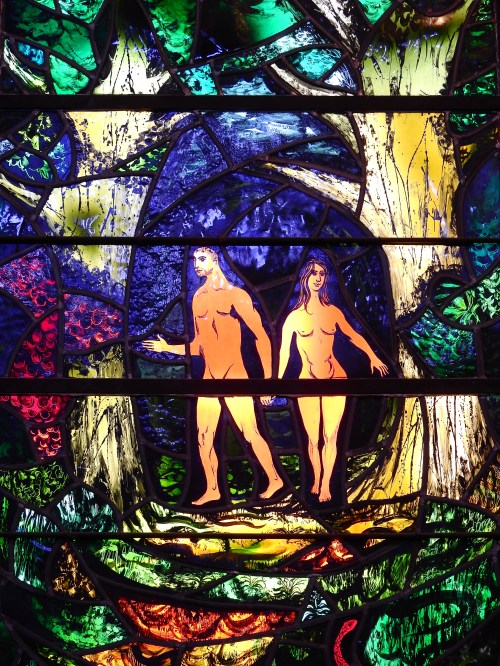
But just as fascinating would be to discover more about the windows that are decidedly modern looking in a style I’m not yet familiar with on the East Coast.

DSCN2132

DSCN2133

Sometimes reminiscent of Chagall for me. What do you think?

DSCN2134

DSCN2130

Anyway, mostly when I see glass of such different styles in a sacred space I am reminded that the building like the people can be dynamic. A lovely, quick visit … 🙂

DSCN2140

DSCN2127

https://stmarksberkeley.org/

Read Full Post »

FC2

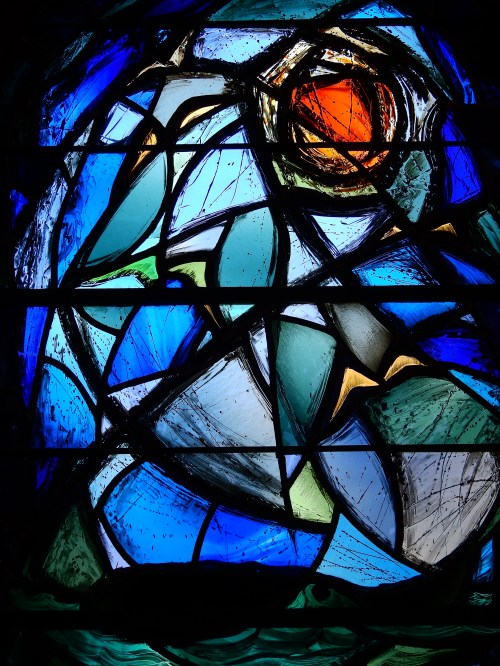
It wasn’t quite one of my “the door was open and I peeked in” adventures. It was more, it was a Sunday, the church doors were open and we were welcomed in and allowed to take pictures before the service began. Very inviting airy place with bright sun shining through colorful windows.

FC4

FC5

FC6

FC7

FC8

http://firstchurchberkeley.org/

Read Full Post »
PurityThermos.JPG

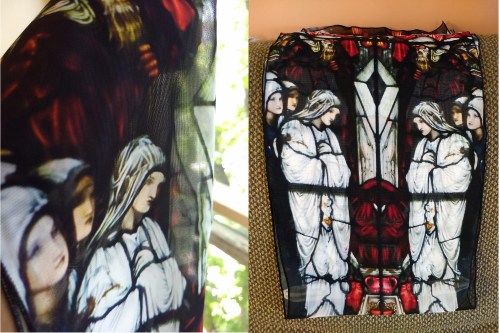
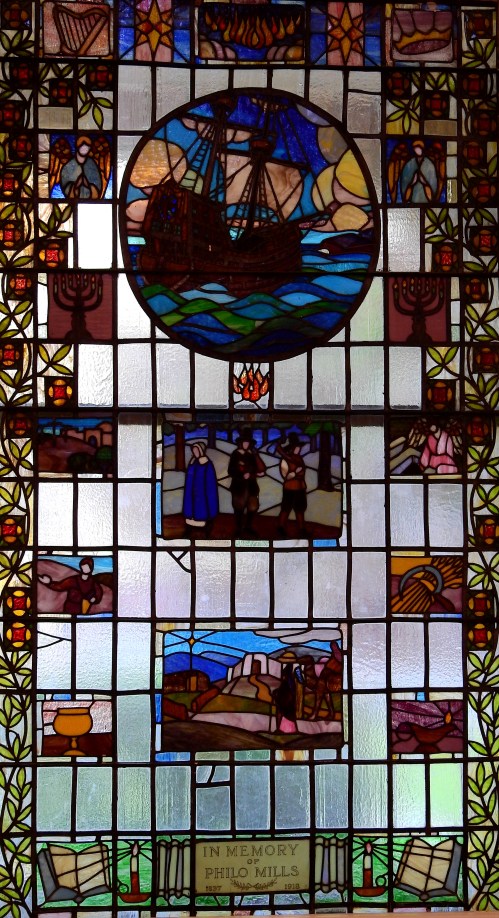
I’m quite pleased with the new travel thermos featuring the Purity stained glass window design. I’m a pretty happy go lucky person but every now and then even I need to add a bit of brightness to my life and I think this thermos fits! Available at the Trinity Church gift shop. If you’re not in Boston, and are interested in purchasing, send inquiries to artandarchitecture@trinitychurchboston.org. And in the works, new silk chiffon scarves inspired by Burne-Jones and William Morris …

IMG_20180531_095246820

At least two variations on a theme are in production, the designs inspired by details from one of my favorite windows at Trinity Church, David’s Charge to Solomon. Soon to be available exclusively at the church gift shop.

DavidsChargeScarfVariations

As for the rest of this day, back to paperwork (aargh!) and then out into the sunshine with my camera. More reflections upon water to view, squirrels and birds to chase down, and maybe even a church or two to be found with sunlit stained glass windows. We’ll see … Have a good day, folks!

Read Full Post »

I couldn’t help myself. Despite how I ended the previous post, I had to dig just a little deeper and this is what I found.

historyofcalvini00hitc_0126

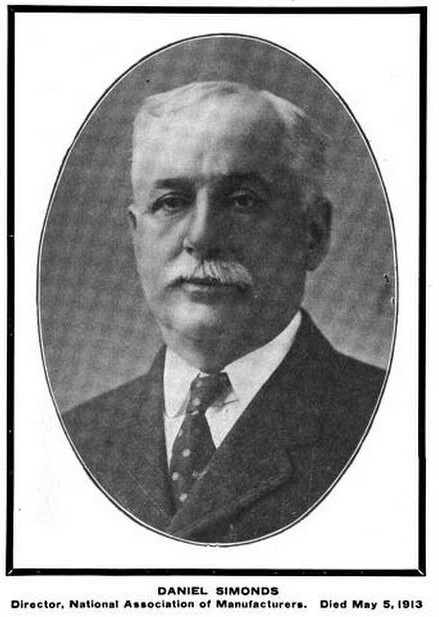
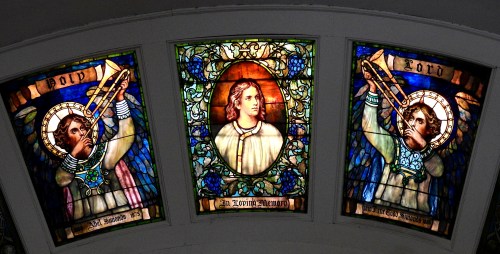
In 1902 this was the archway over the altar in Faith United Parish, then known as the Calvinistic Congregation Church. In 1904 that archway was altered to incorporate a memorial to the parents of Daniel Simonds. Simonds was the son of Abel and Jane Todd Simonds. Abel Simonds was the founder of the Simonds Manufacturing Company, a company operating and still headquartered in Fitchburg. Son Daniel was an astute businessman who led the company’s growth internationally. With his great wealth, he invested heavily in his hometown of Fitchburg and in the good works of his church.

DanielSimonds

In the April 16, 1904 issue of The Congregationalist and Christian World, Volume 89, there is a note in the Record of the Week section stating that at the Fitchburg Calvinistic Congregation Church “Choir arch redecorated and its center supplied with windows of beautiful design, the whole a gift of Daniel Simonds, in memory of his parents. They were dedicated Easter Sunday.” Unfortunately no artist or studio is named in the article.

DSCN1671

DSCN1670

As for mystery #2 …

DSCN1648

Based on information gleaned from Fitchburg Sentinel newspapers from 1930, it appears that the window, named The Resurrection, was a gift to the church by Mrs. Daniel Simonds, born Ellen Gifford.

GiffordWindow

Again, no clues as to studio or artist at this time. But who knows what might be revealed one day. 🙂


Read Full Post »
DSCN1681

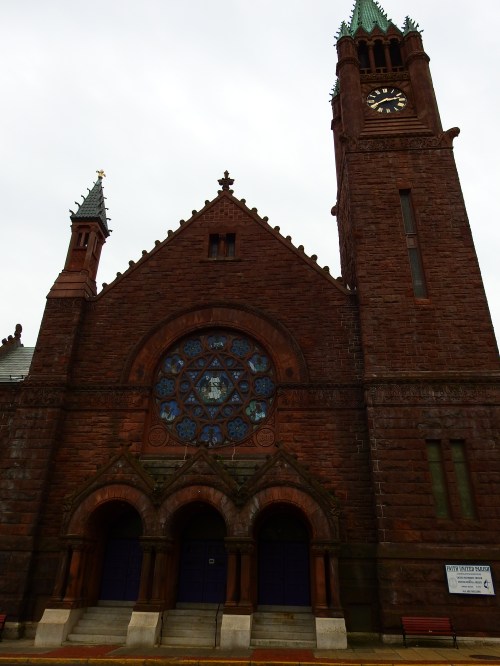
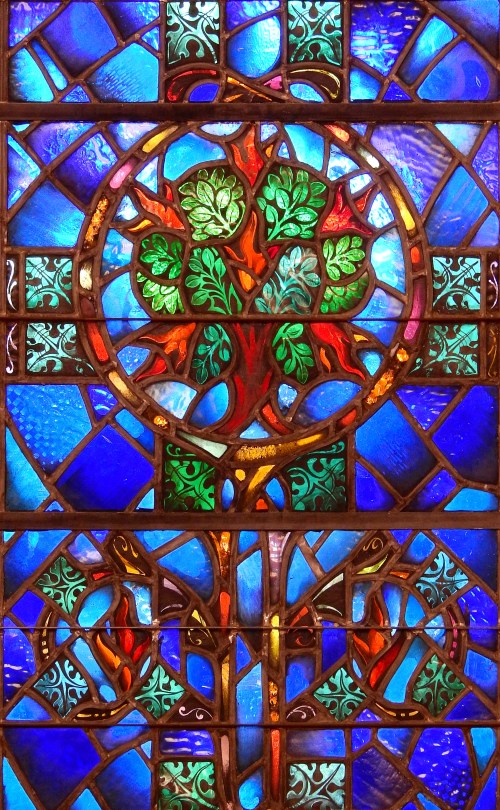
As noted on its website, the church currently known as Faith United Parish is home to a number of beautiful stained glass windows. Located on Main Street in the city of Fitchburg, Massachusetts, both the building and its congregation have evolved over time and continue to do so. Originally known in the 1800s as the Calvinistic Congregational Church, it merged with the First United Methodist Church in 1967, forming an urban cooperative ministry.

DSCN1603

The building, which was to be the third meeting house for this congregation, was designed in 1897 by architect and parishioner H. M. Francis who was influenced by the Romanesque Revival sparked by Henry Hobson Richardson with his creation of Trinity Church in the City of Boston. Standing outside the building on the corner of Main and Rollstone streets, one is immediately struck by the heavy stone facade, rounded arches, tall tower with its beautiful clock, and dark tracery of the interior stained glass windows.  Thanks to Pastor Jeff Conlon who allowed entry inside to see the windows firsthand.

DSCN1682

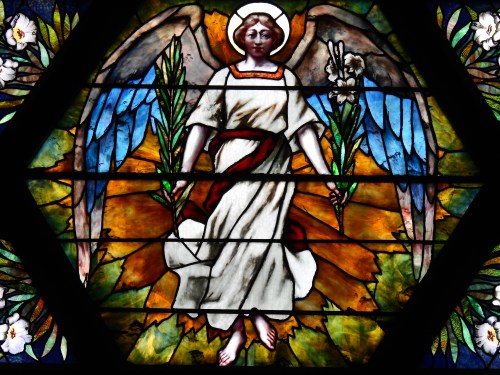
The rose window was designed by the Boston firm of Redding, Baird and Company. It measures twenty feet in diameter and its theme is the angelic choir.

rosewindow

The six angels are the spirits of Praise, with scroll; Love, holding the sacred dove, Music, blowing the trumpet, Music, playing the harp, Teaching, reading from the Book of Life, and the herald-angel of Easter morning.

DSCN1631

DSCN1632

DSCN1633

DSCN1638

DSCN1636

The description of the rose window is taken from the 1902 book, A History of the Calvinistic Congregational Church and Society, Fitchburg, Massachusetts. In 1902there were only two memorial stained glass windows in place, one given by Edward G. Bailey in memory of his mother Mrs. Rodney Wallace …

5

Dorcas

and the other given by George Hildreth in memory of his wife Pauline C. Hildreth.

hildreth2

These windows, plus three others added in 1903, are credited as Tiffany Studio windows designed by artist Frederick Wilson.

DSCN1655

While not widely known today, Frederick Wilson was a major ecclesiastical designer of the late 19th and early 20th centuries. He was employed most notably by Tiffany for nearly thirty years and worked for other studios at the same time including Heaton, Butler and Bayne.

DSCN1656

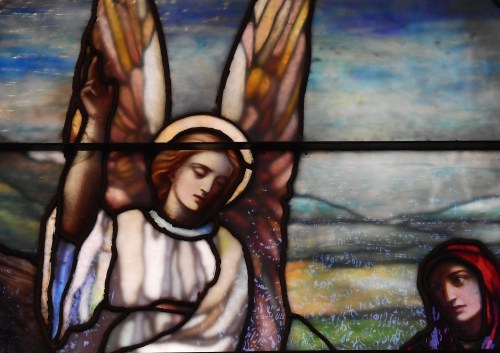
Resurrection Angel

DSCN1611

Call of Matthew

DSCN1613

Call of Matthew

Two other figurative windows are present though not necessarily attributed to Tiffany or Wilson.

DSCN1666

While the above window does have similar opalescent and drapery glass as the Tiffany windows, the final window I photographed is strikingly different.

DSCN1645

A 1938 article in the Fitchburg Sentinel newspaper references this window, the Gifford Memorial window, as having been gifted to the church during the prior ten years. By the 1920s there was a distinct move away from the opalescence and designs that Tiffany and John La Farge had made famous. The use of rich colors and a reworking of the medieval inspired a new generation of artists. As for the name of this artist and his or her studio it is unclear without further research.

DSCN1648

While my focus tends to be stained glass, there were many other beautiful features to be seen inside as well as without, and I’m not the only one who thinks so. The building is considered one of the most important examples of Richardsonian architecture remaining. In 1979, the building was enrolled in the registry of National Historic Places. You can learn more about this important building and its church services via the following link. It was a great pleasure to visit.  http://www.faithunitedparish.com/index.htm


Sources & Additional Reading

https://en.wikipedia.org/wiki/Calvinistic_Congregational_Church

https://en.wikipedia.org/wiki/Henry_M._Francis

A History of the Calvinistic Congregational Church (1902)

Read Full Post »

« Newer Posts - Older Posts »