Two of my favorite phrases that help me get through some days. 😉
Posted in Inspiration, Nature Notes, tagged animals, Charles River, colors, ducks, Inspiration, life, nature, Photography, reflection, water on October 10, 2014| 5 Comments »
Posted in Inspiration, tagged colors, Contributing Writer, culture, Edwidge Danticat, family, fashion, Haiti, Inspiration, Katia Ulysse, life, Photography, poetry, scarves, storytelling on August 19, 2014| 4 Comments »

My mother had a drawer full of scarves, of every size and color imaginable. The textures tended toward silky or the fine sandy grain of those materials that were sheer. My scarves are more dispersed throughout my environment, possibly because, in a way, I have more personal space than my mother ever had.

She would have been a teen and partying young woman in the 1950s and 1960s when scarves were a fashionable part of the ensemble. By the time I came along in the 1970s, my mother wasn’t partying so much but she still had that drawer full of scarves, and I remember my father still buying her scarves throughout much of my childhood.

Whether for elementary school or high school, when I left the house in the morning for my journey, if the wind was blowing fiercely, if she’d done my hair the night before, if there was even a chance of sprinkles … she’d wrap one of her colorful scarves around my head and tie it beneath my chin. In elementary school, I may have looked cute. In high school, when scarves were not fashionable … well, I once passed by a group of girls and one of them said, “What is she wearing?!” But, even as I felt bad, I heard another girl say, “Leave her alone.” What I remember from that moment, this day, is the care of my mother and the care of that stranger.

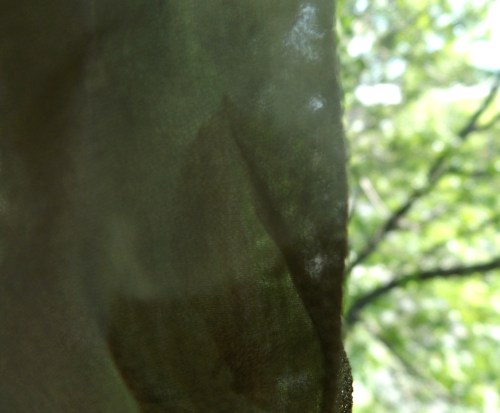
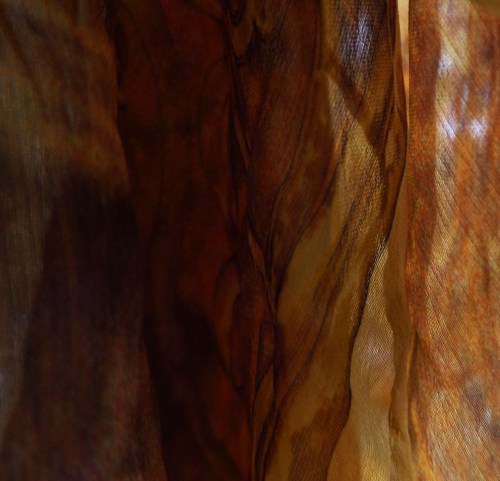
My small scarves I keep in a little gold box on a book shelf. I rarely use them or even look at them but I’m not ready to part with them. Long, narrow scarves I keep in a basket, and when I am too lazy to track down my leather belt, I’ll pull out one of those scarves to hold up my pants. Large, square scarves I learned to wrap around my head using techniques my mother did not know. Those I’ve tucked away in a drawer. I mostly wear long, oblong scarves, especially the ones given in recent years by friends and family. I wear them to freshen up an outfit. And, of course, I photograph them as they are or use them to serve as background for a leaf. And, in this house, with so many windows, I sometimes hold them up to see what happens when the light shines through.

These musing of the morning were inspired by a link recently shared by a friend, a Salon interview by Edwidge Danticat of Katia D. Ulysse. As my friend described to me, it is a thought-provoking, poetic exchange between two writers of Haitian heritage. An excellent read. At some point there is reference to scarves, and that was all the inspiration needed for me to crack open a box. Have a good day.

Posted in Inspiration, tagged compassion, hands, Inspiration, joy, life, Photography on August 3, 2014| 6 Comments »

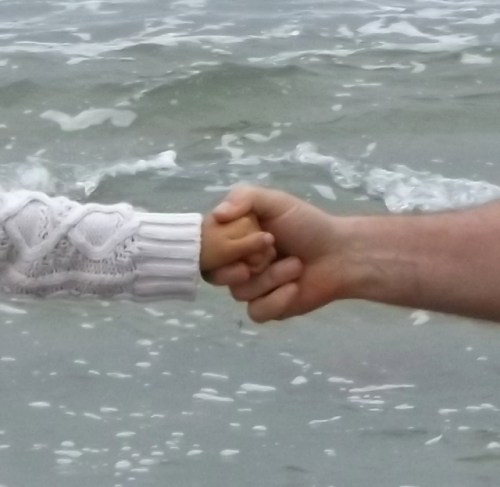
a helping hand across cold waters
An imperfect image yet one I could not make myself delete. An older man was helping a very young child cross big stones at the ocean’s edge. She was having a grand time dancing above the waves and perceived no danger in the rising tide. The man was more wary, and getting quite wet, but given the smile on his face at the child’s unconstrained joy, a bit of wetness was all worth it.
Posted in Inspiration, tagged abstract, beauty, family, Inspiration, kindness, life, light, Photography, shadow, storytelling on June 9, 2014| 7 Comments »

One day, one of my brothers called and it was clear that he was in need of immediate assistance. Not for physical trauma. He needed someone to lean against, as we all do at some time. I was thousands of miles away. I could not get to him so I called a person that my brother had mentioned in recent years, an older gentleman who’d been an important figure in high school but I had not seen or spoken with him in over two decades. That day I used the online white pages to track down his home number. With barely a greeting, I told him I was sending my brother to him. He simply said, in a lovely warm voice, “Okay, Cynthia. I’ll be waiting.” And then I called my brother and I told him that he needed to get to that gentleman’s house and when he did he was to call me. He said, “Okay, Cynthia. I’m going.” Time did pass but then the phone did ring. My brother said, “It’s me. Hold on.” Then he passed the phone to the gentleman who said, “Don’t worry. I’ve got him under my wing.”

Why does that story come to mind today? Years have passed. My brother is fine. He and the gentleman remain close friends. I think the story surfaces because over this past week I have been witness to other acts of kindness, and reminded of people like this gentleman, willing to spread their wings over those in need, without question and without expectation. They are bits of brightness in the sometime dark, men and women who are often not recognized by others or even by themselves for the beauty they add to the world. By the way, I have not seen the gentleman in this story, or spoken to him, since that day. I did send him a postcard saying thank you. And, he sent me a card back saying you’re welcome.
Posted in Branches, Inspiration, Nature Notes, tagged beauty, Boston Back Bay, Branches, colors, Inspiration, leaves, life, nature, neighborhoods, Photography, trees, urban landscape on June 7, 2014| 8 Comments »
Posted in Uncategorized, tagged art, art history, artwork, culture, interlude, interludes, Joseph A. Horne, life, military history, storytelling, war on June 3, 2014| 13 Comments »
Following is an updated table of contents (TOC) for the series of interludes, a collection of historical vignettes, threaded together by following in the footsteps of one gentleman, Joseph A. Horne (1911-1987). It’s a glimpse into history that continues to shape this world. It’s been a wonderful, sometimes surprising, experience for me. The interludes will conclude over the next few months including a few more “interlude extras.” I hope you enjoy this journey of words and images.
I. interludes TOC
iii. interlude: exodus, part 1
v. interlude: dust in the wind
vii. interlude: to protect, preserve, and return … if possible
viii. interlude: offenbach archival depot
II. interlude extras
interlude extra: arnold genthe
interlude extra: edward gordon craig
interlude extra: washington labor canteen, eleanor roosevelt and race relations
interlude extra: erich stenger
Posted in Inspiration, tagged blues, colors, family, Inspiration, James Baldwin, life, music, Photography, Sonny's Blues, storytelling on May 27, 2014| 5 Comments »
“All I know about music is that not many people ever really hear it. And even then, on the rare occasions when something opens within, and the music enters, what we mainly hear, or hear corroborated, are personal, private, vanishing evocations. But the man who creates the music is hearing something else, is dealing with the roar rising from the void and imposing order on it as it hits the air. What is evoked in him, then, is of another order, more terrible because it has no words, and triumphant, too, for that same reason. And his triumph, when he triumphs, is ours.” — Sonny’s brother in Sonny’s Blues by James Baldwin
I’ve been lucky enough to know people with a wide variety of tastes in music, and I’ve especially appreciated their attempts to express what the music evokes for them. I wouldn’t mind asking my father what the blues did for him, but I don’t really need any concrete words. I’ll always remember the looks on his face as he played those 78s. He loved listening to the blues (and wasn’t too bad playing along on a harmonica). He played the blues a lot after my mother passed away, mostly, because he had the freedom to do so. You see, my mother hadn’t been too keen on that music. It made her too sad. But, that music, no matter how dark, seemed to put some pep in my father’s step even as he wiped away tears.
I was reminded of my parents, and other family and friends, as I recently read James Baldwin’s short story, Sonny’s Blues, about two brothers coming to understand one another. Near the end, the youngest brother, the troubled one, and the musician, is up on stage, playing the blues as part of a quartet. As the older brother reflects upon what he is seeing and hearing, the reader is reminded that music can be a salve for old wounds, a bridge between past and the present, and, perhaps most importantly, it is through music that life is shared. As Baldwin writes, “For, while the tale of how we suffer, and how we are delighted, and how we may triumph is never new, it always must be heard. There isn’t any other tale to tell, it’s the only light we’ve got in all this darkness.”

blue lillies along the mystic, 2014
Posted in Inspiration, tagged compassion, family, friends, friendship, gifts, Inspiration, life, love, musings, Photography, seeds, wishes on April 6, 2014| 6 Comments »
I wish I had the money to wipe away all of the debts of my family and friends. Because if their debts were gone, would that make them happy? Would financial freedom allow them to treat themselves better, as well as improve their treatment of the people in their lives? No fancy behavior required, just respect, if not outright love and compassion.

Would it enable them to give the people in their lives a hug, on occasion, or at least a pat on the hand, and even sometimes to perform such actions without even being asked? Would it enable them to talk to each other and communicate in ways that work for all involved and not just one side? Perhaps conversations could take place without someone always having to be wrong so that someone can be right.
But I don’t have such funds to give and even if I did, I’m not sure that it would make a difference because in the end, I can control no one’s behavior except my own. Maybe I should wish for the money so that I can travel around the world, to where all these friends and family members live, those that are suffering and in some form of pain. Perhaps I could pass out those hugs or those pats on the hand, so that certain people know that they are loved and that their presence does make a difference to the people around them and always has, even if words of gratitude are not often shared.
Of late I have received so many calls and notes from friends and family, all suffering in some way, but mostly feeling alone though they are surrounded by others. I hear only their words, and know that there is always more than one side to any story. I can make no judgements about those others in their lives. I just wish that all were happy and each knew how precious each day was to have such people in their lives. I can listen to the words and I can read the notes but I cannot change behavior. But there is something I can do.
Each spring into summer, I buy seeds of all kinds, in packages large and small. I send them out into the world to family and friends, of all ages, to help people pause and maybe even share a precious moment with others as they plant the seeds in the soil. I send them to the closest of friends and family, and I send them to family and friends I know not very well at all. I send them to the people who cannot speak to each other in hopes they can plant a seed together even if they do so in silence. It is a selfish act — to know that I did something, gave something, to another. I do not know what the seeds do for the recipients or even if the seeds are planted. I simply hope they are. I hope they are.
*the photographs are the latest series of photographs taken through the rippled glass, of life blurried but still beautiful
Posted in Inspiration, tagged dreams, family, Inspiration, life, memories, parents, Photography, reflection, rocks, storytelling, water on March 31, 2014| 8 Comments »

blue stone in water in black bowl
One night a year or so ago, I entered my childhood home and walked into the kitchen. The light was low and the air was warm. I sat at the table with my mother, feeling welcomed as always. Just as I did when I returned home from college, I began to tell her the stories of my daily life, the ups, the downs and all that lay in between. I told her about the people I cared about and worried about. I opened up a bit more than usual and began to share mistakes made and the opportunities I saw on the horizon. I explained how I felt older, not sure about wiser, but at least tempered by life and was looking forward to trying to apply some of the lessons learned.

blue stone in water, branches reflected
She listened attentively, as she had always done, and on occasion, she smiled as I described some silliness of mine. As I paused to take a deep breath, I admired how wonderful she looked, the smoothness of her caramel skin, the fullness of her brown hair reaching her proud shoulders, the strength in her arms, and the brightness of her eyes. She was the strong woman of my youth, not the more fragile woman of my adulthood. And yet I sat before her as an adult.

blue stone in water and branches reflected, tilting the bowl
Still trying to catch my breath, I managed to say, “Ma, I’ve been telling you stuff that happened after you died, haven’t I?” She nodded. We stood and she pulled me into her arms. She felt soft and warm and held me tight. “That’s right, baby,” she said. ” And you’ve got a lot more stuff to do. My time has passed but this isn’t your time.” I woke up gasping for breath … which is what I had needed to do since I’d been having trouble breathing in my sleep.

rocks in water
I have not visited my mother’s grave, or my father’s, in well over a decade. My main memories of the site are actually based on the stories my brother told of walking through the area with flower seeds in his pocket and letting them fall when the caretaker wasn’t looking. I don’t know if those flowers ever bloomed but I feel like I carry them with me wherever I go, just as I carry my mother. Or perhaps, she still carries me.
Posted in Books I Love, Inspiration, tagged Arthur Rothstein, culture, dorothea lange, Dust Bowl, family, Farm Security Administration, Great Depression, history, Inspiration, Joseph A. Horne, life, Office of War Information, Photography, politics, propaganda, Resettlement Administration, Rexford G. Tugwell, Roy Stryker, storytelling, vintage images on March 26, 2014| 4 Comments »

Son of farmer in dust bowl area. Cimarron County, Oklahoma , photo by Arthur Rothstein, 1936.
“A gentle wind followed the rain clouds, driving them on northward, a wind that softly clashed the drying corn. A day went by and the wind increased, steady, unbroken by gusts. The dust from the roads fluffed up and spread out … Now the wind grew strong and hard … the dust lifted up out of the fields and drove gray plumes into the air like sluggish smoke. The corn threshed the wind and made a dry, rushing sound. The finest dust did not settle back to earth now, but disappeared into the darkening sky.” — in the opening chapter of The Grapes of Wrath by John Steinbeck.

Liberal (vicinity), Kan. Soil blown by dust bowl winds piled up in large drifts on a farm, photo by Arthur Rothstein, 1936.
In April 1935, as Joseph A. Horne was teaching music in West Virginia, President Franklin Delano Roosevelt was creating the Resettlement Administration (RA) in Washington, D.C. Guided by Rexford G. Tugwell, the agency intent was to help farmers and other rural poor suffering from the economic impacts of the Great Depression and the devastation of dust storms and other ecological events. A Historical Section was created within the agency to document existing poverty as well as report the benefits of the agency’s work. This section would be led by Roy E. Stryker.

Rexford Tugwell and Roy Stryker
In the 1920s, Tugwell and Stryker, both economists, had taught at Columbia University. While there, they had collaborated on the book, American Economic Life. Stryker’s contribution included using photography to complement the text, something he also did as part of his lectures at the university. He was not a photographer but he, and Tugwell, recognized photography as a useful, illustrative tool to convey and strengthen information.

Farmer and sons walking in the face of a dust storm. Cimarron County, Oklahoma, photo by Arthur Rothstein, 1936.
Stryker left academic life to follow his friend and mentor to the Resettlement Administration. Three decades later, Stryker would recount that “Tugwell never said, “Take pictures.” He said, “We need pictures.” He never said how to take them. He said, “Remember,” — and this is the only thing I can remember — “remember that the man with the holes in his shoes, the ragged clothes, can be just as good a citizen as the man who has the better shoes and the better clothes.” (Interview, June 13, 1964)

Farmer, local type, Brown County, Indiana, photo by Theodor Jung, 1935.
The agency’s original focus was on Rural Rehabilitation, Rural Resettlement, Land Utilization and Suburban Resettlement. Activities included purchasing exhausted farmlands from farmers to convert the land into pastures or parks, for instance, and providing training for farmers to rehabilitate their farms through refinancing and other debt adjustments. Out of work farmers were given jobs. Building projects were begun. The most controversial feature of the agency’s efforts was relocation.

Scottsboro (vicinity), Alabama. Farmers who have been resettled at work in a sand pit at Cumberland Mountain Farms, a U.S. Resettlement Administration project, photo by Arthur Rothstein, 1935.
From the beginning, the agency did not have much Congressional support. Part of it was political. Tugwell was considered to be one of the most radical of FDR’s New Dealers. Plus the idea of relocating nearly a million farmers and other rural poor off the land into cities that they’d helped to build seemed too socialistic.

Rehabilitation client, Garrett County, Maryland, photo by Theodor Jung, 1935.
With funding limited by Congress, the Resettlement Administration would eventually dramatically narrow its efforts and focus on building relief camps in California for migratory farm workers. One of these relief camps would inspire John Steinbeck’s The Grapes of Wrath.

All races serve the crops in California, photo by Dorothea Lange, 1935
Faced with rising criticism for his management, Tugwell resigned from the Resettlement Admininistration in 1936. By September 1937, the agency was folded into a new federal entity, the Farm Security Administration (FSA). The FSA, with its mandate to help the rural poor, would complete some of the Resettlement Administration’s original projects as well as embark upon a whole other series of financial and technical assistance programs. Roy Stryker was given the greenlight to continue his documentary photography program.

Negro field worker. Holtville, Imperial Valley, California. He has just made himself shoes out of that old tire, photo by Dorothea Lange, 1935.
He directed his photographers to take the best picture possible and to capture the story behind the image. He could not tell them how to use their cameras, but he did suggest themes to focus on.

Imperial Valley, California, Mexican. He tells his story: he helped drive the French out of Mexico, fought against Maximilian, and he has, by serving the crops for many years, help build up Imperial Valley, photo by Dorothea Lange, 1935.
Based on how they operated in the field, these early documentary photographers, including Dorothea Lange, Walker Evans, Ben Shahn and Arthur Rothstein, were sometimes described as “sociologists with cameras.”

Mexican field worker, father of six. Imperial Valley, Riverside County, California, photo by Dorothea Lange, 1935.
The photographers traveled across the nation, by assignment, sometimes alone and sometimes in groups, to areas of economic challenge, capturing dramatic hardships and also simply documenting people living their daily lives.

Untitled photo, possibly related to: Miners at American Radiator Mine, Mount Pleasant, Westmoreland County, Pennsylvania, photo by Carl Mydans, 1936.

Warm Springs Indian boy. Molalla, Oregon photo by Arthur Rothstein, 1936.
The FSA would operate from 1937 – 1942, with its photography unit capturing the diversity of the United States.

Negro boys on Easter morning. Southside, Chicago, Illinois, photo by Russell Lee, 1941.
That diversity would be represented in the ranks of the photographers that Stryker brought together, men and women of different backgrounds, interests, and photographic skill.

Westmoreland project, Pennsylvania. Westmoreland County. Construction worker on the Westmoreland subsistence homestead project, photo by Walker Evans, 1935.
In 1942, the photography unit moved into the Office of War Information (OWI). The OWI was created shortly after U.S. entry into World War II as an effort to consolidate existing government information services.

Two children in Anacostia, Washington, D.C. at the Frederick Douglass Housing Project, photo by Gordon Parks, 1942.
By 1943, another federal agency, the Office for Emergency Management, would also be brought under the OWI umbrella, and its activities and some of its staff would merge with Roy Stryker’s photographic unit. One of those staff would be Joseph A. Horne.

Chicago, Illinois. In the waiting room of the Union Station, photo by Jack Delano, 1943.
As these many agencies consolidated into one, the Farm Security Administration-Office of War Information (FSA-OWI), the nature of the photographs taken by its photographers changed to some degree as did the purpose of the images.

Office of War Information news bureau. Ted Poston, Negro desk editor of the Office of War Information (OWI), discusses a letter from one of the 240 Negro editors to which he sends war news from Washington, with William Clark and Harriette Easterlin, his assistants, photo by Alfred T. Palmer, 1943.
Documenting American life was still important but now with an emphasis on framing the images so that they would inspire patriotism, educate people about how to live and act during war time, and evoke a sense of national pride in the strength, good humor and resilience of the American people.

Women in industry. Tool production. Arms for the love of America! The capable young woman whose strong hands guide this cutoff machine is one of a Midwest drill and tool factory’s many women employees. Almost 1,000 women have recently been employed in this comparatively new plant; sole men workers, other than foreman, are those in the heat treating department. Republic Drill and Tool Company, Chicago, Illinois, photo by Ann Rosener, 1942.
Joseph Horne’s photos that appear in the FSA-OWI Collection, now housed in the Library of Congress, focused on the Washington, D.C. area where he had settled with his family. His images include the crafting of victory gardens and urban farms.

Washington, D.C. Children with rabbits which were formerly kept as pets, but now are being raised for food, photo by Joseph A. Horne, 1943.
He also photographed the unique monuments located in the Congressional Cemetery, and the mix of peoples who made their way through Washington’s Franklin Park. And then there was that night in February 1944, when he photographed the opening of a new labor canteen.

Washington, D.C. Pete Seeger, noted folk singer entertaining at the opening of the Washington labor canteen, sponsored by the United Federal Labor Canteen, sponsored by the Federal Workers of American, Congress of Industrial Organizations (CIO), photo by Joseph A. Horne, 1944
The photography unit was only one part of the FSA-OWI but it was one of the most successful units. Through domestic and overseas operations, the agency had sought to excite and educate Americans at home, and inform (or intimidate) allies and foes abroad, using radio broadcasts (e.g. Voice of America), newspapers, posters, film and photography. But as World War II progressed, conflicts arose around agency management and how to balance civilian and military interests. Soon, Congress would severely cut the organization’s budget. By 1944, the enormous collection of FSA-OWI photos, black and white and color, would be transferred to the Library of Congress where they remain a valuable resource to this day.

Negro boy near Cincinnati, Ohio, photo by John Vachon, 1942 or 1943.
By 1945, the Office of War Information as an organization was no more. Any relevant international activities were transferred to the U. S. State Department, while relevant information gathering and related responsibilities were handed over to the intelligence agencies like the Office of Strategic Services/Central Intelligence Agency.

Joseph Jr. with Camera, photo by Joseph A. Horne.
By the spring of 1944, Joseph A. Horne, the fellow with whom we are walking through history, had enlisted in the U.S. Army. Soon he would be off to Europe where photography would remain an important feature of his life. But before he traveled overseas, he would let his son play with one of his cameras.
…
Additional Reading/Sources …
Library of Congress Prints and Online Catalog
Oral Interviews with Roy E. Stryker
Out of One, Many: Regionalism in FSA Photography
FDR Presidential Library and Museum