Previously in The Story of My Art: “and then I met Elizabeth”
And now …
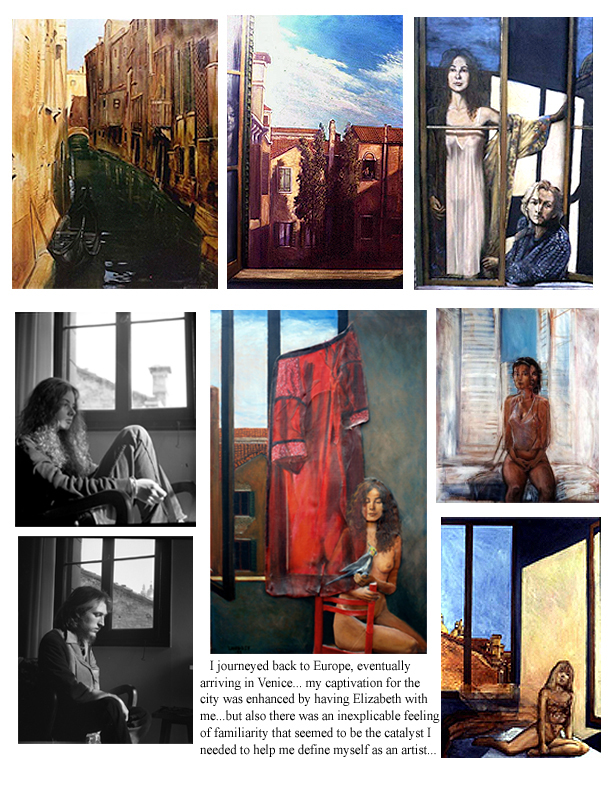

The next chapater in this artistic journey is Thursday June 9th. Meanwhile, learn more about Langosy’s art by contacting Zoe at zlangosy@me.com.
Posted in Inspiration, tagged art, artistis, beauty, bohemian, contemporary art, Donald Langosy, fine art, Inspiration, love, muse, romance, storytelling, travel on June 2, 2016| 4 Comments »
Previously in The Story of My Art: “and then I met Elizabeth”
And now …
The next chapater in this artistic journey is Thursday June 9th. Meanwhile, learn more about Langosy’s art by contacting Zoe at zlangosy@me.com.
Posted in Inspiration, tagged art, artists, beauty, bohemian, contemporary art, creativity, Donald Langosy, fine art, Inspiration, Langosyarts, love, muse, painting, poetry, romance, storytelling, travel on May 26, 2016| 6 Comments »
Sometimes when I am in a room with a group of people, someone will say, “Be careful what you say. We have a writer in our midst and she always sees a story.” I don’t know that I always see a story, but in this case I do. It is the story of a man and a woman, two artists in their own right, who formed a union. A painter-poet and his writer muse. Donald and Elizabeth Langosy.
I have permission to call him Donald but, since I am friends with his daughter Zoe, my southern upbringing drives me to refer to him as Mr. Langosy . Now, Elizabeth has made clear, that since we are writing colleagues, I am to call her Elizabeth. And when she tells you to do something, what else is there to do but what she said in that gentle but oh so firm way of hers. She has that way about her, like a force of nature. Perhaps that is what drew Donald to her. That is his story to tell and, in part, that is what he has begun to do in the pages that his daughter helped him put together, The Story of My Art by Donald Langosy.
In these 14-pages a veil is pulled aside and we the viewer become privy to the bright life of a talented man and his love for a talented woman. We see how that love has enabled and empowered him to produce a body of work that is dynamic, vibrant, sometimes humorous, sometimes sad, and always provocative.
Below are two pages from The Story of My Art. Click on each image for a larger view. Over the course of the next six Thursdays the rest of the story will be shared. Join me on a journey …

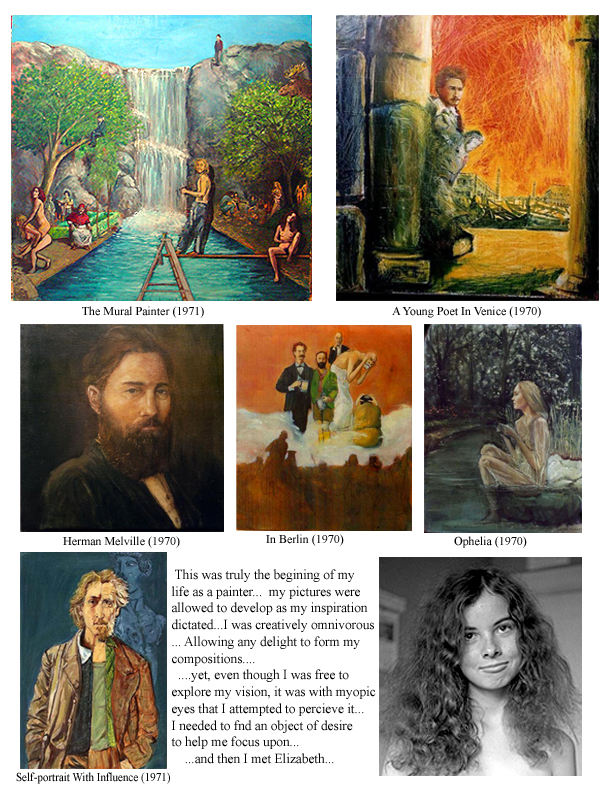
For more information about Langosy’s art, contact Zoe at zlangosy@me.com.
Posted in Inspiration, tagged Antoine Bourdelle, architecture, art, art history, Auguste Rodin, creativity, illustration, Inspiration, murals, painting, Pierre Bourdelle, research, sacred architecture, St. Dominic, storytelling, war on May 23, 2016| 2 Comments »

St. Dominic’s life is on display in Stephen’s living room. Grand in its expression, it appears in a small painting on paper, only slightly larger than 2′ x 2′ unframed. It is in fact the colorful sketch for a much larger work — a mural on the wall of St. Dominic’s Priory in Washington, D.C.
Each section of the painting, and of the final mural, has meaning. The image is divided into seven parts, depicting seven scenes from Dominic’s life, from the center upper part where “God’s Hand puts halo around St. Dominic and drops into beggar’s bowl a star …” to the center lower part where “Two Angels lift the saintly pilgrim by his bleeding feet toward the stars in heaven.”
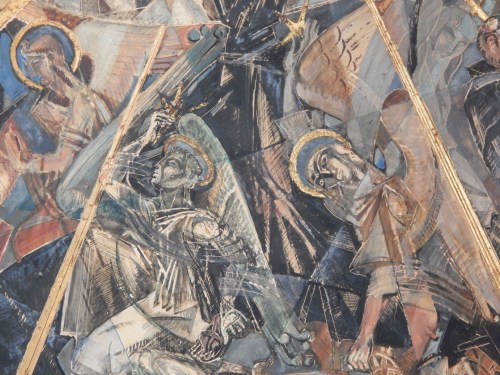
The painting was in the possession of Ludwig Joutz (1910-1998), an architect with the D.C. based firm, Thomas H. Locraft and Associates, noted for what today is often described as sacred architecture. In 1960, his company designed a new priory for St. Dominic’s Church. Construction was completed in 1962. On a lined office pad Joutz sketched the initial concept for the mural. That yellowing piece of paper remains with the painting, a painting that is signed and dated by artist Pierre Bourdelle (1901-1966).
Loutz must have treasured Bourdelle’s work. After he retired, he and his wife moved to Florida and with him he carried Bourdelle’s painting. Loutz, himself an artist, would sketch the interior of his home in Florida. In one drawing there on the wall is the same painting that Loutz’s son would eventually give to Stephen after his father’s death.

artwork by ludwig joutz
Ludwig’s son remembered his father meeting with Bourdelle as he worked on the mural but little else could he tell me and so my research began. Thankfully, there was quite a bit of information to be found online and in newspaper archives.
Born in Paris, France, Pierre Bourdelle was the son of famed sculptor Antoine Bourdelle. He studied under Auguste Rodin in whose studio his father worked from 1893-1908. During his time as Rodin’s chief assistant, his father taught the likes of Henry Matisse and Alberto Giacometti. One biographer notes that with Rodin, a young Bourdelle visited Europe’s great Cathedrals.

rodin by edward steichen, 1911
Eventually Pierre would move to the United States and set up a studio in New York. In effect, he stepped out of his father’s shadow.

antoine bourdelle, 1925
In a 1934 interview, he expressed: “In France, a man is judged by what his father did or by his family tree. In the United States a man is judged by himself, his personality, his own work. In France, they offered me mural jobs because my father was a well-known artist. They did not even look at my work.”

pierre bourdelle, 1934
A man of diverse interests and talents, he’d traveled the world studying the art of different cultures, observing the nature of different places. Over time, based on some of the things he’d seen, he developed a new technique that set him apart as a muralist.

excerpt from 1934 article
Search online and you’ll find a wealth of information about his Art Deco paintings and sculptures from the 1930s and 1940s. His bold and vibrant work adorned the interiors of ocean liners, railway lines like the California Zephyr, and the walls of institutions like Union Terminal in Cincinnati.
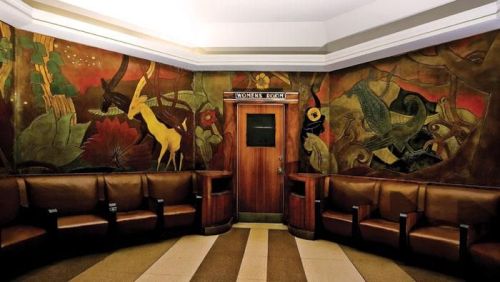
jungle mural by bourdelle for cincinnati terminal
He was a versatile artist capable of working with many media. For Cincinnati’s Union Terminal, he not only created exotic jungle murals carved in linoleum, he also painted the ceilings of several rooms using an electric spray gun on canvas.
For the 1939-1940 New York World’s Fair, he created murals for Food Building North No. 2. As described by a journalist covering the fair for Collier’s Magazine in 1939, “There was Pierre Bourdelle, stripped to the waist in the hot sun and covered with red plaster dust. Gobs of wet plaster, a good blank wall, tools in his hands. That’s all Bourdelle, pupil of Rodin, asks to make him happy.”
His design motif for the fair was described as low bas-relief representing Bacchantes reveling at a wine-harvest festival, mythological animals, and scenes of beverage-making in various cultures.

sunshine and rain by bourdelle 1939

larger detail of vineyard mural on food building, 1939
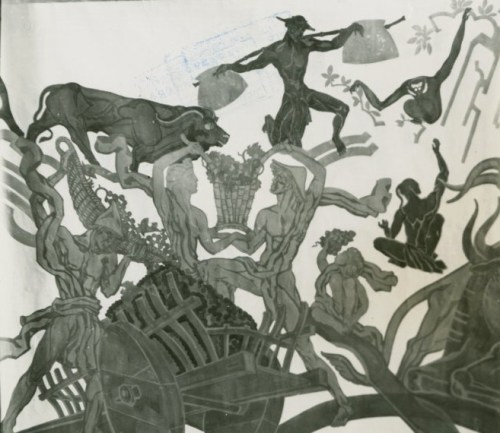
While not everyone appreciated his style, e.g. so many sinuous forms wrapped around each other, few could deny the provocative and captivating nature of his work.

When World War II broke out, Bourdelle felt compelled to join the war effort. He’d served in France during World War I. He’d been too young, only 15, but he’d lied about his age and was able to join an aviation unit. When his plane went down, he suffered traumatic ear injuries. A number of the biographies I found suggest that the horrors of that first war, the so-called Great War, influenced his art as no doubt did his participation in World War II. While unable to enlist because he was considered too old, he did serve in his own way, as a volunteer ambulance driver with the American Field Service at the North African and Italian fronts.

In 1945, upon his return to the U.S., Bourdelle would produce a book of images, simply titled, War. For the foreward, Stephen Galatti , the Director General of the AFS, would write, “Overseas Pierre Bourdelle saw suffering. He did his best to alleviate suffering, driving the wounded soldiers of many Allied armies. Helping staunch and bind their wounds in the field dressing stations. He knows the agony of war. He has no fear of showing war at its useless worst. He is not only a personally brave man who volunteered to go, and went, wherever the wounded were. He is an intellectually brave man, who makes no pretense at hiding the bare hideousness of warfare. … They are not pretty pictures. They show nothing but reality …”

They may not be pretty but they are horribly beautiful. And as I perused all 50+ images, viewable online here, I could not help but be fascinated by Bourdelle’s evolution as an artist …
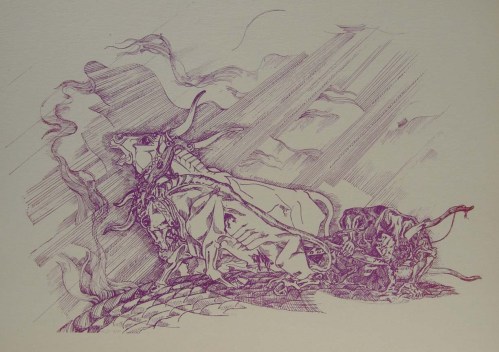
… seeing these works done in the 1940s and then …
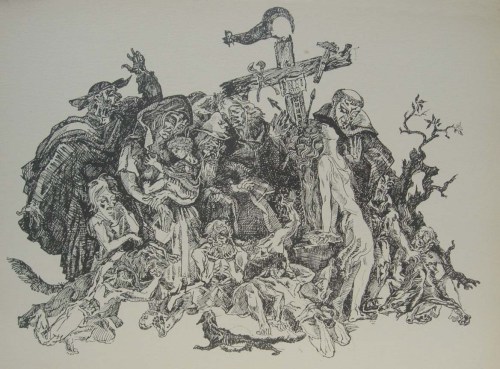
… being able to look at the drawing he did in the early 1960s for the St. Dominic mural.

I suspect I will never see in-person the actual St. Dominic mural. First of all, it is in a monastery chapel. Second of all, it has been covered in an attempt, I believe, to preserve it from the deterioration of time.
During the latter years of his life, Pierre Bourdelle continued to work as an artist and as a teacher. He taught at C. W. Post, part of Long Island University, as an artist-in-residence. He died in 1966 while traveling with his family in Switzerland.
Sources and Additional Reading
Bourdelle Family History – http://www.mountharmonyfarm.com/GH-P-BourdelleItems.html
SS America Unique Story of a Great Ocean Liner/Bourdelle Page – http://www.ssamerica.bplaced.net/art2-en.html
Artwork for the California Zephyr – http://calzephyr.railfan.net/artists/bourdelle.html
Manuscripts and Archives Division, The New York Public Library. “Art – Murals – Food Buildings – The Vineyard (Pierre Bourdelle)” The New York Public Library Digital Collections. 1935 – 1945. http://digitalcollections.nypl.org/items/5e66b3e8-7352-d471-e040-e00a180654d7
Collier’s, Volume 103, p. 16
Bourdelle Art for Dallas Fair Park – http://frenchsculpture.org/dallas-fair-park-1
https://en.wikipedia.org/wiki/Cincinnati_Museum_Center_at_Union_Terminal
The Glass Storybook and the Great Menagerie The Art of Winold Reiss and Pierre Bourdelle – http://www.cincymuseum.org/union-terminal/art
History of Cincinnati Union Terminal – http://library.cincymuseum.org/75th-anniversary/main.swf
Bourdelle’s War – http://www.ourstory.info/library/4-ww2/Bourdelle/pbTC.html
Bourdelle Papers at Syracuse Libraries – http://library.syr.edu/digital/guides/b/bourdelle_p.htm
Posted in Inspiration, Nature Notes, tagged curiosity, Eliot Porter, imagination, Inspiration, James Gleick, landscapes, nature, Nature's Chaos, Photography, storytelling on May 4, 2016| 4 Comments »
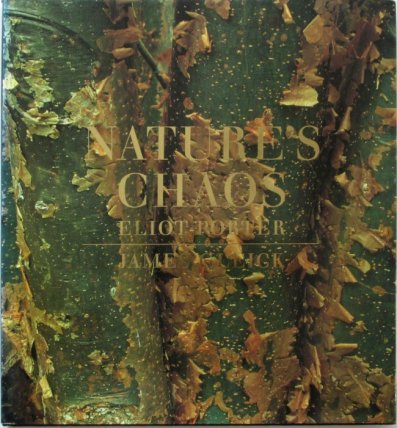
It can be hard to read a coffee table sized book while sitting on a Boston subway during rush hour. But that’s what I was trying to do after a visit to the library to retrieve the book Nature’s Chaos, a collaboration between photographer Eliot Porter and writer James Gleick. I sat snugly between, on my left, an older African fellow wearing a very puffy and, I’m sure, warm coat. On my right sat a young Chinese boy wearing a very puffy and, I’m sure, warm coat. The little boy kept getting in trouble with his dad because he was a bit hyper.
I’d been waiting a long time for this book. Carefully, very carefully, trying to respect the space of my neighbors, I opened up the book into a narrow V-shape. I figured the text I could read later, but I wanted a peek at Porter’s vast landscapes. I could see a little but not enough. Wider I opened the book. I peered closely at the sweeping patterns in cracked mud and lava flows. There were leaves on water and sunset clouds. As I lost myself in these scenes, perhaps the book fell open wider still because all of a sudden I noticed something.
Now the African gentleman was a bit more subtle but I could tell he was looking at the book with me. He’d adjust his glasses as I turned a page and every now and then he’d bend over slightly, trying to see the cover to find out what in the world I was looking at. The little boy hadn’t learned how to be subtle. He just peered right over my arm. I didn’t bother looking at his dad. I just began pointing out features on the page to the boy. Occasionally I’d drag my finger along a seemingly mundane scene, like orange flowers in a green field or vines on a tree trunk. I’d say softly, “That’s pretty cool, hunh?” His eyes never leaving the page, he’d nod and say softly, “Yeah.”
On the last page, I made a dramatic show of closing the book and saying in a little louder voice, “And that’s it!” The little boy (and the gentleman too I suppose) slid back into his chair. His father whispered to him. The little boy looked up at me.
“Thank you,” he said.
I smiled. “You’re welcome.”
Posted in Inspiration, Nature Notes, tagged art, bank notes, banknotes, collecting, currency, engraving, history, illustration, notaphily, paper money, Photography, storytelling, travel on April 27, 2016| 4 Comments »

brazil: banknote showing freed slaves cooking
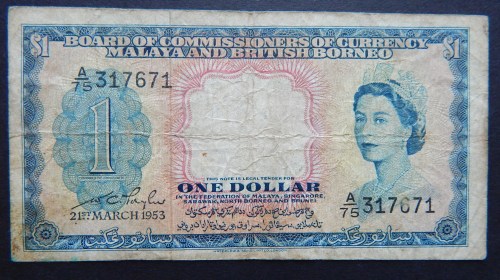
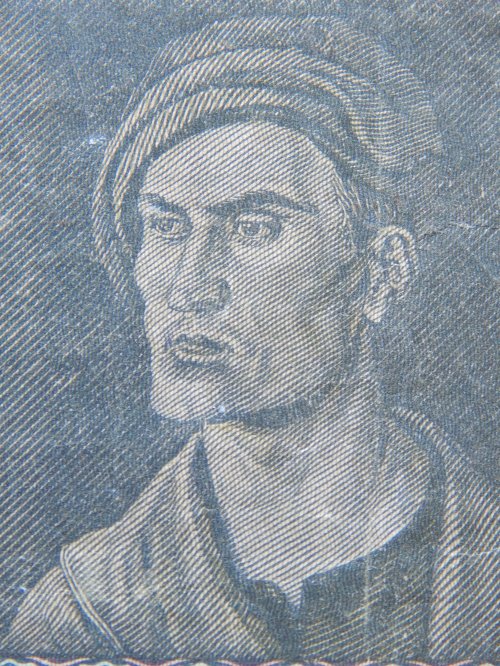
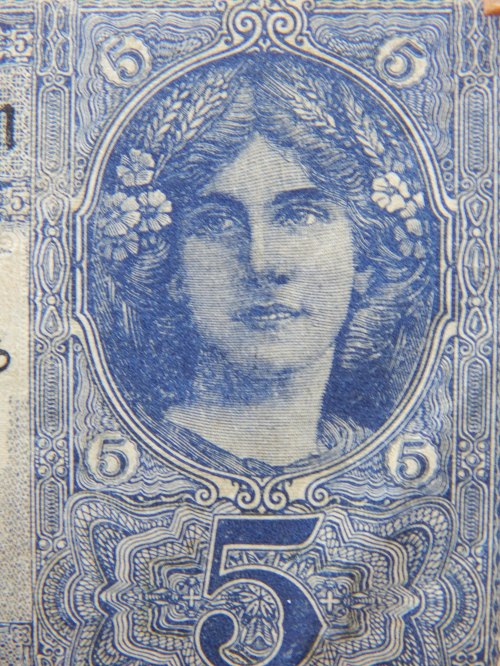
I am helping to research a bank note collection, mostly paper money from pre-World War Europe as well as other parts of the world. It is a fascinating project especially after the sometimes heated discussions here in the U.S. regarding the $20 bill and the plan to swap out the visage of Andrew Jackson for that of Harriet Tubman. Whichever $20 bill is held in hand in the future, embedded in that money, in the illustration, will be the story of that exchange. It’s the storytelling aspect that excites me about this bank note collection. Gathered over many decades, the notes are like tiny time capsules with regard to artistic expression, economics, history and more. The nature of using money certainly continues to evolve (e.g. don’t carry cash at all, just swipe your phone!), but I expect paper money may be around for awhile. Meanwhile, I’m looking forward to delving into the past and discovering the stories etched in these monies, a few of which are highlighted below.

france: 1940s bank note, image of Pyrenean shepherd

germany: notgeld was emergency money

british armed forces special voucher
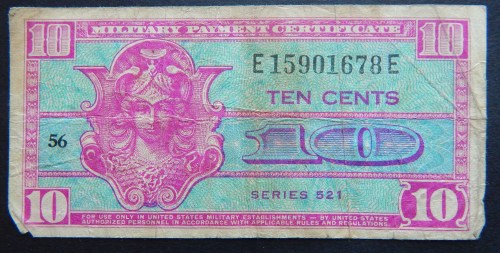
u.s. military payment certificate



Posted in Books I Love, Inspiration, Nature Notes, tagged book review, books, cactus, creativity, design, garden design, gardening, hens and chicks, Inspiration, Photography, storytelling, water on April 25, 2016| 3 Comments »
My mother kept a bucket of chickens next to the back porch. It was a big white bucket like an old stew pot. Hens and chicks was what she called the little spiky plants growing in there. No matter how hot the summers, no matter how many other flowers and vegetables died in the baking Virginia sun, those plants survived to flourish the following year. They were easy to transplant. I remember picking up the little ones … they just popped right up out of the soil … and tossing them into another little cup of dirt. My mom told me to stop doing that because she’d specifically positioned her pot of chickens. Their singular location, next to the porch, was part of her garden design.

photo by cynthia staples
Now my mom and I did not formally speak of things like garden design and water-saving plants like her cacti. My dad did not discuss these things either though I remember he kept a barrel to collect rainwater and that he rotated crops in our little vegetable garden. He didn’t really explain the why of his actions. It was just what you did if you understood the system of which you were a part.

photo by cynthia staples
That’s what stands out for me in books like The Water-Saving Garden by Pam Penick. Penick invites readers who are interested in gardening to deepen their understanding of how their world works. My parents grew up in a time and place and were of a generation that knew the sources of their water and understood that those sources were not guaranteed. For all sorts of reasons that knowledge was lost as human ingenuity and engineering made water readily available in many places and seemingly endless. Today, people are aware that engineering is not enough. We are a part of a complicated system. Water is not endlessly available for our needs. But what if you really want a garden?

It almost seems selfish but I have to admit I’m one of those people. If at all possible, for my peace of mind, I like to see something green growing around me and know I had something to do with it. And despite my fond memories of my mother’s chickens, I don’t necessarily want to grow them. What are my other choices in a water-saving garden?

photo by cynthia staples
Pennick’s book stretches one’s imagination about what form that garden can take. She reminds and encourages people to take the time to understand the landscape and climate particular to their region. Humor is sprinkled throughout the book (e.g. “Think of your plants as astronaut-explorers, boldly going where no plant has gone before.”) as well as lovely and informative pictures.
The Water-Saving Garden is content rich and makes a nice addition to the reference shelf. Every idea can’t be tried all at once. It’s a resource I can imagine filling the margins with notes of lessons learned as I try to garden more wisely while still having fun.
You can learn more about this book via the following links. I received this book from Blogging for Books for this honest review.
Additional Links
About Pam Penick: http://www.penguinrandomhouse.com/authors/152546/pam-penick/
http://www.penguinrandomhouse.com/books/246914/the-water-saving-garden-by-pam-penick/
Posted in Inspiration, Nature Notes, tagged birds, colors, ducks, humor, Inspiration, mallard, nature, nature photography, Photography, poetry, storytelling, waterfowl on April 19, 2016| 11 Comments »
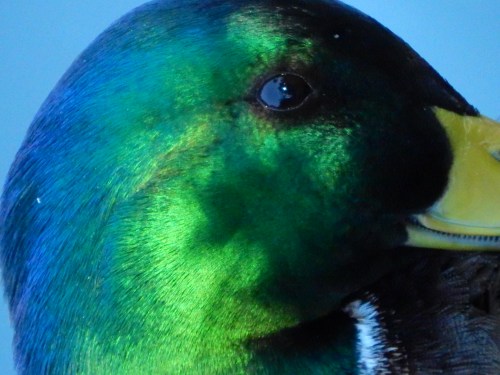
One day a mallard stepped out of the water onto a rock and began to preen.
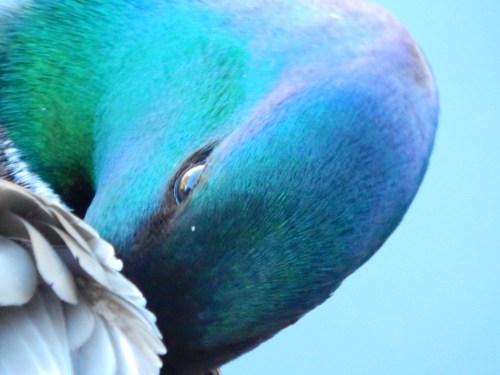
So tame was it, or so quiet I, that it did not seem to mind that I watched the scene.

I braced myself in the bright, hot sun and took photo after photo with the goal,
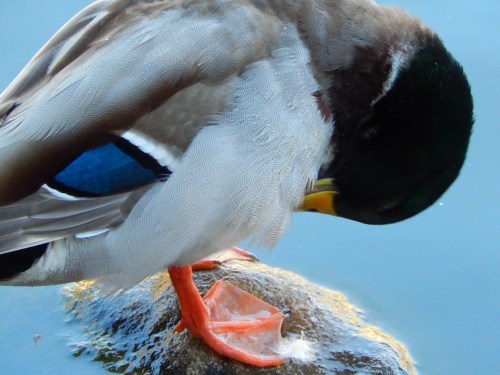
I think, to be surprised, to see what might be revealed by this creature in the shoal.
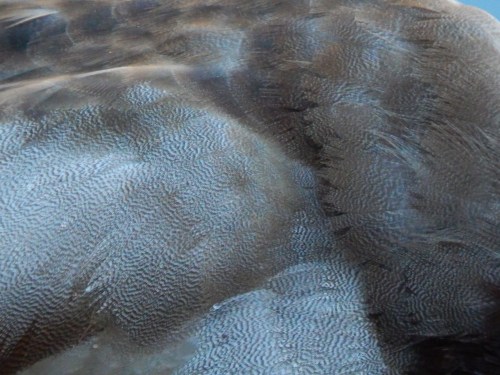
Later I’d discover that most of the pictures were not good but in the moment I did not mind.

I’d had my time with mallard who, I like to think, bowed his head deep at our parting in the ways of his kind.

Posted in Inspiration, tagged compassion, empowerment, homeless, Inspiration, musings, Pilgrim Magazine, storytelling, writers on April 3, 2016| 3 Comments »
I recently met a man who was rather wizened. His hair and beard were white as snow. He was bent over and not just from the bulging back pack he wore. He leaned heavily upon a cane. Still, there was a youthful air about him especially that twinkle in his eyes. He entered the place where I was working and asked to use the bathroom. Now even as I prepared to utter the standard words often uttered in the heart of Boston, he stopped me. “Yes, yes, I know. You don’t have a public restroom. But this is an emergency.” Isn’t it always, I thought.

But then he proceeded to share the nature of his emergency and so after making a quick call for coverage, I helped the gentleman to the bathroom. It was a circuitous path down several small flights of stairs and around some corners. He moved slowly and so he and I had time to chat. And as he talked I could not help but remark, “Sir, you do have a way with words.” He laughed. “Well, I should. I’m a writer.” As we eventually made our way back up the stairs, we talked some more. Once again I remarked upon his way with words. He chuckled, that youthful gleam awful bright. “Have you ever heard of The Pilgrim?” I hadn’t. ” Thumping his chest, he said, “Well, I write for The Pilgrim.”
I saw him to the door. We wished each other well and that was that. I forgot about our encounter until today, for some odd reason, and decided to look up his magazine. I was not completely surprised but still a bit startled to see that it is a publication written by the homeless. It’s edited by Atlantic columnist James Parker and published out of Boston’s Cathedral Church of St. Paul. You can read more about the publication via this link: http://www.thepilgrim.org/#!about/c69s
After reading several entries on the Pilgrim Blog, I almost titled this blog post “hard reading.” The writing is intense. Of the pieces I’ve read so far, one of the most moving passages, Adam Staggering, was written by someone who is no longer homeless but still adrift. And then there’s The Bed Lottery by Ricardo. The print publication must be filled with so much more and that is available through subscription.
I’m glad my path crossed with that of the wizened little man. I only wish that I had asked his name so that I might know which pieces he had written.
Image Source: The Miriam and Ira D. Wallach Division of Art, Prints and Photographs: Print Collection, The New York Public Library. “Head of an old man.” The New York Public Library Digital Collections. http://digitalcollections.nypl.org/items/510d47db-ca87-a3d9-e040-e00a18064a99
Posted in Inspiration, tagged beauty, bouquet, colors, flowers, humor, Inspiration, Photography, serenity, storytelling, white on April 1, 2016| 1 Comment »


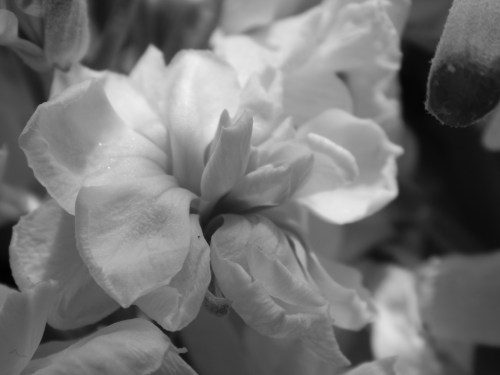
… and it fell apart so beautifully. A mammoth bouquet of white flowers with leaves of frosted green whose name I do not even know. I saw it sitting in a black bucket across the store and knew I had to have it. Back on the shelves went a sundry of things because I decided I needed that bouquet more than dark chocolate and such. It lasted a long time, that bouquet, and during chaotic times I could stare into its midst, with coffee in hand, and just breathe deep. And it was the breathing deep that got me in the end because after a while, darn allergies, the bouquet’s pleasant scent wasn’t so pleasant after all and so into the hallway it went. With hand over nose, I’d occasionally glance out at its soothing beauty until I needed to be soothed no longer. As it dried, it fell apart so beautifully.

Posted in Inspiration, tagged American history, beauty, black history, history, identity, Inspiration, Photography, race, storytelling on March 30, 2016| 1 Comment »
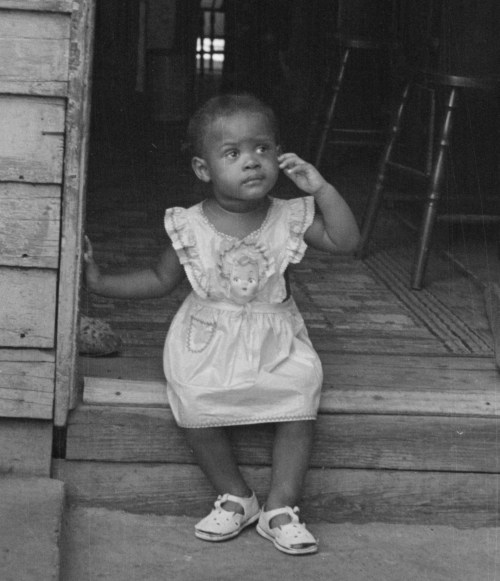
detail from untitled photo by joseph a. horne, 1940s
This photo was taken by Joseph Anthony Horne during the 1940s as he worked for the Farm Security Administration – Office of War Information. As highlighted in a previous chapter of Interludes, he like many other photographers had been sent out across the country, under the direction of Roy Stryker, to capture the American experience. One of the areas that Horne captured on film was southeast Washington, D.C., an area not far from where his family lived and an area that was predominantly African American. The photos he took in that community were notable, for me, in part because there was no characterization or stereotyping. He simply photographed in a straightforward manner people living their daily lives. He, like many of the FSA photographers, was very good at that. Otherwise in commercial media, unless it was an African-American specific publication, there was either no representation of “colored” people or it was often a mimicry. Out of all the photos that Horne took in this community, I was especially struck by the series of photos of this little girl who had been positioned in front of the camera by a person who appeared to be her mother. No doubt she’d been placed in a best dress for the occasion. And its that dress that caught my attention.

There are people far more eloquent and scholarly than I who have written and who continue to write about how we as humans form our sense of self, our sense of self-worth, our sense of what is beautiful and our sense of how we individually fit within that definition of beauty. This little girl is lovely and thoughtful. Her face clearly reads, who are you and what are you doing? The little face affixed to her dress is also lovely. Two different expressions of beauty.
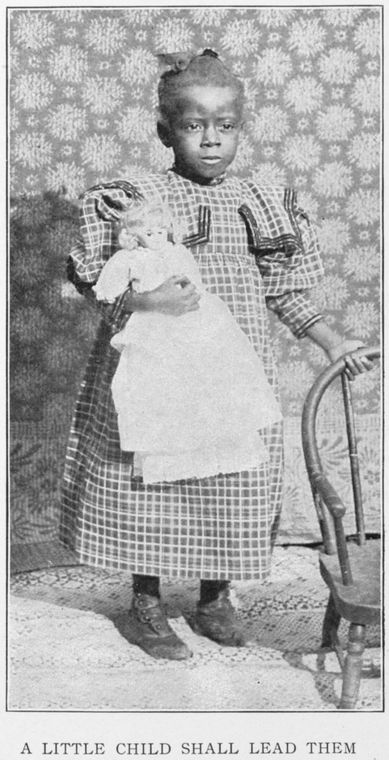
This photograph was taken in 1905 and is located in the NYPL Digital Collection. I don’t know the context in which this photograph was taken though there is that accompanying caption suggesting to me that it was in a magazine and meant as a positive image highlighting how far African Americans had come in the 40-years since slavery and that a new generation would have even more success. Too true as evidenced by the strength in that little girl’s face, and yet I am struck by the doll wrapped in her arm. Growing up in the 1970s, I too had a lovely doll around which to wrap my arms and I enjoyed combing her blonde hair and wondering why it was so hard, in fact impossible, to braid her hair the way my mother braided mine. I grew up in a far different time than these two young girls but Toni Morrison’s The Bluest Eye, published the year I was born, certainly resonated in my teenage years. I don’t remember ever wanting blue eyes but I think I wanted blonde hair (or maybe a lion’s mane).
These musings come to the fore because of a convergence of recent events, including having the opportunity to explore the imagery being made available through digital collections, seeing images of the past that had not been made widely available before, images that today have the potential to spark positive conversations about the past, present and future.
I recently pulled together research to tell two stories of one place. One story focused on two sisters of great wealth whose lives are well-documented and whose enduring influences are often remarked upon. The second story took great effort to pull together, of a gentleman whose image and good works I could only find because of the old texts and photographs being digitized and made available online. The two sisters were white and the gentleman was black. They lived during the same time period and interacted in the same place. When I printed my drafts and shared the stories with an elder (whose age I shall not share), she listened politely to the story of the two women but she took the story of the gentleman. We had a conversation and she said, “Cynthia, all my life I have heard about these women and the people like them. I never heard about this man. You keep doing your research. Why is it important? I want people to know that we were here. To know that we were a part of this place.”
Sources
https://www.loc.gov/item/owi2001000491/PP/
Schomburg Center for Research in Black Culture, Jean Blackwell Hutson Research and Reference Division, The New York Public Library. “A little child shall lead them.” The New York Public Library Digital Collections. 1906. http://digitalcollections.nypl.org/items/510d47df-9e16-a3d9-e040-e00a18064a99
 Words + Images