Feeds:
Posts
Comments

Posts Tagged ‘storytelling’

… and then there was a photo not taken.

I’d walked a long ways, from downtown Boston, across the Charles River and into Central Square.  It had seemed a good idea in the beginning.  Walk. Take pictures. But by the time I hobbled into Central Square and parked myself on a bench, I was done.  I took one last look over my shoulder into the bushes behind me.  A sea of pink blooms and a single stalk of white. This is it, I decided, and then tucked my camera away.

After determining that despite aches and pains I could complete my journey home by foot, I rose and began to meander down Mass Ave.  Ahead of me was a man clearly seeing impaired based on the white cane he swept before him.  I was planning how to slip past him at the next street light when, all of a sudden, his cane knocked over a homeless man’s Dunkin Donuts cup full of change.

Now, this homeless fellow has been a regular in Central Square, an elderly gentleman curled up in a wheelchair.  As far as I knew, he’d never wheeled himself about by hand.  I’d only ever seen him move himself by one foot, very, very slowly.  I suspected he had a compatriot who occasionally whisked him from one side of the Square to the other, else it would take him all day to move one block.

In any case, the homeless man was twisting in his chair trying to reach for the overturned cup and speaking unintelligibly all the while.  The blind man was reaching out but not having much success.  I was close enough to gently take the blind man’s hand and say, “It’s okay, sir, I’ll help him.”  He nodded and moved on, cane once more sweeping out.  Then I knelt and scooped up the coins.  As I wrapped the homeless man’s hands around the clear cup, I better understood why he did not wheel himself.  His hands were gnarled, the fingers twisted.  I felt like I was holding carved oak.

“Here you go,” I said.

He garbled, “Do you have any change?”

That was when I looked into his face in a way I’d not done in all the times I’d seen him before.

Like his hands, his face was like oak.  Dark golden brown and deeply lined.  While I thought him elderly from afar, up close I could see that most likely he was not.  It was the elements, and other life events, that had chiseled his face, browned his skin and grizzled his unkempt hair and beard.  His eyes were blue and shone with such intensity that if we had not been in shade I would have thought they were lit by the sun.  An unforgettable sight.

That was the photo not taken.

“No, sir,” I said.  “I do not have any change.”

I patted his hands and made my way home.

Read Full Post »

He kept asking for money but that I would not do.  In part, because I had too little of it myself and because I could not trust him.  He would most likely spend it on alcohol.  If he did not spend it on alcohol, I was worried that “friends” might siphon him dry.  I did want to send him something, to stay in touch, in addition to the occasional chat by phone.  I wanted him to know that I cared about him as much as I knew he cared about me.  I was still his baby sister and I respected that he was one of the big brothers who so carefully looked out for me as a child.

I think one day, with those thoughts in mind, I looked up into a cabinet and saw the dusty box.  I took out a couple of bags, dropped them into an envelope, included a note that said something like “Drink this and not that other stuff!” When I told him what I had done, he just chuckled, as delighted as a child.

I became a connoisseur of tea design and flavor profiles.  I was not especially picky.  Whenever I stayed in a hotel I’d pocket the teas left in the room for guests with a goal to send them to him later.  While grocery shopping, I’d occasionally splurge on an herbal tea sampler and split up the packs to send him different flavors.  Later, I’d quiz him about which teas he’d liked and didn’t like.  Blueberry was a favorite but all flavors were welcome, I was told.

They had to fit inside a standard envelope (which I occasionally decorated).  Ideally the weight was such that I would only need at most two stamps so that I could drop my packages in a blue box on my way into work.  I didn’t want to wait in line in the post office to mail a larger box.  Sometimes I’d jazz up the mailings with little packages of coffee but I knew from childhood memories that he was more of a tea drinker. He and my mom would sit at the kitchen table drinking Lipton tea, her dark cup sweetened with just a bit of sugar, and his almost white with milk.

Why does this story surface?  Well, it has been a long summer in some ways.  Aside from a few mailings of seeds to family and friends and postcards to my kids club, I did not do much other mailing.  This weekend I was on the phone with this brother. We were having a good chat and as I was about to hang up he said, “Hold it. What happened to it?”

“What happened to what?”

“My tea,” he said.  “You haven’t sent me my tea.  It does help, you know.  When I have tea, I don’t drink.”

“Okay,” I said brightly. “I’m on it.”  Both laughing, we hung up. And then I cried.

That night I pulled together a short pile of envelopes and addressed them all to him.  The next day I bought a box of tea, many flavors.  Yesterday, I mailed him honey vanilla.  We’ll see what the next week holds.  Maybe strawberry. I think a big box of blueberry will wait until Christmas.


Read Full Post »

There is an elderly woman who lives in my childhood home in Virginia.  My brother tells me that she loves to grow tomatoes like some people grow wildflowers.  In every available space, as a border to the porch, in the spots where the roses and hydrangeas grew, all now tomatoes.  While wonderful to see such eccentric growth, it was also hard for my brother to see.  There was a part of him that wanted the old yard back, the flower beds and vegetable garden and the swathe of green grass just big enough for children to run about with clothes lines arching above.  He wanted the fence line back that separated our property from the neighbor’s, a wire fence covered in honeysuckle and milkweed and edged with wild mint.  And he wanted the trees, the maple, the plum and that short-lived apricot.

All had been gone for near two decades but in that moment, of seeing those tomatoes, he fiercely wanted it all back and with it the parents now deceased and the siblings spread far and wide.  “You alright, Daddy?” his son asked.  He looked down at his five-year old who was sprouting up like an oak.  “Yes, son.  Daddy was just remembering.  Remind me to tell you about the seeds I planted in this place.” The son nodded and then said, “Okay, but can we go to the playground first?” My brother laughed, tickled his son, and let the past fade knowing it would never disappear.  “Yes, son, let’s go.  We must have our priorities.”

Read Full Post »

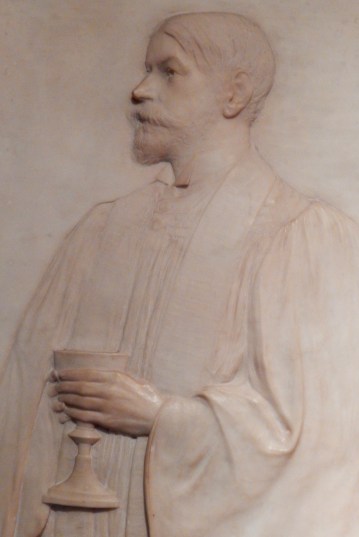
I’d seen the sculpture many times inside Trinity Church but not truly appreciated it. A man holding a cup, a cup-bearer, but the person depicted had no context for me.  I knew nothing of his significance in the past or in the present.  There were too many other visuals capturing my attention, like sunlight through stained glass windows.  Only recently have I returned with greater respect to the relief of Elijah Winchester Donald, Rector of Trinity from 1892 until 1904.

Detail of E. Winchester Donald Sculpture by Bela Pratt

I unexpectedly re-discovered the sculpture, and the man depicted, while researching the history of a church thousands of miles away at what is now known as Tuskegee University in Tuskegee, Alabama.

During my research I came across an issue of The Southern Workman, a publication founded in 1872 by General Samuel Chapman Armstrong of Hampton Institute, Hampton, VA.  Armstrong would leave his mark on American history for many reasons, one of which included founding Hampton just after the Civil War. There, a young Booker T. Washington, formerly a slave, would become a student and eventually a teacher. In 1881, when people in Alabama, wanting to start a new institute for black students, reached out to Armstrong for principal recommendations, Armstrong suggested young Washington who applied for the position and got the job.

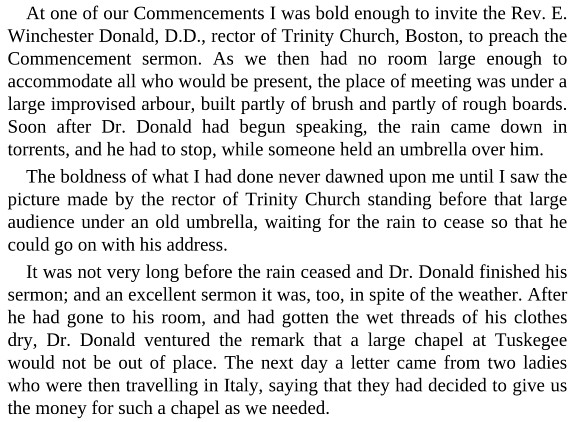
The August 1895 issue of The Southern Workman made note of Tuskegee’s achievements, including recent receipt of anonymous funds to build a new chapel.  But prior to those funds being received graduation commencement services took place and, the journal describes the event in this way:

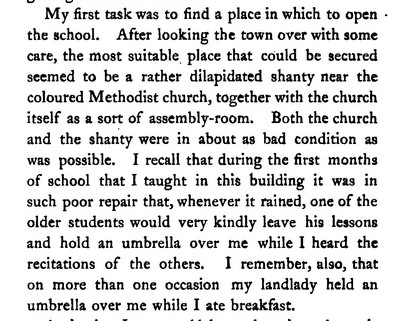
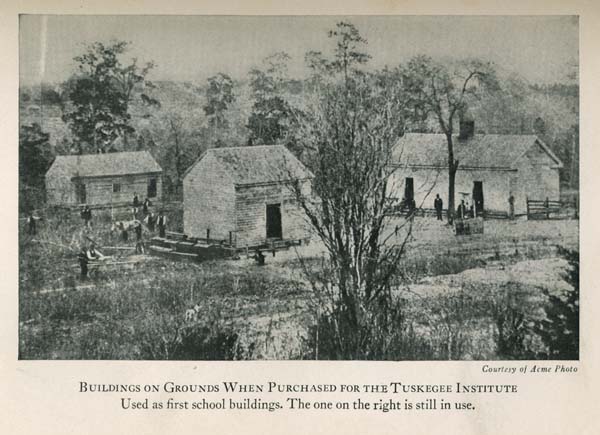
Years late, Booker T. Washington would describe the moment in a slightly different way.  In 1901, Washington wrote Up from Slavery, the chronicle of his journey from slavery, his attendance at Hampton and eventual leadership at Tuskegee and well beyond.  As Washington wrote, money had been found to start Tuskegee, with money set aside to pay future instructors, but no provisions had been made for securing land and buildings.

Later in his autobiography, Washington gives his personal recollection of the 1895 Tuskegee commencement in which Dr. Donald spoke:

The chapel would be built, designed by Robert R. Taylor, the first African American graduate of MIT. The chapel would be erected between 1896 and 1898, a structure some scholars say Taylor considered his masterpiece.

Robert R. Taylor

Robert R. Taylor

In 1900 author Max Thrasher wrote: “The building of this chapel illustrates, as well as any one instance can, the methods of the industrial training at Tuskegee.  The plans for the building were drawn by the school’s instructor in architectural and mechanical drawing.  The bricks, one million two hundred thousand in number, were made by students in the school’s brick yard and laid by the men in the brick-laying classes.  The lumber was was cut on the school’s land and sawed in the saw mill on the grounds.  The various wood-working classes did the work which in their departments.  The floor is of oak; all the rest of the finish in in yellow pine, and the use of this wood … The pews were built after a model designed by one of the students, and another student designed the cornices. The tin and slate roofing was put on by students, and the steam heating and electric lighting apparatus was installed by them …” Before his death in 1904, Donald would have an opportunity to speak in this chapel.

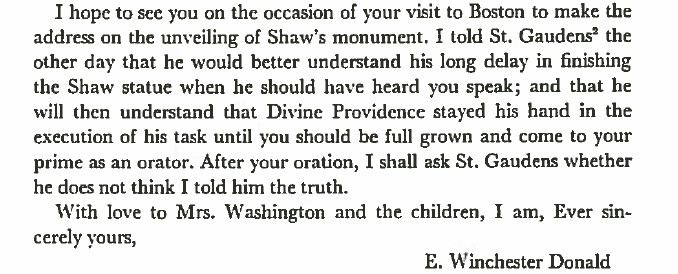
Though from two very different backgrounds, Donald and Washington appear to have greatly respected one another. In 1895  Donald established the Trinity Church Oratorical Prize, an award for the best written and best delivered paper on an assigned subject, a student prize that continues at Tuskegee, with different sources of funding, to this day.  For many reasons, Washington often made his way up North, cultivating philanthropists, accepting honorary degrees, attending national conferences, and speaking in places like Trinity.  In 1897 he was invited to deliver an address at the dedication of the Robert Gould Shaw Monument in Boston.  Prior to his arrival, Donald sent him a letter:

In 1901, Donald presented the dedication address for a new campus building at Tuskegee.  In attendance were noted business leaders and philanthropists including George Foster Peabody and John D. Rockefeller Jr. Before them was a magnificent campus, once a few fragile buildings, transformed by student-labor into a thriving educational institute with over 100 hundred instructors and staff, 50 buildings both functional and aesthetic, over 2500 acres of land with solid farming infrastructure and students applying from around the world.

Chemistry Lab 1902

Chemistry Lab 1902

Instructor George Washington Carver

Tuskegee Instructor George Washington Carver

Donald’s dedication address was made just a few decades after the end of the Civil War.  There was still great philosophical debate about what was to become of the millions of African Americans formerly enslaved.  Like Washington, Donald seemed to believe that education and skill building were the key for black people to let go of the past, achieve success in the present, and build a foundation for future excellence.

During the address, Donald would say: “We are in the presence of a fact. Whether or not the negro can be raised to self-respect, industry, thrift and ethical soundness, let the doctrinaires debate. One thing we know, whereas he was blind to his only chance, now he sees. He has only to keep his eyes open and use his chance to rise clean out of the condition into which 200 years of enforced servitude and thirty-five years of stupid, selfish and merciless political exploitation thrust him down.”  His words would become controversial with statements including “an educated negro without a vote is worth infinitely more than ten illiterate white men who vote as often as the polls are open.

Until the end of his days, in person and in writing, Donald would support the efforts of Washington at Tuskegee and those at other Southern black schools educating new generations.  He supported the efforts of many people inside the U.S. and from abroad trying to make social change.  He may have thought he was being militant.

As was said by the Rector of Grace Church in his memory, “his supreme gift was not militancy,–however it may have seemed to some, as well as to himself,–his supreme gift was not militancy, it was sympathy; he gave drink to the thirsty; he satisfied the longing soul; his true emblem was not the claymore, as he fancied, it was the chalice.”

Others stated, “Some of us disagreed with him, some of us thought his positions untenable, but none of us doubted his fraternal regard.”

His memorial was completed January 27, 1907, the bas relief by sculptor Bela Pratt and its setting designed by Donald’s friend, Charles A. Coolidge.

As for that chapel at Tuskegee, it would continue to evolve but that is a story for another day.

Sources & Additional Reading

Up from Slavery by Booker T. Washington

History of Tuskegee (University Website)

Tuskegee: Its History and its Work (1900)

Samuel Chapman Armstrong (Hampton University Website)

MIT Archives – Robert R. Taylor

Bela Pratt Sculpture of E. Winchester Donald

Trinity Church Art & History

The King’s Cup Bearer, Sermon in Memory of E. Winchester Donald, 1904

Read Full Post »

Bust of Dean Stanley at Trinity Church

I took the picture, I did the research and this is what I learned:  On Easter Monday in 1877, Rev. Phillips Brooks was given leave by his parish, Trinity Church in the City of Boston, to take a sojourn to Europe.  While in England, he spent time with Arthur Stanley, Dean of Westminster Abbey. Brooks was invited to preach at Westminster in July, and it is written that Dean Stanley listened with delight to a doctrine after his own heart.  Brooks would later share in a letter, “Last Sunday I preached for Mr. Stanley at his church in London, and William and I were much in the little man’s company while we were in his town.  He is very pleasant and entertaining, but much changed since his wife’s [Lady Augusta Stanley] death. He has grown old and fights hard to keep up an interest in things.”(1)


In the autumn of 1878, Dean Stanley traveled to America. In Boston he preached for the Rev. Phillips Brooks at Trinity Church.  Brooks would later write that no one who heard the benediction at the close of the service would ever forget it. “He had been but a few days in America. It was the first time he had looked an American congregation in the face. The church was crowded with men and women of whom he knew that to him they represented the New World. He was for a moment a representative of English Christianity. And as he spoke the solemn words, it was not a clergyman dismissing a congregation, it was the Old World blessing the New; it was England blessing America.  The voice trembled while it grew rich and deep, and took every man’s heart into the great conception of the act that filled itself.”


In 1881, following Dean Stanley’s death, Phillips Brooks would write a 12-page retrospective for The Atlantic Monthly.  In conclusion Brooks would highlight lessons of faith and good will he thought taught by Stanley’s life, and then end with these words:

“These lessons will be taught by many lives in many languages before the end shall come; but for many years years yet to come there will be men who will find not the least persuasive and impressive teachings of them in Dean Stanley’s life. The heavens will still be bright with stars, and younger men will never miss the radiance which they never saw. But for those who once watched for his light there will always be a special darkness in the heavens, where a star of special beauty went out when he died.” (3)

Miss Mary Grant, an eminent British sculptor and Stanley’s niece by marriage, would execute a memorial bust.  That bust would be given to Trinity Church to commemorate his visit.  It is located in an area that I believe is known as the baptistry.  His visage “stands upon a bracket of Sienna marble … beneath which is a tablet of Mexican onyx, on which is engraved a tribute by Robert C. Winthrop.” (4) And sitting across from him?  A bust of Phillips Brooks.

Bust of Phillips Brooks by Daniel Chester French

Bust of Phillips Brooks by Daniel Chester French

Learn more about Trinity stories in stone and glass with a tour: http://trinitychurchboston.org/art-history/tours

Sources for this post …

(1) Phillips Brooks, 1835-1893: Memories of his life … by Alexander Viets Griswold Allen (1907)

(2) Life and Correspondence of Arthur Penrhyn Stanley, Volume 2 by Rowland Edmund Prothero (1893)

(3) The Atlantic Monthly, Volume 48, October 1881

(4) Trinity Church in the City of Boston, 1888, pp. 31-32

(5) Mary Grant

(6) Phillips Brooks Bust image is from Wiki Commons

Save

Read Full Post »

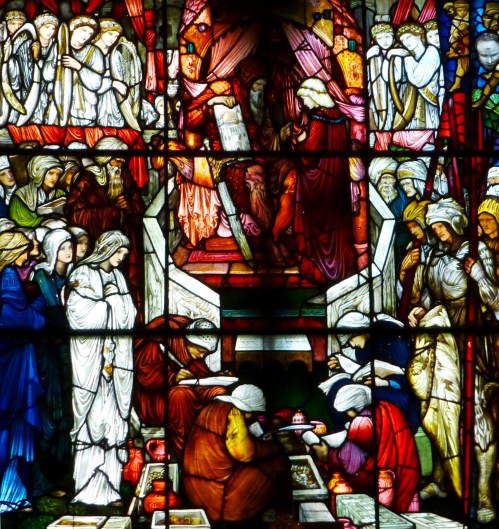
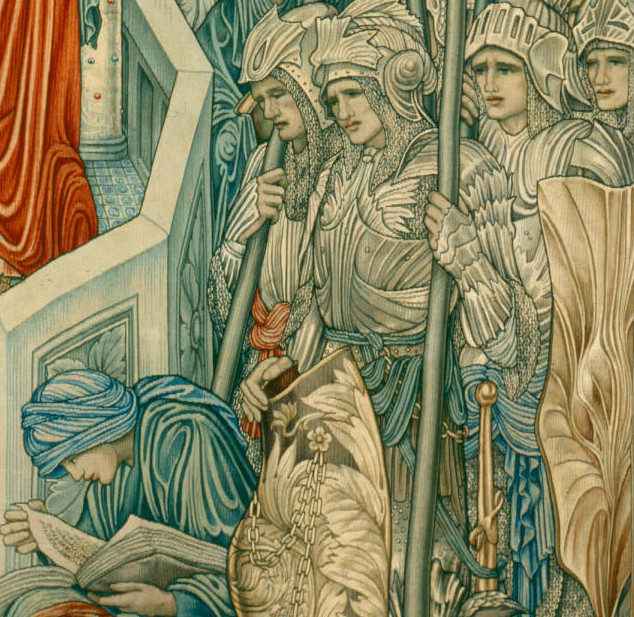
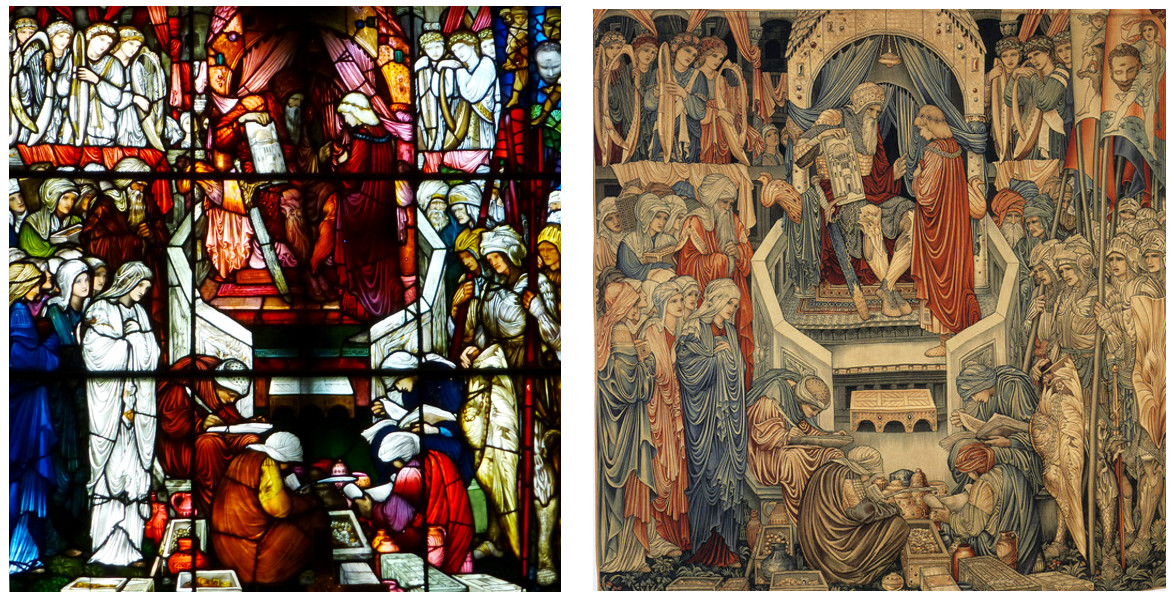
Recently I learned of an image in stained glass also appearing in thread, both based on a design by Burne-Jones.  I couldn’t help but do a bit of digging and learned this:  the stained glass window, David’s Charge to Solomon, was first commissioned in memory of George Minot Dexter (1802-1872) by his son Frederic Dexter. It is located at Trinity Church in the City of Boston.  I’ve had the great pleasure of photographing details over the years.

The window was designed by Edward Burne-Jones, the color harmonies developed by William Morris and the window fabricated in the William Morris & Co studio.

The window was installed at Trinity Church in 1882 in an area known as the baptistry.

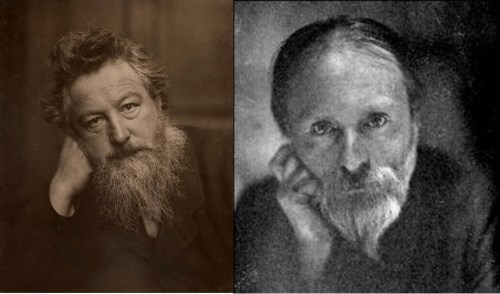
William Morris (1834-1896) and Edward Burne Jones (1833-1898)

William Morris (1834-1896) and Edward Burne Jones (1833-1898)

While Morris and Burne Jones would both pass away in the late 1890s, Morris & Co.’s design work and manufacturing would continue for decades at Merton Abbey, a village in Surrey, England where textile printing had taken place since the mid-19th Century.

Sir George Brookman c. 1920

Sir George Brookman c. 1920

While attending an exhibit at the 1900 Paris International Exhibition, and later visiting Merton Abbey in England, Australian mining magnate George Brookman saw Morris tapestries being custom woven for individual and corporate clients.  He also saw original designs, still being used, to reproduce artwork.  After seeing the Burne-Jones cartoon for David’s Charge to Solomon, he commissioned a tapestry to be made of that image.

Known as David giving Solomon directions for building of the Temple, the tapestry would be described as “a spacious and complex weaving of unusual size.  The soft, abundant reds beloved of the [Pre-Raphaelite] Brotherhood were in evidence.  Of especial beauty were the figures clad in silver-threaded armor.” Weavers were Walter Taylor, John Martin and Robert Ellis.

In 1920, Brookman sold the tapestry back to Morris & Co.  May Morris, the daughter of William Morris, would exhibit the tapestry along with other Merton Abbey works at the Detroit Society of Art and Crafts Exhibit.

May Morris (1862-1938)

May Morris (1862-1938)

excerpt from International Studio Magazine, 1922

excerpt from International Studio Magazine, 1922

Newspaper businessman, philanthropist and art benefactor George G. Booth and his wife, Ellen Scripps Booth, would purchase the tapestry to hang in Christ Church Cranbrook in Bloomfield Hills, Michigan, where I believe it still hangs to this day.

One design expressed in two different ways sharing one of the most influential stories in human history.

Sources/Additional Reading

Cranbrook Digital Archives

Details for comparison taken from David giving Solomon directions for building of the Temple, photograph by Jack Kausch, copyright Cranbrook Archives.

The William Morris Society in the United States


Read Full Post »

Send a single packet of seeds through the mail enclosed in an envelope not much bigger than the seed packet.  Include a single slip of paper with words, to the effect of, I can’t wait to see how you photograph these.  That’s what my cousin did.  A simple gift of great encouragement.

It took me a while, I must admit, to plant the seeds in a cereal bowl.  I was lazy on occasion, not watering the dark earth and letting the top get so dry it seemed an errant breath would blow everything away.  But I did water, pouring on cups at a time and then walking away.

If you follow my blog, you know I grew impatient. I moved the bowl from room to room trying to follow the sun. But then, as happens often in nature, sprouts did appear and then stems and leaves and soon blooms.  Beautiful blooms.

I could have eaten them, you know. Violas are edible but now I too wanted to see what would happen over time.  The blooms made people who were visiting, who were perhaps not in a happy space, smile as they walked past the bowl.  And even I, who can on occasion not find the bright side, they too made me smile as the sun struck the purple and gold.

Then one day as I was sitting in a room staring at the white curtain lit by the sun, and thinking perhaps that curtain was a bit too sheer for that particular room, I was then struck by a new thought:  what a wonderful backdrop for Lorraine’s flowers. And that’s how this series of pictures was taken.

Read Full Post »

As a child I remember a wire fence separating our house and yard from that of the neighbor’s.  Along this fence twined the milkweed vines so thick that we were sometimes a stop for errant monarch butterflies.  And there entwined amidst these sturdy vines were the delicate strands of the honeysuckle.

A friend taught me how to harvest the nectar.  Quite tasty though I did wonder how long would it take to fill a glass or even just a thimble.

Sometimes I’d attempt to braid the vines to make tiny crowns for my dolls’ heads (because my brothers would not deign to wear them).  The flowers adorned play dough cakes and moist mud pies.  With hindsight, I wish that I had placed them upon the dark red mulberries that I once handed to my dad on a tea set plate.

Just some of the thoughts that came to mind as I recently stood next to a wall of honeysuckle.

Read Full Post »

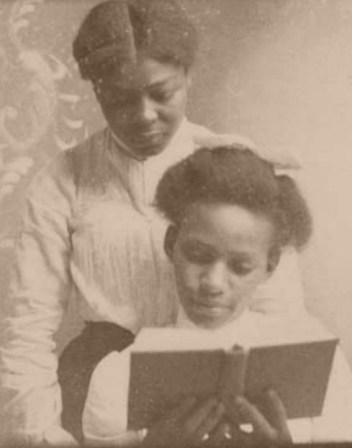
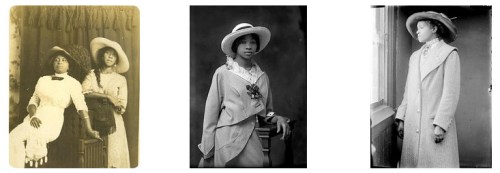
I chanced upon Kicha’s Black History website while researching an African American architect who lived during the late 1800s into early 1900s. I was finding lots of words providing context about the African American experience during this period but very few images until I came across her galleries.

Her unique collection is a moving reminder of the power of images to document the stories of people and places that might otherwise be forgotten.

I highly recommend taking time to peruse the site  and view the wide range of photos and their accompanying text. You can scroll through individual photos or browse different albums.

The photos were taken by different photographers.  They capture a beauty and dignity as well as diversity not always depicted in today’s historical narratives about the African American experience or in most popular media recreations of the time period.

While I don’t know the website creator’s story, I say bravo to what she has pulled together.  I think the site does something important by presenting pictures of an American experience that many may not know but may be important to rediscover and celebrate as we continue to define who we are in this melting pot of a nation.

View Kicha’s Black History galleries:  http://www.ipernity.com/home/285591

Read Full Post »

Here is a link to previous Interludes in our walk though history with Mr. Horne.


Walter Ings Farmer, Director, Wiesbaden Collecting Point

Walter Farmer, Director, Wiesbaden Collecting Point

In his book, The Safekeepers: Memoir of the Arts at the End of World War II (2000), Walter Ings Farmer writes that “The story of the Offenbach Archival Depot has never received the attention given to restoration of monuments … Nevertheless an account of MFA&A activities in the Frankfurt area would be incomplete without a description of the rescue of the literary and scriptural treasures that the Nazis had looted with the same nefarious purposes they applied to art collections. … Looting of libraries became as integral to the Nazis plan for cultural domination as the looting of art collections.

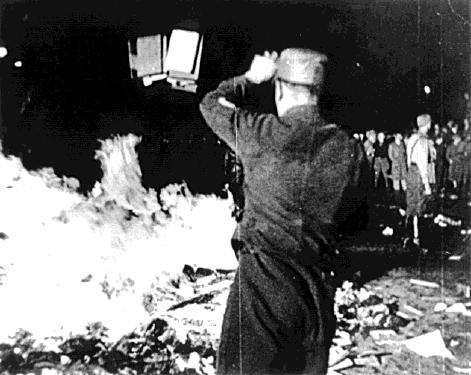
1933 Berlin Book Burning

1933 Berlin Book Burning

He describes how Nazi actions escalated from the 1930s public burnings of the authors they wanted to discredit to “a program of search and seizure among the libraries and archives of the nations that they sought to conquer. … These activities established a pattern which resulted in the eventual accumulation in Germany of storehouses full of other nation’s libraries.

Millions of books would be accumulated, along with a stunning amount of other cultural and religious items collected from across Europe.  Farmer writes of being introduced to Offenbach by “his boss” Captain James Rorimer in the fall of 1945.

James Rorimer

James Rorimer

He took me with him to inspect an abandoned warehouse within the I.G. Farben plant at Offenbach,” remembers Farmer. “This building was under consideration to become to repository primarily for Jewish libraries, archives and the Torahs.” Prior to the warehouse in Offenbach being established as a collecting point, library collections were being stored at the Rothschild Library in Frankfurt. Over time it was clear that infrastructure at the Rothschild Library was inadequate.

Based on his and others assessment of the situation, librarian and MFA&A officer Lt. Leslie Poste suggested that detailed cataloging of the items be stopped at Rothschild and that operations be relocated across the river to the I.G. Farben plant, the site of a five-story, reinforced concrete loft building.

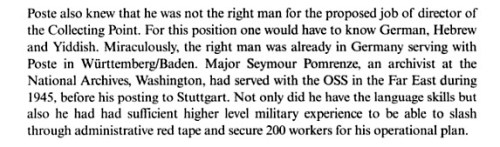
Seymour Pomrenze (center)
Seymour Pomrenze (center)

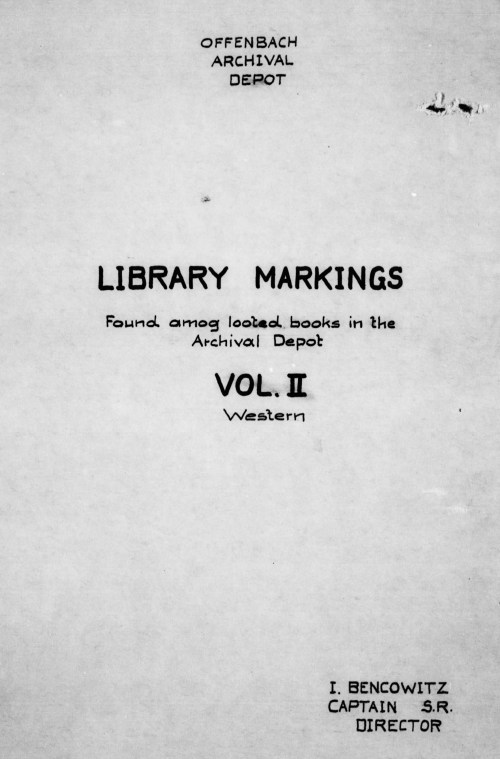
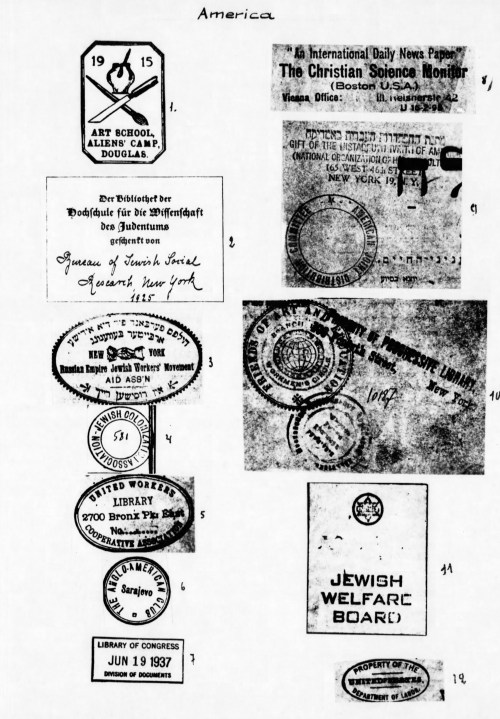
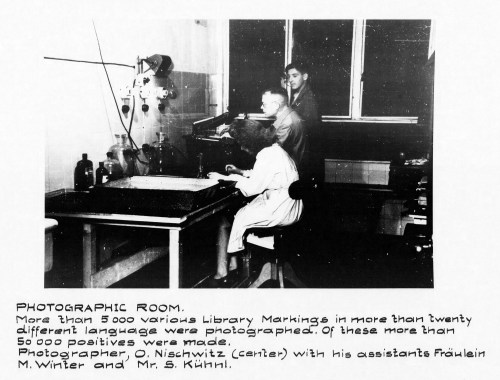
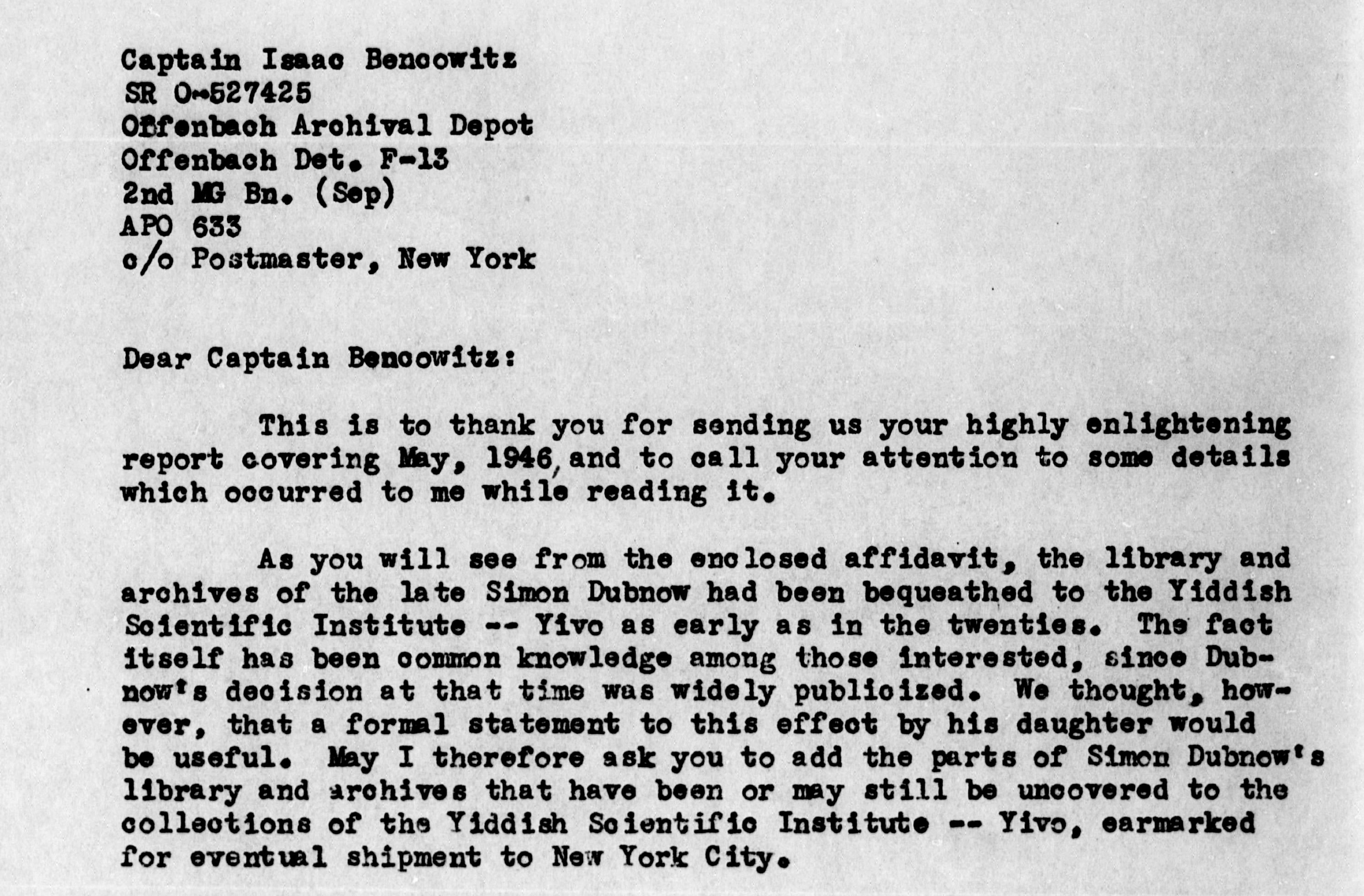
Pomrenze put into place necessary administrative, transportation, cataloging and storage systems enabling the depot to operate much more effectively.  Professional conservation and preservation labs, a photographic studio and other needed infrastructure was created.  His successor, Captain Isaac Bencowitz, refined a system for photographing ex-libris and library markings found in books.

Isaac Bencowitz

Isaac Bencowitz

The resulting cataloging system would significantly increase staff ability to identify and sort items, identifying country of origin and other markers of ownership .  In the end Bencowitz and his team would complete “two volumes with reproductions of library markings belonging to 4,105 libraries of individuals and institutions in Western and Eastern Europe

and two volumes with more than 1,300 bookplates or ex-libris, including 1,200 German-Jewish, German-Masonic and probably German non-Jewish plates as well as over 100 mostly Dutch-Jewish bookplates.” (F. J. Hoogewoud)

As requests were submitted by individuals, families and nation states seeking missing items, MFA&A staff were able to use the catalogs to help them search through the millions of books and cultural items that would eventually be stored at Offenbach.

Bencowitz, during his tenure as director, used photography to document the operations of the depot and its staff and volunteers.

Staffing the depot was a mix of U.S. military, Allied and civilian personnel, as well as German civilians, and scholars from around the world. In October 1946, Bencowitz received orders for redeployment.  The imminent nature of his departure and shifting priorities in the region for policy and decision-making made selecting a new director difficult.  As an “emergency measure,” archivist Major Lester K. Born and his assistant, Joseph A. Horne, were sent to Offenbach for temporary duty.  Born was to develop an interim plan for continued operation of the depot, a plan that Mr. Horne was to implement.  In short, a plan was finally developed and by January 1947, Horne became the third director of the Offenbach Archival Depot.

Exactly what Horne was doing prior to assuming his new role remains opaque without futher research.  Archival records show him often assisting MFA&A colleagues like Gordon Gilkey, Leslie Post, Lester Born and Paul Vanderbilt with the acquisition of information about available artwork and cultural items.  His fluency in German, facility with “dead languages,” appreciation and knowledge of the arts, and photographic skills would have made him invaluable in the field.  He produced numerous reports about his trips across Germany about what he was seeing and hearing from locals. People were often very open with him.  Following is an excerpt from a field report after visiting libraries in over a dozen landkreise or rural districts:

By 1947, relations with the Russians had deteriorated significantly, adversely affecting the restitution of items to individuals and institutions in Russian-controlled territories, and the exchange of items between the Russian Zone and other Allied Zones.  With plans well underway to revitalize German economy and culture (including denazification), military and intelligence priorities shifted to stopping the Russians.  And so Horne like many within the MFA&A unit followed orders as high level officials made clear that those in the U.S. intelligence sector had full access to depot materials and freedom to act as they deemed necessary.

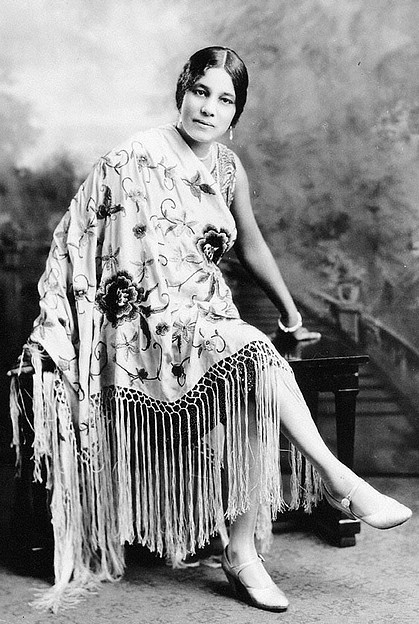
In February 1947, one month after Horne became director of Offenbach, Lucy Schildkret arrived.  She would later write, “his friends called him Tony. Before the war, he’d been on the staff of the Library of Congress’s photographic division.  Transferred from the MFA&A in Berlin, he was then new to the Depot, having taken over his duties barely two weeks before my visit.  About thirty, very tall, thin, lanky, and blond, he was the only American there.  He was in charge of a staff of some forty Germans.”

In her memoir, From That Place and Time, Lucy Schildkret describes her encounter with Horne as she works to sort, identify and return the YIVO library of Vilna, Poland.  The Yiddish Scientific Institute (YIVO) was founded in 1925 for the scientific study of Jewish life.  Headquartered in Vilna, the institute had branches around the world including the United States. At the start of the war its headquarters were transferred to New York City.

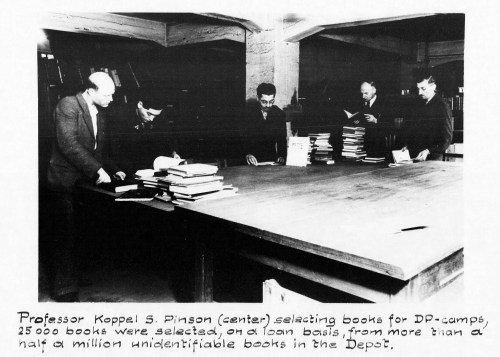
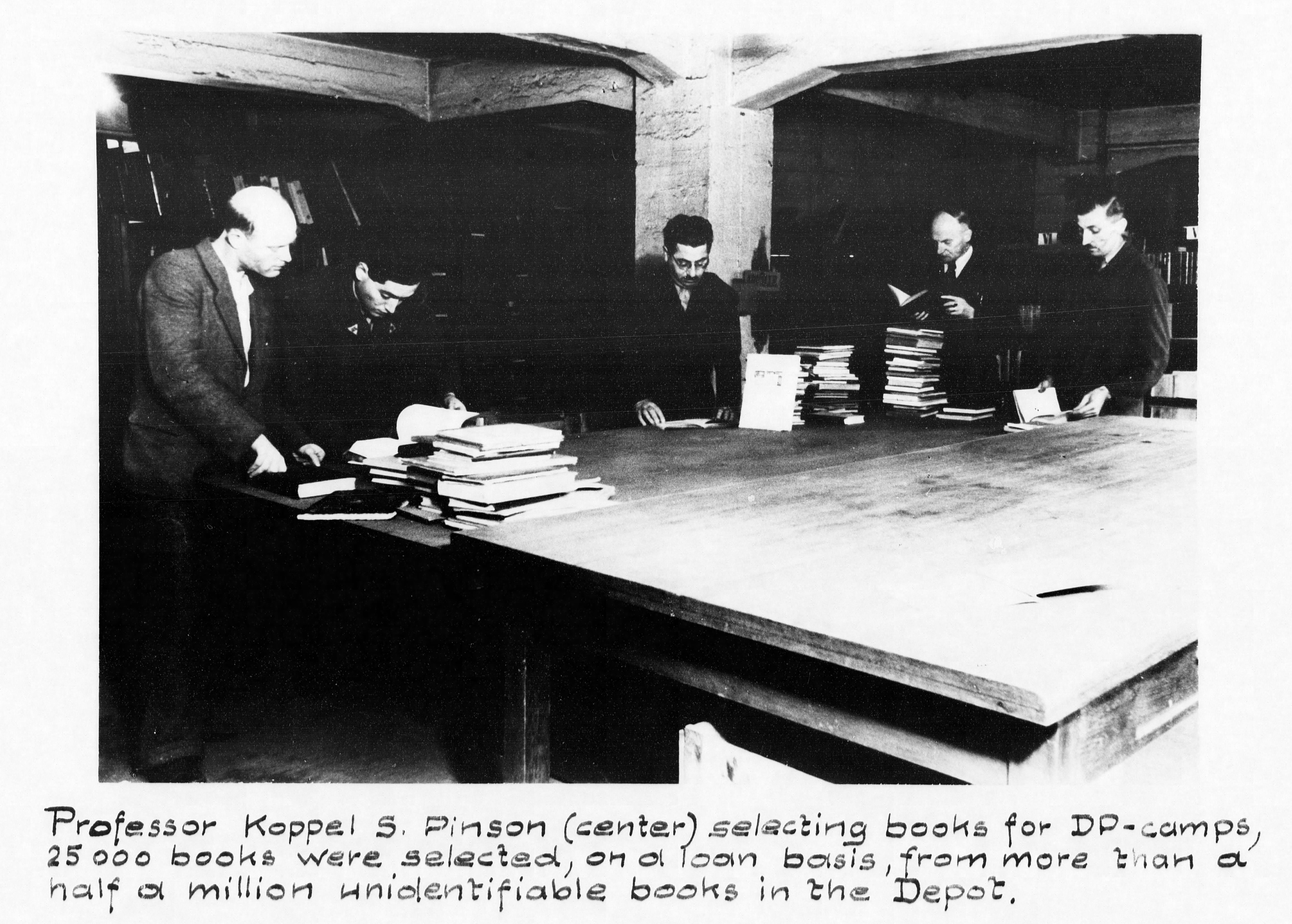
In late 1945, when the YIVO library was identified as being in Frankfurt, visiting Jewish scholar, Prof. Koppel S. Pinson sought permission from the YIVO leadership in New York to distribute, like a lending library, some of the unidentifiable books to Jews living in the Displacement Camps.  It would take time but he would be granted such authority.

A year later, Lucy Schildkret would also be granted authority to work with the books.

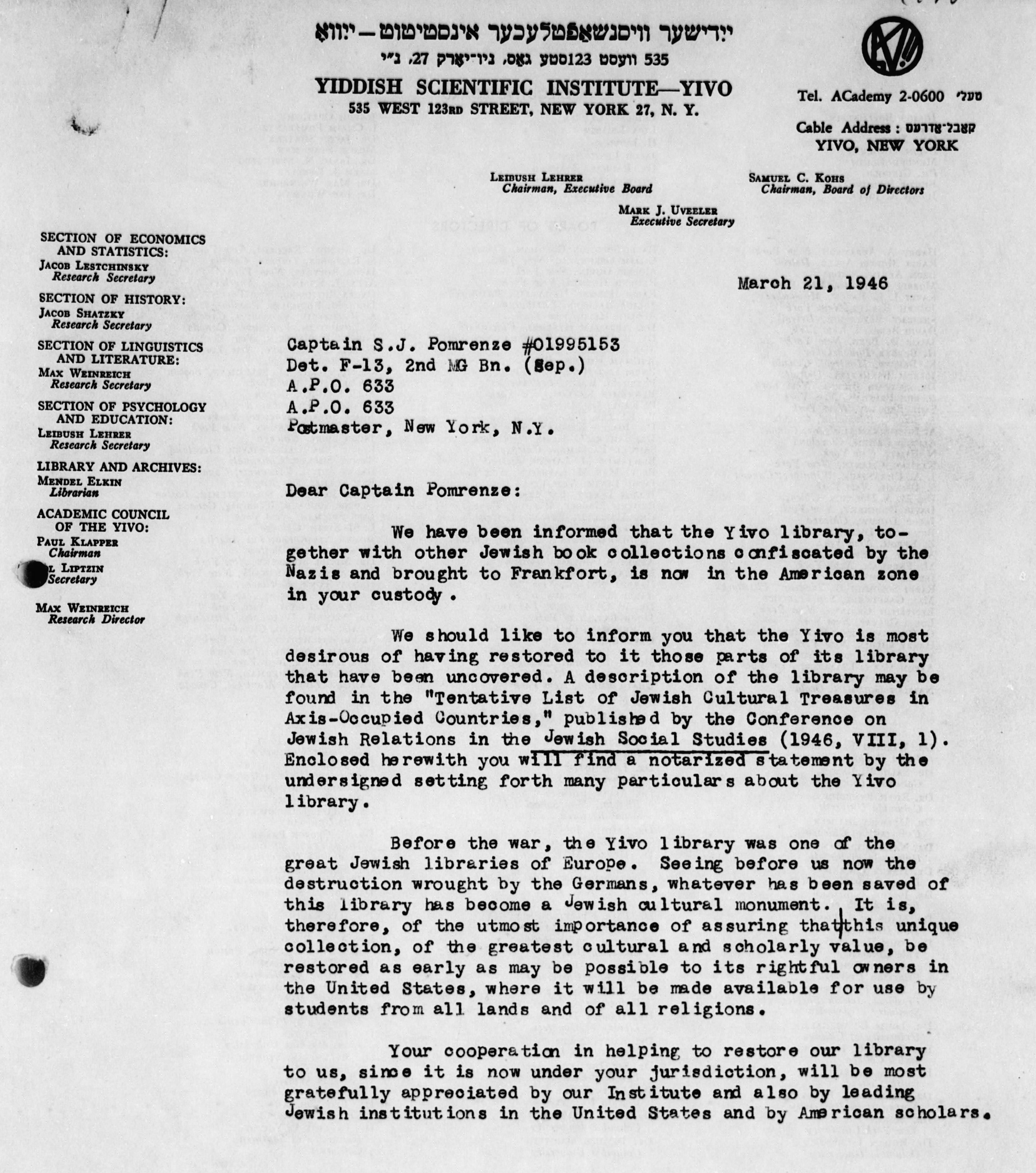
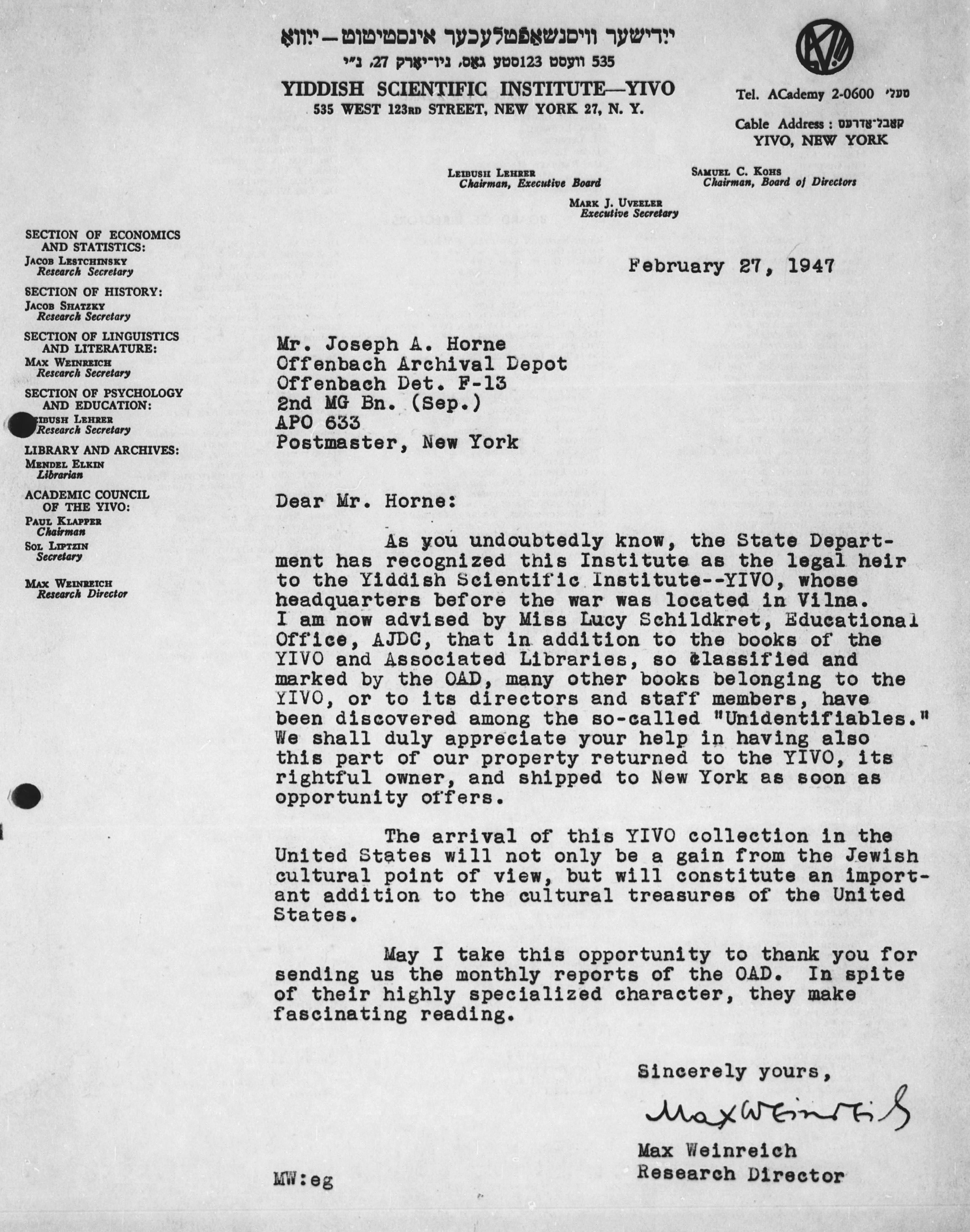
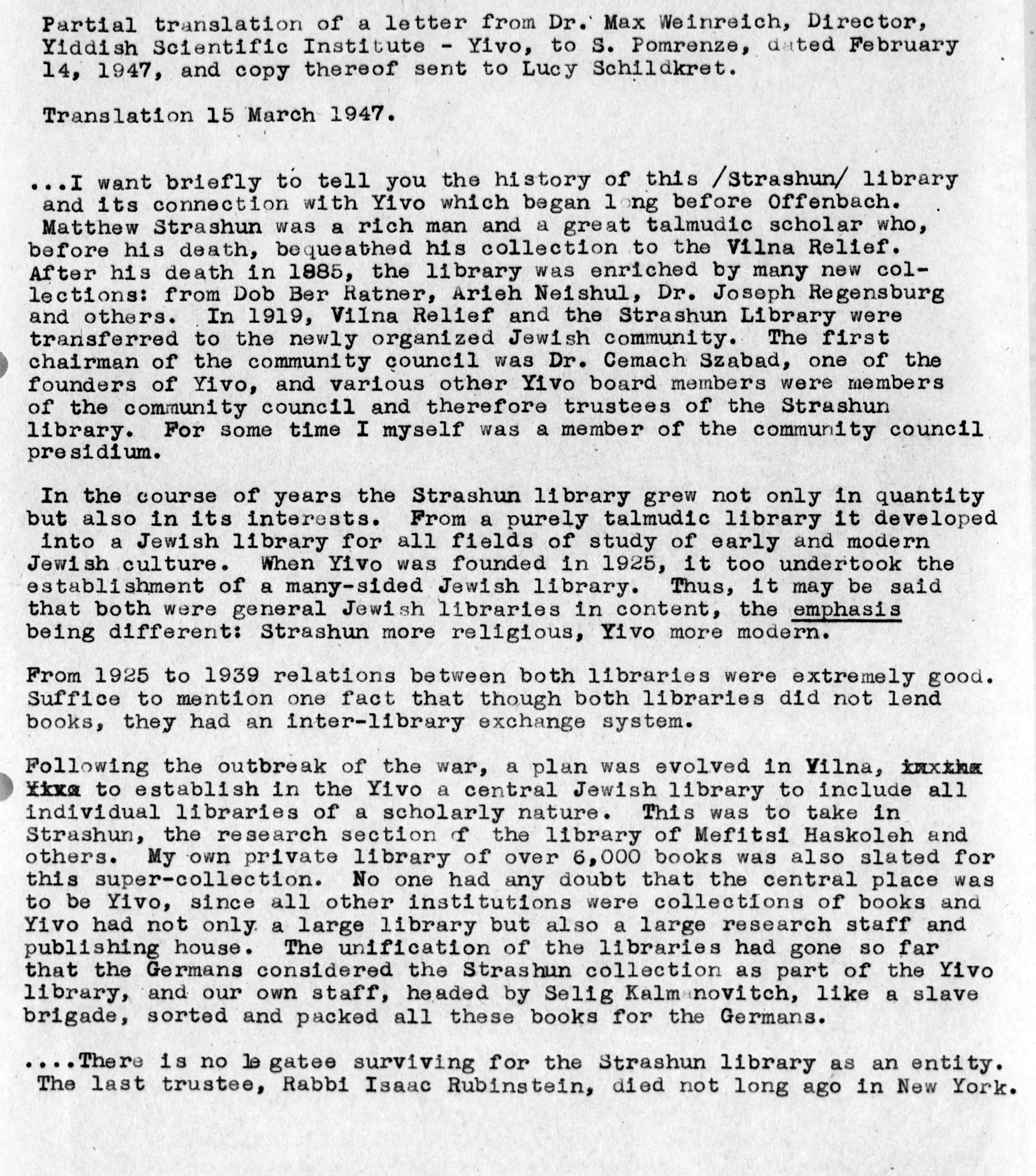
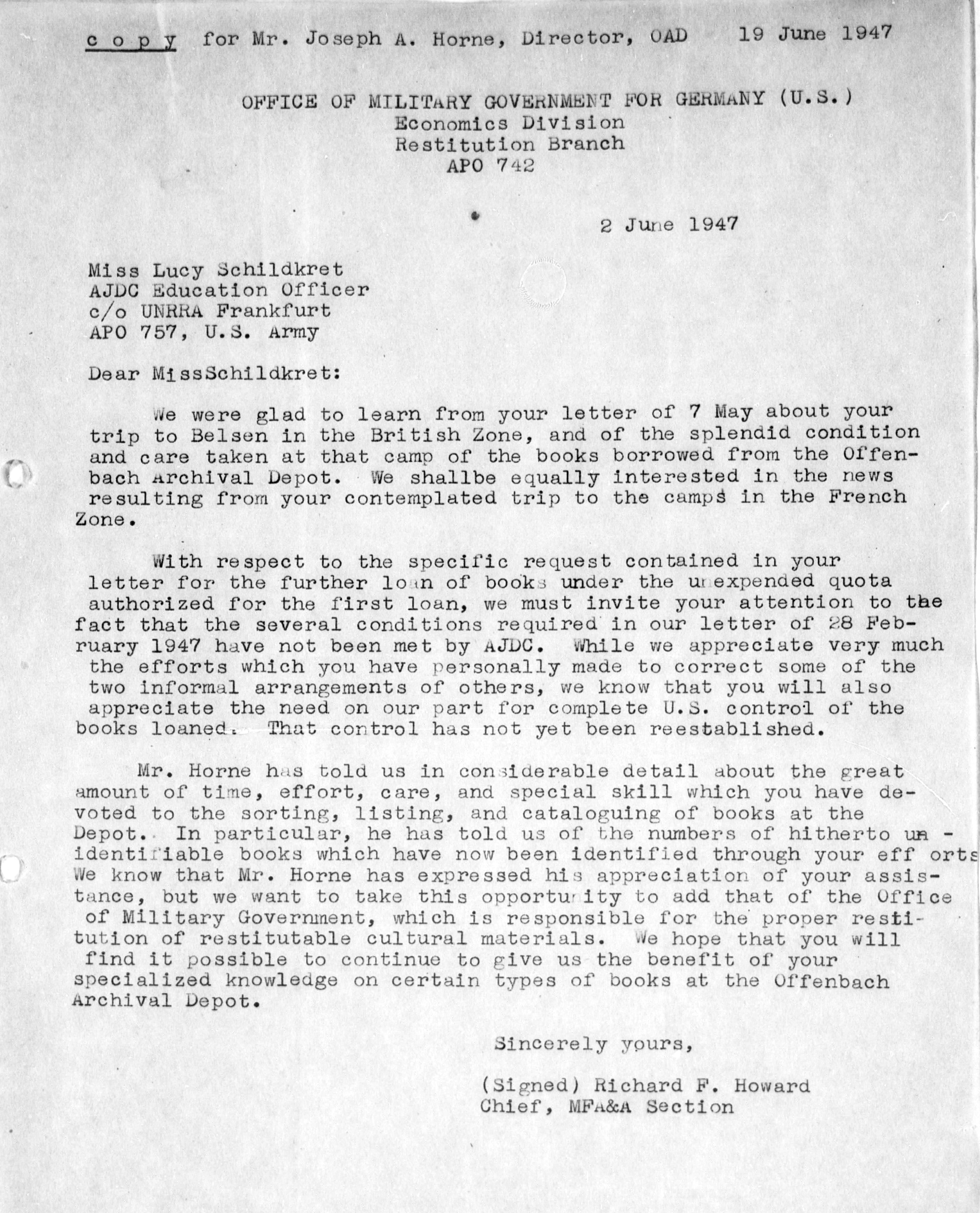
The complexities of sorting, identifying and returning books at the scale demanded of the Offenbach Archival Depot become clearer when reading through the declassified documents relating to what happened with just the YIVO library.  For instance, YIVO like many libraries of its size and mission had been the repository of family libraries.  Books at Offenbach were being identified by ex-libris and other markings as belonging to individuals and/or their families but they had in fact been donated to YIVO (or other institutions) by family members.  There are numerous letters between YIVO administrators with U.S. military officials trying to prove the ownership of items.
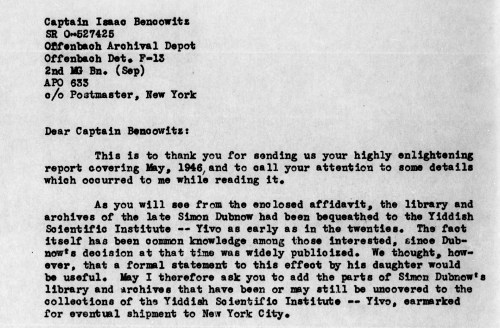
Though correspondence about the YIVO library begins in 1945, by early 1947 the vast library had yet to be shipped to YIVO in New York.  The reasons include continual reduction in manpower, both skilled and unskilled, at the depot and complex, bureaucratic chains of command within the U.S. military, between the Allied zones and even within the YIVO organization.  In a March 1947 document, Horne reports to his superiors that Miss Schildkret has been unable to examine several hundred thousand unidentified books because she had yet to receive authorization.
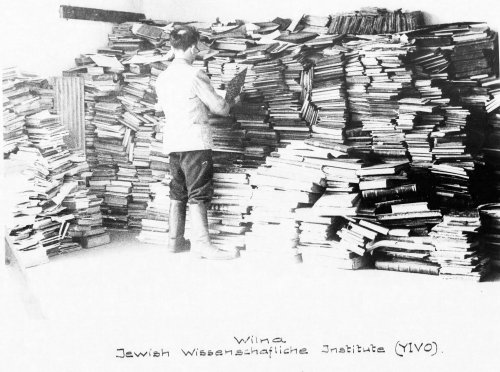
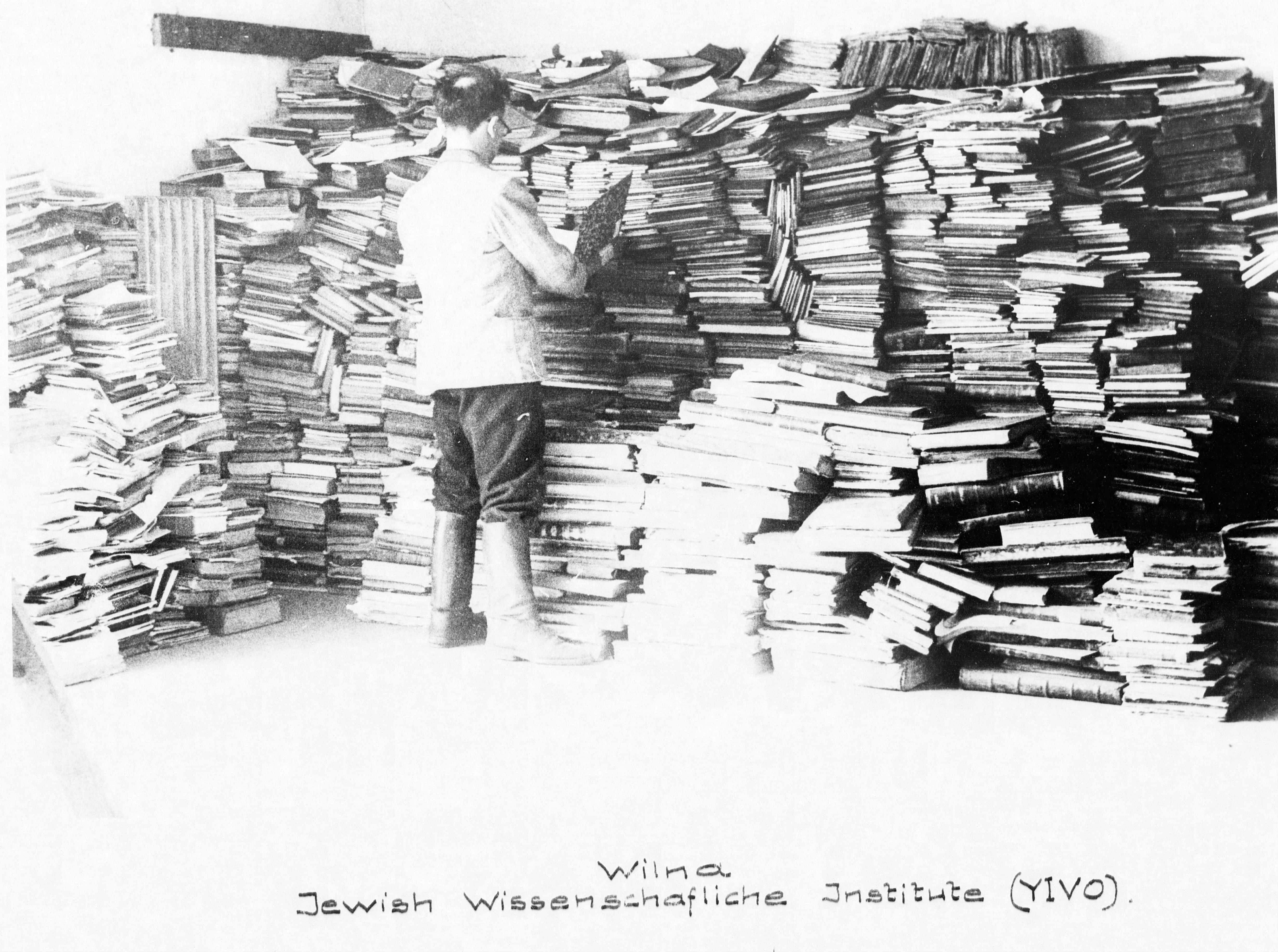
Vilna Library During German Occupation, in the files of the Offenbach Archival Depot

Vilna Library During German Occupation, in the files of the Offenbach Archival Depot

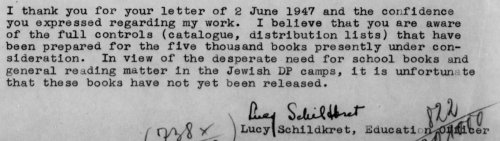
In 1938, Lucy Schildkret had studied in Vilna and worked at the YIVO.  Prior to the war, she would return to the U.S. and work as assistant to the research director at the YIVO headquarters in New York.  In 1946 she journeyed to Europe as an educational worker with the American Jewish Joint Distribution Committee (AJDC), the largest Jewish relief organization in America. Through this organization she was able to work with displaced persons in the camps.  With her skills in Yiddish and time at YIVO, she was able to discern that books that had been labeled as unidentifiable were indeed identifiable.  But even as she acquired the authority to help identify the YIVO library, she maintained her focus of serving the people housed in the displacement camps, and she would do so with a tenacity that would characterize her career for decades to come.
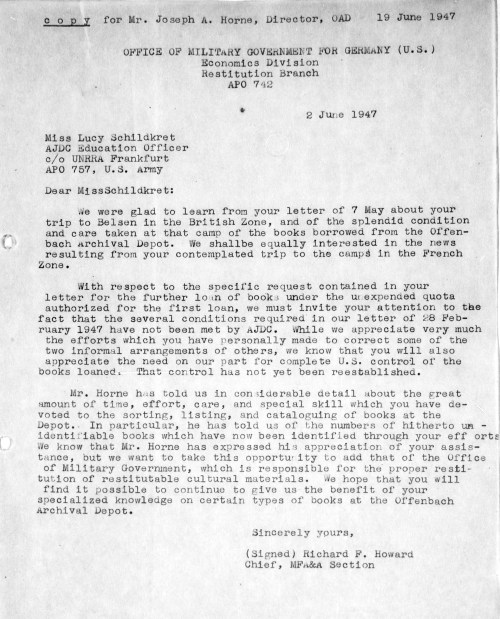
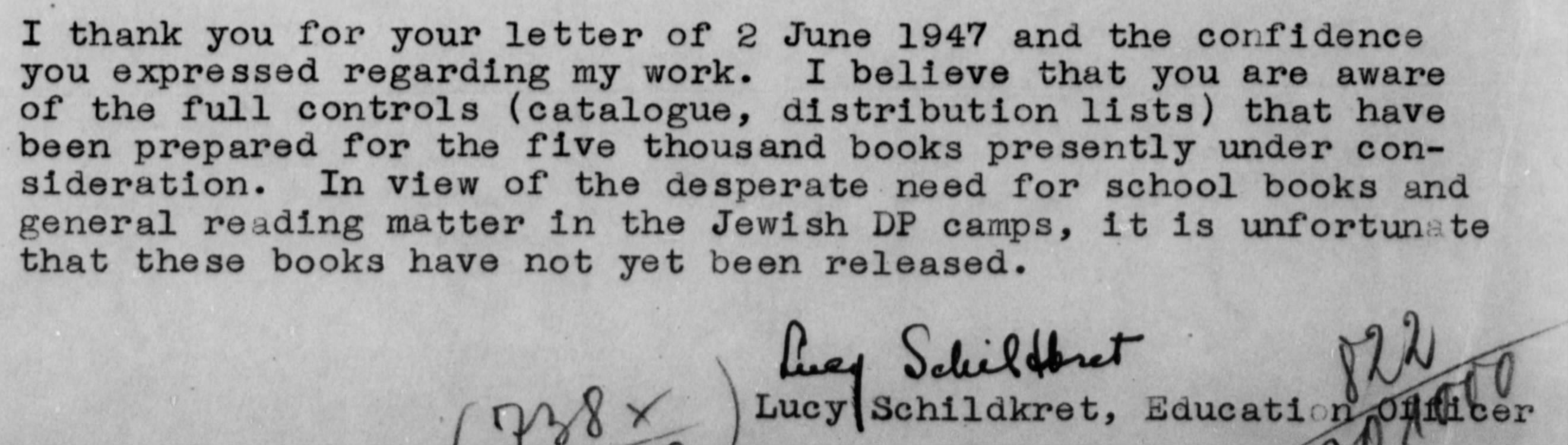
Schildkret responds two weeks later with a letter that concludes:
Her memoir presents a powerful account of the emotions stirred by working with the contents of the library from a place that she had called home and knowing what had happened to the people she’d called friends as the Nazis destroyed the city.
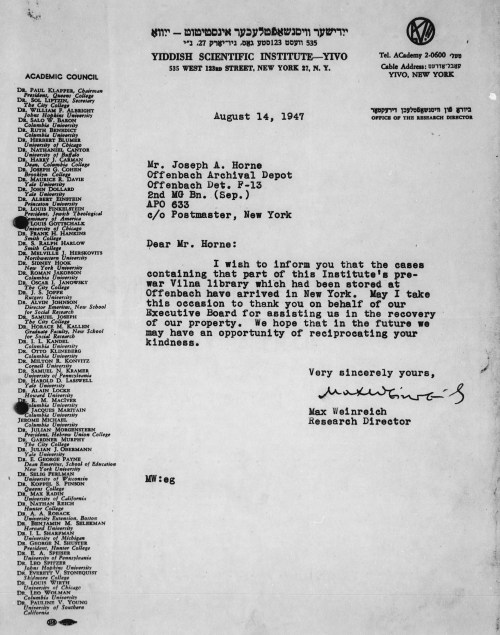
Eventually, with the combined effort of many individuals in several countries, over 90,000 items would be returned to the YIVO.  Seymour Pomrenze who had been pivotal in streamlining systems at the depot would be brought back to help shepherd the return of these items.  In 1998, Pomrenze shared his personal reminiscences of his experience with the Offenbach Archival Depot and the depot’s considerable achievements restituting and distributing millions of Nazi-looted materials including the YIVO library.

Mr. Horne, the person with whom we are taking this walk through history, would wrap up his tenure at Offenbach in 1948 though files show that he continued to support depot activities until its closure.  In the Cold War world, he would, strangely enough, continue to work with books and even return to his earlier interests in music and photography as he embarked upon a new journey.  One world war had ended. A new type of world war had begun. A new weapon in that war was the exchange of culture and what better place to share all that made up culture — from art to music to literature — than in a library.

More to follow …

Sources and Additional Readings

Cultural Plunder by the Einsatzstab Reichsleiter Rosenberg (ERR)

What Became of the Jewish Books? (New Yorker, February 2014)

U.S. Holocaust Memorial Museum — Offenbach Archival Depot

Pomrenze Personal Reminiscence about Offenbach

Mapping the Offenbach Archival Depot

Returning Looted European Library Collections

YIVO Digital Archive on Jewish Life in Poland

YIVO Institute

From That Place and Time: A Memoir, 1938-1947 by Lucy S. Davidowicz and Professor Nancy Sinkoff

Article – Dutch Jewish Ex-Libris Found among Looted Books in the Offenbach Archival Depot (1946) by F. J. Hoogewoud

1939 Photo of Lucy Schildkret in Vilna


Read Full Post »

« Newer Posts - Older Posts »