Feeds:
Posts
Comments

Posts Tagged ‘architecture’

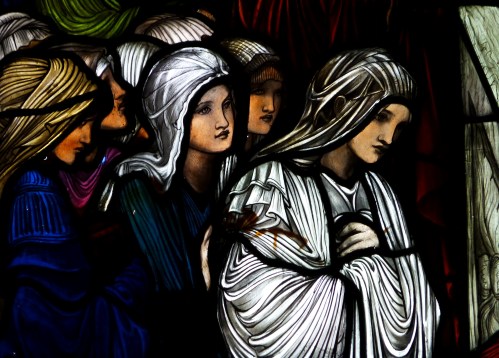
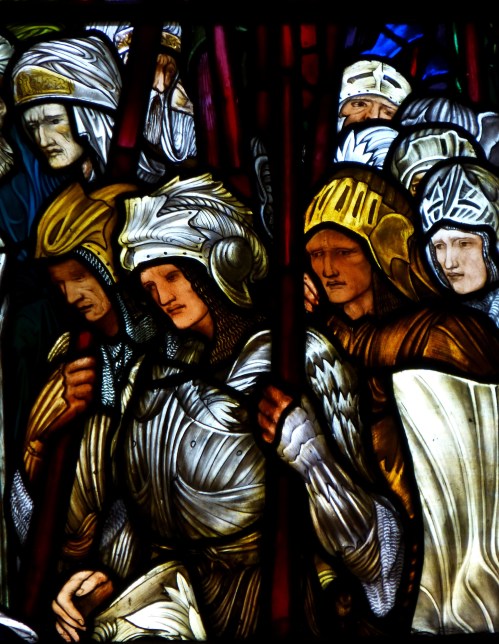
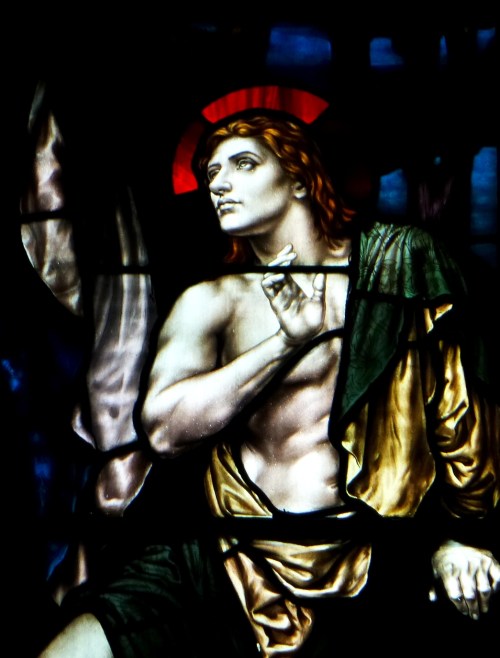
I keep reading that Henry Holiday of London was noted for his execution of drapery, i.e. the fall of cloth, around his figurative subjects; that it was a style reminiscent of Dante Rosetti.  I do love the intricate layering of cloth in these scenes from his stained glass window, The Transfiguration (1878), but it is the hands I particularly notice at present.   As promised in an earlier post, here is a bit more about the artist and his creation.
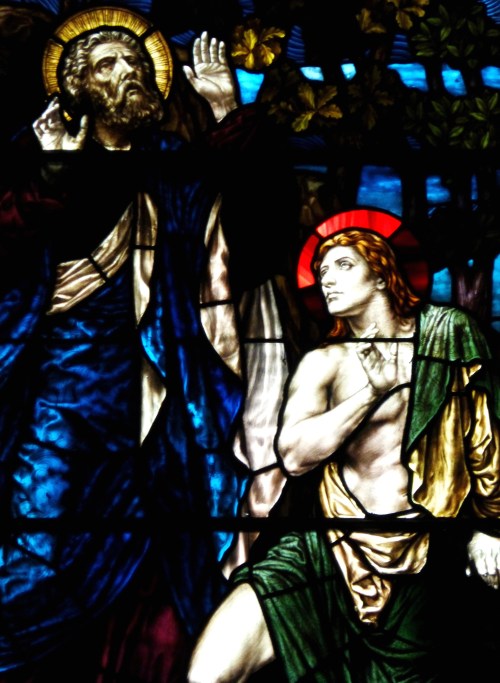
Henry Holiday was born in London in 1839.  His talent for drawing set him on an early artistic path where he would be influenced by Pre-Raphaelites like Burne-Jones, William Morris and Dante Rosetti.  Over time, he would develop his own unique style.  He traveled the world as many an artist of that period did.  Trips to locales like Italy and Egypt influenced his illustration, painting, sculpture and his work with stained glass.  Read more about his diverse interests and artistic expressions in this wikipedia article.
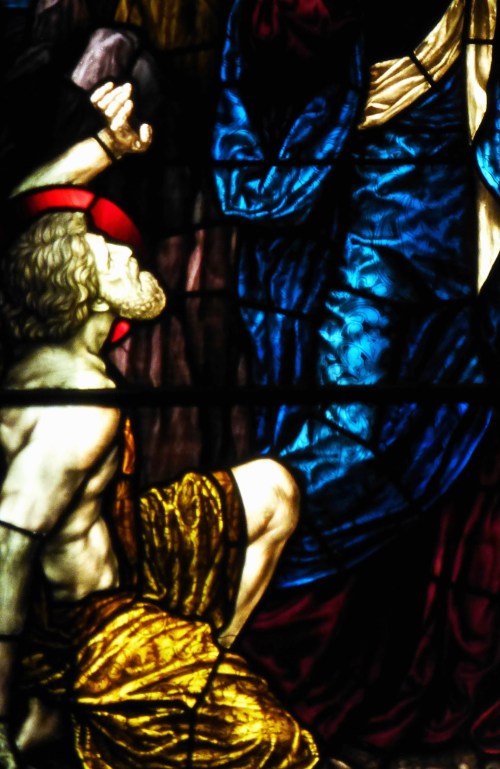
During his lifetime, Holiday did quite a bit of work for American churches, and that’s why I’ve been lucky enough to view and photograph his window, The Transfiguration, at Trinity Church in Copley Square, Boston.
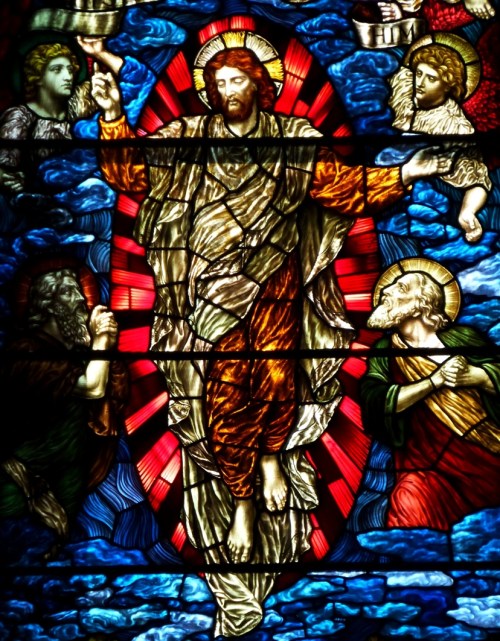
The window depicts a moment described in the New Testament. The basic story is that Jesus and three of his apostles, Peter, James and John, traveled up a mountain to pray.  There Jesus begins to shine like the sun, his clothes becoming white as snow.  The prophets Moses and Elijah appear at his side and talk with him. Eventually “a bright cloud overshadowed them, and a voice from the cloud said, “This is my Beloved Son, with whom I am well pleased; listen to him.” When the disciples heard this, they fell on their faces with awe. But Jesus came and touched them, saying, “Rise, and have no fear.” And when they lifted up their eyes, they saw no one but Jesus only. …” (Matthew 17:1-92, Mark 9:1-9; Luke 9:28-36; 2 Peter 1:16-18).”
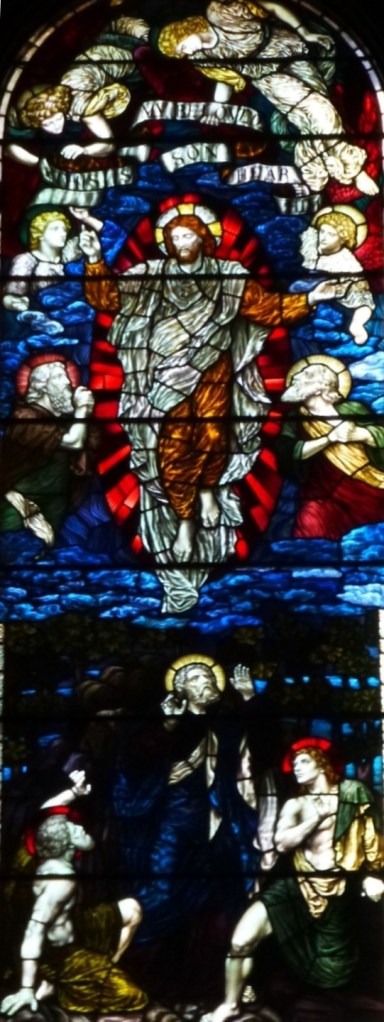
There are a lot of great resources online about the significance of this moment in Christianity and its various interpretations.  If you’re in Boston’s Back Bay, view Holiday’s window firsthand, especially when the sun is shining bright.  Postcards and prints available in the Trinity Book Shop with shipping available worldwide.
Read Full Post »

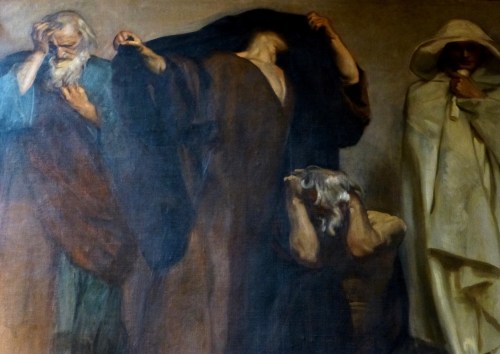
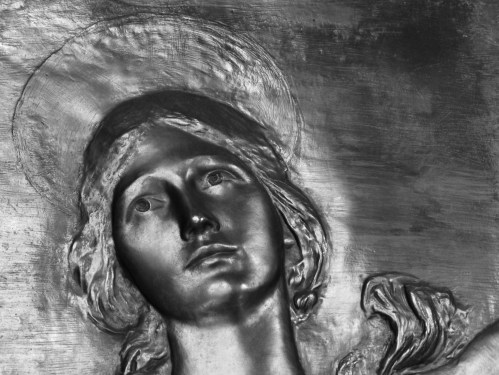
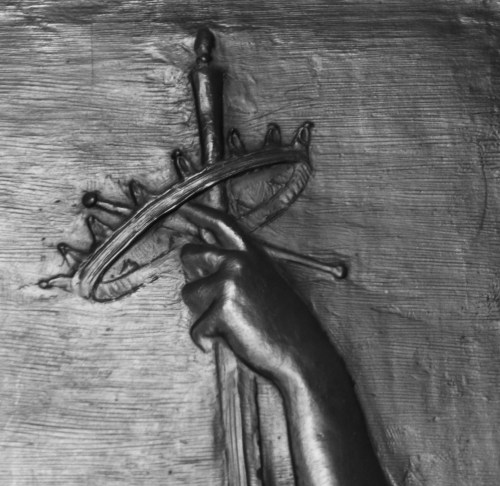
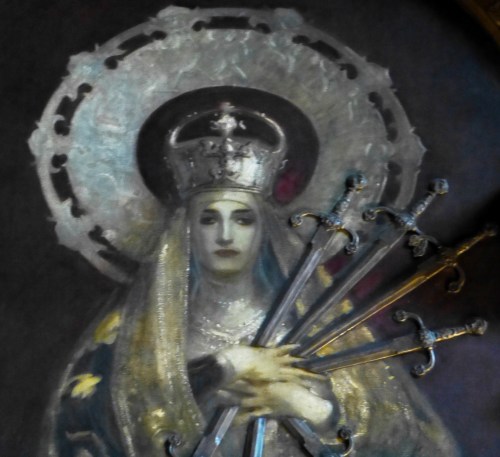
Based on yesterday’s post, I was asked by a few folks if I went up one more flight of stairs to view the hands of the Sargent murals.  Oh, yes indeed I did.  I did not begin with the Madonna of Sorrows with her silver crown.  With my limited time, I focused first on the prophets.

At the end of my stay, as I focused more on the Madonna of Sorrows, I had to stand close to a young security guard.  Finally I turned to her and asked, “Do you ever get bored?” She smiled and suddenly looked about twelve years old.  She said, “No, ma’am.  Every day I see something new.”

See all of the Sargent murals, in context, via this link.  This is an excellent site as well: http://www.sargentmurals.bpl.org/


Read Full Post »

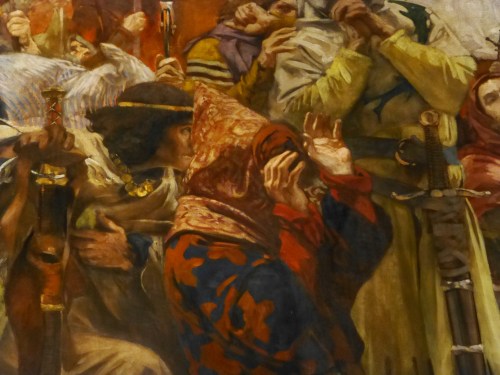
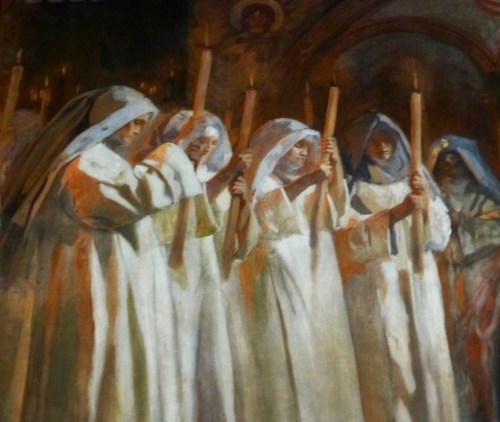
Hands, hands, hands.  I was surprised in preparing this post to discover that I have written about hands quite a bit over the years. Two posts that moved me most were from four years ago, Hands I and Hands II.   Hands stood out again during a recent visit to the Boston Public Library, visiting yet again the room with the Abbey Murals. I’ve photographed the murals often but this time I tried to focus on the hands.

For those new to the murals, in the 1890s Edwin Austin Abbey began a series of 15 wall paintings depicting The Quest and Achievement of the Holy Grail (based on a version of the legend by Henry James).  They were installed in 1895.

On the BPL website, you can read a description of the 15 panels and the story they depict.  Given how many shy maidens must have their hands kissed by Sir Galahad …

… and how many babes, swords and various vessels must be borne aloft and so on …

… well, it’s clear why Abbey paid so much attention to the hands of his legendary figures.

Read Full Post »

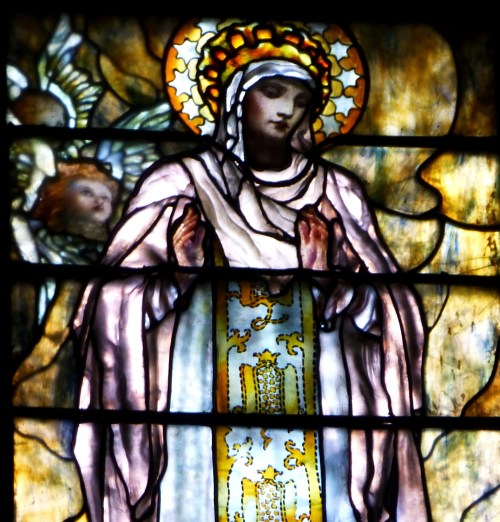
That is this lay person’s interpretation of this image of The Transfiguration of Jesus, a stained glass window in Trinity Church in Copley Square.  It is by Henry Holiday of London.  I hope to share more about the whole window and its maker in the coming month, but meanwhile I can share that I’ve been lucky enough to photograph this center part of the window. It will be available as a postcard in the church’s Book Shop in early October.  Have a good day, folks.
Read Full Post »

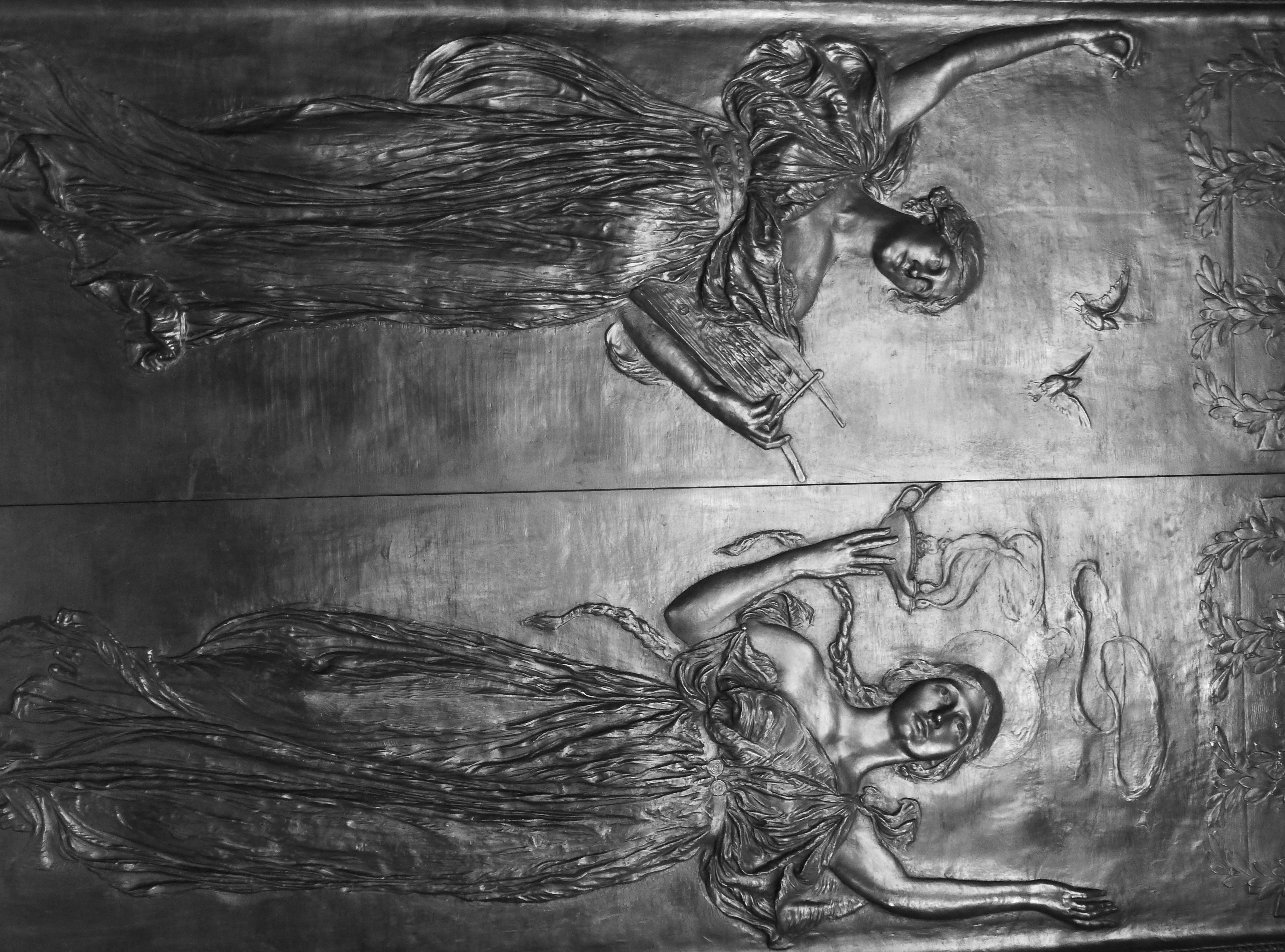
While on Newbury Street, I wasn’t far from one of my favorite haunts, the Boston Public Library.  I ventured there with the intent of perusing the new books and then taking a few more shots of the Sargent murals.  But instead of murals, I found myself photographing the bronze doors created for the library by Daniel Chester French.  According to the library website, there are three sets of bronze doors with each weighing 1500 pounds.  The allegorical figures, modeled in low relief, represent Music and Poetry, Knowledge and Wisdom and Truth and Romance.  I’m afraid I did not photograph Knowledge and Wisdom.  Maybe next time. 😉

You can learn more about Daniel Chester French on this Metropolitan Museum of Art page.

Read Full Post »

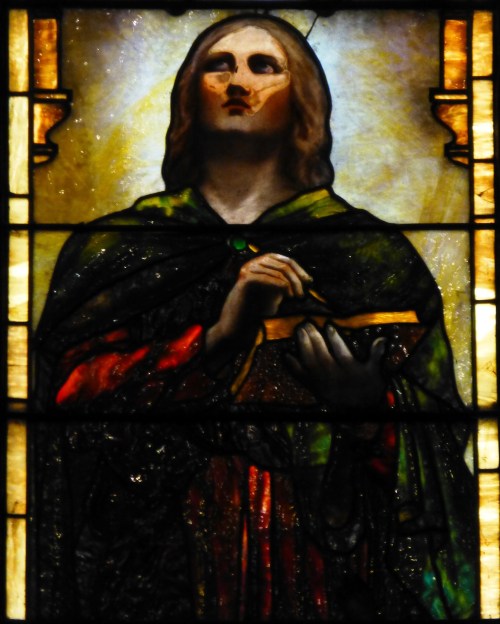
With more time available, I was able to return to the Church of the Covenant on Newbury Street in Boston.  Given the time of day and the angle of the light, I was drawn to photograph what I later learned to be the Sparrow window. Here’s what the church’s self-guided tour brochure says:  “Based on one of Jesus’ parables, the Sparrow window is a tour-de-force of Tiffany art using drapery or ribbed glass for clothing, and mottled glass or confetti glass for the background.  Frederick Wilson designed this image of Jesus as a young working carpenter, with a yoke on his back, pausing to sympathize with the plight of a small bird that only he can see clearly.”

Additional stained glass images can be viewed here.

If you’re in Boston and would like to visit for yourself, information can be found here.

Read Full Post »

At least it is the pinks and golds that stand out to me on this hot, hot day as I review these images recently taken of the stained glass window, David’s Charge to Solomon.

At some point I hope to direct you to some of the stories and resources that other have shared with me about the window and the fascinating relationship between Burne-Jones and Morris.

Until then, here a few more images of the parts that create the whole.

Read Full Post »

I’m excited to share that now available at The Book Shop at Trinity Church in Copley Square, this mug and two different magnets depicting a photograph I took of the stained glass window, David’s Charge to Solomon.  As described in an earlier post, the window was designed by Edward Burne-Jones and executed by William Morris.  The entire window is of course fantastic but for me, with camera in-hand, it is the light streaming through these angels that draws my eyes.  To see these items and other lovely merchandise, visit the Book Shop in the undercroft (basement) of the church, or you can contact the Shop by phone at 617.536.0944 extension 225.

Read Full Post »

Jen Parrish gave me permission to visit her online sites to select images to use as illustration for her interview responses.  As I did with other interviewees in 2012, I asked Jen to share how music inspires her artwork.  Viewing her artwork inspired me.   I had only to see an item described as “Gothic architecture meets nature” to know how appropos it was that she and I met through an art and architecture department in a Romanesque church.

She is an elegant, soft-spoken woman with a piercing gaze and gentle words.  It took me a while to learn that she is also a renowned jewelry designer whose handcrafted pieces are worn by celebrities and other people around the world.  Without ever having seen Jen work firsthand, I have only to listen as she speaks about her work to feel her dedication to beauty.  I expect everyone who purchases one of her unique pieces must know they carry part of Jen, and more than a bit of world history, with them.  I am very grateful she responded to my questions.   Please read her interview here.  I think you’ll find both the words and images quite interesting.

Read Full Post »

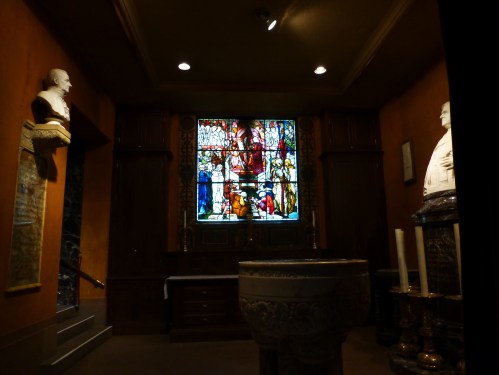
Nine minutes.  That’s all the time I had to walk through the Church of the Convenant before the doors would be closed for the day.  Located in Boston’s Back Bay on Newbury Street, the church is famed for its interior design work and stained glass windows by Tiffany Glass and Decorating Company.  The opportunity to photograph just a bit of this interior arose the same wonderfully rainy day I had my photographic adventures in the Boston Public Library.

You can read more about Church of the Convenant’s architecture and artwork via this link.

Read Full Post »

« Newer Posts - Older Posts »