Feeds:
Posts
Comments

Posts Tagged ‘painting’

painter's box of carol moses

painter’s box of carol moses

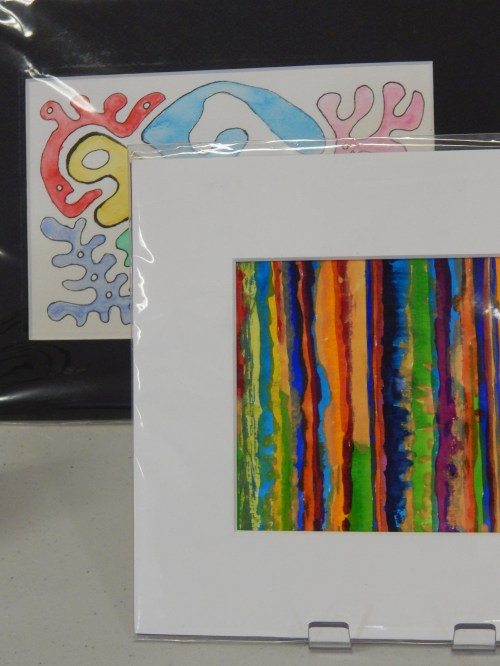
Visit the Riverside Gallery at the Cambridge Community Center from noon to 6pm today.  See artists at work. View their paintings, sculpture, photography and more.  Pieces are available for purchase including small totems by Cedric Harper (read more about this amazing artist here and here)

DSCN6785

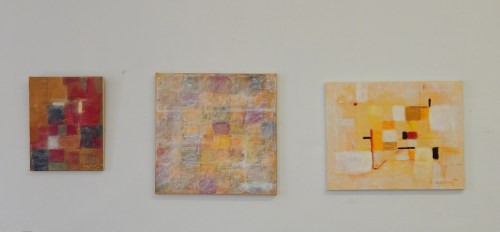
beautiful paintings by Adriana Prat (read more about her artistic expression here) …

vibrant works by Jenny L. Grassl blending words, letters and the visual

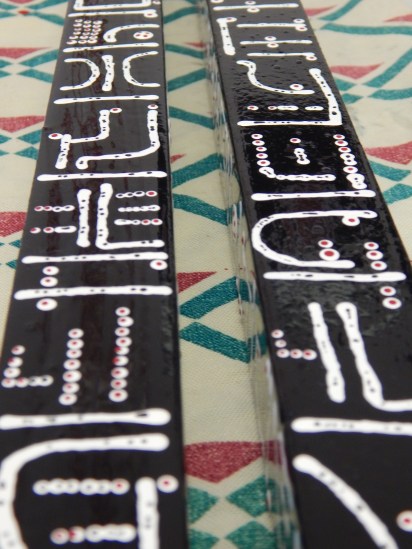
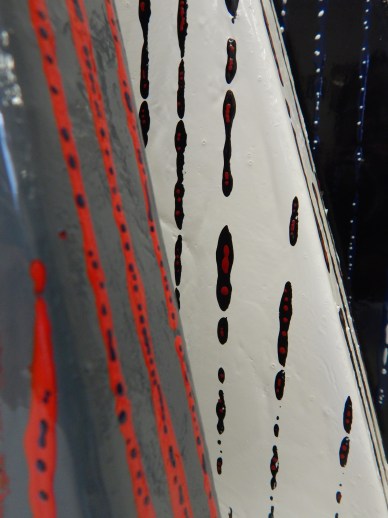
bold inks and watercolors by Carol Moses

and new work by artist Maki Takano

and I’ll be there!

Riverside Gallery 5 Callender Street, Cambridge


Read Full Post »

Part of the fun of playing with watercolors as I’m researching and working on papers is that there are writing rules I must obey on occasion but I don’t feel constrained with the watercolors. I can get up from the computer — good for my back anyway — and just dab paints and water on papers and see what happens.


Read Full Post »

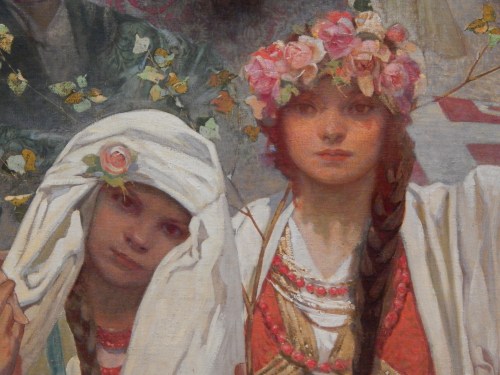
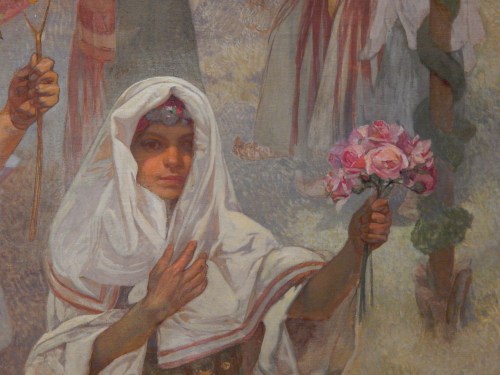
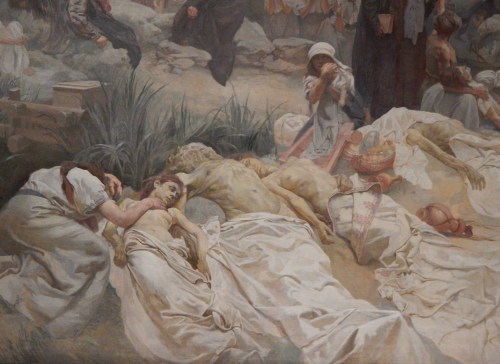
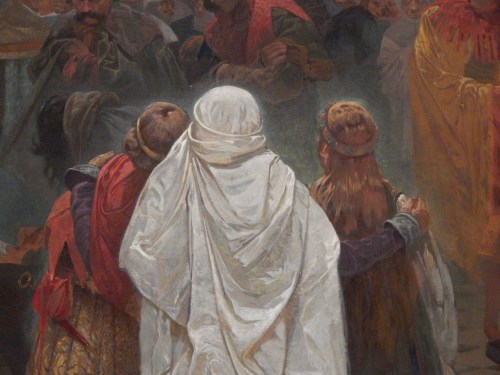
As far as I know, I have no Slavic blood in me but I do not think you need to be of Slavic heritage in order to appreciate the beauty and majesty of Alphonse Mucha’s Slav Epic anymore than you need to be of African American heritage to appreciate the Singing Windows at Tuskegee.

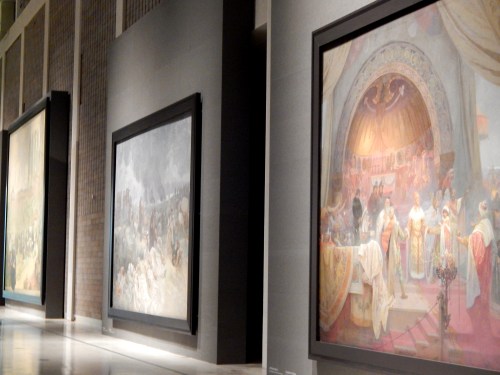
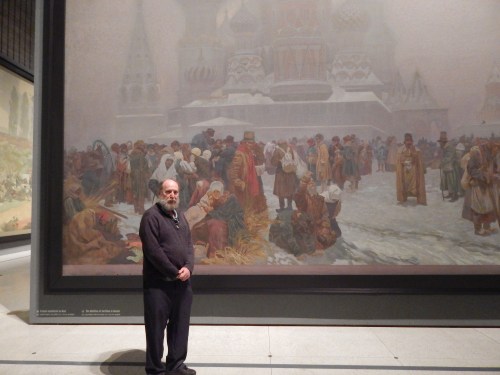
They both employ, in vastly different ways, visual storytelling to convey the histories of peoples and their journeys from subjugation to celebration, from despair to hope. As described on the Mucha Foundation website:  “The Slav Epic (Slovanská epopej) is a series of twenty monumental canvases (the largest measuring over 6 by 8 metres) depicting the history of the Slav people and civilisation. Mucha conceived it as a monument for all the Slavonic peoples …

The idea of the work was formed in 1899, while Mucha was working on the design for the interior of the Pavilion of Bosnia-Herzegovina, which had been commissioned by the Austro-Hungarian government for the Paris Exhibition of 1900.

In preparation for the assignment he travelled widely through the Balkans, researching their history and customs as well as observing the lives of the Southern Slavs in the regions that had been annexed by Austria-Hungary two decades earlier. From this experience sprang the inspiration for a new project – the creation of ‘an epic for all the Slavonic peoples’ that would portray the ‘joys and sorrows’ of his own nation and those of all the other Slavs. ”

On that website you will find a picture of all 20 paintings, a description of the stories depicted in each painting, and “related objects” which include photographs of Mucha at work on particular canvases, working with models, etc.

I read several reviews that said do not go out of your way to see this exhibit. I would say, if you have the opportunity to visit Prague, do all that you can to go out of your way to view this exhibit.  What struck me? The scale of this creation, the source of the inspiration, the vision of the artist and the dedication to completion. And of course the use of color and the expression of light.

It took Mucha approximately five years to shop his idea around and find a benefactor and then over a dozen years to produce his epic even as he produced all of the other art — the posters, the advertisements, murals, etc. — which are considered his definitive works.

Through December 2016 the exhibit can be found at the Trade Fair Palace in the City of Prague (http://www.ngprague.cz/en/exposition-detail/alfons-mucha-the-slav-epic/) and the online exhibit can be found on the Mucha Foundation website (http://www.muchafoundation.org/gallery/themes/theme/slav-epic).


Sources & Additional Readings

http://www.muchafoundation.org/gallery/themes/theme/slav-epic

https://en.wikipedia.org/wiki/The_Slav_Epic

1925 Article about the Epic as a Work in Progress

a 2010 post about the troubled history of the paintings

Read Full Post »

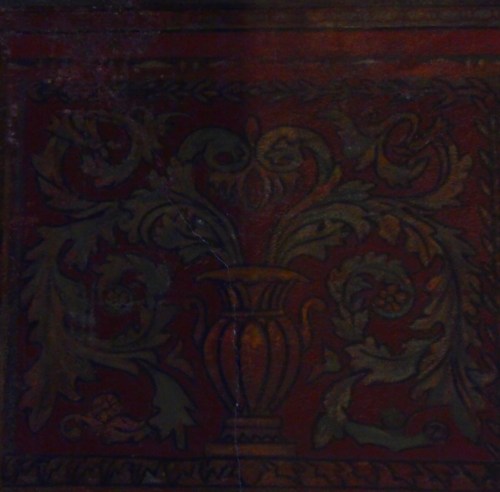
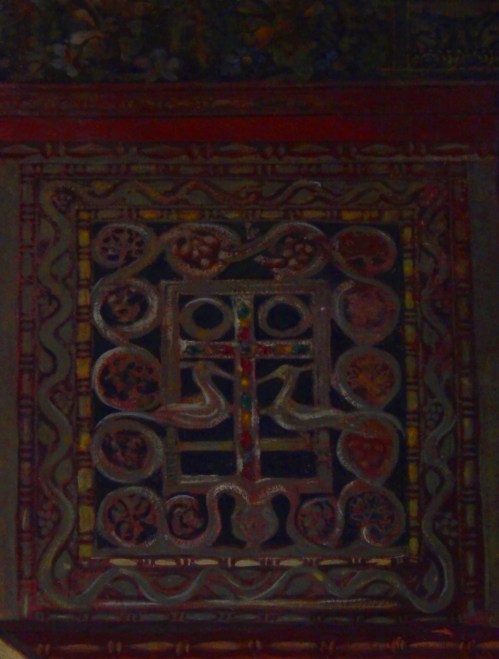
… I just make myself sit in a place, for just a few moments, and watch where the sunlight falls. And sometimes I notice that there are places where I have to shine my own light into a shadowed nook to appease my curiosity.  One day recently, while shining such a light, this is what I saw at Trinity Church.

Read Full Post »

These are the hands of St. Paul, St. Peter and Jesus as painted by John La Farge in the murals for Trinity Church.  I was inspired to create this compilation by the moving images and words in Steve McCurry’s recent post, The Language of Hands. I may write more about hands in the future, but for now, I hope you enjoy these images.

St. Paul’s hands

St. Peter, the key in his hand

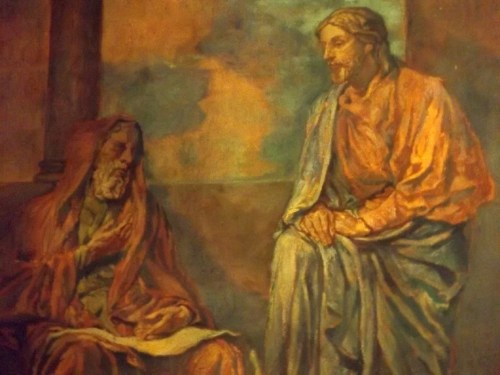
Jesus with Nicodemus, hands resting

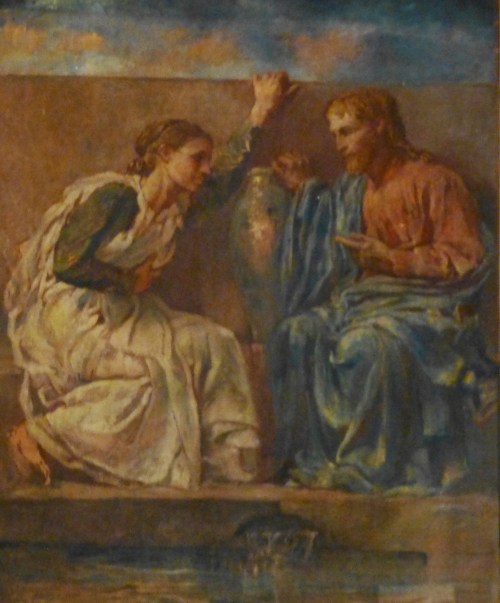
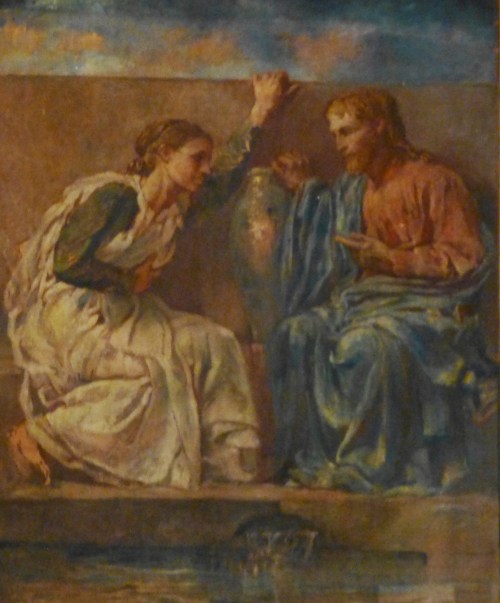
Hands of Christ and Woman at the Well

St. Paul Mural by John La Farge, 1877

St. Paul

The Visit of Nicodemus to Christ by John La Farge, 1878

The Visit of Nicodemus to Christ


Read Full Post »

In The Art and Thought of John La Farge, author Katie Kresser writes that John La Farge (1835-1910) completed his first sketch of Nicodemus and Christ in 1874.  That biblical encounter is a subject that La Farge would depict in several different forms over time.  Here is a sketch dated 1877 in the Yale University Art Gallery, and here is an oil painting completed in 1880, now housed at the Smithsonian.  He would also create a stained glass window for the Church of the Ascension in New York.  The following image, The Visit of Nicodemus to Christ, is a photograph of the mural La Farge painted on the walls of Trinity Church in Boston.

The Visit of Nicodemus to Christ, mural by John La Farge

The Visit of Nicodemus to Christ, mural by John La Farge, 1878

It is one of several murals that La Farge painted inside the building with the aid of assistants like Augustus Saint-Gaudens, Francis D. Millet and Francis Lathrop.  I keep photographing them because I think that there is always something new to see and experience.

In the literature of the time period critiquing his work, there is often reference to La Farge’s use of color in the murals that borders on the poetic.  For example, “In his “Christ and Nicodemus,” … we find the color quality strongly dominant. … the rich blues vein the draperies and background like the threads in a Flemish tapestry …” (The Churchman newspaper, July 6, 1901).

Christ Woman at Well, mural in Trinity Church by John La Farge

Christ Woman at Well, mural by John La Farge, 1877

The beauty of La Farge’s murals is constant but their colors do shift in the light.  Different details become present depending upon where one stands and at what time of day.

David, mural by John La Farge

David, mural by John La Farge, 1877

My favorite is perhaps the painting of David, because of the colors and especially for the expression on the young man’s face.

I had originally titled this post “in his own words” because I came across John La Farge: A Memoir and a Study compiled by Roy Cortissoz, literary and art critic for the New York Tribune, and La Farge’s friend.  In the book, completed in 1911 shortly after La Farge’s death in 1910, La Farge reminisces about what it was like painting the murals at Trinity under tight time constraints, in poor health, up high on scaffolding.  Reading the words made me appreciate the skills of all the artists even more.  If you’d like to read La Farge’ account, begin at the end of page 31 of the book, available online here.

Learn how you can see these murals and other architectural and design features at Trinity Church first hand here. Postcards of some of these images available via The Shop.

Read Full Post »

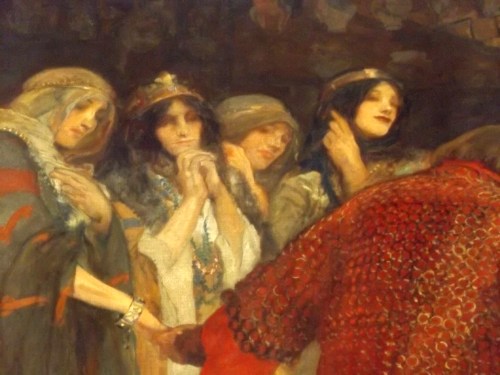
The Abbey Room at the Boston Public Library, with its richly colored wall paintings, is one of my favorite indoor sites in Boston.  The murals depict the Quest and Achievement of the Holy Grail and, according to the Boston Public Library website, were installed in 1895 by Edwin Austin Abbey.  Today I had the opportunity to drop in for a moment to snap a few photos. Here are a few favorites from the day.  You can read more about the Grail story here and you can read more about Edwin Austin Abbey here.

Read Full Post »

paintings by carl hofer

paintings by carl hofer

I enjoyed photographing the apricot and other fruits earlier this week.  In part, I was inspired by Carl Hofer‘s Bowl of Peaches and his other fruit still life paintings.  I did not know he was an artist when I began researching his life, nor could I imagine how much I would love his work.
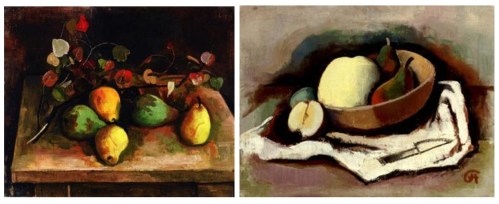
paintings by carl hofer

paintings by carl hofer

My research began with only a name engraved on custom stationery and a signature at the bottom of a handwritten letter, dated 1948, addressed to Joseph A. Horne, the Director of the Offenbach Archival Depot.  The script was beautiful but illegible for me since it was in German.  Horne’s son remembered his father referring to the man but no other details about who he was or how his father and this Hofer might have met.

carl hofer painting

carl hofer painting

As part of my ongoing walk through history with Mr. Horne, I wanted to know more about this man in his life.  Translation of the letter would come later, but I began by researching the only words in the letter I could immediately understand, his name.
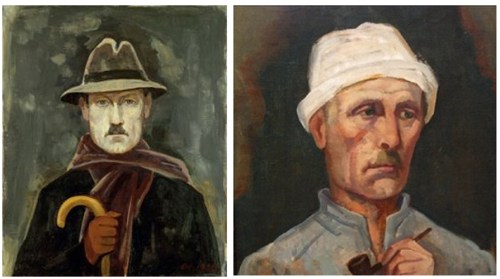
carl hofer self-portraits, spanning1920-1945

carl hofer self-portraits, spanning1920-1945

I quickly learned that Carl Hofer (1878-1955) was a noted German expressionist painter, printer and illustrator whose work  had been appearing in exhibits around the world since the early 1900s. At the end of this post are some of the links I found describing this important artist and teacher whose name may not be that familiar today outside of art circles. If not for Horne’s letter, I would not have learned of his work.
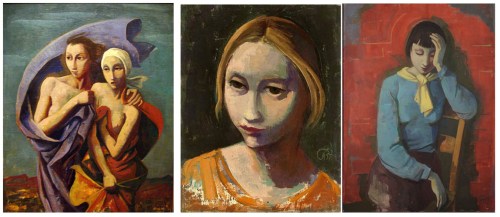
carl hofer paintings

carl hofer paintings

Of the many documents lost over time, that letter was one of the few that Horne retained.  For those of you familiar with my Interludes series, you know that Horne was involved with the recovery and restitution of stolen artwork, books and other cultural items in post-war Germany.  And he was also involved with those activities to foster and reinvigorate the artist communities in a war-ravaged Germany.  It is undoubtedly through these activities that Horne and Hofer met in the late 1940s.

carl hofer in later years, late 1940s

carl hofer in later years, late 1940s

Earlier, in the 1920s Hofer had been teaching art at a respected German institution and his work celebrated world-wide.  But, by the 1930s, he’d made Hitler’s list of degenerate artists.  He was removed from his teaching post.  Over 300 of his works were confiscated from museums and several included in a traveling exhibit of degenerate art alongside the works of Beckmann, Chagall, Kadinsky, Klee, Nolde and other artists.  By the war’s end, in Allied Occupied Germany, he would be reappointed as teacher and director of a new arts academy. As for the years in between and soon after …

carl hofer paintings, period 1947-1948

carl hofer paintings, period 1947-1948

In his memoir, From the Ashes of Disgrace, sociologist Hans Speier describes what happened to Hofer under the Nazis and Speier’s impressions of the man after they met in late 1945:

…The failure to find a safe place to work and live pushed [Hofer] to the brink of despair.  In 1943, a fire destroyed his studio along with all his paintings from the past ten years. He resumed work at once in a room in his apartment, only to be completely bombed out and lose everything in November 1944.  Thereafter he finally found refuge in a sanatorium in Babelsberg near Berlin, where the Nazis were hiding the French politician Herriot … Now [in November 1945] he owns no furniture, and he is hungry.  Nor has he suitable quarters for doing his work.  However, as president of the academy, which has been reconstituted … he is quite busy.  I was almost awed merely by seeing the expression on his face, and by his reserve and his dignity.” (page 25)

I was especially excited to find Speier’s 1945 account because his words corroborated and complemented what Hofer would write to Horne three years later in March 1948.  Once translated, the poignancy of the content came across although the specific meaning of words and references were not immediately clear.  Hofer writes of being touched by Horne’s inquiry into his well-being.  Then, he writes, after having been in the insane asylum for years, “now we are back in an asylum again.” He alludes to the monetary reforms of  postwar Germany that result in the “black market blossoms as never before, only this time prices are higher.”  Finally, he writes of “the American planes drone above our heads, reassuring us day and night that we won’t starve, unless the red Hitler gobbles us up.  It has been a crazy time, so different from what we pictured in our naive hope three years ago.

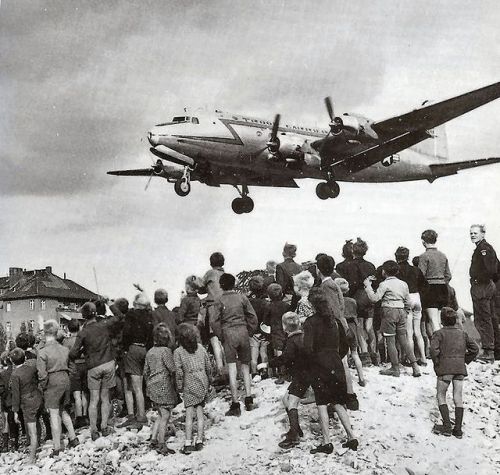
Berliners watch a C-54 Skymaster land at Tempelhof Airport, 1948

Berliners watch a C-54 Skymaster land at Tempelhof Airport, 1948

It wasn’t until I spoke with a woman who grew up in the Soviet Union that I understood that the reference to red Hitler was Stalin.  And when I looked more closely at the letter’s date, then did I understand the reference to crazy times, the security of American planes overhead and the possibilities of starvation.  Hofer wrote the letter only a short time before the Berlin Blockade.  As the Soviet blockade took place (June 1948-May 1949), Western Allies dropped food and other supplies into Western Berlin by air.  While the blockade would eventually end, the Cold War was only just beginning.  Hofer survived the blockade, and would continue to teach and to create art for several more years.

Life Magazine article, 1954

Life Magazine article, 1954

Today his work is found in museums, galleries and private collections around the world.  While there are a few more bits of correspondence between Hofer and Horne that I’ve found, their translation is a future project.  For now, it has been my pleasure to learn just a little bit about this influential artist, his perseverance, and the beauty he created until the end of his days in 1955.


Sources/Additional Reading

Degenerate Art Overview Wikipedia

Spaightwood Galleries Hofer Bio

Hofer Drawings at the Museum of Modern Art

Art Institute of Chicago Collection

Van Ham Art Estate and Hofer Archive

Life Magazine, May 10, 1954 Article

From the Ashes of Disgrace: A Journal from Germany, 1945-1955 by Hans Speier (page 25)

Berlin Blockade


Read Full Post »

One day I found myself walking along, looking at the world around me.  I passed a stand of birch and I found myself thinking, if I only knew how to paint, I’d paint these trees.  I kept moving along, but the sight of the trees remained in my mind and I found myself thinking, if only I could write music then maybe I could write a song about the trees.  But I know I don’t write music and so I started thinking, if only I could sing then maybe I could find someone else to write the music, but that would only work if I wasn’t shy. Now, I don’t really think I can sing but sometimes when I’m sure I’m alone, some kind of sound passes between my lips.  And so that day, with all those if’s put out into the world, I decided to go ahead and try that singing thing.  The following soft words emerged in some kind of rhythm.

If I knew how to paint

I’d paint these trees

How the wind does make them sway

Their leaves sunlit

Their branches bent

While high above soars a bird

Nothing Earth-shattering but it did make me feel good to sing and then hum the song for a bit.  Only later did I realize that the tune (if that’s the right word) that I used for my trees was for that of Amazing Grace, a point made clear when I viewed one of today’s Cowbird Daily stories.  The video short is an excerpt from the journey of another walker, Andrew Forsthoefel.  I hope you have a chance to view and listen to the video for yourself.  And by the way, that picture above … there must have been a day when I forgot that I couldn’t paint. 😉

Amazing Grace

Read Full Post »

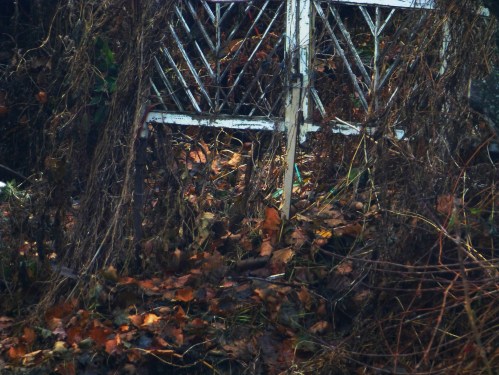
Snow began to fall this morning and so I went to the window to check on my so-called copper branches.

These branches drape over a crumbling concrete wall.

The wall is adjacent to a muffler shop.  If I were to widen my shots you would see the mountain of tires, metal poles and big blue barrels.

The area is not easily accessible.  It is cordoned off on three sides by a metal fence.  It is only because I am next door and up high that I can see the beauty over the wall.

One day I may get up the nerve to talk with the manager and convince him to let me into the area, to climb over the tires, so that I can get up close to the tiny rambling woods.

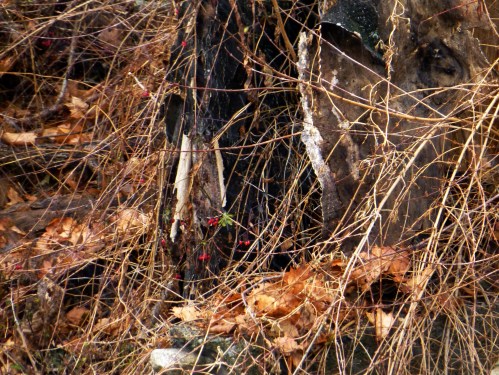
But for now I am happy to shoot from a distance and later play with the images. As different details emerge out of the lovely chaos – a leaf still green, the illumination of paler twigs, and so forth – it feels a bit like painting with light.

Read Full Post »

« Newer Posts - Older Posts »