Feeds:
Posts
Comments

Posts Tagged ‘poetry’

dscn1011

a wall I saw today

Let America Be America Again

Let America be America again.
Let it be the dream it used to be.
Let it be the pioneer on the plain
Seeking a home where he himself is free.

(America never was America to me.)

Let America be the dream the dreamers dreamed–
Let it be that great strong land of love
Where never kings connive nor tyrants scheme
That any man be crushed by one above.

(It never was America to me.)

O, let my land be a land where Liberty
Is crowned with no false patriotic wreath,
But opportunity is real, and life is free,
Equality is in the air we breathe.

(There’s never been equality for me,
Nor freedom in this “homeland of the free.”)

Say, who are you that mumbles in the dark?
And who are you that draws your veil across the stars?

I am the poor white, fooled and pushed apart,
I am the Negro bearing slavery’s scars.
I am the red man driven from the land,
I am the immigrant clutching the hope I seek–
And finding only the same old stupid plan
Of dog eat dog, of mighty crush the weak.

I am the young man, full of strength and hope,
Tangled in that ancient endless chain
Of profit, power, gain, of grab the land!
Of grab the gold! Of grab the ways of satisfying need!
Of work the men! Of take the pay!
Of owning everything for one’s own greed!

I am the farmer, bondsman to the soil.
I am the worker sold to the machine.
I am the Negro, servant to you all.
I am the people, humble, hungry, mean–
Hungry yet today despite the dream.
Beaten yet today–O, Pioneers!
I am the man who never got ahead,
The poorest worker bartered through the years.

Yet I’m the one who dreamt our basic dream
In the Old World while still a serf of kings,
Who dreamt a dream so strong, so brave, so true,
That even yet its mighty daring sings
In every brick and stone, in every furrow turned
That’s made America the land it has become.
O, I’m the man who sailed those early seas
In search of what I meant to be my home–
For I’m the one who left dark Ireland’s shore,
And Poland’s plain, and England’s grassy lea,
And torn from Black Africa’s strand I came
To build a “homeland of the free.”

The free?

Who said the free? Not me?
Surely not me? The millions on relief today?
The millions shot down when we strike?
The millions who have nothing for our pay?
For all the dreams we’ve dreamed
And all the songs we’ve sung
And all the hopes we’ve held
And all the flags we’ve hung,
The millions who have nothing for our pay–
Except the dream that’s almost dead today.

O, let America be America again–
The land that never has been yet–
And yet must be–the land where every man is free.
The land that’s mine–the poor man’s, Indian’s, Negro’s, ME–
Who made America,
Whose sweat and blood, whose faith and pain,
Whose hand at the foundry, whose plow in the rain,
Must bring back our mighty dream again.

Sure, call me any ugly name you choose–
The steel of freedom does not stain.
From those who live like leeches on the people’s lives,
We must take back our land again,
America!

O, yes,
I say it plain,
America never was America to me,
And yet I swear this oath–
America will be!

Out of the rack and ruin of our gangster death,
The rape and rot of graft, and stealth, and lies,
We, the people, must redeem
The land, the mines, the plants, the rivers.
The mountains and the endless plain–
All, all the stretch of these great green states–
And make America again!

by Langston Hughes (1902-1967)


Read more Langston Hughes and find other poems for inspiration, reflection and perhaps even motivation at https://www.poets.org/

 

Read Full Post »

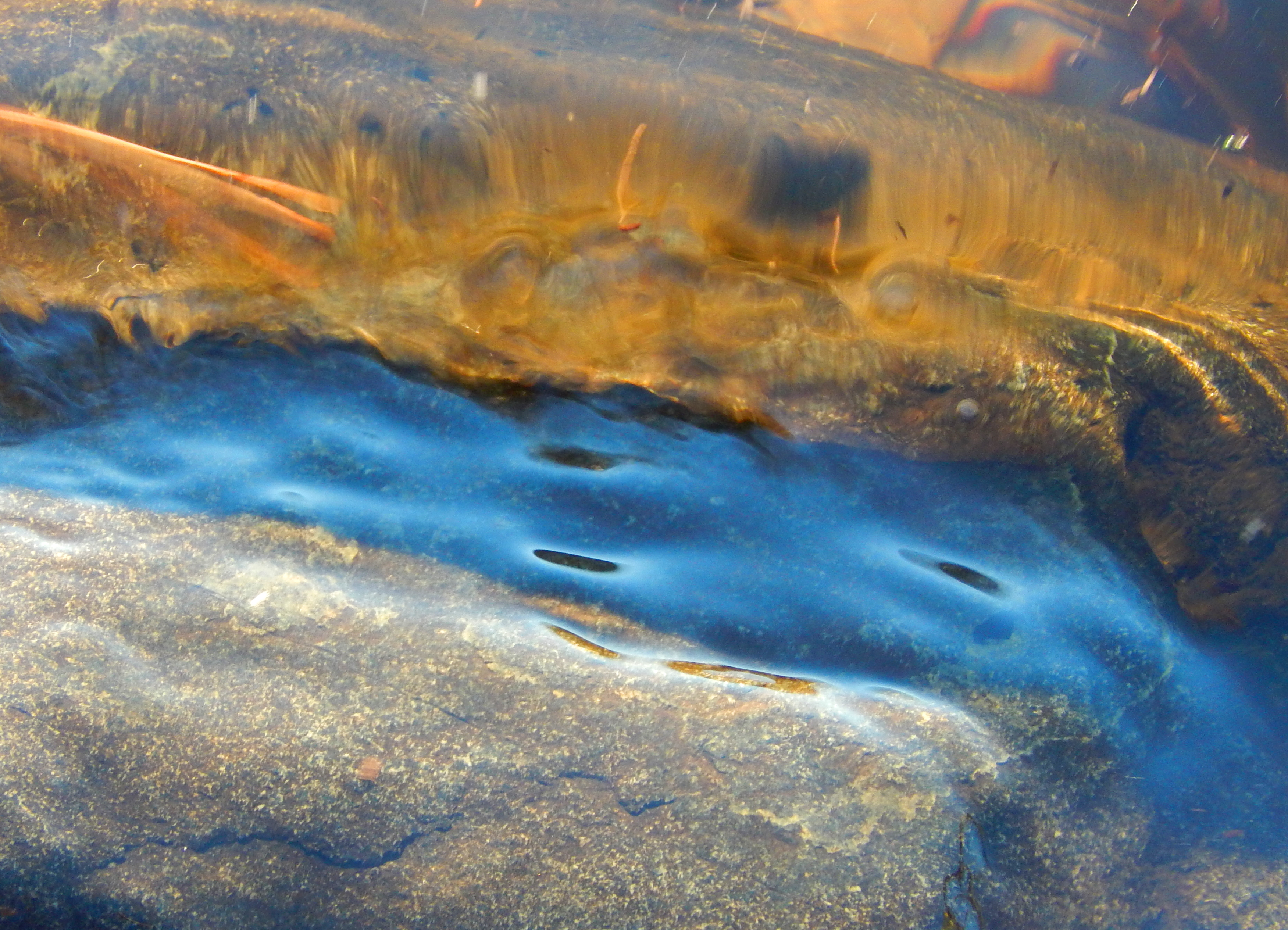
One day I went wandering by the river because I felt a little lost. I thought I might find focus on the leaves fallen in the water but the sun was at such an angle that I could not get the right shot.  I kept wandering by the river, in hope, still focusing my camera on the leaves.

A leaf or two I did find but they were not exactly what I sought and so I continued my journey by the river, in hope, seeking something, though I knew not exactly what.

I grew cold and frustrated. There I stood on the banks of the Charles River knowing I had to give up.  As I paused, undecided of my direction, my eyes rested on the waters — you see, the sun was so low it was hard for me to look up.

Waters lapped upon the shore, cascaded over the rocks and swirled small broken branches about. A lovely sight especially when I realized in the water the blinding light was subdued. It was a delight.

No doubt there was beauty behind me and there would be beauty before me but on this particular journey I found the beauty right in front of me. And that’s what I chose to photograph.

Read Full Post »

James Weldon Johnson and Aaron Douglas

James Weldon Johnson (1871-1938) and Aaron Douglas (1899-1979)

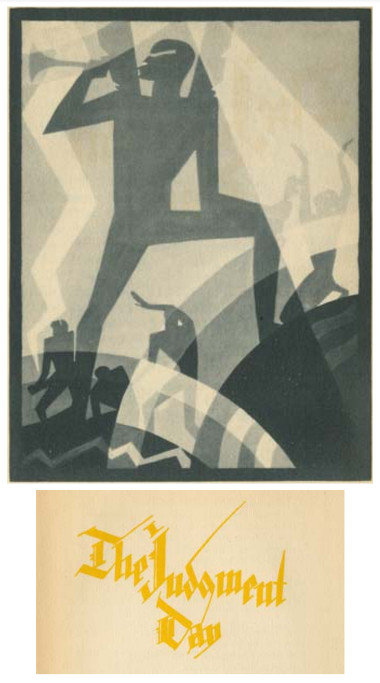
Originally published in 1927, James Weldon Johnson’s book, God’s Trombones, is a slim volume composed of a prayer and seven poems: Listen, Lord–A Prayer, The Creation, The Prodigal Son, Go Down Death, Noah Built the Ark, The Crucifixion, Let My People Go, and The Judgement Day. The verses were inspired by his experiences attending black churches throughout the American south. The preachers’ oratory inspired Johnson to write these poems and, in the book’s preface, to reflect upon the nature of oration and folk traditions. His poems, I assume, inspired his artistic collaborators, Aaron Douglas and Charles B. Falls. The signature styles of two very different artists were brought together to complement Johnson’s words.

lettering by Charles Buckley Falls

Lettering by Charles Buckley Falls (1874-1960)

A publication was produced that is really quite distinctive with regard to words, images and overall concept. Johnson as scholar as well as poet produced a tome that captured in a unique way the power and importance of religion in the African American experience. He makes real even for those not having attended black churches how the preachers – God’s trombones – used word, rhyme and rhythm to give voice to the stories in the bible even when no bible was present.

Illustration

It would be easy to pick up this book, to skip the preface and go straight to the poems. But don’t. Johnson’s preface is critical, for his brief and cohesive insights into religion and the American experience, and for his guidance in how to truly appreciate what he was attempting to do with this book.

I claim no more for these poems than that I have written them after the manner of the primitive sermons. In the writing of them I have, naturally, felt the influence of the Spirituals. There is, of course, no way of recreating the atmosphere — the fervor of the congregation, the amens and hallelujahs, the undertone of singing which was often a soft accompaniment to parts of the sermon; nor the personality of the preacher — his physical magnetism, his gestures and gesticulations, his changes of tempo, his pauses for effect, and, more than all, his tones of voice. These poems would better be intoned than read; especially does this apply to “Listen, Lord,” “The Crucifixion,” and “The Judgment Day.” But the intoning practiced by the old-time preacher is a thing next to impossible to describe; it must be heard, and it is extremely difficult to imitate even when heard. …

“… The tempos of the preacher I have endeavored to indicate by the line arrangement of the poems, and a certain sort of pause that is marked by a quick intaking and an audible expulsion of the breath I have indicated by dashes. There is a decided syncopation of speech — the crowding in of many syllables or the lengthening out of a few to fill one metrical foot, the sensing of which must be left to the reader’s ear. The rhythmical stress of this syncopation is partly obtained by a marked silent fraction of a beat; frequently this silent fraction is filled in by a hand clap. …

The ensuing poems do read like song and the power of the words are echoed and strengthened by the complementary visusals.

Illustrations by Douglas for the poems, The Creation, The Prodigal Son, and Go Down Death.

Illustrations by Douglas for the poems, The Creation, The Prodigal Son, and Go Down Death.

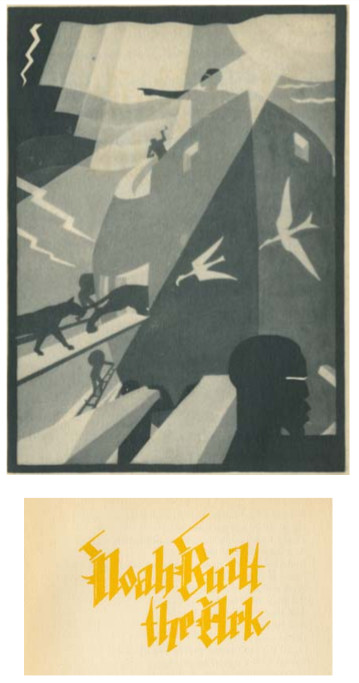
Noah Built the Ark

Illustration and complementary chapter head for Noah Built the Ark

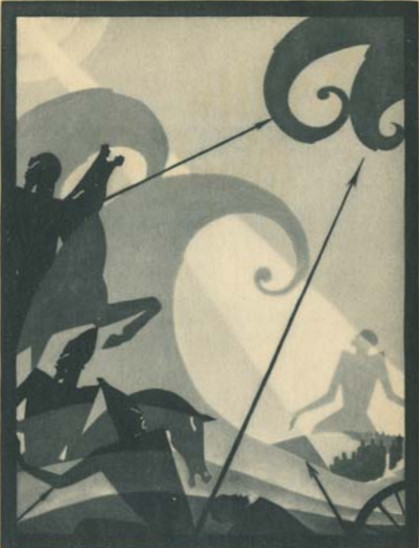
Illustration for The Crucifixion

Illustration for The Crucifixion

Illustration for Let My People Go

Illustration for Let My People Go


Both Johnson and Aaron Douglas are considered key figures of the Harlem Renaissance. Charles B. Falls was a noted illustrator and designer especially remembered for the posters he created during World War I and II as part of the Victory Books Campaign.

Over time the book has been reprinted numerous times including an edition by Penguin Classics, edited by Henry Louis Gates and with an introduction by Maya Angelou. As Johnson wrote in his preface the poems are really meant to be performed and over the years many individuals and institutions have done just that. Recordings can be found online.  You can also find the book fully digitized and viewable online thanks to the Documenting the American South project at University of North Carolina at Chapel Hill, my primary source for this post. I hope you have the opportunity to view the book in-hand or online: http://docsouth.unc.edu/southlit/johnson/johnson.html


Sources & Additional Readings

God’s Trombones (digitized) – http://docsouth.unc.edu/southlit/johnson/johnson.html

James Weldon Johnson – https://en.wikipedia.org/wiki/James_Weldon_Johnson

Aaron Douglas – https://en.wikipedia.org/wiki/Aaron_Douglas

Charles Buckles Falls – https://en.wikipedia.org/wiki/Charles_Buckles_Falls

The New Negro Renaissance – http://exhibitions.nypl.org/africanaage/essay-renaissance.html

More about the Victory Books Campaign – http://arcweb.sos.state.or.us/pages/exhibits/ww2/services/books.htm

Read Full Post »

i keep sitting down to write you about this painting… and each time i draw a blank… it is a favorite of mine… a poster of it welcomes you into my studio …” — Donald Langosy, 2016

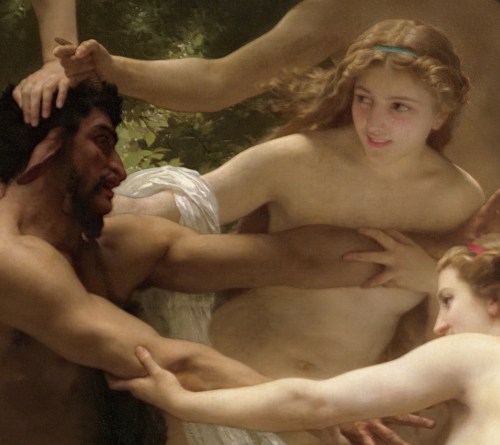
detail from nymphs and satyr by bouguereau

detail from nymphs and satyr by bouguereau

Of late I’ve become quite bold in asking people to share with me in words and sometimes images the beauty that they experience. I want to understand why a certain piece of music heard, a poem read, or a moment in a certain field can move them so deeply. In painter Donald Langosy’s case, I wanted to know why he was so moved by Bouguereau’s Nymphs and Satyr (1873), a painting held in the collection of the Clark Art Institute in Williamstown, MA. I’d learned from Langosy’s daughter that, as with Titian, it was a work of art Langosy might like to see in person one day.  And so I asked him to please tell me why, and as I waited for his words, I did a little bit of my own research into this Bouguereau.

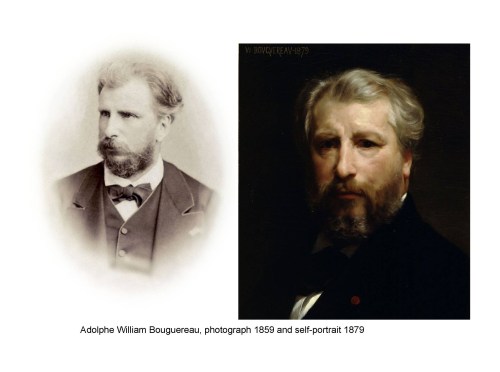
Adolphe William Bouguereau (1825-1905) was a French figurative painter noted for producing rather luminous works with Classical, mythological and religious themes. His work was very popular with the European and American public during his lifetime. He received top prices for his work. He not only painted portraits, but he also decorated private homes, churches and public buildings.

Pieta, 1876

pieta, 1876

Quite prolific, he apparently produced over 800 finished paintings. In addition, beginning in the 1860s he taught at the Academie Julian in Paris. Among his many students over the years he would teach Henry Ossawa Tanner and Ellen Day Hale. As I read criticism about his work from across the different decades, both the words beautiful and escapist were applied. During the height of Bouguereau’s career there was a new movement starting in the French art scene, Impressionism. Many within this new school were not enamored of Bouguereau’s work and actively belittled it. Despite the controversy surrounding his subject matter, so polished and dreamy during an age of great turmoil, few denied the mastery of his technique.

sadly,” notes Langosy, “Bouguereau is remembered for his unending number of paintings of little girls and poetically posed young virginal women…. which is unfortunate… for it distracts from his many accomplishments…like this one, which is among the finest masterpieces ever painted…

…compositionally outstanding…. but outstanding because of the remarkable brush work… which is brilliant because of his command of color and line….. the sensual twirl feeling of the nymphs… the satyr in a diagonal angle attempting to brace himself against their attempts to over power him… Bouguereau’s subtle sense of line accenting the individual rhythms of the different poses…

…rhythm of line is what creates three dimension on a two dimensional plane…. and then there are the leaves and grass and the water… egads!….i’m speechless… i haven’t written enough about this painting… but now you will understand why it took me this long to write

And that is how I came to learn of nymphs, satyrs and appreciate the work of Bouguereau through the words of Donald Langosy.


Additional Readings & Images

http://www.clarkart.edu/Art-Pieces/6158

http://www.bouguereau.org/

http://www.getty.edu/art/collection/artists/780/william-adolphe-bouguereau-french-1825-1905/

https://commons.wikimedia.org/wiki/William-Adolphe_Bouguereau


Save

Read Full Post »

There was an American man named Phillips Brooks who traveled abroad to Europe, and as he traveled he wrote in his notebooks, and in one of those notebooks, as he traveled in Germany, he wrote the following sonnet. Since reading it, I have wanted to seek out what he refers to as noontide blue.


The heaven of Truth lies deep and broad and still

And while I gaze into it, lo, I see

Some human thought, instinct with human will,

Gather from out its deep serenity.

Awhile it hovers, changes, glows, and fades,

Then rolls away; and where it used to be

Naught but the heaven of Truth from which it rose

Looks down upon me deep and broad and free.

So have I seen, shaped in the noontide blue,

A floating cloud attain to gradual birth,

And then absorbed in that from which it grew

Leave only the great Sky which domes the earth.

What are men’s systems, thoughts, and high debates

But clouds which Truth creates and uncreates?

— Phillips Brooks, 1882

Read Full Post »

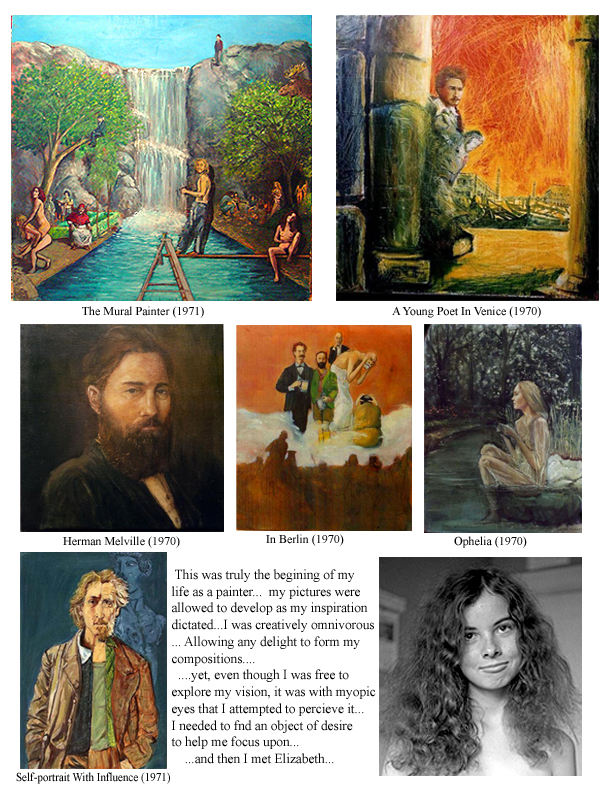
Sometimes when I am in a room with a group of people, someone will say, “Be careful what you say. We have a writer in our midst and she always sees a story.” I don’t know that I always see a story, but in this case I do.  It is the story of a man and a woman, two artists in their own right, who formed a union. A painter-poet and his writer muse.  Donald and Elizabeth Langosy.

I have permission to call him Donald but, since I am friends with his daughter Zoe, my southern upbringing drives me to refer to him as Mr. Langosy . Now, Elizabeth has made clear, that since we are writing colleagues, I am to call her Elizabeth.  And when she tells you to do something, what else is there to do but what she said in that gentle but oh so firm way of hers. She has that way about her, like a force of nature. Perhaps that is what drew Donald to her. That is his story to tell and, in part, that is what he has begun to do in the pages that his daughter helped him put together, The Story of My Art by Donald Langosy.

In these 14-pages a veil is pulled aside and we the viewer become privy to the bright life of a talented man and his love for a talented woman. We see how that love has enabled and empowered him to produce a body of work that is dynamic, vibrant, sometimes humorous, sometimes sad, and always provocative.

Below are two pages from The Story of My Art. Click on each image for a larger view. Over the course of the next six Thursdays the rest of the story will be shared. Join me on a journey …

For more information about Langosy’s art, contact Zoe at zlangosy@me.com.

Read Full Post »

Just last night I spoke with a young friend. I’d sent her a greeting card depicting a cat, sleek and gilded and sparkling with jewels. You see, my young friend tends toward attire that also catches the light. She’d had the card framed and was trying to decide where to hang it on her wall. She already had framed a picture of an owl (I can’t remember if I’d sent her that). She asked, do you think the owl and the cat can be placed side by side? do you think they’d get along? I replied in surprise, my dear! have you never heard of the owl and the pussycat? She hadn’t. She asked, what’s the gist? I told her that I’d share the poem in full in a while but for now it was quite alright, indeed quite wonderful, for the owl and the pussycat to be close on her wall.

The Owl and the Pussycat was first published in 1871 by Edward Lear.  A poem once often told and memorized in schools. A nonsense poem that sparked the imagination. Prequels have been written, and sequels, and many a reinterpretation.  I’m not sure that the original is shared as often as it used to be. As National Poetry Month wraps up, read the poem for yourself on the Poetry Foundation website.  And here is unique interpretation of the story available as a print at LangosyArts.

The Owl and the Pussycat Print by Zoe Langosy

The Owl and the Pussycat Print by Zoe Langosy

Read Full Post »

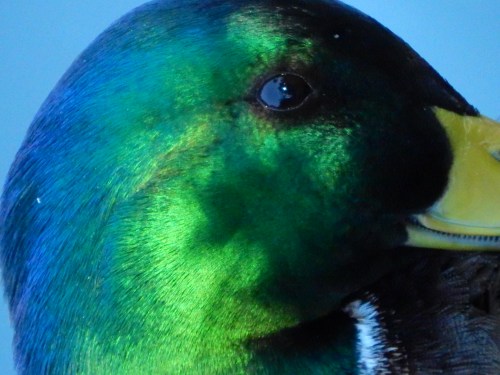
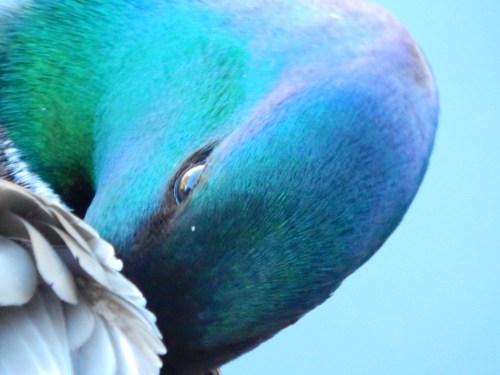
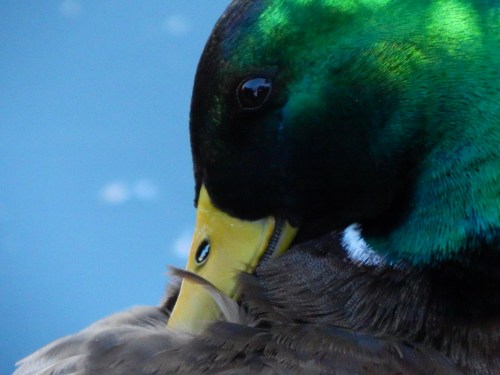
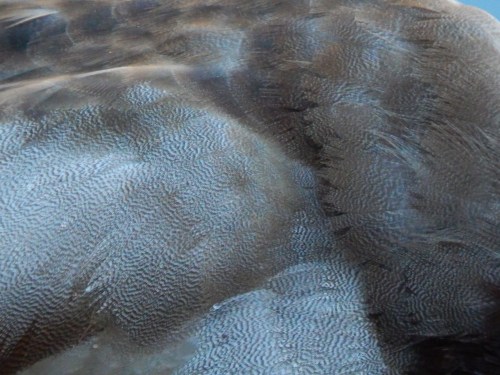
One day a mallard stepped out of the water onto a rock and began to preen.

So tame was it, or so quiet I, that it did not seem to mind that I watched the scene.

I braced myself in the bright, hot sun and took photo after photo with the goal,

I think, to be surprised, to see what might be revealed by this creature in the shoal.

Later I’d discover that most of the pictures were not good but in the moment I did not mind.

I’d had my time with mallard who, I like to think, bowed his head deep at our parting in the ways of his kind.

Read Full Post »

… paired with a powerful poem referencing Icarus.  It can take a while for the free version of the 52 page journal to load but it is worth it to start from page one and work your way to the end.  This Fall 2015 edition of Dirty Chai Magazine is filled with beautiful art, creative nonfiction, fiction and poetry.  As the editor Azia DuPont notes in her opening letter there are a number of sensitive pieces dealing with tough topics chosen “not for their shock value but for their humanity.”  As always I am honored to have one of my photos selected to share the page with such works. Enjoy.

https://dirtychaimag.files.wordpress.com/2015/10/dirtychaiissueviiifall2015.pdf

Read Full Post »

Caustic in Black & White 1

Okay, I first remember reading about John Cage in a story by Alex Ross of The New Yorker. The piece opened with a description of the 1952 performance of John Cage’s composition, 4’33”, which turned out to be four minutes and thirty-three seconds of silence. It’s a bit more complicated than that, or maybe not, but you can read more via this article link.  John Cage and silence came to mind recently because I was sharing a video I’d made with the physicist in my life and when I asked him what piece of music should I pair with these images, he suggested, “soundtrack by John Cage.”

Caustic in Black & White 2

Caustic in Black & White 2

At first I thought he was kidding.  There had to be a short classical piece to fit the light and motion so reminiscent of northern lights.  When I’d asked him what music to pair with a short video of sunlit water flowing over rocks, he’d suggested Faure’s Requiem in Paradisum.  Now he recommended silence? On my own, I found Bartock’s Evening in the Village. I tried the pairing. He appreciated Bartok but he still favored Cage.  I read a bit more about Cage, his compositions, his performances, his poetry … an interesting man to say the last.

Caustics in Color

Caustics in Color

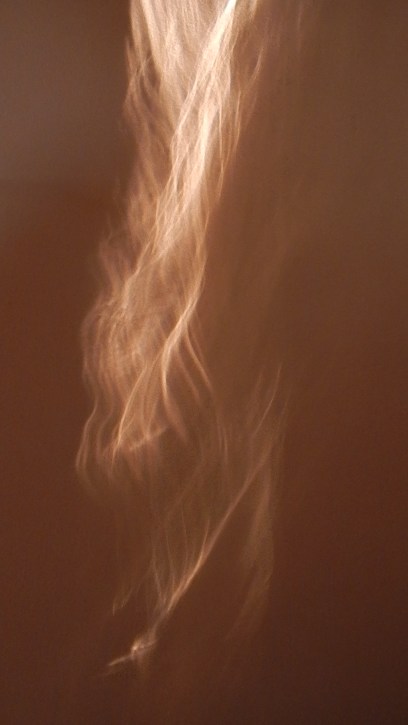
So what I captured on the wall one morning took place in less than four minutes and thirty-three seconds.  It involved a rippled window, a different one in the house.  Light shone down through the gaps in the leaves and branches of the oak tree that towers over the house.  That light made its way through the glass refracting through the ripples producing a dynamic pattern of caustics on the wall.  Most often that pattern of light is static but this particular morning the wind was blowing. The branches and the leaves they moved creating what that physicist described as “a pattern of illumination that varied in space and time.” It was a good moment inspiring some experimentation as you can see in the video below.  The flickering on the wall is as it happened … in less than four minutes and thirty-three seconds.

A Silent Dance from Cynthia Staples on Vimeo.

Read Full Post »

« Newer Posts - Older Posts »