Feeds:
Posts
Comments

Posts Tagged ‘art’

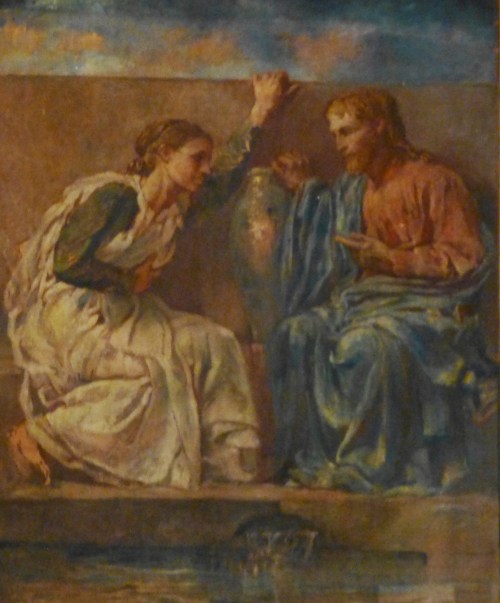
In The Art and Thought of John La Farge, author Katie Kresser writes that John La Farge (1835-1910) completed his first sketch of Nicodemus and Christ in 1874.  That biblical encounter is a subject that La Farge would depict in several different forms over time.  Here is a sketch dated 1877 in the Yale University Art Gallery, and here is an oil painting completed in 1880, now housed at the Smithsonian.  He would also create a stained glass window for the Church of the Ascension in New York.  The following image, The Visit of Nicodemus to Christ, is a photograph of the mural La Farge painted on the walls of Trinity Church in Boston.

The Visit of Nicodemus to Christ, mural by John La Farge

The Visit of Nicodemus to Christ, mural by John La Farge, 1878

It is one of several murals that La Farge painted inside the building with the aid of assistants like Augustus Saint-Gaudens, Francis D. Millet and Francis Lathrop.  I keep photographing them because I think that there is always something new to see and experience.

In the literature of the time period critiquing his work, there is often reference to La Farge’s use of color in the murals that borders on the poetic.  For example, “In his “Christ and Nicodemus,” … we find the color quality strongly dominant. … the rich blues vein the draperies and background like the threads in a Flemish tapestry …” (The Churchman newspaper, July 6, 1901).

Christ Woman at Well, mural in Trinity Church by John La Farge

Christ Woman at Well, mural by John La Farge, 1877

The beauty of La Farge’s murals is constant but their colors do shift in the light.  Different details become present depending upon where one stands and at what time of day.

David, mural by John La Farge

David, mural by John La Farge, 1877

My favorite is perhaps the painting of David, because of the colors and especially for the expression on the young man’s face.

I had originally titled this post “in his own words” because I came across John La Farge: A Memoir and a Study compiled by Roy Cortissoz, literary and art critic for the New York Tribune, and La Farge’s friend.  In the book, completed in 1911 shortly after La Farge’s death in 1910, La Farge reminisces about what it was like painting the murals at Trinity under tight time constraints, in poor health, up high on scaffolding.  Reading the words made me appreciate the skills of all the artists even more.  If you’d like to read La Farge’ account, begin at the end of page 31 of the book, available online here.

Learn how you can see these murals and other architectural and design features at Trinity Church first hand here. Postcards of some of these images available via The Shop.

Read Full Post »

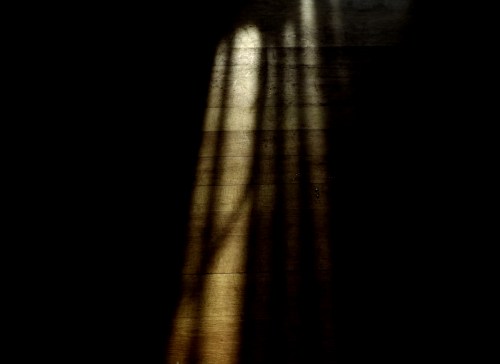
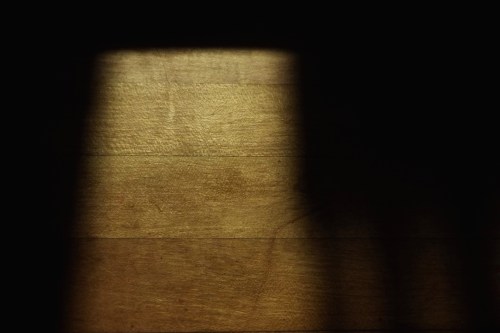
last ray's of sunlight falling on the kitchen table

last rays of sunlight falling on the kitchen table

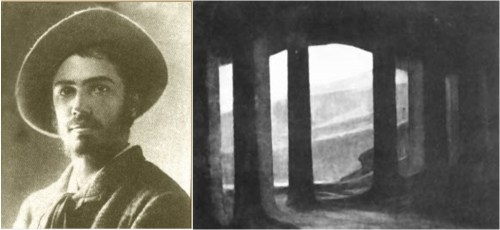
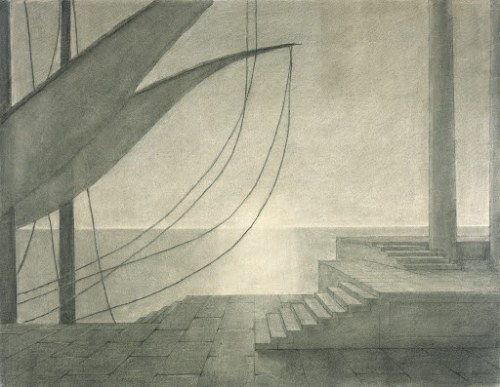
Well, in my walk through history with Mr. Horne, I’ve been introduced to a number of people who have stirred my imagination.  One of those people is Adolphe Appia.  Like Edward Gordon Craig (for whom I did post an interlude extra), Adolphe Appia (1862-1928) transformed set design in the theater world by developing and exploring, among other ideas, new theories of using light and shadows as a way to unify productions.

Adolphe Appia and his set design for Parsifal (1896)

Adolphe Appia and his set design for Parsifal

Appia’s (and Craig’s) dark illustrations struck a chord.  As if I didn’t love shadows before, but now, more so than ever, when I see shadows lengthening upon a table or wall, I wonder:  what scene is being set for what story?  Thus, the reason why I photographed sunlight on a kitchen table.  😉

more light falls on the kitchen table

more light falls on the kitchen table

Perhaps, one day I will sit with these images and write a story.  Meanwhile, if you’d like to learn more about Appia, in December 2013 an architectural group produced this great visual overview of Appia’s work.  Here is his Wikipedia page listing works and references.  And highly recommend this brief read by Pericles Lewis of Yale.  Below are more of Appia’s drawings from the late 1800s and early 1900s.

Read Full Post »

In a world filled with such sadness and confusion, I think that is why it is such a pleasure to sit in the Boston Public Library courtyard and stare into these faces filled with such joy and awe.  The actual name of the sculpture is Bacchante and Infant Faun.  It is a replica of the bronze sculpture created by Frederick William MacMonnies.

You can read an interesting and very detailed analysis of the statue’s history in Boston and at the BPL via this link.  In short, while treasured today, this naked figure serving the infant god, Bacchus, caused quite the uproar in 1890’s Boston. Imagine that. 😉

Read Full Post »

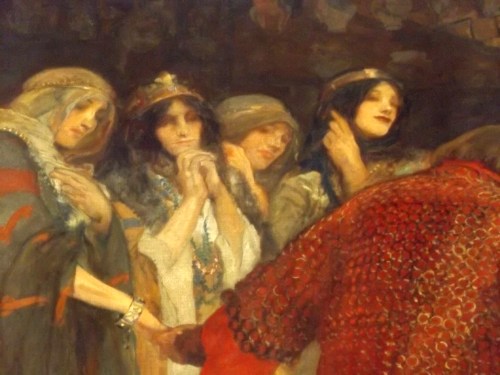
The Abbey Room at the Boston Public Library, with its richly colored wall paintings, is one of my favorite indoor sites in Boston.  The murals depict the Quest and Achievement of the Holy Grail and, according to the Boston Public Library website, were installed in 1895 by Edwin Austin Abbey.  Today I had the opportunity to drop in for a moment to snap a few photos. Here are a few favorites from the day.  You can read more about the Grail story here and you can read more about Edwin Austin Abbey here.

Read Full Post »

paintings by carl hofer

paintings by carl hofer

I enjoyed photographing the apricot and other fruits earlier this week.  In part, I was inspired by Carl Hofer‘s Bowl of Peaches and his other fruit still life paintings.  I did not know he was an artist when I began researching his life, nor could I imagine how much I would love his work.
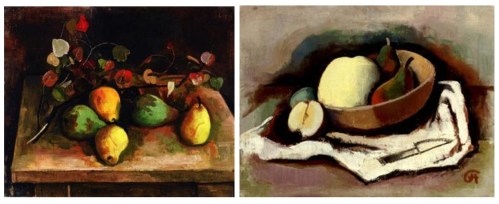
paintings by carl hofer

paintings by carl hofer

My research began with only a name engraved on custom stationery and a signature at the bottom of a handwritten letter, dated 1948, addressed to Joseph A. Horne, the Director of the Offenbach Archival Depot.  The script was beautiful but illegible for me since it was in German.  Horne’s son remembered his father referring to the man but no other details about who he was or how his father and this Hofer might have met.

carl hofer painting

carl hofer painting

As part of my ongoing walk through history with Mr. Horne, I wanted to know more about this man in his life.  Translation of the letter would come later, but I began by researching the only words in the letter I could immediately understand, his name.
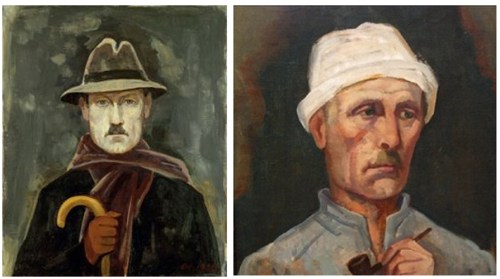
carl hofer self-portraits, spanning1920-1945

carl hofer self-portraits, spanning1920-1945

I quickly learned that Carl Hofer (1878-1955) was a noted German expressionist painter, printer and illustrator whose work  had been appearing in exhibits around the world since the early 1900s. At the end of this post are some of the links I found describing this important artist and teacher whose name may not be that familiar today outside of art circles. If not for Horne’s letter, I would not have learned of his work.
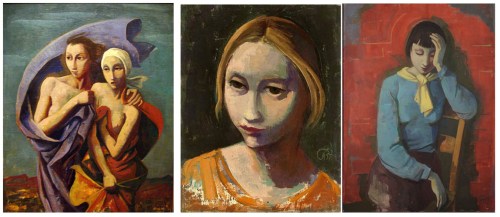
carl hofer paintings

carl hofer paintings

Of the many documents lost over time, that letter was one of the few that Horne retained.  For those of you familiar with my Interludes series, you know that Horne was involved with the recovery and restitution of stolen artwork, books and other cultural items in post-war Germany.  And he was also involved with those activities to foster and reinvigorate the artist communities in a war-ravaged Germany.  It is undoubtedly through these activities that Horne and Hofer met in the late 1940s.

carl hofer in later years, late 1940s

carl hofer in later years, late 1940s

Earlier, in the 1920s Hofer had been teaching art at a respected German institution and his work celebrated world-wide.  But, by the 1930s, he’d made Hitler’s list of degenerate artists.  He was removed from his teaching post.  Over 300 of his works were confiscated from museums and several included in a traveling exhibit of degenerate art alongside the works of Beckmann, Chagall, Kadinsky, Klee, Nolde and other artists.  By the war’s end, in Allied Occupied Germany, he would be reappointed as teacher and director of a new arts academy. As for the years in between and soon after …

carl hofer paintings, period 1947-1948

carl hofer paintings, period 1947-1948

In his memoir, From the Ashes of Disgrace, sociologist Hans Speier describes what happened to Hofer under the Nazis and Speier’s impressions of the man after they met in late 1945:

…The failure to find a safe place to work and live pushed [Hofer] to the brink of despair.  In 1943, a fire destroyed his studio along with all his paintings from the past ten years. He resumed work at once in a room in his apartment, only to be completely bombed out and lose everything in November 1944.  Thereafter he finally found refuge in a sanatorium in Babelsberg near Berlin, where the Nazis were hiding the French politician Herriot … Now [in November 1945] he owns no furniture, and he is hungry.  Nor has he suitable quarters for doing his work.  However, as president of the academy, which has been reconstituted … he is quite busy.  I was almost awed merely by seeing the expression on his face, and by his reserve and his dignity.” (page 25)

I was especially excited to find Speier’s 1945 account because his words corroborated and complemented what Hofer would write to Horne three years later in March 1948.  Once translated, the poignancy of the content came across although the specific meaning of words and references were not immediately clear.  Hofer writes of being touched by Horne’s inquiry into his well-being.  Then, he writes, after having been in the insane asylum for years, “now we are back in an asylum again.” He alludes to the monetary reforms of  postwar Germany that result in the “black market blossoms as never before, only this time prices are higher.”  Finally, he writes of “the American planes drone above our heads, reassuring us day and night that we won’t starve, unless the red Hitler gobbles us up.  It has been a crazy time, so different from what we pictured in our naive hope three years ago.

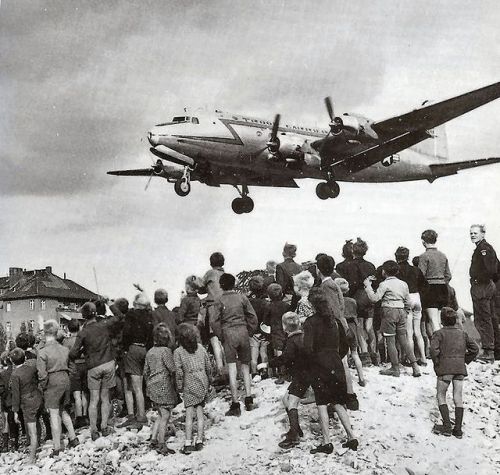
Berliners watch a C-54 Skymaster land at Tempelhof Airport, 1948

Berliners watch a C-54 Skymaster land at Tempelhof Airport, 1948

It wasn’t until I spoke with a woman who grew up in the Soviet Union that I understood that the reference to red Hitler was Stalin.  And when I looked more closely at the letter’s date, then did I understand the reference to crazy times, the security of American planes overhead and the possibilities of starvation.  Hofer wrote the letter only a short time before the Berlin Blockade.  As the Soviet blockade took place (June 1948-May 1949), Western Allies dropped food and other supplies into Western Berlin by air.  While the blockade would eventually end, the Cold War was only just beginning.  Hofer survived the blockade, and would continue to teach and to create art for several more years.

Life Magazine article, 1954

Life Magazine article, 1954

Today his work is found in museums, galleries and private collections around the world.  While there are a few more bits of correspondence between Hofer and Horne that I’ve found, their translation is a future project.  For now, it has been my pleasure to learn just a little bit about this influential artist, his perseverance, and the beauty he created until the end of his days in 1955.


Sources/Additional Reading

Degenerate Art Overview Wikipedia

Spaightwood Galleries Hofer Bio

Hofer Drawings at the Museum of Modern Art

Art Institute of Chicago Collection

Van Ham Art Estate and Hofer Archive

Life Magazine, May 10, 1954 Article

From the Ashes of Disgrace: A Journal from Germany, 1945-1955 by Hans Speier (page 25)

Berlin Blockade


Read Full Post »
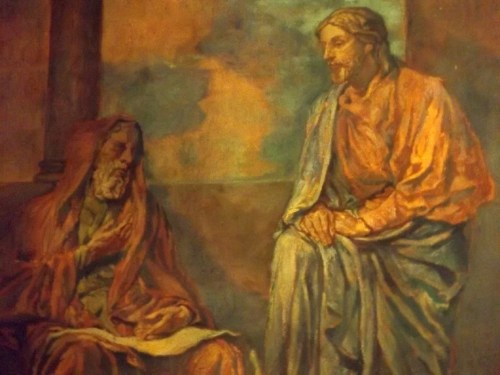
Inspired by Georgia O’Keeffe, of course.

Read Full Post »
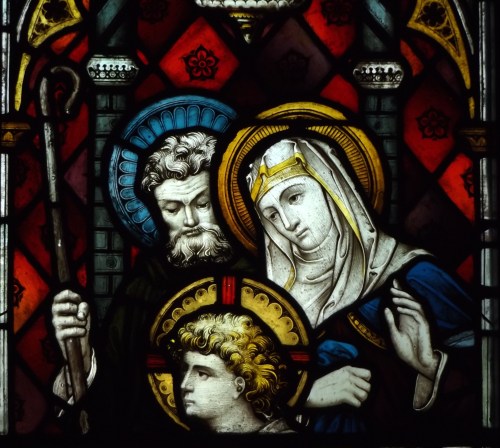
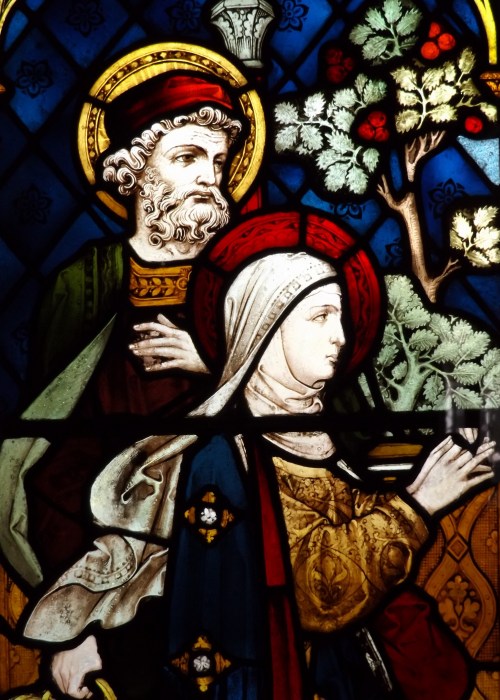
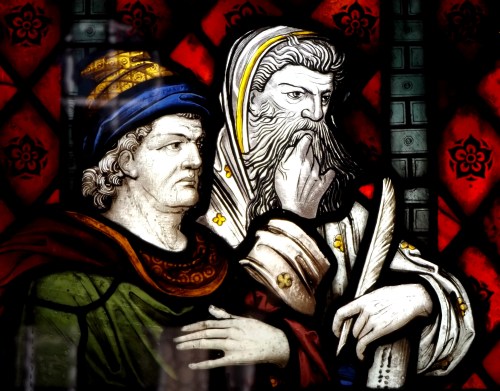
It is another one of those hidden gems in an architectural masterpiece that sits in the heart of the city of Boston.  The Sunday School Windows were designed by Clayton & Bell of London, England.  The left window depicts the story of the Presentation of Jesus, with Simeon holding the baby in his arms …

while standing nearby are Mary and Joseph.

The right window tells the story of Jesus in the Temple, with the doctors in the room …

as a young Jesus both listens and asks questions …

with two little children beside him.

Most captivating to me are the hands and the eyes, and the mix of colors and patterns within the glass, and how all of these components are pulled together to tell stories without words.

While these windows, a gift of the Children of Trinity Sunday School, are not viewable as a part of a traditional tour of Trinity Church in Copley Square, many other beautiful works can be seen as part of a tour of this historic landmark.  Learn more here.  Meanwhile, I look forward to sharing more images from this building and other structures in the future.

Read Full Post »

Spring/Summer Geisha, artwork by Zoe Langosy

Spring/Summer Geisha, artwork by Zoe Langosy

I feel like I was just complaining about how long the winter was and now spring is easing into summer.  That’s all the excuse I need to share this post from the past — Embodying Nature Through Collage — about a collaboration with artist Zoe Langosy who is one of the few people in the world encouraged to cut up my photos because she incorporates the pieces into such beauty, like this Spring/Summer Geisha.  Have a good weekend, folks, and here’s to having a good summer. 😉

Read Full Post »

Detail from the Lucy R. Woods Window, Trinity Church, Boston

Detail from the Lucy R. Woods Window, Trinity Church, Boston

It is one of the many hidden gems of Trinity Church in the City of Boston.  According to archival records, the Woods Window was commissioned in memory of Miss Lucy R. Woods (1847-1904).  Miss Woods taught the Young Ladies’ Bible Class in the church Sunday School for thirty-three years, beginning in 1871.

The window was executed by John Hardman and Company, Birmingham, England, and designed by Dunstan John Powell, grandson of noted English architect and artist Augustus Pugin.

The window is located in a stairwell not easily accessible to the public but postcards and prints will soon be coming to the Book Shop.

Until then, you can read more about the original 1906 unveiling of the window here.  Hope to share more information about this window, and other hidden gems, in the near future.


Read Full Post »

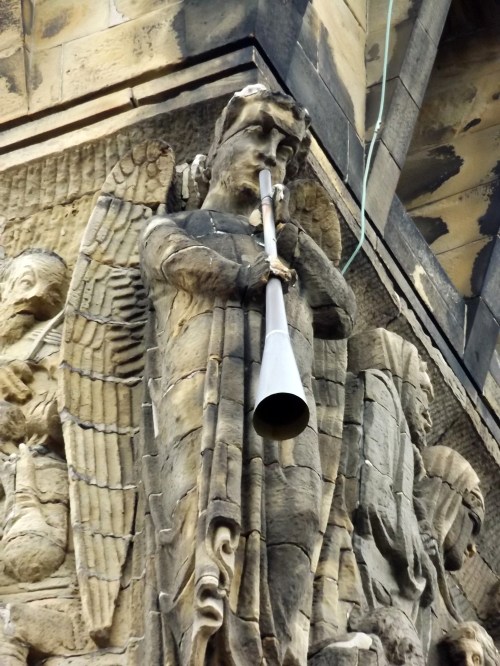
In the Back Bay, I’ve been walking past the First Baptist Church of Boston for years, but, today, for the first time, I trained my camera up to the top of the building tower.  And what an amazing sight.

Designed by Henry Hobson Richardson, “… its square tower is 176 feet high. At the top of the tower … is a frieze of sculpted figures representing baptism, communion, marriage and death. The frieze was designed by Frederic Auguste Bartholdi, famous for the Statue of Liberty, and was carved by Italian artists after the stones were set in place. It includes the faces of Sumner, Longfellow, Emerson, Hawthorne, Lincoln, Lafarge, and his comrade Garibaldi, and other prominent Bostonians …” (History of the First Baptist Church of Boston)  I hope to learn more about this amazing building, and take more photos, over the summer.

Read Full Post »

« Newer Posts - Older Posts »