Feeds:
Posts
Comments

Posts Tagged ‘storytelling’

… mad at some things that had happened around me.  Things that were kind of like bits of straw raining down upon a camel’s back.  What I felt was certainly legit but I also felt myself getting angrier than I needed to be.  I wanted to redirect that anger. A long walk, my method of choice, was out of the option because of the cold.  Yet I was determined not to do what I remember my mom having penchant for doing which was to sit in a literal and figurative dark place.  I was not ready to talk about what was bothering me.  There were no words quite formed for me to write.  What do do, what to do.  I decided to follow the advice I sometimes give to others when they tell me that they are tired of talking or that they cannot write (“I don’t know how to write. You’re the writer!”).  What do I suggest?  Draw.  So, I sat down to draw.  Now I almost stopped myself.  Why? Because I can’t draw.  Yes, I’ve dabbled in this that and the other thing but really even with the help of a ruler, I can’t make a straight line!  Then I took a deep breath and decided not to worry about straight lines. Curves can be cool.

As for what to draw … now I’ve been having this ongoing conversation with one of my little postcard penpals.  He’s my four-year old nephew living down in Virginia.  I’ve been sending him pictures of birds and squirrels and such.  He’s tasked with drawing me a fish.  Or a school of fish.  Maybe a shark.  As I sat at my desk in the bright sunlight, I drew fish for him and for myself, bright colored, imperfect, smiling fish.  My anger did not disappear but it came into perspective.  I have not sent the fishy bookmarks to the little guy.  I want to give him time to draw his fish for me and for himself in whatever colors of the rainbow he decides.

Read Full Post »

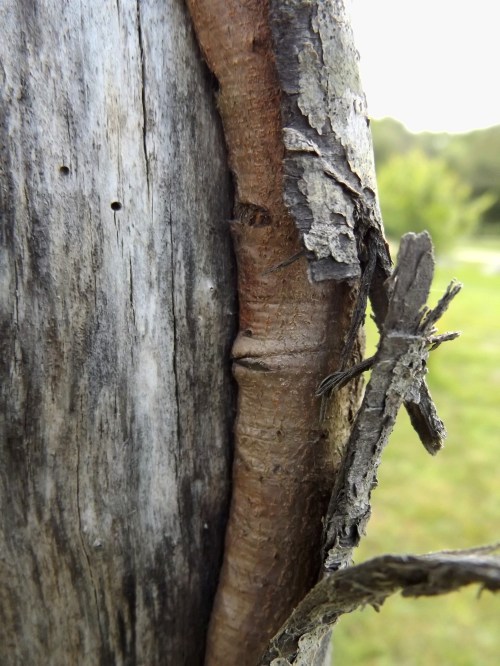
The tree I photograph most often through the rippled window is dead.  The greenery and blooms captured throughout the seasons are mostly from vines like forsythia, ivy and something holly-like.  With each storm, more of the tree falls to the ground, whole branches and bits of bark.

For safety’s sake, at some point soon, whoever owns that particular piece of ground will have to chop that tree down.  The woodpeckers will certainly miss their perch and the insects that they dine upon will miss their home.  The vines I suspect will continue to thrive.

Even cut off at the base, they always seem to come back, finding new objects to drape upon. And the moss is ever present.


Adjacent is the neighbor’s garden.  He did quite well his first season with a multi-tiered, lush affair of eggplant and kale, tomatoes and cauliflower.

I expect he grew potatoes, too, like me.  And I know for sure I saw the green beans climbing up their strings.

As December looms, all that’s left are the relics of dark greens and tomatoes that I guess the city rabbits and city squirrels couldn’t figure out how to get.

There is the chain link fence but that doesn’t prevent his cat from getting out so I’d think that wouldn’t prevent other animals from getting in.  If I do my local Open Studios next year, perhaps I will focus on prints of scenes through the rippled glass.

One window, many views.  We’ll see.  Ideas are easy. It is the follow-through that’s hard. FYI, these are untouched photos of views in this early morning’s light.

Read Full Post »

As I’ve written about before, one of the great pleasures for me of stepping into a church is to see the wide variety of artistic expression through stained glass.  Such is certainly the case with a quick visit to St. Augustine’s, a Gothic church in Galway completed in 1859.

Apparently during renovations in the 1970s, the original window over the main altar was replaced by a new window depicting the Resurrection. The artist is George W. Walsh.You can read a bit more about Mr. Walsh via this link. His father, with whom he apprenticed for several years, was a pupil of stained glass artist and illustrator Harry Clarke.

While no one seemed to mind me meandering about with my camera, I focused mostly on that window above the altar with its many lovely parts making an incredibly beautiful whole.

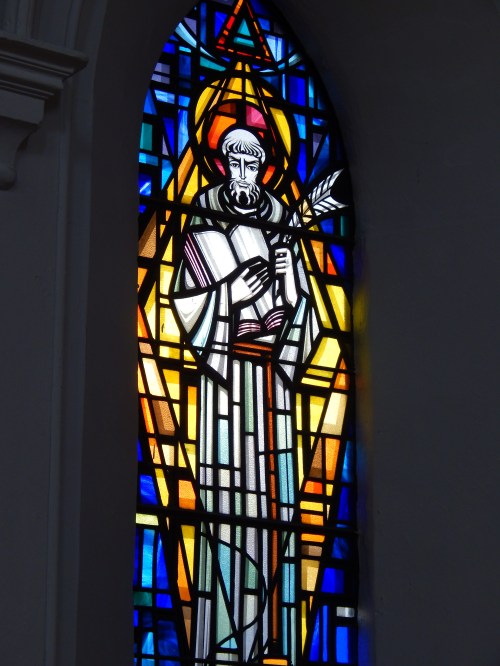
The other window that caught my attention happened to be a depiction of St. Augustine himself.  Later I discovered that Mr. Walsh also composed and completed that window.

It was a bit rainy that day so I did not take many exterior shots, but via this link you can view the building.  On this webpage, you can read just a bit more about the history of the Augustinians in Galway and more about the construction of this particular building.


Read Full Post »

Lazarus and the Rich Man by Gustave Dore

Lazarus and the Rich Man by Gustave Dore

“No individual can live alone, no nation can live alone, and anyone who feels that he can live alone is sleeping through a revolution. The world in which we live is geographically one. The challenge that we face today is to make it one in terms of brotherhood. … Through our scientific and technological genius, we have made of this world a neighborhood and yet we have not had the ethical commitment to make of it a brotherhood. But somehow, and in some way, we have got to do this. We must all learn to live together as brothers or we will all perish together as fools.”

Words spoken not today but nearly fifty years ago by Dr. Martin Luther King Jr during  this talk at the National Cathedral in Washington, DC on March 31, 1968.  In this day and age of soundbites and tweets, it might be a challenge to read in entirety but I hope you have the opportunity to do so.  I chanced upon it while researching Dives and Lazarus.  I was curious about the parable that inspired one of my favorite pieces of music.

Five Variants of Dives and Lazarus by Ralph Vaughn Williams I play to help me unlock a part of my brain when I am stuck on a writing project.  The music moved me long before I truly understood the story at its core.  A friend explained the story of the rich man, Dives, and the poor man, Lazarus, a parable appearing in the Gospel of Luke.  He recently summed it up as a story of inequality and early trickle down economics.

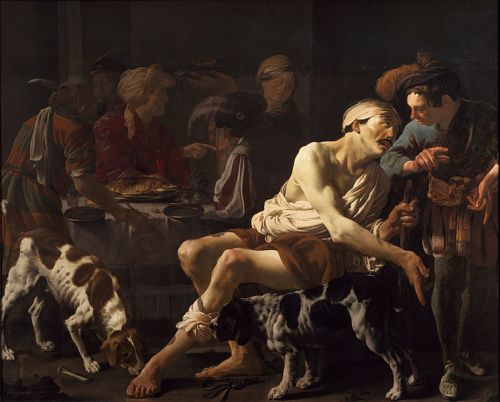
The Rich Man and the Poor Lazarus by Hendrick ter Brugghen, 1625

The Rich Man and the Poor Lazarus by Hendrick ter Brugghen, 1625

I was curious who else may have used or been inspired by such a perspective of that parable.  Thus, I found Dr. King’s talk from 1968.  During the talk, of Dives and Lazarus he wrote:

“… Because our expressways carry us from the ghetto, we don’t see the poor. … Jesus told a parable one day, and he reminded us that a man went to hell because he didn’t see the poor. His name was Dives. He was a rich man. And there was a man by the name of Lazarus who was a poor man, but not only was he poor, he was sick. Sores were all over his body, and he was so weak that he could hardly move. But he managed to get to the gate of Dives every day, wanting just to have the crumbs that would fall from his table. And Dives did nothing about it. And the parable ends saying, “Dives went to hell, and there were a fixed gulf now between Lazarus and Dives.”

There is nothing in that parable that said Dives went to hell because he was rich. Jesus never made a universal indictment against all wealth. …  Dives didn’t realize that his wealth was his opportunity. It was his opportunity to bridge the gulf that separated him from his brother Lazarus. Dives went to hell because he was passed by Lazarus every day and he never really saw him. He went to hell because he allowed his brother to become invisible. …”

Lazarus and the Rich Man by Fyodor Bronnikov

Lazarus and the Rich Man by Fyodor Bronnikov

Regardless of one’s religious beliefs, throughout the talk there is a sad timelessness to King’s words about racism, injustice, economic inequality, and silence.  But there is also a beautiful timelessness about the power and potential of people to make a difference. Near the end of his talk, he says:

“There is nothing new about poverty. What is new is that we now have the techniques and the resources to get rid of poverty. The real question is whether we have the will.  In a few weeks some of us are coming to Washington to see if the will is still alive or if it is alive in this nation. We are coming to Washington in a Poor People’s Campaign. Yes, we are going to bring the tired, the poor, the huddled masses. We are going to bring those who have known long years of hurt and neglect.  … We are not coming to engage in any histrionic gesture. We are not coming to tear up Washington. We are coming to demand that the government address itself to the problem of poverty. … We are coming to ask America to be true to the huge promissory note that it signed years ago. And we are coming to engage in dramatic nonviolent action, to call attention to the gulf between promise and fulfillment; to make the invisible visible.”


 Sources/Additional Reading

Rich Man and Lazarus

Remaining Awake Through a Great Revolution by Martin Luther King Jr, 1968

More on the March on Washington for Jobs and Freedom 1968

More about Ralph Vaughn Williams and his composition

Five Variants of Dives and Lazarus on Youtube


Read Full Post »

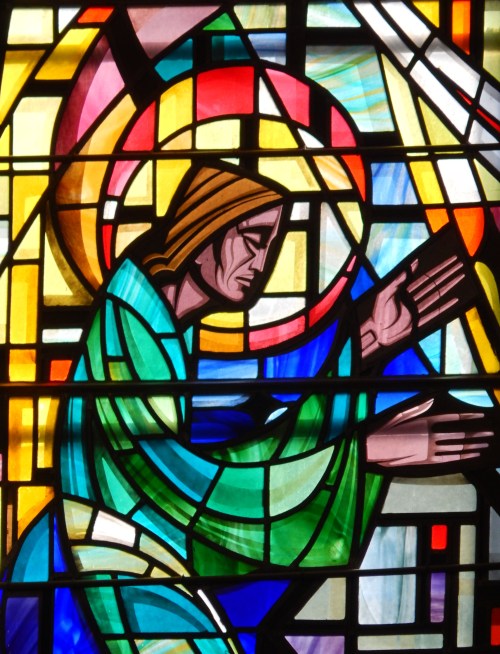
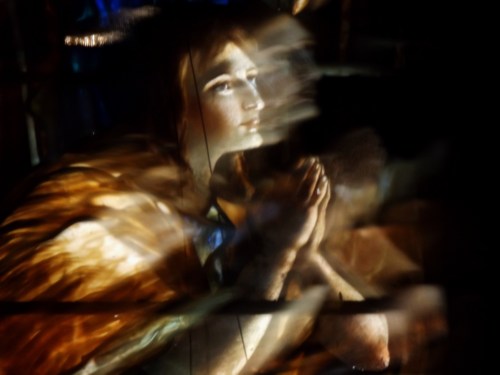
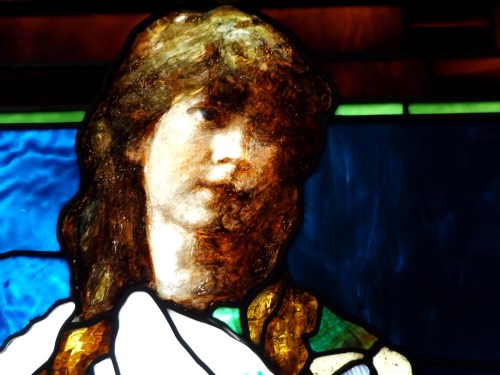
One of the reasons that I have come to love photographing stained glass windows is story.  There’s the story of the building in which the window is placed.  There’s the story of the people who commissioned the creation of the window.  There’s the story that the artist and his or her team is asked to express in paint and layers of glass, and their artistic interpretation of that story.  And then there’s the completed window and what story it actually conveys to each individual viewer across the generations.

These are details from the windows at Church of the Convenant, located on Newbury Street in Boston’s Back Bay. It is a National Historic Landmark built 1865-1867.  Then, in the late 1890s, the sanctuary was completely redecorated by Tiffany Glass  & Decorating Company.

It is still an active parish and they have put together a wealth of information detailing the story of the parish, the Gothic architecture of the building, and its Tiffany decoration.

There is an online tour of the windows and interior via this link.  But, of course, if you’re in the area, definitely take the self-guided tour still available.  The walking map provides interesting descriptions of the three Tiffany designers’ interpretations of the biblical stories they were to represent in glass.

And of the photographs I took during my most recent walking tour, following is an image that did not work out and yet I could not make myself delete it.  So, I suppose such an action is part of the story of me.

More information available: http://www.cotcbos.org/

Read Full Post »

The story behind the image:  Steve and I were taking a short walk along Revere Beach.  The tide had receded quite a bit.  He followed the water. I stayed on shore searching out seashells and stones and wishing I’d worn a thicker sweater.  As he returned to me, he suddenly paused and shouted, “Come here. You have to see this.” I raced over and looked down at where he was pointing.  Lines and curves in the sand?  “Bifurcation diagrams in nature,” he exclaimed.  I peered more closely, frowning.  He tried explaining the mathematics of what he saw for me. “It’s like the multiplication of little streams leading to chaos.” “Well,” I said slowly, “I’m reminded of those Asian landscape paintings of mountains with cascading waterfalls over the rocks.”  We studied the sand for a bit longer, he helping to point out different ways to frame photographs of the bifurcation he was seeing, and we both appreciating our different perspectives of the world.

A poster print of this “mountainous” scene is available online here.


Read Full Post »

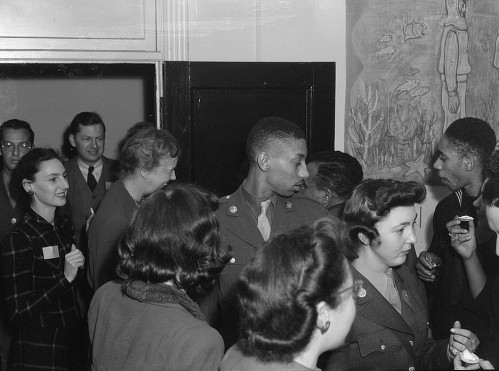
Eleanor Roosevelt arriving at opening of CIO Canteen, by Joseph A. Horne, 1944

Eleanor Roosevelt arriving at opening of Labor Canteen, by Joseph A. Horne, 1944

During World War II, canteens were sponsored nationwide by a wide array of different organizations, their overall goal to provide U.S. servicemen with refreshments, entertainment and good company.  Often the food, entertainment and the company of the hostesses was all volunteer.  The Washington Labor Canteen was sponsored by the Federal Workers of America, Congress of Industrial Organizations (CIO).  It opened with great fanfare on February 13, 1944.  The party was to start at 8pm, with First Lady Eleanor Roosevelt scheduled to appear soon after.
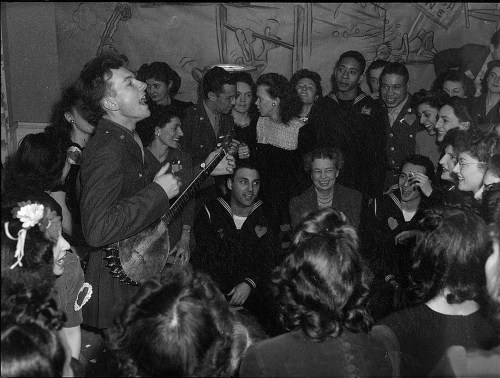
photo by Joseph A. Horne, 1944

Folksinger Pete Seeger, photo by Joseph A. Horne, February 1944

Photographs from opening night show that there was good food, good company, great music and big smiles in abundance.
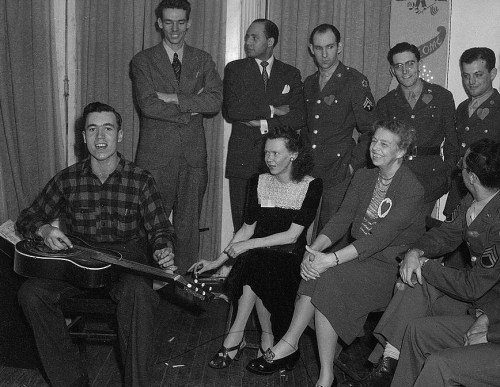
Folksinger Carlie Tart, photo by Joseph A. Horne, February 1944

Folksinger Carlie Tart, photo by Joseph A. Horne, February 1944

I first learned of the canteen because of my research into the life of Joseph Anthony Horne, where I chanced upon that iconic photo he took of a young Pete Seeger performing before the First Lady.  Horne was one of several photographers at this inaugural event, and so there are many photos capturing the uniqueness of the gathering.
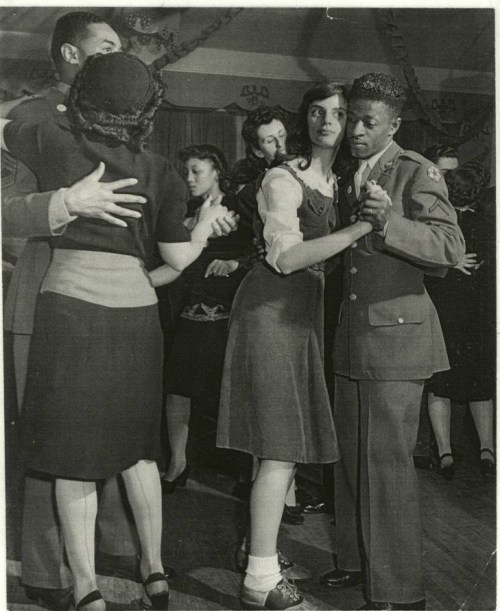
photo by Alfred Eisenstaedt for Life Magazine, 1944

photo by Alfred Eisenstaedt for Life Magazine, 1944

Unique not so much because of the presence of the First Lady or the musical entertainment, but because of the interracial mix of party guests, having a good time together, as equals.  Operated by the CIO Women’s Auxiliary, the Labor Canteen was the only Washington canteen that was open to servicemen of all races.  Others provided services and entertainment to men of one color only.
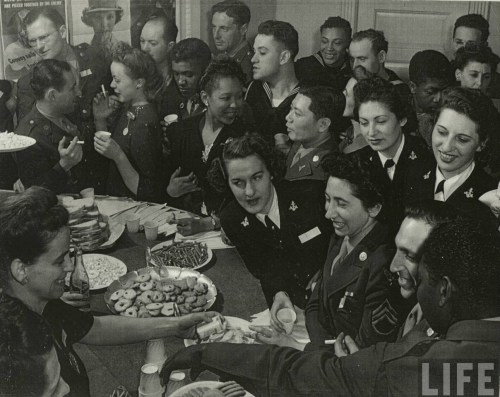
photo by Alfred Eisenstaedt for Life Magazine, 1944

photo by Alfred Eisenstaedt for Life Magazine, 1944

Washington, DC, like much of America, was deeply segregated in the 1940s.  The photos by Horne and the other photographers suggested something special was taking place. In her February 16, 1944, My Day column, Eleanor Roosevelt wrote:  “After dinner Sunday night I went to the opening of the labor canteen under the auspices of the Washington Industrial Union Council.  It was crowded with servicemen and the hostesses were very busy providing entertainment and refreshments.  I think this will be a popular canteen, and I am sure that those who work there will find it very rewarding.”

Canteen Hostesses, photo by J. A. Horne, February 1944

Canteen Hostesses, photo by J. A. Horne, February 1944

Additional research pulled up several articles in a weekly newspaper called the Baltimore Afro-American.   Still in operation today (though in a very different format), it is apparently the longest running African American, family owned, newspaper in the U.S. dating back to 1892.  A February 1944 article in the newspaper highlights Eleanor Roosevelt’s support of the canteen as well as the consternation of others in Washington.

In June 1944, the article Army Jim Crow Hits CIO Canteen described the canteen being denied use of facilities due to “army policy” though the author indicates that the denial had more to do with the canteen’s racial integration.

Agnes Smedley, 1914

Agnes Smedley, 1914

In that same issue, another article stood out with its title A White Woman Tours the South by Agnes Smedley (1892-1950).  I’m not sure how her tour originated but Ms. Smedley, based in New York, had traveled to speak in the deep South.  Afterwards, she wrote in her article, “I am so bitter from experiences… that everything seems dark.”  The ferocity with which she wrote prompted me to look her up.  Quite a story there, but you can read more about her life via the links at the bottom of this post.
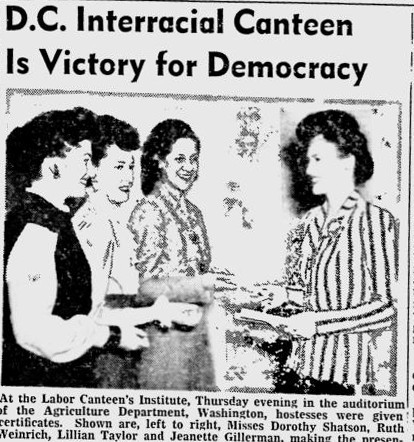
By December 1944, there was a new article in the Afro-American newspaper celebrating the 10-month success of the interracial canteen as a “victory for democracy.”  Labor Canteen hostess Miss Dorothy Shatson is quoted:  “The existence of a successful interracial canteen in a Southern city like Washington represents a victory of democratic forces, and the realization of some of the things for which we are fighting.”

A Washington Labor Canteen Hostess, photo by J. A. Horne, Feb. 1944

A Washington Labor Canteen Hostess, photo by J. A. Horne, Feb. 1944

In another newspaper article from March 31,1945, Mrs. Fern Urling, writes that she gives all her spare time to the canteen because she, too, feels it stands for real democracy.  Co-manager of the canteen at the time, she adds, “At first some Southern whites are startled to see the interracial atmosphere but they usually come back and finally get used to it and are just as contented as we are. … It is unfortunate that the Army won’t publish any of our activities in its official bulletin. We have to depend mostly on personal contact to advertise the canteen.”

Marian Anderson, photo by Roger Smith, 1943

Marian Anderson, photo by Roger Smith, 1943

Perhaps most surprising for me was the discovery of an October 1945 article in the Afro-American, The Democratic Labor Canteen Flays Mrs. Truman’s Stand.  In short, the membership of the canteen wanted Mrs. Truman to break her relationship with the Daughters of the American Revolution (DAR), citing as an example the actions of former First Lady Eleanor Roosevelt who had resigned from the DAR after the organization refused to allow Marian Anderson, as a person of color, to sing at Constitution Hall.  The telegram highlights how the the canteen’s two-year success was “living proof” of the fallacies of segregation.
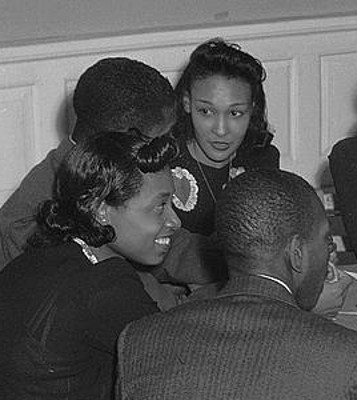
photo by Joseph A. Horne

around a table at the canteen, photo by Joseph A. Horne

So what happened to the Washington Labor Canteen?  With the war’s end, I imagine the canteen closed.  But what a legacy to leave behind.  What seeds of friendship and camaraderie — or maybe just a little bit more respect — were planted in those few years between people who had few other opportunities to positively interact.


Sources/Further Reading

Prior Interlude features can be found HERE

Eleanor Roosevelt’s My Day Newspaper Columns

More about the Baltimore Afro-American

Army Jim Crow Hits CIO Canteen in Baltimore Afro-American, 1944

Democratic Labor Canteen Flays Mrs. Truman’s Stand in the Baltimore Afro-American, 1945

What Washington Citizens Are Doing (Fern Urling) in the Baltimore Afro-American, 1945

About Agnes Smedley on Wikipedia and summary from PBS Documentary

Agnes Smedley Collection at Arizona State University

Other famous canteens:

The Stage Door Canteen

The North Platte Canteen


Read Full Post »

My mother had a drawer full of scarves, of every size and color imaginable.  The textures tended toward silky or the fine sandy grain of those materials that were sheer.  My scarves are more dispersed throughout my environment, possibly because, in a way, I have more personal space than my mother ever had.

She would have been a teen and partying young woman in the 1950s and 1960s when scarves were a fashionable part of the ensemble.  By the time I came along in the 1970s, my mother wasn’t partying so much but she still had that drawer full of scarves, and I remember my father still buying her scarves throughout much of my childhood.

Whether for elementary school or high school, when I left the house in the morning for my journey, if the wind was blowing fiercely, if she’d done my hair the night before, if there was even a chance of sprinkles … she’d wrap one of her colorful scarves around my head and tie it beneath my chin.  In elementary school, I may have looked cute.  In high school, when scarves were not fashionable … well, I once passed by a group of girls and one of them said, “What is she wearing?!” But, even as I felt bad, I heard another girl say, “Leave her alone.”  What I remember from that moment, this day, is the care of my mother and the care of that stranger.

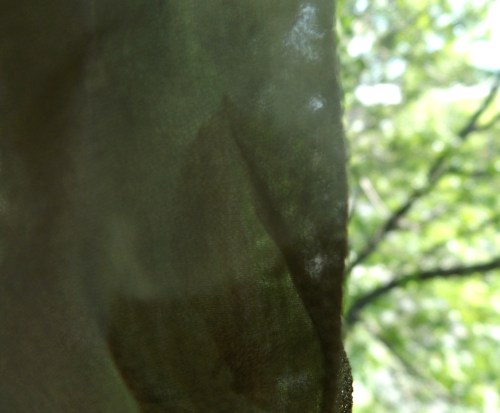
My small scarves I keep in a little gold box on a book shelf.  I rarely use them or even look at them but I’m not ready to part with them.  Long, narrow scarves I keep in a basket, and when I am too lazy to track down my leather belt, I’ll pull out one of those scarves to hold up my pants.  Large, square scarves I learned to wrap around my head using techniques my mother did not know.  Those I’ve tucked away in a drawer.  I mostly wear long, oblong scarves, especially the ones given in recent years by friends and family.  I wear them to freshen up an outfit.  And, of course, I photograph them as they are or use them to serve as background for a leaf.  And, in this house, with so many windows, I sometimes hold them up to see what happens when the light shines through.

These musing of the morning were inspired by a link recently shared by a friend, a Salon interview by Edwidge Danticat of Katia D. Ulysse.  As my friend described to me, it is a thought-provoking, poetic exchange between two writers of Haitian heritage.  An excellent read.  At some point there is reference to scarves, and that was all the inspiration needed for me to crack open a box.  Have a good day.

Read Full Post »
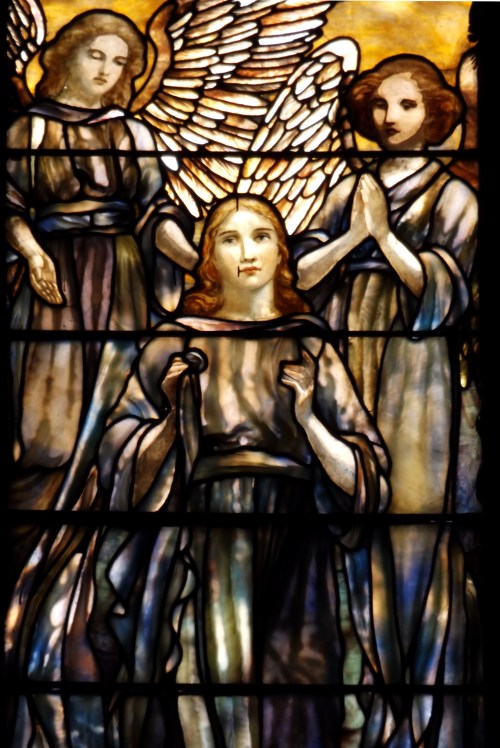
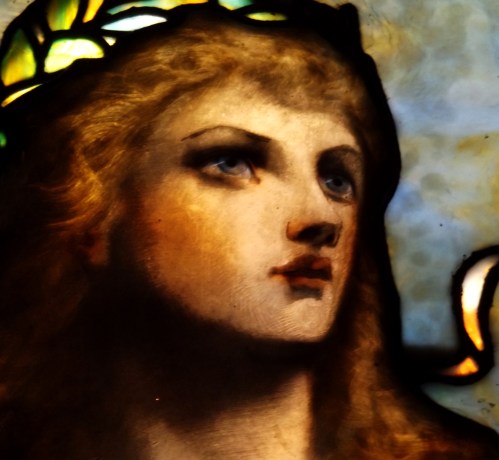
Detail from Purity by John La Farge, 1885

Detail from Purity by John La Farge

Designed and executed by artists and stained glass manufacturers like John La Farge, Clayton and Bell, Burlison and Grylls, and others, these particular stained glass windows at Trinity Church in the City of Boston are “hidden gems.”

Detail 2 from Purity by John La Farge, 1885

Detail 2 from Purity by John La Farge

They are located in the Parish House. In part, due to renovation activities at different times over the past 100 years, some of the windows are now in stairwells, like Purity as well as John Hardman and Company’s Woods Window

The Woods Window, executed by John Hardman and Company

The Woods Window, executed by John Hardman and Company

others are in restricted areas like Ephphatha by Burlison and Grylls …

Detail from Ephphatha by Burlison and Grylls

Detail from Ephphatha by Burlison and Grylls


and others in areas dedicated to use by parishoners of all ages like The Sunday-School Windows by Clayton & Bell.  

They are not windows accessible as part of a traditional art and architecture tour of the sanctuary, but it has been my pleasure this summer to roam the halls a bit with my camera and to share this glimpse of details from some of the windows. Postcards and prints, and information about tours, are available at the Trinity Book Shop.

Interior of Trinity Church in the City of Boston, Copley Square

Interior of Trinity Church in the City of Boston, Copley Square


Read Full Post »
there was a small wooded area

through which there flowed a stream

frogs hopped about but those I could not photograph (I wasn’t fast enough)

but across the road in a field I found a bunny rabbit who mostly sat still except when he was nibbling

Read Full Post »

« Newer Posts - Older Posts »