
Nearly one-year after U.S. entry into World War II, after the bombing of Pearl Harbor, President Franklin Delano Roosevelt would receive a letter from Harlan F. Stone, Chief Justice of the United States. He shared the concerns of many in the art and architectural fields at the destruction taking place in Europe.

Bombing of Hamburg, 1943
While Germany must, of course, be defeated, Stone and the others were urging the development of an organization charged with the protection and conservation of European works of art. The organization would aid “in the establishment of machinery to return to the rightful owners works of art and historic documents appropriated by the Axis Powers.”
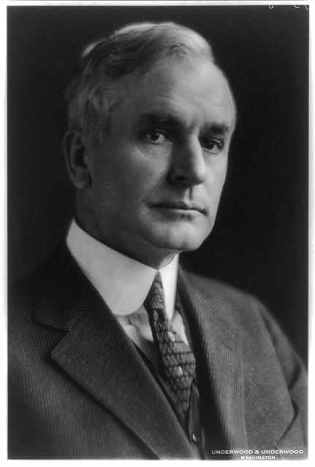
Cordell Hull, U.S. Secretary of State
By 1943, FDR would establish this American Commission for the Protection and Salvage of Artistic and Historic Monuments in Europe, its intent to operate for three years and to cooperate with the appropriate branches of the Army, Department of State and civilian agencies. Secretary of State Cordell Hull recommended that it be headquartered at the National Gallery of Art in Washington, DC.

Archibald MacLeish, 1944
The Commission would include Archibald MacLeish, Librarian of Congress, Paul J. Sachs, Asst. Director of the Harvard Fogg Museum, and Francis Henry Taylor, Director of the Metropolitan Museum of Art. Using this group’s networks of former students, colleagues and peers, experts would be sought to volunteer and help the Commission complete two functions:

Even prior to U.S. involvement in the war, efforts had been made to catalog endangered art and historic monuments. Card files were also compiled of scholars and specialists in the Fine Arts, Books and Manuscripts. All information was considered significant, from scholarly skills to possible political leanings.

Detailed maps were created and/or collected showing areas to be spared, if at all possible, and aerial photographs were taken.

Example of Map Noting Cultural Areas to Protect in France
By April 1944, recognizing the need to prepare maps for the protection of art and historic monuments in Asia, as well, the Commission’s name would be altered, and the words “War Areas” would replace “Europe.” In August, Supreme Court Justice Owen Roberts would become Commission chair. Roberts was one of three Supreme Court Justices to vote against the plan for internment of Japanese Americans during the war. Over time the Commission would simply be referred to as the Roberts Commission.
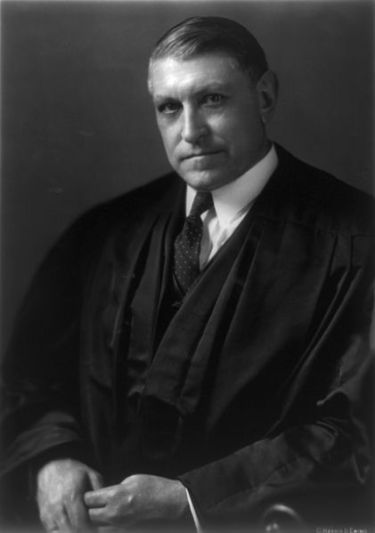
Supreme Court Justice Owen J. Roberts
The Roberts Commission would establish the Monuments, Fine Arts and Archives Unit (MFA&A) within the Civil Affairs and Military Government Sections of the Allied Armies. Eventually numbering over 300 men and women, the unit’s “Monuments Men” included architects, archaeologists, art historians, artists, curators, and librarians. During the war, they would be assigned in small numbers to Allied troops in the field.

George Stout
Monuments Men had to be fluent in the languages of the places where they were to be assigned. And to appease concerns about shifting manpower away from fighting forces, they had to be older than the age for fighting eligibility, so most were in their thirties or older. Early days for the Monuments Men, as they traveled with Allied troops, were difficult since they had little authority or supports in place. That would change somewhat over time as Allied leadership including MacArthur in the Pacific and Eisenhower in Europe made clear that cultural preservation was a priority, though never one to outweigh the protection of soldiers’ lives.

American Zone Poster
The preservation and protection of artistic and historic monuments would take place differently in the two different theaters of World War II — Europe and the Pacific. In Europe, even before the war ended, there would be a focus by Monuments Men like Mason Hammond, George Stout and others on recovering the artwork and cultural items taken by Hitler and the Nazis from wealthy Jewish families, museums, university libraries and religious institutions. The goal: to protect and preserve these cultural assets, and to prevent the Germans from using the stolen loot to fund German war efforts.
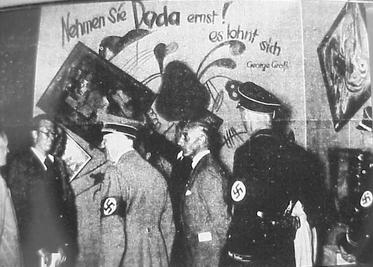
As early as 1937, Hitler’s intentions to use art as propaganda had been clear. Expressionist and modern art was labeled as degenerate. Those works not sold or destroyed outright were paraded for years in exhibits extolling their worthlessness. Less than a decade later, these same works would be celebrated in the U.S. National Gallery and other museums around the world.

MFAA Officer James Rorimer supervises U.S. soldiers recovering looted paintings from Neuschwanstein Castle
But before those works of art and their creators would be celebrated, the war in Europe had to end which it did in May 1945. As the Allied forces settled in, the Monuments Men continued to fan out, recovering art, and beginning the long process of cataloging and restitution. In the Pacific theater, the war would end in August.

Hiroshima 1945
On August 6, 1945, the U.S. dropped the first atomic bomb over Hiroshima. “The explosion wiped out 90 percent of the city and immediately killed 80,000 people; tens of thousands more would later die of radiation exposure. Three days later, a second B-29 dropped another A-bomb on Nagasaki, killing an estimated 40,000 people.” On August 15th, Emperor Hirohito would announce surrender.

Nagasaki Under Atomic Bomb, 1945
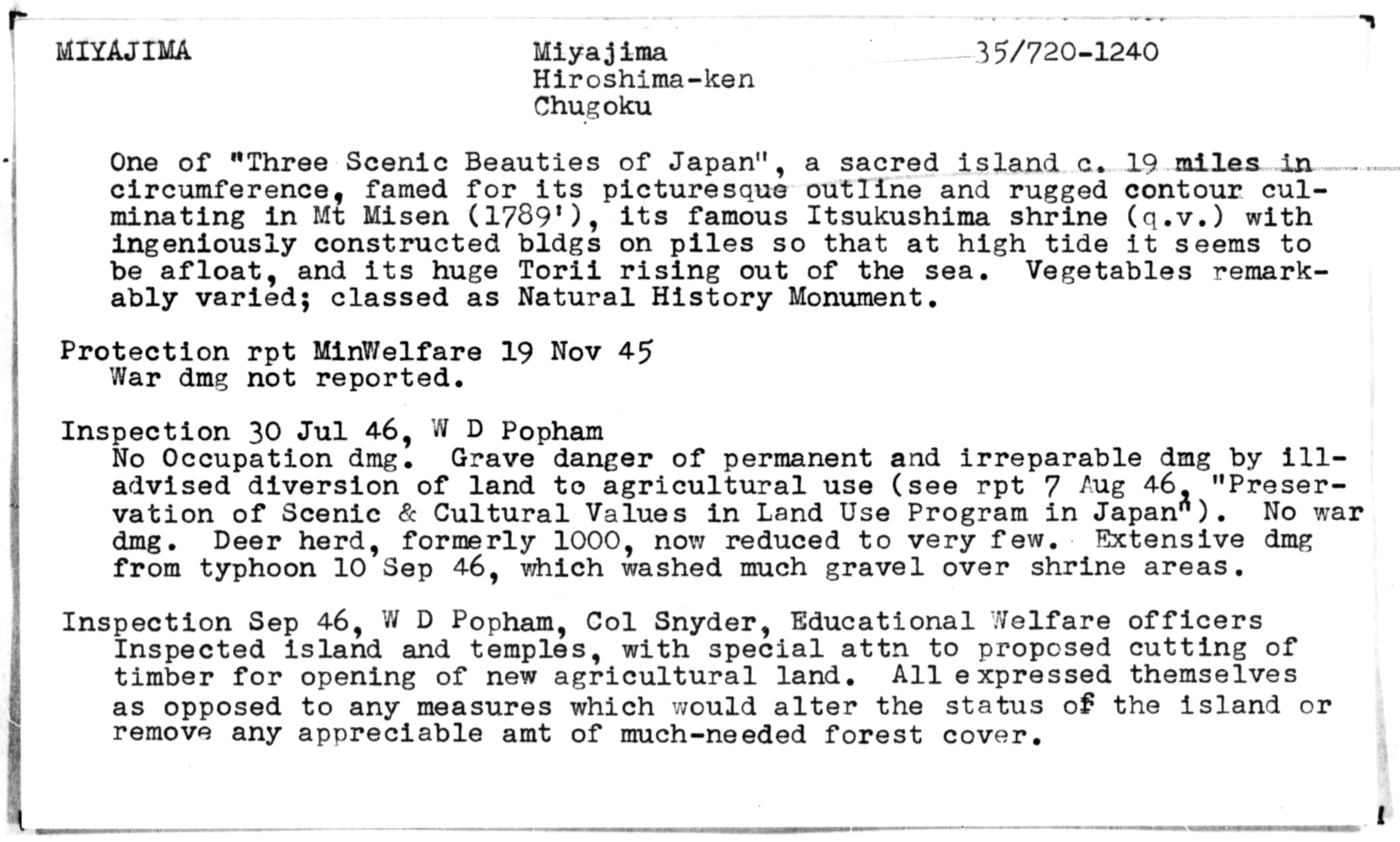
Into this devastated, postwar landscape, Monuments Men like Lt. Walter D. Popham would document damage done by the war and make suggestions for recovery and future protection of cultural assets. Popham was a noted landscape architect and professor prior to the war. He’d written books on the gardens of Asia including the tree-lined strees of Tokyo. George Stout, respected for his work as a Monuments Man in Europe, was especially pleased to learn of Popham’s Japan assignment. Stout had been one of several Monuments Men to recommend deploying the Monuments Men in Japan after its surrender.

The effort of the Monuments Men in Japan and across Asia is one that remains to be shared more widely. Peruse just a few of the catalog cards, filed in the National Archives, in which Popham and others describe their perceptions of the postwar Japanese landscape, and their interactions with the populace, it is clear that many stories remain to be told.
With the war’s end, in both Europe and Asia, the role of the Monuments Men would shift. Governments mobilized to literally rebuild whole nations. How could one balance (and budget for) the collection, preservation and restitution of artwork while meeting the immediate needs of feeding, clothing and housing millions of displaced peoples? Former allies were clearly becoming enemies. What role could art have, if any, in forging new bonds or cementing old ties?
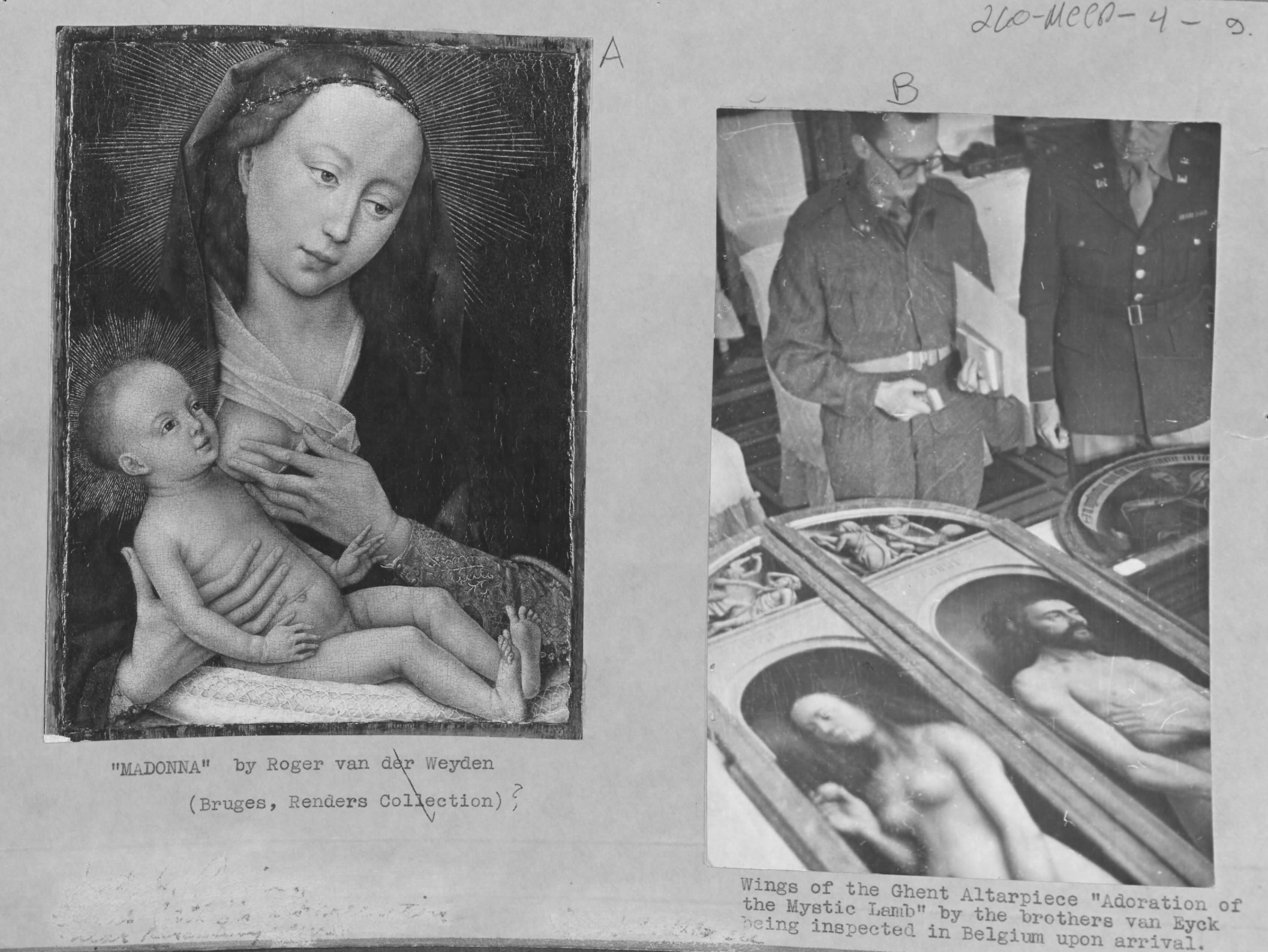
photographs of artwork collected at wiesbaden collection point
In Europe, by the spring of 1946, three central collection points were firmly established in Germany, in Wiesbaden, Munich and Offenbach. The Offenbach Archival Depot would specialize in collecting and cataloging Jewish cultural items, books and archives. The establishment of Offenbach was led by archivist Lt. Leslie Poste. One of his assistants was Joseph A. Horne.

Joseph A. Horne, 1940s
By February 1947, Horne would become the depot’s third director. According to the memoirs of Lucy Dawidowicz, his friends called him Tony. “Before the war, he’d been on the staff of the Library of Congress’s photographic division. Transferred from the MFA&A in Berlin, he was then new to the Depot, having taken over his duties barely two weeks before my visit. About thirty, very tall, thin, lanky, and blond, he was the only American there. He was in charge of a staff of some forty Germans.”
His tenure would coincide with one of the worst winters to strike Europe in recent memory. The Cold War with the Russians was dawning. The restitution (or not) of artwork and cultural items was to become a strategic tool used by military intelligence and policymakers on all sides. Individuals, including war survivors as well as surviving relatives of those killed by the Nazis, universities and museums whose collections had been sacked … their demands for restitution and return of art, books and cultural items poured in. Horne, like many others, would deal with these requests as respectfully as he could even as events unfolded around him that would place Offenbach at the center of one of the most unexpected efforts to return looted cultural items to Jewish communities around the world.
More to follow in July…
Sources/Additional Reading
World War II records from the National Archives searchable here
More information about Hamburg photo
Bombing of Hiroshima and Nagasaki, History.Com
About Mason Hammond, First Monuments Man in the Field
World War II Photography Database










 Words + Images